


 |
市場調查報告書
商品編碼
2114990
汽車NVH材料:市場佔有率分析、產業趨勢與統計、成長預測(2026-2031年)Automotive NVH Materials - Market Share Analysis, Industry Trends & Statistics, Growth Forecasts (2026 - 2031) |
||||||

※ 本網頁內容可能與最新版本有所差異。詳細情況請與我們聯繫。
根據 Mordor Intelligence 預測,汽車 NVH 材料市場將從 2025 年的 139.1 億美元成長到 2026 年的 147.4 億美元,然後在 2031 年達到 197.2 億美元,2026 年至 2031 年的複合年成長率為 5.99%。
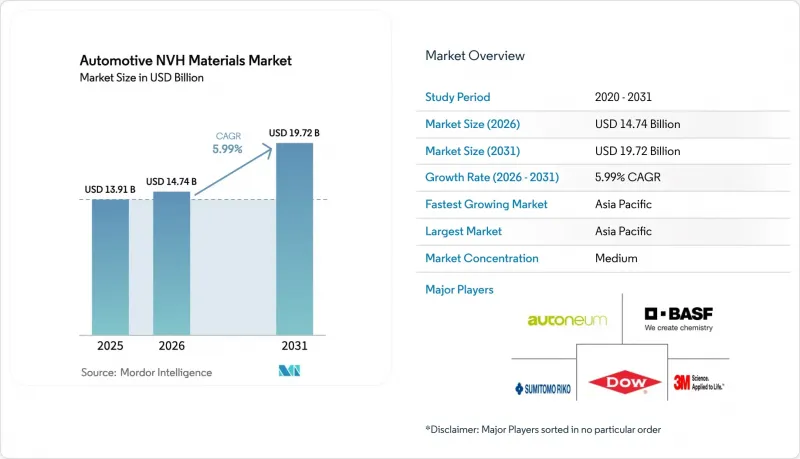
本報告按材料類型(橡膠、樹脂等)、車輛類型(乘用車、輕型商用車等)、推進類型(內燃機 (ICE) 車輛、混合動力電動車 (HEV/PHEV) 等)、應用(吸收、阻尼等)和地區(亞太地區、北美地區等)對產業市場進行細分。
全球汽車NVH材料市場趨勢及洞察
車內噪音的嚴格規定以及人們對舒適性的日益成長的需求
歐盟第540/2014號法規提高了車輛外部和內部噪音的允許限值,迫使汽車製造商採用性能更高的NVH材料,這些材料既能通過合規性測試,又不會增加不必要的重量。消費者對更安靜的車廂環境的意識也在不斷提高,促使各大品牌在其多個車型系列中引入了諸如本田主動降噪(ANC)系統之類的功能。因此,供應商面臨著不受宏觀經濟週期影響的必然需求,因為噪音測試不合格可能會導致罰款並損害品牌形象。汽車製造商現在將車內音質定位為品牌推廣工具,BMW為其Neue Klasse電動車推出的HyperpersonX計畫凸顯了客製化聲學特性在行銷中的重要性。法規與消費者期望的融合,為先進的吸音、減振和隔音材料的未來發展奠定了堅實的基礎。
隨著電動車和混合動力汽車產量的擴大,高頻 NVH(噪音、振動和不平順性)的挑戰日益凸顯。
電動馬達產生的高頻嘯叫聲來自逆變器,路面和輪胎產生的嗡嗡聲也來自電機,傳統橡膠材質難以有效抑制這些噪音。 Ascend Materials 的 Vydyne 隔振技術可將車室噪音降低高達 84%,證明工程聚醯胺在 3 kHz 至 4 kHz頻寬內優於傳統泡棉材料。現代汽車的道路噪音主動降噪系統透過即時相位反轉將低頻噪音減半,使汽車製造商能夠將輕質織物與電子反向波相結合,從而實現更精緻的駕駛體驗。隨著亞太地區工廠加速生產電池式電動車,對專為高頻 NVH 特性量身訂製的複合材料和聲波超材料的需求日益成長,並且變得更加迫切。因此,汽車 NVH 材料市場正迎來新電動車平台訂單的破紀錄成長。
石油基橡膠和聚氨酯泡沫原料價格的波動
合成橡膠的價格受原油提煉的丁二烯供應量的影響而波動。 2024年,亞洲現貨價格超過每噸3,000美元,促使大陸集團和固特異提高輪胎價格,迫使NVH(噪音、振動與聲振粗糙度)材料供應商降低利潤率,除非他們將成本轉嫁給消費者。低價位輪胎市場最難消化價格上漲,因此一些汽車製造商正在縮減或推遲其高階聲學組件的推出。供應中斷,例如2024年福特汽車工廠因稀土元素磁鐵短缺而被迫關閉,凸顯了全球原料供應鏈的脆弱性。因此,在避險和在地採購策略成熟之前,汽車NVH材料市場將面臨短期成本壓力。
細分市場分析
2025年,橡膠憑藉其多功能的減振性能和成熟的供應鏈,在汽車NVH材料市場保持了32.74%的領先市場佔有率。然而,隨著監管政策的變化和OEM廠商碳排放減排目標的推動,材料替代的需求日益成長,生物基和再生聚合物的複合年成長率預計將達到6.79%。隨著大規模生產的汽車項目開始採用碳足跡更低的內飾,其他類型聚合物材料(例如生物基和再生聚合物)的汽車NVH材料市場預計將快速擴張。亨斯邁的ACOUSTIFLEX HR BIO泡沫材料生物基含量超過9%,同時維持了與傳統PU相同的回彈性能,實現了綠色環保與提升駕乘舒適性的完美平衡。朗盛正透過提供含有超過80%可再生原料的Tepex複合材料(用於結構嵌件)來推動這一轉變。
類似布料的不織布材正日益普及,這符合輕量化和可回收的目標。米利肯公司的紡織襯墊重量減輕了50%,在吸音性能方面優於競爭對手,並且在使用壽命結束後可用於聚合物回收。 ScienceDirect研究的菌絲體吸音材料能夠有效衰減低至1 kHz的座艙頻率,同時具有天然可生物分解性。在預測期內,將橡膠護套與天然纖維芯材融合的複合材料層壓板有望在成本和永續性方面為一級供應商創造新的價值。隨著這些技術的普及,汽車NVH材料市場將從嚴重依賴石油衍生材料的配方轉向使用混合和可再生材料的配方。具有週期性空隙的聲波超材料可在不增加質量的情況下將低頻嗡嗡聲降低2.0-2.3 dB,這表明幾何形狀將在未來佔據主導地位,取代基於“質量定律”的較重解決方案。這種多功能方法模糊了吸音、衰減和隔音之間的傳統界線。
到2025年,乘用車將佔汽車NVH材料市場的64.78%,預計2031年仍將以7.57%的最高複合年成長率成長。這一成長並非簡單的銷售成長,而是反映了單車使用量的增加,因為緊湊型跨界車如今也配備了高階隔音組件以匹配其價格定位。輕型商用車正受惠於配送車輛的電氣化。 Autonorm新成立的商用車部門正在開發專為靜音電動貨車量身定做的地板系統,因為道路噪音在電動貨車中往往會被放大。重型卡車正在採用更厚的儀表板墊,以滿足長途駕駛員的疲勞和安全要求。在摩托車和微型出行領域,隨著都市區噪音法規的日益嚴格,更薄的減震條的應用也越來越多。因此,汽車NVH材料市場的應用範圍正在進一步擴大,要求供應商最佳化隔音、耐久性和成本特性,以適應截然不同的使用條件。乘用車的成長證實,高階聲學性能不再局限於頂級轎車,而是正在向主流展示室蔓延。
區域分析
預計到2025年,亞太地區將佔據汽車NVH材料市場46.78%的佔有率,年複合成長率達6.66%,主要成長動力來自中國、日本和韓國。隨著中國整車製造商(OEM)對設計到生產週期的需求不斷成長,安特尼姆收購江蘇華宇多數股權,進一步強化了其本土供應鏈。日本大型企業集團正在重組業務,主要集中在電動車零件領域,為了解電池聲學特性的NVH專家創造了新的商機。東麗等韓國材料集團正在擴大吸聲碳纖維片材的產能,並顯示其專業化程度持續提高。泰國和印尼新建的組裝廠吸引了來自日本和中國的頂級供應商,他們希望進入免關稅的東協市場。
歐洲憑藉嚴格的法規結構和豪華車製造業的集中,保持著重要的市場佔有率。歐盟第540/2014號法規制定了全面的噪音排放標準,直接影響NVH材料的規格。德國汽車製造商正敦促其供應商在聲學領域打造品牌,寶馬的「HypersonX」計畫便是一個很好的例證。儘管法規進一步推動了再生聚合物的應用,但符合FMVSS標準的消防安全規範卻減緩了其大規模普及。弗羅伊登貝格在旁遮普邦投資4,200萬歐元的工廠,清楚展現了這家歐洲公司透過在地化生產滿足全球需求的策略。
在北美,嚴格的消防安全標準FMVSS 302與特殊橡膠供應基礎不均衡之間需要尋求平衡。福特磁鐵短缺事件凸顯了確保區域供應鏈韌性的緊迫性。 Aurelius私募股權以10億美元收購帝人汽車技術公司,擴大了其國內複合材料產能,並使被收購公司在電動車聲學領域佔據成長優勢。在南美洲、中東和非洲,由於在地採購義務的加強,早期商業機會正在出現。然而,經濟波動和基礎設施不足暫時限制了產量。
其他好處:
- Excel格式的市場預測(ME)表
- 3個月的分析師支持
目錄
第1章:引言
- 研究假設和市場定義
- 調查範圍
第2章:調查方法
第3章執行摘要
第4章 市場狀況
- 市場概覽
- 市場促進因素
- 關於飛行噪音的嚴格法律規定以及人們對舒適度日益成長的期望。
- 電動車和混合動力汽車生產的擴張凸顯了高頻噪音和振動 (NVH) 的挑戰。
- 輕量化策略的核心是轉向使用聚合物和複合材料的NVH材料。
- 高階和豪華汽車的激增,使得良好的品牌塑造變得至關重要。
- 汽車NVH材料在乘用車的應用日益廣泛
- 市場限制因素
- 替代技術帶來的替代產品威脅
- 石油基橡膠和聚氨酯泡沫原料價格的波動
- 再生發泡材的防火安全挑戰
- 價值鏈分析
- 波特五力模型
第5章 市場規模與成長預測
- 依材料類型
- 橡皮
- 熱塑性聚合物
- 樹脂
- 類似織物的材料
- 其他材料類型(生物基材料、回收材料等)
- 依推進類型
- 內燃機車
- 混合動力電動車(HEV/PHEV)
- 電池式電動車(BEV)
- 燃料電池汽車(FCEV)
- 車輛類型
- 搭乘用車
- 輕型商用車
- 大型商用車輛
- 摩托車和微型交通工具
- 透過使用
- 吸收
- 傾銷
- 隔熱材料
- 隔音
- 其他用途(例如防止吱吱作響和嘎嘎作響)
- 地區
- 亞太地區
- 中國
- 印度
- 日本
- 韓國
- 其他亞太國家
- 北美洲
- 美國
- 加拿大
- 墨西哥
- 歐洲
- 德國
- 英國
- 法國
- 義大利
- 其他歐洲國家
- 南美洲
- 巴西
- 阿根廷
- 其他南美國家
- 中東和非洲
- 沙烏地阿拉伯
- 南非
- 其他中東和非洲國家
- 亞太地區
第6章 競爭情勢
- 市場集中度
- 策略趨勢
- 市佔率和排名分析
- 公司簡介
- 3M
- Autoneum
- BASF
- Dow
- DuPont
- ElringKlinger AG
- FoamPartner(Recticel)
- Freudenberg SE
- Henkel AG and Co. KGaA
- Huntsman Corporation
- Saint Gobain
- Sumitomo Riko Company Limited
- Tenneco Inc.
- Wolverine Advanced Materials
第7章 市場機會與未來展望
According to Mordor Intelligence, the automotive NVH materials market size is expected to grow from USD 13.91 billion in 2025 to USD 14.74 billion in 2026 and is forecast to reach USD 19.72 billion by 2031 at 5.99% CAGR over 2026-2031.
This report Segments the Industry by Material Type (Rubber, Resins, and More), Vehicle Type (Passenger Cars, Light Commercial Vehicles, and More), Propulsion Type (Internal Combustion Engine (ICE) Vehicles, Hybrid Electric Vehicles (HEV/PHEV), and More), Application (Absorption, Damping, and More), and Geography (Asia-Pacific, North America, and More).
Global Automotive NVH Materials Market Trends and Insights
Stringent Cabin-Noise Legislation and Rising Comfort Expectations
European Union Regulation 540/2014 tightened permissible exterior and interior noise limits, forcing OEMs to adopt higher-performance NVH materials that can pass compliance tests without adding unwanted mass Consumer awareness of quiet cabins also matured, encouraging mainstream brands to roll out features such as Honda's Active Noise Control system across multiple model lines. Suppliers therefore observe non-discretionary demand that is insulated from macroeconomic cycles, since failing noise tests triggers financial penalties and brand damage. Automakers now frame interior sound quality as a branding device; BMW's HypersonX program for Neue Klasse electric cars underscores the marketing weight attached to tailor-made acoustic signatures. The overlap of regulation and customer expectation cements a multi-year growth runway for advanced absorption, damping and insulation media.
Booming EV and Hybrid Output Exposing High-Frequency NVH Gaps
Electric motors reveal inverter whine and road-tire harmonics that traditional rubbers suppress poorly. Ascend Materials' Vydyne Anti-Vibration Technology cuts cabin noise by up to 84%, proving that engineered polyamides can outperform legacy foams in the 3 kHz-4 kHz range. Hyundai's Road-Noise Active Noise Control halves low-frequency disturbance through real-time phase inversion, letting carmakers mix lighter fabrics with electronic counterwaves for a refined ride. The urgency grows as Asia-Pacific factories accelerate battery-electric production, amplifying the need for composite mats and acoustic metamaterials tailored to high-frequency NVH profiles. As a result, the Automotive NVH materials market records its quickest contract wins in new EV platforms.
Feed-Stock Price Volatility for Petro-Rubber and PU Foams
Synthetic rubber prices swing with crude-derived butadiene supply. Spot Asian quotes surpassed USD 3,000 per ton in 2024, prompting Continental and Goodyear to lift tire prices and forcing NVH suppliers to pass on cost or lose margin. Budget segments are least able to absorb spikes, so some automakers scale back premium acoustic packs or delay launches. Supply disruptions such as rare-earth magnet shortages that idled a Ford plant in 2024 reveal the vulnerability of global feed-stock chains. The Automotive NVH materials market thus faces near-term expense pressure until hedging and localized sourcing strategies mature.
Other drivers and restraints analyzed in the detailed report include:
- Light-Weighting Strategies Pivoting to Polymer and Composite NVH Media
- Premium and Luxury Vehicle Proliferation Demanding Acoustic Branding
- Fire-Safety Hurdles for Recycled Foams
For complete list of drivers and restraints, kindly check the Table Of Contents.
Segment Analysis
Rubber held the leading 32.74% share of the Automotive NVH materials market in 2025 because of its all-round vibration isolation performance and mature supply base. However, bio-based and recycled polymers clock a 6.79% CAGR as legislation and OEM carbon targets accelerate material substitution. The Automotive NVH materials market size for other types of polymer materials like bio-based and recycled polymers is projected to rise sharply once large-volume vehicle programs commit to lower-footprint interiors. Huntsman's ACOUSTIFLEX HR BIO foam provides over 9% bio content while matching legacy PU resilience, demonstrating parity between green chemistry and ride refinement. LANXESS complements this shift with Tepex composites boasting more than 80% renewable feedstock for structural inserts.
Fabric-like non-woven sheets grow along lightweighting and recyclability goals. Milliken's 50% lighter textile liner exceeds rivals in absorption and can reenter polymer streams at end of life. Mycelium-grown absorbers studied on ScienceDirect effectively damp 1 kHz cabin frequencies while biodegrading naturally. Over the forecast horizon, composite laminates that merge rubber skins with natural-fiber cores could unlock new cost-plus-sustainability value for Tier 1 suppliers. As those technologies scale, the Automotive NVH materials market will pivot from petro-heavy menus toward hybrid and renewable formulations. Acoustic metamaterials designed with periodic voids cancel 2.0-2.3 dB of low-frequency drone without mass, pointing to a future where geometry replaces heavier mass-law solutions. Such multifunctional approaches blur the historical lines between absorption, damping and insulation.
Passenger cars dominated the Automotive NVH materials market with 64.78% share in 2025 yet still deliver the highest 7.57% CAGR to 2031. The surge reflects rising per-unit content rather than sheer volume, as compact crossovers receive luxury-style acoustic packages to justify sticker prices. Light commercial vehicles benefit from parcel fleet electrification: Autoneum's new Commercial Vehicle unit develops floor systems tuned to silent e-vans that amplify road roar. Heavy trucks adopt thicker dash mats to meet fatigue and safety guidelines for long-haul drivers. Two-wheelers and micro-mobility categories begin to integrate slimline damping strips as urban sound rules tighten. Consequently, the Automotive NVH materials market records wider application breadth, and suppliers must tailor acoustic, durability and cost attributes to vastly different duty cycles. Passenger car growth confirms that premium-feel acoustics are no longer confined to top-end sedans but span the mainstream showroom.
Complete Report Scope:
- By Material Type
- Rubber
- Thermoplastic Polymers
- Resins
- Fabric-like Materials
- Other Material Types (Bio-based, Recycled, etc.)
- By Propulsion Type
- Internal Combustion Engine (ICE) Vehicles
- Hybrid Electric Vehicles (HEV/PHEV)
- Battery Electric Vehicles (BEV)
- Fuel-Cell Electric Vehicles (FCEV)
- By Vehicle Type
- Passenger Cars
- Light Commercial Vehicles
- Heavy Commercial Vehicles
- Two-Wheelers and Micro-Mobility
- By Application
- Absorption
- Damping
- Insulation
- Sound Proofing
- Other Applications (Anti squeak and rattle prevention, etc.)
- Geography
- Asia-Pacific
- China
- India
- Japan
- South Korea
- Rest of Asia-Pacific
- North America
- United States
- Canada
- Mexico
- Europe
- Germany
- United Kingdom
- France
- Italy
- Rest of Europe
- South America
- Brazil
- Argentina
- Rest of South America
- Middle East and Africa
- Saudi Arabia
- South Africa
- Rest of Middle-East and Africa
- Asia-Pacific
Geography Analysis
Asia-Pacific commanded 46.78% of the Automotive NVH materials market in 2025 and is forecast to grow at 6.66% CAGR, anchored by China, Japan and South Korea. Autoneum's majority buyout of Jiangsu Huanyu strengthens local supply depth as Chinese OEMs demand quicker design-to-production cycles. Japanese conglomerates reorganize around EV parts, opening white space for NVH specialists who grasp battery-related acoustic profiles. South Korean material groups like Toray ramp capacity for sound-absorbing carbon-fiber sheets, signaling continued specialization. New assembly hubs in Thailand and Indonesia attract Japanese and Chinese Tier 1s that want tariff-free ASEAN access.
Europe maintains significant market presence driven by stringent regulatory frameworks and premium vehicle manufacturing concentration, with EU Regulation 540/2014 establishing comprehensive noise emission standards that directly influence NVH material specifications . German OEMs push suppliers toward acoustic branding, as BMW's HypersonX project illustrates. Regulations further stimulate recycled polymer adoption, although FMVSS-equivalent fire standards slow mass uptake. Freudenberg's EUR 42 million Punjab plants underscore European players' strategy to serve global demand with localized output.
North America balances strict fire-safety code FMVSS 302 with a patchy supply base for specialty rubbers. Ford's magnet shortage episode highlighted the urgency of regional resilience. AURELIUS Private Equity's USD 1 billion acquisition of Teijin Automotive Technologies expands composite capabilities onshore, positioning the buyer for growth in EV acoustics. South America and the Middle East & Africa offer early-stage openings as local content mandates rise, yet economic swings and infrastructure gaps temper immediate volume.
- 3M
- Autoneum
- BASF
- Dow
- DuPont
- ElringKlinger AG
- FoamPartner (Recticel)
- Freudenberg SE
- Henkel AG and Co. KGaA
- Huntsman Corporation
- Saint Gobain
- Sumitomo Riko Company Limited
- Tenneco Inc.
- Wolverine Advanced Materials
Additional Benefits:
- The market estimate (ME) sheet in Excel format
- 3 months of analyst support
TABLE OF CONTENTS
1 Introduction
- 1.1 Study Assumptions and Market Definition
- 1.2 Scope of the Study
2 Research Methodology
3 Executive Summary
4 Market Landscape
- 4.1 Market Overview
- 4.2 Market Drivers
- 4.2.1 Stringent Cabin-Noise Legislation and Rising Comfort Expectations
- 4.2.2 Booming EV and Hybrid Output Exposing High-Frequency NVH Gaps
- 4.2.3 Light-Weighting Strategies Pivoting to Polymer and Composite NVH Media
- 4.2.4 Premium and Luxury Vehicle Proliferation Demanding Acoustic Branding
- 4.2.5 Increasing Usage of Automotive NVH Materials in Passenger Vehicles
- 4.3 Market Restraints
- 4.3.1 Threat of Substitutes from Alternative Technologies
- 4.3.2 Feed-Stock Price Volatility for Petro-Rubber and PU Foams
- 4.3.3 Fire-Safety Hurdles for Recycled Foams
- 4.4 Value Chain Analysis
- 4.5 Porter's Five Forces
- 4.5.1 Threat of New Entrants
- 4.5.2 Bargaining Power of Buyers
- 4.5.3 Bargaining Power of Suppliers
- 4.5.4 Threat of Substitutes
- 4.5.5 Degree of Competition
5 Market Size and Growth Forecasts (Value)
- 5.1 By Material Type
- 5.1.1 Rubber
- 5.1.2 Thermoplastic Polymers
- 5.1.3 Resins
- 5.1.4 Fabric-like Materials
- 5.1.5 Other Material Types (Bio-based, Recycled, etc.)
- 5.2 By Propulsion Type
- 5.2.1 Internal Combustion Engine (ICE) Vehicles
- 5.2.2 Hybrid Electric Vehicles (HEV/PHEV)
- 5.2.3 Battery Electric Vehicles (BEV)
- 5.2.4 Fuel-Cell Electric Vehicles (FCEV)
- 5.3 By Vehicle Type
- 5.3.1 Passenger Cars
- 5.3.2 Light Commercial Vehicles
- 5.3.3 Heavy Commercial Vehicles
- 5.3.4 Two-Wheelers and Micro-Mobility
- 5.4 By Application
- 5.4.1 Absorption
- 5.4.2 Damping
- 5.4.3 Insulation
- 5.4.4 Sound Proofing
- 5.4.5 Other Applications (Anti squeak and rattle prevention, etc.)
- 5.5 Geography
- 5.5.1 Asia-Pacific
- 5.5.1.1 China
- 5.5.1.2 India
- 5.5.1.3 Japan
- 5.5.1.4 South Korea
- 5.5.1.5 Rest of Asia-Pacific
- 5.5.2 North America
- 5.5.2.1 United States
- 5.5.2.2 Canada
- 5.5.2.3 Mexico
- 5.5.3 Europe
- 5.5.3.1 Germany
- 5.5.3.2 United Kingdom
- 5.5.3.3 France
- 5.5.3.4 Italy
- 5.5.3.5 Rest of Europe
- 5.5.4 South America
- 5.5.4.1 Brazil
- 5.5.4.2 Argentina
- 5.5.4.3 Rest of South America
- 5.5.5 Middle East and Africa
- 5.5.5.1 Saudi Arabia
- 5.5.5.2 South Africa
- 5.5.5.3 Rest of Middle-East and Africa
- 5.5.1 Asia-Pacific
6 Competitive Landscape
- 6.1 Market Concentration
- 6.2 Strategic Moves
- 6.3 Market Share(%)/Ranking Analysis
- 6.4 Company Profiles (includes Global level Overview, Market level overview, Core Segments, Financials as available, Strategic Information, Market Rank/Share for key companies, Products and Services, and Recent Developments)
- 6.4.1 3M
- 6.4.2 Autoneum
- 6.4.3 BASF
- 6.4.4 Dow
- 6.4.5 DuPont
- 6.4.6 ElringKlinger AG
- 6.4.7 FoamPartner (Recticel)
- 6.4.8 Freudenberg SE
- 6.4.9 Henkel AG and Co. KGaA
- 6.4.10 Huntsman Corporation
- 6.4.11 Saint Gobain
- 6.4.12 Sumitomo Riko Company Limited
- 6.4.13 Tenneco Inc.
- 6.4.14 Wolverine Advanced Materials
7 Market Opportunities and Future Outlook
- 7.1 White-space and Unmet-need Assessment

 汽車主動降噪市場預測至2034年-全球分析(依降噪類型、系統元件、控制架構、車輛類型、驅動系統、銷售管道和地區分類)
 2026-2030年全球汽車NVH材料市場
 全球汽車主動降噪音響系統銷售市場報告、競爭分析及區域商機(2026-2032年)
 NVH測試市場-2026-2032年全球市場預測
 NVH測試:市場佔有率分析、產業趨勢與統計、成長預測(2026-2031年)
 2026年全球噪音、振動和聲音市場報告
 全球NVH(噪音、振動和粗糙度)材料市場規模、佔有率、趨勢和成長分析報告(2026-2034年)
 NVH測試市場分析及至2035年預測:類型、產品類型、服務、技術、組件、應用、最終用戶、功能、安裝配置、解決方案汽車NVH材料市場:市場規模、佔有率、成長率、全球產業分析、按類型、應用和地區分類的分析以及未來預測(2026-2034年)
 汽車NVH材料市場規模、佔有率、趨勢及預測(依產品、車輛類型、應用及地區分類),2026-2034年