


 |
市場調查報告書
商品編碼
2062345
NVH測試:市場佔有率分析、產業趨勢與統計、成長預測(2026-2031年)NVH Testing - Market Share Analysis, Industry Trends & Statistics, Growth Forecasts (2026 - 2031) |
||||||

※ 本網頁內容可能與最新版本有所差異。詳細情況請與我們聯繫。
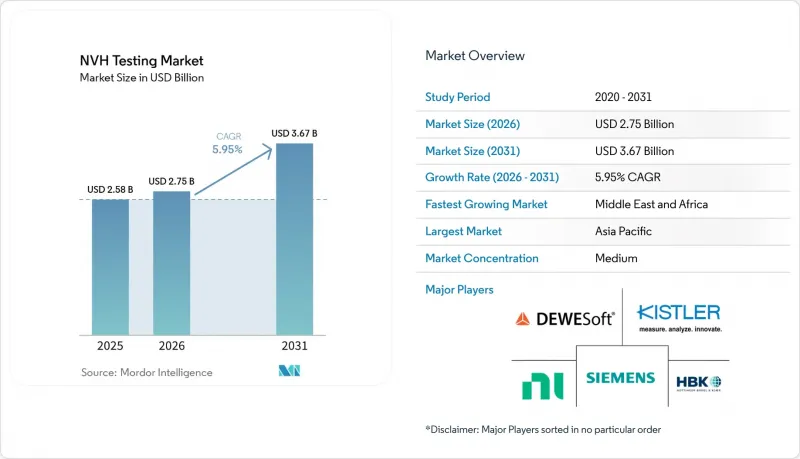
根據 Mordor Intelligence 預測,nVH(非速度光譜)測試市場規模將從 2025 年的 25.8 億美元和 2026 年的 27.5 億美元成長到 2031 年的 36.7 億美元,2026 年至 2031 年的年複合成長率(CAGR)為 5.95%。
本報告按組件(硬體、軟體、服務)、測試類型(模式測試、道路噪音測試、環境艙NVH測試等)、最終用戶產業(汽車、航太與國防、工業機械、家用電子電器等)、應用(動力傳動系統、車內噪音、外部噪音等)和地區進行細分。市場預測以價值(美元)表示。
全球NVH測試市場趨勢與洞察
電動動力傳動系統的NVH要求
在電池式電動車和插電式混合動力汽車中,逆變器脈衝寬度調變噪音、齒輪嚙合噪音以及輪胎與路面的相互作用噪音都會暴露出來。這些噪音曾經被內燃機所掩蓋,因此,人們致力於在1 kHz至10 kHz頻寬進行階次追蹤分析,並採用心理聲學不適指數進行研究。對於豪華汽車製造商而言,到2025年,客戶提出的NVH申訴將佔所有品質問題的78%,這將導致檢驗預算增加三分之一。歐洲汽車研究合作夥伴協會(EARPA)已發布了區分結構傳播路徑和空氣傳播路徑的調查方法,而聯合國歐洲經濟委員會(UNECE)R138標準規定,在20 km/h以下的速度下,聲壓級應為56 dB(A)至75 dB(A),並將客戶舒適性和行人安全的目標整合到一個統一的合規標準中。因此,到2031年,電動動力傳動系統中的NVH問題仍將是導致測試台架時間增加的主要因素。
降低小型MEMS感測器的成本
從2024年到2025年,MEMS加速計和麥克風的單價年減約15%,這使得64通道和128通道陣列成為可能,並使中型供應商更容易進行運行模式分析。 DewesoftX 2026.1引入了原生乙太網路連接的MEMS支持,並具備亞微秒同步能力,從而擴展了美國國家儀器公司FieldDAQ FD-11634在戶外火箭測試場景中的穩健性。此外,更低的採購成本為連續狀態監測鋪平了道路,這可以將製造工廠的意外停機時間減少高達40%,而感測器價格的降低正在加速短期需求的成長。
熟練的NVH工程師短缺
根據CohanHR發布的《2025年勞動力調查報告》,目前NVH(噪音、振動與聲振粗糙度)專業人才缺口高達12萬至15萬人,光是中國就有約5萬至6萬個職缺。雖然95%的招募資訊都要求應徵者俱備CAE(電腦輔助工程)技能,但鮮有大學將Actran、MSC Nastran或AVL EXCITE等軟體納入課程,迫使雇主將招募前置作業時間延長6至12個月。人工智慧相關職位的人才競爭日益激烈,但實際操作測試單元的技能仍然不可替代,導致產品發布延遲,並增加了外部諮詢成本。
細分市場分析
預計到2025年,硬體將佔NVH測試市場42.19%的佔有率,而軟體的複合年成長率最高,達到6.83%。 Actran、AVL X-ion和Siemens Simcenter TestLab等公司的AI模組透過自動化傳輸路徑分析,將後處理工作量減少高達70%,從而縮短設計週期並提高授權續約率。 HEAD acoustics和NVH Consulting LLC提供的服務透過打包承包檢驗來應對人才短缺問題,而雲端訂閱則模糊了硬體和軟體之間的界限,並使前端資料收集商品化。
由於硬體對於高精度測量仍然至關重要,Kistler 於 2026 年 3 月對其 jBEAM Lab 衛星測試的更新以及 Dewesoft 基於 MEMS 的平台都凸顯了混合型未來發展趨勢。隨著訂閱模式的日益普及,供應商將分析入口網站整合到感測器生態系統中,這將增加轉換成本,並將採購重點從資本投資轉向營運支出。這種轉變將進一步影響 2031 年以後的 NVH 測試市場規模。
預計到2025年,動力傳動系統NVH將佔銷售額的29.06%,但環境測試實驗室的NVH測試業務成長速度超過整體NVH測試市場,成長率達6.55%,這主要得益於聯合國歐洲經濟委員會(UNECE)法規對溫度相關的通過認證要求日益嚴格。在Polytec雷射測振儀的支援下,模態測試能夠識別城市空中運輸交通工具中輕質複合複合材料的共振,而運行測試則用於解決靜態測試設備無法捕捉到的再生煞車瞬態過程。
里卡多公司升級後的344千瓦測功機凸顯了對高扭矩電動車進行基準測試的必要性,而歐洲的「靜音鐵路」(QuieterRail)計畫則將對溫控環境的需求擴展到了高速鐵路領域。隨著測試範圍的擴大,環境測試實驗室預計在十年內縮小與動力傳動系統測試台的利潤差距,從而重塑NVH測試在整個服務目錄中的市場佔有率格局。
區域分析
預計到2025年,亞太地區將佔全球收入的38.33%。這主要得益於中國在全球汽車產量中30%的佔有率,以及日本大力推廣模組化測試實驗室。政府對國內電動車製造商的補貼正在推動測試實驗室利用率的提高,而印度的Ecotone Systems公司正在擴大其承包測試實驗室的供給能力,以滿足二級供應商的需求。憑藉密集的供應商基礎、龐大的製造規模以及電池式電動車日益成長的普及率,該地區擁有結構性優勢,並有望在2031年以後繼續保持NVH測試市場的主導地位。
歐洲仍然是相關法規的標竿。 UNECE R51-03 和 ISO 362 標準的修訂,以及奧地利 TÜV 集團位於伯恩的測試跑道,正迫使製造商投資建設本地道路噪音測試基礎設施。現代汽車斥資 1.5 億歐元在拉塞爾斯海姆建設的園區,象徵其對高階品牌的承諾;歐盟資助的鐵路降噪措施也提振了非汽車產業的需求。儘管由於監管的持續收緊,歐洲的複合年成長率高於全球平均水平,但其 NVH 測試市場的絕對規模仍落後於規模更大的亞太地區。
在北美,AVL 和 HBK 正透過利用近岸外包和整合墨西哥及美國東南部地區的汽車專案來擴大服務範圍。中東地區的基礎設施項目,例如沙烏地阿拉伯和阿拉伯聯合大公國的項目,透過將 ISO 20816 振動條款納入石化和海水淡化競標中,實現了 6.95% 的最高複合年成長率。南美洲的市佔率正從巴西 Sonitus Engenharia 的小規模規模成長開始,而非洲的市佔率則主要集中在南非的出口組裝業務。儘管區域差異依然存在,但預計到 2031 年,中東地區加速採用 ISO 20816 標準將使其市場佔有率達到個位數低至中位數。
其他好處:
- Excel格式的市場預測(ME)表
- 3個月的分析師支持
目錄
第1章:引言
- 研究假設和市場定義
- 調查範圍
第2章:調查方法
第3章執行摘要
第4章 市場狀況
- 市場概覽
- 市場促進因素
- 電動動力傳動系統的NVH要求
- 降低小型MEMS感測器的成本
- 聯合國歐洲經濟委員會更嚴格的外部噪音法規
- 引入工業4.0的預測性維護
- 城市空中運輸原型機的激增
- 即時雲端NVH分析
- 市場限制因素
- 熟練的NVH工程師短缺
- 模組化半消音室的高初始投資成本
- 缺乏全球統一的檢測方案
- 遠端測試中的資料安全問題
- 產業價值鏈分析
- 宏觀經濟因素對市場的影響
- 監理情勢
- 技術展望
- 波特五力分析
第5章 市場規模與成長預測
- 按組件
- 硬體
- 數據採集系統
- 感應器和換能器
- 分析器
- 其他硬體
- 軟體
- 訊號分析
- 模擬與建模
- 服務
- 測試服務
- 諮詢和培訓
- 硬體
- 按測試類型
- 模態測試
- 噪音測試道測試
- 駕駛/動態NVH測試
- NVH(自然蒸氣加熱)實驗室
- 動力傳動系統NVH
- 按最終用途行業分類
- 車
- 航太/國防
- 工業機械
- 家用電子產品
- 鐵路
- 海上
- 透過使用
- 動力傳動系統
- 艙內
- 外部噪音
- 電氣和混合動力組件
- 結構部件
- 按地區
- 北美洲
- 美國
- 加拿大
- 墨西哥
- 南美洲
- 巴西
- 阿根廷
- 其他南美國家
- 歐洲
- 德國
- 英國
- 法國
- 俄羅斯
- 其他歐洲國家
- 亞太地區
- 中國
- 日本
- 印度
- 韓國
- 澳洲
- 其他亞太國家
- 中東
- 沙烏地阿拉伯
- 阿拉伯聯合大公國
- 其他中東國家
- 非洲
- 南非
- 埃及
- 其他非洲國家
- 北美洲
第6章 競爭情勢
- 市場集中度
- 策略趨勢
- 市佔率分析
- 公司簡介
- Bruel & Kjaer Sound & Vibration Measurement A/S
- National Instruments Corporation
- Siemens AG
- HEAD acoustics GmbH
- Hottinger Bruel & Kjaer GmbH(HBK)
- Dewesoft doo
- Kistler Instrumente AG
- GRAS Sound & Vibration A/S
- m+p international Mess-und Rechnertechnik GmbH
- Prosig Ltd.
- Data Physics Corporation
- Polytec GmbH
- Signal.X Technologies, LLC
- IMV Corporation
- RION Co., Ltd.
- SoundPlan GmbH
- Ono Sokki Co., Ltd.
- PCB Piezotronics, Inc.
- Microflown Technologies BV
- CRYSOUND Acoustic Technology Co., Ltd.
第7章 市場機會與未來展望
According to Mordor Intelligence, the nVH testing market size is projected to expand from USD 2.58 billion in 2025 and USD 2.75 billion in 2026 to USD 3.67 billion by 2031, registering a CAGR of 5.95% between 2026 and 2031.
This report is Segmented by Component (Hardware, Software, and Services), Testing Type (Modal Testing, Pass-By Noise Testing, Environmental-Chamber NVH, and More), End-Use Industry (Automotive, Aerospace and Defense, Industrial Machinery, Consumer Electronics, and More), Application (Powertrain, Interior Cabin, Exterior Noise, and More), and Geography. The Market Forecasts are Provided in Terms of Value (USD).
Global NVH Testing Market Trends and Insights
Electrified-Powertrain NVH Requirements
Battery-electric and plug-in hybrid models expose inverter pulse-width-modulation tones, gear-mesh whine, and tire-road interaction once masked by combustion engines, steering programs toward order-tracking analysis and psychoacoustic annoyance metrics between 1 kHz and 10 kHz. Luxury automakers saw customer NVH complaints rise to 78% of total quality issues in 2025, prompting validation budgets to climb by one-third. The European Automotive Research Partners Association has published methodologies that separate structure-borne and airborne paths, while UNECE R138 mandates sound-pressure levels of 56 dB(A) to 75 dB(A) below 20 km/h, merging customer comfort and pedestrian-safety objectives into a single compliance stream. As a result, electrified-powertrain NVH remains the primary catalyst for incremental test-bench hours through 2031.
Miniaturized MEMS Sensor Cost Declines
Unit prices for MEMS accelerometers and microphones fell roughly 15% year-on-year between 2024 and 2025, enabling 64- and 128-channel arrays that democratize operational modal analysis for mid-tier suppliers. DewesoftX 2026.1 introduced native Ethernet-linked MEMS support with sub-microsecond synchronization, and National Instruments' FieldDAQ FD-11634 extended ruggedized coverage to outdoor rocket-test scenarios. Lower acquisition cost also opens the door to continuous condition-based monitoring that can cut unplanned downtime by up to 40 % in manufacturing plants, making sensor affordability a short-cycle demand accelerator.
Shortage of Skilled NVH Engineers
CohanHR's 2025 workforce audit revealed a deficit of 120,000 to 150,000 NVH professionals, with China carrying roughly 50,000 to 60,000 unfilled roles. Ninety-five percent of postings require CAE fluency, yet few university curricula integrate Actran, MSC Nastran, or AVL EXCITE, forcing employers to extend hiring lead times by 6-12 months. Competition from artificial-intelligence roles siphons talent, while hands-on test-cell skills remain irreplaceable, delaying product launches and inflating external consulting spend.
Other drivers and restraints analyzed in the detailed report include:
- Stricter UNECE Exterior-Noise Rules
- Predictive-Maintenance Adoption in Industry 4.0
- High Capex for Modular Hemi-Anechoic Chambers
For complete list of drivers and restraints, kindly check the Table Of Contents.
Segment Analysis
Software claimed the fastest growth rate at a 6.83% CAGR, even though hardware held 42.19% of the NVH testing market share in 2025. Artificial-intelligence modules in Actran, AVL X-ion, and Siemens Simcenter TestLab automate transfer-path analysis and reduce post-processing labor by up to 70%, shrinking design loops and increasing license renewals. Services from HEAD acoustics and NVH Consulting LLC offset the talent shortfall by bundling turnkey validation, while cloud subscriptions blur hardware-software boundaries and commoditize front-end data acquisition.
Hardware remains irreplaceable for precision capture, so Kistler's March 2026 jBEAM Lab satellite test update and Dewesoft's MEMS-enabled platforms underline the hybrid future. As subscription models spread, vendors will tie analytics portals to sensor ecosystems, reinforcing switching costs and nudging procurement from capital expenditure toward operating expenditure, a shift that will further influence the NVH testing market size beyond 2031.
Powertrain NVH retained 29.06% of 2025 sales, yet environmental-chamber NVH is outpacing the total NVH testing market, with a 6.55% run rate, as UNECE limits tighten temperature-dependent pass-by certification. Modal testing, supported by Polytec's laser vibrometers, identifies lightweight-composite resonance in urban air-mobility airframes, while operational testing addresses regenerative-braking transients invisible to static rigs.
Ricardo's upgraded 344 kW dynamometer underscores the need for higher-torque electric-vehicle benchmarking, and Europe's QuieterRail project extends climate-controlled demand into high-speed rail. The widening application range means environmental chambers will narrow the revenue gap with powertrain benches by decade-end, reshaping NVH testing market share allocations across service catalogs.
Geography Analysis
Asia-Pacific accounted for 38.33% of 2025 revenue, as China produced 30% of the world's vehicles and Japan advanced modular chamber installations. Government subsidies for domestic electric-vehicle makers translate into brisk lab utilization, while India's Ecotone Systems expands turnkey chamber capacity to serve Tier-2 suppliers. A dense supplier base, broad manufacturing scale, and rising battery-electric penetration give the region structural advantages that will secure its leading NVH testing market share well past 2031.
Europe remains a regulatory bellwether: UNECE R51-03, ISO 362 updates, and TUV AUSTRIA's Bad Sobernheim track compel manufacturers to invest in local pass-by infrastructure. Hyundai's EUR 150 million Russelsheim campus spotlights premium-brand commitment, and EU-funded rail noise mitigation adds non-automotive volume. Continuous rule tightening keeps Europe's CAGR above the global mean even as its absolute NVH testing market size trails Asia-Pacific's larger base.
North America leverages near-shoring, channeling vehicle programs to Mexico and the U.S. Southeast, prompting AVL and HBK to expand their service offerings. Middle East infrastructure projects in Saudi Arabia and the United Arab Emirates yield the fastest 6.95% CAGR by embedding ISO 20816 vibration clauses into petrochemical and desalination tenders. South America grows from a small base through Brazil's Sonitus Engenharia, whereas Africa's share clusters around South Africa's export assembly. Regional dispersion will persist, but accelerated Middle East adoption nudges its stake from low to mid-single digits by 2031.
- Bruel & Kjaer Sound & Vibration Measurement A/S
- National Instruments Corporation
- Siemens AG
- HEAD acoustics GmbH
- Hottinger Bruel & Kjaer GmbH (HBK)
- Dewesoft d.o.o.
- Kistler Instrumente AG
- GRAS Sound & Vibration A/S
- m+p international Mess- und Rechnertechnik GmbH
- Prosig Ltd.
- Data Physics Corporation
- Polytec GmbH
- Signal.X Technologies, LLC
- IMV Corporation
- RION Co., Ltd.
- SoundPlan GmbH
- Ono Sokki Co., Ltd.
- PCB Piezotronics, Inc.
- Microflown Technologies B.V.
- CRYSOUND Acoustic Technology Co., Ltd.
Additional Benefits:
- The market estimate (ME) sheet in Excel format
- 3 months of analyst support
TABLE OF CONTENTS
1 INTRODUCTION
- 1.1 Study Assumptions and Market Definition
- 1.2 Scope of the Study
2 RESEARCH METHODOLOGY
3 EXECUTIVE SUMMARY
4 MARKET LANDSCAPE
- 4.1 Market Overview
- 4.2 Market Drivers
- 4.2.1 Electrified-Powertrain NVH Requirements
- 4.2.2 Miniaturised MEMS Sensor Cost Declines
- 4.2.3 Stricter UNECE Exterior-Noise Rules
- 4.2.4 Predictive-Maintenance Adoption in Industry 4.0
- 4.2.5 Growth of Urban Air-Mobility Prototypes
- 4.2.6 Real-Time Cloud-Based NVH Analytics
- 4.3 Market Restraints
- 4.3.1 Shortage of Skilled NVH Engineers
- 4.3.2 High Capex for Modular Hemi-Anechoic Chambers
- 4.3.3 Absence of Global Test-Protocol Harmonisation
- 4.3.4 Data-Security Concerns in Remote Testing
- 4.4 Industry Value-Chain Analysis
- 4.5 Impact of Macroeconomic Factors on the Market
- 4.6 Regulatory Landscape
- 4.7 Technological Outlook
- 4.8 Porter's Five Forces Analysis
- 4.8.1 Bargaining Power of Suppliers
- 4.8.2 Bargaining Power of Buyers
- 4.8.3 Threat of New Entrants
- 4.8.4 Threat of Substitutes
- 4.8.5 Competitive Rivalry
5 MARKET SIZE AND GROWTH FORECASTS (VALUE)
- 5.1 By Component
- 5.1.1 Hardware
- 5.1.1.1 Data Acquisition Systems
- 5.1.1.2 Sensors and Transducers
- 5.1.1.3 Analyzers
- 5.1.1.4 Other Hardware
- 5.1.2 Software
- 5.1.2.1 Signal Analysis
- 5.1.2.2 Simulation and Modelling
- 5.1.3 Services
- 5.1.3.1 Testing Services
- 5.1.3.2 Consulting and Training
- 5.1.1 Hardware
- 5.2 By Testing Type
- 5.2.1 Modal Testing
- 5.2.2 Pass-By Noise Testing
- 5.2.3 Operational / Dynamic NVH Testing
- 5.2.4 Environmental-Chamber NVH
- 5.2.5 Powertrain NVH
- 5.3 By End-Use Industry
- 5.3.1 Automotive
- 5.3.2 Aerospace and Defense
- 5.3.3 Industrial Machinery
- 5.3.4 Consumer Electronics
- 5.3.5 Railways
- 5.3.6 Marine
- 5.4 By Application
- 5.4.1 Powertrain
- 5.4.2 Interior Cabin
- 5.4.3 Exterior Noise
- 5.4.4 Electric and Hybrid Components
- 5.4.5 Structural Components
- 5.5 By Geography
- 5.5.1 North America
- 5.5.1.1 United States
- 5.5.1.2 Canada
- 5.5.1.3 Mexico
- 5.5.2 South America
- 5.5.2.1 Brazil
- 5.5.2.2 Argentina
- 5.5.2.3 Rest of South America
- 5.5.3 Europe
- 5.5.3.1 Germany
- 5.5.3.2 United Kingdom
- 5.5.3.3 France
- 5.5.3.4 Russia
- 5.5.3.5 Rest of Europe
- 5.5.4 Asia-Pacific
- 5.5.4.1 China
- 5.5.4.2 Japan
- 5.5.4.3 India
- 5.5.4.4 South Korea
- 5.5.4.5 Australia
- 5.5.4.6 Rest of Asia-Pacific
- 5.5.5 Middle East
- 5.5.5.1 Saudi Arabia
- 5.5.5.2 United Arab Emirates
- 5.5.5.3 Rest of Middle East
- 5.5.6 Africa
- 5.5.6.1 South Africa
- 5.5.6.2 Egypt
- 5.5.6.3 Rest of Africa
- 5.5.1 North America
6 COMPETITIVE LANDSCAPE
- 6.1 Market Concentration
- 6.2 Strategic Moves
- 6.3 Market Share Analysis
- 6.4 Company Profiles (includes Global Level Overview, Market Level Overview, Core Segments, Financials as available, Strategic Information, Market Rank/Share, Products and Services, Recent Developments)
- 6.4.1 Bruel & Kjaer Sound & Vibration Measurement A/S
- 6.4.2 National Instruments Corporation
- 6.4.3 Siemens AG
- 6.4.4 HEAD acoustics GmbH
- 6.4.5 Hottinger Bruel & Kjaer GmbH (HBK)
- 6.4.6 Dewesoft d.o.o.
- 6.4.7 Kistler Instrumente AG
- 6.4.8 GRAS Sound & Vibration A/S
- 6.4.9 m+p international Mess- und Rechnertechnik GmbH
- 6.4.10 Prosig Ltd.
- 6.4.11 Data Physics Corporation
- 6.4.12 Polytec GmbH
- 6.4.13 Signal.X Technologies, LLC
- 6.4.14 IMV Corporation
- 6.4.15 RION Co., Ltd.
- 6.4.16 SoundPlan GmbH
- 6.4.17 Ono Sokki Co., Ltd.
- 6.4.18 PCB Piezotronics, Inc.
- 6.4.19 Microflown Technologies B.V.
- 6.4.20 CRYSOUND Acoustic Technology Co., Ltd.
7 MARKET OPPORTUNITIES AND FUTURE OUTLOOK
- 7.1 White-Space and Unmet-Need Assessment

 NVH測試市場-2026-2032年全球市場預測汽車NVH材料市場:依材料類型、技術、應用、車輛類型和銷售管道分類-2026-2032年全球市場預測
 2026年全球噪音、振動和聲音市場報告
 全球NVH(噪音、振動和粗糙度)材料市場規模、佔有率、趨勢和成長分析報告(2026-2034年)
 NVH測試市場分析及至2035年預測:類型、產品類型、服務、技術、組件、應用、最終用戶、功能、安裝配置、解決方案汽車NVH材料市場:市場規模、佔有率、成長率、全球產業分析、按類型、應用和地區分類的分析以及未來預測(2026-2034年)
 汽車NVH材料市場規模、佔有率、趨勢及預測(依產品、車輛類型、應用及地區分類),2026-2034年
 汽車NVH材料市場-全球產業規模、佔有率、趨勢、機會、預測:按車輛類型、材料類型、應用類型、地區和競爭格局分類,2021-2031年
 車用音訊個人化及降噪系統市場規模、佔有率及預測:依技術(主動降噪、個人音訊區)、演算法(人工智慧賦能)及乘客體驗劃分-全球預測至2036年汽車動力系統動力傳動系統類型、車輛類型、麥克風技術、應用和最終用戶分類),全球預測(2026-2032)