


 |
市場調查報告書
商品編碼
2114989
玻璃纖維織物:市場佔有率分析、產業趨勢與統計、成長預測(2026-2031)Fiberglass Fabric - Market Share Analysis, Industry Trends & Statistics, Growth Forecasts (2026 - 2031) |
||||||

※ 本網頁內容可能與最新版本有所差異。詳細情況請與我們聯繫。
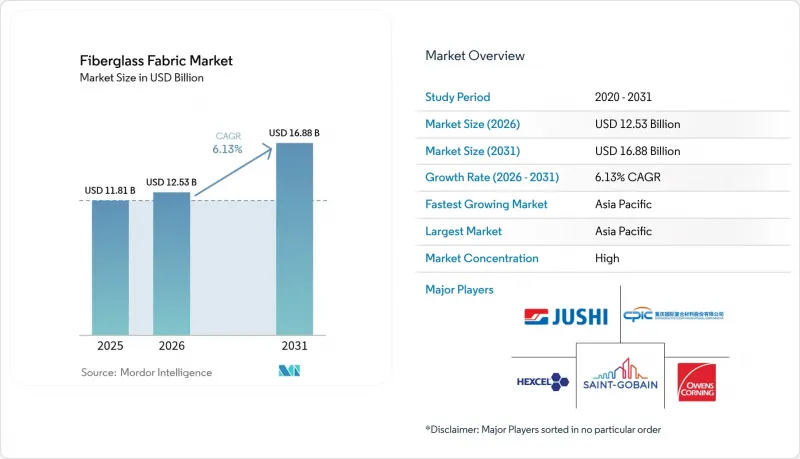
根據 Mordor Intelligence 預測,玻璃纖維紡織品市場規模將從 2025 年的 118.1 億美元成長到 2026 年的 125.3 億美元,然後在 2031 年達到 168.8 億美元,2026 年至 2031 年的複合年成長率為 6.13%。
本報告按纖維類型(S玻璃纖維、C玻璃纖維及其他)、紡織品類型(機織玻璃纖維、不織布玻璃纖維及其他)、應用領域(汽車與航太、建築及其他)和地區(亞太地區、北美地區、歐洲地區、南美地區、中東和非洲地區)對產業進行分類。市場預測以美元(USD)為單位。
全球玻璃纖維紡織品市場趨勢及洞察
汽車和航太領域對輕量材料的需求不斷成長。
汽車製造商和航太公司正擴大使用輕量材料,以滿足嚴格的法規要求並提升性能。在美國,將於2027年至2032年間實施的新燃油和排放氣體法規,使得輕量化成為全球供應鏈的優先事項。福特汽車公司在其Bronco Raptor車型中使用的複合材料C型加強桿便是這一趨勢的體現。此加強桿採用玻璃纖維增強支架和底盤面板,在不影響安全性的前提下減輕了重量。在商業航空領域,一個荷蘭財團正致力於在2025年前完成全複合材料材料液氫儲槽的認證,凸顯了該產業對高強度玻璃纖維在低溫材料封裝上的依賴。私募股權投資進一步凸顯了這些資料的戰略重要性。例如,AURELIUS於2024年以超過10億美元的價格收購了帝人汽車技術北美公司,旨在利用其在輕量化方面的專業知識。雖然天然纖維複合材料可以減少高達 60% 的溫室氣體排放,但它們目前缺乏玻璃纖維的機械穩定性,這進一步鞏固了玻璃纖維在安全性至關重要的應用領域中的地位。
風力發電設施擴建
根據全球風力發電理事會(GWEC)的記錄,2024年新增裝置容量將達到117吉瓦,預計到2030年將以每年8.8%的速度成長。當葉片長度超過115公尺時,例如維斯塔斯V236的設計,每颱風力發電機所需的材料量會增加,因此採用E玻璃和S玻璃混合層壓結構可以更好地平衡成本和剛度目標。在地採購政策正在加速製造地的轉移,Kineko Excel Composites公司於2025年下半年開始從果阿邦向亞洲離岸風力發電項目供應拉擠成型的玻璃纖維和碳纖維複合材料。經陶氏化學和維斯塔斯認證的聚氨酯-碳纖維支柱帽技術已實現超過90%的硬化率,但大多數剪力腹板仍保留玻璃纖維芯材以確保其強度。 SGL Carbon 報告稱,由於原料價格飆升,對風電客戶的銷售額下降了 35.2%,但玻璃纖維供應商卻受益於對價格較低的增強材料替代品的需求增加,從而提振了玻璃纖維紡織品市場。
原料能源成本波動
玻璃熔煉需要消耗大量的天然氣和電力。儘管Sibelco透過最佳化投資組合實現了22%的EBITDA成長,但2023-2024年歐洲能源價格的上漲仍然給利潤率帶來了壓力。全球矽砂產量已達3.8億噸,由於物流和授權成本的增加,矽砂價格持續上漲。美國環保署(EPA)對羊毛和玻璃纖維熔爐的監管要求持續監測鉻排放,這迫使北美工廠進行合規投資。生產商正透過自有可再生能源資產來對沖價格波動風險;例如,中國巨石零碳工廠已併入一座200兆瓦的風電場以穩定電力供應。回收製程廢料,例如Johns Manville在斯洛伐克開展的1萬噸回收項目,正在抵銷原生玻璃的需求,並緩解成本波動。
細分市場分析
2025年,E玻璃憑藉其成熟的全球供應鏈網路和低於每磅5美元的單位成本,維持了54.52%的市場佔有率,滿足了主流工程應用的需求。 S玻璃以6.69%的複合年成長率成長,在航太、國防和旋翼飛機零件市場佔據主導地位,其高出30-35%的抗張強度使其定價合理。 E6強化玻璃等特殊等級產品正在填補一些性能空白,而生物可吸收玻璃纖維則在醫用紡織品領域創造了新的機會。到2031年,平衡E玻璃和S玻璃產能的供應商將能夠靈活調整產量,以實現盈利最高的產品組合。
儘管AR玻璃在水泥加固領域的應用以及C玻璃在化學品密封領域的應用依然強勁,但D玻璃在高介電常數雷達和雷達罩領域仍保持著成長勢頭。一些公司正在研發非圓形截面的截面,旨在將腎形和三葉形纖維商業化,這些纖維在重量相近的情況下彎曲剛度提高了12%至18%,但這需要新的編織過程。 E玻璃仍然是主要產品,玻璃纖維織物市場透過遍布全球的熔爐網路保持穩定的供應。
區域分析
預計到2025年,亞太地區將佔全球銷售額的41.47%,在未來以6.93%的複合年成長率成長,這主要得益於中國的市場規模和印度的基礎設施獎勵策略。中國巨石集團投資8.12億美元的零碳熔爐專案將該地區產能提升至40萬噸,從而縮短本地客戶的交貨週期。東南亞國家正以關稅優惠吸引海外原始設備製造商(OEM),而越南沿海工業園區正在安裝新的紡織織機,以縮短銷往歐洲的風力渦輪機葉片的前置作業時間。印度的「印度製造」計畫鼓勵玻璃纖維製造商與邦政府合作建造新的熔煉廠,從而確保國內轉子工廠原料的穩定供應。
在北美,聯邦稅額扣抵正在刺激風力發電廠的普及和建築隔熱維修。此外,美國複合材料造船企業對縫合式多軸向玻璃纖維織物的需求日益成長,這種織物能夠在減輕作業船重量的同時提高抗衝擊性。同時,隨著汽車製造商為符合修訂後的CAFE標準而對玻璃纖維和熱塑性車門模組進行原型設計,該地區的玻璃纖維織物市場也持續擴張。
在歐洲,住宅建設週期放緩抑制了對隔熱紡織品的短期需求,而離岸風力發電目標和航太領域產量的增加則維持了基準需求。英國對來自中國和埃及的紡織品徵收高達99.7%的反傾銷稅,這促使歐盟買家尋求多元化採購管道,並將供應鏈轉向土耳其和當地生產商。監管機構對循環經濟的重視正在推動對玻璃回收的投資,一家德國工廠正在試行高純度玻璃屑線,以供應新型E玻璃抽屜。
隨著巴西大型石油公司對耐腐蝕基礎設施進行現代化改造,南美洲複合材料管線和儲槽市場正逐漸成長。智利和哥倫比亞的區域風電場競標正在採購100公尺長的陸上風力渦輪機葉片,這為當地紡織品製造商創造了新的機會。雖然中東和非洲的市場佔有率仍然較小,但阿拉伯聯合大公國的一個海水淡化項目指定使用耐腐蝕的玻璃纖維複合材料格柵,這確保了在乾旱氣候地區存在穩定而獨特的市場需求。
其他福利
- Excel格式的市場預測(ME)表
- 3個月的分析師支持
目錄
第1章:引言
- 研究假設和市場定義
- 調查範圍
第2章:調查方法
第3章執行摘要
第4章 市場狀況
- 市場概覽
- 市場促進因素
- 汽車和航太領域對輕質、高強度材料的需求不斷成長。
- 風力發電設施擴建
- 由於節能建築的普及,對絕緣纖維產品的需求不斷成長。
- 電子設備的微型化正在推動對電磁干擾屏蔽織物的需求。
- 工業煙囪維修
- 市場限制因素
- 原料能源成本波動
- 來自碳纖維和玄武岩纖維織物的競爭日益激烈。
- 對玻璃纖維處置的高成本監管
- 價值鏈分析
- 波特五力模型
第5章 市場規模與成長預測
- 依纖維類型
- S玻璃
- C 玻璃
- D 玻璃
- 一杯
- E玻璃
- 其他光纖類型(AR玻璃等)
- 按布料類型
- 玻璃纖維織物
- 不織布玻璃纖維
- 透過使用
- 汽車和航太
- 建築/施工
- 風力
- 電氣和電子設備
- 海上
- 其他用途(石油及天然氣、化學加工等)
- 按地區
- 亞太地區
- 中國
- 印度
- 日本
- 韓國
- 其他亞太國家
- 北美洲
- 美國
- 加拿大
- 墨西哥
- 歐洲
- 德國
- 英國
- 法國
- 義大利
- 其他歐洲國家
- 南美洲
- 巴西
- 阿根廷
- 其他南美國家
- 中東和非洲
- 沙烏地阿拉伯
- 南非
- 其他中東和非洲國家
- 亞太地區
第6章 競爭情勢
- 市場集中度
- 策略趨勢
- 市佔率和排名分析
- 公司簡介
- Ahlstrom
- BGF Industries Inc.
- Central Glass Co. Ltd
- China Jushi Co., Ltd.
- Chongqing Polycomp International(CPIC)
- CTG Group
- Fulltech Industries Corp.
- Hexcel Corporation
- Johns Manville
- Mid-Mountain Materials Inc.
- Owens Corning
- Saertex GmbH & Co. KG
- Saint-Gobain
- Taiwan Electric Insulator Co. Ltd
第7章 市場機會與未來展望
According to Mordor Intelligence, the fiberglass fabric market size is expected to grow from USD 11.81 billion in 2025 to USD 12.53 billion in 2026 and is forecast to reach USD 16.88 billion by 2031 at 6.13% CAGR over 2026-2031.
This report Segments the Industry by Fiber Type (S-Glass, C-Glass and More), Fabric Type (Woven Fiberglass Fabric, and Non-Woven Fiberglass Fabric), Application (Automotive and Aerospace, Building and Construction, and More), and Geography (Asia-Pacific, North America, Europe, South America, Middle-East and Africa). The Market Forecasts are Provided in Terms of Value (USD).
Global Fiberglass Fabric Market Trends and Insights
Growing demand for lightweight materials in automotive & aerospace
Automakers and aerospace firms increasingly use lightweight materials to meet stringent regulations and enhance performance. In the United States, new fuel-economy and emissions rules for 2027-2032 are driving global supply chains to prioritize weight reduction. Ford exemplifies this trend with its composite C-brace in the Bronco Raptor, incorporating fiberglass-reinforced brackets and under-body panels that reduce mass without compromising safety. In civil aviation, a Dutch consortium is progressing toward validating fully composite liquid-hydrogen tanks by 2025, emphasizing the industry's reliance on high-strength glass fabrics for cryogenic containment. The strategic importance of these materials is further highlighted by private-equity investments, such as AURELIUS acquiring Teijin Automotive Technologies North America in 2024 for over USD 1 billion to leverage their lightweighting expertise. While natural-fiber composites offer up to 60% lower greenhouse gas emissions, they currently lack the mechanical consistency of fiberglass, reinforcing fiberglass's position in safety-critical applications.
Expansion of wind-energy installations
The Global Wind Energy Council recorded 117 GW of new capacity in 2024, with 8.8% annual growth expected through 2030. Blade lengths surpassing 115 m, such as Vestas' V236 design, elevate material-volume requirements per turbine and favor hybrid E-Glass and S-Glass lay-ups that manage cost and stiffness targets. Local content policies accelerate manufacturing shifts; Kineco Exel Composites began supplying pultruded glass-carbon planks from Goa in late 2025 for Asian offshore projects. Polyurethane-carbon spar-cap technology, qualified by Dow and Vestas, achieves cure rates above 90%, yet most shear webs retain glass-fiber cores for robustness. Although SGL Carbon noted a 35.2% sales decline to wind customers due to raw-material inflation, glass-fiber suppliers benefit from substitution to lower-price reinforcements, bolstering the fiberglass fabric market.
Raw-material & energy cost volatility
Glass melting consumes significant natural-gas and electricity inputs; spikes in European energy prices during 2023-2024 squeezed margins despite Sibelco's 22% EBITDA rise from portfolio mix improvements. Silica-sand prices trend upward as 380 million t global output faces higher logistics and permitting costs. U.S. EPA rules for wool-fiberglass furnaces require continuous chromium-emission monitoring, adding compliance capital to North American plants. Producers hedge volatility through captive renewable-energy assets; China Jushi's zero-carbon plant integrates a 200 MW wind farm to stabilize power supply. Process scrap recycling, such as Johns Manville's 10,000 t program in Slovakia, offsets virgin-glass demand and buffers cost swings.
Other drivers and restraints analyzed in the detailed report include:
- Energy-efficient buildings boost insulation textiles demand
- Electronics miniaturization driving EMI-shielding fabrics
- Rising competition from carbon & basalt fiber fabrics
For complete list of drivers and restraints, kindly check the Table Of Contents.
Segment Analysis
E-Glass maintained 54.52% market share in 2025 due to mature global supply networks and unit costs below USD 5/lb that meet mainstream engineering targets. S-Glass, advancing at the fastest CAGR of 6.69%, captures aerospace, defense, and rotorcraft parts where 30-35% higher tensile strength justifies its premium pricing. Specialty grades such as E6 enhanced glass bridge some performance gaps, while bioabsorbable glass fibers add opportunities in medical textiles. Suppliers balancing E- and S-Glass capacity can flex volume toward the most profitable mixes through 2031.
Adoption of AR-Glass for cement reinforcement and C-Glass for chemical containment remains steady, whereas D-Glass continues niche growth in high-dielectric radar radomes. Developers of non-circular cross-sections seek to commercialize kidney-shaped and trilobal filaments that exhibit 12-18% higher flexural stiffness at similar weight, yet require new weaving parameters. E-Glass remains the anchor product, and the fiberglass fabric market preserves supply security via multi-continent melter networks.
Complete Report Scope:
- By Fiber Type
- S-Glass
- C-Glass
- D-Glass
- A-Glass
- E-Glass
- Other Fiber Types (AR-Glass, etc.)
- By Fabric Type
- Woven Fiberglass Fabrics
- Non-Woven Fiberglass Fabrics
- By Application
- Automotive and Aerospace
- Building and Construction
- Wind Energy
- Electrical and Electronics
- Marine
- Other Applications (Oil and Gas, Chemical Processing, etc.)
- By Geography
- Asia-Pacific
- China
- India
- Japan
- South Korea
- Rest of Asia-Pacific
- North America
- United States
- Canada
- Mexico
- Europe
- Germany
- United Kingdom
- France
- Italy
- Rest of Europe
- South America
- Brazil
- Argentina
- Rest of South America
- Middle East and Africa
- Saudi Arabia
- South Africa
- Rest of Middle East and Africa
- Asia-Pacific
Geography Analysis
Asia-Pacific generated 41.47% of 2025 global revenue and leads future growth with a 6.93% CAGR, propelled by China's scale and India's infrastructure stimulus. China Jushi's USD 812 million zero-carbon furnace complex elevates regional capacity to 400,000 t and provides local customers faster delivery cycles. Southeast Asian economies attract foreign OEMs seeking tariff advantages, and Vietnam's coastal industrial parks host new woven-fabric looms that shorten European wind-blade lead times. India's "Make in India" push encourages glass-fiber producers to partner with state governments on greenfield melts, ensuring raw-material availability for domestic rotor factories.
North America benefits from federal tax credits that extend wind-farm deployments and building-insulation retrofits. U.S. composite shipbuilders also stimulate demand for stitched multiaxial glass fabrics that lower weight while improving impact tolerance in workboats. Meanwhile, the fiberglass fabric market size for the region remains under expansion as automotive OEMs prototype glass-thermoplastic door modules to comply with updated CAFE standards.
Europe experiences mixed signals: a softer residential-construction cycle restrains short-term insulation textiles, yet offshore-wind targets and aerospace ramp-ups sustain baseline volume. The U.K. enforces anti-dumping duties up to 99.7% on Chinese and Egyptian fabrics, prompting EU buyers to diversify toward Turkish and local producers, thereby adjusting supply chains. Regulatory focus on circularity spurs investments in glass recycling, with German plants piloting high-purity cullet streams that feed new E-Glass pulls.
South America's composite pipe and tank markets grow gradually as oil majors modernize corrosion-resistant infrastructure in Brazil. Regional wind-farm auctions in Chile and Colombia call for 100-m onshore blades, opening opportunities for local fabric conversion. The Middle East & Africa region remains a smaller slice, yet United Arab Emirates desalination projects specify glass-fiber composite gratings for corrosion resistance, anchoring a steady, if niche, demand profile across arid climates.
- Ahlstrom
- BGF Industries Inc.
- Central Glass Co. Ltd
- China Jushi Co., Ltd.
- Chongqing Polycomp International (CPIC)
- CTG Group
- Fulltech Industries Corp.
- Hexcel Corporation
- Johns Manville
- Mid-Mountain Materials Inc.
- Owens Corning
- Saertex GmbH & Co. KG
- Saint-Gobain
- Taiwan Electric Insulator Co. Ltd
Additional Benefits:
- The market estimate (ME) sheet in Excel format
- 3 months of analyst support
TABLE OF CONTENTS
1 Introduction
- 1.1 Study Assumptions & Market Definition
- 1.2 Scope of the Study
2 Research Methodology
3 Executive Summary
4 Market Landscape
- 4.1 Market Overview
- 4.2 Market Drivers
- 4.2.1 Growing demand for lightweight, high-strength materials in automotive & aerospace
- 4.2.2 Expansion of wind-energy installations
- 4.2.3 Energy-efficient buildings boost insulation textiles demand
- 4.2.4 Electronics miniaturization driving EMI-shielding fabrics
- 4.2.5 Retrofitting of industrial chimneys
- 4.3 Market Restraints
- 4.3.1 Raw-material & energy cost volatility
- 4.3.2 Rising competition from carbon & basalt fiber fabrics
- 4.3.3 Costly end-of-life fiberglass disposal regulations
- 4.4 Value Chain Analysis
- 4.5 Porter's Five Forces
- 4.5.1 Threat of New Entrants
- 4.5.2 Bargaining Power of Buyers
- 4.5.3 Bargaining Power of Suppliers
- 4.5.4 Threat of Substitute Products
- 4.5.5 Degree of Competition
5 Market Size & Growth Forecasts (Value)
- 5.1 By Fiber Type
- 5.1.1 S-Glass
- 5.1.2 C-Glass
- 5.1.3 D-Glass
- 5.1.4 A-Glass
- 5.1.5 E-Glass
- 5.1.6 Other Fiber Types (AR-Glass, etc.)
- 5.2 By Fabric Type
- 5.2.1 Woven Fiberglass Fabrics
- 5.2.2 Non-Woven Fiberglass Fabrics
- 5.3 By Application
- 5.3.1 Automotive and Aerospace
- 5.3.2 Building and Construction
- 5.3.3 Wind Energy
- 5.3.4 Electrical and Electronics
- 5.3.5 Marine
- 5.3.6 Other Applications (Oil and Gas, Chemical Processing, etc.)
- 5.4 By Geography
- 5.4.1 Asia-Pacific
- 5.4.1.1 China
- 5.4.1.2 India
- 5.4.1.3 Japan
- 5.4.1.4 South Korea
- 5.4.1.5 Rest of Asia-Pacific
- 5.4.2 North America
- 5.4.2.1 United States
- 5.4.2.2 Canada
- 5.4.2.3 Mexico
- 5.4.3 Europe
- 5.4.3.1 Germany
- 5.4.3.2 United Kingdom
- 5.4.3.3 France
- 5.4.3.4 Italy
- 5.4.3.5 Rest of Europe
- 5.4.4 South America
- 5.4.4.1 Brazil
- 5.4.4.2 Argentina
- 5.4.4.3 Rest of South America
- 5.4.5 Middle East and Africa
- 5.4.5.1 Saudi Arabia
- 5.4.5.2 South Africa
- 5.4.5.3 Rest of Middle East and Africa
- 5.4.1 Asia-Pacific
6 Competitive Landscape
- 6.1 Market Concentration
- 6.2 Strategic Moves
- 6.3 Market Share(%)/Ranking Analysis
- 6.4 Company Profiles (includes Global level Overview, Market level overview, Core Segments, Financials as available, Strategic Information, Market Rank/Share for key companies, Products & Services, and Recent Developments)
- 6.4.1 Ahlstrom
- 6.4.2 BGF Industries Inc.
- 6.4.3 Central Glass Co. Ltd
- 6.4.4 China Jushi Co., Ltd.
- 6.4.5 Chongqing Polycomp International (CPIC)
- 6.4.6 CTG Group
- 6.4.7 Fulltech Industries Corp.
- 6.4.8 Hexcel Corporation
- 6.4.9 Johns Manville
- 6.4.10 Mid-Mountain Materials Inc.
- 6.4.11 Owens Corning
- 6.4.12 Saertex GmbH & Co. KG
- 6.4.13 Saint-Gobain
- 6.4.14 Taiwan Electric Insulator Co. Ltd
7 Market Opportunities & Future Outlook
- 7.1 White-space & unmet-need assessment

 高模量玻璃纖維短切絲市場:全球市場預測,2026-2032年高模量玻璃纖維粗紗市場:全球市場預測(2026-2032年)高平滑度電子玻璃纖維市場-2026年至2032年全球市場預測特種複合材料用電子玻璃布市場:2026-2032年全球市場預測微玻璃纖維過濾器市場:全球市場預測,2026-2032年
 玻璃纖維織物市場報告:趨勢、預測和競爭分析(至2035年)生物玻璃市場報告:趨勢、預測和競爭分析(至2035年)電子玻璃纖維氈市場報告:趨勢、預測與競爭分析(至2035年)
 2034年玻璃纖維市場預測-按產品類型、玻璃類型、應用、終端用戶產業和地區分類的全球分析
 玻璃纖維:市場佔有率分析、行業趨勢和統計數據、成長預測(2026-2031)