


 |
市場調查報告書
商品編碼
2114983
油墨添加劑:市場佔有率分析、產業趨勢與統計、成長預測(2026-2031)Ink Additives - Market Share Analysis, Industry Trends & Statistics, Growth Forecasts (2026 - 2031) |
||||||

※ 本網頁內容可能與最新版本有所差異。詳細情況請與我們聯繫。
根據 Mordor Intelligence 預測,油墨添加劑市場規模將從 2025 年的 25.4 億美元成長到 2026 年的 26.7 億美元,然後在 2031 年達到 34 億美元,2026 年至 2031 年的複合年成長率為 4.98%。
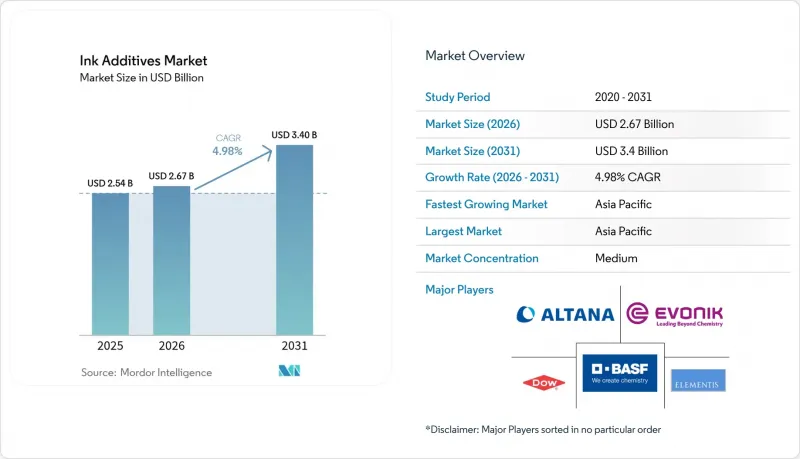
本報告按添加劑類型(分散劑/潤濕劑、消泡劑等)、技術(水性、溶劑型等)、印刷過程(平版印刷、柔印等)、應用領域(包裝、印刷及其他應用)和地區(亞太地區、北美、歐洲、南美、中東和非洲)進行細分。市場預測以美元計價。
全球油墨添加劑市場趨勢及洞察
包裝加工商的需求增加
加工商指定添加劑以維持多層薄膜、紙張和聚合物複合材料以及金屬化鋁箔的印刷密度和附著力。BASF在荷蘭擴大了其 Joncryl 和 Acronal Pro 水性分散體產品線,以滿足軟包裝對低遷移性的需求。領先的加工商集團要求批次間一致性高,以適應自動化檢測線,這促使供應商提供更高純度的原料和更嚴格的生產標準。對閉合迴路色彩管理和擴增實境(AR) 的作業設定的投資進一步凸顯了對能夠在印刷速度、濕度和溫度波動下保持穩定性的添加劑的需求。因此,預計到 2030 年,全球對包裝產品的需求將持續成長,這確保了優質添加劑化學品的長期成長潛力。
電子商務推動紙板運輸量激增。
D2C(直接面對消費者)品牌將包裝盒視為行銷畫布,尋求能夠提高油墨覆蓋率並保持高黏度噴墨配方噴塗穩定性的流變改性劑。實驗室研究表明,使用高固態分散劑可使塗層白紙的色彩密度提高高達 67%,且不會造成噴嘴阻塞。都市區履約中心傾向於選擇適用期長的油墨以更好地管理庫存,並建議使用即使儲存數週也不會發生相分離的防沉降包裝。整合式QR碼、新鮮度指示器和防偽功能的各種功能性油墨正在湧現,這需要添加導電或發光添加劑,而這些添加劑在瓦楞紙板製造流程中並不常見。
嚴格的食品接觸法規和揮發性有機化合物法規
美國食品藥物管理局(FDA) 對油墨成分的核准仍採取個案審查的方式,這延長了核准週期,並增加了中小供應商的合規成本。在瑞士,2024 年對《油墨條例》的修訂取消了未經評估物質的暫定清單,迫使配方設計人員只能依賴預先批准的化學物質。在歐盟,2025 年 9 月生效的 REACH 法規附件 XVII 對 CMR 物質的更嚴格規定,勢必會推動配方的進一步變革。美國各州和歐盟各成員國對揮發性有機化合物 (VOC) 的限量標準各不相同,這使得產品線的精簡變得更加複雜。大型跨國公司正利用其內部的法規合規團隊來應對這些法規,而本土企業則面臨相對較高的測試成本,這限制了它們的創新發展。
細分市場分析
到了2025年,分散劑和潤濕劑將佔銷售額的32.10%,凸顯它們在色彩開發和長期穩定性方面的關鍵作用。BASF的Efka PX和Dispex Ultra PX系列產品可透過提高透明度和降低研磨基料黏度,從而降低研磨過程中的能耗。科萊恩的Dispersogen系列產品涵蓋有機、無機和碳基顏料,使配方設計師能夠為多種基材建立多功能系統。消泡劑在高速混合和柔版印刷中仍然至關重要,因為微氣泡的滯留會導致缺陷。滑爽劑和流平劑可改善低表面能薄膜(例如BOPP)的潤濕性,而BYK的流變改性劑成為成長最快的細分市場,複合年成長率達5.74%。離子液體和超支化聚合物添加劑的開發代表了下一代水性體系的一個有前景的發展方向。
到2025年,水性化學品將佔據46.80%的市場佔有率,這主要得益於低VOC(揮發性有機化合物)法規的實施以及印刷廠火災保險費用的降低。BASF在荷蘭擴大水性樹脂產能,凸顯了對食品級、無味平台的承諾。溶劑型油墨在汽車內飾、電纜標記和工業塗料等領域仍然至關重要,因為在這些領域,耐化學性比環境因素更重要。紫外光固化配方的成長率為5.62%,可即時固化,減少印刷機面積,並降低LED-UV燈的能耗。為了符合日益嚴格的內分泌干擾物指南,供應商目前正在採用無錫光引發劑和無APEO分散劑。結合紫外光和電子束固化的混合化學技術正在彌合現有技術之間的性能差距,滿足收縮套管和蒸餾蒸煮包裝袋對高遮蓋力白色層的需求。
區域分析
亞太地區是油墨添加劑市場的主要驅動力,預計2025年將佔全球銷售額的46.10%,並預計在2031年之前以5.68%的複合年成長率成長。中國食品接觸油墨標準GB 4806.14-2023正在推動添加劑產品系列為低遷移和無二苯甲酮體系。東南亞國家正在投資特種化學品生產能力,地方政府也透過擴大綠色化學計畫的稅收優惠來促進區域自給自足。印度禁止在印刷油墨中使用甲苯的政策持續推動市場向水性配方轉變,而日本嚴格的有害物質法規則促進了高品質添加劑的應用。
北美在技術上依然領先,並堅持以合規為導向的立場。華盛頓州針對多種油墨類別提出的提案凸顯了日益嚴格的環境審查。美國環保署 (EPA) 已將顏料紫29列入《有毒物質管制法》(TSCA) 評估範圍,要求對整個顏料和分散劑配方進行主動風險評估。加拿大品牌商正大力推廣可回收的單一材料包裝,這推動了對有助於產品輕鬆分離的添加劑的需求。
歐洲在永續性法規方面一直處於領先地位。歐盟的「零污染行動計畫」針對礦物油基油墨,而環保油墨在德國的市佔率已超過15%。法國即將於2025年禁止使用礦物油基油墨,將加速向植物來源和紫外線LED系統的快速轉型,並增加對源自可再生資源的生物基分散劑和消泡劑的需求。在長期倡導「從搖籃到搖籃(C2C)」認證的北歐國家,超低遷移添加劑包憑藉其溢價優勢,已形成獨特的市場機會。
拉丁美洲、中東和非洲雖然市場規模較小,但成長迅速。儘管法律規範尚不完善,但全球品牌所有者對標準化配方的需求不斷成長,推動了對受監管添加劑的需求。墨西哥和土耳其對軟包裝製造基礎設施的投資正在提振區域需求。南非在包裝行業引入生產者延伸責任制(EPR)可能會加速向水性油墨的過渡,並進一步促進該地區添加劑的使用。
其他好處:
- Excel格式的市場預測(ME)表
- 3個月的分析師支持
目錄
第1章:引言
- 研究假設和市場定義
- 調查範圍
第2章:調查方法
第3章執行摘要
第4章 市場狀況
- 市場概覽
- 市場促進因素
- 包裝製造商的需求不斷成長
- 電子商務推動紙板運輸量激增。
- 水性及紫外線固化系統的調控進展
- 採用功能性和智慧包裝油墨
- 數位紡織印花技術的滲透率
- 市場限制因素
- 食品接觸和揮發性有機化合物方面的嚴格規定
- 特種單體供應鏈極不穩定
- 專利到期後的商品化壓力
- 價值鏈分析
- 波特五力模型
第5章 市場規模與成長預測
- 按添加劑類型
- 分散劑和潤濕劑
- 消泡劑
- 滑移劑和流平劑
- 流變改性劑
- 其他類型的添加劑(例如黏合促進劑)
- 透過技術
- 水溶液
- 溶劑型
- 紫外線固化型
- 其他技術(石油基、混合型)
- 透過印刷過程
- 微影術
- 柔版印刷
- 數位的
- 凹版印刷
- 其他印刷過程(例如網版印刷)
- 透過使用
- 包裝
- 紙板
- 靈活的
- 食物
- 印刷
- 陶瓷
- 玻璃
- 紙
- 塑膠
- 其他應用(例如,功能性電子產品)
- 包裝
- 按地區
- 亞太地區
- 中國
- 日本
- 印度
- 韓國
- 東南亞國協
- 其他亞太國家
- 北美洲
- 美國
- 加拿大
- 墨西哥
- 歐洲
- 德國
- 英國
- 法國
- 義大利
- 西班牙
- 俄羅斯
- 北歐國家
- 其他歐洲國家
- 南美洲
- 巴西
- 阿根廷
- 其他南美國家
- 中東和非洲
- 沙烏地阿拉伯
- 南非
- 其他中東和非洲國家
- 亞太地區
第6章 競爭情勢
- 市場集中度
- 策略趨勢
- 市佔率和排名分析
- 公司簡介
- ALTANA
- Arkema
- artience Co., Ltd.
- BASF
- Clariant
- Croda International Plc
- DIC Corporation
- Dorf Ketal
- Dow
- Elementis PLC
- Evonik Industries AG
- Hubergroup Deutschland GmbH
- Huntsman International, LLC
- K-TECH(INDIA)LIMITED
- Michelman, Inc.
- Shamrock Technologies
- The Lubrizol Corporation
- Venator Materials PLC
第7章 市場機會與未來展望
According to Mordor Intelligence, the ink additives market size is expected to grow from USD 2.54 billion in 2025 to USD 2.67 billion in 2026 and is forecast to reach USD 3.4 billion by 2031 at 4.98% CAGR over 2026-2031.
This report is Segmented by Additive Type (Dispersing and Wetting Agents, Defoamers, and More), Technology (Water-Based, Solvent-Based, and More), Printing Process (Lithographic, Flexographic, and More), Application (Packaging, Printing, Other Applications), and Geography (Asia-Pacific, North America, Europe, South America, Middle East and Africa). The Market Forecasts are Provided in Terms of Value (USD).
Global Ink Additives Market Trends and Insights
Growing Demand from Packaging Converters
Converters are specifying additives that maintain print density and adhesion across multilayer films, paper-poly laminates, and metallized foils. BASF expanded its Joncryl and Acronal Pro waterborne dispersion line in the Netherlands to address food-grade flexibles that require low-migration profiles. Larger converter groups also insist on batch-to-batch consistency to support automated inspection lines, pushing suppliers toward high-purity raw materials and tighter production standards. Investments in closed-loop colour management and augmented-reality job set-up further underscore the need for additives that remain stable under variable press speeds, humidity, and temperature. The expected rise in global packaged-goods demand through 2030 therefore secures a long runway for premium additive chemistries.
Surge in E-commerce Corrugated Volume
Direct-to-consumer brands treat the shipping box as a marketing canvas, driving higher ink laydown and demanding rheology modifiers able to maintain jetting stability in high-viscosity inkjet formulations. Laboratory studies show up to 67% higher colour density on coated white-liners when high-solids dispersants are used, without nozzle clogging. Urban fulfilment centres favour inventory-friendly inks with extended pot life, encouraging anti-settling packages that resist phase separation after weeks of storage. Functional inks that embed QR codes, freshness indicators, or anti-counterfeit features are emerging, requiring conductive or luminescent additives previously uncommon in corrugated workflows.
Stringent Food-Contact and VOC Regulations
The US Food and Drug Administration continues its case-by-case approach to ink components, lengthening approval cycles and raising compliance costs for smaller suppliers. Switzerland's 2024 revision of its inks ordinance removed the provisional list of unevaluated substances, forcing formulators to rely on pre-approved chemistries only. The EU will tighten CMR substance restrictions under REACH Annex XVII in September 2025, compelling another wave of reformulations. VOC caps differ by state in the US and by member state in the EU, thereby complicating product-line rationalisation. Large multinationals exploit in-house regulatory teams to navigate these rules, whereas regional players face higher relative testing costs, constraining innovation pipelines.
Other drivers and restraints analyzed in the detailed report include:
- Regulatory Push Toward Water-based and UV-curable Systems
- Adoption of Functional and Smart-Packaging Inks
- Volatile Specialty-Monomer Supply Chain
For complete list of drivers and restraints, kindly check the Table Of Contents.
Segment Analysis
Dispersing and wetting agents represented 32.10% of revenue in 2025, underscoring their pivotal role in colour development and long-term stability. BASF's Efka PX and Dispex Ultra PX lines improve transparency and lower mill-base viscosities, reducing energy consumption during grinding. Clariant's Dispersogen range covers organic, inorganic, and carbon pigment classes, enabling formulators to build universal systems for multi-substrate workflows. Defoamers remain vital during high-speed mixing and flexographic printing, where micro-bubble entrapment causes defects. Slip and levelling agents enhance wetting on low-surface-energy films such as BOPP, while rheology modifiers from BYK deliver anti-settling benefits across the full shear profile. Specialty modifiers and adhesion promoters are the fastest-growing sub-group at 5.74% CAGR as smart-packaging, high-temperature ceramics, and outdoor signage demand tailored performance. Developments in ionic-liquid and hyper-branched-polymer additives show promise for next-generation water-based systems.
Water-based chemistries commanded 46.80% share in 2025, driven by low-VOC regulations and lower fire-insurance costs in pressrooms. BASF's scale-up of waterborne resin capacity in the Netherlands emphasises the commitment to food-grade, odour-neutral platforms. Solvent-based inks remain essential in automotive interiors, cable marking, and industrial coding where chemical resistance eclipses environmental concerns. UV-curable formulations-growing at 5.62%-offer instant curing, smaller press footprints, and reduced energy use with LED-UV lamps. Suppliers now introduce tin-free photoinitiators and APEO-free dispersants to meet tightening endocrine-disruptor guidelines. Hybrid chemistries that merge UV and electron-beam curing address high-opacity white layers on shrink sleeves and retort-able pouches, bridging performance gaps between existing technologies.
Complete Report Scope:
- By Additive Type
- Dispersing and Wetting Agents
- Defoamers
- Slip and Leveling Agents
- Rheology Modifiers
- Other Additive Types (Adhesion Promoters, etc.)
- By Technology
- Water-based
- Solvent-based
- UV Curable
- Other Technologies (Oil-based, Hybrid)
- By Printing Process
- Lithographic
- Flexographic
- Digital
- Gravure
- Other Printing Process (Screen , etc)
- By Application
- Packaging
- Corrugated
- Flexible
- Food
- Printing
- Ceramics
- Glass
- Paper
- Plastics
- Other Applications (Functional Electronics, etc.)
- Packaging
- By Geography
- Asia-Pacific
- China
- Japan
- India
- South Korea
- ASEAN Countries
- Rest of Asia-Pacific
- North America
- United States
- Canada
- Mexico
- Europe
- Germany
- United Kingdom
- France
- Italy
- Spain
- Russia
- NORDIC Countries
- Rest of Europe
- South America
- Brazil
- Argentina
- Rest of South America
- Middle East and Africa
- Saudi Arabia
- South Africa
- Rest of Middle East and Africa
- Asia-Pacific
Geography Analysis
Asia-Pacific dominated the ink additives market with 46.10% revenue in 2025 and is forecast to exhibit a 5.68% CAGR to 2031. China's GB 4806.14-2023 standard for food-contact inks is reshaping additive portfolios toward low-migration, benzophenone-free systems. Southeast Asian nations invest in specialty-chemical capacity, and local governments extend tax incentives for green-chemistry projects, fostering regional self-sufficiency. India's prohibition of toluene in printing inks continues to steer demand toward water-based formulations, while Japan's stringent toxics control drives premium additive uptake.
North America remains technologically advanced and compliance-focused. Washington State's proposal to restrict several ink classes underscores mounting environmental scrutiny. The US Environmental Protection Agency listed Pigment Violet 29 under Toxic Substances Control Act evaluation, compelling proactive risk assessments across pigment dispersant packages. Canadian brand owners emphasise recyclable mono-material packaging, prompting demand for additives that promote delamination-free separation.
Europe consistently leads sustainability regulation. The EU's Zero-Pollution Action Plan targets mineral-oil-based inks, and Germany's market share in eco inks already exceeds 15%. France's impending 2025 ban on mineral-based inks spurs rapid migration to plant-based and UV-LED systems, escalating demand for bio-based dispersants and renewable-resource defoamers. Nordic countries, long proponents of cradle-to-cradle certification, offer niche opportunities for ultra-low-migration additive packages that command price premiums.
Latin America and the Middle East & Africa represent smaller but rising markets. Regulatory frameworks are less mature, yet global brand owners require harmonised formulations, creating pull-through for compliant additives. Infrastructure investment in flexible packaging manufacturing in Mexico and Turkey augments regional demand. South Africa's adoption of extended producer responsibility schemes for packaging could accelerate the shift to water-based inks, boosting additive uptake in the region.
- ALTANA
- Arkema
- artience Co., Ltd.
- BASF
- Clariant
- Croda International Plc
- DIC Corporation
- Dorf Ketal
- Dow
- Elementis PLC
- Evonik Industries AG
- Hubergroup Deutschland GmbH
- Huntsman International, LLC
- K-TECH (INDIA) LIMITED
- Michelman, Inc.
- Shamrock Technologies
- The Lubrizol Corporation
- Venator Materials PLC
Additional Benefits:
- The market estimate (ME) sheet in Excel format
- 3 months of analyst support
TABLE OF CONTENTS
1 Introduction
- 1.1 Study Assumptions and Market Definition
- 1.2 Scope of the Study
2 Research Methodology
3 Executive Summary
4 Market Landscape
- 4.1 Market Overview
- 4.2 Market Drivers
- 4.2.1 Growing demand from packaging converters
- 4.2.2 Surge in e-commerce corrugated volume
- 4.2.3 Regulatory push toward water-based and UV-curable systems
- 4.2.4 Adoption of functional and smart-packaging inks
- 4.2.5 Digital textile-printing penetration
- 4.3 Market Restraints
- 4.3.1 Stringent food-contact and VOC regulations
- 4.3.2 Volatile specialty-monomer supply chain
- 4.3.3 Post-patent commoditization pressure
- 4.4 Value Chain Analysis
- 4.5 Porter's Five Forces
- 4.5.1 Bargaining Power of Suppliers
- 4.5.2 Bargaining Power of Buyers
- 4.5.3 Threat of New Entrants
- 4.5.4 Threat of Substitutes
- 4.5.5 Degree of Competition
5 Market Size and Growth Forecasts (Value)
- 5.1 By Additive Type
- 5.1.1 Dispersing and Wetting Agents
- 5.1.2 Defoamers
- 5.1.3 Slip and Leveling Agents
- 5.1.4 Rheology Modifiers
- 5.1.5 Other Additive Types (Adhesion Promoters, etc.)
- 5.2 By Technology
- 5.2.1 Water-based
- 5.2.2 Solvent-based
- 5.2.3 UV Curable
- 5.2.4 Other Technologies (Oil-based, Hybrid)
- 5.3 By Printing Process
- 5.3.1 Lithographic
- 5.3.2 Flexographic
- 5.3.3 Digital
- 5.3.4 Gravure
- 5.3.5 Other Printing Process (Screen , etc)
- 5.4 By Application
- 5.4.1 Packaging
- 5.4.1.1 Corrugated
- 5.4.1.2 Flexible
- 5.4.1.3 Food
- 5.4.2 Printing
- 5.4.2.1 Ceramics
- 5.4.2.2 Glass
- 5.4.2.3 Paper
- 5.4.2.4 Plastics
- 5.4.3 Other Applications (Functional Electronics, etc.)
- 5.4.1 Packaging
- 5.5 By Geography
- 5.5.1 Asia-Pacific
- 5.5.1.1 China
- 5.5.1.2 Japan
- 5.5.1.3 India
- 5.5.1.4 South Korea
- 5.5.1.5 ASEAN Countries
- 5.5.1.6 Rest of Asia-Pacific
- 5.5.2 North America
- 5.5.2.1 United States
- 5.5.2.2 Canada
- 5.5.2.3 Mexico
- 5.5.3 Europe
- 5.5.3.1 Germany
- 5.5.3.2 United Kingdom
- 5.5.3.3 France
- 5.5.3.4 Italy
- 5.5.3.5 Spain
- 5.5.3.6 Russia
- 5.5.3.7 NORDIC Countries
- 5.5.3.8 Rest of Europe
- 5.5.4 South America
- 5.5.4.1 Brazil
- 5.5.4.2 Argentina
- 5.5.4.3 Rest of South America
- 5.5.5 Middle East and Africa
- 5.5.5.1 Saudi Arabia
- 5.5.5.2 South Africa
- 5.5.5.3 Rest of Middle East and Africa
- 5.5.1 Asia-Pacific
6 Competitive Landscape
- 6.1 Market Concentration
- 6.2 Strategic Moves
- 6.3 Market Share(%)/Ranking Analysis
- 6.4 Company Profiles (includes Global level Overview, Market level overview, Core Segments, Financials as available, Strategic Information, Market Rank/Share, Products and Services, Recent Developments)
- 6.4.1 ALTANA
- 6.4.2 Arkema
- 6.4.3 artience Co., Ltd.
- 6.4.4 BASF
- 6.4.5 Clariant
- 6.4.6 Croda International Plc
- 6.4.7 DIC Corporation
- 6.4.8 Dorf Ketal
- 6.4.9 Dow
- 6.4.10 Elementis PLC
- 6.4.11 Evonik Industries AG
- 6.4.12 Hubergroup Deutschland GmbH
- 6.4.13 Huntsman International, LLC
- 6.4.14 K-TECH (INDIA) LIMITED
- 6.4.15 Michelman, Inc.
- 6.4.16 Shamrock Technologies
- 6.4.17 The Lubrizol Corporation
- 6.4.18 Venator Materials PLC
7 Market Opportunities and Future Outlook
- 7.1 White-space and Unmet-Need Assessment
- 7.2 Emerging Bio-based Additive Platforms

 油墨添加劑市場-2026-2032年全球市場預測
 油墨添加劑市場:商機、成長要素、產業趨勢分析及2026-2035年預測數位油墨添加劑市場:按添加劑類型、技術、應用和最終用途產業分類-2026-2032年全球預測
 油墨添加劑市場規模、佔有率和成長分析(按製程、應用、技術和地區分類)—產業預測(2026-2033 年)
 油墨添加劑市場-全球產業規模、佔有率、趨勢、機會及預測,按類型、技術、應用、地區及競爭情況細分,2020-2030 年預測
 油墨添加劑全球市場報告:趨勢、預測和競爭分析(至2031年)
 油墨添加劑市場至2030年的預測:按產品、油墨配方、製程、應用、最終用戶和地區的全球分析