


 |
市場調查報告書
商品編碼
2027599
油墨添加劑市場:商機、成長要素、產業趨勢分析及2026-2035年預測Ink Additive Market Opportunity, Growth Drivers, Industry Trend Analysis, and Forecast 2026 - 2035 |
||||||

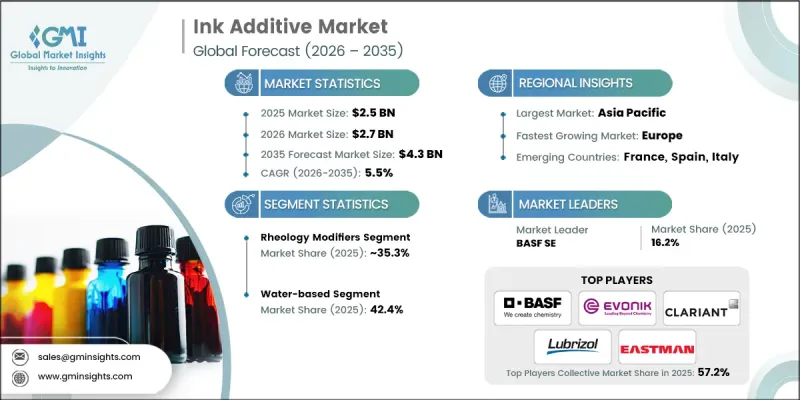
全球油墨添加劑市場預計到 2025 年將達到 25 億美元,並預計以 5.5% 的複合年成長率成長,到 2035 年將達到 43 億美元。
油墨添加劑是由專門設計用於改善印刷油墨性能和特性的化合物組成。這些添加劑具有多種功能,包括調節黏度、提高附著力、增強顯色性、抑制發泡和控制乾燥。印刷業對出版、包裝和紡織品印刷等高品質表面處理的需求推動了該行業的發展。印刷製程的快速技術進步增加了對能夠提升油墨性能並滿足不斷變化的客戶需求的添加劑的需求。環境法規和永續發展計劃正在推動環保油墨解決方案的應用,這些解決方案能夠減少廢棄物和揮發性有機化合物 (VOC)的排放,從而創造新的市場機會。隨著製造商圖在成本效益和法規遵循之間取得平衡,預計油墨添加劑市場將在所有地區穩步成長。
| 市場範圍 | |
|---|---|
| 開始年份 | 2025 |
| 預測期 | 2026-2035 |
| 上市時的市場規模 | 25億美元 |
| 預測金額 | 43億美元 |
| 複合年成長率 | 5.5% |
預計到2025年,流變改性劑市佔率將達到35.3%,到2035年將以5.7%的複合年成長率成長。這一成長主要得益於印刷業對精確黏度控制的需求,以確保油墨均勻塗覆和高品質的印刷效果。這些改質劑能夠改善油墨的穩定性和流動性,從而在最新的印刷技術中實現最佳性能。此外,對環保印刷方式的日益重視也推動了對源自可再生資源的流變改性劑的需求,進一步促進了市場擴張。
到2025年,水性油墨添加劑的市佔率將達到42.4%。這一細分市場的成長主要得益於消費者對低VOC和環保配方日益成長的認知,以及日益嚴格的環境法規。水性系統因其對環境影響小、排放低、健康和安全性能優異等優勢,在各種印刷應用中越來越受歡迎,並逐漸成為永續印刷作業的首選。
受北美包裝、出版和工業印刷行業日益成長的環保需求推動,預計2026年至2035年北美油墨添加劑市場將以5.6%的複合年成長率成長。監管壓力以及消費者對可生物分解和可回收油墨產品日益成長的期望,正促使製造商專注於開發能夠降低揮發性有機化合物(VOC)排放、提高油墨可回收性並保持高性能的添加劑。
目錄
第1章:調查方法和範圍
第2章執行摘要
第3章業界考察
- 生態系分析
- 供應商情況
- 利潤率
- 每個階段增加的價值
- 影響價值鏈的因素
- 中斷
- 影響產業的因素
- 促進因素
- 高品質印刷材料的需求
- 印刷技術的創新
- 客製化和個人化印刷解決方案的發展趨勢
- 產業潛在風險與挑戰
- 客戶期望和不斷變化的市場趨勢
- 市場區隔與競爭
- 市場機遇
- 對環保型、可生物分解油墨添加劑的需求日益成長
- 數位印刷技術的普及降低了對傳統油墨配方的依賴。
- 促進因素
- 成長潛力分析
- 監理情勢
- 北美洲
- 歐洲
- 亞太地區
- 拉丁美洲
- 中東和非洲
- 波特的分析
- PESTEL 分析
- 價格趨勢
- 按地區
- 按類型
- 未來市場趨勢
- 科技與創新趨勢
- 當前技術趨勢
- 新興技術
- 專利趨勢
- 貿易統計(HS編碼)
- 主要進口國
- 主要出口國
- 永續性和環境方面
- 永續計劃
- 減少廢棄物策略
- 生產中的能源效率
- 環保意識的舉措
- 考慮碳足跡
第4章 競爭情勢
- 介紹
- 企業市佔率分析
- 按地區
- 北美洲
- 歐洲
- 亞太地區
- 拉丁美洲
- 中東和非洲
- 按地區
- 主要市場公司的競爭分析
- 競爭定位矩陣
- 主要進展
- 併購
- 夥伴關係與合作
- 新產品發布
- 業務拓展計劃
第5章 市場估計與預測:依類型分類,2022-2035年
- 流變改性劑
- 合成水系統
- 無機物
- 纖維素基
- 溶劑法合成
- 消泡劑
- 保濕劑
- 礦物油基
- 基於表面活性劑
- 聚合物基
- 矽基
- 丙烯酸聚合物
- 含氟表面活性劑
- 其他
第6章 市場估計與預測:依技術分類,2022-2035年
- 水溶液
- 溶劑型
- 紫外光和LED固化
- 其他
第7章 市場估計與預測:依應用領域分類,2022-2035年
- 包裝
- 軟包裝
- 硬包裝
- 標籤和吊牌
- 紙板包裝
- 出版/商業印刷
- 紡織服裝
- 其他
第8章 市場估計與預測:依地區分類,2022-2035年
- 北美洲
- 美國
- 加拿大
- 歐洲
- 德國
- 英國
- 法國
- 西班牙
- 義大利
- 其他歐洲地區
- 亞太地區
- 中國
- 印度
- 日本
- 澳洲
- 韓國
- 亞太其他地區
- 拉丁美洲
- 巴西
- 墨西哥
- 阿根廷
- 其他拉丁美洲地區
- 中東和非洲
- 沙烏地阿拉伯
- 南非
- 阿拉伯聯合大公國
- 其他中東和非洲地區
第9章:公司簡介
- BASF SE
- Arkema SA
- Ashland
- Clariant AG
- Eastman Chemical Company
- Elementis
- Evonik Industries AG
- Lubrizol Corporation
- Munzing Corporation
- Patcham FZC
- Shamrock Technologies
The Global Ink Additive Market was valued at USD 2.5 billion in 2025 and is estimated to grow at a CAGR of 5.5% to reach USD 4.3 billion by 2035.
Ink additives consist of specialized chemical compounds designed to enhance the performance and characteristics of printing inks. These additives serve a wide range of functions, including viscosity adjustment, adhesion improvement, color enhancement, foam suppression, and drying control. The industry is driven by the printing sector's demand for higher-quality outcomes in publishing, packaging, and textile printing. Rapid technological advancements in printing processes have heightened the need for additives that improve ink performance while meeting evolving customer requirements. Environmental regulations and sustainability initiatives are encouraging the adoption of eco-friendly ink solutions, which reduce waste and VOC emissions, creating new market opportunities. As manufacturers seek to balance cost efficiency with regulatory compliance, the ink additive market is expected to expand steadily across all regions.
| Market Scope | |
|---|---|
| Start Year | 2025 |
| Forecast Year | 2026-2035 |
| Start Value | $2.5 Billion |
| Forecast Value | $4.3 Billion |
| CAGR | 5.5% |
The rheology modifiers segment accounted for 35.3% share in 2025 and is expected to grow at a CAGR of 5.7% by 2035. Their growth is driven by the printing industry's requirement for precise viscosity control, which ensures uniform ink application and high-quality printing results. These modifiers enhance ink stability and flow characteristics, enabling optimal performance in modern printing technologies. Additionally, the push for environmentally sustainable printing practices is increasing demand for rheology modifiers derived from green sources, further supporting market expansion.
The water-based ink additives held 42.4% share in 2025. This segment's growth is fueled by rising consumer awareness and stringent environmental regulations that favor low-VOC and eco-friendly formulations. Water-based systems are increasingly preferred across multiple printing applications due to their minimal environmental impact, lower emissions, and improved health and safety profile, establishing them as a primary choice for sustainable printing operations.
North America Ink Additive Market is projected to grow at a CAGR of 5.6% from 2026 to 2035, driven by the region's packaging, publishing, and industrial printing sectors, which are increasingly adopting environmentally responsible solutions. Regulatory pressures, coupled with growing consumer expectations for biodegradable and recyclable ink products, are prompting manufacturers to innovate with additives that reduce VOC emissions and enhance ink recyclability while maintaining high performance.
Key players in the Ink Additive Industry include Evonik Industries AG, Clariant AG, BASF SE, Arkema S.A., Lubrizol Corporation, Eastman Chemical Company, Patcham FZC, Ashland, Munzing Corporation, Shamrock Technologies, and Elementis. Companies in the Ink Additive Market are strengthening their market foothold by investing in research and development to create environmentally sustainable and high-performance formulations. Strategic partnerships and joint ventures allow them to expand their regional presence and access new end-use sectors. Firms are focusing on customization, offering additives tailored to specific printing processes, substrates, and customer requirements. They are also implementing advanced production technologies to improve efficiency and consistency while reducing costs. Intellectual property development, technical support services, and compliance with evolving environmental standards help companies maintain long-term client relationships and reinforce their competitive positioning in the global ink additive market.
Table of Contents
Chapter 1 Methodology & Scope
- 1.1 Market scope and definition
- 1.2 Research design
- 1.2.1 Research approach
- 1.2.2 Data collection methods
- 1.3 Data mining sources
- 1.3.1 Global
- 1.3.2 Regional/Country
- 1.4 Base estimates and calculations
- 1.4.1 Base year calculation
- 1.4.2 Key trends for market estimation
- 1.5 Primary research and validation
- 1.5.1 Primary sources
- 1.6 Forecast model
- 1.7 Research assumptions and limitations
Chapter 2 Executive Summary
- 2.1 Industry 360° synopsis
- 2.2 Key market trends
- 2.2.1 Regional
- 2.2.2 Type
- 2.2.3 Technology
- 2.2.4 Application
- 2.3 TAM Analysis, 2026-2035
- 2.4 CXO perspectives: Strategic imperatives
Chapter 3 Industry Insights
- 3.1 Industry ecosystem analysis
- 3.1.1 Supplier landscape
- 3.1.2 Profit margin
- 3.1.3 Value addition at each stage
- 3.1.4 Factor affecting the value chain
- 3.1.5 Disruptions
- 3.2 Industry impact forces
- 3.2.1 Growth drivers
- 3.2.1.1 Demand for high-quality prints
- 3.2.1.2 Innovations in printing technologies
- 3.2.1.3 Trend towards customized and personalized printing solutions
- 3.2.2 Industry pitfalls and challenges
- 3.2.2.1 Customer expectations and changing market trends
- 3.2.2.2 Market fragmentation and competition
- 3.2.3 Market opportunities
- 3.2.3.1 Growing demand for eco-friendly and biodegradable ink additives
- 3.2.3.2 Expansion of digital printing reducing reliance on traditional ink formulations
- 3.2.1 Growth drivers
- 3.3 Growth potential analysis
- 3.4 Regulatory landscape
- 3.4.1 North America
- 3.4.2 Europe
- 3.4.3 Asia Pacific
- 3.4.4 Latin America
- 3.4.5 Middle East & Africa
- 3.5 Porter’s analysis
- 3.6 PESTEL analysis
- 3.7 Price trends
- 3.7.1 By region
- 3.7.2 By type
- 3.8 Future market trends
- 3.9 Technology and innovation landscape
- 3.9.1 Current technological trends
- 3.9.2 Emerging technologies
- 3.10 Patent Landscape
- 3.11 Trade statistics (HS code)
- 3.11.1 Major importing countries
- 3.11.2 Major exporting countries
- 3.12 Sustainability and environmental aspects
- 3.12.1 Sustainable practices
- 3.12.2 Waste reduction strategies
- 3.12.3 Energy efficiency in production
- 3.12.4 Eco-friendly initiatives
- 3.13 Carbon footprint consideration
Chapter 4 Competitive Landscape, 2025
- 4.1 Introduction
- 4.2 Company market share analysis
- 4.2.1 By region
- 4.2.1.1 North America
- 4.2.1.2 Europe
- 4.2.1.3 Asia Pacific
- 4.2.1.4 LATAM
- 4.2.1.5 MEA
- 4.2.1 By region
- 4.3 Competitive analysis of major market players
- 4.4 Competitive positioning matrix
- 4.5 Key developments
- 4.5.1 Mergers & acquisitions
- 4.5.2 Partnerships & collaborations
- 4.5.3 New Product Launches
- 4.5.4 Expansion Plans
Chapter 5 Market Estimates and Forecast, By Type, 2022-2035 (USD Billion) (Kilo Tons)
- 5.1 Key trends
- 5.2 Rheology modifiers
- 5.2.1 Synthetic water-based
- 5.2.2 Inorganic
- 5.2.3 Cellulosic
- 5.2.4 Solvent-based synthetic
- 5.3 Defoamers
- 5.4 Wetting agents
- 5.4.1 Mineral oil-based
- 5.4.2 Surfactant-based
- 5.4.3 Polymer-based
- 5.4.4 Silicone-based
- 5.4.5 Acrylic polymer-based
- 5.4.6 Fluorosurfactants
- 5.5 Others
Chapter 6 Market Estimates and Forecast, By Technology, 2022-2035 (USD Billion) (Kilo Tons)
- 6.1 Key trends
- 6.2 Water-based
- 6.3 Solvent-based
- 6.4 UV and LED curing
- 6.5 Other
Chapter 7 Market Estimates and Forecast, By Application, 2022-2035 (USD Billion) (Kilo Tons)
- 7.1 Key trends
- 7.2 Packaging
- 7.2.1 Flexible packaging
- 7.2.2 Rigid packaging
- 7.2.3 Labels & tags
- 7.2.4 Corrugated packaging
- 7.3 Publishing & commercial printing
- 7.4 Textile & garments
- 7.5 Others
Chapter 8 Market Estimates and Forecast, By Region, 2022-2035 (USD Billion) (Kilo Tons)
- 8.1 Key trends
- 8.2 North America
- 8.2.1 U.S.
- 8.2.2 Canada
- 8.3 Europe
- 8.3.1 Germany
- 8.3.2 UK
- 8.3.3 France
- 8.3.4 Spain
- 8.3.5 Italy
- 8.3.6 Rest of Europe
- 8.4 Asia Pacific
- 8.4.1 China
- 8.4.2 India
- 8.4.3 Japan
- 8.4.4 Australia
- 8.4.5 South Korea
- 8.4.6 Rest of Asia Pacific
- 8.5 Latin America
- 8.5.1 Brazil
- 8.5.2 Mexico
- 8.5.3 Argentina
- 8.5.4 Rest of Latin America
- 8.6 Middle East and Africa
- 8.6.1 Saudi Arabia
- 8.6.2 South Africa
- 8.6.3 UAE
- 8.6.4 Rest of Middle East and Africa
Chapter 9 Company Profiles
- 9.1 BASF SE
- 9.2 Arkema S.A.
- 9.3 Ashland
- 9.4 Clariant AG
- 9.5 Eastman Chemical Company
- 9.6 Elementis
- 9.7 Evonik Industries AG
- 9.8 Lubrizol Corporation
- 9.9 Munzing Corporation
- 9.10 Patcham FZC
- 9.11 Shamrock Technologies

 油墨添加劑:市場佔有率分析、產業趨勢與統計、成長預測(2026-2031)
 油墨添加劑市場-2026-2032年全球市場預測數位油墨添加劑市場:按添加劑類型、技術、應用和最終用途產業分類-2026-2032年全球預測
 油墨添加劑市場規模、佔有率和成長分析(按製程、應用、技術和地區分類)—產業預測(2026-2033 年)
 油墨添加劑市場-全球產業規模、佔有率、趨勢、機會及預測,按類型、技術、應用、地區及競爭情況細分,2020-2030 年預測
 油墨添加劑全球市場報告:趨勢、預測和競爭分析(至2031年)
 油墨添加劑市場至2030年的預測:按產品、油墨配方、製程、應用、最終用戶和地區的全球分析