


 |
市場調查報告書
商品編碼
2114980
雙面膠帶:市場佔有率分析、產業趨勢與統計、成長預測(2026-2031)Double-sided Tape - Market Share Analysis, Industry Trends & Statistics, Growth Forecasts (2026 - 2031) |
||||||

※ 本網頁內容可能與最新版本有所差異。詳細情況請與我們聯繫。
據 Mordor Intelligence 稱,雙面膠帶市場預計到 2026 年價值 154 億美元,高於 2025 年的 145.6 億美元,預計到 2031 年將達到 204 億美元。
預計 2026 年至 2031 年的複合年成長率為 5.78%。
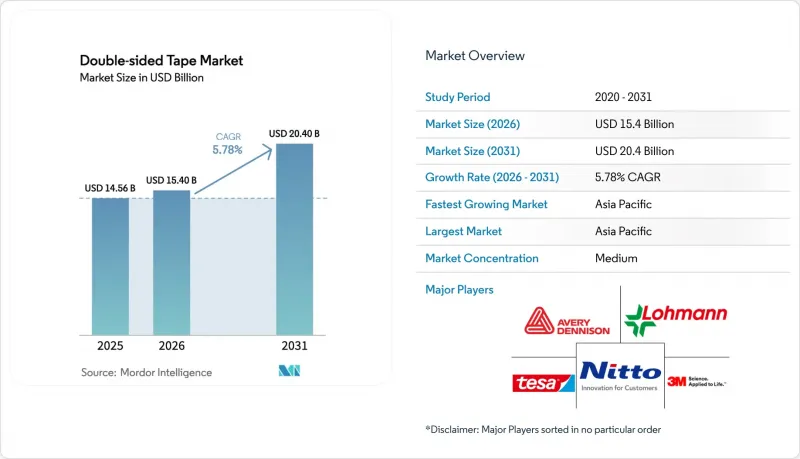
本報告按黏合劑化學成分(丙烯酸、橡膠、矽膠等)、基材(泡棉、薄膜、紙張等)、膠帶厚度(小於 100 毫米、100-200 毫米、大於 200 毫米)、最終用戶產業(汽車、建築等)、應用(安裝、黏合等)和地區(亞太地區分類、北美、歐洲、南美、中東和非洲)進行分類。
全球雙面膠帶市場趨勢及洞察
擴展應用範圍,適用於室內外建築工地
建築專業人士正使用感壓膠帶代替螺絲和釘子,以防止基材損壞並加快安裝速度。防水丙烯酸泡棉膠帶可牢固地固定外牆和室內面板,同時滿足嚴格的建築規範。模組化建築商更傾向於使用工廠預塗膠帶,因為這種膠帶能夠實現均勻可控的黏合線,從而減少現場施工。生物基黏合劑正開始被應用於旨在減少碳排放的高階綠色項目。泡沫芯材產品也適用於維修項目中常見的凹凸不平的牆面,而亞太地區的城市更新熱潮正在推動這一需求。這些趨勢共同推動了雙面膠帶市場中與建築相關的訂單成長。
減輕汽車重量的要求
汽車製造商正擴大採用黏合劑黏接技術來取代鉚釘,鉚釘會增加車重並導致電流腐蝕。在電動車領域,高剪切強度的丙烯酸膠帶用於將鋁製車頂面板粘合到碳纖維車架上,從而提高能源效率。在電池組中,導熱膠帶在隔熱的同時還能散發熱量,符合中國嚴格的車載VOC排放法規。歐洲的成長速度正在加快,因為那裡的二氧化碳排放法規日益嚴格,迫使汽車製造商(OEM)生產更輕的組件。低VOC化學成分確保符合車載環保法規,同時不影響剝離強度。這些趨勢正在推動汽車產業對雙面膠帶市場需求的成長。
橡膠基膠帶的耐熱極限
標準橡膠基黏合劑在 150 度C以上會失去內聚強度,限制了其在引擎和工業烤箱等場所的應用。原始設備製造商 (OEM) 被迫改用價格更高的矽膠或壓克力產品,增加了系統成本。電池製造商需要膠帶能夠在較寬的溫度範圍內保持穩定性,而橡膠類膠帶並不適用。儘管混合聚合物的研究前景可觀,但其價格仍然高成本。因此,在最高溫度超過可接受範圍的情況下,注重成本的買家不願放棄機械緊固件,減緩了雙面膠帶市場的整體普及速度。
細分市場分析
由於丙烯酸膠帶與金屬、塑膠和玻璃具有廣泛的兼容性,預計到2025年將佔據雙面膠帶市場51.20%的佔有率。其卓越的抗紫外線性能和光學透明度使其在家用電子電器和汽車外飾件應用領域佔據主導地位。橡膠膠帶在低成本包裝領域保持市場佔有率,而矽膠膠帶則在引擎室和醫療應用領域表現出色。受電動車電池封裝和高溫工業生產線需求的推動,特種丁基膠帶和EVA膠帶預計將以6.92%的複合年成長率成長。改質丙烯酸酯樹脂對低表面能聚烯具有良好的潤濕性,正在拓展丙烯酸膠帶的應用範圍,並保持其核心地位。
壓克力產品的創新旨在實現低壓下的快速潤濕,從而使高速機器人能夠進行應用。供應商也在努力降低殘留單體含量,以滿足加州揮發性有機化合物 (VOC) 低於 70 克/公升的限制。混合矽酮-丙烯酸酯平台兼具初始黏性和高達 200 度C的耐熱性,使其可應用於電子功率模組。這些改進進一步鞏固了丙烯酸酯的戰略優勢,同時,一些小眾化學技術正在填補雙面膠帶市場新的性能空白。
預計到2025年,發泡基材將佔銷售額的29.74%,複合年成長率(CAGR)高達6.95%,成為成長最快的材料。微孔聚乙烯(PE)和丙烯酸發泡體是外牆板和電動車電池外殼的理想選擇,因為它們能夠均衡應力、填充縫隙並吸收振動。此外,薄膜背襯材料用於相機模組的組裝,因為尺寸穩定性至關重要。紙張仍被用作文具和印刷行業的低成本襯紙,但其市場佔有率正被可回收的PET材料蠶食。
繼舒爾塔普推出採用90%再生PET材料製成的膠帶後,人們對永續發展的關注度日益提升,這表明對循環利用背襯材料的需求正在成長。發泡材供應商正在降低密度,同時不影響其黏合性,從而減少材料用量。金屬箔背襯材料正在5G天線電磁干擾屏蔽此細分市場中站穩腳步。這些技術的進步共同拓展了發泡材的應用場景,並鞏固了其在雙面膠帶市場中的地位。
區域分析
預計到2025年,亞太地區將佔全球銷售額的41.80%,並在2031年之前維持7.01%的複合年成長率。電動車產量的擴張、電子產品外包的活性化以及城市基礎設施項目的推進是該地區的兩大主要驅動力。中國對高黏合劑電池組的大規模生產以及日本智慧設備生產線的擴張,正在推動電動車的普及。 Tesa已在孟買和班加羅爾開設辦事處,進一步加強了在亞太地區的業務,以更好地支援汽車和電子產業。
在北美,建築業需求和電子組裝回歸美國是推動市場成長的主要動力。 3M公司在內布拉斯加州投資6,700萬美元進行升級改造,擴大了工業膠帶的產能,並提高了區域供應的穩定性。此外,美國各地電動車電池工廠數量的不斷增加也帶動了耐熱膠帶需求的成長。
永續性是歐洲關注的重點,供應商被要求根據歐盟綠色交易轉型為無溶劑生產線。德國黏合劑市場預計到2024年將達到約20億歐元,受益於DIY家居裝修和包裝產業的蓬勃發展。
在南美洲、中東和非洲,雙面膠帶的應用仍處於起步階段,但由於基礎設施的擴建和汽車組裝的成長,其發展勢頭正日益強勁。巴西和阿拉伯聯合大公國政府對本地電子產品製造業的扶持政策,也為雙面膠帶開拓了新的市場。
其他好處:
- Excel格式的市場預測(ME)表
- 3個月的分析師支持
目錄
第1章:引言
- 研究假設和市場定義
- 調查範圍
第2章:調查方法
第3章執行摘要
第4章 市場狀況
- 市場概覽
- 市場促進因素
- 在室內外建築領域不斷擴展的應用
- 減輕汽車重量的要求
- 家用電子電器組裝中的小型化
- 預製和模組化建築的擴張
- 電動汽車電池的鍵結和熱間隙填充
- 市場限制因素
- 橡膠膠帶的耐熱性有限。
- 石化原料價格波動
- 溶劑型黏合劑生產線中較嚴格的VOC法規
- 價值鏈分析
- 波特五力模型
第5章 市場規模與成長預測
- 黏合劑的化學分類
- 丙烯酸纖維
- 橡皮
- 矽酮
- 其他黏合劑化學成分(丁基、EVA 等)
- 按基礎材料
- 發泡材
- 電影
- 紙
- 布
- 金屬箔和其他
- 膠帶厚度
- 小於100微米
- 100~200µm
- 200微米或以上
- 按最終用戶行業分類
- 車
- 建造
- 電子設備
- 其他終端用戶產業(包裝、圖形等)
- 透過使用
- 依戀
- 黏合/連接
- 密封和縫隙填充
- 隔熱和減震
- 其他用途(拼接、製片等)
- 按地區
- 亞太地區
- 中國
- 日本
- 印度
- 韓國
- 東南亞國協
- 其他亞太國家
- 北美洲
- 美國
- 加拿大
- 墨西哥
- 歐洲
- 德國
- 英國
- 法國
- 義大利
- 西班牙
- 俄羅斯
- 北歐國家
- 其他歐洲國家
- 南美洲
- 巴西
- 阿根廷
- 其他南美國家
- 中東和非洲
- 沙烏地阿拉伯
- 南非
- 其他中東和非洲國家
- 亞太地區
第6章 競爭情勢
- 市場集中度
- 策略趨勢
- 市佔率和排名分析
- 公司簡介
- 3M
- Advance Tapes International
- Amcor plc
- Arkema
- AVERY DENNISON CORPORATION
- Daehyun ST co., Ltd.
- Dongguan Haixiang Adhesive Products Co., Ltd.
- Duraco Inc.
- GUANGZHOU BROADYA NEW MATERIALS MANUFACTURING CO.,LTD.
- Henkel AG and Co. KGaA
- IPG(Intertape Polymer Group)
- LINTEC Corporation
- Lohmann
- Nitto Denko Corporation
- SEKISUI CHEMICAL CO., LTD.
- Shurtape Technologies, LLC
- Soken Chemical Asia Co., Ltd.
- Tape-Rite Co., Inc.
- tesa SE
第7章 市場機會與未來展望
According to Mordor Intelligence, double-sided tape market size in 2026 is estimated at USD 15.4 billion, growing from 2025 value of USD 14.56 billion with 2031 projections showing USD 20.4 billion, growing at 5.78% CAGR over 2026-2031.
This report is Segmented by Adhesive Chemistry (Acrylic, Rubber, Silicone, and More), Backing Material (Foam, Film, Paper, and More), Tape Thickness (Less Than 100 Mm, 100-200 Mm, Greater Than 200 Mm), End-User Industry (Automotive, Construction, and More), Application (Mounting, Bonding and Joining, and More), and Geography (Asia-Pacific, North America, Europe, South America, Middle East and Africa).
Global Double-sided Tape Market Trends and Insights
Increasing Applications in Indoor and Outdoor Construction
Construction professionals replace screws and nails with pressure-sensitive tapes to avoid substrate damage and accelerate installation. Waterproof acrylic foam variants anchor facades and interior panels while meeting stringent building codes. Modular builders favor factory-applied tapes that assure consistent bond-line control and reduce on-site labor. Bio-based adhesives enter premium green projects that target lower embodied carbon. Foam-core formats accommodate uneven walls common in retrofits, boosting demand in Asia-Pacific's urban renovation boom. Together, these trends lift construction-related orders for the double-sided tape market.
Automotive Lightweighting Requirements
Vehicle makers pursue adhesive bonding to remove rivets that add mass and cause galvanic corrosion. High-shear acrylic tapes bond aluminum roof panels to carbon-fiber frames in EVs, raising energy efficiency. In battery packs, thermally conductive tapes dissipate heat while isolating cells, aligning with strict interior VOC limits in China. Growth accelerates in Europe where CO2 mandates tighten, pushing OEMs toward lighter assemblies. Low-VOC chemistries secure interior cabin compliance without sacrificing peel strength. These dynamics underpin rising automotive intake in the double-sided tape market.
Limited High-temperature Resistance of Rubber-based Tapes
Standard rubber adhesives lose cohesion beyond 150 °C, restricting deployment near engines or industrial ovens. OEMs must shift to higher-priced silicone or acrylic versions, adding system cost. Battery makers require tapes that stay stable across wide thermal cycles, making rubber grades unsuitable. Research into hybrid polymers shows promise but remains expensive. As a result, cost-driven buyers hesitate to convert from mechanical fasteners where peak temperatures exceed limits, tempering overall uptake in the double-sided tape market.
Other drivers and restraints analyzed in the detailed report include:
- Miniaturisation in Consumer Electronics Assembly
- EV Battery Cell Bonding and Thermal Gap-Filling
- Petrochemical Feed-stock Price Volatility
For complete list of drivers and restraints, kindly check the Table Of Contents.
Segment Analysis
Acrylics held 51.20% of the double-sided tape market in 2025 thanks to broad compatibility with metals, plastics, and glass. Superior UV stability and optical clarity underpin leadership in consumer electronics and exterior automotive trims. Rubber grades retain share in budget packaging, while silicone excels in engine-bay and medical uses. Specialty butyl and EVA tapes are forecast for a 6.92% CAGR, propelled by EV battery encapsulation and high-temperature industrial lines. Modified acrylate systems that wet low-surface-energy polyolefins extend acrylic reach, preserving its anchor role.
Acrylic innovations target faster wet-out at low pressure, enabling high-speed robotic application. Suppliers also lower residual monomers to meet sub-70 g/L VOC caps in California. Hybrid silicone-acrylic platforms blend initial tack with 200 °C resistance to address electronic power modules. These improvements reinforce acrylic's strategic edge even as niche chemistries capture emerging performance gaps within the double-sided tape market.
Foam substrates contributed 29.74% revenue in 2025 and are projected for the fastest 6.95% CAGR. Micro-cellular PE and acrylic foams equalize stress, fill gaps, and damp vibration, ideal for facade panels and EV battery housings. Film backings follow for camera module assembly, where dimensional stability prevails. Paper remains a low-cost liner in stationery and graphic arts, though it cedes ground to recyclable PET options.
Sustainability gains traction as Shurtape's launch of 90% post-consumer recycled PET tape signals growing demand for circular backings. Foam suppliers lower density without sacrificing cohesion, trimming material use. Metal foil backings niche into EMI shielding of 5G antennas. Collectively, these advances widen addressable use-cases, reinforcing foam's position in the double-sided tape market.
Complete Report Scope:
- By Adhesive Chemistry
- Acrylic
- Rubber
- Silicone
- Other Adhesive Chemistries (Butyl, EVA, etc.)
- By Backing Material
- Foam
- Film
- Paper
- Cloth
- Metal Foil and Others
- By Tape Thickness
- Less than 100 µm
- 100 - 200 µm
- Greater than 200 µm
- By End-user Industry
- Automotive
- Construction
- Electronics
- Other End-user Industries (Packaging and Graphics, etc.)
- By Application
- Mounting
- Bonding and Joining
- Sealing and Gap-filling
- Insulation and Dampening
- Other Applications (Splicing, Tabbing, etc.)
- By Geography
- Asia-Pacific
- China
- Japan
- India
- South Korea
- ASEAN Countries
- Rest of Asia-Pacific
- North America
- United States
- Canada
- Mexico
- Europe
- Germany
- United Kingdom
- France
- Italy
- Spain
- Russia
- NORDIC Countries
- Rest of Europe
- South America
- Brazil
- Argentina
- Rest of South America
- Middle East and Africa
- Saudi Arabia
- South Africa
- Rest of Middle East and Africa
- Asia-Pacific
Geography Analysis
Asia-Pacific accounted for 41.80% of global revenue in 2025 and is forecast for a 7.01% CAGR through 2031. Expanding EV production, intensive electronics outsourcing, and urban infrastructure projects underpin this dual leadership. China's output of adhesive-intensive battery packs and the proliferation of Japanese smart-device lines sustain high-volume uptake. tesa reinforced its regional presence by opening Mumbai and Bengaluru hubs to bolster automotive and electronics support.
North America follows with construction stimulus and the reshoring of electronics assembly. 3M's USD 67 million upgrade in Nebraska adds industrial tape capacity that addresses regional supply resilience. Growing EV battery factories across the United States expand demand for high-heat tapes.
Europe emphasizes sustainability, pushing suppliers toward solvent-free lines aligned with the EU Green Deal. Germany's adhesive market, valued near EUR 2 billion in 2024, benefits from booming DIY refurbishment and packaging activity.
South America, the Middle East, and Africa remain early in adoption but gain traction through infrastructure expansion and growing automotive assembly. Government incentives for local electronics manufacturing in Brazil and the United Arab Emirates open incremental channels for the double-sided tape market.
- 3M
- Advance Tapes International
- Amcor plc
- Arkema
- AVERY DENNISON CORPORATION
- Daehyun ST co., Ltd.
- Dongguan Haixiang Adhesive Products Co., Ltd.
- Duraco Inc.
- GUANGZHOU BROADYA NEW MATERIALS MANUFACTURING CO.,LTD.
- Henkel AG and Co. KGaA
- IPG (Intertape Polymer Group)
- LINTEC Corporation
- Lohmann
- Nitto Denko Corporation
- SEKISUI CHEMICAL CO., LTD.
- Shurtape Technologies, LLC
- Soken Chemical Asia Co., Ltd.
- Tape-Rite Co., Inc.
- tesa SE
Additional Benefits:
- The market estimate (ME) sheet in Excel format
- 3 months of analyst support
TABLE OF CONTENTS
1 Introduction
- 1.1 Study Assumptions and Market Definition
- 1.2 Scope of the Study
2 Research Methodology
3 Executive Summary
4 Market Landscape
- 4.1 Market Overview
- 4.2 Market Drivers
- 4.2.1 Increasing applications in indoor and outdoor construction
- 4.2.2 Automotive lightweighting requirements
- 4.2.3 Miniaturisation in consumer electronics assembly
- 4.2.4 Expansion of prefabricated/ modular buildings
- 4.2.5 EV battery cell bonding and thermal-gap filling
- 4.3 Market Restraints
- 4.3.1 Limited high-temperature resistance of rubber-based tapes
- 4.3.2 Petrochemical feed-stock price volatility
- 4.3.3 Stricter VOC limits on solvent-based adhesive lines
- 4.4 Value Chain Analysis
- 4.5 Porter's Five Forces
- 4.5.1 Threat of New Entrants
- 4.5.2 Bargaining Power of Buyers
- 4.5.3 Bargaining Power of Suppliers
- 4.5.4 Threat of Substitute Products
- 4.5.5 Intensity of Competitive Rivalry
5 Market Size and Growth Forecasts (Value)
- 5.1 By Adhesive Chemistry
- 5.1.1 Acrylic
- 5.1.2 Rubber
- 5.1.3 Silicone
- 5.1.4 Other Adhesive Chemistries (Butyl, EVA, etc.)
- 5.2 By Backing Material
- 5.2.1 Foam
- 5.2.2 Film
- 5.2.3 Paper
- 5.2.4 Cloth
- 5.2.5 Metal Foil and Others
- 5.3 By Tape Thickness
- 5.3.1 Less than 100 µm
- 5.3.2 100 - 200 µm
- 5.3.3 Greater than 200 µm
- 5.4 By End-user Industry
- 5.4.1 Automotive
- 5.4.2 Construction
- 5.4.3 Electronics
- 5.4.4 Other End-user Industries (Packaging and Graphics, etc.)
- 5.5 By Application
- 5.5.1 Mounting
- 5.5.2 Bonding and Joining
- 5.5.3 Sealing and Gap-filling
- 5.5.4 Insulation and Dampening
- 5.5.5 Other Applications (Splicing, Tabbing, etc.)
- 5.6 By Geography
- 5.6.1 Asia-Pacific
- 5.6.1.1 China
- 5.6.1.2 Japan
- 5.6.1.3 India
- 5.6.1.4 South Korea
- 5.6.1.5 ASEAN Countries
- 5.6.1.6 Rest of Asia-Pacific
- 5.6.2 North America
- 5.6.2.1 United States
- 5.6.2.2 Canada
- 5.6.2.3 Mexico
- 5.6.3 Europe
- 5.6.3.1 Germany
- 5.6.3.2 United Kingdom
- 5.6.3.3 France
- 5.6.3.4 Italy
- 5.6.3.5 Spain
- 5.6.3.6 Russia
- 5.6.3.7 NORDIC Countries
- 5.6.3.8 Rest of Europe
- 5.6.4 South America
- 5.6.4.1 Brazil
- 5.6.4.2 Argentina
- 5.6.4.3 Rest of South America
- 5.6.5 Middle East and Africa
- 5.6.5.1 Saudi Arabia
- 5.6.5.2 South Africa
- 5.6.5.3 Rest of Middle East and Africa
- 5.6.1 Asia-Pacific
6 Competitive Landscape
- 6.1 Market Concentration
- 6.2 Strategic Moves
- 6.3 Market Share(%)/Ranking Analysis
- 6.4 Company Profiles (includes Global level Overview, Market level overview, Core Segments, Financials as available, Strategic Information, Market Rank/Share for key companies, Products and Services, and Recent Developments)
- 6.4.1 3M
- 6.4.2 Advance Tapes International
- 6.4.3 Amcor plc
- 6.4.4 Arkema
- 6.4.5 AVERY DENNISON CORPORATION
- 6.4.6 Daehyun ST co., Ltd.
- 6.4.7 Dongguan Haixiang Adhesive Products Co., Ltd.
- 6.4.8 Duraco Inc.
- 6.4.9 GUANGZHOU BROADYA NEW MATERIALS MANUFACTURING CO.,LTD.
- 6.4.10 Henkel AG and Co. KGaA
- 6.4.11 IPG (Intertape Polymer Group)
- 6.4.12 LINTEC Corporation
- 6.4.13 Lohmann
- 6.4.14 Nitto Denko Corporation
- 6.4.15 SEKISUI CHEMICAL CO., LTD.
- 6.4.16 Shurtape Technologies, LLC
- 6.4.17 Soken Chemical Asia Co., Ltd.
- 6.4.18 Tape-Rite Co., Inc.
- 6.4.19 tesa SE
7 Market Opportunities and Future Outlook
- 7.1 White-space and Unmet-need Assessment

 雙面膠帶市場規模、佔有率和成長分析:按產品類型、材料類型、應用、最終用戶產業、黏合劑類型、離型紙類型和地區分類-2026-2033年產業預測
 雙面膠帶市場規模、佔有率、成長和行業分析:按基材、黏合劑類型、應用、地區分類,並預測至 2034 年。
 2026年全球可移除海報膠帶市場報告
 雙面膠帶市場:2026-2032年全球市場預測(按產品類型、黏合劑類型、材料、厚度、應用和銷售管道)超薄雙面膠帶市場:按最終用途行業、應用、基材、黏合劑類型、產品類型和寬度分類 - 全球預測(2026-2032年)
 雙面膠帶市場機會、成長動力、產業趨勢分析及 2025 - 2034 年預測