


 |
市場調查報告書
商品編碼
2114973
抗衝擊玻璃:市場佔有率分析、行業趨勢和統計數據、成長預測(2026-2031 年)Impact Resistant Glass - Market Share Analysis, Industry Trends & Statistics, Growth Forecasts (2026 - 2031) |
||||||

※ 本網頁內容可能與最新版本有所差異。詳細情況請與我們聯繫。
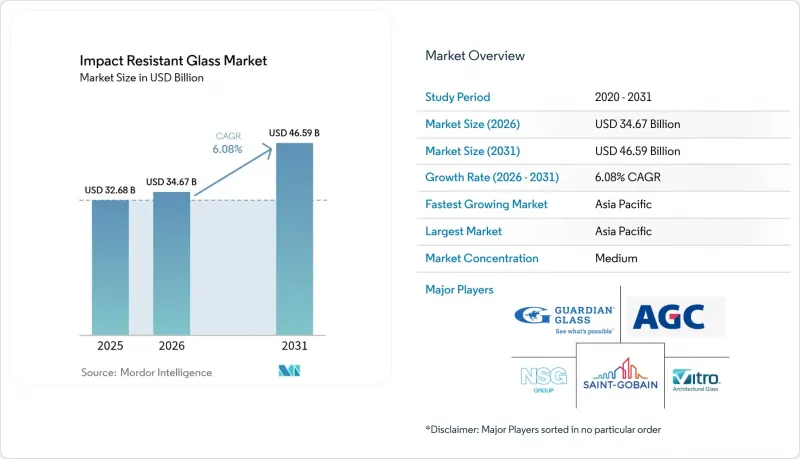
據 Mordor Intelligence 稱,2025 年抗衝擊玻璃市值為 326.8 億美元,預計到 2031 年將達到 465.9 億美元,而 2026 年為 346.7 億美元,預測期(2026-2031 年)的複合年成長率為 6.08%。
本報告按產品類型(夾層玻璃、強化玻璃等)、中間層(聚乙烯丁醛(PVB)、離子聚合物等)、應用領域(帷幕牆、外牆、窗戶等)、終端用戶產業(建築、汽車等)和地區(亞太地區、北美地區等)對產業進行細分。市場預測以美元(USD)為單位。
全球抗衝擊玻璃市場趨勢及洞察
在颶風易發地區擴大建築業的應用
2023 年佛羅裡達州建築標準法案擴大了風力驅動碎片的影響範圍,強制開發商指定能夠承受高達每小時 120 英里風壓的玻璃規格。路易斯安那州和德克薩斯州也進行了類似的修訂,將需求範圍擴大到傳統高風速颶風區之外。颶風伊恩過後,保險理賠數據顯示,使用符合標準的窗戶的房屋保險賠償減少了 75%。建築商因此受益匪淺:損失減少,保險折扣高達 55%,從而抵消了額外的資本投入。因此,抗衝擊玻璃市場在新建沿海多用戶住宅項目和公立學校中持續應用。供應商正在喬治亞和德克薩斯州擴建夾層玻璃生產線,以降低運輸成本,並確保在颶風季節及時交貨建築工地。
汽車玻璃安全法規更加嚴格
美國聯邦機動車輛安全標準 (FMVSS) 205 規定了更高的抗衝擊標準,以適應整合在擋風玻璃中的攝影機和雷射雷達單元。康寧的 Fusion5 夾層玻璃符合這些測試標準,同時重量減輕了 12%,有助於實現電動車的續航里程目標。在歐洲,透過對 ECE R43 的修訂,相關標準已實現統一,並已確認將在 2026 年推出的 OEM 平台上採用夾層玻璃側燈。因此,抗衝擊玻璃市場正受惠於全球部署的同步化,從而縮短了對新型高壓釜投資的回報週期。一級玻璃製造商正在與電動車新創公司洽談多年期契約,這些新創公司採用薄離子聚合物層來增強光學性能和剛性。
高昂的生產成本和資本投資成本
用於夾層玻璃和強化玻璃生產線的熔爐升級改造成本比基礎浮法玻璃設備高出30-40%,這限制了小規模加工商的參與。根據美國能源資訊署(EIA)的數據顯示,玻璃工廠消耗73%的天然氣和24%的電力,使其面臨燃料價格波動的雙重風險。生產者物價指數(PPI)數據顯示,2024年燃料價格將上漲4.5%,但承包商不願將這些成本轉嫁給客戶,因此壓縮了利潤空間。因此,除了像AGC這樣的跨區域企業外,其他公司很難證明每個廠址持續超過3億美元的資本投資是合理的。因此,在抗衝擊玻璃市場,每次大規模熔爐運作維修都存在產能瓶頸的風險。
細分市場分析
到2025年,夾層玻璃將佔總銷售額的44.62%,憑藉其聚乙烯丁醛)層,夾層玻璃將成為抗衝擊玻璃市場的基礎。 PVB層能夠在衝擊後將碎片黏合在一起。沿海地區的建築商和汽車製造商在選擇擋風玻璃基板時,都依賴此特性來滿足建築規範和安全審核要求。強化玻璃的銷售量預計將在2031年之前以7.39%的複合年成長率快速成長,這得益於新型輥壓淬火製程帶來的平整度提升和能耗降低。生產技術的創新使加工商能夠以更低的單位成本供應大尺寸面板,從而鼓勵建築師在中高層辦公大樓中指定使用強化玻璃牆。熱強化玻璃填補了退火玻璃和全強化玻璃之間的空白,是承受熱應力的超大尺寸玻璃板的首選。 AGC的「Temperlite」平台在維持汽車級光學性能的同時,將抗衝擊性提高了五倍。特殊混合玻璃中嵌入了纖維複合材料,目前正被用於防爆設施和軍事建築中,但目前它僅佔整個抗衝擊玻璃產業的一小部分。
第二代夾層玻璃透過整合離子交換膜層,顯著增強了組件強度並降低了厚度。這種重新設計減輕了帷幕牆的重量,同時也縮小了鋁合金中梃的尺寸。這項改變顯著降低了帷幕牆框架和安裝人工成本,即使中間層仍存在溢價,也能提升夾層玻璃的經濟效益。因此,儘管強化玻璃的產量可能成長更快,但夾層玻璃的銷售仍將保持強勁,並在2031年之前繼續佔據抗衝擊玻璃市場的大部分佔有率。
聚乙烯丁醛)佔2025年需求的48.63%。其優異的耐高壓釜處理性能和可回收性使其繼續保持作為擋風玻璃和住宅門主要中間層材料的地位。伊士曼公司近期發布的Saflex LiteCarbon Clear旨在減少商業高層建築的碳排放,並獲得LEED認證積分。同時,由於離子聚合物具有高剪切模量,可用於製造更薄的玻璃夾層和更輕的汽車玻璃,預計其複合應用將以7.46%的複合年成長率成長。當光學儀器需要精確對準時,原始設備製造商(OEM)會選擇離子聚合物。 EVA中間層在太陽能玻璃和整合佈線的智慧幕牆領域正不斷擴大市場佔有率。這是因為EVA黏合劑能夠承受局部高溫。學術測試證實,EVA的剛度與PVB相當,這意味著隨著供應規模的擴大,EVA的應用範圍可望進一步擴大。 TPU 和多層複合材料在防爆領域佔據了高階細分市場,其規格價值遠遠超過了材料成本,從而促進了抗衝擊玻璃市場的進一步多元化。
歐洲開發商正在探索利用生物聚合物來遵守循環經濟指令,該指令限制將聚乙烯醇縮丁醛(PVB)廢料掩埋處理。在一個回收試點計畫中,用過的中間層被粉碎並重新用作地板材料和密封劑的原料,這有望緩解玻璃廠環境、安全和衛生(EHS)預算所面臨的廢物處理瓶頸。雖然在商業化生產開始之前,PVB仍將佔據主導地位,但離子聚合物因其即使在高紫外線照射下也能保持透明度的特性而備受青睞,這一特性在熱帶地區尤為重要。
區域分析
預計到2025年,亞太地區將佔全球市場規模的39.88%,複合年成長率(CAGR)為7.62%。中國正在基礎設施建設規劃中採用大型夾層玻璃天窗,例如大規模高鐵車站,以支援連續燒製爐的運作。印度的智慧城市計畫和商業大廈建設熱潮正在推動生產擴張,而菲律賓和越南的防風暴指南正在加速學校和醫院對抗衝擊玻璃的應用。福耀投資91億美元的多廠區擴建工程正在提升浮法玻璃的產能和下游夾層貼合加工能力,以最佳化區域內的運輸效率,並快速供應給汽車出口平台。因此,該地區的供應商正在設定價格基準,這些基準會影響全球競標,並左右抗衝擊玻璃市場的趨勢。
北美佔據第二大市場。在佛羅裡達州,針對風載碎片的監管範圍已擴大到先前被認為風險較低的縣,這提振了訂單前景。保險賠償進一步增強了新建和維修的經濟獎勵。國內浮法玻璃供應仍然緊張,《聯邦公報》報道了一項針對亞洲進口產品的反傾銷調查,這顯示為了保護本地定價權,成本可能會上漲。密西根州和田納西州的汽車製造商正在將其擋風玻璃生產線轉向帶有整合ADAS感測器的夾層玻璃,這進一步推動了沿海建築需求以外的市場需求。這些因素共同確保了市場在能源成本波動的情況下仍能維持穩定成長。
歐洲正引領永續性。聖戈班在法國的混合式電爐已將二氧化碳排放量減少了75%,其產品符合低碳建築認證的要求。歐盟的「翻新浪潮」計畫已為外觀維修提供了資金,越來越多的夾層板被安裝在老舊住宅存量中。德國和奧地利正在支持可再生能源的併網,EVA夾層光伏玻璃的早期採用者也正在出現。同時,隨著安全評估的不斷發展,大使館和火車站的防爆玻璃規格日益受到關注。嚴格的回收義務使供應鏈受益,迫使生產商創新利用PVB廢料的解決方案,並影響整個抗衝擊玻璃市場的產品設計選擇。
其他好處:
- Excel格式的市場預測(ME)表
- 3個月的分析師支持
目錄
第1章:引言
- 研究假設和市場定義
- 調查範圍
第2章:調查方法
第3章執行摘要
第4章 市場狀況
- 市場概覽
- 市場促進因素
- 在易受颶風破壞的建築業中擴大應用。
- 加強汽車玻璃安全法規
- 基礎建設安全投資
- 為提高現有建築應對氣候變遷的能力維修
- 對經過抗衝擊性評估的外牆提供保險費優惠。
- 市場限制因素
- 高昂的生產成本和資本成本
- 原物料和能源價格波動
- 層壓板回收和掩埋規定
- 價值鏈分析
- 波特五力模型
第5章 市場規模與成長預測
- 依產品類型
- 夾層玻璃
- 強化(熱處理)玻璃
- 強化玻璃
- 混合型/其他抗衝擊玻璃
- 按類型分類的層間
- 聚乙烯丁醛(PVB)
- 離子塑膠聚合物
- 乙烯-醋酸乙烯酯共聚物(EVA)
- 其他中階(例如熱塑性聚氨酯(TPU))
- 透過使用
- 立面、帷幕牆、窗戶
- 結構玻璃和地板材料
- 擋風玻璃和側窗
- 安全和防爆設備
- 按最終用戶行業分類
- 建造
- 車
- 其他終端用戶產業(航太、國防等)
- 按地區
- 亞太地區
- 中國
- 印度
- 日本
- 韓國
- 其他亞太國家
- 北美洲
- 美國
- 加拿大
- 墨西哥
- 歐洲
- 德國
- 英國
- 法國
- 義大利
- 其他歐洲國家
- 南美洲
- 巴西
- 阿根廷
- 其他南美國家
- 中東和非洲
- 沙烏地阿拉伯
- 南非
- 其他中東和非洲國家
- 亞太地區
第6章 競爭情勢
- 市場集中度
- 策略趨勢
- 市佔率分析
- 公司簡介
- AGC Inc.
- CGS Holding
- Eastman Chemical Company
- Fuyao Glass Industry Group
- Guardian Industries Holdings
- MITER Brands
- Nippon Sheet Glass Co., Ltd
- Saint-Gobain
- Schott AG
- Sisecam
- Trulite
- Vitro Architectural Glass
- Xinyi Glass Holdings Limited.
第7章 市場機會與未來展望
According to Mordor Intelligence, the impact resistant glass market size was valued at USD 32.68 billion in 2025 and estimated to grow from USD 34.67 billion in 2026 to reach USD 46.59 billion by 2031, at a CAGR of 6.08% during the forecast period (2026-2031).
This report Segments the Industry by Product Type (Laminated Glass, Tempered Glass, and More), Interlayer (Polyvinyl Butyral (PVB), Ionoplast Polymer, and More), Application (Facades, Curtain Walls and Windows, and More), End-User Industry (Construction, Automotive, and More), and Geography (Asia-Pacific, North America, and More). The Market Forecasts are Provided in Terms of Value (USD).
Global Impact Resistant Glass Market Trends and Insights
Growing Adoption in Hurricane-Prone Construction
Wider wind-borne debris zones under the 2023 Florida Building Code compel developers to specify glazing able to withstand 120 mph wind impacts. Louisiana and Texas mirror these updates, so demand extends beyond traditional High Velocity Hurricane Zones. Claim data after Hurricane Ian showed 75% fewer payouts for properties using compliant windows. Builders see a dual return: reduced damage plus up to 55% insurer discounts that offset incremental capex. As a result, the impact resistant glass market gains constant specification in new coastal multifamily projects and public schools. Suppliers scale laminated lines in Georgia and Texas to curb freight costs and guarantee just-in-time deliveries to storm-season job sites.
Stricter Automotive Glazing Safety Regulations
Federal Motor Vehicle Safety Standard 205 now requires higher impact thresholds that accommodate cameras and lidar units embedded in windshields. Corning's Fusion5 laminate meets these tests while cutting weight by 12% to support electric vehicle range targets. Europe aligns through ECE R43 updates, and OEM platforms launching in 2026 already lock in laminated side-lites. Therefore, the impact resistant glass market benefits from synchronized global rollouts that shorten payback on new autoclave investments. Tier-one glass producers are negotiating multiyear contracts with EV startups that favor thin ionoplast layers for optics and stiffness.
High Production & Capital Costs
Furnace upgrades for laminated or tempered lines cost 30-40% more than basic float glass setups, limiting entry by small fabricators. The U.S. Energy Information Administration reports that glass plants consume 73% natural gas and 24% electricity, exposing them to dual fuel price curves. Producer Price Index data show a 4.5% climb in 2024 that contractors resist passing to owners, squeezing margins. Consequently, only multiregional firms such as AGC can justify back-to-back capital projects that exceed USD 300 million per site. Therefore, the impact resistant glass market risks capacity pinch points whenever a large furnace goes offline for a rebuild.
Other drivers and restraints analyzed in the detailed report include:
- Infrastructure Security Investments
- Climate-Resilience Retrofitting of Legacy Buildings
- Raw-Material & Energy Price Volatility
For complete list of drivers and restraints, kindly check the Table Of Contents.
Segment Analysis
Laminated glass retained 44.62% of 2025 revenue and anchors the impact resistant glass market thanks to polyvinyl butyral layers that keep shards intact after impact. Builders in coastal zones and automakers selecting windshield substrates rely on this characteristic to satisfy code and safety audits. Tempered glass picks up speed at a 7.39% CAGR to 2031 because new roller quench designs improve flatness and cut energy usage. Production innovations let fabricators supply large panels at lower unit cost, encouraging architects to specify tempered walls in mid-rise offices. Heat-strengthened glass serves a narrow gap between annealed and fully tempered, favored for oversized lites that face thermal stress. AGC's Temperlite platform delivers five-fold shock resistance while maintaining automotive-grade optics. Specialty hybrid panes that embed fiber composites enter blast and military facilities, but today they still form a small slice of the impact resistant glass industry.
Second-generation laminated formats integrate ionoplast layers that stiffen assemblies enough to trim thickness. This redesign lowers facade weight and decreases aluminum mullion size. The shift yields measurable savings in curtain-wall framing and installation labor, lifting laminated economics even when interlayer price premiums persist. Thus, while tempered volumes may rise faster, laminated revenue remains robust and underpins much of the impact resistant glass market size through 2031.
Polyvinyl butyral commanded 48.63% of the 2025 demand. Its track record with autoclave cycles and recyclability keeps it the go-to interlayer for windshields and residential doors. Eastman's recent Saflex LiteCarbon Clear variant reduces embodied carbon and targets LEED credits for commercial towers. Ionoplast formulations, however, should climb 7.46% CAGR as their high shear modulus enables thinner glass stacks and lighter vehicle glazing. OEMs select ionoplast where optical devices need precise alignment. EVA interlayers gain share in photovoltaic glass and smart facades that carry wiring because EVA bonds handle higher localized temperatures. Academic tests confirm EVA stiffness comparable with PVB, hinting at wider adoption once supply scales. TPU and multilayer laminates occupy premium blast-rated niches where specification value dwarfs material cost, further diversifying the impact resistant glass market.
Developers in Europe explore biopolymers to comply with circular-economy directives that restrict landfill disposal of PVB scrap. Recycling pilots grind used interlayers into feedstock for flooring and sealants, potentially easing disposal bottlenecks that weigh on glass plant EHS budgets. Until commercial volumes emerge, PVB remains dominant, but ionoplast marketing underscores its transparency retention at elevated UV loads, a factor resonating in tropical installations.
Complete Report Scope:
- By Product Type
- Laminated Glass
- Tempered (Heat-treated) Glass
- Heat-Strengthened Glass
- Hybrid/Other Impact Resistant Glass
- By Interlayer
- Polyvinyl Butyral (PVB)
- Ionoplast Polymer
- Ethylene-Vinyl Acetate (EVA)
- Other Interlayers (Thermoplastic Polyurethane (TPU), etc.)
- By Application
- Facades, Curtain Walls & Windows
- Structural Glazing & Floors
- Windscreens & Side-lites
- Security & Blast-Resistant Installations
- By End-User Industry
- Construction
- Automotive
- Other End User Industries (Aerospace and Defense, etc.)
- By Geography
- Asia-Pacifc
- China
- India
- Japan
- South Korea
- Rest of Asia-Pacific
- North America
- United States
- Canada
- Mexico
- Europe
- Germany
- United Kingdom
- France
- Italy
- Rest of Europe
- South America
- Brazil
- Argentina
- Rest of South America
- Middle East and Africa
- Saudi Arabia
- South Africa
- Rest of Middle East and Africa
- Asia-Pacifc
Geography Analysis
Asia-Pacific contributed 39.88% of 2025 value and should post 7.62% CAGR. Chinese infrastructure programs, including expansive high-speed rail stations, embed large laminated skylights that feed continuous furnace workloads. India's smart-city push and commercial tower boom extend volume, while storm-preparedness guidelines in Philippines and Vietnam lift specification of impact panes in schools and hospitals. Fuyao's multi-site expansion worth USD 9.1 billion increases float capacity plus downstream laminating, ensuring regional freight optimization and rapid supply for automotive export platforms. Hence suppliers there shape pricing norms that spill into global tenders and influence the trajectory of the impact resistant glass market.
North America ranks second in size. Florida's broader wind-borne debris rules apply to counties once considered low-risk, strengthening pipeline visibility. Insurance rebates magnify the financial incentive for both new builds and retrofits. Domestic float supply remains tight; the Federal Register notes antidumping probes into Asian imports, suggesting possible cost pass-throughs that defend local pricing power. Automakers in Michigan and Tennessee retool windshield lines to laminated formats that integrate ADAS sensors, reinforcing demand beyond coastal construction. Combined, these forces lock in stable growth even as energy bills fluctuate.
Europe advances as a sustainability leader. Saint-Gobain's hybrid electric furnace in France cuts CO2 by 75%, and the output qualifies for low-carbon building certifications. EU renovation wave programs free funds for facade upgrades, channeling more laminated panels into aging housing stock. Germany and Austria support renewable energy integration, so EVA-laminated photovoltaic glazing finds early adopters. Simultaneously, blast-resistant glass specifications for embassies and rail stations gain traction amid evolving security assessments. Supply chains benefit from strong recycling mandates that pressure producers to innovate end-of-life PVB solutions, influencing product design choices across the impact resistant glass market.
- AGC Inc.
- CGS Holding
- Eastman Chemical Company
- Fuyao Glass Industry Group
- Guardian Industries Holdings
- MITER Brands
- Nippon Sheet Glass Co., Ltd
- Saint-Gobain
- Schott AG
- Sisecam
- Trulite
- Vitro Architectural Glass
- Xinyi Glass Holdings Limited.
Additional Benefits:
- The market estimate (ME) sheet in Excel format
- 3 months of analyst support
TABLE OF CONTENTS
1 Introduction
- 1.1 Study Assumptions & Market Definition
- 1.2 Scope of the Study
2 Research Methodology
3 Executive Summary
4 Market Landscape
- 4.1 Market Overview
- 4.2 Market Drivers
- 4.2.1 Growing adoption in hurricane-prone construction
- 4.2.2 Stricter automotive glazing safety regulations
- 4.2.3 Infrastructure security investments
- 4.2.4 Climate-resilience retrofitting of legacy buildings
- 4.2.5 Insurance premium incentives for impact-rated facades
- 4.3 Market Restraints
- 4.3.1 High production & capital costs
- 4.3.2 Raw-material & energy price volatility
- 4.3.3 Laminate recycling & landfill restrictions
- 4.4 Value Chain Analysis
- 4.5 Porter's Five Forces
- 4.5.1 Threat of New Entrants
- 4.5.2 Bargaining Power of Buyers
- 4.5.3 Bargaining Power of Suppliers
- 4.5.4 Threat of Substitutes
- 4.5.5 Degree of Competition
5 Market Size & Growth Forecasts (Value)
- 5.1 By Product Type
- 5.1.1 Laminated Glass
- 5.1.2 Tempered (Heat-treated) Glass
- 5.1.3 Heat-Strengthened Glass
- 5.1.4 Hybrid/Other Impact Resistant Glass
- 5.2 By Interlayer
- 5.2.1 Polyvinyl Butyral (PVB)
- 5.2.2 Ionoplast Polymer
- 5.2.3 Ethylene-Vinyl Acetate (EVA)
- 5.2.4 Other Interlayers (Thermoplastic Polyurethane (TPU), etc.)
- 5.3 By Application
- 5.3.1 Facades, Curtain Walls & Windows
- 5.3.2 Structural Glazing & Floors
- 5.3.3 Windscreens & Side-lites
- 5.3.4 Security & Blast-Resistant Installations
- 5.4 By End-User Industry
- 5.4.1 Construction
- 5.4.2 Automotive
- 5.4.3 Other End User Industries (Aerospace and Defense, etc.)
- 5.5 By Geography
- 5.5.1 Asia-Pacifc
- 5.5.1.1 China
- 5.5.1.2 India
- 5.5.1.3 Japan
- 5.5.1.4 South Korea
- 5.5.1.5 Rest of Asia-Pacific
- 5.5.2 North America
- 5.5.2.1 United States
- 5.5.2.2 Canada
- 5.5.2.3 Mexico
- 5.5.3 Europe
- 5.5.3.1 Germany
- 5.5.3.2 United Kingdom
- 5.5.3.3 France
- 5.5.3.4 Italy
- 5.5.3.5 Rest of Europe
- 5.5.4 South America
- 5.5.4.1 Brazil
- 5.5.4.2 Argentina
- 5.5.4.3 Rest of South America
- 5.5.5 Middle East and Africa
- 5.5.5.1 Saudi Arabia
- 5.5.5.2 South Africa
- 5.5.5.3 Rest of Middle East and Africa
- 5.5.1 Asia-Pacifc
6 Competitive Landscape
- 6.1 Market Concentration
- 6.2 Strategic Moves
- 6.3 Market Share Analysis
- 6.4 Company Profiles (includes Global level Overview, Market level overview, Core Segments, Financials as available, Strategic Information, Market Rank/Share for key companies, Products & Services, and Recent Developments)
- 6.4.1 AGC Inc.
- 6.4.2 CGS Holding
- 6.4.3 Eastman Chemical Company
- 6.4.4 Fuyao Glass Industry Group
- 6.4.5 Guardian Industries Holdings
- 6.4.6 MITER Brands
- 6.4.7 Nippon Sheet Glass Co., Ltd
- 6.4.8 Saint-Gobain
- 6.4.9 Schott AG
- 6.4.10 Sisecam
- 6.4.11 Trulite
- 6.4.12 Vitro Architectural Glass
- 6.4.13 Xinyi Glass Holdings Limited.
7 Market Opportunities & Future Outlook
- 7.1 White-space & Unmet-Need Assessment
- 7.2 Increasing Demand for Safety and Security

 抗衝擊玻璃市場規模、佔有率和趨勢分析報告:按最終用途、中階、地區和細分市場預測(2026-2033 年)
 強化玻璃市場-2026-2032年全球市場預測耐刮玻璃市場:2026-2032年全球市場預測(按材料、玻璃類型、製造流程、塗層類型、厚度和應用分類)
 抗衝擊玻璃市場規模、佔有率和成長分析:按玻璃類型、中階材料、應用、終端用戶產業和地區分類-2026-2033年產業預測
 耐刮玻璃市場規模、佔有率和成長分析:按技術、產品形式、應用、最終用戶和地區分類-2026-2033年產業預測
 強化玻璃市場報告:按類型、形狀、應用和地區分類(2026-2034年)耐刮玻璃市場報告:按產品類型、材料、應用和地區分類(2026-2034 年)
 抗衝擊玻璃市場機會、成長要素、產業趨勢分析及2026-2035年預測。抗衝擊玻璃市場:按中間層類型、應用和最終用途產業分類-2026-2032年全球市場預測
 強化玻璃市場分析及預測(至2035年):依類型、產品類型、應用、技術、材質、最終用戶、製程、安裝類型、設備及解決方案分類