


 |
市場調查報告書
商品編碼
2019101
抗衝擊玻璃市場機會、成長要素、產業趨勢分析及2026-2035年預測。Impact Resistant Glass Market Opportunity, Growth Drivers, Industry Trend Analysis, and Forecast 2026 - 2035 |
||||||

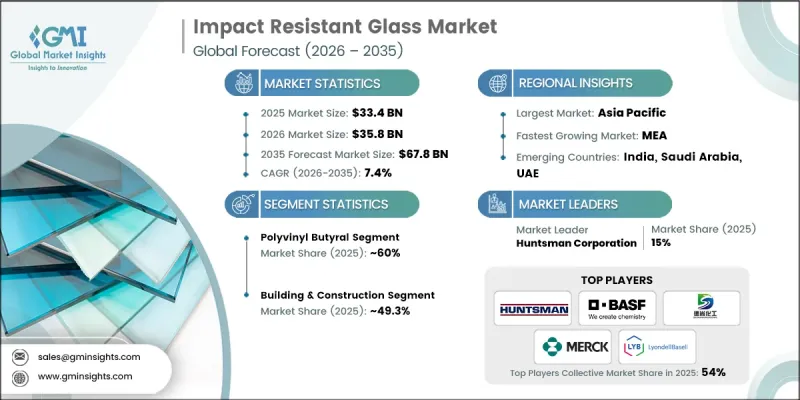
預計到 2025 年,全球抗衝擊玻璃市場價值將達到 334 億美元,並預計以 7.4% 的複合年成長率成長,到 2035 年達到 678 億美元。
在都市化加速和建設活動活性化的推動下,高性能建材的需求推動市場呈現強勁成長動能。隨著人們對結構安全、耐久性和能源效率的日益重視,夾層玻璃和先進安全玻璃解決方案在現代建築中的應用也日益廣泛。同時,汽車產業也為市場成長做出了顯著貢獻,推動了對更高安全性和舒適性以及先進玻璃系統的需求。專注於碰撞安全和建築抗災能力的法規結構進一步促進了全部區域玻璃的採用。此外,氣候變遷帶來的風險以及對抗災基礎設施日益成長的需求也推動了對堅固耐用玻璃解決方案的需求。智慧玻璃技術以及隔音、太陽輻射控制和紫外線防護等多功能性能的整合正在改變產品的性能。這些不斷變化的需求正使抗衝擊玻璃成為建築、汽車和基礎設施領域不可或缺的一部分。
| 市場範圍 | |
|---|---|
| 開始年份 | 2025 |
| 預測期 | 2026-2035 |
| 上市時的市場規模 | 334億美元 |
| 預測金額 | 678億美元 |
| 複合年成長率 | 7.4% |
預計到2025年,聚乙烯丁醛(PVB)將佔據60%的市場佔有率,成為抗衝擊玻璃領域領先的中間層材料。其優異的加工性能以及在建築和汽車領域的廣泛應用,推動了PVB的廣泛應用。同時,對更高結構性能和安全性的日益成長的需求,也推動了先進中間層材料的應用,尤其是在需要高強度和耐久性的應用中。
預計到2025年,建築業將佔據49.3%的市場佔有率,這主要得益於日益嚴格的安全法規和建築外觀的持續現代化。夾層玻璃解決方案在安全性和耐久性至關重要的結構應用中正廣泛應用。此外,交通運輸領域的應用也日益普及,更高的安全性和舒適性已成為業界標準,也支撐了市場需求。
預計到2035年,北美抗衝擊玻璃市場規模將達164億美元。該地區的成長主要得益於嚴格的建築規範、對防災建築方法的日益重視以及汽車行業的強勁需求。此外,維修和基礎設施升級也推動了市場的持續擴張。
目錄
第1章:調查方法和範圍
第2章執行摘要
第3章業界考察
- 生態系分析
- 供應商情況
- 利潤率
- 每個階段增加的價值
- 影響價值鏈的因素
- 中斷
- 影響產業的因素
- 促進因素
- 嚴格執行建築規範與安全標準
- 電動車和全景車窗玻璃的成長
- 抗氣候變遷與抗災害建築
- 產業潛在風險與挑戰
- 高昂的資本成本、加工成本和認證成本
- 開發中國家維修投資下滑
- 市場機遇
- 智慧玻璃和多功能玻璃的廣泛應用
- 綠建築和淨零能耗建築的發展趨勢
- 促進因素
- 成長潛力分析
- 監理情勢
- 北美洲
- 歐洲
- 亞太地區
- 拉丁美洲
- 中東和非洲
- 波特五力分析
- PESTEL 分析
- 價格趨勢
- 按地區
- 中階
- 未來市場趨勢
- 科技與創新趨勢
- 當前技術趨勢
- 新興技術
- 專利趨勢
- 貿易統計(HS編碼:700721)
- 主要進口國
- 主要出口國
- 永續性和環境方面
- 永續計劃
- 減少廢棄物策略
- 生產中的能源效率
- 環保意識的舉措
- 考慮碳足跡
第4章 競爭情勢
- 介紹
- 企業市佔率分析
- 按地區
- 北美洲
- 歐洲
- 亞太地區
- 拉丁美洲
- 中東和非洲
- 按地區
- 企業矩陣分析
- 主要市場公司的競爭分析
- 競爭定位矩陣
- 主要進展
- 併購
- 夥伴關係與合作
- 新產品發布
- 業務拓展計劃
第5章 市場估計與預測:依中階,2022-2035年
- 聚乙烯丁醛
- 離子塑膠聚合物
- 乙烯-醋酸乙烯酯
- 其他
- 中階
- 終端用戶產業
第6章 市場估計與預測:依最終用途產業分類,2022-2035年
- 建築/施工
- 住宅
- 商業的
- 公共機構
- 扶手和天花板玻璃
- 汽車和交通運輸
- 搭乘用車
- 商用車輛
- 鐵路和船舶
- 安全與國防
- 銀行和關鍵設施
- 高度安全設施
- 工業和基礎設施
- 工業廠房
- 關鍵基礎設施
- 交通基礎設施
- 特殊用途/其他
第7章 市場估計與預測:依地區分類,2022-2035年
- 北美洲
- 美國
- 加拿大
- 歐洲
- 德國
- 英國
- 法國
- 西班牙
- 義大利
- 其他歐洲地區
- 亞太地區
- 中國
- 印度
- 日本
- 澳洲
- 韓國
- 亞太其他地區
- 拉丁美洲
- 巴西
- 墨西哥
- 阿根廷
- 其他拉丁美洲地區
- 中東和非洲
- 沙烏地阿拉伯
- 南非
- 阿拉伯聯合大公國
- 其他中東和非洲地區
第8章:公司簡介
- AGC
- Cardinal Glass
- Central Glass Company
- CGS Holding
- Corning
- Fuyao Glass Industry Group
- Guardian Industries
- Nippon Sheet Glass
- Pilkington
- Qingdao Kangdeli Industrial
- Saint-Gobain
- SCHOTT
- Sekurit
- Vitro
- Xinyi Glass
The Global Impact Resistant Glass Market was valued at USD 33.4 billion in 2025 and is estimated to grow at a CAGR of 7.4% to reach USD 67.8 billion by 2035.
The market is gaining strong momentum due to accelerating urbanization and increasing construction activity, which are driving demand for high-performance building materials. Growing emphasis on structural safety, durability, and energy efficiency is encouraging the adoption of laminated and advanced safety glass solutions in modern architecture. In parallel, the automotive sector is contributing significantly to market growth, with rising demand for enhanced safety, comfort, and advanced glazing systems. Regulatory frameworks focused on crash safety and building resilience are further reinforcing adoption across key regions. Additionally, climate-related risks and the need for disaster-resistant infrastructure are pushing demand for robust glazing solutions. The integration of smart glass technologies and multifunctional performance features, such as acoustic insulation, solar control, and UV protection, is transforming product capabilities. These evolving requirements are positioning impact resistant glass as a critical component across construction, automotive, and infrastructure applications.
| Market Scope | |
|---|---|
| Start Year | 2025 |
| Forecast Year | 2026-2035 |
| Start Value | $33.4 Billion |
| Forecast Value | $67.8 Billion |
| CAGR | 7.4% |
The polyvinyl butyral segment accounted for 60% share in 2025, making it the dominant interlayer material in impact resistant glass. Its widespread use is supported by strong processing capabilities and compatibility with both architectural and automotive applications. At the same time, increasing demand for enhanced structural performance and safety is encouraging the adoption of advanced interlayer materials, particularly in applications requiring higher strength and durability.
The building and construction segment held a 49.3% share in 2025, driven by strict safety regulations and the ongoing modernization of building facades. Laminated glass solutions are increasingly being used across structural applications where safety and resilience are critical. Demand is further supported by growing adoption in transportation applications, where enhanced safety and comfort features are becoming standard requirements.
North America Impact Resistant Glass Market is projected to reach USD 16.4 billion by 2035. Growth in the region is supported by stringent building codes, increasing focus on resilient construction practices, and strong demand from the automotive sector. Retrofit activities and infrastructure upgrades are also contributing to sustained market expansion.
Key players operating in the Global Impact Resistant Glass Market include Saint-Gobain, AGC, Guardian Industries, Nippon Sheet Glass, Pilkington, SCHOTT, Corning, Central Glass Company, Cardinal Glass, CGS Holding, Fuyao Glass Industry Group, Sekurit, Vitro, Xinyi Glass, and Qingdao Kangdeli Industrial. Companies in the Global Impact Resistant Glass Market are focusing on innovation and strategic expansion to strengthen their competitive position. Investments in advanced interlayer technologies and smart glass integration are enabling multifunctional product offerings. Firms are expanding manufacturing capabilities and enhancing supply chain networks to meet growing global demand. Strategic collaborations with construction firms, automotive manufacturers, and technology providers are supporting product development and market penetration. Additionally, companies are prioritizing sustainable production practices and compliance with evolving safety regulations.
Table of Contents
Chapter 1 Methodology & Scope
- 1.1 Market scope and definition
- 1.2 Research design
- 1.2.1 Research approach
- 1.2.2 Data collection methods
- 1.3 Data mining sources
- 1.3.1 Global
- 1.3.2 Regional/Country
- 1.4 Base estimates and calculations
- 1.4.1 Base year calculation
- 1.4.2 Key trends for market estimation
- 1.5 Primary research and validation
- 1.5.1 Primary sources
- 1.6 Forecast model
- 1.7 Research assumptions and limitations
Chapter 2 Executive Summary
- 2.1 Industry 360° synopsis
- 2.2 Key market trends
- 2.2.1 Regional
- 2.2.2 Interlayer
- 2.2.3 End Use Industry
- 2.3 TAM Analysis, 2026-2035
- 2.4 CXO perspectives: Strategic imperatives
- 2.4.1 Executive decision points
- 2.4.2 Critical success factors
- 2.5 Future Outlook and Strategic Recommendations
Chapter 3 Industry Insights
- 3.1 Industry ecosystem analysis
- 3.1.1 Supplier landscape
- 3.1.2 Profit margin
- 3.1.3 Value addition at each stage
- 3.1.4 Factor affecting the value chain
- 3.1.5 Disruptions
- 3.2 Industry impact forces
- 3.2.1 Growth drivers
- 3.2.1.1 Strong building and safety code enforcement
- 3.2.1.2 Growth in EVs and panoramic vehicle glazing
- 3.2.1.3 Climate resilience and disaster-prone construction
- 3.2.2 Industry pitfalls and challenges
- 3.2.2.1 High capital, processing, and certification costs
- 3.2.2.2 Weak retrofit spending in developing economies
- 3.2.3 Market opportunities
- 3.2.3.1 Expansion of smart and multifunctional glazing
- 3.2.3.2 Green building and net-zero construction trends
- 3.2.1 Growth drivers
- 3.3 Growth potential analysis
- 3.4 Regulatory landscape
- 3.4.1 North America
- 3.4.2 Europe
- 3.4.3 Asia Pacific
- 3.4.4 Latin America
- 3.4.5 Middle East & Africa
- 3.5 Porter's analysis
- 3.6 PESTEL analysis
- 3.7 Price trends
- 3.7.1 By region
- 3.7.2 By Interlayer
- 3.8 Future market trends
- 3.9 Technology and Innovation landscape
- 3.9.1 Current technological trends
- 3.9.2 Emerging technologies
- 3.10 Patent Landscape
- 3.11 Trade statistics (HS code: 700721)
- 3.11.1 Major importing countries
- 3.11.2 Major exporting countries
- 3.12 Sustainability and environmental aspects
- 3.12.1 Sustainable practices
- 3.12.2 Waste reduction strategies
- 3.12.3 Energy efficiency in production
- 3.12.4 Eco-friendly initiatives
- 3.13 Carbon footprint consideration
Chapter 4 Competitive Landscape, 2025
- 4.1 Introduction
- 4.2 Company market share analysis
- 4.2.1 By region
- 4.2.1.1 North America
- 4.2.1.2 Europe
- 4.2.1.3 Asia Pacific
- 4.2.1.4 LATAM
- 4.2.1.5 MEA
- 4.2.1 By region
- 4.3 Company matrix analysis
- 4.4 Competitive analysis of major market players
- 4.5 Competitive positioning matrix
- 4.6 Key developments
- 4.6.1 Mergers & acquisitions
- 4.6.2 Partnerships & collaborations
- 4.6.3 New Product Launches
- 4.6.4 Expansion Plans
Chapter 5 Market Estimates and Forecast, By Interlayer, 2022-2035 (USD Billion) (Kilo Tons)
- 5.1 Key trends
- 5.2 Polyvinyl butyral
- 5.3 Ionoplast polymer
- 5.4 Ethylene vinyl acetate
- 5.5 Others
- 5.6 Interlayer
- 5.7 End Use Industry
Chapter 6 Market Estimates and Forecast, By End Use Industry, 2022-2035 (USD Billion) (Kilo Tons)
- 6.1 Key trends
- 6.2 Building & Construction
- 6.2.1 Residential
- 6.2.2 Commercial
- 6.2.3 Public / Institutional
- 6.2.4 Balustrades & Overhead Glazing
- 6.3 Automotive & Transportation
- 6.3.1 Passenger Vehicles
- 6.3.2 Commercial Vehicles
- 6.3.3 Rail & Marine
- 6.4 Security & Defense
- 6.4.1 Banks & Sensitive Facilities
- 6.4.2 High-Security Sites
- 6.5 Industrial & Infrastructure
- 6.5.1 Industrial Plants
- 6.5.2 Critical Infrastructure
- 6.5.3 Transport Infrastructure
- 6.6 Specialty & Others
Chapter 7 Market Estimates and Forecast, By Region, 2022-2035 (USD Billion) (Kilo Tons)
- 7.1 Key trends
- 7.2 North America
- 7.2.1 U.S.
- 7.2.2 Canada
- 7.3 Europe
- 7.3.1 Germany
- 7.3.2 UK
- 7.3.3 France
- 7.3.4 Spain
- 7.3.5 Italy
- 7.3.6 Rest of Europe
- 7.4 Asia Pacific
- 7.4.1 China
- 7.4.2 India
- 7.4.3 Japan
- 7.4.4 Australia
- 7.4.5 South Korea
- 7.4.6 Rest of Asia Pacific
- 7.5 Latin America
- 7.5.1 Brazil
- 7.5.2 Mexico
- 7.5.3 Argentina
- 7.5.4 Rest of Latin America
- 7.6 Middle East and Africa
- 7.6.1 Saudi Arabia
- 7.6.2 South Africa
- 7.6.3 UAE
- 7.6.4 Rest of Middle East and Africa
Chapter 8 Company Profiles
- 8.1 AGC
- 8.2 Cardinal Glass
- 8.3 Central Glass Company
- 8.4 CGS Holding
- 8.5 Corning
- 8.6 Fuyao Glass Industry Group
- 8.7 Guardian Industries
- 8.8 Nippon Sheet Glass
- 8.9 Pilkington
- 8.10 Qingdao Kangdeli Industrial
- 8.11 Saint-Gobain
- 8.12 SCHOTT
- 8.13 Sekurit
- 8.14 Vitro
- 8.15 Xinyi Glass

 抗衝擊玻璃市場規模、佔有率和趨勢分析報告:按最終用途、中階、地區和細分市場預測(2026-2033 年)
 抗衝擊玻璃:市場佔有率分析、行業趨勢和統計數據、成長預測(2026-2031 年)
 強化玻璃市場-2026-2032年全球市場預測耐刮玻璃市場:2026-2032年全球市場預測(按材料、玻璃類型、製造流程、塗層類型、厚度和應用分類)
 抗衝擊玻璃市場規模、佔有率和成長分析:按玻璃類型、中階材料、應用、終端用戶產業和地區分類-2026-2033年產業預測
 耐刮玻璃市場規模、佔有率和成長分析:按技術、產品形式、應用、最終用戶和地區分類-2026-2033年產業預測
 強化玻璃市場報告:按類型、形狀、應用和地區分類(2026-2034年)耐刮玻璃市場報告:按產品類型、材料、應用和地區分類(2026-2034 年)抗衝擊玻璃市場:按中間層類型、應用和最終用途產業分類-2026-2032年全球市場預測
 強化玻璃市場分析及預測(至2035年):依類型、產品類型、應用、技術、材質、最終用戶、製程、安裝類型、設備及解決方案分類