


 |
市場調查報告書
商品編碼
2114958
聚合物黏合劑:市場佔有率分析、產業趨勢和統計數據、成長預測(2026-2031)Polymer Binder - Market Share Analysis, Industry Trends & Statistics, Growth Forecasts (2026 - 2031) |
||||||

※ 本網頁內容可能與最新版本有所差異。詳細情況請與我們聯繫。
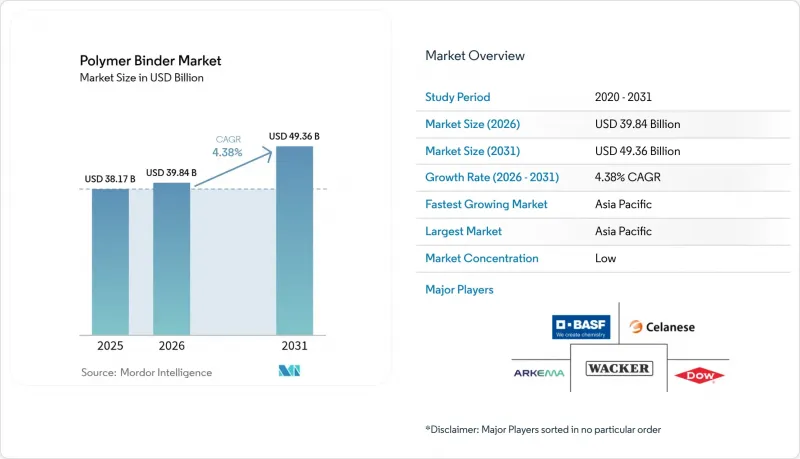
據 Mordor Intelligence 稱,聚合物黏合劑市場預計到 2026 年價值 398.4 億美元,高於 2025 年的 381.7 億美元,預計到 2031 年將達到 493.6 億美元。
預計 2026 年至 2031 年的複合年成長率為 4.38%。
本報告按類型(醋酸乙烯酯、丙烯酸酯、苯乙烯-丙烯酸酯、乳膠)、形態(粉末、液體、高固態)、應用(塗料、黏合劑、紡織品、油墨、金屬、其他應用)和地區(亞太地區、北美地區、歐洲地區、南美地區、中東和非洲地區)進行細分。市場預測以美元計價。
全球聚合物黏合劑市場趨勢與洞察
建築和工業塗料需求激增
都市化、基礎設施現代化以及對惡劣氣候條件下性能日益成長的需求,正迫使塗料配方開發商採用先進的聚合物黏合劑,以確保塗料即使在熱帶潮濕環境和嚴酷的冬季凍融循環下也能保持耐久性、抗污性和保色性。預計到2025年,水性乳液將佔新型建築塗料配方的近三分之二,這一里程碑式的發展反映了更嚴格的排放法規以及終端用戶對低氣味產品的偏好。在工業設施中,高固態環氧丙烯酸混合塗料正被廣泛應用,以延長橋樑、管道和鐵路車輛的維護週期,其優勢在於黏合劑具有耐化學腐蝕和耐熱衝擊的化學特性。高檔外牆塗料採用自交聯醋酸乙烯酯體系,在不影響塗膜完整性的前提下,減少了共軛物的使用並降低了VOC排放。這種追求更高性能的趨勢在中國、印度和印尼尤為顯著,這些國家的大規模住宅建設項目和不斷成長的可支配收入,推動了人們對建築外牆耐久性的更高期望。跨國塗料集團正在實現供應鏈本地化,從而鞏固了區域對可靠黏合劑原料的需求。
快速過渡到水性、低VOC配方
監管機構正在將建築塗料的VOC(揮發性有機化合物)限值降低至遠低於50克/公升,這意味著在加州和幾個歐盟成員國,傳統的溶劑型塗料系統將在兩年內成為小眾產品。為了應對這一變化,黏合劑生產商開發了丙烯酸和乙烯基丙烯酸乳液,這些乳液在室溫下即可形成堅硬、耐化學腐蝕的漆膜,同時將VOC含量控制在遠低於5克/公升的水平。例如,陶氏化學的ML-520丙烯酸黏合劑具有與長期使用的溶劑型醇酸樹脂相當的戶外耐久性。隨著建築師和注重健康的住宅指定學校和醫院使用無味塗料,這種趨勢加速了其普及,並產生了拉動效應,將需求擴展到了受監管區域之外。設備供應商也做出了回應,噴槍製造商推出了針對低黏度水性塗料最佳化的噴嘴,減少了過噴,使承包商更容易轉換。面向出口的塗料製造商已調整其配方以符合歐盟生態標籤標準,亞洲建築市場也正在迅速跟進。因此,對水性黏合劑的需求激增,訂單週期縮短,迫使一些供應商幾乎滿載運作工廠。
造紙和地毯製造業的結構性衰退
數位化進程的推進導致印刷用紙的需求持續下降,曾經穩定用於表面施膠的澱粉-醋酸乙烯酯共聚物黏合劑的需求也逐漸消失。住宅裝修中對地毯的需求也正被高檔乙烯基瓷磚和複合地板所取代,這些產品使用的黏合劑化學成分各不相同,給北美和西歐的乳膠粘合劑銷售帶來了壓力。包裝紙和衛生紙行業仍在成長,但這些產業需要添加劑和濕強度更高的生物基黏合劑,這要求不同的配方平衡,迫使製造商重新設計生產線。國際紙業宣布與DS Smith合併,將紡織包裝材料定位為電商產品,為新型水性黏合劑創造了新的機會。新興產品單價更高,吸水率更低,導致聚合物黏合劑總銷售量略微下降。由於自2023年以來一直運作的區域工廠沒有運作的希望,這種結構性變化正逐漸成為永久性的。
細分市場分析
預計到2025年,醋酸乙烯酯將佔聚合物黏合劑市場37.68%的佔有率,並在2031年之前保持5.83%的複合年成長率,這表明其適用於水性、低VOC塗料以及需要穩定膠體分散的新興電池漿料。在需要抗粉化的高階面漆配方中,純丙烯酸酯等互補化學品佔據主導地位;而苯乙烯-丙烯酸酯則用於經濟型室內塗料和某些紙張浸漬劑。近期生物基中試批試驗表明,醋酸乙烯酯與發酵衍生的乙酸結合使用時不會損害聚合物性能,從而使基質能夠符合範圍3的脫碳目標。
對自交聯技術的持續研究提高了戶外塗料的抗粘連性和初始耐水性,這些性能此前僅在純丙烯酸塗料中才有,從而進一步增強了醋酸乙烯酯塗料的競爭力。活性界面活性劑的加入提高了耐磨性並減少了遊離界面活性劑的遷移,從而提高了內牆的抗污性。
區域分析
預計到2025年,亞太地區將佔全球銷售額的54.20%,以5.19%的複合年成長率超越其他所有地區,鞏固其作為銷售量領先者和成長引擎的雙重地位。中國大都會圈的擴張和老舊多用戶住宅的維修,使得對以多功能醋酸乙烯酯黏合劑為核心的外牆塗料的需求持續旺盛。同時,國內電池製造商正以前所未有的運作其正極活性材料生產線的產能,而每條生產線都需要滿足嚴格雜質容差要求的專用黏合劑。
在北美,一種成熟的、由替代需求主導的需求趨勢正在興起,儘管這種趨勢受到監管主導的配方變更的限制。美國各州機構設定的揮發性有機化合物(VOC)閾值比聯邦標準更為嚴格,加拿大建築規範也開始提及嵌入式碳排放目標。歐洲繼續保持其監管領導地位,積極推動儘早採用無氟水性丙烯酸和矽酮混合黏合劑。擬議的關於全氟烷基物質(PFAS)的法規營造了一種緊迫感,迫使配方生產商處置庫存並尋找替代化學品。
其他好處:
- Excel格式的市場預測(ME)表
- 3個月的分析師支持
目錄
第1章:引言
- 研究假設和市場定義
- 調查範圍
第2章:調查方法
第3章執行摘要
第4章 市場狀況
- 市場概覽
- 市場促進因素
- 建築和工業塗料需求激增
- 快速過渡到水性、低VOC配方
- 鋰離子電池電極中聚合物黏合劑的應用日益廣泛
- 粉末層積層製造流程的應用擴展
- 研發生物基黏合劑以適應循環經濟
- 市場限制因素
- 造紙和地毯製造業的結構性衰退
- 主要防腐劑價格波動
- 加強與含氟聚合物黏合劑相關的 PFAS 法規
- 價值鏈分析
- 波特五力模型
第5章 市場規模與成長預測
- 按類型
- 醋酸乙烯酯
- 丙烯酸纖維
- 苯乙烯和丙烯酸
- 乳膠
- 按形式
- 粉末
- 液體
- 高固態含量
- 透過使用
- 塗層
- 黏合劑
- 紡織品
- 墨水
- 金屬
- 其他應用(積層製造粉末、儲能等)
- 按地區
- 亞太地區
- 中國
- 日本
- 印度
- 韓國
- 東南亞國協
- 其他亞太國家
- 北美洲
- 美國
- 加拿大
- 墨西哥
- 歐洲
- 德國
- 英國
- 法國
- 義大利
- 西班牙
- 俄羅斯
- 北歐國家
- 其他歐洲國家
- 南美洲
- 巴西
- 阿根廷
- 其他南美國家
- 中東和非洲
- 沙烏地阿拉伯
- 南非
- 其他中東和非洲國家
- 亞太地區
第6章 競爭情勢
- 市場集中度
- 策略趨勢
- 市佔率和排名分析
- 公司簡介
- AkzoNobel NV
- Arkema
- Ashland
- BASF
- Celanese Corporation
- Covestro AG
- DCC(Dairen Chemical Corp.)
- Dow
- Eastman Chemical Company
- Evonik Industries AG
- HB Fuller Co.
- Solvay
- Synthomer Plc
- The Lubrizol Corporation
- Toagosei Co., Ltd.
- Trinseo
- Wacker Chemie AG
第7章 市場機會與未來展望
According to Mordor Intelligence, polymer binder market size in 2026 is estimated at USD 39.84 billion, growing from 2025 value of USD 38.17 billion with 2031 projections showing USD 49.36 billion, growing at 4.38% CAGR over 2026-2031.
This report is Segmented by Type (Vinyl Acetate, Acrylic, Styrene-Acrylic, and Latex), Form (Powder, Liquids, and High-Solids), Application (Coatings, Adhesives, Textiles, Inks, Metals, and Other Applications), and Geography (Asia-Pacific, North America, Europe, South America, and Middle-East and Africa). The Market Forecasts are Provided in Terms of Value (USD).
Global Polymer Binder Market Trends and Insights
Surging Demand from Architectural and Industrial Coatings
Urbanization, infrastructure renewal, and higher performance expectations in harsh climates push coating formulators to specify advanced polymer binders that deliver durability, stain resistance, and color retention under tropical humidity or severe winter freeze-thaw cycles. Waterborne emulsions claimed almost two-thirds of new architectural coating formulations 2025, a milestone reflecting stricter emissions rules and end-user preferences for low-odor products. Industrial facilities are adopting high-solids epoxy-acrylic hybrids to extend maintenance intervals on bridges, pipelines, and rolling stock, drawing on binder chemistries that withstand chemical immersion and thermal shock. Premium exterior paints integrate self-crosslinking vinyl acetate systems that reduce coalescent demand, trimming VOC emissions without compromising film integrity. The upgrading trend is particularly visible in China, India, and Indonesia, where mass housing programs combine with rising disposable income to lift expectations for facade longevity. Multinational coatings groups localize supply chains, anchoring regional demand for reliable binder raw materials.
Rapid Shift Toward Waterborne Low-VOC Formulations
Regulators now push VOC limits well below 50 g/L in building coatings, turning legacy solvent-borne systems into niche products within two years in California and several EU states. Binder producers responded with acrylic and vinyl acrylic emulsions capable of forming hard, chemical-resistant films at room temperature while keeping VOC well under 5 g/L. For instance, Dow's ML-520 acrylic binder achieves exterior durability ratings comparable with long-standing solvent-borne alkyds. Architects and health-conscious homeowners accelerated adoption by specifying zero-odor paints for schools and hospitals, creating a pull effect that spreads beyond regulated regions. Equipment suppliers also adapted; spray-gun manufacturers launched tips optimized for low-viscosity water-borne paints, reducing overspray and easing the switch for contractors. Asian construction markets are following quickly as export-oriented coating companies align formulations to meet EU eco-labels. The resulting demand surge for water-compatible binders has shortened order cycles, forcing some suppliers to run plants near capacity.
Structural Decline in Paper and Carpet Manufacturing
Digitalization keeps shrinking demand for graphic printing papers, eliminating once-steady volumes for starch-vinyl acetate copolymer binders used in surface sizing. Carpet demand in residential remodeling is also waning in favor of luxury vinyl tile and laminate flooring that use different adhesive chemistries, undercutting latex binder sales in North America and Western Europe. Packaging paper and tissue segments still grow, yet they require higher wet-strength additives and bio-based binders that command different formulation balances, forcing producers to redesign lines. International Paper announced its merger with DS Smith, positions fiber-based packaging to serve e-commerce, creating pockets of opportunity for new aqueous binders. The net effect on total polymer binder volume is modestly negative because emerging grades have higher unit value but lower wet pickup rates, resulting in smaller tonnage. Regional mills idled since 2023 are unlikely to restart, cementing the structural shift.
Other drivers and restraints analyzed in the detailed report include:
- Rising Adoption of Polymer Binders in Li-Ion Battery Electrodes
- Expanding Use in Powder-Bed Additive Manufacturing Processes
- Volatility in Key Monomer Feedstock Prices
For complete list of drivers and restraints, kindly check the Table Of Contents.
Segment Analysis
Vinyl acetate held 37.68% of the polymer binder market in 2025 and is forecast to record a 5.83% CAGR through 2031, underscoring its adaptability to water-borne, low-VOC paints and to emerging battery slurries that demand stable colloidal dispersions. Complementary chemistries such as pure acrylics dominate premium topcoat formulations requiring chalking resistance, while styrene-acrylics serve economical interior paints and select paper saturations. Recent bio-attributed pilot batches demonstrate that vinyl acetate can incorporate fermentative acetic acid without altering polymer performance, aligning the matrix with Scope 3 decarbonization targets.
Continued research into self-crosslinking technology is sharpening vinyl acetate's competitive edge by boosting block resistance and early water resistance in exterior paints, features once reserved for pure acrylics. The incorporation of reactive surfactants improves scrub durability while lowering free surfactant migration, an attribute that enhances stain resistance on interior walls.
Complete Report Scope:
- By Type
- Vinyl Acetate
- Acrylic
- Styrene-Acrylic
- Latex
- By Form
- Powder
- Liquids
- High-Solids
- By Application
- Coatings
- Adhesives
- Textiles
- Inks
- Metals
- Other Applications (Additive Manufacturing Powders, Energy Storage, etc.)
- By Geography
- Asia-Pacific
- China
- Japan
- India
- South Korea
- ASEAN Countries
- Rest of Asia-Pacific
- North America
- United States
- Canada
- Mexico
- Europe
- Germany
- United Kingdom
- France
- Italy
- Spain
- Russia
- NORDIC Countries
- Rest of Europe
- South America
- Brazil
- Argentina
- Rest of South America
- Middle-East and Africa
- Saudi Arabia
- South Africa
- Rest of Middle-East and Africa
- Asia-Pacific
Geography Analysis
Asia-Pacific delivered 54.20% of 2025 revenue and is forecast to outpace all regions with a 5.19% CAGR, cementing its dual role as volume leader and growth engine. China's megacity expansions and refurbishment of older apartment blocks sustain a massive need for exterior wall coatings that rely on versatile vinyl acetate binders. At the same time, the country's battery manufacturers are commissioning cathode-active material lines at a record pace, each requiring dedicated binder supply streams with rigorous impurity thresholds.
North America exhibits mature, replacement-driven demand dynamics tempered by regulation-led formulation shifts. State agencies in the United States push VOC thresholds lower than federal baselines, while Canadian building codes now reference embodied-carbon targets. Europe upholds its role as a regulatory bellwether, compelling early adoption of fluorine-free, waterborne acrylic and silicone-hybrid binders. PFAS proposals add urgency, prompting formulators to clear inventories and secure alternative chemistries.
- AkzoNobel N.V.
- Arkema
- Ashland
- BASF
- Celanese Corporation
- Covestro AG
- DCC (Dairen Chemical Corp.)
- Dow
- Eastman Chemical Company
- Evonik Industries AG
- H.B. Fuller Co.
- Solvay
- Synthomer Plc
- The Lubrizol Corporation
- Toagosei Co., Ltd.
- Trinseo
- Wacker Chemie AG
Additional Benefits:
- The market estimate (ME) sheet in Excel format
- 3 months of analyst support
TABLE OF CONTENTS
1 Introduction
- 1.1 Study Assumptions and Market Definition
- 1.2 Scope of the Study
2 Research Methodology
3 Executive Summary
4 Market Landscape
- 4.1 Market Overview
- 4.2 Market Drivers
- 4.2.1 Surging Demand from Architectural and Industrial Coatings
- 4.2.2 Rapid Shift Toward Waterborne Low-VOC Formulations
- 4.2.3 Rising Adoption of Polymer Binders in Li-Ion Battery Electrodes
- 4.2.4 Expanding Use in Powder-Bed Additive Manufacturing Processes
- 4.2.5 Bio-Based Binder Research and Development for Circular-Economy Compliance
- 4.3 Market Restraints
- 4.3.1 Structural Decline in Paper and Carpet Manufacturing
- 4.3.2 Volatility in Key Monomer Feedstock Prices
- 4.3.3 Tightening PFAS-Related Regulations on Fluoropolymer Binders
- 4.4 Value Chain Analysis
- 4.5 Porter's Five Forces
- 4.5.1 Threat of New Entrants
- 4.5.2 Bargaining Power of Buyers
- 4.5.3 Bargaining Power of Suppliers
- 4.5.4 Threat of Substitute Products
- 4.5.5 Degree of Competition
5 Market Size and Growth Forecasts (Value)
- 5.1 By Type
- 5.1.1 Vinyl Acetate
- 5.1.2 Acrylic
- 5.1.3 Styrene-Acrylic
- 5.1.4 Latex
- 5.2 By Form
- 5.2.1 Powder
- 5.2.2 Liquids
- 5.2.3 High-Solids
- 5.3 By Application
- 5.3.1 Coatings
- 5.3.2 Adhesives
- 5.3.3 Textiles
- 5.3.4 Inks
- 5.3.5 Metals
- 5.3.6 Other Applications (Additive Manufacturing Powders, Energy Storage, etc.)
- 5.4 By Geography
- 5.4.1 Asia-Pacific
- 5.4.1.1 China
- 5.4.1.2 Japan
- 5.4.1.3 India
- 5.4.1.4 South Korea
- 5.4.1.5 ASEAN Countries
- 5.4.1.6 Rest of Asia-Pacific
- 5.4.2 North America
- 5.4.2.1 United States
- 5.4.2.2 Canada
- 5.4.2.3 Mexico
- 5.4.3 Europe
- 5.4.3.1 Germany
- 5.4.3.2 United Kingdom
- 5.4.3.3 France
- 5.4.3.4 Italy
- 5.4.3.5 Spain
- 5.4.3.6 Russia
- 5.4.3.7 NORDIC Countries
- 5.4.3.8 Rest of Europe
- 5.4.4 South America
- 5.4.4.1 Brazil
- 5.4.4.2 Argentina
- 5.4.4.3 Rest of South America
- 5.4.5 Middle-East and Africa
- 5.4.5.1 Saudi Arabia
- 5.4.5.2 South Africa
- 5.4.5.3 Rest of Middle-East and Africa
- 5.4.1 Asia-Pacific
6 Competitive Landscape
- 6.1 Market Concentration
- 6.2 Strategic Moves
- 6.3 Market Share(%)/Ranking Analysis
- 6.4 Company Profiles (includes Global level Overview, Market level overview, Core Segments, Financials as available, Strategic Information, Market Rank/Share for key companies, Products and Services, and Recent Developments)
- 6.4.1 AkzoNobel N.V.
- 6.4.2 Arkema
- 6.4.3 Ashland
- 6.4.4 BASF
- 6.4.5 Celanese Corporation
- 6.4.6 Covestro AG
- 6.4.7 DCC (Dairen Chemical Corp.)
- 6.4.8 Dow
- 6.4.9 Eastman Chemical Company
- 6.4.10 Evonik Industries AG
- 6.4.11 H.B. Fuller Co.
- 6.4.12 Solvay
- 6.4.13 Synthomer Plc
- 6.4.14 The Lubrizol Corporation
- 6.4.15 Toagosei Co., Ltd.
- 6.4.16 Trinseo
- 6.4.17 Wacker Chemie AG
7 Market Opportunities and Future Outlook
- 7.1 White-space and Unmet-Need Assessment

