


 |
市場調查報告書
商品編碼
2114942
氧化鋅:市場佔有率分析、產業趨勢與統計、成長預測(2026-2031)Zinc Oxide - Market Share Analysis, Industry Trends & Statistics, Growth Forecasts (2026 - 2031) |
||||||

※ 本網頁內容可能與最新版本有所差異。詳細情況請與我們聯繫。
據 Mordor Intelligence 稱,預計到 2026 年氧化鋅市場將達到 244 萬噸,高於 2025 年的 236 萬噸,預計到 2031 年將達到 292 萬噸。
預計從 2026 年到 2031 年,其複合年成長率將達到 3.58%。
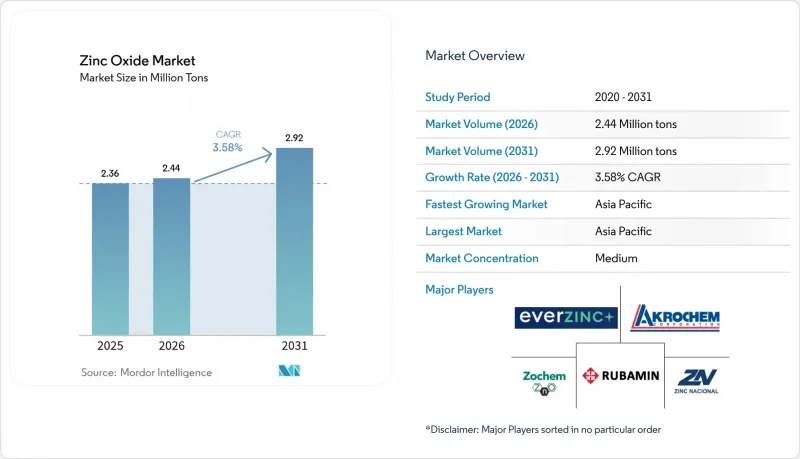
本報告按製造流程(間接法、直接法和濕化學法)、應用領域(橡膠和輪胎、陶瓷和玻璃、醫藥和化妝品、農業、油漆和塗料以及其他應用)和地區(亞太地區、北美地區、歐洲地區、南美地區以及中東和非洲地區)進行細分。市場預測以噸為單位。
全球氧化鋅市場趨勢及洞察
橡膠和輪胎行業的強勁需求
全球輪胎製造商依賴氧化鋅作為硫化促進劑,以增強輪胎的耐候性和機械耐久性。隨著電動車重量和扭矩的增加,這些性能變得日益重要。根據JG Chemicals的報告顯示,汽車應用約佔該公司59,904噸年產量的30%,凸顯了該領域對亞洲供應商的巨大吸引力。透過採用奈米級氧化鋅,每份配方中鋅的用量可減少高達40%,同時保持輪胎性能,使輪胎製造商能夠在不犧牲里程數的情況下滿足日益嚴格的排放標準。目前,一些大型工廠使用超過90%的回收金屬,降低了成本和碳排放強度。加之全球汽車生產的復甦,這些因素正推動氧化鋅市場穩定成長。
擴大化妝品和防曬油配方
隨著監管機構限制使用氧苯酮等化學物質,礦物基UV防曬的需求正在蓬勃發展。氧化鋅具有廣泛的防護效果,且被公認為「GRASE」(一般安全),因此,超細級氧化鋅的需求不斷成長,因為它可以消除傳統產品泛白的問題。 EverZinc 的「Zano」系列產品以 GMP 標準生產,其透明分散體已獲得 Ecocert 和 Cosmos 認證,符合其「清潔美妝」的定位。經表面處理的顆粒在保持高 SPF 值的同時改善了質地,加速了其在亞太地區高階護膚系列和北美珊瑚礁友善防曬油產品中的應用。採用植物萃取物的環保合成方法進一步提升了產品在注重健康的消費者中的吸引力。
鋅精礦價格波動
由於供應中斷和地緣政治緊張局勢,2024年鋅精礦價格上漲13%,每噸2978.50美元。這給冶煉廠的加工費帶來了壓力,並降低了氧化鋅生產商的利潤率。國際鉛鋅研究小組(ILZSG)目前預測,2025年精煉鋅將出現15萬噸的過剩,但運輸瓶頸和礦石品質的波動持續導致價格波動,使得採購計畫難以製定。美國生產商73%依賴進口,因此特別容易受到外匯波動和關稅風險的影響。大型企業正透過延長供應合約和整合再生資源來應對,再生資源目前已佔其鋅投入的40%以上;而中小企業則面臨日益沉重的營運資金負擔,這正在減緩氧化鋅市場的短期成長。
細分市場分析
至2025年,間接法(法國法)生產將佔總產量的70.62%。這得歸功於數十年來不斷改進,以實現橡膠、陶瓷和顏料等大眾市場所需的成本效益和穩定純度。連續式爐、熱回收迴路和廢氣熱電汽電共生等技術的升級進一步降低了單位能耗,增強了間接法在氧化鋅市場的競爭力。同時,濕化學法生產也在快速成長,年複合成長率達到4.02%,這主要得益於其能夠設計奈米級或微米級、粒徑分佈窄的產品,而這些產品對於化妝品、電子產品和精密農業至關重要。工廠維修現已將間接煅燒製程與濕化學沉澱法結合,打造出靈活的等級產品組合,既滿足了大眾生產領域的需求,也滿足了高價值細分市場的需求。
隨著監管力度的加大,濕化學製程生產線中綠色化學的應用正在加速推進。植物萃取物和微生物催化劑正在取代傳統的鹼性沉澱劑,以生產適用於皮膚科和生物醫學產品的生物相容性奈米顆粒。同時,數位化製程控制演算法能夠即時監測pH值、溫度和停留時間,最大限度地減少批次間差異,提高產率。這些創新將共同拓展氧化鋅的終端應用領域,並使氧化鋅市場能夠維持平衡的製程配置,以滿足不斷變化的客戶需求。
區域分析
預計到2025年,亞太地區將佔全球總量的45.10%,並預計在2031年以3.92%的複合年成長率超越其他地區,這主要得益於中國、印度和東南亞大規模的下游產業,尤其是橡膠和電子產業。光是中國每年就消耗0萬3至50萬噸氧化鋅,佔全國提煉鋅消費量的5%至10%,凸顯了氧化鋅在亞太地區製造業生態系統中的重要戰略地位。區域生產商利用低成本能源和一體化的冶煉及氧化鋅生產系統,與全球主要輪胎製造商簽訂了長期契約,從而鞏固了亞太地區在氧化鋅市場的核心地位。
儘管北美在產量上落後於其他地區,但在應用創新方面卻處於領先地位,尤其是在航太陶瓷、醫療設備和光電子領域,這些領域對高純度或奈米工程級鋅的需求量很大。然而,由於北美73%的精煉鋅依賴進口,其氧化鋅生產商極易受到外匯波動和運輸瓶頸的影響。對二次鋅回收和電池級回收的投資旨在降低這些風險。在歐洲,嚴格的生命週期法規正在推動封閉回路型水處理系統和低碳冶煉原料的採用,例如EverZinc公司使用的原料,該公司使用的回收金屬佔比超過40%,這進一步鞏固了歐洲作為永續性領導者的形象。
在南美洲、中東和非洲等新興地區,基礎設施和建築業的蓬勃發展推動了塗料和橡膠需求的成長。儘管這些地區目前依賴進口,但秘魯和阿曼新增冶煉產能表明,中期將轉向本地生產。這種需求多元化促進了針對區域需求的產品開發,從而增強了氧化鋅市場整體成長的韌性。
其他好處:
- Excel格式的市場預測(ME)表
- 3個月的分析師支持
目錄
第1章:引言
- 研究假設和市場定義
- 調查範圍
第2章:調查方法
第3章執行摘要
第4章 市場狀況
- 市場概覽
- 市場促進因素
- 橡膠和輪胎行業的強勁需求
- 擴大化妝品和防曬油配方
- 特種陶瓷和玻璃應用領域的成長
- 富含微量元素的肥料用於精密農業
- 奈米氧化鋅在光電子領域的商業化應用
- 市場限制因素
- 鋅精礦價格波動
- 加強氧化鋅滲濾液排放法規
- 不含鈣或鋅的綠色輪胎活化劑替代品
- 價值鏈分析
- 波特五力模型
第5章 市場規模與成長預測
- 透過流程
- 間接(法式)過程
- 直接(美國)工藝
- 濕化學工藝
- 透過使用
- 橡膠和輪胎
- 陶瓷和玻璃
- 藥品和化妝品
- 農業
- 油漆和塗料
- 其他用途(化學品、食品等)
- 按地區
- 亞太地區
- 中國
- 日本
- 印度
- 韓國
- 東南亞國協
- 其他亞太國家
- 北美洲
- 美國
- 加拿大
- 墨西哥
- 歐洲
- 德國
- 英國
- 法國
- 義大利
- 西班牙
- 俄羅斯
- 北歐國家
- 其他歐洲國家
- 南美洲
- 巴西
- 阿根廷
- 其他南美國家
- 中東和非洲
- 沙烏地阿拉伯
- 南非
- 其他中東和非洲國家
- 亞太地區
第6章 競爭情勢
- 市場集中度
- 策略趨勢
- 市佔率和排名分析
- 公司簡介
- Akrochem Corporation
- American Chemet Corporation
- EverZinc
- GRILLO-Werke AG
- HAKUSUI TECH.
- HANIL
- Hindustan Zinc
- Pan-Continental Chemical Co., Ltd.
- RUBAMIN
- Silox India Pvt Ltd
- SURAJ UDYOG
- Zinc Nacional SA
- Zinc-o-India
- ZM SILESIA SA
- Zochem LLC
第7章 市場機會與未來展望
According to Mordor Intelligence, zinc oxide market size in 2026 is estimated at 2.44 million tons, growing from 2025 value of 2.36 million tons with 2031 projections showing 2.92 million tons, growing at 3.58% CAGR over 2026-2031.
This report is Segmented by Process (Indirect Process, Direct Process, Wet-Chemical Process), Application (Rubber and Tires, Ceramics and Glass, Pharmaceuticals and Cosmetics, Agriculture, Paints and Coatings, Other Applications), and Geography (Asia-Pacific, North America, Europe, South America, Middle East and Africa). The Market Forecasts are Provided in Terms of Volume (Tons).
Global Zinc Oxide Market Trends and Insights
Robust Demand from Rubber and Tire Industry
Global tire makers rely on zinc oxide as a vulcanization activator that delivers weather resistance and mechanical durability, attributes that become more critical as electric vehicles increase curb weight and torque. JG Chemicals reports that automotive applications contribute roughly 30% of its 59,904 MTPA output, highlighting the segment's pull on Asian suppliers. Adoption of nano-grade zinc oxide allows up to 40% reduction in zinc dosage per compound while sustaining performance, helping tire makers meet tightening discharge targets without sacrificing mileage. Recycled-metal inputs now exceed 90% at several large plants, lowering both cost and carbon intensity. Coupled with a rebound in global vehicle production, these factors reinforce a steady upward trajectory for the zinc oxide market.
Expansion of Cosmetics and Sunscreen Formulations
Mineral UV filters enjoy tailwinds as regulators restrict chemicals such as oxybenzone. Zinc oxide's broad-spectrum protection, recognized as GRASE, drives formulators toward ultrafine grades that eliminate the historical white-cast hurdle. EverZinc's Zano portfolio, produced under GMP, offers transparent dispersions that carry Ecocert and Cosmos approvals, aligning with clean-beauty positioning. Surface-treated particles improve skin feel while maintaining high SPF, accelerating take-up across premium skincare lines in Asia-Pacific and reef-safe sun care in North America. Green synthesis methods using plant extracts further differentiate products for health-conscious consumers.
Zinc Concentrate Price Volatility
Supply disruptions and geopolitical tensions drove concentrate prices up 13% to USD 2,978.50 / t in 2024, squeezing smelter treatment charges and narrowing margins for oxide producers. The International Lead and Zinc Study Group now projects a 150,000-ton refined zinc surplus in 2025, yet freight bottlenecks and ore-quality variation sustain price swings that complicate procurement planning. U.S. producers, 73% reliant on imports, remain especially exposed to currency fluctuations and tariff risk. Larger firms respond by lengthening supply contracts and integrating recycling streams that already supply over 40% of their zinc input, whereas smaller firms encounter higher working-capital burdens, damping near-term growth in the zinc oxide market.
Other drivers and restraints analyzed in the detailed report include:
- Growth of Specialty Ceramics and Glass Applications
- Micronutrient-Rich Fertilizers in Precision Agriculture
- Tightening Discharge Regulations on ZnO Leachate
For complete list of drivers and restraints, kindly check the Table Of Contents.
Segment Analysis
Indirect (French) production delivered 70.62% of output in 2025, benefiting from decades of fine-tuning that anchor cost efficiency and consistent purity demanded by mass markets in rubber, ceramics, and pigments. Continuous furnace upgrades, heat-recovery loops, and waste-gas cogeneration further lower specific energy consumption, reinforcing the indirect route's competitiveness in the zinc oxide market. In parallel, wet-chemical operations are scaling quickly, recording a 4.02% CAGR thanks to their ability to engineer nano- or micro-level morphology with narrow size distributions essential for cosmetics, electronics, and precision agriculture. Plant retrofits now blend indirect calcination stages with wet-chemical precipitation for flexible grade portfolios that capture both high-volume and niche value segments.
Growing regulatory scrutiny accelerates adoption of green chemistry inside wet-chemical lines. Botanical extracts and microbial catalysts replace conventional alkali precipitants, producing bio-compatible nanoparticles suited for dermatological and biomedical products. Simultaneously, digital process-control algorithms monitor pH, temperature, and residence time in real time, minimizing batch-to-batch variance and improving yield. Collectively, these innovations broaden end-use fields and ensure that the zinc oxide market maintains a balanced process mix responsive to evolving customer specifications.
Complete Report Scope:
- By Process
- Indirect (French) Process
- Direct (American) Process
- Wet-chemical Process
- By Application
- Rubber and Tires
- Ceramics and Glass
- Pharmaceuticals and Cosmetics
- Agriculture
- Paints and Coatings
- Other Applications (Chemicals and Food, etc.)
- By Geography
- Asia-Pacific
- China
- Japan
- India
- South Korea
- ASEAN Countries
- Rest of Asia-Pacific
- North America
- United States
- Canada
- Mexico
- Europe
- Germany
- United Kingdom
- France
- Italy
- Spain
- Russia
- NORDIC Countries
- Rest of Europe
- South America
- Brazil
- Argentina
- Rest of South America
- Middle East and Africa
- Saudi Arabia
- South Africa
- Rest of Middle East and Africa
- Asia-Pacific
Geography Analysis
Asia-Pacific accounted for 45.10% of global volume in 2025 and is slated to outpace other regions with a 3.92% CAGR through 2031, powered by large downstream rubber and electronics sectors in China, India, and Southeast Asia. China alone consumes 0.3-0.5 million tons per year, equal to 5-10% of its refined-zinc usage, underscoring the material's strategic relevance to the region's manufacturing ecosystems. Regional producers leverage low-cost energy and integrated smelting-oxide chains to secure long-term contracts with global tire majors, a factor that consolidates Asia-Pacific's anchor role within the zinc oxide market.
North America trails in volume yet leads in application innovation, particularly in aerospace ceramics, medical devices, and optoelectronics that command high-purity or nano-engineered grades. However, a 73% import reliance on refined zinc leaves regional oxide makers exposed to forex swings and freight bottlenecks. Investment in secondary zinc recovery and battery-grade recycling aims to mitigate this exposure. In Europe, stringent life-cycle regulations spur adoption of closed-loop water systems and low-carbon smelting inputs such as EverZinc's use of over 40% recycled metal, reinforcing the region's image as a sustainability leader.
Emerging zones in South America and the Middle East & Africa benefit from infrastructure and construction booms that raise coatings and rubber volumes. Although these regions currently depend on imports, new smelting capacity in Peru and Oman signals a shift toward local production over the medium term. This diffusion spreads demand and invites regional customization, adding resilience to overall zinc oxide market growth.
- Akrochem Corporation
- American Chemet Corporation
- EverZinc
- GRILLO-Werke AG
- HAKUSUI TECH.
- HANIL
- Hindustan Zinc
- Pan-Continental Chemical Co., Ltd.
- RUBAMIN
- Silox India Pvt Ltd
- SURAJ UDYOG
- Zinc Nacional S.A.
- Zinc-o-India
- ZM SILESIA SA
- Zochem LLC
Additional Benefits:
- The market estimate (ME) sheet in Excel format
- 3 months of analyst support
TABLE OF CONTENTS
1 Introduction
- 1.1 Study Assumptions and Market Definition
- 1.2 Scope of the Study
2 Research Methodology
3 Executive Summary
4 Market Landscape
- 4.1 Market Overview
- 4.2 Market Drivers
- 4.2.1 Robust demand from rubber and tire industry
- 4.2.2 Expansion of cosmetics and sunscreen formulations
- 4.2.3 Growth of specialty ceramics and glass applications
- 4.2.4 Micronutrient-rich fertilizers in precision agriculture
- 4.2.5 Commercialisation of nano-ZnO in opto-electronics
- 4.3 Market Restraints
- 4.3.1 Zinc concentrate price volatility
- 4.3.2 Tightening discharge regulations on ZnO leachate
- 4.3.3 Substitution by Calcium or Zinc-free green-tire activators
- 4.4 Value Chain Analysis
- 4.5 Porter's Five Forces
- 4.5.1 Bargaining Power of Suppliers
- 4.5.2 Bargaining Power of Buyers
- 4.5.3 Threat of New Entrants
- 4.5.4 Threat of Substitutes
- 4.5.5 Degree of Competition
5 Market Size and Growth Forecasts (Volume)
- 5.1 By Process
- 5.1.1 Indirect (French) Process
- 5.1.2 Direct (American) Process
- 5.1.3 Wet-chemical Process
- 5.2 By Application
- 5.2.1 Rubber and Tires
- 5.2.2 Ceramics and Glass
- 5.2.3 Pharmaceuticals and Cosmetics
- 5.2.4 Agriculture
- 5.2.5 Paints and Coatings
- 5.2.6 Other Applications (Chemicals and Food, etc.)
- 5.3 By Geography
- 5.3.1 Asia-Pacific
- 5.3.1.1 China
- 5.3.1.2 Japan
- 5.3.1.3 India
- 5.3.1.4 South Korea
- 5.3.1.5 ASEAN Countries
- 5.3.1.6 Rest of Asia-Pacific
- 5.3.2 North America
- 5.3.2.1 United States
- 5.3.2.2 Canada
- 5.3.2.3 Mexico
- 5.3.3 Europe
- 5.3.3.1 Germany
- 5.3.3.2 United Kingdom
- 5.3.3.3 France
- 5.3.3.4 Italy
- 5.3.3.5 Spain
- 5.3.3.6 Russia
- 5.3.3.7 NORDIC Countries
- 5.3.3.8 Rest of Europe
- 5.3.4 South America
- 5.3.4.1 Brazil
- 5.3.4.2 Argentina
- 5.3.4.3 Rest of South America
- 5.3.5 Middle East and Africa
- 5.3.5.1 Saudi Arabia
- 5.3.5.2 South Africa
- 5.3.5.3 Rest of Middle East and Africa
- 5.3.1 Asia-Pacific
6 Competitive Landscape
- 6.1 Market Concentration
- 6.2 Strategic Moves
- 6.3 Market Share(%)/Ranking Analysis
- 6.4 Company Profiles (includes Global level Overview, Market level overview, Core Segments, Financials as available, Strategic Information, Market Rank/Share, Products and Services, Recent Developments)
- 6.4.1 Akrochem Corporation
- 6.4.2 American Chemet Corporation
- 6.4.3 EverZinc
- 6.4.4 GRILLO-Werke AG
- 6.4.5 HAKUSUI TECH.
- 6.4.6 HANIL
- 6.4.7 Hindustan Zinc
- 6.4.8 Pan-Continental Chemical Co., Ltd.
- 6.4.9 RUBAMIN
- 6.4.10 Silox India Pvt Ltd
- 6.4.11 SURAJ UDYOG
- 6.4.12 Zinc Nacional S.A.
- 6.4.13 Zinc-o-India
- 6.4.14 ZM SILESIA SA
- 6.4.15 Zochem LLC
7 Market Opportunities and Future Outlook
- 7.1 White-space and Unmet-Need Assessment

 2026-2030年全球氧化鋅市場
 氧化鋅塊市場報告:趨勢、預測與競爭分析(至2035年)
 氧化鋅市場:2026-2032年全球市場預測(依產品類型、形態、等級、應用、最終用途及分銷通路分類)
 奈米氧化鋅市場規模、佔有率和成長分析:按類型、形態、應用、粒徑、純度、終端用戶產業和地區分類-2026-2033年產業預測
 奈米氧化鋅市場報告:按類型、應用和地區分類(2026-2034年)
 奈米氧化鋅:市場佔有率分析、產業趨勢與統計、成長預測(2026-2031)
 全球氧化鋅市場(至 2031 年):按製造流程(間接法、直接法和濕化學法)、等級(標準級、加工級、USP 級和 FCC 級)、應用(橡膠、陶瓷、化學品、化妝品和個人護理用品以及藥品)和地區分類。
 全球氧化鋅市場規模、佔有率、趨勢和成長分析報告(2026-2034)
 2026年全球氧化鋅市場報告
 氧化鋅市場-全球產業規模、佔有率、趨勢、機會和預測,按形態、最終用戶、地區和競爭格局分類,2020-2030年預測