


 |
市場調查報告書
商品編碼
2062027
奈米氧化鋅:市場佔有率分析、產業趨勢與統計、成長預測(2026-2031)Nano Zinc Oxide - Market Share Analysis, Industry Trends & Statistics, Growth Forecasts (2026 - 2031) |
||||||

※ 本網頁內容可能與最新版本有所差異。詳細情況請與我們聯繫。
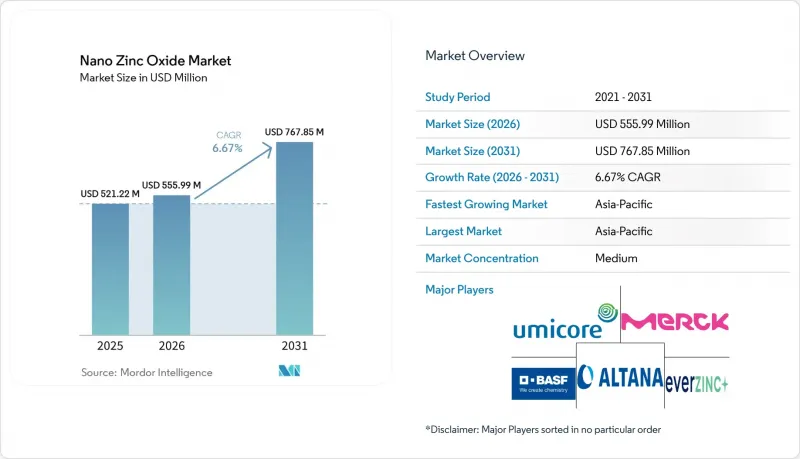
根據 Mordor Intelligence 預測,奈米氧化鋅的市場規模預計將從 2025 年的 5.2122 億美元和 2026 年的 5.5599 億美元成長到 2031 年的 7.6785 億美元,2026 年至 2031 年的複合年成長率為 6.67%。
本報告按類型(包覆型和非包覆型奈米氧化鋅)、形態(粉末和分散體/漿料)、應用領域(個人護理和化妝品、油漆和塗料、電子產品、紡織品、橡膠和塑膠、藥品及其他)以及地區(亞太地區、北美地區、歐洲地區、南美地區以及中東和非洲地區)進行細分。市場預測以美元計價。
全球奈米氧化鋅市場趨勢與洞察
防曬油中非奈米二氧化鈦替代品的監管趨勢
對二氧化鈦的強化監管改變了防曬油的創新方向。消費者安全科學委員會 (SCCS) 於 2024 年加強了對奈米二氧化鈦的審查,促使配方研發人員優先考慮氧化鋅,其粒徑略高於 100 奈米的閾值。這使得產品既可以避免奈米標籤,又能保持透明度。同時,由於美國食品藥物管理局(FDA) 尚未解決一項專論問題,12 種有機防曬劑仍處於不確定狀態,而氧化鋅則保持其一級防曬劑的地位,進一步鞏固了其作為安全港的優勢。像 Solesence 這樣的供應商透過應用氧化鋁或有機矽烷外殼,在實現高 SPF 值的同時,最大限度地減少了泛白現象,這一能力已獲得澳洲藥品管理局 (TGA) 的本地批准。在 SCCS 於 2025 年 5 月決定禁止使用 4-甲基亞芐基樟腦後,市場諮詢量激增,鞏固了氧化鋅作為少數幾種全球統一的UV防曬之一的地位。這些監管趨勢表明,礦物活性成分將繼續在已開發市場的高階防曬油產品發布中佔據主導地位。
Mini-LED/µ-LED背板在電子設備中的應用日益廣泛。
顯示器製造商正轉向使用鋁摻雜或鎵摻雜的氧化鋅作為經濟高效的透明導電材料。根據2024年發表的一項同儕審查研究,採用原子層沉積(ALD)技術製備的AZO薄膜表面電阻率低於10 Ω/sq,可見光透過率超過85%,符合4K和8K面板的規格要求。在日本和韓國,這些薄膜已應用於高階電視,預計到2025年出貨量將超過200萬台。中國mini-LED背光產能的快速擴張進一步推動了區域需求。由於氧化鋅可在低溫溶液中加工,因此也適用於軟性穿戴式電子設備,隨著micro-LED架構的商業性普及,奈米氧化鋅市場預計將持續成長。
火焰噴射合成需要較高的資本支出(CAPEX)和營運費用(OPEX)。
建造一座年產能1萬噸的火焰噴塗工廠,需要400萬至700萬美元用於反應器、除塵器和污染控制設備。由於天然氣火焰和廢氣洗滌,每噸營運成本高達800至1200美元,這給西方公司的利潤率帶來了壓力,尤其是在歐盟碳排放權價格預計到2025年將超過每噸80歐元(約93.20美元)的情況下。雖然中試規模的水熱項目已實現成本持平,但由於成核反應速率問題,其規模化生產面臨挑戰。在連續水熱加工技術成熟之前,擁有較低公用事業收費的中國生產商將保持結構性的成本優勢,從而抑制整個奈米氧化鋅市場的價格上漲。
細分市場分析
由於採用了表面處理技術,塗層產品能夠降低光催化活性,並在防曬油中呈現更不明顯的塗層效果,預計到2025年,塗層產品將佔據奈米氧化鋅市場62.21%的佔有率。每公斤2-5美元的額外成本主要由那些優先考慮消費者美學和珊瑚礁安全的個人護理品牌承擔。雖然未塗佈產品的市佔率較小,但預計將以6.88%的複合年成長率推動市場成長,因為藥物遞送技術的開發者需要純淨的表面以實現最佳的細胞吸收。 2024年發布的藥物測試結果顯示,未塗層奈米顆粒的生物利用度為60%,而塗層產品的生物利用度僅35-40%。監管方面的細微差別至關重要。塗層產品通常需要單獨的歐盟REACH(化學品註冊、評估、授權和限制)文件,這為新進入者構成了准入門檻。 Advance ZincTek 已提前投資於 REACH 和 TGA(治療藥物管理局)的合規性,並已做好準備,以滿足歐洲禁用 4-MBC 後激增的需求。
其次,擁有塗層相關智慧財產權組合的公司將獲得競爭保護。 Solesence 擁有 10 項美國專利和 100 多項國際專利申請,並正利用其獨家經營權與BASF談判長期供應協議。隨著消費品牌為尋求透明度而整合供應商,塗層產品仍將是奈米氧化鋅市場的價格基準,而未塗層產品的成長將開拓利潤更高的醫藥管道。
區域分析
預計到2025年,亞太地區將佔全球銷售額的48.11%,並在預測期(2026-2031年)以7.74%的複合年成長率成長。這主要得益於中國低成本火焰噴塗設備的普及以及日本電子產品市場的需求。中國供應商如滬正和SAT NANO正以每公斤1.50-2.13美元的價格銷售通用型奈米氧化鋅粉末,比歐美價格低40%。由於品質波動限制了其在高價值醫藥級奈米氧化鋅市場的滲透,日本和澳洲公司則專注於高階細分市場。印度在生產關聯激勵計畫(PLI)下化妝品產業的蓬勃發展,以及Rubamin公司將產能擴大至每年5萬噸,都增強了南亞地區對奈米氧化鋅市場動態日益成長的影響力。
2025年,北美市場佔有率的提升得益於消費者對清潔美容產品日益成長的偏好以及對電動車基礎設施的投資。 Solesense公司2024年的累計為5,230萬美元,其中85%來自成品消費品,顯示該公司能夠在品牌一線附近創造價值。 2025年12月,美韓鋅業公司簽署了一項契約,將在田納西州建造一座價值67億至74億美元的冶煉廠,這將確保到2029年美國國內超特高品位(SHG)鋅的供應,從而降低區域奈米氧化鋅市場參與企業的原料風險。
在歐洲,由於REACH法規申請文件的成本高昂以及歐洲化學安全委員會(SCCS)的監管體系,合規門檻很高,這使得BASF和默克集團等老牌企業佔優勢。 2025年5月對4-溴甲烷化物(4-MBC)的禁令刺激了對礦物基UV防曬的需求,但根據Advance ZincTech的季度報告,其在歐洲的銷售額一直維持在41萬澳元,表明配方核准週期較長。純度為99.99%或更高的鋅供應仍然緊張,歐盟製造商正試圖透過與哈薩克和挪威的冶煉廠簽訂承購協議來實現供應來源多元化。
其他好處
- Excel格式的市場預測(ME)表
- 3個月的分析師支持
目錄
第1章:引言
- 研究假設和市場定義
- 調查範圍
第2章:調查方法
第3章執行摘要
第4章 市場狀況
- 市場概覽
- 市場促進因素
- 防曬油領域監管轉向非奈米二氧化鈦替代品
- 在有背板的電子設備中擴大使用微型LED/μLED。
- 用於頻繁接觸的公共設施的抗菌表面塗層
- 歐盟微塑膠法規正在推動可生物分解的紫外線包裝油墨的應用。
- 用於電動車快速充電突波保護的氧化鋅壓敏陶瓷
- 市場限制因素
- 火焰噴射合成需要較高的資本支出(CAPEX)和營運費用(OPEX)。
- 更嚴格的奈米金屬職業暴露限值
- 純度為99.9%及以上的鋅原料的供應狀況及價格波動情況。
- 價值鏈分析
- 波特五力模型
第5章 市場規模與成長預測
- 按類型
- 包覆奈米氧化鋅
- 未包覆奈米氧化鋅
- 按形式
- 粉末
- 分散體/漿料
- 透過使用
- 個人護理和化妝品
- 油漆和塗料
- 電子學
- 紡織品
- 橡膠和塑膠
- 製藥
- 其他用途(紡織品、橡膠等)
- 按地區
- 亞太地區
- 中國
- 日本
- 印度
- 韓國
- ASEAN
- 其他亞太國家
- 北美洲
- 美國
- 加拿大
- 墨西哥
- 歐洲
- 德國
- 英國
- 法國
- 義大利
- 西班牙
- 俄羅斯
- 北歐國家
- 其他歐洲國家
- 南美洲
- 巴西
- 阿根廷
- 其他南美國家
- 中東和非洲
- 沙烏地阿拉伯
- 南非
- 其他中東和非洲國家
- 亞太地區
第6章 競爭情勢
- 市場集中度
- 策略趨勢
- 市佔率和排名分析
- 公司簡介
- Advanced NanoTech Lab
- ALTANA
- American Elements
- BASF
- EverZinc
- Inframat Advanced Materials LLC
- Intelligent Materials Private Limited
- Merck KGaA
- Nanoshel LLC
- Reade
- SkySpring Nanomaterials, Inc.
- Umicore
- US Research Nanomaterials, Inc.
第7章 市場機會與未來展望
According to Mordor Intelligence, the nano zinc oxide market size is projected to expand from USD 521.22 million in 2025 and USD 555.99 million in 2026 to USD 767.85 million by 2031, registering a CAGR of 6.67% between 2026 and 2031.
This report is Segmented by Type (Coated Nano Zinc Oxide and Uncoated Nano Zinc Oxide), Form (Powder and Dispersion/Slurry), Application (Personal Care and Cosmetics, Paints and Coatings, Electronics, Textiles, Rubber and Plastics, Pharmaceuticals, and More), and Geography (Asia-Pacific, North America, Europe, South America, and Middle-East and Africa). The Market Forecasts are Provided in Terms of Value (USD).
Global Nano Zinc Oxide Market Trends and Insights
Regulatory Shift Toward Non-Nano TiO2 Alternatives in Sunscreens
Expanded scrutiny of titanium dioxide has redirected sunscreen innovation. The Scientific Committee on Consumer Safety (SCCS) intensified its review of nano-TiO2 during 2024, prompting formulators to prioritize zinc oxide that stays just above the 100-nm threshold, thereby avoiding nano labeling while preserving transparency. Concurrently, the US Food and Drug Administration (FDA)'s unresolved monograph leaves 12 organic filters in limbo, whereas zinc oxide retains Category I status, reinforcing its safe-harbor advantage. Suppliers such as Solesence apply aluminum-oxide and organosilane shells that deliver high SPF with minimal whitening, a capability validated by its Australian TGA site clearance. Market inquiries rose sharply after the May 2025 SCCS ban on 4-methylbenzylidene camphor, consolidating zinc oxide's position as one of the few globally harmonized UV filters. These converging regulations are forecast to keep mineral actives at the forefront of premium sun-care launches across developed economies.
Rising Use in Mini-LED/µ-LED Backplane Electronics
Display manufacturers are transitioning to aluminum- or gallium-doped zinc oxide as a cost-efficient transparent conductor. Peer-reviewed 2024 studies showed atomic-layer-deposited AZO films achieving sheet resistance below 10 Ω/sq with over 85% visible-light transmittance, meeting 4K and 8K panel specifications. Japan and South Korea integrated these films into premium televisions that shipped in excess of 2 million units in 2025. China's rapid capacity build-out for mini-LED backlights further elevates regional demand. Because zinc oxide can be solution-processed at low temperatures, the material also aligns with flexible and wearable electronics, positioning the nano zinc oxide market for continued expansion as micro-LED architectures scale commercially.
High CAPEX/OPEX for Vapor-Phase Flame-Spray Synthesis Routes
Building a 10,000 tons per year flame-spray plant requires USD 4-7 million for reactors, precipitators, and pollution controls. Operating costs of USD 800-1,200 per ton, driven by natural-gas flames and exhaust scrubbing, squeeze Western margins, especially with EU carbon allowances exceeding EUR 80 (~USD 93.20) per ton in 2025. Pilot hydrothermal projects achieved cost parity but face scalability challenges due to nucleation kinetics. Until continuous hydrothermal processing matures, Chinese producers with lower utility tariffs retain a structural cost edge, restraining price realization across the nano zinc oxide market.
Other drivers and restraints analyzed in the detailed report include:
- Antibacterial Surface Coatings for High-Touch Public Assets
- EU Micro-Plastics Ban Spurring Bio-Degradable UV-Packaging Inks
- Stricter Occupational Exposure Limits for Nano-Metals
For complete list of drivers and restraints, kindly check the Table Of Contents.
Segment Analysis
Coated variants secured 62.21% nano zinc oxide market share in 2025, owing to surface treatments that reduce photocatalysis and deliver an invisible finish in sunscreens. The premium added cost of USD 2-5/kg is absorbed by personal-care brands that prioritize consumer aesthetics and reef safety. Uncoated grades, though smaller, are predicted to outpace with a 6.88% CAGR as drug-delivery developers need pristine surfaces for optimal cell uptake. Pharmaceutical trials published in 2024 showed 60% bioavailability for uncoated nanoparticles versus 35-40% for coated ones. Regulatory nuance is pivotal: coated grades often require separate EU REACH (Registration, Evaluation, Authorisation and Restriction of Chemicals) dossiers, posing a hurdle for new entrants. Advance ZincTek invested early in REACH and TGA (Therapeutic Goods Administration) compliance, positioning itself for post-4-MBC demand spikes in Europe.
Second-order effects include competitive protection for firms holding coating IP portfolios. Solesence lists 10 US patents and over 100 foreign filings, leveraging exclusivity to negotiate long-term supply agreements with BASF. As consumer brands consolidate suppliers for transparency, the coated segment will remain the pricing anchor of the nano zinc oxide market, while uncoated growth taps higher-margin pharmaceutical channels.
Geography Analysis
Asia-Pacific held 48.11% of 2025 revenue, with a forecast of 7.74% CAGR during the forecast period (2026-2031), led by China's low-cost flame-spray plants and Japan's electronics demand. Chinese suppliers such as Huzheng and SAT NANO sell commodity powder at USD 1.50-2.13/kg, undercutting Western prices by up to 40%. Quality variability limits penetration in high-value pharma grades, allowing Japanese and Australian players to serve premium niches. India's cosmetics boom under the PLI scheme and Rubamin's 50,000 tons per year capacity extension reinforce South Asia's emerging influence over nano zinc oxide market dynamics.
North America's 2025 market share was buoyed by clean-beauty preferences and EV infrastructure investment. Solesence booked USD 52.3 million revenue in 2024, with finished consumer products representing 85% of sales, demonstrating value capture closer to the brand front line. The December 2025 U.S.-Korea Zinc deal to build a USD 6.7-7.4 billion smelter in Tennessee secures domestic Super Special High Grade (SHG) zinc supply by 2029, mitigating feedstock risk for regional nano zinc oxide market participants.
In Europe, REACH dossier costs and SCCS vigilance create high compliance barriers, favoring incumbents such as BASF and Merck KGaA. The May 2025 4-MBC ban catalyzed mineral UV filter demand, yet Advance ZincTek's interim report showed flat European sales at AUD 0.41 million, illustrating long formulary qualification cycles. Supply tightness persists for more than or equal to 99.99% purity zinc, prompting EU manufacturers to diversify sourcing via off-take agreements with Kazakhstan and Norway smelters.
- Advanced NanoTech Lab
- ALTANA
- American Elements
- BASF
- EverZinc
- Inframat Advanced Materials LLC
- Intelligent Materials Private Limited
- Merck KGaA
- Nanoshel LLC
- Reade
- SkySpring Nanomaterials, Inc.
- Umicore
- US Research Nanomaterials, Inc.
Additional Benefits:
- The market estimate (ME) sheet in Excel format
- 3 months of analyst support
TABLE OF CONTENTS
1 Introduction
- 1.1 Study Assumptions and Market Definition
- 1.2 Scope of the Study
2 Research Methodology
3 Executive Summary
4 Market Landscape
- 4.1 Market Overview
- 4.2 Market Drivers
- 4.2.1 Regulatory shift toward non-nano TiO2 alternatives in sunscreens
- 4.2.2 Rising use in mini-LED/µ-LED backplane electronics
- 4.2.3 Antibacterial surface coatings for high-touch public assets
- 4.2.4 EU micro-plastics ban spurring bio-degradable UV-packaging inks
- 4.2.5 ZnO varistor ceramics for EV fast-charging surge protection
- 4.3 Market Restraints
- 4.3.1 High CAPEX/OPEX for vapor-phase flame-spray synthesis routes
- 4.3.2 Stricter occupational exposure limits for nano-metals
- 4.3.3 Volatile availability-pricing of more than or equal to 99.9% purity Zn feedstock
- 4.4 Value Chain Analysis
- 4.5 Porter's Five Forces
- 4.5.1 Threat of New Entrants
- 4.5.2 Bargaining Power of Buyers
- 4.5.3 Bargaining Power of Suppliers
- 4.5.4 Threat of Substitutes
- 4.5.5 Degree of Competition
5 Market Size and Growth Forecasts (Value)
- 5.1 By Type
- 5.1.1 Coated Nano Zinc Oxide
- 5.1.2 Uncoated Nano Zinc Oxide
- 5.2 By Form
- 5.2.1 Powder
- 5.2.2 Dispersion/Slurry
- 5.3 By Application
- 5.3.1 Personal Care and Cosmetics
- 5.3.2 Paints and Coatings
- 5.3.3 Electronics
- 5.3.4 Textiles
- 5.3.5 Rubber and Plastics
- 5.3.6 Pharmaceuticals
- 5.3.7 Other Applications (Textiles, Rubber, and More)
- 5.4 By Geography
- 5.4.1 Asia-Pacific
- 5.4.1.1 China
- 5.4.1.2 Japan
- 5.4.1.3 India
- 5.4.1.4 South Korea
- 5.4.1.5 ASEAN Countries
- 5.4.1.6 Rest of Asia-Pacific
- 5.4.2 North America
- 5.4.2.1 United States
- 5.4.2.2 Canada
- 5.4.2.3 Mexico
- 5.4.3 Europe
- 5.4.3.1 Germany
- 5.4.3.2 United Kingdom
- 5.4.3.3 France
- 5.4.3.4 Italy
- 5.4.3.5 Spain
- 5.4.3.6 Russia
- 5.4.3.7 NORDIC Countries
- 5.4.3.8 Rest of Europe
- 5.4.4 South America
- 5.4.4.1 Brazil
- 5.4.4.2 Argentina
- 5.4.4.3 Rest of South America
- 5.4.5 Middle-East and Africa
- 5.4.5.1 Saudi Arabia
- 5.4.5.2 South Africa
- 5.4.5.3 Rest of Middle-East and Africa
- 5.4.1 Asia-Pacific
6 Competitive Landscape
- 6.1 Market Concentration
- 6.2 Strategic Moves
- 6.3 Market Share(%)/Ranking Analysis
- 6.4 Company Profiles (includes Global Overview, Market Overview, Core Segments, Financials, Strategic Information, Products and Services, Recent Developments)
- 6.4.1 Advanced NanoTech Lab
- 6.4.2 ALTANA
- 6.4.3 American Elements
- 6.4.4 BASF
- 6.4.5 EverZinc
- 6.4.6 Inframat Advanced Materials LLC
- 6.4.7 Intelligent Materials Private Limited
- 6.4.8 Merck KGaA
- 6.4.9 Nanoshel LLC
- 6.4.10 Reade
- 6.4.11 SkySpring Nanomaterials, Inc.
- 6.4.12 Umicore
- 6.4.13 US Research Nanomaterials, Inc.
7 Market Opportunities and Future Outlook
- 7.1 White-space and Unmet-need Assessment

 2026-2030年全球氧化鋅市場
 氧化鋅塊市場報告:趨勢、預測與競爭分析(至2035年)
 氧化鋅:市場佔有率分析、產業趨勢與統計、成長預測(2026-2031)
 氧化鋅市場:2026-2032年全球市場預測(依產品類型、形態、等級、應用、最終用途及分銷通路分類)
 奈米氧化鋅市場規模、佔有率和成長分析:按類型、形態、應用、粒徑、純度、終端用戶產業和地區分類-2026-2033年產業預測
 奈米氧化鋅市場報告:按類型、應用和地區分類(2026-2034年)
 全球氧化鋅市場(至 2031 年):按製造流程(間接法、直接法和濕化學法)、等級(標準級、加工級、USP 級和 FCC 級)、應用(橡膠、陶瓷、化學品、化妝品和個人護理用品以及藥品)和地區分類。
 全球氧化鋅市場規模、佔有率、趨勢和成長分析報告(2026-2034)
 2026年全球氧化鋅市場報告
 氧化鋅市場-全球產業規模、佔有率、趨勢、機會和預測,按形態、最終用戶、地區和競爭格局分類,2020-2030年預測