


 |
市場調查報告書
商品編碼
2114934
光電感測器:市場佔有率分析、產業趨勢與統計、成長預測(2026-2031)Photoelectric Sensor - Market Share Analysis, Industry Trends & Statistics, Growth Forecasts (2026 - 2031) |
||||||

※ 本網頁內容可能與最新版本有所差異。詳細情況請與我們聯繫。
根據 Mordor Intelligence 預測,光電感測器市場規模將從 2025 年的 20.2 億美元成長到 2026 年的 21.6 億美元,然後在 2031 年達到 30.5 億美元,2026 年至 2031 年的複合年成長率為 7.12%。
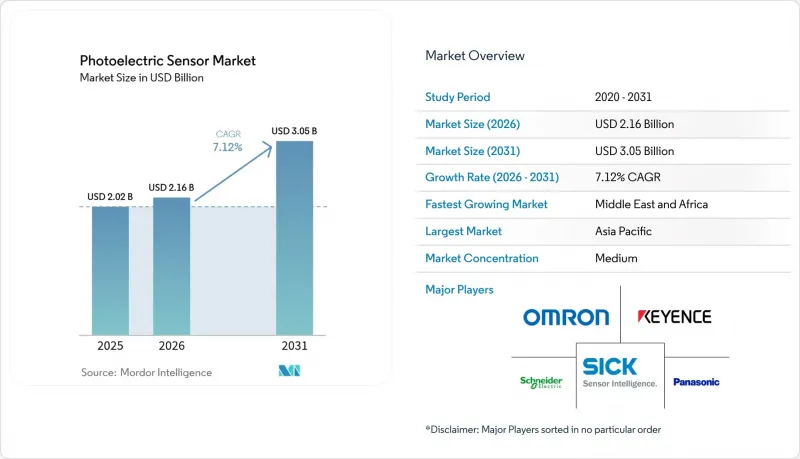
本報告按類型(雷射、光纖、其他)、檢測技術(對射式、反射式、其他)、機殼/安裝類型(圓柱形(M8-M30)、矩形/立方體、其他)、終端用戶行業(消費電子、汽車/電動車、其他)和地區進行細分。市場預測以美元計價。
全球光電感測器市場趨勢及洞察
加速引進工業4.0生產線
在工廠中,正在建立一個複雜的智慧感測器網路,將即時數據傳輸到邊緣控制器和雲端平台,從而實現預測性維護,並將意外停機時間減少高達 30%。光電感測器向機械臂和輸送機系統提供高頻位置訊息,實現自適應控制,從而減少廢棄物和能源消耗。 IO-Link 協定已成為事實上的數位介面,允許將診斷參數直接傳輸到 ERP 控制面板。據亞太地區的生產線安裝商稱,感測器升級的投資回收期不到 18 個月,因為增加的運轉率足以抵消初始硬體成本。 「即插即用」光電元件的普及進一步減輕了試運行負擔,使中小型製造商更容易採用工業自動化。
政府為智慧工廠維修提供稅額扣抵計劃
在美國,聯邦研發稅收稅額扣抵持續擴大,允許根據第179D條加速折舊自動化硬體。歐盟也正在實施類似的獎勵策略,向安裝節能安全感測器的企業提供高達專案成本20%的現金補貼。德國聯邦教育與研究部(BMBF)已撥款6.5億歐元用於其「融合2040」計劃,以支援先進製造業的整合感測器平台。韓國和新加坡的地方政府也紛紛效仿,推出津貼計劃,補貼與數位轉型相關的員工培訓費用。這些獎勵正在加速採購決策,並促進原本可能被推遲的多條生產線維修。
低成本 3D ToF 相機在短距離揀選領域的廣泛應用。
像泰萊公司(Teledyne)的832x600像素「Hydra3D」這樣的飛行時間(ToF)陣列,如今已能實現小於1毫米的深度精度,並以416幀/秒的速度運行,使機器人單元能夠識別雜亂料箱中形狀不規則的貨物。其價格的不斷下降正在縮小其與高階光電感測器在物流和倉儲作業中的差距。識別完整點雲的能力使系統整合商能夠減少感測器的數量。光電感測器在輸送機上的高速合格/不合格判斷方面仍然具有優勢,而向3D視覺過渡的風險僅限於特定應用場景。
細分市場分析
雷射光電感測器憑藉其無與倫比的精度和遠距離檢測能力,在2025年佔據了光電感測器市場33.58%的佔有率。預計該細分市場將以8.95%的複合年成長率成長,到2031年,雷射光電感測器市場規模預計將達到11.3億美元。高功率紅色雷射晶片價格的下降使得這些裝置即使在對成本要求較高的生產單元中也實用化。在汽車動力傳動系統生產線上,檢測範圍達500毫米的自主型CMOS雷射單元正被用於驗證齒輪嚙合。光纖感測器在焊接車間佔據了穩固的地位,因為電磁雜訊會對傳統電子設備造成不利影響。 IO-Link相容型號的普及使得生產線操作人員能夠收集即時訊號強度和污染警報訊息,從而透過預測性維護製定清潔計畫。平行結構光學技術的創新使得多光束廣域偵測成為可能,提高了對粉塵的偵測精度並減少了誤報。
新推出的反射式陣列感測器兼具易於安裝和寬光束範圍的優點,使其在瓦楞紙板成型機和堆垛機中廣泛應用。砷化鎵奈米脊發射器的應用推動了光學封裝的小型化,並降低了熱負荷,小型化進程正逐季度推進。供應商正在推出可承受乳製品填充車間腐蝕性清洗循環的IP69K不銹鋼外殼。這些進步共同支撐著強勁的成長勢頭,並使雷射感測器繼續保持在光電感測器市場的中心地位。
到2025年,對射式光電感測器將佔總銷售額的40.62%,成為高速沖壓線和製罐製程的核心零件。這些感測器具有開放式安裝特性,在對可靠性要求極高的應用中仍然備受青睞。背景抑制型光電感測器的複合年成長率(CAGR)為10.05%,超越競爭對手,預計將推動光電感測器市場從2026年的5.48億美元成長到2031年的8.85億美元。其光學設計使其能夠在較窄的範圍內識別目標,避免因輸送機和機殼造成的誤檢。機器人系統整合商正在自動導引運輸車(AGV)中使用這些感測器,以實現±1毫米以內的對接精度。反射式感測器適用於空間受限、只能單側安裝的輸送機,其安裝簡便,易於使用。
目前的研究和開發重點是ASIC驅動的自適應閾值技術,該技術使背景抑制單元能夠學習表面光潔度並補償環境光波動。 IO-Link通道將滯後參數暴露給PLC,使控制工程師無需手動調整電位器即可微調偵測曲線。漫射感測器在環境光穩定的條件下有效,並且已被注重成本的封裝設備OEM廠商用於將感測器整合到入門級設備中。在所有檢測技術中,人工智慧演算法增強了消除錯誤訊號和報告污染物積聚的能力,從而提高了系統在多塵、高速環境中的可靠性。
區域分析
預計到2025年,亞太地區將佔全球銷售額的47.40%,主要得益於中國、日本和韓國在智慧工廠領域的大量投資。政府的支持措施,特別是中國的「中國製造2025」計畫(該計畫對智慧設備資本支出提供高達50%的補貼),正在加速感測器的普及應用。國內機器人製造商正在將光電感測功能整合到智慧型手機組裝的拾取放置模組中。日本精密機械製造商正在採用能夠識別半導體晶圓上微米級邊緣的高階雷射設備。
預計中東地區將實現最快成長,複合年成長率將達到13.12%。沙烏地阿拉伯的「2030願景」正在支持建造一座新的金屬加工和化工綜合體,該綜合體從一運作就需要工業4.0連接。艾默生位於達曼的工廠(佔地13,000平方公尺)目前正在生產整合式測量儀器(包括光電感測器)的控制系統。阿拉伯聯合大公國的一個智慧城市示範計畫正在部署戶外相容的逆反射感測器,以實現停車引導和廢棄物通道的自動化,從而在非工業領域開發新的收入來源。
在北美和歐洲,受關鍵供應鏈回流和永續性法規的推動,設備現代化進程穩步推進。美國食品加工企業正在擴大線上檢測範圍,以符合《食品安全現代化法案》(FSMA)的要求。德國汽車原始設備製造商(OEM)正在組裝上實施預測性維護,並整合IO-Link感測器,將診斷資料傳輸到製造執行系統(MES)平台。南美和非洲仍在發展中,但產業工人工資的上漲迫使企業採用基礎自動化系統,為具有成本競爭力的通用感測器創造了長期潛在需求。
其他福利
- Excel格式的市場預測(ME)表
- 3個月的分析師支持
目錄
第1章:引言
- 研究假設和市場定義
- 調查範圍
第2章:調查方法
第3章執行摘要
第4章 市場狀況
- 市場概覽
- 市場促進因素
- 加速引進工業4.0生產線
- 政府為智慧工廠維修提供稅額扣抵計劃
- 高功率紅色雷射振盪器的平均售價(ASP)正在下降。
- 食品飲料產業向「零缺陷」包裝生產線的快速轉變
- 符合新的IEC 61496-5安全標準的光電感測器標準。
- 人工智慧驅動的自動校準減少了維護工作所需的人力。
- 市場限制因素
- 低成本 3D ToF 相機在短距離拾取的廣泛應用。
- 清潔環境中的高匯率
- 砷化鎵的現貨價格波動很大。
- OEM介面協定的分段
- 價值供應鏈分析
- 監理情勢
- 技術展望
- 波特五力分析
第5章 市場規模與成長預測
- 按類型
- 雷射
- 光纖
- LED/紅外線
- 逆反射陣列
- 透過檢測技術
- 光束
- 反光型
- 擴散型
- 背景抑制
- 機殼和安裝類型
- 圓柱形(M8 至 M30)
- 長方體/立方體
- 槽叉
- 微型PCB組裝
- 按最終用戶行業分類
- 家用電子產品
- 汽車和電動旅行
- 飲食
- 包裝器材OEM
- 藥品和醫療設備
- 建築與智慧基礎設施
- 按地區
- 北美洲
- 美國
- 加拿大
- 墨西哥
- 歐洲
- 英國
- 德國
- 法國
- 義大利
- 其他歐洲國家
- 亞太地區
- 中國
- 日本
- 印度
- 韓國
- 其他亞太國家
- 中東
- 以色列
- 沙烏地阿拉伯
- 阿拉伯聯合大公國
- 土耳其
- 其他中東國家
- 非洲
- 南非
- 埃及
- 其他非洲國家
- 南美洲
- 巴西
- 阿根廷
- 南美洲其他地區
- 北美洲
第6章 競爭情勢
- 市場集中度
- 策略趨勢
- 市佔率分析
- 公司簡介
- Omron Corporation
- Keyence Corporation
- Sick AG
- Panasonic Holdings Corporation
- Rockwell Automation Inc.
- Schneider Electric SE
- Pepperl+Fuchs SE
- Banner Engineering Corp.
- Leuze electronic GmbH+Co. KG
- SensoPart Industrie-sensorik GmbH
- HTM Sensors Inc.
- Balluff GmbH
- Autonics Corporation
- IFM Electronic gmbh
- Datasensing SpA
- Fargo Controls Inc.
- Baumer Holding AG
- Contrinex AG
- Eaton Corporation plc
- Wenglor Sensoric GmbH
第7章 市場機會與未來展望
According to Mordor Intelligence, the photoelectric sensor market size is expected to grow from USD 2.02 billion in 2025 to USD 2.16 billion in 2026 and is forecast to reach USD 3.05 billion by 2031 at 7.12% CAGR over 2026-2031.
This report is Segmented by Type (Laser, Fiber-Optic, and More), Detection Technology (Through-Beam, Retro-Reflective and More), Housing / Mounting Style (Cylindrical (M8-M30), Rectangular / Cubic and More), End-User Industry (Consumer Electronics, Automotive and E-Mobility and More), and Geography. The Market Forecasts are Provided in Terms of Value (USD).
Global Photoelectric Sensor Market Trends and Insights
Accelerated Deployment of Industry 4.0 Production Lines
Factories are weaving dense networks of smart sensors that feed real-time data into edge controllers and cloud platforms, allowing predictive maintenance routines that slash unplanned downtime by as much as 30%. Photoelectric sensors furnish high-frequency positional feedback to robotic arms and conveyor systems, permitting adaptive control that limits waste and energy consumption. The IO-Link protocol has become a de-facto digital interface, making it possible to stream diagnostic parameters straight into ERP dashboards. Line installers in APAC report payback periods of less than 18 months on sensor upgrades because higher uptime compensates for initial hardware costs. Broader availability of "plug-and-produce" photoelectric devices further reduces commissioning effort, helping small and mid-size manufacturers adopt industrial automation.
Government Tax-Credit Programmed for Smart-Factory Retrofits
The United States continues to expand federal RandD credits and allows accelerated depreciation for automation hardware under Section 179D. Similar stimulus measures in the European Union funnel up to 20% of project spending into cash rebates when firms add energy-efficient, safety-rated sensors. Germany's BMBF-funded "Fusion 2040" programme set aside EUR 650 million to support integrated sensor platforms for advanced manufacturing. Local authorities in South Korea and Singapore follow suit with grant schemes that reimburse employee training tied to digital transformation. These incentives are bringing forward purchase decisions and supporting multi-line retrofits that might otherwise have been delayed.
Uptake of Low-Cost 3D ToF Cameras in Short-Range Picking
Time-of-flight arrays such as Teledyne's 832 X 600-pixel Hydra3D now deliver sub-millimetre depth accuracy and run at 416 fps, letting robotic cells identify irregular loads in chaotic bins. Their falling price narrows the gap with premium photoelectric sensors in logistics and warehouse operations. The ability to perceive full point clouds gives integrators freedom to cut sensor counts. Nonetheless, photoelectric sensors remain ahead in high-speed pass-fail detection on conveyor belts, keeping displacement risk confined to specific 3D-vision use cases.
Other drivers and restraints analyzed in the detailed report include:
- Falling ASP of High-Power Red-Laser Emitters
- Rapid Shift to Zero-Defect Packaging Lines in F and B
- Volatile Gallium-Arsenide Spot Prices
For complete list of drivers and restraints, kindly check the Table Of Contents.
Segment Analysis
Laser photoelectric sensors commanded a 33.58% photoelectric sensor market share in 2025, reflecting their unrivalled accuracy and long sensing ranges. The segment is forecast to record a 8.95% CAGR, raising the laser photoelectric sensor market size for this segment to USD 1.13 billion by 2031. Price erosion in high-power red-laser dies makes these devices viable even in cost-sensitive production cells. Automotive power-train lines deploy self-contained CMOS laser units with 500 mm detection distance to confirm gear-wheel seating. Fiber-optic variants secure positions in welding booths where electromagnetic noise threatens conventional electronics. The proliferation of IO-Link-enabled models means line operators collect live signal strength and contamination alarms for predictive cleaning schedules. Parallel structured light innovations offer multi-beam coverage that improves detection through dust, reducing false trips.
Emerging retro-reflective array sensors blend easy setup with wide beam reach, useful in carton-forming machines and palletizers. Miniaturization progresses each quarter as gallium arsenide nano-ridge emitters shrink optical packages and trim thermal loads. Suppliers introduce stainless-steel IP69K housings that withstand caustic wash-down cycles in dairy filling rooms. Combined, these advances underpin strong forward momentum and keep the laser category at the centre of the photoelectric sensor market.
Through-beam devices held 40.62% revenue in 2025, forming the backbone of high-speed press lines and canning operations. They remain favoured where open mounting is possible and total reliability is paramount. Background-suppression sensors will outpace rivals at 10.05% CAGR, enlarging their photoelectric sensor market size from USD 548 million in 2026 to USD 885 million by 2031. Their optical design isolates the target within a narrow distance window, preventing false positives from conveyors or enclosures. Robotics integrators specify these sensors on automated guided vehicles for docking accuracy within +-1 mm. Retro-reflective versions support space-restricted conveyors that permit only one-sided mounting, retaining their simplicity with their installation simplicity.
Ongoing R&D focuses on ASIC-driven adaptive thresholds that let background-suppression units learn surface finishes and compensate for ambient light drift. IO-Link channels expose hysteresis parameters to the PLC, letting control engineers fine-tune detection curves without manual potentiometer twists. Diffuse sensors survive where ambient light is stable, serving cost-oriented packaging OEMs that bundle sensors into entry-level machines. Across detection technologies, artificial intelligence algorithms increasingly prune false signals and report contaminant buildup, raising system reliability in dusty, high-speed settings.
Complete Report Scope:
- By Type
- Laser
- Fiber-optic
- LED/Infra-red
- Retro-reflective Array
- By Detection Technology
- Through-beam
- Retro-reflective
- Diffuse
- Background-suppression
- By Housing / Mounting Style
- Cylindrical (M8-M30)
- Rectangular / Cubic
- Slot / Fork
- Miniature PCB-mount
- By End-user Industry
- Consumer Electronics
- Automotive and E-Mobility
- Food and Beverages
- Packaging Machinery OEMs
- Pharmaceuticals and Medical Devices
- Building and Smart Infrastructure
- By Geography
- North America
- United States
- Canada
- Mexico
- Europe
- United Kingdom
- Germany
- France
- Italy
- Rest of Europe
- Asia-Pacific
- China
- Japan
- India
- South Korea
- Rest of Asia-Pacific
- Middle East
- Israel
- Saudi Arabia
- United Arab Emirates
- Turkey
- Rest of Middle East
- Africa
- South Africa
- Egypt
- Rest of Africa
- South America
- Brazil
- Argentina
- Rest of South America
- North America
Geography Analysis
APAC controlled 47.40% of revenue in 2025 as China, Japan, and South Korea invested heavily in intelligent factories. Government incentives, especially China's "Made in China 2025" programme, repay up to 50% of capital expenses on smart equipment, accelerating sensor adoption. Domestic robot makers embed photoelectric detection in pick-and-place modules for smartphone assembly. Japan's precision machinery builders rely on high-end laser models that discern micron-level edges on semiconductor wafers.
The Middle East will grow fastest at 13.12% CAGR. Saudi Arabia's Vision 2030 supports fresh metal-processing and chemical complexes that specify Industry 4.0 connectivity from day one. Emerson's 13,000 m2 Dammam hub now manufactures control systems with integrated measurement instrumentation, including photoelectric sensors. UAE smart-city pilots deploy outdoor-rated retro-reflective sensors to automate parking guidance and waste-handling chutes, opening non-industrial revenue channels.
North America and Europe post steady gains as reshoring of critical supply chains and sustainability mandates drive upgrades. US food processors increase inline inspection to meet FSMA regulations. German automotive OEMs embrace predictive maintenance on assembly lines, embedding IO-Link sensors that stream diagnostics into MES platforms. South America and Africa remain nascent but rising industrial wages push firms to install basic automation, presenting long-term potential for cost-competitive diffuse sensors.
- Omron Corporation
- Keyence Corporation
- Sick AG
- Panasonic Holdings Corporation
- Rockwell Automation Inc.
- Schneider Electric SE
- Pepperl+Fuchs SE
- Banner Engineering Corp.
- Leuze electronic GmbH + Co. KG
- SensoPart Industrie-sensorik GmbH
- HTM Sensors Inc.
- Balluff GmbH
- Autonics Corporation
- IFM Electronic gmbh
- Datasensing S.p.A.
- Fargo Controls Inc.
- Baumer Holding AG
- Contrinex AG
- Eaton Corporation plc
- Wenglor Sensoric GmbH
Additional Benefits:
- The market estimate (ME) sheet in Excel format
- 3 months of analyst support
TABLE OF CONTENTS
1 INTRODUCTION
- 1.1 Study Assumptions and Market Definition
- 1.2 Scope of the Study
2 RESEARCH METHODOLOGY
3 EXECUTIVE SUMMARY
4 MARKET LANDSCAPE
- 4.1 Market Overview
- 4.2 Market Drivers
- 4.2.1 Accelerated deployment of Industry 4.0 production lines
- 4.2.2 Government tax-credit programmes for smart-factory retrofits
- 4.2.3 Falling ASP of high-power red-laser emitters
- 4.2.4 Rapid shift to zero-defect packaging lines in FandB
- 4.2.5 New IEC 61496-5 safety-rated photoelectric standards
- 4.2.6 AI-enabled self-calibration reducing maintenance labour
- 4.3 Market Restraints
- 4.3.1 Uptake of low-cost 3-D ToF cameras in short-range picking
- 4.3.2 High replacement rate in wash-down environments
- 4.3.3 Volatile gallium-arsenide spot prices
- 4.3.4 Fragmented OEM interface protocols
- 4.4 Value/Supply-Chain Analysis
- 4.5 Regulatory Landscape
- 4.6 Technological Outlook
- 4.7 Porter's Five Forces Analysis
- 4.7.1 Bargaining Power of Suppliers
- 4.7.2 Bargaining Power of Buyers
- 4.7.3 Threat of New Entrants
- 4.7.4 Threat of Substitutes
- 4.7.5 Intensity of Competitive Rivalry
5 MARKET SIZE AND GROWTH FORECASTS (VALUE)
- 5.1 By Type
- 5.1.1 Laser
- 5.1.2 Fiber-optic
- 5.1.3 LED/Infra-red
- 5.1.4 Retro-reflective Array
- 5.2 By Detection Technology
- 5.2.1 Through-beam
- 5.2.2 Retro-reflective
- 5.2.3 Diffuse
- 5.2.4 Background-suppression
- 5.3 By Housing / Mounting Style
- 5.3.1 Cylindrical (M8-M30)
- 5.3.2 Rectangular / Cubic
- 5.3.3 Slot / Fork
- 5.3.4 Miniature PCB-mount
- 5.4 By End-user Industry
- 5.4.1 Consumer Electronics
- 5.4.2 Automotive and E-Mobility
- 5.4.3 Food and Beverages
- 5.4.4 Packaging Machinery OEMs
- 5.4.5 Pharmaceuticals and Medical Devices
- 5.4.6 Building and Smart Infrastructure
- 5.5 By Geography
- 5.5.1 North America
- 5.5.1.1 United States
- 5.5.1.2 Canada
- 5.5.1.3 Mexico
- 5.5.2 Europe
- 5.5.2.1 United Kingdom
- 5.5.2.2 Germany
- 5.5.2.3 France
- 5.5.2.4 Italy
- 5.5.2.5 Rest of Europe
- 5.5.3 Asia-Pacific
- 5.5.3.1 China
- 5.5.3.2 Japan
- 5.5.3.3 India
- 5.5.3.4 South Korea
- 5.5.3.5 Rest of Asia-Pacific
- 5.5.4 Middle East
- 5.5.4.1 Israel
- 5.5.4.2 Saudi Arabia
- 5.5.4.3 United Arab Emirates
- 5.5.4.4 Turkey
- 5.5.4.5 Rest of Middle East
- 5.5.5 Africa
- 5.5.5.1 South Africa
- 5.5.5.2 Egypt
- 5.5.5.3 Rest of Africa
- 5.5.6 South America
- 5.5.6.1 Brazil
- 5.5.6.2 Argentina
- 5.5.6.3 Rest of South America
- 5.5.1 North America
6 COMPETITIVE LANDSCAPE
- 6.1 Market Concentration
- 6.2 Strategic Moves
- 6.3 Market Share Analysis
- 6.4 Company Profiles (includes Global-level Overview, Market-level Overview, Core Segments, Financials, Strategic Info, Market Rank/Share, Products and Services, Recent Developments)
- 6.4.1 Omron Corporation
- 6.4.2 Keyence Corporation
- 6.4.3 Sick AG
- 6.4.4 Panasonic Holdings Corporation
- 6.4.5 Rockwell Automation Inc.
- 6.4.6 Schneider Electric SE
- 6.4.7 Pepperl+Fuchs SE
- 6.4.8 Banner Engineering Corp.
- 6.4.9 Leuze electronic GmbH + Co. KG
- 6.4.10 SensoPart Industrie-sensorik GmbH
- 6.4.11 HTM Sensors Inc.
- 6.4.12 Balluff GmbH
- 6.4.13 Autonics Corporation
- 6.4.14 IFM Electronic gmbh
- 6.4.15 Datasensing S.p.A.
- 6.4.16 Fargo Controls Inc.
- 6.4.17 Baumer Holding AG
- 6.4.18 Contrinex AG
- 6.4.19 Eaton Corporation plc
- 6.4.20 Wenglor Sensoric GmbH
7 MARKET OPPORTUNITIES AND FUTURE OUTLOOK
- 7.1 White-space and Unmet-need Assessment

 2026-2030年全球光電感測器市場
 光電感測器市場:全球市場預測(2026-2032)
 四象限檢測器市場報告:趨勢、預測與競爭分析(至2035年)
 全球光電感測器市場規模、佔有率、趨勢和成長分析報告(2026-2034年)
 光電感測器:全球市場佔有率和排名、總收入和需求預測(2026-2032年)全球光電感測器市場:依偵測模式、偵測範圍、結構、光束光源、安裝方式、最終用戶、國家及地區分類-產業分析、市場規模、佔有率及預測(2025-2032年)
 光電感測器市場分析及預測(至2035年):依類型、產品類型、技術、應用、組件、功能、安裝類型及最終用戶分類光電感測器市場分析及預測(至2035年):按類型、產品、技術、應用、組件、最終用戶、安裝類型、解決方案、功能和模式分類
 2026 年至 2035 年光電感測器市場的機會、成長要素、產業趨勢分析與預測。
 2026年全球光電感測器市場報告