

 |
市場調查報告書
商品編碼
1959626
2026 年至 2035 年光電感測器市場的機會、成長要素、產業趨勢分析與預測。Photoelectric Sensor Market Opportunity, Growth Drivers, Industry Trend Analysis, and Forecast 2026 - 2035 |
||||||

2025 年全球光電感測器市場價值 24 億美元,預計到 2035 年將達到 51 億美元,年複合成長率為 8.1%。
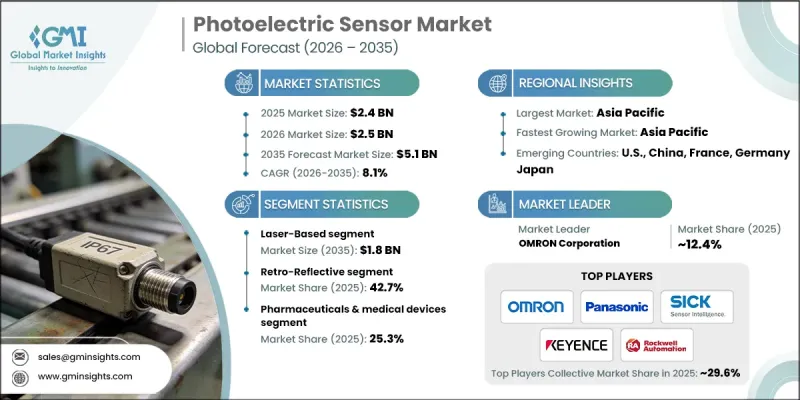
該行業的成長得益於各領域流程自動化和智慧製造的普及。企業擴大使用光電感測器進行產品檢測、計數和檢驗,從而幫助製造商減少誤差並提高生產效率。對自動化物流、電商履約和庫存管理日益成長的需求進一步推動了感測器的應用,因為感測器能夠實現更快的貨物分類、追蹤和精準處理。工業4.0和物聯網技術的整合正在改變市場格局,在智慧工廠環境中實現即時監控、預測性維護和互聯營運。這些互聯感測器能夠提供可操作的洞察,最佳化生產流程,並最大限度地減少停機時間,尤其是在汽車、電子和包裝行業。此外,小型化趨勢正在推動感測器的更廣泛應用,因為緊湊且節省空間的感測器適用於PCB組裝設備、機器人以及其他空間受限的應用。
| 市場範圍 | |
|---|---|
| 開始年份 | 2025 |
| 預測年份 | 2026-2035 |
| 起始值 | 24億美元 |
| 預測金額 | 51億美元 |
| 複合年成長率 | 8.1% |
預計到2035年,雷射光電感測器市場規模將達到18億美元,主要得益於工業環境中對高精度、遠距離檢測的需求。雷射感測器透過聚焦光斑實現對微小物體的精確檢測和定位,在組裝和半導體製造等對一致性要求極高的應用中發揮著至關重要的作用。
預計2026年至2035年間,對射式感測器市場將以9.5%的複合年成長率成長。對射式感測器非常適合高精度、遠距離偵測需求,並且正在協助智慧工廠和高速包裝作業的發展。物聯網感測技術和先進光電設計等技術創新正在提升可靠性、精度和系統整合度,推動製造商採用對射式解決方案。
預計到2025年,北美光電感測器市場佔有率將達到28.2%。該地區的成長主要得益於製造業、物流和包裝行業的快速工業自動化,感測器能夠實現精準的物件檢測和高效的工作流程。工業物聯網(IIoT)、智慧工廠計劃以及嚴格的安全和品質標準的普及,正在加速光電感測器在工業工廠的部署,而現有市場參與者也在不斷創新,以滿足不斷變化的工業需求。
目錄
第1章:調查方法和範圍
第2章執行摘要
第3章業界考察
- 生態系分析
- 供應商情況
- 利潤率分析
- 成本結構
- 每個階段增加的價值
- 影響價值鏈的因素
- 中斷
- 影響產業的因素
- 促進因素
- 工業自動化的廣泛應用
- 工業4.0和智慧工廠概念
- 包裝和物流行業需求不斷成長
- 各領域對高精度感測的需求日益成長
- 人們對能源效率感測器的興趣日益濃厚
- 產業潛在風險與挑戰
- 大量資本支出和營運費用
- 與舊有系統整合
- 市場機遇
- 正在經歷工業化和自動化的地區
- 智慧建築應用範圍的擴大
- 促進因素
- 監管環境
- 北美洲
- 歐洲
- 亞太地區
- 拉丁美洲
- 中東和非洲
- 波特的分析
- PESTEL 分析
- 科技與創新趨勢
- 當前技術趨勢
- 新興技術
- 新興經營模式
- 合規要求
- 專利和智慧財產權分析
- 地緣政治和貿易趨勢
第4章 競爭情勢
- 介紹
- 企業市佔率分析
- 按地區
- 北美洲
- 歐洲
- 亞太地區
- 拉丁美洲
- 中東和非洲
- 按地區
- 主要企業的競爭標竿分析
- 財務績效比較
- 收入
- 利潤率
- 研究與開發
- 產品系列比較
- 產品線廣度
- 科技
- 創新
- 區域擴張比較
- 全球擴張分析
- 服務網路覆蓋
- 按地區分類的市場滲透率
- 競爭定位矩陣
- 領導企業
- 受讓人
- 追蹤者
- 小眾玩家
- 戰略展望矩陣
- 財務績效比較
- 2022-2025 年重大發展
- 併購
- 合作夥伴關係和合資企業
- 技術進步
- 擴張和投資策略
- 數位轉型計劃
- 新興/Start-Ups競爭對手的發展趨勢
第5章 光源市場估算與預測(2022-2035年)
- LED底座
- 雷射基座
- 光纖
第6章 市場估算與預測:依光學配置分類,2022-2035年
- 對射式系統
- 反光
- 漫反射型
第7章 市場估計與預測:依檢測距離分類,2022-2035年
- 短距離:100毫米或更短
- 中等距離:大於 100 毫米至小於 1000 毫米
- 長距離:大於 1,000 毫米至小於 10,000 毫米
- 超遠距離/擴展距離:超過 10,000 毫米
第8章 市場估算與預測:依房屋類型分類,2022-2035年
- 圓柱形
- 矩形/盒形
- 插槽/叉
第9章 市場估計與預測:依最終用戶產業分類,2022-2035年
- 工業製造
- 汽車/運輸設備
- 食品/飲料加工
- 藥品和醫療設備
- 建築自動化和智慧基礎設施
- 電子設備及半導體製造
- 能源、公共產業和基礎設施
- 航太/國防
- 其他
第10章 市場估價與預測:依地區分類,2022-2035年
- 北美洲
- 美國
- 加拿大
- 歐洲
- 德國
- 英國
- 法國
- 西班牙
- 義大利
- 荷蘭
- 亞太地區
- 中國
- 印度
- 日本
- 澳洲
- 韓國
- 拉丁美洲
- 巴西
- 墨西哥
- 阿根廷
- 中東和非洲
- 南非
- 沙烏地阿拉伯
- 阿拉伯聯合大公國
第11章:公司簡介
- OMRON Corporation
- Panasonic Industry Co., Ltd.
- SICK AG
- KEYENCE CORPORATION
- Rockwell Automation
- Balluff Inc
- OPTEX FA CO., LTD.
- Baumer
- Pepperl+Fuchs SE
- TAKEX EUROPE LTD.
- Wenglor
- Schneider Electric
- Banner Engineering Corp.
- Hans Turck GmbH &Co. KG
- Leuze Electronic Pvt. Ltd.
The Global Photoelectric Sensor Market was valued at USD 2.4 billion in 2025 and is estimated to grow at a CAGR of 8.1% to reach USD 5.1 billion by 2035.
The growth of the industry is driven by the widespread adoption of process automation and smart manufacturing across sectors. Companies are increasingly using photoelectric sensors to detect, count, and inspect products, allowing manufacturers to reduce errors and boost production efficiency. Rising demand for automated logistics, e-commerce fulfillment, and inventory management has further propelled adoption, as sensors enable faster sorting, tracking, and precise handling of goods. Integration of Industry 4.0 and IoT technologies is transforming the market, enabling real-time monitoring, predictive maintenance, and connected operations in smart factory environments. These connected sensors provide actionable insights, optimize production workflows, and minimize downtime, particularly in automotive, electronics, and packaging sectors. Additionally, the trend toward miniaturization has made compact, space-efficient sensors suitable for PCB-mounted equipment, robots, and other confined applications, fueling broader adoption.
| Market Scope | |
|---|---|
| Start Year | 2025 |
| Forecast Year | 2026-2035 |
| Start Value | $2.4 Billion |
| Forecast Value | $5.1 Billion |
| CAGR | 8.1% |
The laser-based photoelectric sensor segment is projected to reach USD 1.8 billion by 2035, driven by its demand for high-precision, long-range detection in industrial environments. Laser sensors provide focused light spots for accurate detection of small objects and precise positioning, which is essential for applications requiring consistency, such as assembly lines and semiconductor manufacturing.
The through-beam segment is expected to grow at a CAGR of 9.5% between 2026 and 2035. Through-beam sensors are favored for high-precision, long-distance detection needs, supporting the development of smart factories and high-speed packaging operations. Technological innovations, including IoT-enabled sensing and advanced photoelectric designs, are improving reliability, accuracy, and system integration, prompting manufacturers to adopt through-beam solutions.
North America Photoelectric Sensor Market accounted for a 28.2% share in 2025. The region's growth is supported by rapid industrial automation in manufacturing, logistics, and packaging, where sensors enable precise object detection and streamlined workflows. Adoption of IIoT, smart factory initiatives, and strict safety and quality standards has accelerated implementation in industrial plants, while established market players continue to innovate to meet evolving industrial requirements.
Key players in the Global Photoelectric Sensor Market include Panasonic Industry Co., Ltd., Rockwell Automation, Baumer, Banner Engineering Corp., SICK AG, Hans Turck GmbH & Co. KG, OMRON Corporation, TAKEX EUROPE LTD., OPTEX FA CO., LTD., Wenglor, Leuze electronic Pvt. Ltd., Keyence Corporation, Schneider Electric, Balluff Inc., and Pepperl+Fuchs SE. Companies in the photoelectric sensor market are adopting multiple strategies to strengthen their market presence and maintain a competitive edge. Firms focus on continuous innovation, developing sensors with higher precision, smaller footprints, and enhanced reliability to meet advanced industrial needs. Investments in research and development enable integration of IoT, AI, and predictive maintenance features into sensor solutions. Companies also expand their global footprint through strategic partnerships, mergers, and regional distribution networks. Additionally, they emphasize customer-centric solutions by providing customization, technical support, and training services.
Table of Contents
Chapter 1 Methodology and Scope
- 1.1 Market scope and definition
- 1.2 Research design
- 1.2.1 Research approach
- 1.2.2 Data collection methods
- 1.3 Data mining sources
- 1.3.1 Global
- 1.3.2 Regional/Country
- 1.4 Base estimates and calculations
- 1.4.1 Base year calculation
- 1.4.2 Key trends for market estimation
- 1.5 Primary research and validation
- 1.5.1 Primary sources
- 1.6 Forecast model
- 1.7 Research assumptions and limitations
Chapter 2 Executive Summary
- 2.1 Industry 360° synopsis, 2022 - 2035
- 2.2 Key market trends
- 2.2.1 System type trends
- 2.2.2 Deployment model trends
- 2.2.3 End-user industry trends
- 2.2.4 Regional trends
- 2.3 TAM analysis, 2025-2035
- 2.4 CXO perspectives: Strategic imperatives
- 2.4.1 Executive decision points
- 2.4.2 Critical success factors
- 2.5 Future outlook and strategic recommendations
Chapter 3 Industry Insights
- 3.1 Industry ecosystem analysis
- 3.1.1 Supplier landscape
- 3.1.2 Profit margin analysis
- 3.1.3 Cost structure
- 3.1.4 Value addition at each stage
- 3.1.5 Factor affecting the value chain
- 3.1.6 Disruptions
- 3.2 Industry impact forces
- 3.2.1 Growth drivers
- 3.2.1.1 Widespread adoption of industrial automation
- 3.2.1.2 Industry 4.0 & Smart factory initiatives
- 3.2.1.3 Growing demand in packaging & logistics
- 3.2.1.4 Rising Demand for high precision sensing in sectors
- 3.2.1.5 Growing focus towards energy efficiency sensors
- 3.2.2 Industry pitfalls and challenges
- 3.2.2.1 Significant capital and operational expenditure
- 3.2.2.2 Integration challenges with legacy systems
- 3.2.3 Market opportunities
- 3.2.3.1 Growing regions with rising industrialization and automation
- 3.2.3.2 Expanding adoption in smart buildings
- 3.2.1 Growth drivers
- 3.3 Regulatory landscape
- 3.3.1 North America
- 3.3.2 Europe
- 3.3.3 Asia Pacific
- 3.3.4 Latin America
- 3.3.5 Middle East & Africa
- 3.4 Porter’s analysis
- 3.5 PESTEL analysis
- 3.6 Technology and innovation landscape
- 3.6.1 Current technological trends
- 3.6.2 Emerging technologies
- 3.7 Emerging business models
- 3.8 Compliance requirements
- 3.9 Patent and IP analysis
- 3.10 Geopolitical and trade dynamics
Chapter 4 Competitive Landscape, 2025
- 4.1 Introduction
- 4.2 Company market share analysis
- 4.2.1 By region
- 4.2.1.1 North America
- 4.2.1.2 Europe
- 4.2.1.3 Asia Pacific
- 4.2.1.4 Latin America
- 4.2.1.5 Middle East & Africa
- 4.2.1 By region
- 4.3 Competitive benchmarking of key players
- 4.3.1 Financial performance comparison
- 4.3.1.1 Revenue
- 4.3.1.2 Profit margin
- 4.3.1.3 R&D
- 4.3.2 Product portfolio comparison
- 4.3.2.1 Product range breadth
- 4.3.2.2 Technology
- 4.3.2.3 Innovation
- 4.3.3 Geographic presence comparison
- 4.3.3.1 Global footprint analysis
- 4.3.3.2 Service network coverage
- 4.3.3.3 Market penetration by region
- 4.3.4 Competitive positioning matrix
- 4.3.4.1 Leaders
- 4.3.4.2 Challengers
- 4.3.4.3 Followers
- 4.3.4.4 Niche players
- 4.3.5 Strategic outlook matrix
- 4.3.1 Financial performance comparison
- 4.4 Key developments, 2022-2025
- 4.4.1 Mergers and acquisitions
- 4.4.2 Partnerships and collaborations
- 4.4.3 Technological advancements
- 4.4.4 Expansion and investment strategies
- 4.4.5 Digital transformation initiatives
- 4.5 Emerging/ startup competitors’ landscape
Chapter 5 Market Estimates and Forecast, By Light Source, 2022 - 2035 (USD Billion, Units)
- 5.1 Key trends
- 5.2 LED-Based
- 5.3 Laser-Based
- 5.4 Fiber-Optic
Chapter 6 Market Estimates and Forecast, By Optical Configuration, 2022 - 2035 (USD Billion, Units)
- 6.1 Key trends
- 6.2 Through-Beam
- 6.3 Retro-Reflective
- 6.4 Diffuse
Chapter 7 Market Estimates and Forecast, By Sensing Range, 2022 - 2035 (USD Billion, Units)
- 7.1 Key trends
- 7.2 Short Range: ≤ 100 mm
- 7.3 Medium Range: >100 mm - ≤ 1,000 mm
- 7.4 Long Range: >1,000 mm - ≤ 10,000 mm
- 7.5 Ultra-Long / Extended Range: >10,000 mm
Chapter 8 Market Estimates and Forecast, By Housing Geometry, 2022 - 2035 (USD Billion, Units)
- 8.1 Key trends
- 8.2 Cylindrical
- 8.3 Rectangular / Box
- 8.4 Slot / Fork
Chapter 9 Market Estimates and Forecast, By End-User Industry, 2022 - 2035 (USD Billion, Units)
- 9.1 Key trends
- 9.2 Industrial Manufacturing
- 9.3 Automotive & Transportation
- 9.4 Food & Beverage Processing
- 9.5 Pharmaceuticals & Medical Devices
- 9.6 Building Automation & Smart Infrastructure
- 9.7 Electronics & Semiconductor Manufacturing
- 9.8 Energy, Utilities & Infrastructure
- 9.9 Aerospace & Defense
- 9.10 Others
Chapter 10 Market Estimates and Forecast, By Region, 2022 - 2035 (USD Mn)
- 10.1 Key trends
- 10.2 North America
- 10.2.1 U.S.
- 10.2.2 Canada
- 10.3 Europe
- 10.3.1 Germany
- 10.3.2 UK
- 10.3.3 France
- 10.3.4 Spain
- 10.3.5 Italy
- 10.3.6 Netherlands
- 10.4 Asia Pacific
- 10.4.1 China
- 10.4.2 India
- 10.4.3 Japan
- 10.4.4 Australia
- 10.4.5 South Korea
- 10.5 Latin America
- 10.5.1 Brazil
- 10.5.2 Mexico
- 10.5.3 Argentina
- 10.6 Middle East and Africa
- 10.6.1 South Africa
- 10.6.2 Saudi Arabia
- 10.6.3 UAE
Chapter 11 Company Profiles
- 11.1 OMRON Corporation
- 11.2 Panasonic Industry Co., Ltd.
- 11.3 SICK AG
- 11.4 KEYENCE CORPORATION
- 11.5 Rockwell Automation
- 11.6 Balluff Inc
- 11.7 OPTEX FA CO., LTD.
- 11.8 Baumer
- 11.9 Pepperl+Fuchs SE
- 11.10 TAKEX EUROPE LTD.
- 11.11 Wenglor
- 11.12 Schneider Electric
- 11.13 Banner Engineering Corp.
- 11.14 Hans Turck GmbH & Co. KG
- 11.15 Leuze Electronic Pvt. Ltd.

 2026-2030年全球光電感測器市場
 光電感測器:市場佔有率分析、產業趨勢與統計、成長預測(2026-2031)
 光電感測器市場:全球市場預測(2026-2032)
 四象限檢測器市場報告:趨勢、預測與競爭分析(至2035年)
 全球光電感測器市場規模、佔有率、趨勢和成長分析報告(2026-2034年)
 光電感測器:全球市場佔有率和排名、總收入和需求預測(2026-2032年)全球光電感測器市場:依偵測模式、偵測範圍、結構、光束光源、安裝方式、最終用戶、國家及地區分類-產業分析、市場規模、佔有率及預測(2025-2032年)
 光電感測器市場分析及預測(至2035年):依類型、產品類型、技術、應用、組件、功能、安裝類型及最終用戶分類光電感測器市場分析及預測(至2035年):按類型、產品、技術、應用、組件、最終用戶、安裝類型、解決方案、功能和模式分類
 2026年全球光電感測器市場報告