


 |
市場調查報告書
商品編碼
2114923
檸檬酸鋅:市場佔有率分析、產業趨勢與統計、成長預測(2026-2031)Zinc Citrate - Market Share Analysis, Industry Trends & Statistics, Growth Forecasts (2026 - 2031) |
||||||

※ 本網頁內容可能與最新版本有所差異。詳細情況請與我們聯繫。
據 Mordor Intelligence 稱,2025 年檸檬酸鋅市值為 21.4 億美元,預計到 2031 年將從 2026 年的 22.3 億美元成長至 27.3 億美元,預測期(2026-2031 年)複合年成長率為 4.12%。
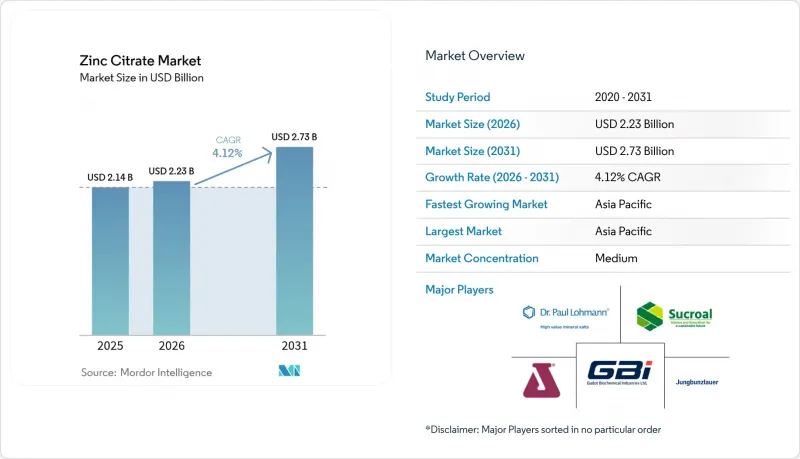
本報告按形態(二水合物、三水合物)、純度等級(醫藥級、食品飲料級、工業級)、應用領域(個人護理、醫療保健、食品飲料、農業及其他應用)和地區(亞太地區、北美地區、歐洲地區、南美地區、中東和非洲)進行細分。市場預測以美元計價。
全球檸檬酸鋅市場趨勢及洞察
免疫保健品的需求正在飆升。
隨著疫情後人們對微量營養素缺乏症的認知不斷提高,檸檬酸鋅已成為旨在改善免疫功能的配方中的核心成分。歐洲食品安全局 (EFSA) 對鋅在正常免疫功能中的作用給予了認可,進一步支持了這一觀點。臨床研究表明,補充檸檬酸鋅可以改善嗜中性白血球趨化性和自然殺手細胞 (NK 細胞) 活性,這對吸收效率較低的老年人尤其重要。與無機鹽相比,檸檬酸鋅具有更高的吸收率,因此被定位為高階產品。將檸檬酸鋅與益生菌菌株(例如克勞氏鹼桿菌)結合使用,可以增強腸道與免疫系統的相互作用,從而為配方研發人員帶來更多價值。穩定的生物利用度也支持了其治療功效的說法,而醫藥級需求則最為有利。因此,北美和歐洲的老化人口確保了檸檬酸鋅市場穩定的市場需求。
口腔清潔用品配方中加速採用
臨床研究表明,在牙膏中添加檸檬酸鋅可使牙齦炎減少13.4%,牙齦出血減少55.3%,證實了其對常見牙周致病菌的抗菌活性。與氯化鋅和硫酸鋅不同,這種螯合化合物在提供類似功效的同時,不會產生苦味或金屬味,這對於提高消費者接受度至關重要。 2024年,化妝品成分安全專家委員會重申了檸檬酸鋅的安全性,消除了先前阻礙其推廣應用的監管障礙。檸檬酸鋅與精胺酸結合使用,可對生物膜破壞產生協同效應,在降低鋅含量的同時提高成本效益。消費者對無鋁個人保健產品的廣泛需求,正在加速推動除臭劑和止汗劑中對檸檬酸鋅的需求,進一步增強了檸檬酸鋅的市場前景。
低成本替代品(氧化鋅、葡萄糖酸鋅、硫酸鋅)
由於氧化鋅的價格遠低於檸檬酸鋅,因此已成為對價格敏感的作物營養劑和散裝製劑的首選。葡萄糖酸鋅以更低的成本實現了與檸檬酸鋅相當的吸收率(60.9%),正在蠶食檸檬酸鋅在大眾市場補充劑中的高階地位。工業用戶仍然偏愛硫酸鋅,因為其供應鏈和法律規範完善。隨著鋅商品市場週期性地進入供過於求階段,價格差距不斷擴大,迫使製劑生產商透過宣稱更強的功效來證明額外成本的合理性。這對檸檬酸鋅市場構成了短期挑戰。
細分市場分析
到2025年,三水合檸檬酸鋅將佔據檸檬酸鋅市場61.87%的佔有率。這反映了其均衡的鋅含量和優異的加工特性。由於膳食補充劑生產商青睞其低吸濕性(有利於片劑和膠囊的穩定生產),預計到2031年,三水合檸檬酸鋅的複合年成長率將達到4.62%。三水合檸檬酸鋅在農業領域也具有應用潛力。奈米顆粒形式的三水合檸檬酸鋅能被葉片快速吸收,這在生物強化項目擴展中具有優勢。二水合檸檬酸鋅仍用於對溶解度要求較高的特定醫藥應用領域,但其操作複雜性限制了其成長。飲料生產商和個人保健產品配方開發商需要能夠在較寬的pH範圍內保持穩定的成分,因此,三水合檸檬酸鋅廣泛的兼容性有望使其繼續在檸檬酸鋅市場佔據主導地位。
針對三水合物結晶製程最佳化的生產基礎設施進一步促進了規模經濟,即使原物料成本上漲,也能保持價格競爭力。鑑於其在酸性飲料和鹼性牙膏環境中的穩定性,預計三水合物檸檬酸鋅產品的市場規模將在預測期內穩步成長。
區域分析
預計到2025年,亞太地區將佔全球檸檬酸鋅市場佔有率的39.05%,並在2031年之前以4.65%的複合年成長率成長。中國在檸檬酸生產領域的領先地位確保了原料的穩定供應,而印度的營養強化和生物強化計畫則推動了農業領域的強勁需求。都市區的壯大促進了膳食補充劑和個人保健產品的銷售,而區域永續性舉措,例如印度斯坦鋅業公司(Hindustan Zinc)的低碳品牌“EcoZen”,也十分契合尋求更環保礦產的跨國買家的需求。
另一方面,北美擁有成熟的保健品消費文化和強勁的軟糖維生素銷售。 FDA的GRAS認證促進了產品上市,但由於其高度依賴進口精製鋅(76%),供應鏈對外部衝擊較為敏感。高度個人化的平台推動了螯合礦物質的銷售,並支撐了其高階定價,但全部區域成長速度落後於新興經濟體。
在歐洲,由於製藥和口腔護理產品生產基地的支撐,市場對鋅的需求穩定。歐洲食品安全局 (EFSA) 對螯合鋅的積極態度降低了監管門檻,潔淨標示趨勢也備受關注。儘管地緣政治貿易緊張局勢和英國脫歐導致成本上升,但供應商多元化降低了供應中斷的風險。如果試驗研究證明東歐的生物強化計畫比硫酸鹽農業更具成本效益,則有望創造新的農業需求。建議使用低劑量、高生物利用度鋅製劑的環境法規進一步凸顯了檸檬酸鋅的環境效益。
其他福利
- Excel格式的市場預測(ME)表
- 3個月的分析師支持
目錄
第1章:引言
- 研究假設和市場定義
- 調查範圍
第2章:調查方法
第3章執行摘要
第4章 市場狀況
- 市場概覽
- 市場促進因素
- 免疫保健品的需求正在飆升。
- 口腔清潔用品配方中加速採用
- 鋅強化食品和飲料產品的成長
- 對軟糖和螯合劑型的需求不斷成長
- 農業微量元素生物強化計劃
- 市場限制因素
- 低成本替代品(氧化鋅、葡萄糖酸鋅、硫酸鋅)
- 檸檬酸原料價格波動
- 關於相對抗菌效果的臨床討論
- 價值鏈分析
- 波特五力模型
第5章 市場規模與成長預測
- 按形式
- 二水合物
- 三水合物
- 按純度等級
- 醫藥級
- 食品飲料級
- 技術級
- 透過使用
- 個人護理
- 衛生保健
- 飲食
- 農業
- 其他用途(工業等)
- 按地區
- 亞太地區
- 中國
- 日本
- 印度
- 韓國
- ASEAN
- 其他亞太國家
- 北美洲
- 美國
- 加拿大
- 墨西哥
- 歐洲
- 德國
- 英國
- 法國
- 義大利
- 西班牙
- 俄羅斯
- 北歐國家
- 其他歐洲國家
- 南美洲
- 巴西
- 阿根廷
- 其他南美國家
- 中東和非洲
- 沙烏地阿拉伯
- 南非
- 其他中東和非洲國家
- 亞太地區
第6章 競爭情勢
- 市場集中度
- 策略趨勢
- 市佔率和排名分析
- 公司簡介
- Ava Chemicals.
- Dr. Paul Lohmann GmbH & Co. KGaA
- Gadot Biochemical Industries Ltd.
- Global Calcium
- Henan Alfa Chemical Co., Ltd.
- Jost Chemical Co.
- Jungbunzlauer Suisse AG
- Kronox Lab Sciences Ltd.
- NINGXIANG Xinyang Chemical Co., Ltd.
- Noah Chemicals
- Salvi Chemical Industries Ltd.
- Sisco Research Laboratories Pvt. Ltd.
- Sucroal
- Thermo Fisher Scientific Inc.
第7章 市場機會與未來展望
According to Mordor Intelligence, the zinc citrate market size was valued at USD 2.14 billion in 2025 and estimated to grow from USD 2.23 billion in 2026 to reach USD 2.73 billion by 2031, at a CAGR of 4.12% during the forecast period (2026-2031).
This report is Segmented by Form (Dihydrate, Trihydrate), Purity Grade (Pharma Grade, Food & Beverage Grade, Technical Grade), Application (Personal Care, Healthcare, Food & Beverage, Agriculture, Other Applications), and Geography (Asia-Pacific, North America, Europe, South America, Middle East and Africa). The Market Forecasts are Provided in Terms of Value (USD).
Global Zinc Citrate Market Trends and Insights
Demand Surge for Immune-Health Supplements
Heightened post-pandemic awareness of micronutrient gaps has pushed zinc citrate into center stage for immune formulations, supported by EFSA recognition of zinc's role in normal immune function. Clinical work shows supplementation improves neutrophil chemotaxis and NK-cell activity, outcomes that matter for older adults who experience declining absorption efficiency. Superior uptake over inorganic salts enables premium positioning, and pairing zinc citrate with probiotic strains such as Alkalihalobacillus clausii enhances gut-immune crosstalk, adding perceived value for formulators. Pharmaceutical-grade demand benefits most because consistent bioavailability underpins therapeutic claims. Ageing populations in North America and Europe therefore ensure a stable demand floor for the zinc citrate market.
Accelerating Uptake in Oral-Care Formulations
Clinical trials document 13.4% gingivitis and 55.3% gingival-bleeding reductions when zinc citrate is used in toothpaste, validating its antimicrobial activity against common periodontal pathogens. Unlike zinc chloride or sulfate, the chelate gives comparable efficacy without bitter or metallic notes, key for consumer acceptance. In 2024, the Expert Panel for Cosmetic Ingredient Safety reaffirmed zinc citrate's safety, removing a regulatory block that had slowed adoption. Co-formulation with arginine offers synergistic biofilm disruption, permitting lower zinc loads and better cost economics. The broader consumer shift toward aluminum-free personal-care items accelerates zinc citrate demand in deodorants and antiperspirants, strengthening the zinc citrate market outlook.
Low-Cost Substitutes (Oxide, Gluconate, Sulfate)
Zinc oxide sells at a steep discount to zinc citrate, making it the default choice in price-sensitive crop nutrition and bulk-technical formulations. Gluconate reaches similar absorption levels (60.9%) for less money, eroding zinc citrate's premium proposition in mass-market supplements. Industrial users keep favoring zinc sulfate because supply chains and regulatory templates are well established. With commodity zinc markets entering cyclical oversupply, price gaps widen, forcing formulators to justify added cost through stronger efficacy claims-a hurdle in the near term for the zinc citrate market.
Other drivers and restraints analyzed in the detailed report include:
- Growth of Zinc-Fortified Food and Beverage Products
- Growing Demand for Gummy/Chelated Delivery Formats
- Citric-Acid Feedstock Price Volatility
For complete list of drivers and restraints, kindly check the Table Of Contents.
Segment Analysis
Trihydrate took 61.87% of the zinc citrate market share in 2025, reflecting balanced zinc content and superior processing attributes. The form is forecast to clock a 4.62% CAGR through 2031 as supplement makers favor its low hygroscopicity for stable tablets and capsules. Trihydrate also opens agronomic possibilities: nanoparticulate trihydrate achieves faster leaf uptake, an advantage as biofortification programs scale. Dihydrate remains in niche pharmaceutical use where specific dissolution profiles matter, but handling complexity restrains growth. As beverage companies and personal-care formulators require resilient ingredients across pH ranges, trihydrate's broad compatibility should elongate its lead in the zinc citrate market.
A manufacturing base already optimized for trihydrate crystallization furthers economies of scale, enabling competitive pricing despite higher raw material costs. Its stability under both acidic beverage conditions and alkaline dentifrice environments underscores why the zinc citrate market size for trihydrate-based products is projected to expand steadily through the forecast.
Complete Report Scope:
- By Form
- Dihydrate
- Trihydrate
- By Purity Grade
- Pharma Grade
- Food and Beverage Grade
- Technical Grade
- By Application
- Personal Care
- Healthcare
- Food and Beverage
- Agriculture
- Other Applications (Industrial, etc.)
- By Geography
- Asia-Pacific
- China
- Japan
- India
- South Korea
- ASEAN Countries
- Rest of Asia-Pacific
- North America
- United States
- Canada
- Mexico
- Europe
- Germany
- United Kingdom
- France
- Italy
- Spain
- Russia
- NORDIC Countries
- Rest of Europe
- South America
- Brazil
- Argentina
- Rest of South America
- Middle East and Africa
- Saudi Arabia
- South Africa
- Rest of Middle East and Africa
- Asia-Pacific
Geography Analysis
Asia-Pacific retained 39.05% of the zinc citrate market size in 2025 and is on track for a 4.65% CAGR to 2031. China's dominance in citric-acid manufacturing delivers feedstock security, while India's fortification and biofortification policies keep agricultural demand buoyant. Urban middle-class expansion boosts supplement and personal-care sales, and regional sustainability initiatives such as Hindustan Zinc's low-carbon EcoZen brand align well with multinational buyers seeking greener minerals.
North America follows, buoyed by an established supplement culture and robust gummy-vitamin sales. FDA's GRAS status streamlines product launches, but high import reliance for refined zinc (76%) leaves supply chains sensitive to external shocks. Advanced personalization platforms push chelated minerals, supporting premium pricing, though overall regional growth trails emerging economies.
Europe shows steady demand underpinned by pharmaceutical and oral-care production hubs. EFSA's positive stance toward chelated zinc eases regulatory hurdles, and clean-label trends amplify interest. Geopolitical trade friction and Brexit add costs, yet diversified suppliers mitigate disruption risk. Biofortification projects in Eastern Europe could inject new agricultural demand if pilot trials prove cost-effective versus sulfate agronomy. Environmental regulation favoring lower-dose bioavailable forms reinforces zinc citrate's ecological proposition.
- Ava Chemicals.
- Dr. Paul Lohmann GmbH & Co. KGaA
- Gadot Biochemical Industries Ltd.
- Global Calcium
- Henan Alfa Chemical Co., Ltd.
- Jost Chemical Co.
- Jungbunzlauer Suisse AG
- Kronox Lab Sciences Ltd.
- NINGXIANG Xinyang Chemical Co., Ltd.
- Noah Chemicals
- Salvi Chemical Industries Ltd.
- Sisco Research Laboratories Pvt. Ltd.
- Sucroal
- Thermo Fisher Scientific Inc.
Additional Benefits:
- The market estimate (ME) sheet in Excel format
- 3 months of analyst support
TABLE OF CONTENTS
1 Introduction
- 1.1 Study Assumptions & Market Definition
- 1.2 Scope of the Study
2 Research Methodology
3 Executive Summary
4 Market Landscape
- 4.1 Market Overview
- 4.2 Market Drivers
- 4.2.1 Demand surge for immune-health supplements
- 4.2.2 Accelerating uptake in oral-care formulations
- 4.2.3 Growth of zinc-fortified food and beverage products
- 4.2.4 Growing demand for Gummy/chelated delivery formats
- 4.2.5 Bio-fortification programs in agri-micronutrients
- 4.3 Market Restraints
- 4.3.1 Low-cost substitutes (oxide, gluconate, sulfate)
- 4.3.2 Citric-acid feedstock price volatility
- 4.3.3 Clinical debates on relative antibacterial efficacy
- 4.4 Value Chain Analysis
- 4.5 Porter's Five Forces
- 4.5.1 Bargaining Power of Suppliers
- 4.5.2 Bargaining Power of Buyers
- 4.5.3 Threat of New Entrants
- 4.5.4 Threat of Substitutes
- 4.5.5 Degree of Competition
5 Market Size & Growth Forecasts (Value)
- 5.1 By Form
- 5.1.1 Dihydrate
- 5.1.2 Trihydrate
- 5.2 By Purity Grade
- 5.2.1 Pharma Grade
- 5.2.2 Food and Beverage Grade
- 5.2.3 Technical Grade
- 5.3 By Application
- 5.3.1 Personal Care
- 5.3.2 Healthcare
- 5.3.3 Food and Beverage
- 5.3.4 Agriculture
- 5.3.5 Other Applications (Industrial, etc.)
- 5.4 By Geography
- 5.4.1 Asia-Pacific
- 5.4.1.1 China
- 5.4.1.2 Japan
- 5.4.1.3 India
- 5.4.1.4 South Korea
- 5.4.1.5 ASEAN Countries
- 5.4.1.6 Rest of Asia-Pacific
- 5.4.2 North America
- 5.4.2.1 United States
- 5.4.2.2 Canada
- 5.4.2.3 Mexico
- 5.4.3 Europe
- 5.4.3.1 Germany
- 5.4.3.2 United Kingdom
- 5.4.3.3 France
- 5.4.3.4 Italy
- 5.4.3.5 Spain
- 5.4.3.6 Russia
- 5.4.3.7 NORDIC Countries
- 5.4.3.8 Rest of Europe
- 5.4.4 South America
- 5.4.4.1 Brazil
- 5.4.4.2 Argentina
- 5.4.4.3 Rest of South America
- 5.4.5 Middle East and Africa
- 5.4.5.1 Saudi Arabia
- 5.4.5.2 South Africa
- 5.4.5.3 Rest of Middle East and Africa
- 5.4.1 Asia-Pacific
6 Competitive Landscape
- 6.1 Market Concentration
- 6.2 Strategic Moves
- 6.3 Market Share(%)/Ranking Analysis
- 6.4 Company Profiles (includes Global level Overview, Market level overview, Core Segments, Financials as available, Strategic Information, Market Rank/Share for key companies, Products & Services, and Recent Developments)
- 6.4.1 Ava Chemicals.
- 6.4.2 Dr. Paul Lohmann GmbH & Co. KGaA
- 6.4.3 Gadot Biochemical Industries Ltd.
- 6.4.4 Global Calcium
- 6.4.5 Henan Alfa Chemical Co., Ltd.
- 6.4.6 Jost Chemical Co.
- 6.4.7 Jungbunzlauer Suisse AG
- 6.4.8 Kronox Lab Sciences Ltd.
- 6.4.9 NINGXIANG Xinyang Chemical Co., Ltd.
- 6.4.10 Noah Chemicals
- 6.4.11 Salvi Chemical Industries Ltd.
- 6.4.12 Sisco Research Laboratories Pvt. Ltd.
- 6.4.13 Sucroal
- 6.4.14 Thermo Fisher Scientific Inc.
7 Market Opportunities & Future Outlook
- 7.1 White-space & Unmet-need Assessment

 鋅:市場佔有率分析、產業趨勢和統計數據、成長預測(2026-2031 年)
 2026-2030年全球鋅粉、鋅片和鋅粉市場
 鋅片塗層市場:全球市場預測,2026-2032年
 2026-2030年全球高純度鋅市場
 無機鋅塗佈市場機會、成長要素、產業趨勢分析及2026-2035年預測。
 全球丁香酚鋅市場規模、佔有率、趨勢和成長分析報告(2026-2034)ZDDP添加劑市場:依基礎油類型、添加劑形式、鋅濃度、應用和分銷管道分類-2026-2032年全球預測鋅市場:全球鋅市場預測(依產品類型、形態、應用、終端用戶產業和分銷管道分類)-2026年至2032年鍍鋅市場:依技術、製程、鍍層厚度、基材及應用分類-2026年至2032年全球預測
 2026年全球銅、鎳、鉛和鋅市場報告