


 |
市場調查報告書
商品編碼
2114916
三醋精:市場佔有率分析、產業趨勢與統計、成長預測(2026-2031)Triacetin - Market Share Analysis, Industry Trends & Statistics, Growth Forecasts (2026 - 2031) |
||||||

※ 本網頁內容可能與最新版本有所差異。詳細情況請與我們聯繫。
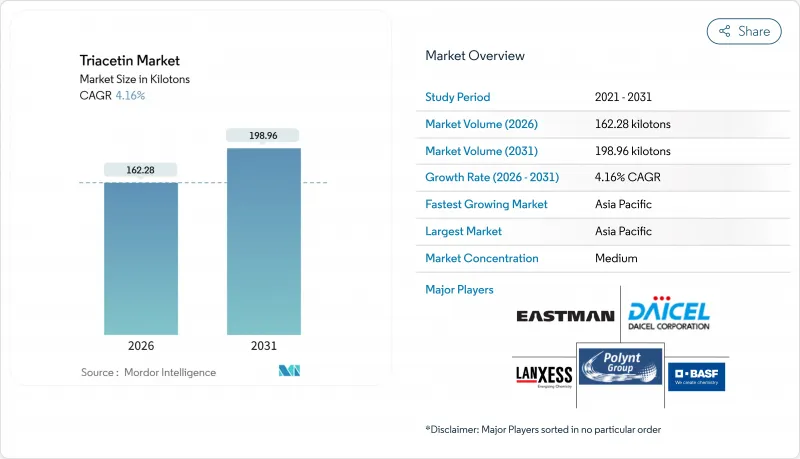
據 Mordor Intelligence 稱,2026 年三醋精市場規模估計為 162.28 千噸,預計到 2031 年將達到 198.96 千噸,在預測期(2026-2031 年)以 4.16% 的複合年成長率成長。
本報告按等級(菸草、食品、工業)、產品類型(塑化劑、溶劑等)、原料(植物甘油衍生物和合成甘油衍生物)、終端用戶產業(菸草、食品飲料、製藥等)以及地區(亞太、北美、歐洲等)進行細分。市場預測以噸為單位。
全球三醋精市場趨勢與洞察
亞洲菸草過濾嘴中三醋精增塑醋酸纖維素絲束的應用日益廣泛。
在中國,在以400-800米/分鐘運作的濾嘴棒生產線上,需要一種穩定的塑化劑來控制絲束密度,使其保持在1.28-1.32克/立方厘米。三醋精可以達到所需的遷移特性,並符合菸草規格。DAICEL的雙帶專利規定,三醋精的標準添加量為6-8%(重量比),這意味著每生產一根濾嘴棒都需要重複購買。伊士曼纖維部門預測,2024年銷售額將達到13.18億美元,其中60%來自前十大菸草製造商,這不僅體現了銷售量的確定性,也凸顯了市場集中度帶來的風險。在印度和印度尼西亞,吸菸者持續轉向過濾嘴香菸,為了降低焦油含量,濾嘴棒的長度也在不斷增加,這推高了每支香菸對三醋精的需求。美國FDA和歐盟菸草產品指令的監管可追溯性要求提高了低成本供應商的進入門檻,並增強了現有企業的優勢。
營養保健品產業對軟膠囊的需求正在激增。
軟膠囊依靠塑化劑來最大限度地減少快速包封過程中膠囊殼的脆性。三醋精兼具親水性和親油性,可最佳化明膠基和鹿角菜膠基製劑的釋放曲線。BASF的「Kollisolv GTA」將三醋精定位為符合歐洲藥典 (Ph.Eur.) 和美國藥典 (USP/NF) 標準的成膜添加劑,為契約製造生產商提供了監管方面的信心。巴林和印度素食軟膠囊產能的提升推動了對藥用級三醋精的需求。 FDA GRAS(公認安全)認證以及多個 IV 類藥物主文件的存在,正在促進三醋精在膳食補充劑領域的應用,而膳食補充劑領域對法律責任問題尤為關注。儘管由於缺乏多醣基膠囊的比較數據,研發仍面臨挑戰,但早期研究表明,三醋精的親水性在鹿角菜膠製劑中具有優勢。
由於甲醇供應受限,乙酸酐價格出現波動。
依賴乙酸酐生產三醋精的生產商面臨與天然氣和煤炭市場相關的原物料價格波動。一項2024年的可再生能源模擬表明,在目前的價格水平下,第二條路線(乙酸酐)的經濟效益將不具競爭力。伊士曼公司已對沖了75%的原物料風險,但仍將45%的營運成本分配給原料,凸顯了該產業的結構性脆弱性。中國的煤炭氣化甲醇生產基地在實施電力發行限制或安全檢查時,會進一步加劇價格波動。雖然對沖和雙原料策略在一定程度上緩解了這些影響,但區域成本差異仍然存在。
細分市場分析
到2025年,菸草級三醋精將佔總產量的55.45%,這得益於中國每年4,000億支捲菸產量所配套的成熟過濾嘴規格。儘管受到反吸菸運動的限制,菸草級三醋精市場預計將以較低的個位數成長率緩慢擴張。相較之下,食品級三醋精的複合年成長率(CAGR)為5.56%,主要得益於其在糖果甜點和乳製品中作為調味溶劑的廣泛應用。在這些領域,GRAS(公認安全)認證使得配方開發更加便利。在需要USP/NF(美國藥典/國家藥典)文件和批次追溯的食品和製藥管道,定價權仍然強大。這種轉變凸顯了市場正逐步向受監管的高純度細分市場轉移,從而緩解菸草業的供應波動。
雖然老牌企業透過整合傳統乙醯基化學品在通用菸草領域獲得了成本優勢,但食品級菸草的合規溢價卻在銷售較低的情況下擴大了毛利率。像伊士曼、BASF和波林特這樣在兩個領域都具備實力的供應商,可以利用不同等級煙草之間的價格套利,並在過濾嘴需求放緩時調整生產。而新創公司進入食品級菸草市場則需要承擔高昂的分析成本並建立品牌信譽,這將導致損益平衡期延長。
2025年,塑化劑的需求佔比將達到45.32%,主要促進因素為過濾棒、軟膠囊和PVC共混物。然而,隨著軟包裝印刷商轉向高固態油墨,以及藥物製劑研發人員利用雙重互溶性,溶劑市場預計將以6.61%的複合年成長率成長,超過塑化劑市場。隨著主要印刷廠對揮發性有機化合物(VOC)的監管日益嚴格,三醋精在溶劑市場的佔有率預計將會擴大。
儘管保濕劑在食品和外用藥品領域的應用仍保持著小眾但穩定的市場佔有率,但由於安全和環境審核的日益嚴格,其在炸藥和鑄造領域的應用正在下降。製程密集型生產能力確保了供應的柔軟性,使生產商能夠在不進行大規模工廠維修的情況下調整生產以滿足溶劑買家的需求。食品包裝油墨對高純度的需求與食品級要求形成了監管協同效應。
區域分析
到2025年,亞太地區將佔全球出貨量的55.71%,其中中國(佔全球菸草產量的35%)支撐著基本需求。預計到2031年,亞太地區三醋精市場規模將以5.22%的複合年成長率成長,這得益於醋酸纖維的一體化供應鏈以及印度代工膠囊生產的成長。伊士曼公司從金斯波特向其在中國的合資企業供應100%純醋酸片,這顯示其對跨太平洋原料的依賴性。
北美市場在伊士曼紡織品銷售額中佔據相當大的佔有率。儘管從煤炭到乙醯基的垂直整合確保了成本穩定,但吸菸趨勢的趨於成熟抑制了銷售量的成長。然而,對醫藥級材料和生物噴射機燃料衍生甘油產品的需求支撐著適度成長。歐洲、中東和非洲實施了最嚴格的塑化劑法規,迫使中小企業要麼升級產能,要麼退出市場。
在南美洲,巴西和阿根廷生物柴油衍生甘油的過剩供應為當地的三醋精計畫提供了有利的原料優勢。在中東,隨著沙烏地阿拉伯擴大其下游業務,乙醯基產品的多元化發展正受到關注,但水資源短缺和甘油供應限制了短期內的規模擴張。整體而言,地域多元化有助於規避政策和商品價格風險,但亞洲仍佔據核心地位。
其他好處:
- Excel格式的市場預測(ME)表
- 3個月的分析師支持
目錄
第1章:引言
- 研究假設和市場定義
- 調查範圍
第2章:調查方法
第3章執行摘要
第4章 市場狀況
- 市場概覽
- 市場促進因素
- 亞洲菸草過濾嘴中三醋精增塑醋酸纖維素絲束的應用日益廣泛。
- 營養保健品領域對凝膠膠囊的需求激增
- 由於歐洲油漆和塗料法規,向生物基塑化劑過渡。
- 三醋精作為高固態含量噴墨油墨中的載體溶劑在軟質包裝。
- 連續反應蒸餾系統的引入降低了生產成本和碳排放。
- 市場限制因素
- 甲醇供應受限導致乙酸酐價格波動。
- 歐洲對塑化劑的監管
- 針對一次性纖維素濾嘴的禁煙政策
- 價值鏈分析
- 波特五力模型
第5章 市場規模與成長預測
- 按年級
- 煙草等級
- 食品級
- 工業級
- 依產品類型
- 塑化劑
- 溶劑
- 保濕霜
- 其他產品類型
- 來源
- 植物甘油基
- 合成甘油
- 按最終用途行業分類
- 菸草
- 食品/飲料
- 製藥
- 化妝品
- 油漆和塗料
- 黏合劑和密封劑
- 其他終端用戶產業
- 按地區
- 亞太地區
- 中國
- 印度
- 日本
- 韓國
- 其他亞太國家
- 北美洲
- 美國
- 加拿大
- 墨西哥
- 歐洲
- 德國
- 英國
- 義大利
- 法國
- 其他歐洲國家
- 南美洲
- 巴西
- 阿根廷
- 其他南美國家
- 中東和非洲
- 沙烏地阿拉伯
- 南非
- 其他中東和非洲國家
- 亞太地區
第6章 競爭情勢
- 市場集中度
- 策略趨勢
- 市佔率和排名分析
- 公司簡介
- BASF
- Daicel Corporation
- Eastman Chemical Company
- Innova Global(India)
- Jiangsu Licheng Chemical Co., Ltd.
- Jiangsu Ruijia Food Ingredient Co., Ltd.
- Kanoria Chemicals & Industries Ltd.(KCI)
- LANXESS
- Polynt SpA
- Sisco Research Laboratories Pvt. Ltd.
- Spectrum Chemical
- WUXI KAILAI BIOTECHNOLOGY CO.,LTD.
- Zhonglan Industry Co.,Ltd.
第7章 市場機會與未來展望
According to Mordor Intelligence, the triacetin market size is estimated at 162.28 kilotons in 2026 and is expected to reach 198.96 kilotons by 2031, at a CAGR of 4.16% during the forecast period (2026-2031).
This report is Segmented by Grade (Tobacco Grade, Food Grade, Industrial Grade), Product Type (Plasticizer, Solvent, and More), Source (Vegetable-Glycerin-Based and Synthetic-Glycerin-Based), End-Use Industry (Tobacco, Food and Beverage, Pharmaceuticals, and More), and Geography (Asia-Pacific, North America, Europe, and More). The Market Forecasts are Provided in Terms of Volume (Tons).
Global Triacetin Market Trends and Insights
Growing Implementation of Triacetin-Plasticized Cellulose-Acetate Tow in Asian Cigarette Filters
China's filter-rod lines operating at 400-800 m/min require a stable plasticizer to control tow density at 1.28-1.32 g/cm3; triacetin delivers the needed migration profile, locking it into cigarette specifications. Daicel's two-band patent quantifies typical triacetin dosing at 6-8 wt%, translating into repeat purchases with every rod formed. Eastman's Fibers unit logged USD 1,318 million sales in 2024, 60% of which came from the ten largest cigarette manufacturers, underscoring volume certainty but also concentration risk. India and Indonesia continue to shift smokers toward filtered formats, lengthening rods to cut tar yields and pushing per-stick triacetin demand upward. Regulatory traceability requirements from the FDA and the EU's Tobacco Products Directive elevate the barriers for low-cost suppliers, reinforcing incumbent dominance.
Surging Demand for Gel-Caps in Nutraceuticals
Soft-gel capsules rely on plasticizers to curb shell brittleness during high-speed encapsulation; triacetin's dual hydrophilic and lipophilic miscibility tailors release profiles in both gelatin and carrageenan systems. BASF's Kollisolv GTA positions triacetin as a film-forming excipient compliant with Ph.Eur. and USP/NF monographs, lending regulatory confidence to contract manufacturers. Vegetarian soft-gel capacity additions in Bahrain and India intensify pharmaceutical-grade pull. FDA GRAS affirmation and the presence of multiple Type IV Drug Master Files bolster adoption in liability-sensitive nutraceuticals. Limited comparative data on polysaccharide shells present a research and development gap, yet early evidence favors triacetin's hydrophilicity for carrageenan formulations.
Volatility in Acetic-Anhydride Prices Linked to Methanol Supply Constraints
Triacetin producers dependent on acetic anhydride endure feedstock swings tied to natural-gas and coal markets; a 2024 Renewable Energy simulation flagged route-2 economics (acetic anhydride) as uncompetitive under recent price decks. Eastman hedges 75% of raw-material exposure yet still devotes 45% of operations cost to feedstocks, illustrating systemic sensitivity. Coal-gasified methanol hubs in China amplify volatility during power rationing or safety inspections. Hedging and dual-feed strategies partially mitigate, but regional cost gaps persist.
Other drivers and restraints analyzed in the detailed report include:
- Shift Toward Bio-Based Plasticizers Under Europe's Paints and Coatings Regulations
- Emergence of Triacetin as Carrier Solvent in High-Solid Ink-Jet Inks for Flexible Packaging
- Regulatory Scrutiny on Plasticizers in Europe
For complete list of drivers and restraints, kindly check the Table Of Contents.
Segment Analysis
Tobacco grade anchored 55.45% of 2025 volume, benefiting from entrenched filter specifications in China's 400-billion-stick output. The triacetin market size for tobacco grade is projected to inch forward at low single-digit rates, constrained by anti-smoking drives. By contrast, food grade is expanding at 5.56% CAGR, propelled by flavor-solvent roles in confectionery and dairy, where GRAS status eases formulation. Pricing power remains higher in food and pharma channels that demand USP/NF documentation and lot traceability. The shift underscores a gradual pivot toward regulated, high-purity niches that cushion volatility in tobacco volumes.
Legacy acetyl-chemical integration grants incumbents a cost edge in commodity tobacco streams, yet the compliance premium in food-grade widens gross margins despite lower tonnage. Suppliers with dual capabilities-Eastman, BASF, Polynt-can arbitrage between grades, redirecting output as filter demand moderates. Start-ups chasing food-grade must absorb high analytical overheads and build brand trust, elongating break-even timelines.
Plasticizers accounted for 45.32% of 2025 demand on the back of filter rods, soft-gel shells, and PVC blends. However, the solvent segment is forecast to grow 6.61% CAGR, outpacing plasticizers as flexible-packaging printers shift to high-solid inks and pharma formulators exploit dual miscibility. The triacetin market share for solvents is set to widen as VOC caps tighten in major print hubs.
Humectant roles in food and topical pharma hold niche but steady slices, while explosive and foundry uses retreat amid safety and environmental audits. Process-intensified capacity keeps supply agile, allowing producers to pivot volumes toward solvent buyers without major plant revamps. High-purity needs in inks intended for food wrappers weave regulatory synergy with food-grade requirements.
Complete Report Scope:
- By Grade
- Tobacco Grade
- Food Grade
- Industrial Grade
- By Product Type
- Plasticizer
- Solvent
- Humectant
- Other Product Types
- By Source
- Vegetable-Glycerin-Based
- Synthetic-Glycerin-Based
- By End-Use Industry
- Tobacco
- Food and Beverage
- Pharmaceuticals
- Cosmetics
- Paints and Coatings
- Adhesives and Sealants
- Other End-user Industries
- By Geography
- Asia-Pacific
- China
- India
- Japan
- South Korea
- Rest of Asia-Pacific
- North America
- United States
- Canada
- Mexico
- Europe
- Germany
- United Kingdom
- Italy
- France
- Rest of Europe
- South America
- Brazil
- Argentina
- Rest of South America
- Middle East and Africa
- Saudi Arabia
- South Africa
- Rest of Middle East and Africa
- Asia-Pacific
Geography Analysis
Asia-Pacific commanded 55.71% of 2025 shipments, with China's 35% share of global cigarette production anchoring basal demand. The triacetin market size in Asia-Pacific will expand at a 5.22% CAGR through 2031, buoyed by integrated acetate-tow supply chains and rising contract capsule output in India. Eastman supplies 100% acetate flake to its Chinese venture from Kingsport, illustrating trans-Pacific feedstock dependency.
North America contributes a significant share of Eastman's fiber sales; vertical coal-to-acetyl integration ensures cost resilience, while mature smoking trends curb volume upside. Nevertheless, pharmaceutical-grade pull and bio-jet-fuel glycerol streams support modest growth. Europe, Middle East, and Africa face the most stringent plasticizer rules, forcing capacity upgrades or exit decisions among smaller players.
South America benefits from biodiesel-derived glycerin surpluses in Brazil and Argentina, offering feedstock leverage for local triacetin projects. The Middle East eye acetyl diversification in Saudi Arabia's downstream push, though water scarcity and glycerol availability temper near-term scale. Overall, geographic diversification hedges policy and commodity risk, yet Asia remains the gravitational center.
- BASF
- Daicel Corporation
- Eastman Chemical Company
- Innova Global (India)
- Jiangsu Licheng Chemical Co., Ltd.
- Jiangsu Ruijia Food Ingredient Co., Ltd.
- Kanoria Chemicals & Industries Ltd. (KCI)
- LANXESS
- Polynt S.p.A
- Sisco Research Laboratories Pvt. Ltd.
- Spectrum Chemical
- WUXI KAILAI BIOTECHNOLOGY CO.,LTD.
- Zhonglan Industry Co.,Ltd.
Additional Benefits:
- The market estimate (ME) sheet in Excel format
- 3 months of analyst support
TABLE OF CONTENTS
1 Introduction
- 1.1 Study Assumptions and Market Definition
- 1.2 Scope of the Study
2 Research Methodology
3 Executive Summary
4 Market Landscape
- 4.1 Market Overview
- 4.2 Market Drivers
- 4.2.1 Growing implementation of triacetin-plasticized cellulose-acetate tow in Asian cigarette filters
- 4.2.2 Surging demand for gel-caps in nutraceuticals
- 4.2.3 Shift toward bio-based plasticizers under Europe's paints and coatings regulations
- 4.2.4 Emergence of triacetin as carrier solvent in high-solid ink-jet inks for flexible packaging
- 4.2.5 Adoption of continuous reactive-distillation units lowering production cost and carbon footprint
- 4.3 Market Restraints
- 4.3.1 Volatility in acetic-anhydride prices linked to methanol supply constraints
- 4.3.2 Regulatory scrutiny on plasticizers in Europe
- 4.3.3 Anti-smoking policies targeting single-use cellulose filters
- 4.4 Value Chain Analysis
- 4.5 Porter's Five Forces
- 4.5.1 Bargaining Power of Suppliers
- 4.5.2 Bargaining Power of Buyers
- 4.5.3 Threat of New Entrants
- 4.5.4 Threat of Substitutes
- 4.5.5 Competitive Rivalry
5 Market Size and Growth Forecasts (Volume)
- 5.1 By Grade
- 5.1.1 Tobacco Grade
- 5.1.2 Food Grade
- 5.1.3 Industrial Grade
- 5.2 By Product Type
- 5.2.1 Plasticizer
- 5.2.2 Solvent
- 5.2.3 Humectant
- 5.2.4 Other Product Types
- 5.3 By Source
- 5.3.1 Vegetable-Glycerin-Based
- 5.3.2 Synthetic-Glycerin-Based
- 5.4 By End-Use Industry
- 5.4.1 Tobacco
- 5.4.2 Food and Beverage
- 5.4.3 Pharmaceuticals
- 5.4.4 Cosmetics
- 5.4.5 Paints and Coatings
- 5.4.6 Adhesives and Sealants
- 5.4.7 Other End-user Industries
- 5.5 By Geography
- 5.5.1 Asia-Pacific
- 5.5.1.1 China
- 5.5.1.2 India
- 5.5.1.3 Japan
- 5.5.1.4 South Korea
- 5.5.1.5 Rest of Asia-Pacific
- 5.5.2 North America
- 5.5.2.1 United States
- 5.5.2.2 Canada
- 5.5.2.3 Mexico
- 5.5.3 Europe
- 5.5.3.1 Germany
- 5.5.3.2 United Kingdom
- 5.5.3.3 Italy
- 5.5.3.4 France
- 5.5.3.5 Rest of Europe
- 5.5.4 South America
- 5.5.4.1 Brazil
- 5.5.4.2 Argentina
- 5.5.4.3 Rest of South America
- 5.5.5 Middle East and Africa
- 5.5.5.1 Saudi Arabia
- 5.5.5.2 South Africa
- 5.5.5.3 Rest of Middle East and Africa
- 5.5.1 Asia-Pacific
6 Competitive Landscape
- 6.1 Market Concentration
- 6.2 Strategic Moves
- 6.3 Market Share(%)/Ranking Analysis
- 6.4 Company Profiles (includes Global-level Overview, Market-level Overview, Core Segments, Financials as available, Strategic Information, Products and Services, Recent Developments)
- 6.4.1 BASF
- 6.4.2 Daicel Corporation
- 6.4.3 Eastman Chemical Company
- 6.4.4 Innova Global (India)
- 6.4.5 Jiangsu Licheng Chemical Co., Ltd.
- 6.4.6 Jiangsu Ruijia Food Ingredient Co., Ltd.
- 6.4.7 Kanoria Chemicals & Industries Ltd. (KCI)
- 6.4.8 LANXESS
- 6.4.9 Polynt S.p.A
- 6.4.10 Sisco Research Laboratories Pvt. Ltd.
- 6.4.11 Spectrum Chemical
- 6.4.12 WUXI KAILAI BIOTECHNOLOGY CO.,LTD.
- 6.4.13 Zhonglan Industry Co.,Ltd.
7 Market Opportunities and Future Outlook
- 7.1 White-Space and Unmet-Need Assessment
- 7.2 Growing Demand for E-Cigarettes

 三油酸甘油酯市場:全球市場預測,2026-2032年
 全球三醋精市場
 甘油市場機會、成長要素、產業趨勢分析及2026-2035年預測。
 全球甘油市場規模、佔有率、趨勢和成長分析報告(2026-2034年)全球聚甘油癸二酸酯市場規模、佔有率、趨勢和成長分析報告(2026-2034年)
 2026年全球甘油衍生物市場報告木質松香甘油酯市場按類型、純度等級、最終用途產業、應用和分銷管道分類,全球預測(2026-2032年)
 甘油市場規模、佔有率和成長分析(按等級、來源、應用和地區分類)-2026-2033年產業預測
 三醋酸甘油酯市場-全球產業規模、佔有率、趨勢、機會與預測,按等級、產品類型、最終用戶、地區和競爭細分,2020-2030 年