


 |
市場調查報告書
商品編碼
2114886
凝聚劑:市場佔有率分析、產業趨勢與統計、成長預測(2026-2031)Coalescing Agents - Market Share Analysis, Industry Trends & Statistics, Growth Forecasts (2026 - 2031) |
||||||

※ 本網頁內容可能與最新版本有所差異。詳細情況請與我們聯繫。
根據 Mordor Intelligence 預測,凝聚劑市場規模將從 2025 年的 11.8 億美元成長到 2026 年的 12.4 億美元,然後在 2031 年達到 15.7 億美元,2026 年至 2031 年的複合年成長率為 4.86%。
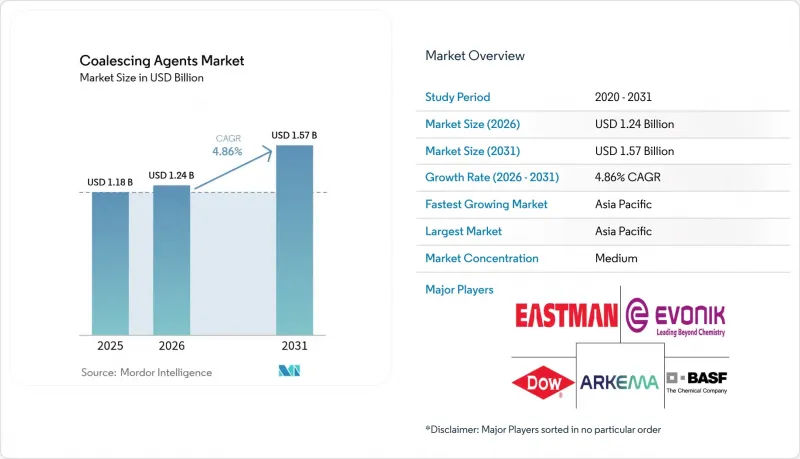
本報告按類型(親水性、疏水性)、化學成分(酯類、酮類、醇類、二醇/乙二醇醚類及其他化學品)、應用領域(油漆和塗料、黏合劑和密封劑、油墨、個人護理及其他應用)以及地區(亞太地區、北美地區、歐洲地區、南美地區以及中東和非洲地區)進行細分。市場預測以美元計價。
全球凝聚劑市場趨勢及洞察
新興經濟體工業塗裝生產線的擴張
中國、印度和東南亞正在進行創紀錄的基礎設施投資,擴大了工業塗料加工能力,並推動了凝聚劑市場的需求。新建的乙烯和丙烯裂解裝置,例如沙烏地基礎工業公司(SABIC)投資64億美元、年產能180萬噸的福建項目,確保了添加劑生產所需的丙烯酸酯和乙二醇醚衍生物的後向整合。隨著水性配方成為工廠應用金屬、塑膠和木材塗料的強制性要求,市場需求集中在能夠在環境濕度下促進成膜的疏水性絮凝劑。此外,區域石化產品的自給自足減少了對進口的依賴,使當地供應商能夠縮短前置作業時間,並根據各國不同的VOC法規客製化產品。這些因素共同提高了供應穩定性,並鞏固了亞太地區在凝聚劑市場的主導地位。
汽車噴漆領域低溫成膜添加劑的應用日益廣泛
電動車平台的需求以及空氣品質控制區嚴格的法規迫使汽車修補漆廠轉向更低的烘烤溫度,以節省能源並保護敏感的電池組件。南海岸空氣品質控制區修訂後的第1151號規則將於2025年5月生效,該規則收緊了底漆、底塗層和透明塗層體系中的揮發性有機化合物(VOC)含量限制,加速了向高沸點、低氣味凝聚劑的過渡,這些絮凝劑可在60 度C以下實現良好的絮漆膜凝集。領先的修補漆製造商正在使用酯類混合物,這些混合物在漆膜中停留足夠長的時間以促進乳膠熔合,但在車輛交付前揮發,從而使汽車修理廠能夠滿足週期時間的關鍵績效指標(KPI)。塑膠飾面、航太修補和複合材料修復領域也存在類似的低溫加工需求,這促使全球迅速採用這種技術。這種跨產業的應用正在擴大凝聚劑市場,緩解完全依賴汽車產量的週期性波動。
REACH 和 EPA 關於高 VOC 酯醇的法規
歐盟的REACH法規和美國的國家VOC排放標準正逐步將高活性酯醇列入黑名單,迫使配方設計人員重新審查原料並重新認證最終用途塗料。合規期限的增加給研發預算帶來了壓力,導致產品上市延遲,尤其對中小企業而言更是如此。可接受的替代方案通常成本高昂,並且可能需要額外的界面活性劑包裝來穩定乳膠顆粒,從而降低了整體配方的經濟效益。區域監管差異進一步限制了規模經濟,導致庫存分散,並增加了物流複雜性,阻礙了凝聚劑市場的發展。
細分市場分析
2025年,凝聚劑,這得益於其在重型塗料中久經考驗的附著力和耐水性。施工機械、海洋平台和船舶面漆由於長期暴露於潮濕和溶劑環境中,都需要使用疏水性混合物。然而,為了在高固態含量下保持光澤均勻性,負責人擴大將這些疏水性絮凝劑與輔助潤濕劑結合使用。由於主要塗料製造商傾向於簽訂長期合約以確保穩定的採購量,因此利潤率仍然可觀。
儘管親水性絮凝劑目前市場規模較小,但在日益嚴格的室內空氣品質標準的推動下,預計到2031年將達到5.51%的複合年成長率。由於其分子級親和性,與疏水性產品相比,親水性絮凝劑可減少10-15%的使用量,從而降低每公升產品的VOC排放總量。化妝品乳液生產商正在使用這類絮凝劑來穩定水油配方,並在不使用合成界面活性劑的情況下改善產品的功能特性。隨著成膜性能透過研發不斷改進,預計其在室內乳膠塗料和新一代黏合劑中的應用將加速,進一步豐富凝聚劑市場。
區域分析
至2025年,亞太地區將佔凝聚劑市場38.40%的佔有率。中國沿海省份和越南龍山綜合設施新建的乙烯和丙烯酸酯生產設施,保障了原料供應,並降低了運輸成本。各地政府持續推動揮發性有機化合物(VOC)控制措施與經合組織(OECD)標準的接軌,推動了水性塗料的普及。政策的推動,加上消費者需求的成長和電子商務包裝的擴張,預計將使亞太地區絮凝劑市場在2031年實現5.29%的複合年成長率,成為全球成長最快的地區。
北美約佔全球需求的四分之一,這主要得益於成熟且不斷創新的塗料和個人護理領域。美國環保署將氣霧劑塗料監管期限延長至2027年1月,為配方測試提供了寬限期,並穩定了短期需求。同時,電動車組裝的轉型增加了塑膠內飾部件中重塗和冷凝固混合物的消耗量。原物料價格波動仍然是該地區的主要不利因素,下游用戶正在協商縮短合約期限。
歐洲正在採用與北美類似的技術,但天然氣價格飆升正影響丙烯酸和乙二醇醚的生產。生產商正透過專注於零揮發性有機化合物(VOC)創新和生物基原料的可追溯性認證來抵消成本上漲的影響。有關廢棄塑膠回收目標的法規的明確正在促進研發夥伴關係,這使得歐洲企業在循環化學領域處於領先地位,並保持對凝聚劑市場的穩定貢獻。
拉丁美洲、中東和非洲共同構成了新興市場,具有巨大的成長潛力。沙烏地阿拉伯和阿布達比石化工廠的擴建正在增強樹脂溶劑的供應基礎,從而促進下游添加劑業務的發展。在巴西和墨西哥,住宅市場的復甦和出口導向家電製造業正在創造多元化的消費群體。跨國公司透過在這些地區部署技術服務團隊並客製化產品以滿足熱帶氣候性能標準,正在長期擴大凝聚劑的潛在市場。
其他福利
- Excel格式的市場預測(ME)表
- 3個月的分析師支持
目錄
第1章:引言
- 研究假設和市場定義
- 調查範圍
第2章:調查方法
第3章執行摘要
第4章 市場狀況
- 市場概覽
- 市場促進因素
- 新興經濟體工業塗裝生產線的擴張
- 汽車噴漆領域低溫成膜添加劑的應用日益廣泛
- 建築規範中更嚴格的室內空氣品質標準
- 活性(不含揮發性有機化合物)凝聚劑的商業化
- 對特種和高性能油墨及塗料的需求日益成長
- 市場限制因素
- REACH 和 EPA 關於高 VOC 酯醇的法規
- 乙二醇醚原料價格波動
- 自聚集聚合物分散技術
- 價值鏈分析
- 波特五力模型
第5章 市場規模與成長預測
- 按類型
- 親水性
- 疏水性
- 化學分類
- 酯
- 酮類
- 酒精飲料
- 二醇乙二醇醚
- 其他化學物質(乳酸鹽、檸檬酸鹽、矽氧烷)
- 透過使用
- 油漆和塗料
- 黏合劑和密封劑
- 墨水
- 個人護理
- 其他應用(塑膠聚合物、油氣分離設備等)
- 按地區
- 亞太地區
- 中國
- 日本
- 印度
- 韓國
- ASEAN
- 其他亞太國家
- 北美洲
- 美國
- 加拿大
- 墨西哥
- 歐洲
- 德國
- 英國
- 法國
- 義大利
- 西班牙
- 俄羅斯
- 北歐國家
- 其他歐洲國家
- 南美洲
- 巴西
- 阿根廷
- 其他南美國家
- 中東和非洲
- 沙烏地阿拉伯
- 南非
- 其他中東和非洲國家
- 亞太地區
第6章 競爭情勢
- 市場集中度
- 策略趨勢
- 市佔率和排名分析
- 公司簡介
- Arkema
- BASF
- Cargill, Incorporated.
- Cristol
- Dow
- Eastman Chemical Company
- Elementis PLC
- Evonik Industries AG
- Indorama Ventures
- Perstorp
- Runtai Chemical Co., Ltd.
- Shell Plc
- Stepan Company
- Synthomer plc
第7章 市場機會與未來展望
According to Mordor Intelligence, the coalescing agent market size is expected to grow from USD 1.18 billion in 2025 to USD 1.24 billion in 2026 and is forecast to reach USD 1.57 billion by 2031 at 4.86% CAGR over 2026-2031.
This report is Segmented by Type (Hydrophilic, Hydrophobic), Chemistry (Esters, Ketones, Alcohols, Diols and Glycol-Ethers, Other Chemistries), Application (Paints and Coatings, Adhesives and Sealants, Inks, Personal Care, Other Applications), and Geography (Asia-Pacific, North America, Europe, South America, Middle East and Africa). The Market Forecasts are Provided in Terms of Value (USD).
Global Coalescing Agents Market Trends and Insights
Expansion of Industrial Coating Lines in Developing Economies
Record infrastructure outlays across China, India, and Southeast Asia are lifting industrial coating throughput and creating a volume pull for the coalescing agents market. New ethylene and propylene crackers, such as SABIC's USD 6.4 billion Fujian project with 1.8 million t/y capacity, guarantee backward integration for acrylic esters and glycol-ether derivatives essential to additive production. As water-borne formulations become mandatory in factory-applied metal, plastic, and wood coatings, demand concentrates on hydrophobic grades that accelerate film formation at ambient humidity. Regional petrochemical self-sufficiency also curbs import dependency, enabling local suppliers to shorten lead times while tailoring products to divergent national VOC caps. Collectively, these factors improve supply security and strengthen APAC's positional advantage within the broader coalescing agents market.
Uptake of Low-Temperature Film-Formation Additives in Automotive Refinish
Electric-vehicle platforms and stringent air-district rules push refinish shops toward lower bake profiles to conserve energy and protect sensitive battery components. The South Coast Air Quality Management District's revised Rule 1151, effective May 2025, tightens VOC ceilings across primer, base-coat, and clear-coat systems, accelerating the switch to high-boiling, low-odor coalescing agents that deliver proper film coalescence below 60 °C. Large refinish paint makers are incorporating ester blends that remain in the film long enough to promote latex fusion yet volatilize before service, helping body shops meet cycle-time KPIs. Global uptake is rapid because identical low-temperature needs exist in plastics finishing, aerospace touch-ups, and composite repair. This cross-sector adoption enlarges the coalescing agents market and mitigates cyclical swings tied solely to automotive volumes.
REACH and EPA Restrictions on High-VOC Ester Alcohols
EU REACH dossiers and the U.S. National VOC Emission Standards are progressively blacklisting high-reactivity ester alcohols, obliging formulators to re-screen raw materials and re-qualify end-use coatings Compliance timelines consume R&D budgets and slow product launches, especially for SMEs. Because acceptable substitutes often cost more and may require additional surfactant packages to stabilize latex particles, overall formulation economics tighten. Regional rule deviations further limit economies of scale, fragmenting inventories and adding logistics complexity that restrains the coalescing agents market.
Other drivers and restraints analyzed in the detailed report include:
- Tightening Indoor-Air-Quality Norms in Building Codes
- Commercialization of Reactive (Zero-VOC) Coalescing Agents
- Volatility in Glycol-Ether Feedstock Pricing
For complete list of drivers and restraints, kindly check the Table Of Contents.
Segment Analysis
The hydrophobic category retained 60.10% of the coalescing agents market share in 2025, benefiting from proven adhesion and water-resistance properties in heavy-duty coatings. Construction equipment, offshore platforms, and marine topcoats all specify hydrophobic blends due to prolonged exposure to moisture and solvents. Yet formulators increasingly complement these agents with ancillary wetting aids to manage gloss uniformity at higher solid contents. Margins remain attractive because large-volume paint makers favor long-term contracts that guarantee steady off-take.
Hydrophilic grades, while smaller today, log a 5.51% CAGR through 2031 on the back of stringent indoor-air-quality targets. Their molecular affinity to water packages allows use levels 10-15% lower than hydrophobic counterparts, trimming total VOC grams per liter. Cosmetic emulsion producers leverage these agents to stabilize oil-in-water formulations, improving sensory attributes without synthetic surfactants. As R&D refines film-formation profiles, uptake will accelerate in interior latex paints and next-generation adhesives, further diversifying the coalescing agents market.
Complete Report Scope:
- By Type
- Hydrophilic
- Hydrophobic
- By Chemistry
- Esters
- Ketones
- Alcohols
- Diols and Glycol-ethers
- Other Chemistries (Lactates, Citrates, Siloxanes)
- By Application
- Paints and Coatings
- Adhesives and Sealants
- Inks
- Personal Care
- Other Applications (Plastics and Polymers, Oil-and-Gas Separators, etc.)
- By Geography
- Asia-Pacific
- China
- Japan
- India
- South Korea
- ASEAN Countries
- Rest of Asia-Pacific
- North America
- United States
- Canada
- Mexico
- Europe
- Germany
- United Kingdom
- France
- Italy
- Spain
- Russia
- NORDIC Countries
- Rest of Europe
- South America
- Brazil
- Argentina
- Rest of South America
- Middle East and Africa
- Saudi Arabia
- South Africa
- Rest of Middle East and Africa
- Asia-Pacific
Geography Analysis
Asia-Pacific commanded 38.40% of coalescing agents market size in 2025. New ethylene and acrylic ester capacity clusters in China's coastal provinces and in Vietnam's Long Son complex assure raw-material supply and reduce freight expense. Regional governments continue to harmonize VOC measures with OECD benchmarks, propelling water-borne coating adoption. This policy push, combined with consumer upgrading and e-commerce packaging growth, yields a 5.29% CAGR through 2031, the fastest worldwide.
North America accounts for roughly one-quarter of demand, underpinned by mature but innovation-rich coatings and personal-care sectors. The EPA's aerosol-coating deadline extension to January 2027 offers breathing room for formulation trials, stabilizing near-term offtake. Meanwhile, the shift to electric vehicle assembly lines raises consumption of low-temperature coalescing blends in refinish and plastic interior parts. Feedstock pricing volatility remains the primary regional headwind, prompting downstream users to negotiate shorter contracts.
Europe mirrors North American technology adoption yet grapples with elevated natural-gas costs that feed into acrylic-acid and glycol-ether production. Producers offset cost inflation by emphasizing zero-VOC innovations and bio-feedstock chain-of-custody certifications. Regulatory clarity on post-consumer plastic recycling targets stimulates R&D partnerships that position European firms at the vanguard of circular chemistry, maintaining steady contributions to the coalescing agents market.
Latin America, the Middle East, and Africa together represent a high-growth frontier. Petrochemical build-outs in Saudi Arabia and Abu Dhabi underpin resin-grade solvent availability, inviting downstream additive ventures. In Brazil and Mexico, housing rebound and export-oriented appliance manufacturing add diverse consumption points. Multinationals deploy technical service teams in these regions to tailor products to tropical climate performance norms, thereby expanding the addressable coalescing agents market over the long term.
- Arkema
- BASF
- Cargill, Incorporated.
- Cristol
- Dow
- Eastman Chemical Company
- Elementis PLC
- Evonik Industries AG
- Indorama Ventures
- Perstorp
- Runtai Chemical Co., Ltd.
- Shell Plc
- Stepan Company
- Synthomer plc
Additional Benefits:
- The market estimate (ME) sheet in Excel format
- 3 months of analyst support
TABLE OF CONTENTS
1 Introduction
- 1.1 Study Assumptions and Market Definition
- 1.2 Scope of the Study
2 Research Methodology
3 Executive Summary
4 Market Landscape
- 4.1 Market Overview
- 4.2 Market Drivers
- 4.2.1 Expansion of Industrial Coating Lines in Developing Economies
- 4.2.2 Uptake of Low-Temperature Film-Formation Additives in Automotive Refinish
- 4.2.3 Tightening Indoor-Air-Quality Norms in Building Codes
- 4.2.4 Commercialisation of Reactive (Zero-VOC) Coalescing Agents
- 4.2.5 Increasing Demand for Specialty and High Performance Inks and Coatings
- 4.3 Market Restraints
- 4.3.1 REACH And EPA Restrictions on High-VOC Ester Alcohols
- 4.3.2 Volatility in Glycol-Ether Feedstock Pricing
- 4.3.3 Self-Coalescing Polymer Dispersion Technologies
- 4.4 Value Chain Analysis
- 4.5 Porter's Five Forces
- 4.5.1 Bargaining Power of Suppliers
- 4.5.2 Bargaining Power of Buyers
- 4.5.3 Threat of New Entrants
- 4.5.4 Threat of Substitutes
- 4.5.5 Degree of Competition
5 Market Size and Growth Forecasts (Value)
- 5.1 By Type
- 5.1.1 Hydrophilic
- 5.1.2 Hydrophobic
- 5.2 By Chemistry
- 5.2.1 Esters
- 5.2.2 Ketones
- 5.2.3 Alcohols
- 5.2.4 Diols and Glycol-ethers
- 5.2.5 Other Chemistries (Lactates, Citrates, Siloxanes)
- 5.3 By Application
- 5.3.1 Paints and Coatings
- 5.3.2 Adhesives and Sealants
- 5.3.3 Inks
- 5.3.4 Personal Care
- 5.3.5 Other Applications (Plastics and Polymers, Oil-and-Gas Separators, etc.)
- 5.4 By Geography
- 5.4.1 Asia-Pacific
- 5.4.1.1 China
- 5.4.1.2 Japan
- 5.4.1.3 India
- 5.4.1.4 South Korea
- 5.4.1.5 ASEAN Countries
- 5.4.1.6 Rest of Asia-Pacific
- 5.4.2 North America
- 5.4.2.1 United States
- 5.4.2.2 Canada
- 5.4.2.3 Mexico
- 5.4.3 Europe
- 5.4.3.1 Germany
- 5.4.3.2 United Kingdom
- 5.4.3.3 France
- 5.4.3.4 Italy
- 5.4.3.5 Spain
- 5.4.3.6 Russia
- 5.4.3.7 NORDIC Countries
- 5.4.3.8 Rest of Europe
- 5.4.4 South America
- 5.4.4.1 Brazil
- 5.4.4.2 Argentina
- 5.4.4.3 Rest of South America
- 5.4.5 Middle East and Africa
- 5.4.5.1 Saudi Arabia
- 5.4.5.2 South Africa
- 5.4.5.3 Rest of Middle East and Africa
- 5.4.1 Asia-Pacific
6 Competitive Landscape
- 6.1 Market Concentration
- 6.2 Strategic Moves
- 6.3 Market Share(%)/Ranking Analysis
- 6.4 Company Profiles (includes Global-level Overview, Market-level Overview, Core Segments, Financials as available, Strategic Information, Market Rank/Share for key companies, Products and Services, and Recent Developments)
- 6.4.1 Arkema
- 6.4.2 BASF
- 6.4.3 Cargill, Incorporated.
- 6.4.4 Cristol
- 6.4.5 Dow
- 6.4.6 Eastman Chemical Company
- 6.4.7 Elementis PLC
- 6.4.8 Evonik Industries AG
- 6.4.9 Indorama Ventures
- 6.4.10 Perstorp
- 6.4.11 Runtai Chemical Co., Ltd.
- 6.4.12 Shell Plc
- 6.4.13 Stepan Company
- 6.4.14 Synthomer plc
7 Market Opportunities and Future Outlook
- 7.1 White-space and Unmet-Need Assessment
- 7.2 Rising Focus on Eco-friendly Products

 成膜助劑市場:依化學性質、技術、揮發性有機化合物、溶解度、應用和通路分類-全球市場預測(2026-2032 年)
 全球凝聚劑市場規模、佔有率、趨勢和成長分析報告(2026-2034年)塗料用薄膜凝聚劑市場按類型、應用方法、樹脂、塗料和最終用途分類-2026-2032年全球市場預測生物基凝聚劑市場按產品類型、應用、最終用戶和分銷管道分類-2026-2032年全球預測
 凝聚劑市場規模、佔有率和成長分析(按產品類型、應用和地區分類)-2026-2033年產業預測
 2025-2029年全球凝聚劑市場
 成膜助劑市場規模、佔有率、趨勢分析報告:按產品、應用、地區和細分市場預測,2025 年至 2030 年
 全球絮凝劑市場:市場規模、市場佔有率、趨勢、行業分析(依種類、應用和地區)、未來預測(2025-2034年)
 成膜助劑市場報告:2030 年趨勢、預測與競爭分析