


 |
市場調查報告書
商品編碼
2114880
橡膠結合磨料:市場佔有率分析、產業趨勢與統計、成長預測(2026-2031 年)Rubber Bonded Abrasive - Market Share Analysis, Industry Trends & Statistics, Growth Forecasts (2026 - 2031) |
||||||

※ 本網頁內容可能與最新版本有所差異。詳細情況請與我們聯繫。
根據 Mordor Intelligence 預測,橡膠黏結磨料的市場規模預計將從 2025 年的 12.9 億美元成長到 2026 年的 13.3 億美元,然後從 2026 年到 2031 年以 3.05% 的複合年成長率成長,到 2031 億美元。
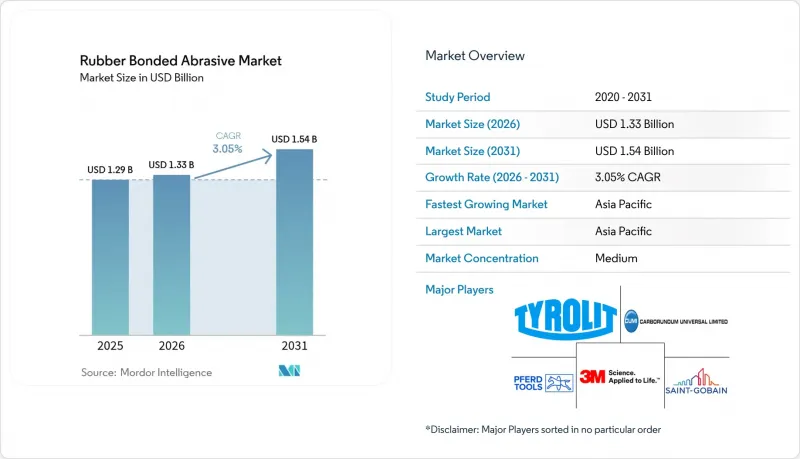
本報告按產品類型(車輪、尖軌、桿件等)、橡膠類型(天然橡膠等)、應用領域(齒輪、軸承、渦輪機等)、終端用戶行業(工業機械、汽車、醫療等)以及地區(亞太、北美、歐洲、南美、中東和非洲)進行細分。市場預測以美元計價。
全球橡膠黏結磨料市場趨勢及洞察
金屬和鋼鐵加工需求不斷成長
隨著基礎設施和造船業鋼鐵產能的擴張,對符合防熱變形標準的研磨工具的需求日益成長。橡膠結合劑砂輪能夠承受鈑金研磨的高壓,而玻璃砂輪在這種高壓下會破碎。目前,合成樹脂增強化合物能夠延長砂輪壽命,從而兼顧生產效率和成本控制。北美和歐洲的生產本地化正在催生新的需求中心,因為買家正在尋求進口研磨顆粒的替代品。橡膠結合劑砂輪因其磨損更可預測且可延長無人值守運作,在自動化研磨線中更受歡迎。
汽車製造商擴大產能
全球汽車製造商正在擴大生產設施,以滿足電動車 (EV) 項目對動力傳動系統和電池外殼精密加工的需求。細顆粒橡膠砂輪能夠對鋼和鋁製部件進行鏡面拋光,且不會傷害其表面下層。歐洲和美國的投資計畫表明,研磨基礎設施正在經歷長期升級。該領域輕量化材料的趨勢正在推動對橡膠砂輪的需求,因為只需對參數進行少量調整,同樣的砂輪即可加工從鋼材到複合材料的各種材料。
有關橡膠和揮發性有機化合物排放的環境法規
美國提案的「最大可行控制技術」(MACT)標準以及歐洲日益嚴格的「化學品註冊、評估、授權和限制」(REACH)法規,正在增加橡膠混煉企業的合規成本。製造商正在改進配方,使用低揮發性有機化合物(VOC)硫化劑,並投資熱氧化設備以捕獲有害空氣污染物。這對小規模生產商來說是一筆沉重的資金負擔,並可能加速產業整合。目前,研發重點集中在生物基替代材料上,這些材料既能保持橡膠的韌性,又能減少排放。率先採用這些材料的公司正在獲得競爭優勢,為未來的成長奠定基礎。
細分市場分析
到2025年,砂輪將佔橡膠結合磨料市場47.72%的佔有率,這表明它們在大批量生產的重型研磨中發揮著至關重要的作用。砂輪寬大的接觸面使其能夠快速切割曲軸和鋼板。雖然尖頭和棒狀磨料的產量較小,但在電子和醫療設備製造領域,由於需要對精密零件進行精細加工,其市場佔有率正以3.92%的複合年成長率成長。塊狀和片狀磨料則用於一些特殊應用,例如渦輪葉片的根部研磨,在這些應用中,形狀的柔軟性至關重要。
隨著數控加工的普及,對具有高形狀穩定性、即使在長循環加工中也能保持公差的加工點的需求日益成長。混合式砂輪設計應運而生,它將分段自適應功能整合到砂輪本體中,從而無需更換刀具即可兼顧砂輪生產效率和加工點精度。
區域分析
預計到2025年,亞太地區將佔全球橡膠結合磨料市場佔有率的39.25%,到2031年將以4.02%的複合年成長率成長。中國龐大的汽車、電子和機械產業構成了需求基礎,國家鼓勵高品質製造業發展的政策提高了精密研磨的要求。日本先進的電子產業需要高純度砂輪,而韓國半導體產業的快速發展也增加了對超精密磨料的需求。
在北美,製造業回流和國防領域的投資正在推動能夠加工先進合金的特殊砂輪的應用,市場也呈現復甦跡象。尤其是在美國,智慧研磨解決方案正被積極採用,這些方案將橡膠結合劑砂輪的性能數據整合到工廠級數位孿生模型中。在歐洲,市場需求依然強勁,尤其值得關注的是,在低VOC配方方面處於領先地位,以滿足嚴格的環保法規要求。
儘管南美洲、中東和非洲的產量落後於全球,但它們蘊藏著巨大的成長潛力。巴西汽車產業的重組以及海灣國家的大型大型企劃正在推動重型砂輪的採購。來自全球供應商的技術轉讓,加上外國直接投資,正在為當地精加工能力的提升奠定基礎,預計橡膠結合劑產品在這些地區的應用將逐步擴大。
其他好處:
- Excel格式的市場預測(ME)表
- 3個月的分析師支持
目錄
第1章:引言
- 研究假設和市場定義
- 調查範圍
第2章:調查方法
第3章執行摘要
第4章 市場狀況
- 市場概覽
- 市場促進因素
- 金屬和鋼鐵加工需求不斷成長
- 汽車OEM廠商擴大產能
- 透過流程自動化和數控整合提高生產效率
- 3D列印金屬表面處理技術的快速普及
- 電子設備和半導體製造量增加
- 市場限制因素
- 有關橡膠和揮發性有機化合物排放的環境法規
- 原物料價格波動
- 精密研磨中超磨粒的過渡
- 價值鏈分析
- 波特五力模型
第5章 市場規模與成長預測
- 依產品類型
- 車輪
- 指哪打哪
- 積木和片段
- 其他
- 不同類型的橡膠
- 天然橡膠
- 丁腈橡膠(NBR)
- 氯丁橡膠
- 其他類型的橡膠(例如矽膠)
- 透過使用
- 動力傳動系統
- 齒輪
- 軸承
- 渦輪
- 其他用途(切割和成型工具等)
- 按最終用戶行業分類
- 工業機械
- 車
- 電氣和電子設備
- 衛生保健
- 其他終端用戶產業(例如航太)
- 按地區
- 亞太地區
- 中國
- 日本
- 印度
- 韓國
- 東南亞國協
- 其他亞太國家
- 北美洲
- 美國
- 加拿大
- 墨西哥
- 歐洲
- 德國
- 英國
- 法國
- 義大利
- 西班牙
- 俄羅斯
- 北歐國家
- 其他歐洲國家
- 南美洲
- 巴西
- 阿根廷
- 其他南美國家
- 中東和非洲
- 沙烏地阿拉伯
- 南非
- 其他中東和非洲國家
- 亞太地區
第6章 競爭情勢
- 市場集中度
- 策略趨勢
- 市佔率和排名分析
- 公司簡介
- 3M
- ABRASIVOS MANHATTAN SA
- Atto Abrasive Ltd.
- Buehler
- Buffalo Abrasives, Inc.
- CUMI.
- KINIK COMPANY
- Klingspor Abrasives, Inc.
- Marrose Abrasives
- Osborn
- Pacer Industries Inc.
- PFERD INC.
- Saint-Gobain
- Schwarzhaupt GmbH & Co. KG
- Tyrolit-Schleifmittelwerke Swarovski AG & Co KG
第7章 市場機會與未來展望
According to Mordor Intelligence, the rubber bonded abrasive market size is expected to grow from USD 1.29 Billion in 2025 to USD 1.33 Billion in 2026 and is forecast to reach USD 1.54 Billion by 2031 at 3.05% CAGR over 2026-2031.
This report is Segmented by Product Type (Wheels, Points and Sticks, and More), Rubber Type (Natural Rubber and More), Application (Gears, Bearings, Turbines, and More), End-User Industry (Industrial Machinery, Automotive, Healthcare, and More), and Geography (Asia-Pacific, North America, Europe, South America, and Middle East and Africa). The Market Forecasts are Provided in Terms of Value (USD).
Global Rubber Bonded Abrasive Market Trends and Insights
Rising Demand for Metal and Steel Fabrication
Steel capacity additions for infrastructure and shipbuilding amplify the need for compliant grinding tools to prevent thermal distortion. Rubber bonded wheels withstand the high pressures of plate grinding, where vitrified alternatives can fracture. Synthetic-enhanced compounds now extend wheel life, balancing productivity with cost control. Localization of fabrication in North America and Europe opens new demand pockets as buyers seek alternatives to imported grains. Automated grinding lines favor rubber bonded designs because their predictable wear supports longer unattended runs .
Expanding Automotive OEM Production Capacities
Global automakers are enlarging facilities to serve electric vehicle programs that call for precise finishing of powertrain and battery housings. Fine-grit rubber bonded wheels deliver mirror finishes without subsurface damage on steel and aluminum components. Investment announcements in Europe and the United States point to long-term grinding infrastructure upgrades. The segment's tilt toward lightweight materials enhances rubber bonded traction because the same wheel can shift from steel to composites with minor parameter changes.
Environmental Regulations on Rubber and VOC Emissions
Proposed United States Maximum Achievable Control Technology (MACT) standards and tighter European Registration, Evaluation, Authorization and Restriction of Chemicals (REACH) rules are elevating compliance costs for rubber compounders. Manufacturers are reformulating with low-VOC curatives and investing in thermal oxidizers to capture hazardous air pollutants. Small producers may struggle with the capital burden, accelerating consolidation. R&D pipelines now prioritize bio-based alternatives that maintain elasticity while reducing emissions, positioning early adopters for future growth .
Other drivers and restraints analyzed in the detailed report include:
- Process-automation and CNC Integration Boosting Productivity
- Rapid Uptake in 3D-Printed Metal Finishing
- Raw-material Price Volatility
For complete list of drivers and restraints, kindly check the Table Of Contents.
Segment Analysis
Wheels represented 47.72% of the Rubber Bonded Abrasive market size in 2025, reflecting their indispensability in high-volume heavy-duty grinding. Their broad contact surface supports rapid stock removal on crankshafts and steel plates. Points and sticks, although smaller in volume, are climbing at 3.92% CAGR as electronics and medical plants require pinpoint accuracy for finishing delicate parts. Blocks and segments serve niche applications such as turbine blade root grinding where geometry flexibility is paramount.
CNC adoption is reinforcing demand for shape-stable points that uphold tolerances across extended cycles. Hybrid wheel designs that integrate segment adaptability within a wheel body are emerging, offering shops the productivity of wheels and the finesse of points without tool changeovers.
Complete Report Scope:
- By Product Type
- Wheels
- Points and Sticks
- Blocks and Segments
- Others
- By Rubber Type
- Natural Rubber
- Nitrile (NBR)
- Neoprene
- Other Rubber Types (Silicone, etc.)
- By Application
- Powertrain
- Gears
- Bearings
- Turbines
- Other Applications (Cutting and Forming Tools, etc.)
- By End-user Industry
- Industrial Machinery
- Automotive
- Electrical and Electronics
- Healthcare
- Other End-user Industries (Aerospace, etc.)
- By Geography
- Asia-Pacific
- China
- Japan
- India
- South Korea
- ASEAN Countries
- Rest of Asia-Pacific
- North America
- United States
- Canada
- Mexico
- Europe
- Germany
- United Kingdom
- France
- Italy
- Spain
- Russia
- NORDIC Countries
- Rest of Europe
- South America
- Brazil
- Argentina
- Rest of South America
- Middle East and Africa
- Saudi Arabia
- South Africa
- Rest of Middle East and Africa
- Asia-Pacific
Geography Analysis
Asia-Pacific accounted for 39.25% of the Global Rubber Bonded Abrasive market share in 2025 and is on course for 4.02% CAGR to 2031. China's vast automotive, electronics, and machinery sectors anchor demand, while national programs encouraging high-quality manufacturing are elevating precision grinding standards. Japan's advanced electronics industry requires high-purity wheels, and South Korea's semiconductor surge is lifting ultra-precision point consumption.
North America is witnessing a rebound as reshoring and defense investments spur the adoption of specialty wheels capable of processing advanced alloys. The United States is particularly active in integrating smart grinding solutions that tie rubber bonded wheel performance data into plant-wide digital twins. Europe shows steady demand but stands out for its leadership in low-VOC formulations to comply with stringent environmental frameworks.
South America and the Middle East and Africa trail in volume yet present upside potential. Brazil's automotive rebuild and Gulf infrastructure megaprojects are spurring procurement of heavy-duty wheels. Technology transfer from global suppliers, coupled with foreign direct investment, is laying the foundation for local finishing capacity, positioning these regions for incremental uptake of rubber bonded products.
- 3M
- ABRASIVOS MANHATTAN S.A.
- Atto Abrasive Ltd.
- Buehler
- Buffalo Abrasives, Inc.
- CUMI.
- KINIK COMPANY
- Klingspor Abrasives, Inc.
- Marrose Abrasives
- Osborn
- Pacer Industries Inc.
- PFERD INC.
- Saint-Gobain
- Schwarzhaupt GmbH & Co. KG
- Tyrolit - Schleifmittelwerke Swarovski AG & Co KG
Additional Benefits:
- The market estimate (ME) sheet in Excel format
- 3 months of analyst support
TABLE OF CONTENTS
1 Introduction
- 1.1 Study Assumptions and Market Definition
- 1.2 Scope of the Study
2 Research Methodology
3 Executive Summary
4 Market Landscape
- 4.1 Market Overview
- 4.2 Market Drivers
- 4.2.1 Rising Demand for Metal and Steel Fabrication
- 4.2.2 Expanding Automotive OEM Production Capacities
- 4.2.3 Process-automation and CNC Integration Boosting Productivity
- 4.2.4 Rapid Uptake in 3D-printed Metal Finishing
- 4.2.5 Increase in Electronics and Semiconductors Manufacturing
- 4.3 Market Restraints
- 4.3.1 Environmental Regulations on Rubber and VOC Emissions
- 4.3.2 Raw-material Price Volatility
- 4.3.3 Shift Toward Super-abrasives in Precision Grinding
- 4.4 Value Chain Analysis
- 4.5 Porter's Five Forces
- 4.5.1 Threat of New Entrants
- 4.5.2 Bargaining Power of Buyers
- 4.5.3 Bargaining Power of Suppliers
- 4.5.4 Threat of Substitute Products
- 4.5.5 Degree of Competition
5 Market Size and Growth Forecasts (Value)
- 5.1 By Product Type
- 5.1.1 Wheels
- 5.1.2 Points and Sticks
- 5.1.3 Blocks and Segments
- 5.1.4 Others
- 5.2 By Rubber Type
- 5.2.1 Natural Rubber
- 5.2.2 Nitrile (NBR)
- 5.2.3 Neoprene
- 5.2.4 Other Rubber Types (Silicone, etc.)
- 5.3 By Application
- 5.3.1 Powertrain
- 5.3.2 Gears
- 5.3.3 Bearings
- 5.3.4 Turbines
- 5.3.5 Other Applications (Cutting and Forming Tools, etc.)
- 5.4 By End-user Industry
- 5.4.1 Industrial Machinery
- 5.4.2 Automotive
- 5.4.3 Electrical and Electronics
- 5.4.4 Healthcare
- 5.4.5 Other End-user Industries (Aerospace, etc.)
- 5.5 By Geography
- 5.5.1 Asia-Pacific
- 5.5.1.1 China
- 5.5.1.2 Japan
- 5.5.1.3 India
- 5.5.1.4 South Korea
- 5.5.1.5 ASEAN Countries
- 5.5.1.6 Rest of Asia-Pacific
- 5.5.2 North America
- 5.5.2.1 United States
- 5.5.2.2 Canada
- 5.5.2.3 Mexico
- 5.5.3 Europe
- 5.5.3.1 Germany
- 5.5.3.2 United Kingdom
- 5.5.3.3 France
- 5.5.3.4 Italy
- 5.5.3.5 Spain
- 5.5.3.6 Russia
- 5.5.3.7 NORDIC Countries
- 5.5.3.8 Rest of Europe
- 5.5.4 South America
- 5.5.4.1 Brazil
- 5.5.4.2 Argentina
- 5.5.4.3 Rest of South America
- 5.5.5 Middle East and Africa
- 5.5.5.1 Saudi Arabia
- 5.5.5.2 South Africa
- 5.5.5.3 Rest of Middle East and Africa
- 5.5.1 Asia-Pacific
6 Competitive Landscape
- 6.1 Market Concentration
- 6.2 Strategic Moves
- 6.3 Market Share(%)/Ranking Analysis
- 6.4 Company Profiles (includes Global level Overview, Market level overview, Core Segments, Financials, Strategic Information, Market Rank/Share, Products and Services, Recent Developments)
- 6.4.1 3M
- 6.4.2 ABRASIVOS MANHATTAN S.A.
- 6.4.3 Atto Abrasive Ltd.
- 6.4.4 Buehler
- 6.4.5 Buffalo Abrasives, Inc.
- 6.4.6 CUMI.
- 6.4.7 KINIK COMPANY
- 6.4.8 Klingspor Abrasives, Inc.
- 6.4.9 Marrose Abrasives
- 6.4.10 Osborn
- 6.4.11 Pacer Industries Inc.
- 6.4.12 PFERD INC.
- 6.4.13 Saint-Gobain
- 6.4.14 Schwarzhaupt GmbH & Co. KG
- 6.4.15 Tyrolit - Schleifmittelwerke Swarovski AG & Co KG
7 Market Opportunities and Future Outlook
- 7.1 White-space and Unmet-need Assessment
- 7.2 Biodegradable and Recyclable Rubber Materials


