


 |
市場調查報告書
商品編碼
2114855
乳品加工設備:市場佔有率分析、產業趨勢與統計、成長預測(2026-2031)Dairy Processing Equipment - Market Share Analysis, Industry Trends & Statistics, Growth Forecasts (2026 - 2031) |
||||||

※ 本網頁內容可能與最新版本有所差異。詳細情況請與我們聯繫。
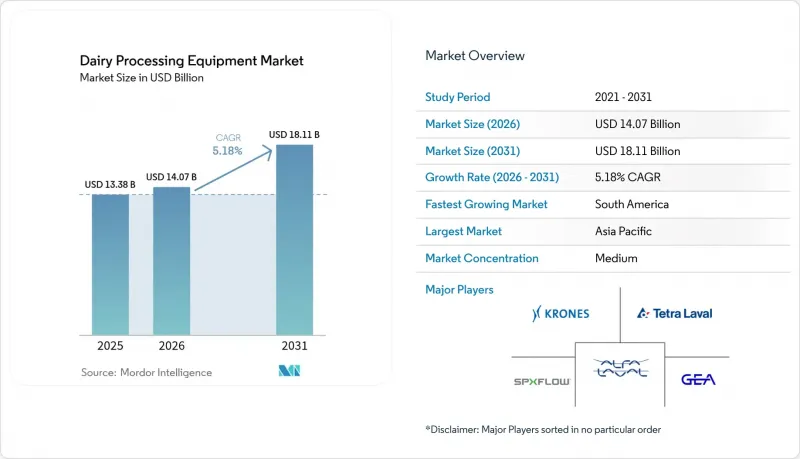
據 Mordor Intelligence 稱,2025 年乳製品加工設備市場價值為 133.8 億美元,預計到 2031 年將達到 181.1 億美元,而 2026 年為 140.7 億美元,預測期(2026-2031 年)的複合年成長率為 5.18%。
本報告按設備類型(滅菌設備、滅菌設備/超高溫瞬時滅菌系統、均質機及其他)、應用領域(液態奶、乳酪、奶粉/嬰幼兒配方奶粉、優格/發酵產品及其他)和地區(北美、歐洲、亞太、南美、中東和非洲)對產業進行分類。市場預測以美元計價。
全球乳製品加工設備市場趨勢及洞察
加工乳製品和加值乳製品的消費量不斷擴大
隨著消費者越來越傾向於便利型乳製品,全球乳製品加工設備市場對先進加工設備的需求激增。這些設備專門用於延長保存期限和生產具有獨特配方的產品,從而推動高價值乳製品的消費。美國農業部農業市場服務局指出,市場對特種乳製品成分的需求不斷成長,其中乳清蛋白和牛奶蛋白在出口市場表現強勁。為了滿足這項需求,加工廠優先投資於能夠處理多種產品線的彈性設備配置。這些投資符合美國食品藥物管理局(FDA)的A級巴氏殺菌乳法規,該法規對用於生產高附加價值乳製品的設備提出了嚴格的要求。此外,賓州食品藥物管理局強調了專為特定乳製品(如優格和起司)量身定做的專用設備的關鍵作用。這些產品需要獨特的加工流程和設備規格。這些小眾產品促使企業投資先進設備,以提高產能和市場競爭力,不僅是為了滿足不斷變化的消費者偏好,也是為了實現更高的售價。
對可在室溫下長期儲存的乳製品的需求正在增加。
對常溫保存乳製品日益成長的需求,正推動乳製品加工設備市場對超高溫瞬時滅菌(UHT)加工系統和無菌包裝技術的大量投資。這些技術進步對於滿足監管標準和拓展市場機會至關重要。美國食品藥物管理局(FDA)對常溫保存產品規定了具體的滅菌要求,其中21 CFR 1240.61明確規定,所有最終包裝的乳製品必須採用經批准的方法進行滅菌。 UHT加工設備必須嚴格控制溫度和時間,FDA也要求使用精確的記錄設備來記錄滅菌參數的符合情況。 UHT技術不僅在已開發市場,在低溫運輸基礎設施薄弱的地區也越來越受歡迎。美國農業部(USDA)報告稱,常溫保存乳製品出口到這些地區的機會正在增加,並強調了這項技術在應對物流挑戰方面發揮的作用。此外,政府機構也強調了UHT加工在確保食品安全的重要性。這項技術對於應對無法進行冷藏保管的緊急情況尤其重要,凸顯了其在國內和國際市場上的重要性。
乳製品加工設備的初始投資和維護成本較高
小規模乳製品加工企業在採用新設備方面面臨許多挑戰。主要原因是高昂的合規成本,持續影響乳製品加工設備市場。明尼蘇達州農業部強調,小規模乳製品加工廠需要投入大量資金才能滿足監管標準,購買諸如滅菌器、均質機和發酵槽等關鍵設備。同樣,田納西大學也指出,這種經濟負擔不僅限於初始購買成本,還包括監管機構要求的持續維護、校準和更換費用。高昂的初始投資和持續的維護成本共同構成了中小企業採用現代化乳製品加工設備的主要障礙。此外,包括日常維護、能源消耗和熟練勞動力在內的營運成本進一步增加了總擁有成本。因此,許多加工企業被迫繼續使用過時的系統或依賴基礎設備,這嚴重阻礙了生產效率並限制了產品創新。這種情況對全球乳製品行業構成了重大挑戰,因為它限制了中小加工商在日益受到技術進步和消費者對高品質乳製品需求驅動的市場中有效競爭的能力。
細分市場分析
預計到2025年,巴氏殺菌機將以27.84%的市場佔有率引領乳製品加工設備市場,凸顯其在確保乳製品加工全製程符合食品安全標準方面發揮的關鍵作用。這一主導地位得益於嚴格的監管要求,這些要求規定了巴氏殺菌過程中對溫度和時間的精確控制。美國食品藥物管理局(FDA)要求巴氏殺菌機在指定的時間內保持規定的溫度,並配備精確的記錄裝置以確保合規性。明尼蘇達州農業部等州監管機構進一步強調了巴氏殺菌機的重要性,將其定位為尋求監管批准的乳製品加工廠的必要投資。此外,田納西大學針對乳製品加工廠的指導方針強調,巴氏殺菌機必須同時滿足聯邦食品藥物管理局(PMO)標準和州法規,以確保產品安全並促進市場准入。
薄膜過濾系統預計將成為乳品加工設備市場中成長最快的設備細分市場,2026年至2031年的複合年成長率預計為6.68%。這一成長主要得益於其在多種應用領域的廣泛適用性,包括蛋白質濃縮、乳糖去除和水回收。加拿大自然資源部已將薄膜過濾認定為一項關鍵的節能技術,可顯著降低濃縮乳清或標準化牛奶成分時的能耗。包括美國食品藥物管理局(FDA)在內的監管機構已批准膜過濾作為一種在不影響食品安全的前提下實現特定產品特性的已通過核准方法。此外,政府機構正在推廣該技術的環境效益,例如水回收和減少廢棄物,這與乳品加工行業日益成長的永續性需求相契合。該細分市場的快速擴張反映了市場對靈活加工技術的日益成長的需求,這些技術使製造商能夠利用單一生產線生產各種特色乳製品,從而滿足監管要求和不斷變化的市場需求。
區域分析
至2025年,亞太地區將佔據全球乳製品市場39.21%的佔有率,凸顯其作為全球最大牛奶生產地和成長最快消費市場的地位。這一成長主要得益於印度積極的政府政策。印度食品加工工業部已根據「總理農民財富計畫」(PM Kisan Sampada Yojana)撥款460億印度盧比,專注於促進乳製品加工。同時,中國的監管環境正在發生變化,國家食品安全標準提案禁止在巴氏殺菌產品中使用復原乳。此舉可能會重新定義中國乳製品加工商的設備要求。美國農業部(USDA)指出中國乳製品市場存在一個悖論:儘管乳牛數量下降,但國內產量卻略有成長,這表明高效乳製品加工設備具有巨大的市場潛力。在日本,由於面臨勞動力短缺,在政府努力確保人口結構變化下生產效率的支持下,向高度自動化轉型正在推進。
預計南美洲將成為乳製品加工設備市場成長最快的地區,2026年至2031年間的複合年成長率將達到7.05%。這一成長得益於有利的生產條件和政府鼓勵出口導向乳製品加工的政策。美國農業部農業市場服務局指出,南美洲的牛奶產量正在成長,這得益於良好的氣候和強勁的乳製品出口需求。巴西的食品加工業尤其以乳製品為主,政府數據顯示乳製品在該國食品生產中佔比高。憑藉有利的氣候和低廉的生產成本等優勢,南美國家正在全球乳製品市場建立競爭優勢。各地區的政府機構不僅認知到這一潛力,而且正在積極推動乳製品加工成為戰略性產業,並發展基礎設施和技術以增強其全球競爭力。北美憑藉其完善的法律規範和積極的政府項目,繼續保持市場主導地位。尤其值得一提的是“東北乳製品商業研發中心”,該中心體現了聯邦政府為實現加工技術現代化而進行的大量投資。
其他福利
- Excel格式的市場預測(ME)表
- 3個月的分析師支持
目錄
第1章:引言
- 研究假設和市場定義
- 調查範圍
第2章:調查方法
第3章執行摘要
第4章 市場狀況
- 市場概覽
- 市場促進因素
- 加工乳製品和加值乳製品的消費量不斷擴大
- 對可在室溫下長期儲存的乳製品的需求正在增加。
- 政府支持乳製品加工現代化的措施
- 嚴格的食品安全法規
- 自動化和工業4.0技術的實施
- 節能低排放量處理系統的創新
- 市場限制因素
- 乳製品加工設備的初始投資和維護成本較高
- 缺乏技術專長
- 將新設備複雜地整合到現有工廠中
- 新興市場的價格敏感性
- 供應鏈分析
- 監理展望
- 波特五力模型
第5章 市場規模與成長預測
- 依設備類型
- 消毒器
- 滅菌設備及超高溫瞬時滅菌系統
- 均質機
- 離心分離器和分離器
- 蒸發設備/乾燥設備
- 薄膜過濾系統
- 混合/配製
- CIP自動化模組
- 透過使用
- 液態乳
- 起司
- 奶粉/嬰兒配方奶粉
- 優格和發酵產品
- 奶油塗抹
- 其他
- 按地區
- 北美洲
- 美國
- 加拿大
- 墨西哥
- 其他北美國家
- 歐洲
- 英國
- 德國
- 西班牙
- 法國
- 義大利
- 俄羅斯
- 其他歐洲國家
- 亞太地區
- 中國
- 印度
- 日本
- 澳洲
- 其他亞太國家
- 南美洲
- 巴西
- 阿根廷
- 其他南美國家
- 中東和非洲
- 沙烏地阿拉伯
- 南非
- 其他中東和非洲國家
- 北美洲
第6章 競爭情勢
- 市場集中度
- 策略趨勢
- 市場排名分析
- 公司簡介
- SPX FLOW, Inc
- GEA Group Aktiengesellschaft
- Alfa Laval
- Tetra Laval Group(Tetra Pack)
- Krones AG
- JBT Corporation
- Paul Mueller Company
- Pentair plc
- Feldmeier Equipment, Inc.
- Scherjon Equipment BV
- IDMC Limited
- Agrometal Ltd
- Fristam Pumpen KG(GmbH & Co. KG)
- IMA Group
- Van den Heuvel Dairy & Food Equipment BV
- Iwai Kikai Kogyo Co., Ltd.
- Shanghai Triowin Intelligent Machinery Co.,Ltd(Triowin Intelligent)
- Bucher Industries AG
- Shanghai Genyond Technology Co. LTD
- Neologic Engineers Pvt. Ltd.
第7章 市場機會與未來展望
According to Mordor Intelligence, the dairy processing equipment market size was valued at USD 13.38 billion in 2025 and estimated to grow from USD 14.07 billion in 2026 to reach USD 18.11 billion by 2031, at a CAGR of 5.18% during the forecast period (2026-2031).
This report Segments the Industry by Equipment Type (Pasteurizers, Sterilizers and UHT Systems, Homogenizers, and More ); Application (Liquid Milk, Cheese, Milk Powder and Infant Formula, Yogurt and Fermented Products, and More); and Geography (North America, Europe, Asia-Pacific, South America, and Middle East and Africa). The Market Forecasts are Provided in Terms of Value (USD).
Global Dairy Processing Equipment Market Trends and Insights
Rising consumption of processed and value-added dairy products
As consumers increasingly favor convenience-oriented dairy products, there's a growing demand for advanced processing equipment within the global dairy processing equipment market. This equipment is tailored to produce products with extended shelf lives and specialty formulations, subsequently boosting the consumption of value-added dairy products. The USDA's Agricultural Marketing Service highlights a growing demand for specialized dairy ingredients, with whey protein and milk albumin experiencing robust growth in export markets. To meet this demand, processing facilities are prioritizing investments in flexible equipment configurations that can support multiple product lines. These investments align with the FDA's Grade 'A' Pasteurized Milk Ordinance, which outlines stringent requirements for equipment used in manufacturing value-added dairy products. Additionally, the Pennsylvania Department of Agriculture underscores the critical role of specialized equipment tailored to specific dairy products, such as yogurt and cheese, which require distinct processing protocols and equipment specifications. These niche offerings not only cater to evolving consumer preferences but also command premium pricing, justifying the adoption of advanced equipment to enhance production capabilities and competitiveness in the market.
Growing demand for shelf-stable and long-life dairy formats
The growing demand for shelf-stable dairy products is driving significant investments in ultra-high temperature (UHT) processing systems and aseptic packaging technologies across the dairy processing equipment market. These advancements are critical for meeting regulatory standards and expanding market opportunities. The FDA mandates specific pasteurization requirements for shelf-stable products, with 21 CFR 1240.61 stipulating that all milk products in their final packaged form must be pasteurized using approved methods. UHT processing equipment must adhere to strict temperature and time controls, and the FDA requires the use of accurate recording devices to document compliance with sterilization parameters. Beyond developed markets, UHT technology is gaining traction in regions with limited cold-chain infrastructure. The USDA reports increasing opportunities for exporting shelf-stable dairy products to these areas, highlighting the technology's role in addressing logistical challenges. Additionally, government agencies emphasize the importance of UHT processing for ensuring food security. This technology is particularly vital in emergency preparedness scenarios where refrigerated storage is unavailable, underscoring its relevance in both domestic and international markets.
High initial investment and maintenance costs for dairy processing equipment
Small-scale processors face significant challenges in adopting new equipment, primarily due to the high costs tied to regulatory compliance which continues to impact on the dairy processing equipment market. The Minnesota Department of Agriculture emphasizes the substantial investments required by small dairy processing plants to procure essential equipment, such as pasteurizers, homogenizers, and fermentation vats, to meet regulatory standards. Similarly, the University of Tennessee highlights that the financial burden extends beyond the initial purchase, encompassing ongoing maintenance, calibration, and replacements mandated by regulatory authorities. These high initial investments, coupled with recurring maintenance costs, create a significant barrier for small and medium-sized enterprises (SMEs) in adopting modern dairy processing equipment. Additionally, operational costs, including regular maintenance, energy consumption, and skilled labor, further escalate the total cost of ownership. As a result, many processors are compelled to either continue using outdated systems or rely on basic equipment, which significantly hampers production efficiency and limits product innovation. This situation poses a critical challenge to the global dairy industry, as it restricts the ability of small-scale and medium-sized processors to compete effectively in a market increasingly driven by technological advancements and consumer demand for high-quality dairy products.
Other drivers and restraints analyzed in the detailed report include:
- Government incentives for dairy processing modernization
- Stringent food safety regulations
- Limited technical expertise
For complete list of drivers and restraints, kindly check the Table Of Contents.
Segment Analysis
In 2025, pasteurizers dominate the dairy processing equipment market with a 27.84% share, highlighting their indispensable role in ensuring food safety compliance across dairy processing operations. This dominance is driven by stringent regulatory requirements that mandate precise temperature and time controls during pasteurization. The FDA requires pasteurization equipment to maintain specified temperatures for designated durations and to include accurate recording devices to ensure compliance. State regulatory bodies, such as the Minnesota Department of Agriculture, further emphasize the importance of pasteurization equipment, identifying it as a critical investment for dairy processing facilities seeking regulatory approval. Additionally, the University of Tennessee's guidelines for dairy processing plants underscore the necessity of pasteurizers in meeting both federal PMO standards and state-specific regulations, ensuring product safety and facilitating market access.
Membrane filtration systems are poised to be the fastest-growing equipment segment within the dairy processing equipment market, with a projected CAGR of 6.68% from 2026 to 2031. Their growth is fueled by their versatility in applications such as protein concentration, lactose removal, and water recovery. Natural Resources Canada highlights membrane filtration as a key energy-efficient technology capable of significantly reducing energy consumption while concentrating cheese whey and standardizing milk composition. Regulatory bodies, including the FDA, recognize membrane filtration as an approved method for achieving specific product characteristics without compromising food safety. Furthermore, government agencies advocate for the technology's environmental benefits, such as water recovery and waste reduction, aligning with sustainability mandates that are increasingly shaping the dairy processing industry. The segment's rapid expansion reflects the growing need for flexible processing technologies that enable manufacturers to produce a variety of specialized dairy products from a single processing line, meeting both regulatory requirements and evolving market demands.
Complete Report Scope:
- By Equipment Type
- Pasteurizers
- Sterilizers and UHT Systems
- Homogenizers
- Centrifuges and Separators
- Evaporators and Dryers
- Membrane Filtration Systems
- Mixing and Blending
- CIP and Automation Modules
- By Application
- Liquid Milk
- Cheese
- Milk Powder and Infant Formula
- Yogurt and Fermented Products
- Butter and Spreads
- Other
- By Geography
- North America
- United States
- Canada
- Mexico
- Rest of North America
- Europe
- United Kingdom
- Germany
- Spain
- France
- Italy
- Russia
- Rest of Europe
- Asia-Pacific
- China
- India
- Japan
- Australia
- Rest of Asia-Pacific
- South America
- Brazil
- Argentina
- Rest of South America
- Middle East and Africa
- Saudi Arabia
- South Africa
- Rest of Middle East and Africa
- North America
Geography Analysis
In 2025, Asia-Pacific commands a 39.21% share of the global dairy market, underscoring its position as both the leading milk producer and the fastest-growing consumer market. This growth is bolstered by proactive government policies, notably in India, where the Ministry of Food Processing Industries has earmarked INR 4,600 crore under the PM Kisan Sampada Yojana, emphasizing dairy processing. Meanwhile, China's evolving regulatory landscape sees the National Food Safety Standards proposing bans on reconstituted milk in sterilized products, a move that could redefine equipment needs for local processors. The USDA highlights a paradox in China's dairy market: domestic production inches up even as cow inventories dwindle, signaling a ripe opportunity for efficient dairy processing equipment. Japan, facing labor challenges, is turning to advanced automation, backed by government initiatives to ensure production efficiency amidst demographic shifts.
South America is set to be the fastest-growing region in the dairy processing equipment market, projected at a 7.05% CAGR from 2026 to 2031. This growth is underpinned by favorable production conditions and government policies that champion export-oriented dairy processing. The USDA's Agricultural Marketing Service notes a rise in South American milk production, thanks to favorable weather and a robust demand for dairy exports. Brazil's food processing landscape is notably dominated by dairy, as evidenced by government data highlighting its significant share in the country's food manufacturing. With advantages like a conducive climate and lower production costs, South American nations are carving out a competitive edge in the global dairy arena. Regional government agencies are not just recognizing this potential but are actively promoting dairy processing as a strategic industry, bolstering infrastructure and technology to enhance global competitiveness. North America, with its comprehensive regulatory frameworks and proactive government programs, continues to hold a dominant market position. A notable highlight is the Northeast Dairy Business Innovation Center, a testament to significant federal investment aimed at modernizing processing technologies.
- SPX FLOW, Inc
- GEA Group Aktiengesellschaft
- Alfa Laval
- Tetra Laval Group (Tetra Pack)
- Krones AG
- JBT Corporation
- Paul Mueller Company
- Pentair plc
- Feldmeier Equipment, Inc.
- Scherjon Equipment B.V.
- IDMC Limited
- Agrometal Ltd
- Fristam Pumpen KG (GmbH & Co. KG)
- IMA Group
- Van den Heuvel Dairy & Food Equipment B.V.
- Iwai Kikai Kogyo Co., Ltd.
- Shanghai Triowin Intelligent Machinery Co.,Ltd (Triowin Intelligent)
- Bucher Industries AG
- Shanghai Genyond Technology Co. LTD
- Neologic Engineers Pvt. Ltd.
Additional Benefits:
- The market estimate (ME) sheet in Excel format
- 3 months of analyst support
TABLE OF CONTENTS
1 INTRODUCTION
- 1.1 Study Assumptions and Market Definition
- 1.2 Scope of the Study
2 RESEARCH METHODOLOGY
3 EXECUTIVE SUMMARY
4 MARKET LANDSCAPE
- 4.1 Market Overview
- 4.2 Market Drivers
- 4.2.1 Rising consumption of processed and value-added dairy products
- 4.2.2 Growing demand for shelf-stable and long-life dairy formats
- 4.2.3 Government incentives for dairy processing modernization
- 4.2.4 Stringent food safety regulations
- 4.2.5 Adoption of automation and industry 4.0 technologies
- 4.2.6 Innovation in energy-efficient and low-emission processing systems
- 4.3 Market Restraints
- 4.3.1 High initial investment and maintenance costs for dairy processing equipment
- 4.3.2 Limited technical expertise
- 4.3.3 Complex integration of new equipment into legacy plants
- 4.3.4 Price sensitivity in emerging markets
- 4.4 Supply Chain Analysis
- 4.5 Regulatory Outlook
- 4.6 Porter's Five Forces
- 4.6.1 Threat of New Entrants
- 4.6.2 Bargaining Power of Buyers/Consumers
- 4.6.3 Bargaining Power of Suppliers
- 4.6.4 Threat of Substitute Products
- 4.6.5 Intensity of Competitive Rivalry
5 MARKET SIZE AND GROWTH FORECASTS (VALUE)
- 5.1 By Equipment Type
- 5.1.1 Pasteurizers
- 5.1.2 Sterilizers and UHT Systems
- 5.1.3 Homogenizers
- 5.1.4 Centrifuges and Separators
- 5.1.5 Evaporators and Dryers
- 5.1.6 Membrane Filtration Systems
- 5.1.7 Mixing and Blending
- 5.1.8 CIP and Automation Modules
- 5.2 By Application
- 5.2.1 Liquid Milk
- 5.2.2 Cheese
- 5.2.3 Milk Powder and Infant Formula
- 5.2.4 Yogurt and Fermented Products
- 5.2.5 Butter and Spreads
- 5.2.6 Other
- 5.3 By Geography
- 5.3.1 North America
- 5.3.1.1 United States
- 5.3.1.2 Canada
- 5.3.1.3 Mexico
- 5.3.1.4 Rest of North America
- 5.3.2 Europe
- 5.3.2.1 United Kingdom
- 5.3.2.2 Germany
- 5.3.2.3 Spain
- 5.3.2.4 France
- 5.3.2.5 Italy
- 5.3.2.6 Russia
- 5.3.2.7 Rest of Europe
- 5.3.3 Asia-Pacific
- 5.3.3.1 China
- 5.3.3.2 India
- 5.3.3.3 Japan
- 5.3.3.4 Australia
- 5.3.3.5 Rest of Asia-Pacific
- 5.3.4 South America
- 5.3.4.1 Brazil
- 5.3.4.2 Argentina
- 5.3.4.3 Rest of South America
- 5.3.5 Middle East and Africa
- 5.3.5.1 Saudi Arabia
- 5.3.5.2 South Africa
- 5.3.5.3 Rest of Middle East and Africa
- 5.3.1 North America
6 COMPETITIVE LANDSCAPE
- 6.1 Market Concentration
- 6.2 Strategic Moves
- 6.3 Market Ranking Analysis
- 6.4 Company Profiles (includes Global-level Overview, Market-level Overview, Core Segments, Financials (if available), Strategic Information, Market Rank/Share, Products and Services, Recent Developments)
- 6.4.1 SPX FLOW, Inc
- 6.4.2 GEA Group Aktiengesellschaft
- 6.4.3 Alfa Laval
- 6.4.4 Tetra Laval Group (Tetra Pack)
- 6.4.5 Krones AG
- 6.4.6 JBT Corporation
- 6.4.7 Paul Mueller Company
- 6.4.8 Pentair plc
- 6.4.9 Feldmeier Equipment, Inc.
- 6.4.10 Scherjon Equipment B.V.
- 6.4.11 IDMC Limited
- 6.4.12 Agrometal Ltd
- 6.4.13 Fristam Pumpen KG (GmbH & Co. KG)
- 6.4.14 IMA Group
- 6.4.15 Van den Heuvel Dairy & Food Equipment B.V.
- 6.4.16 Iwai Kikai Kogyo Co., Ltd.
- 6.4.17 Shanghai Triowin Intelligent Machinery Co.,Ltd (Triowin Intelligent)
- 6.4.18 Bucher Industries AG
- 6.4.19 Shanghai Genyond Technology Co. LTD
- 6.4.20 Neologic Engineers Pvt. Ltd.
7 MARKET OPPORTUNITIES AND FUTURE OUTLOOK

 乳品加工設備市場規模、佔有率、成長率、全球產業分析、區域趨勢及2026年至2034年預測。
 乳品加工設備市場:依設備類型、自動化程度、應用、加工能力及地區分類
 乳品加工設備市場:2026-2032年全球市場預測(依設備類型、自動化程度、運作模式、部署情境、應用程式、最終用戶和通路分類)
 2026-2035 年乳製品加工中超過濾和微過濾的市場機會、成長要素、產業趨勢和預測。
 乳品加工設備市場報告:趨勢、預測及競爭分析(至2035年)
 全球乳品加工設備市場:按類型、應用、運作、工廠規模和地區分類-預測至2031年乳品設備市場:依產品類型、應用、運作模式及地區分類全球乳品加工設備市場規模、佔有率、趨勢及成長分析報告(2026-2034年)
 乳品加工設備市場規模、佔有率、趨勢和預測:按設備、類型、應用和地區分類,2026-2034年
 2026年全球乳品加工設備市場報告