


 |
市場調查報告書
商品編碼
2101883
2026-2035 年乳製品加工中超過濾和微過濾的市場機會、成長要素、產業趨勢和預測。Ultra-Filtration and Microfiltration in Dairy Processing Market Opportunity, Growth Drivers, Industry Trend Analysis, and Forecast 2026 - 2035 |
||||||

全球乳製品加工用超過濾和微過濾市場預計到 2025 年將達到 19 億美元,年複合成長率為 9.4%,到 2035 年將達到 47 億美元。
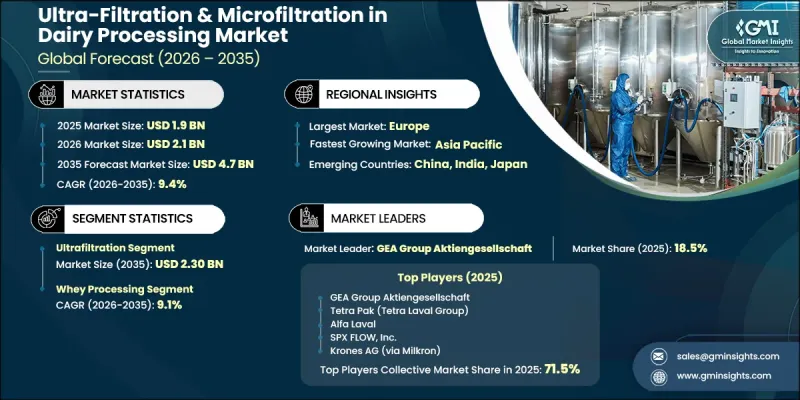
這一成長是由多方面因素共同推動的:對高蛋白乳成分的需求不斷成長、食品加工環境中微生物安全標準日益嚴格,以及膜分離乳品生產系統的持續擴展。超過濾和微過濾技術正從輔助加工工具轉變為現代乳品生產的核心基礎設施,這得益於它們能夠提高蛋白質回收率、降低能耗(與熱蒸發相比)並提升整體製程效率。高蛋白乳成分的高溢價持續推動全部區域膜分離系統的再投資。同時,鑑於全球相當一部分人口患有不同程度的乳糖不耐症,對無乳糖乳製品的需求不斷成長,也推動了先進過濾製程的應用。膜分離系統能夠有效分離乳品,同時保留營養成分,從而支持全球乳品供應鏈的產品創新和合規性。
| 市場範圍 | |
|---|---|
| 開始年份 | 2025 |
| 預測期 | 2026-2035 |
| 初始市場規模 | 19億美元 |
| 預測金額 | 47億美元 |
| 複合年成長率 | 9.4% |
累計到2025年,超過濾業務的銷售額將達到9.09億美元,佔市場佔有率的47.5%,到2035年將達到23億美元,年複合成長率為9.8%。該業務在乳製品加工行業中繼續發揮核心作用,膜系統被廣泛應用於主要產區的大規模乳製品加工廠,用於乳清蛋白濃縮、乳蛋白質濃縮物生產和預濃縮製程。
乳清加工市場規模達到6.08億美元,佔市場佔有率的31.7%,預計將以9.1%的複合年成長率成長,到2035年達到14.5億美元。這一市場主導地位歸功於薄膜過濾在乳清蛋白生產系統中的關鍵作用。這些系統透過超過濾,能夠以經濟高效的方式大規模生產高價值的濃縮蛋白和分離蛋白,滿足全球對富含蛋白質的乳製品原料的需求。
預計到2025年,北美乳製品加工領域的超過濾和微過濾市場規模將達到5.66億美元。美國仍然是主要的需求中心,這得益於其高度發達的乳清加工產業以及集中在主要乳製品產區的廣泛膜過濾基礎設施。先進分離技術在大規模乳製品加工廠的廣泛應用,進一步鞏固了主導地位。
目錄
第1章:調查方法和範圍
第2章執行摘要
第3章 行業洞察
- 產業生態系分析
- 供應商情況
- 利潤率
- 每個階段增加的價值
- 影響價值鏈的因素
- 中斷
- 影響產業的因素
- 促進因素
- 產業潛在風險與挑戰
- 市場機遇
- 成長潛力分析
- 監理情勢
- 波特的分析
- PESTLE分析
- 價格趨勢
- 按地區
- 依產品類型
- 未來市場趨勢
- 技術與創新展望
- 最新科技趨勢
- 新興技術
- 專利趨勢
- 貿易統計
- 主要進口國
- 主要出口國
- 永續性和環境方面
- 永續計劃
- 減少廢棄物策略
- 生產中的能源效率
- 具有環保意識的舉措
- 考慮碳足跡
第4章 競爭情勢
- 介紹
- 企業市佔率分析
- 按地區
- 北美洲
- 歐洲
- 亞太地區
- 拉丁美洲
- 中東和非洲
- 按地區
- 企業矩陣分析
- 主要市場公司的競爭分析
- 競爭定位矩陣
- 主要進展
- 併購
- 夥伴關係和聯盟
- 新產品發布
- 業務拓展計劃
第5章 市場估計與預測:依技術類型分類,2022-2035年
- 超過濾(UF)
- 螺旋纏繞超濾
- UF型板框
- 管式超濾
- 中空纖維超濾
- 微過濾(MF)
- 陶瓷MF
- 聚合物MF
- 低溫MF
- 奈米過濾(NF)
- 螺旋纏繞超濾
- 管狀NF
- 逆滲透(RO)
- 螺旋繞線 RO
- 板框式RO
- 其他
- 透析濾
- 電滲析
- 膜接觸器
第6章 市場估價與預測:依模組設計分類,2022-2035年
- 螺旋纏繞式
- 管狀系統
- 板材和框架
- 中空纖維
第7章 市場估計與預測:依應用領域分類,2022-2035年
- 乳製品加工
- 牛奶的標準化和蛋白質濃度
- 去除細菌和孢子
- 乳糖減量
- 脂肪組分
- 乳清加工
- 乳清蛋白濃縮物(WPC)的生產
- 乳清蛋白隔離群(WPI)生產
- 乳糖回收
- 乳清脫礦質
- 乳酪生產
- 乳酪製作中牛奶的製備
- 去除細菌以延長保存期限
- 鹽水處理
- MCC Production
- 優格生產
- 希臘優格和高蛋白優格
- Skyal 和 Quark 的生產
- 發酵產品的蛋白質標準化
- 奶油生產
- 脂肪分離純化
- 酪乳濃度
- 其他
- 奶油
- 嬰兒配方奶粉的成分
- 適用於運動員和老年人的營養蛋白產品
第8章 市場估算與預測:依最終用戶分類,2022-2035年
- 乳製品加工廠
- 大型綜合設施
- 中型區域工廠
- 小規模手工藝加工企業
- 乳酪製造商
- 天然乳酪生產商
- 加工起士生產廠
- 優格機
- 傳統優格生產廠
- 高蛋白優格和希臘優格生產廠
- 奶油生產商
- 乳製品生產商的奶油生產
- 特種奶油生產
- 生乳生產商
- 生乳加工
- 長保存期限(ESL)牛奶
- 超高溫滅菌牛奶生產
第9章 市場估計與預測:依地區分類,2022-2035年
- 北美洲
- 美國
- 加拿大
- 歐洲
- 德國
- 英國
- 法國
- 西班牙
- 義大利
- 其他歐洲國家
- 亞太地區
- 中國
- 印度
- 日本
- 澳洲
- 韓國
- 其他亞太國家
- 拉丁美洲
- 巴西
- 墨西哥
- 阿根廷
- 其他拉丁美洲國家
- 中東和非洲
- 沙烏地阿拉伯
- 南非
- UAE
- 其他中東和非洲國家
第10章:公司簡介
- GEA Group Aktiengesellschaft
- Tetra Pak(Tetra Laval Group)
- Alfa Laval
- SPX FLOW, Inc.
- Krones AG(via Milkron)
- Koch Membrane Systems
- IDMC Limited
- Andritz AG
- Pentair plc
- Kovalus Separation Solutions
- Neologic Engineers Private Limited
- Gemak Ltd.
- Permionics Membranes Private Limited
- Caloris Engineering LLC
- Synder Filtration
The Global Ultra-Filtration and Microfiltration in Dairy Processing Market was valued at USD 1.9 billion in 2025 and is estimated to grow at a CAGR of 9.4% to reach USD 4.7 billion by 2035.
Growth is driven by the convergence of rising demand for high-protein dairy ingredients, stricter microbial safety requirements in food processing environments, and the continued scaling of membrane-based dairy manufacturing systems. Ultrafiltration and microfiltration technologies have shifted from secondary processing tools to core infrastructure in modern dairy production, supported by their ability to improve protein recovery, reduce energy consumption compared to thermal evaporation, and enhance overall process efficiency. Premium pricing for high-protein dairy ingredients continues to support reinvestment in membrane systems across major dairy-producing regions. At the same time, expanding demand for lactose-free dairy products is reinforcing the adoption of advanced filtration processes, as a significant share of the global population experiences varying degrees of lactose intolerance. Membrane-based separation systems enable efficient fractionation of dairy streams while preserving nutritional composition, supporting both product innovation and regulatory compliance across global dairy supply chains.
| Market Scope | |
|---|---|
| Start Year | 2025 |
| Forecast Year | 2026-2035 |
| Start Value | $1.9 Billion |
| Forecast Value | $4.7 Billion |
| CAGR | 9.4% |
The ultrafiltration segment generated USD 909 million in 2025, accounting for 47.5% share, and is projected to reach USD 2.30 billion by 2035 at a CAGR of 9.8%. This segment remains central to dairy processing operations, with membrane systems widely used for whey protein concentration, milk protein concentrate production, and pre-concentration processes in large-scale dairy facilities across key producing regions.
The whey processing segment reached USD 608 million, holding 31.7% share, and is expected to grow at a CAGR of 9.1% to reach USD 1.45 billion by 2035. This dominance is driven by the essential role of membrane filtration in whey protein production systems, where ultrafiltration enables the economic production of high-value protein concentrates and isolates at an industrial scale, supporting global demand for protein-rich dairy ingredients.
North America Ultra-Filtration and Microfiltration in Dairy Processing Market accounted for USD 566 million in 2025. The United States remains the primary demand hub, supported by a highly developed whey processing industry and extensive membrane filtration infrastructure concentrated in major dairy-producing regions. Strong integration of advanced separation technologies within large-scale dairy processing facilities continues to reinforce regional market leadership.
Major players operating in the global ultra-filtration & microfiltration in dairy processing industry are Dexcom, Inc., Medtronic Plc, Abbott Laboratories, Novo Nordisk A/S, F. Hoffmann-La Roche Ltd, Tandem Diabetes Care, Inc., Insulet Corporation, Ypsomed Holding, Ascensia Diabetes Care Holdings AG, DarioHealth Corporation, Senseonics, Glooko Inc., Emperra GmbH E-Health Technologies, Pendiq. Companies operating in the ultra-filtration and microfiltration in dairy processing market are focusing on expanding membrane efficiency and improving separation performance through advanced material engineering and optimized pore structure designs. Many players are investing in automation and digital monitoring systems to enhance process control, reduce downtime, and improve yield consistency across dairy production lines. Strategic collaborations with dairy processors are strengthening long-term supply contracts and enabling customized system integration for whey and milk processing applications. Firms are also prioritizing energy-efficient membrane technologies to reduce operational costs and improve sustainability performance in large-scale plants.
Table of Contents
Chapter 1 Methodology & Scope
- 1.1 Research approach
- 1.2 Quality Commitments
- 1.2.1 GMI AI policy & data integrity commitment
- 1.2.1.1 Source consistency protocol
- 1.2.1 GMI AI policy & data integrity commitment
- 1.3 Research Trail & Confidence Scoring
- 1.3.1 Research Trail Components
- 1.3.2 Scoring Components
- 1.4 Data Collection
- 1.4.1 Partial list of primary sources
- 1.5 Data mining sources
- 1.5.1 Paid sources
- 1.5.1.1 Sources, by region
- 1.5.1 Paid sources
- 1.6 Base estimates and calculations
- 1.6.1 Base year calculation for any one approach
- 1.7 Forecast model
- 1.7.1 Quantified market impact analysis
- 1.7.1.1 Mathematical impact of growth parameters on forecast
- 1.7.1 Quantified market impact analysis
- 1.8 Research transparency addendum
- 1.8.1 Source attribution framework
- 1.8.2 Quality assurance metrics
- 1.8.3 Our commitment to trust
Chapter 2 Executive Summary
- 2.1 Industry 360° synopsis
- 2.2 Key market trends
- 2.2.1 Regional
- 2.2.2 Technology Type
- 2.2.3 Module Design
- 2.2.4 Application
- 2.2.5 End-User
- 2.3 TAM Analysis, 2026-2035
- 2.4 CXO perspectives: Strategic imperatives
Chapter 3 Industry Insights
- 3.1 Industry ecosystem analysis
- 3.1.1 Supplier landscape
- 3.1.2 Profit margin
- 3.1.3 Value addition at each stage
- 3.1.4 Factor affecting the value chain
- 3.1.5 Disruptions
- 3.2 Industry impact forces
- 3.2.1 Growth drivers
- 3.2.2 Industry pitfalls and challenges
- 3.2.3 Market opportunities
- 3.3 Growth potential analysis
- 3.4 Regulatory landscape
- 3.4.1 North America
- 3.4.2 Europe
- 3.4.3 Asia Pacific
- 3.4.4 Latin America
- 3.4.5 Middle East & Africa
- 3.5 Porter's analysis
- 3.6 PESTEL analysis
- 3.7 Price trends
- 3.7.1 By region
- 3.7.2 By product type
- 3.8 Future market trends
- 3.9 Technology and Innovation landscape
- 3.9.1 Current technological trends
- 3.9.2 Emerging technologies
- 3.10 Patent Landscape
- 3.11 Trade statistics (HS code)
- 3.11.1 Major importing countries
- 3.11.2 Major exporting countries
- 3.12 Sustainability and environmental aspects
- 3.12.1 Sustainable practices
- 3.12.2 Waste reduction strategies
- 3.12.3 Energy efficiency in production
- 3.12.4 Eco-friendly initiatives
- 3.13 Carbon footprint consideration
Chapter 4 Competitive Landscape, 2025
- 4.1 Introduction
- 4.2 Company market share analysis
- 4.2.1 By region
- 4.2.1.1 North America
- 4.2.1.2 Europe
- 4.2.1.3 Asia Pacific
- 4.2.1.4 LATAM
- 4.2.1.5 MEA
- 4.2.1 By region
- 4.3 Company matrix analysis
- 4.4 Competitive analysis of major market players
- 4.5 Competitive positioning matrix
- 4.6 Key developments
- 4.6.1 Mergers & acquisitions
- 4.6.2 Partnerships & collaborations
- 4.6.3 New Product Launches
- 4.6.4 Expansion Plans
Chapter 5 Market Estimates and Forecast, By Technology Type, 2022-2035 (USD Million)
- 5.1 Key trends
- 5.2 Ultrafiltration (UF)
- 5.2.1 Spiral Wound UF
- 5.2.2 Plate & Frame UF
- 5.2.3 Tubular UF
- 5.2.4 Hollow Fiber UF
- 5.3 Microfiltration (MF)
- 5.3.1 Ceramic MF
- 5.3.2 Polymeric MF
- 5.3.3 Cold MF
- 5.4 Nanofiltration (NF)
- 5.4.1 Spiral Wound NF
- 5.4.2 Tubular NF
- 5.5 Reverse Osmosis (RO)
- 5.5.1 Spiral Wound RO
- 5.5.2 Plate & Frame RO
- 5.6 Others
- 5.6.1 Diafiltration
- 5.6.2 Electrodialysis
- 5.6.3 Membrane Contactors
Chapter 6 Market Estimates and Forecast, By Module Design, 2022-2035 (USD Million)
- 6.1 Key trends
- 6.2 Spiral Wound
- 6.3 Tubular Systems
- 6.4 Plate & Frame
- 6.5 Hollow Fiber
Chapter 7 Market Estimates and Forecast, By Application, 2022-2035 (USD Million)
- 7.1 Key trends
- 7.2 Milk Processing
- 7.2.1 Milk Standardization & Protein Concentration
- 7.2.2 Bacterial & Spore Removal
- 7.2.3 Lactose Reduction
- 7.2.4 Fat Fractionation
- 7.3 Whey Processing
- 7.3.1 Whey Protein Concentrate (WPC) Production
- 7.3.2 Whey Protein Isolate (WPI) Production
- 7.3.3 Lactose Recovery
- 7.3.4 Whey Demineralization
- 7.4 Cheese Production
- 7.4.1 Cheese Milk Preparation
- 7.4.2 Bacterial Removal for Extended Shelf Life
- 7.4.3 Brine Treatment
- 7.4.4 MCC Production
- 7.5 Yogurt Production
- 7.5.1 Greek Yogurt & High-Protein Yogurt
- 7.5.2 Skyr & Quark Production
- 7.5.3 Protein Standardization for Fermented Products
- 7.6 Butter Production
- 7.6.1 Fat Fractionation & Clarification
- 7.6.2 Buttermilk Concentration
- 7.7 Others
- 7.7.1 Cream Processing
- 7.7.2 Infant Formula Ingredients
- 7.7.3 Sports & Senior Nutrition Protein Products
Chapter 8 Market Estimates and Forecast, By End-User, 2022-2035 (USD Million)
- 8.1 Key trends
- 8.2 Dairy Processing Plants
- 8.2.1 Large-Scale Integrated Facilities
- 8.2.2 Medium-Scale Regional Plants
- 8.2.3 Small-Scale Artisanal Processors
- 8.3 Cheese Manufacturers
- 8.3.1 Natural Cheese Producers
- 8.3.2 Processed Cheese Facilities
- 8.4 Yogurt Producers
- 8.4.1 Conventional Yogurt Plants
- 8.4.2 High-Protein & Greek Yogurt Facilities
- 8.5 Butter Manufacturers
- 8.5.1 Creamery Butter Production
- 8.5.2 Specialty Butter Processing
- 8.6 Fluid Milk Producers
- 8.6.1 Fresh Milk Processing
- 8.6.2 Extended Shelf Life (ESL) Milk
- 8.6.3 UHT Milk Production
Chapter 9 Market Estimates and Forecast, By Region, 2022-2035 (USD Million)
- 9.1 Key trends
- 9.2 North America
- 9.2.1 U.S.
- 9.2.2 Canada
- 9.3 Europe
- 9.3.1 Germany
- 9.3.2 UK
- 9.3.3 France
- 9.3.4 Spain
- 9.3.5 Italy
- 9.3.6 Rest of Europe
- 9.4 Asia Pacific
- 9.4.1 China
- 9.4.2 India
- 9.4.3 Japan
- 9.4.4 Australia
- 9.4.5 South Korea
- 9.4.6 Rest of Asia Pacific
- 9.5 Latin America
- 9.5.1 Brazil
- 9.5.2 Mexico
- 9.5.3 Argentina
- 9.5.4 Rest of Latin America
- 9.6 Middle East and Africa
- 9.6.1 Saudi Arabia
- 9.6.2 South Africa
- 9.6.3 UAE
- 9.6.4 Rest of Middle East and Africa
Chapter 10 Company Profiles
- 10.1 GEA Group Aktiengesellschaft
- 10.2 Tetra Pak (Tetra Laval Group)
- 10.3 Alfa Laval
- 10.4 SPX FLOW, Inc.
- 10.5 Krones AG (via Milkron)
- 10.6 Koch Membrane Systems
- 10.7 IDMC Limited
- 10.8 Andritz AG
- 10.9 Pentair plc
- 10.10 Kovalus Separation Solutions
- 10.11 Neologic Engineers Private Limited
- 10.12 Gemak Ltd.
- 10.13 Permionics Membranes Private Limited
- 10.14 Caloris Engineering LLC
- 10.15 Synder Filtration

 乳品加工設備:市場佔有率分析、產業趨勢與統計、成長預測(2026-2031)
 乳品加工設備市場規模、佔有率、成長率、全球產業分析、區域趨勢及2026年至2034年預測。
 乳品加工設備市場:依設備類型、自動化程度、應用、加工能力及地區分類
 乳品加工設備市場:2026-2032年全球市場預測(依設備類型、自動化程度、運作模式、部署情境、應用程式、最終用戶和通路分類)
 乳品加工設備市場報告:趨勢、預測及競爭分析(至2035年)
 全球乳品加工設備市場:按類型、應用、運作、工廠規模和地區分類-預測至2031年乳品設備市場:依產品類型、應用、運作模式及地區分類全球乳品加工設備市場規模、佔有率、趨勢及成長分析報告(2026-2034年)
 乳品加工設備市場規模、佔有率、趨勢和預測:按設備、類型、應用和地區分類,2026-2034年
 2026年全球乳品加工設備市場報告