


 |
市場調查報告書
商品編碼
2114826
工業齒輪箱:市場佔有率分析、產業趨勢與統計、成長預測(2026-2031)Industrial Gearbox - Market Share Analysis, Industry Trends & Statistics, Growth Forecasts (2026 - 2031) |
||||||

※ 本網頁內容可能與最新版本有所差異。詳細情況請與我們聯繫。
根據 Mordor Intelligence 預測,工業變速箱市場規模將從 2025 年的 304.1 億美元成長到 2026 年的 316.5 億美元,然後在 2031 年達到 384.9 億美元,2026 年至 2031 年的複合年成長率為 3.9%。
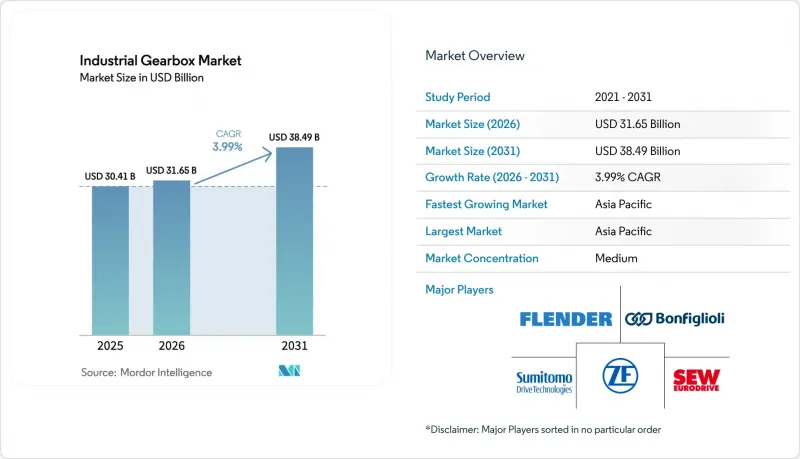
本報告按類型(蝸輪蝸桿、螺旋齒輪、斜齒輪-螺旋齒輪、行星齒輪及其他)、最終用戶(汽車及電動車、能源、製造及工具機、採礦及冶金、用水和污水處理及其他)及地區(北美、歐洲、亞太、南美以及中東和非洲)進行細分。市場規模和預測均以美元計價。
全球工業齒輪箱市場趨勢與洞察
利用工業4.0的自動化
狀態監測感測器、IO-Link介面和邊緣運算模組整合到齒輪箱中,實現了封閉回路型控制策略,在2025年即將發布的模組化平台上,安裝時間縮短了40%。無線振動和溫度感測器與智慧潤滑系統結合,使得偏遠礦場和離岸風力發電電場的維護間隔可超過10,000小時。基於雲端的數位孿生技術能夠接收即時遙測數據,並以高達90%的準確率預測剩餘使用壽命,使營運商能夠根據計畫停機時間安排更換。 5G低延遲網路的部署支援在機分析,可根據工件硬度動態調整齒輪比,在無需硬體變更的情況下提高吞吐量。因此,工業齒輪箱市場正從被動動力傳輸轉向資料豐富的機電一體化子系統。
風力發電機機齒輪的需求快速成長
全球離岸風力發電裝置容量預計在2024年達到83.2吉瓦,並在2025年至2034年間成長超過350吉瓦。目前,兆瓦級風力渦輪機需要主齒輪箱在其15-20年的使用壽命週期內承受超過10,000千牛頓米的扭矩負載,這導致大直徑行星齒輪級的訂單激增。德國已累計80億歐元用於離岸風力發電的擴張,並計劃在2025年至2027年間競標7-9吉瓦的計畫。 2024年,中速齒輪傳動系統佔了91.3%的市場佔有率,凸顯了齒輪箱的重要性,儘管直驅技術的應用日益廣泛。效率高達98%的壓縮機組齒輪箱也被應用於綠色氫能電解槽專案中,這表明齒輪箱的需求範圍已擴展到風電以外的領域。
鋼鐵價格波動
2024年至2025年間,熱軋鋼卷價格在每噸620美元至900美元之間波動,導致未採取避險策略的組裝毛利率下降2-3個百分點。 2025年,合金鋼價格每公斤加收0.15-0.25美元的附加費,導致部分合金鋼被表面硬化碳鋼取代,儘管碳鋼的疲勞壽命降低了10-15%。垂直整合的供應商正利用其內部齒輪加工和熱處理能力來抵消價格波動的影響。積層製造平台正在推動模組化設計,顯著降低了廢品率,從18-22%降至5%以下,並將原型製作前置作業時間從8週縮短至5天。儘管價格風險預計會有所緩解,但在可預見的未來,價格風險仍將對工業齒輪箱市場構成拖累。
細分市場分析
行星齒輪減速機預計到2031年將以4.71%的複合年成長率成長,這主要得益於機器人、精密工具工具機和太陽能追蹤器等應用領域對有限安裝空間內高扭力密度的需求。納博特斯科(Nabtesco)佔據精密減速器市場60%以上的佔有率,其出貨的RV減速器無變形、零背隙,使用壽命超過100萬次循環。螺旋齒輪減速機預計到2025年將佔銷售額的37.58%,這反映了其在輸送機、攪拌器和通用機械等領域的廣泛應用。
在工業齒輪箱市場,螺旋齒輪因其高效、低噪音和易於維護等優點仍佔據主導地位,但客戶對感測器整合和IO-Link連接的需求日益成長。蝸輪蝸桿傳動裝置在需要自鎖功能和極高減速比的領域,例如電梯煞車和閥門執行器,仍然佔有一席之地。錐螺旋齒輪用於冷卻塔風扇和立式攪拌機,傳遞直角驅動力;而擺線齒輪因其零背隙和抗衝擊載荷能力,在精密分度驅動領域越來越受歡迎。 2024年推出的線上配置器允許用戶自訂扭力、方向和潤滑條件,將報價時間從三天縮短至一小時。積層製造和拓樸最佳化的齒輪毛坯可進一步減輕15-20%的重量,進而提高功率品質比。
區域分析
預計到2025年,亞太地區將佔全球銷售額的43.63%,並在2031年之前以4.68%的複合年成長率成長。這主要得益於中國在2024年部署了33萬台工業機器人,以及該地區主導的一系列離岸風力發電計畫帶來的利多。印度1.4兆美元的國家基礎設施計畫正在推動對建築齒輪箱的需求,該國到2030年實現140吉瓦風電裝置容量的目標也為國內供應商創造了新的機會。日本和韓國專注於半導體製造設備和協作機器人的精密減速器,而隨著住友商事在越南於2024年運作一座4萬平方公尺的工廠,越南正崛起為低成本出口基地。
德國、義大利和法國是歐洲工具機和渦輪機供應鏈的核心。德國80億歐元的離岸風力發電計畫以及將於2027年生效的歐盟機械法規正在推動符合IEC 62443標準的智慧齒輪箱的普及。在義大利的包裝器材叢集中,緊湊型行星齒輪箱是高速填充線的首選。同時,斯堪的納維亞半島對電解設備的投資需要效率高達98%的壓縮機齒輪來降低能耗。歐洲供應商正擴大利用積層製造技術來縮短原型製作週期並實現備件的本地化生產。
北美的需求主要受倉庫自動化、頁岩氣基礎設施建設以及電動車產量擴張的推動。根據美國《通貨膨脹削減法案》,符合條件的變速箱製造成本可獲得高達25%的稅額扣抵抵免,高達45倍,這促使Regal Rexnord公司於2024年在威斯康辛州投資7,500萬美元進行擴建。加拿大礦業公司正在升級驅動系統,配備感測器以減少停機時間;而在墨西哥,電動車的普及推動了電池卡車單速減速器的訂單成長。在南美洲、中東和非洲,巴西的鐵礦石、智利的銅礦以及海灣國家的海水淡化計畫都在推動市場發展,這些計畫都需要耐腐蝕的齒輪傳動裝置。
其他好處:
- Excel格式的市場預測(ME)表
- 3個月的分析師支持
目錄
第1章:引言
- 研究假設和市場定義
- 調查範圍
第2章:調查方法
第3章執行摘要
第4章 市場狀況
- 市場概覽
- 市場促進因素
- 利用工業4.0擴大自動化應用
- 風力發電機機齒輪的需求量激增。
- 物流/倉儲自動化快速擴張
- 建築和採礦設備產量增加
- 向模組化和3D列印齒輪組件過渡
- 數據驅動的預測性維護合約正在推動升級改造。
- 市場限制因素
- 原物料(鋼鐵)價格波動
- 成熟產業的更換週期延長
- 高扭力密度電液執行器正在蠶食緊湊型變速箱市場。
- 智慧變速箱網路安全認證延誤
- 供應鏈分析
- 技術展望
- 監理情勢
- 波特五力模型
第5章 市場規模與成長預測
- 按類型
- 蠕蟲
- 螺旋
- 斜面螺旋
- 行星類型
- 其他類型
- 最終用戶
- 汽車和電動旅行
- 能源
- 製造和工具機
- 採礦和冶金
- 供水和廢水處理
- 其他最終用戶
- 按地區
- 北美洲
- 美國
- 加拿大
- 墨西哥
- 歐洲
- 德國
- 英國
- 法國
- 義大利
- 西班牙
- 北歐國家
- 俄羅斯
- 其他歐洲國家
- 亞太地區
- 中國
- 印度
- 日本
- 韓國
- ASEAN
- 其他亞太國家
- 南美洲
- 巴西
- 阿根廷
- 哥倫比亞
- 其他南美國家
- 中東和非洲
- 沙烏地阿拉伯
- 阿拉伯聯合大公國
- 南非
- 埃及
- 其他中東和非洲國家
- 北美洲
第6章 競爭情勢
- 市場集中度
- 策略趨勢(併購、聯盟、購電協議)
- 市場佔有率分析(主要公司的市場排名和佔有率)
- 公司簡介
- Flender International GmbH
- Bonfiglioli Riduttori SpA
- SEW-Eurodrive GmbH & Co KG
- Sumitomo Drive Technologies
- ZF Friedrichshafen AG
- Getriebebau NORD GmbH
- Liebherr-Components
- DB Santasalo
- Regal Rexnord Corporation
- Tandler Zahnrad-& Getriebefabrik
- Nanjing High Accurate Drive
- Emerson Power Transmission(Baldor-Dodge)
- Renold plc
- Dana Brevini
- Cone Drive(Timken)
- Nabtesco Corporation
- Elecon Engineering
- Jiangsu Tailong Decelerator
- Rossi SpA
- Zollern GmbH & Co KG
第7章 市場機會與未來展望
According to Mordor Intelligence, the industrial gearbox market size is expected to grow from USD 30.41 billion in 2025 to USD 31.65 billion in 2026 and is forecast to reach USD 38.49 billion by 2031 at 3.99% CAGR over 2026-2031.
This report is Segmented by Type (Worm, Helical, Bevel-Helical, Planetary, and Other Types), End-User (Automotive and E-Mobility, Energy, Manufacturing and Machine Tools, Mining & Metallurgy, Water and Wastewater Treatment, and Other End-Users), and Geography (North America, Europe, Asia-Pacific, South America, and Middle East and Africa). The Market Sizes and Forecasts are Provided in Terms of Value (USD).
Global Industrial Gearbox Market Trends and Insights
Industry 4.0-enabled automation
Condition-monitoring sensors, IO-Link interfaces, and edge-compute modules are being embedded inside gearboxes, enabling closed-loop control strategies that trim installation time by 40% on modular platforms launched in 2025. Wireless vibration and temperature nodes paired with smart lubrication systems have extended service intervals beyond 10,000 hours in remote mines and offshore wind farms. Cloud-based digital twins ingest live telemetry to predict remaining useful life with up to 90% accuracy, letting operators align replacements with planned shutdowns. The roll-out of 5G low-latency networks supports on-machine analytics that dynamically adapt gear ratios to workpiece hardness, boosting throughput without hardware changes. As a result, the industrial gearbox market is pivoting from passive power transmission toward data-rich mechatronic subsystems.
Surging wind-turbine gear demand
Global offshore wind capacity hit 83.2 GW in 2024 and is forecast to swell by more than 350 GW between 2025 and 2034. Multi-megawatt turbines now require main gearboxes that withstand torque loads exceeding 10,000 kN-m over 15-20 year lifecycles, spurring orders for large-diameter planetary stages. Germany has earmarked EUR 8 billion for offshore expansion, with 7-9 GW of auctions scheduled between 2025 and 2027. Medium-speed geared drivetrains held 91.3% market share in 2024, underlining gearbox relevance despite rising direct-drive adoption. Electrolyser projects for green hydrogen also specify 98%-efficiency compressor-train gearboxes, broadening the demand base beyond wind.
Steel-price volatility
Hot-rolled coil swung between USD 620 and USD 900 per metric ton during 2024-2025, cutting gross margins by 2-3 percentage points for assemblers lacking hedging programs. Alloy-steel surcharges added USD 0.15-0.25 per kilogram in 2025, triggering selective substitution of case-hardened carbon steels at the expense of 10-15% fatigue-life reduction. Vertically integrated suppliers offset swings through captive gear-cutting and heat-treatment capacity. Additive-manufacturing platforms are driving modular designs that slash scrap from 18-22% to below 5%, compressing prototype lead times from eight weeks to five days. Although price risk is expected to moderate, it remains a near-term drag on the industrial gearbox market.
Other drivers and restraints analyzed in the detailed report include:
- Rapid intralogistics and warehouse expansion
- Growth in construction and mining output
- Electro-hydraulic actuator substitution
For complete list of drivers and restraints, kindly check the Table Of Contents.
Segment Analysis
Planetary gearboxes are forecast to expand at a 4.71% CAGR through 2031 as robotics, precision machine tools, and solar trackers require high torque density in tight envelopes. Nabtesco controls over 60% of precision reduction gears, shipping strain-wave-free RV reducers that exceed 1 million cycles with zero backlash. Helical configurations delivered 37.58% of 2025 revenue, reflecting their versatility in conveyors, agitators, and general-purpose machinery.
The industrial gearbox market continues to prize helical designs for efficiency, low noise, and ease of maintenance, yet customers increasingly specify integrated sensors and IO-Link connectivity. Worm units retain niche roles where self-locking or extreme ratios are vital, such as elevator brakes and valve actuators. Bevel-helical styles transmit right-angle power for cooling-tower fans and vertical mixers, while cycloidal drives gain favor in precision indexing because of zero backlash and shock-load resilience. Online configurators launched in 2024 allow users to tailor torque, orientation, and lubrication, shrinking quote cycles from three days to one hour. Additive-manufactured, topology-optimized gear blanks further cut weight by 15-20%, enhancing power-to-mass ratios.
Complete Report Scope:
- By Type
- Worm
- Helical
- Bevel-Helical
- Planetary
- Other Types
- By End-user
- Automotive and E-Mobility
- Energy
- Manufacturing and Machine Tools
- Mining and Metallurgy
- Water and Waste-water Treatment
- Other End-Users
- By Geography
- North America
- United States
- Canada
- Mexico
- Europe
- Germany
- United Kingdom
- France
- Italy
- Spain
- NORDIC Countries
- Russia
- Rest of Europe
- Asia-Pacific
- China
- India
- Japan
- South Korea
- ASEAN
- Rest of Asia-Pacific
- South America
- Brazil
- Argentina
- Colombia
- Rest of South America
- Middle East and Africa
- Saudi Arabia
- United Arab Emirates
- South Africa
- Egypt
- Rest of Middle East and Africa
- North America
Geography Analysis
Asia-Pacific generated 43.63% of global revenue in 2025 and is projected to grow at a 4.68% CAGR through 2031, benefiting from China's 330,000 industrial-robot installations in 2024 and the region's dominant offshore-wind pipeline. India's USD 1.4 trillion National Infrastructure Pipeline fosters demand for construction gearboxes, while the country's wind capacity target of 140 GW by 2030 opens new opportunities for domestic suppliers. Japan and South Korea specialize in precision reducers for semiconductor tools and collaborative robots, and Vietnam has emerged as a lower-cost export base following Sumitomo's 40,000 m2 plant launch in 2024.
Germany, Italy, and France are anchoring machine-tool and turbine supply chains in Europe. Germany's EUR 8 billion offshore-wind program and the EU Machinery Regulation taking effect in 2027 drive uptake of IEC 62443-compliant smart gearboxes. Italy's packaging-machinery cluster favors compact planetary units for high-speed filling lines, while Nordic electrolyser investments demand 98%-efficiency compressor gears to curb energy consumption. European suppliers increasingly use additive manufacturing to shorten prototype cycles and localize spare-part production.
Demand in North America is buoyed by warehouse-automation roll-outs, shale-gas infrastructure, and EV production ramp-ups. The U.S. Inflation Reduction Act's 45X credit reimburses up to 25% of eligible gearbox manufacturing costs, catalyzing a USD 75 million Wisconsin expansion by Regal Rexnord in 2024. Canadian miners retrofit sensor-equipped drives to cut downtime, while Mexico's EV transition fuels orders for single-speed reductions in battery-electric trucks. South America and the Middle East & Africa markets are dominated by Brazilian iron ore, Chilean copper, and Gulf desalination projects that demand corrosion-resistant gear trains.
- Flender International GmbH
- Bonfiglioli Riduttori SpA
- SEW-Eurodrive GmbH & Co KG
- Sumitomo Drive Technologies
- ZF Friedrichshafen AG
- Getriebebau NORD GmbH
- Liebherr-Components
- DB Santasalo
- Regal Rexnord Corporation
- Tandler Zahnrad- & Getriebefabrik
- Nanjing High Accurate Drive
- Emerson Power Transmission (Baldor-Dodge)
- Renold plc
- Dana Brevini
- Cone Drive (Timken)
- Nabtesco Corporation
- Elecon Engineering
- Jiangsu Tailong Decelerator
- Rossi SpA
- Zollern GmbH & Co KG
Additional Benefits:
- The market estimate (ME) sheet in Excel format
- 3 months of analyst support
TABLE OF CONTENTS
1 Introduction
- 1.1 Study Assumptions & Market Definition
- 1.2 Scope of the Study
2 Research Methodology
3 Executive Summary
4 Market Landscape
- 4.1 Market Overview
- 4.2 Market Drivers
- 4.2.1 Rising adoption of Industry 4.0-enabled automation
- 4.2.2 Surging wind-turbine gear demand
- 4.2.3 Rapid expansion of intralogistics/warehouse automation
- 4.2.4 Growing construction & mining equipment output
- 4.2.5 Shift to modular, 3-D printed gear components
- 4.2.6 Data-driven predictive-maintenance contracts boosting upgrades
- 4.3 Market Restraints
- 4.3.1 Volatility in raw-material (steel) prices
- 4.3.2 Extended replacement cycles in mature industries
- 4.3.3 Torque-dense electro-hydraulic actuators cannibalising compact gearboxes
- 4.3.4 Cyber-security certification delays for smart gearboxes
- 4.4 Supply-Chain Analysis
- 4.5 Technological Outlook
- 4.6 Regulatory Landscape
- 4.7 Porter's Five Forces
- 4.7.1 Bargaining Power of Suppliers
- 4.7.2 Bargaining Power of Buyers
- 4.7.3 Threat of New Entrants
- 4.7.4 Threat of Substitutes
- 4.7.5 Competitive Rivalry
5 Market Size & Growth Forecasts
- 5.1 By Type
- 5.1.1 Worm
- 5.1.2 Helical
- 5.1.3 Bevel-Helical
- 5.1.4 Planetary
- 5.1.5 Other Types
- 5.2 By End-user
- 5.2.1 Automotive and E-Mobility
- 5.2.2 Energy
- 5.2.3 Manufacturing and Machine Tools
- 5.2.4 Mining and Metallurgy
- 5.2.5 Water and Waste-water Treatment
- 5.2.6 Other End-Users
- 5.3 By Geography
- 5.3.1 North America
- 5.3.1.1 United States
- 5.3.1.2 Canada
- 5.3.1.3 Mexico
- 5.3.2 Europe
- 5.3.2.1 Germany
- 5.3.2.2 United Kingdom
- 5.3.2.3 France
- 5.3.2.4 Italy
- 5.3.2.5 Spain
- 5.3.2.6 NORDIC Countries
- 5.3.2.7 Russia
- 5.3.2.8 Rest of Europe
- 5.3.3 Asia-Pacific
- 5.3.3.1 China
- 5.3.3.2 India
- 5.3.3.3 Japan
- 5.3.3.4 South Korea
- 5.3.3.5 ASEAN
- 5.3.3.6 Rest of Asia-Pacific
- 5.3.4 South America
- 5.3.4.1 Brazil
- 5.3.4.2 Argentina
- 5.3.4.3 Colombia
- 5.3.4.4 Rest of South America
- 5.3.5 Middle East and Africa
- 5.3.5.1 Saudi Arabia
- 5.3.5.2 United Arab Emirates
- 5.3.5.3 South Africa
- 5.3.5.4 Egypt
- 5.3.5.5 Rest of Middle East and Africa
- 5.3.1 North America
6 Competitive Landscape
- 6.1 Market Concentration
- 6.2 Strategic Moves (M&A, Partnerships, PPAs)
- 6.3 Market Share Analysis (Market Rank/Share for key companies)
- 6.4 Company Profiles (includes Global level Overview, Market level overview, Core Segments, Financials as available, Strategic Information, Products & Services, and Recent Developments)
- 6.4.1 Flender International GmbH
- 6.4.2 Bonfiglioli Riduttori SpA
- 6.4.3 SEW-Eurodrive GmbH & Co KG
- 6.4.4 Sumitomo Drive Technologies
- 6.4.5 ZF Friedrichshafen AG
- 6.4.6 Getriebebau NORD GmbH
- 6.4.7 Liebherr-Components
- 6.4.8 DB Santasalo
- 6.4.9 Regal Rexnord Corporation
- 6.4.10 Tandler Zahnrad- & Getriebefabrik
- 6.4.11 Nanjing High Accurate Drive
- 6.4.12 Emerson Power Transmission (Baldor-Dodge)
- 6.4.13 Renold plc
- 6.4.14 Dana Brevini
- 6.4.15 Cone Drive (Timken)
- 6.4.16 Nabtesco Corporation
- 6.4.17 Elecon Engineering
- 6.4.18 Jiangsu Tailong Decelerator
- 6.4.19 Rossi SpA
- 6.4.20 Zollern GmbH & Co KG
7 Market Opportunities & Future Outlook
- 7.1 White-space & Unmet-need Assessment

 多齒輪驅動裝置市場:全球市場預測(2026-2032年)
 精密齒輪箱機械市場機會、成長促進因素、產業趨勢分析及2026-2035年預測汽車變速箱市場:2026-2032年全球市場預測(按變速箱類型、車輛類型、燃料類型、技術類型、驅動系統和應用分類)工業齒輪箱和齒輪馬達市場:2026-2032年全球市場預測(按產品類型、齒輪類型、安裝類型、額定功率、應用和銷售管道)工業齒輪箱市場:按類型、級數、安裝方式、潤滑方式、材質、運作模式、應用和銷售管道分類-2026-2032年全球市場預測
 電動駐煞車系統市場:依系統類型、車輛類型和地區分類
 鐵路齒輪箱市場報告:趨勢、預測及競爭分析(至2035年)
 精密齒輪箱機械市場規模、佔有率和成長分析:依產品類型、精度等級、最終用途產業、銷售管道和地區分類-2026-2033年產業預測工業齒輪箱市場:按類型、應用和地區分類
 2026年全球汽車變速箱市場報告