


 |
市場調查報告書
商品編碼
2109239
精密齒輪箱機械市場機會、成長促進因素、產業趨勢分析及2026-2035年預測Precision Gearbox Machinery Market Opportunity, Growth Drivers, Industry Trend Analysis, and Forecast 2026 - 2035 |
||||||

全球精密齒輪箱機械市場預計到 2025 年將達到 42 億美元,年複合成長率為 8.6%,到 2035 年將達到 97 億美元。
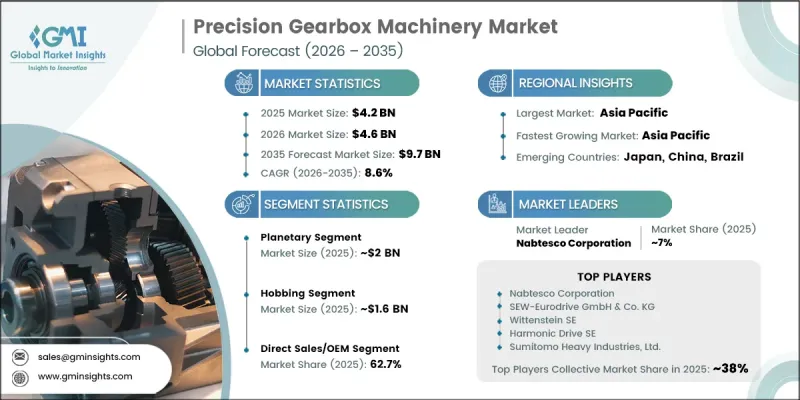
精密齒輪箱機械產業的整體成長主要得益於工業自動化領域的持續投入、齒輪製造技術的現代化以及對高精度運動控制系統日益成長的需求。製造商不斷優先提升其先進齒輪箱的生產能力,以滿足現代工業設備日益成長的精度要求,同時提高生產效率和運作可靠性。自動化生產系統的廣泛應用正在加速對能夠提供卓越精度和穩定輸出的高性能齒輪箱機械的需求。工業4.0技術、工業IoT(IIoT)連接、數位化監控和即時機器分析的持續整合正在改變生產環境,並推動對下一代製造設備的投資。對緊湊型設備設計、改進的運動控制和提高生產精度的日益重視,進一步強化了對先進齒輪箱製造解決方案的需求。這些持續的技術進步和不斷擴大的工業自動化投入,將在預測期內持續支撐全球精密齒輪箱製造機械市場的長期成長。
| 市場範圍 | |
|---|---|
| 開始年份 | 2025 |
| 預測期 | 2026-2035 |
| 初始市場規模 | 42億美元 |
| 預測金額 | 97億美元 |
| 複合年成長率 | 8.6% |
精密齒輪箱機械市場持續受惠於自動化製造技術的快速發展和日益嚴格的生產標準。設備製造商致力於生產能夠在緊湊的機器結構中實現極高精度並支援多軸運動的齒輪箱系統。對先進運動控制、更高製造精度和更高運行效率的日益成長的需求,正在推動技術先進的齒輪箱生產設備的廣泛應用。智慧製造系統和數位化生產技術的持續創新,正進一步提升機器性能、最佳化製程流程並提高工業應用整體的生產可靠性。
行星齒輪市佔率高達47.9%,預計到2025年市場規模將達20億美元。該細分市場之所以能保持主導地位,是因為行星齒輪設計具有高扭矩傳輸能力、卓越的效率、緊湊的結構以及在各種精密運動應用中可靠的性能。其多功能性和滿足嚴苛工業應用需求的能力持續推動著強勁的市場需求,鞏固了其在預測期內作為最大產品細分市場的地位。
預計到2025年,滾齒加工將佔據39.1%的市場佔有率,市場規模將達到16億美元。滾齒加工因其生產效率高、加工精度高以及與各種齒輪結構的廣泛兼容性,仍然是首選的加工過程。數控滾齒設備的日益普及和數位化製造技術的融合,進一步增強了市場對該製程的需求,並鞏固了主導地位。
美國精密齒輪箱機械市場預計到2025年將佔據25%的市場佔有率,並在2026年至2035年間以9.3%的複合年成長率成長,成為全球第二快成長速度的區域市場。對先進製造技術的持續投資、不斷擴大的工業自動化計劃以及高科技工業設備產量的增加,正在推動該市場的強勁成長。對現代化製造能力的日益重視以及自動化生產技術的廣泛應用,持續為美國市場帶來對精密齒輪箱機械的巨大需求。
目錄
第1章:調查方法和範圍
第2章執行摘要
第3章 行業洞察
- 產業生態系分析
- 供應商情況
- 利潤率
- 每個階段增加的價值
- 影響價值鏈的因素
- 影響產業的因素
- 促進因素
- 產業潛在風險與挑戰
- 機會
- 成長潛力分析
- 價格波動和市場不可預測性
- 對品質保證和設備可靠性的擔憂
- 未來市場趨勢
- 技術與創新展望
- 最新科技趨勢
- 新興技術
- 價格分析
- 對過去價格趨勢的分析
- 依球員類型分類的定價策略(高級球員、超值球員、成本加成球員)
- 按產品類型和容量分類的平均售價
- 監理情勢
- 標準和合規要求
- 區域監理框架
- 認證標準
- 波特的分析
- PESTLE分析
- 貿易數據分析
- 按地區分類的進出口數量和價值趨勢
- 主要貿易路線(中國-北美、中國-歐洲)及關稅的影響
- 人工智慧和生成式人工智慧對精密齒輪箱機械市場的影響
- 利用人工智慧改造現有經營模式
- 按細分市場分類的生成式人工智慧用例和部署藍圖
- 風險、限制和監管考量
- 生產能力和生產情況
- 各國及主要生產商的設備產能
- 運轉率和擴張計劃
第4章 競爭情勢
- 介紹
- 企業市佔率分析
- 按地區
- 企業矩陣分析
- 主要市場公司的競爭分析
- 競爭定位矩陣
- 主要進展
- 併購
- 夥伴關係和聯盟
- 新產品發布
- 業務拓展計劃
第5章 市場估算與預測:依產品類型分類,2022-2035年
- 行星
- 直角
- 平行軸
第6章 市場估價與預測:依製造流程分類,2022-2035年
- 霍賓
- 研磨
- 轉彎
- 搪光
第7章 市場估計與預測:依應用領域分類,2022-2035年
- 機器人與自動化
- 風力
- 工具機
- 車
- 物料輸送
- 包裝
- 航太、國防和醫療
- 非公路
- 鐵路
- 海上
- 農業
- 其他
第8章 市場估算與預測:依通路分類,2022-2035年
- 直銷/OEM
- 銷售代理商和經銷商
- 線上電子商務
- 專賣店和展示室
第9章 市場估計與預測:依地區分類,2022-2035年
- 北美洲
- 美國
- 加拿大
- 歐洲
- 德國
- 英國
- 法國
- 義大利
- 西班牙
- 亞太地區
- 中國
- 日本
- 印度
- 澳洲
- 韓國
- 拉丁美洲
- 巴西
- 墨西哥
- 阿根廷
- 中東和非洲
- 南非
- 沙烏地阿拉伯
- UAE
第10章:公司簡介
- 全球主要公司
- Nabtesco Corporation
- SEW-Eurodrive GmbH & Co. KG
- Wittenstein SE
- Harmonic Drive SE
- Sumitomo Heavy Industries, Ltd.
- Nidec Corporation
- Bonfiglioli Riduttori SpA
- Flender GmbH
- The Timken Company
- 當地公司
- Neugart GmbH
- STOBER Antriebstechnik GmbH
- Regal Rexnord Corporation
- NGC Gear Group
- Apex Dynamics Inc.
- Elecon Engineering Company Ltd.
- Reggiana Riduttori Srl
- Rossi SpA
- 新興企業
- Leaderdrive Systems
- Zhejiang Shuanghuan Driveline
- HIWIN Technologies Corp.
- Maxon Group
The Global Precision Gearbox Machinery Market was valued at USD 4.2 billion in 2025 and is estimated to grow at a CAGR of 8.6% to reach USD 9.7 billion by 2035.
Growth across the precision gearbox machinery industry is driven by sustained investments in industrial automation, modernization of gear manufacturing technologies, and rising demand for highly accurate motion control systems. Manufacturers continue to prioritize advanced gearbox production capabilities to meet the increasing precision requirements of modern industrial equipment while improving manufacturing efficiency and operational reliability. The expanding adoption of automated production systems is accelerating demand for high-performance gearbox machinery capable of delivering superior accuracy and consistent output. Continuous integration of Industry 4.0 technologies, Industrial Internet of Things (IIoT) connectivity, digital monitoring, and real-time machine analytics is transforming production environments and encouraging investment in next-generation manufacturing equipment. Growing emphasis on compact equipment design, improved motion control, and enhanced production precision is further strengthening demand for advanced gearbox manufacturing solutions. These ongoing technological advancements and increasing industrial automation initiatives continue to support the long-term expansion of the global precision gearbox machinery market throughout the forecast period.
| Market Scope | |
|---|---|
| Start Year | 2025 |
| Forecast Year | 2026-2035 |
| Start Value | $4.2 Billion |
| Forecast Value | $9.7 Billion |
| CAGR | 8.6% |
The precision gearbox machinery market continues to benefit from the rapid advancement of automated manufacturing technologies and increasingly demanding production standards. Equipment manufacturers are focusing on producing gearbox systems capable of achieving extremely high levels of accuracy while supporting multi-axis motion within compact machine configurations. The growing need for advanced motion control, improved manufacturing precision, and higher operational efficiency is encouraging broader adoption of technologically advanced gearbox production equipment. Continuous innovation in intelligent manufacturing systems and digital production technologies is further enhancing machine performance, improving process optimization, and increasing overall production reliability across industrial applications.
The planetary segment accounted for a 47.9% share, generating USD 2 billion in 2025. The segment maintains its leading position because planetary gearbox designs provide high torque transmission, excellent efficiency, compact construction, and dependable performance across a wide variety of precision motion applications. Their versatility and ability to support demanding industrial operations continue to drive strong market demand, reinforcing their position as the largest product segment throughout the forecast period.
The hobbing segment held a 39.1% share in 2025, capturing USD 1.6 billion. Hobbing remains the preferred manufacturing process because it offers high production efficiency, excellent machining accuracy, and broad compatibility with multiple gear configurations. The widespread use of CNC-based hobbing equipment and increasing integration of digital manufacturing technologies continue to strengthen demand for this process, supporting its leadership within the market.
U.S. Precision Gearbox Machinery Market held a 25% share in 2025 and is expected to grow at a CAGR of 9.3% from 2026 to 2035, making it the second-fastest-growing regional market worldwide. Continued investment in advanced manufacturing, expanding industrial automation initiatives, and increasing production of high-technology industrial equipment are supporting strong market growth. Rising emphasis on modern manufacturing capabilities and increasing adoption of automated production technologies continue to generate substantial demand for precision gearbox machinery across the country.
Major companies operating in the global precision gearbox machinery market include Apex Dynamics Inc., Bonfiglioli Riduttori S.p.A., Elecon Engineering Company Ltd., Flender GmbH, Harmonic Drive SE, HIWIN Technologies Corp., Leaderdrive Systems, maxon Group, Nabtesco Corporation, Neugart GmbH, NGC Gear Group, Nidec Corporation, Regal Rexnord Corporation, Reggiana Riduttori S.r.l., Rossi S.p.A., SEW-Eurodrive GmbH & Co. KG, STOBER Antriebstechnik GmbH, Sumitomo Heavy Industries Ltd., The Timken Company, Wittenstein SE, and Zhejiang Shuanghuan Driveline. Companies competing in the precision gearbox machinery market are strengthening their market position through continuous investment in advanced manufacturing technologies, product innovation, and precision engineering capabilities. Manufacturers are focusing on improving machining accuracy, production efficiency, digital integration, and equipment reliability to meet evolving industrial requirements. Many organizations are expanding manufacturing capacity, strengthening global distribution channels, and enhancing technical support services to improve customer satisfaction and market reach. Strategic partnerships, technology collaborations, and sustained investment in research and development remain key approaches for accelerating innovation and broadening product portfolios.
Table of Contents
Chapter 1 Methodology and Scope
- 1.1 Market scope and definition
- 1.2 Research design
- 1.2.1 Research approach
- 1.2.2 Data collection methods
- 1.3 Data mining sources
- 1.3.1 Global
- 1.3.2 Regional/Country
- 1.4 Base estimates and calculations
- 1.4.1 Base year calculation
- 1.4.2 Key trends for market estimation
- 1.5 Primary research and validation
- 1.5.1 Primary sources
- 1.6 Forecast model
- 1.7 Research assumptions and limitations
Chapter 2 Executive Summary
- 2.1 Industry 360° synopsis
- 2.2 Key market trends
- 2.2.1 Regional
- 2.2.2 Product Type
- 2.2.3 Manufacturing Process
- 2.2.4 Application
- 2.2.5 Distribution Channel
Chapter 3 Industry Insights
- 3.1 Industry ecosystem analysis
- 3.1.1 Supplier landscape
- 3.1.2 Profit margin
- 3.1.3 Value addition at each stage
- 3.1.4 Factor affecting the value chain
- 3.2 Industry impact forces
- 3.2.1 Growth drivers
- 3.2.2 Industry pitfalls & challenges
- 3.2.3 Opportunities
- 3.3 Growth potential analysis
- 3.3.1 Price volatility and market unpredictability
- 3.3.2 Quality assurance and equipment reliability concerns
- 3.4 Future market trends
- 3.5 Technology and innovation landscape
- 3.5.1 Current technological trends
- 3.5.2 Emerging technologies
- 3.6 Pricing Analysis (Driven by Primary Research)
- 3.6.1 Historical Price Trend Analysis (Driven by Primary Research)
- 3.6.2 Pricing Strategy by Player Type (Premium/Value/Cost-plus) (Driven by Primary Research)
- 3.6.3 Average Selling Price by Product Type & Capacity
- 3.7 Regulatory landscape
- 3.7.1 Standards and compliance requirements
- 3.7.2 Regional regulatory frameworks
- 3.7.3 Certification standards
- 3.8 Porter’s analysis
- 3.9 PESTEL analysis
- 3.10 Trade Data Analysis (Driven by Primary Research)
- 3.10.1 Import/Export Volume & Value Trends by Region (HS Code Level) (Driven by Primary Research)
- 3.10.2 Key Trade Corridors (China–North America, China–Europe) & Tariff Impact (Driven by Primary Research)
- 3.11 Impact of AI & Generative AI on the Precision Gearbox Machinery Market
- 3.11.1 AI-Driven Disruption of Existing Business Models
- 3.11.2 GenAI Use Cases & Adoption Roadmap by Segment
- 3.11.3 Risks, Limitations & Regulatory Considerations
- 3.12 Capacity and Production Landscape (Driven by Primary Research)
- 3.12.1 Installed Capacity by Country and Key Producer (Driven by Primary Research)
- 3.12.2 Capacity Utilization Rates and Expansion Pipelines (Driven by Primary Research)
Chapter 4 Competitive Landscape, 2025
- 4.1 Introduction
- 4.2 Company market share analysis
- 4.2.1 By region
- 4.2.1.1 North America
- 4.2.1.2 Europe
- 4.2.1.3 Asia Pacific
- 4.2.1.4 Latin America
- 4.2.1.5 Middle East and Africa
- 4.2.1 By region
- 4.3 Company matrix analysis
- 4.4 Competitive analysis of major market players
- 4.5 Competitive positioning matrix
- 4.6 Key developments
- 4.6.1 Mergers & acquisitions
- 4.6.2 Partnerships & collaborations
- 4.6.3 New product launches
- 4.6.4 Expansion plans
Chapter 5 Market Estimates & Forecast, By Product Type, 2022 – 2035, (USD Billion) (Thousand Units)
- 5.1 Key trends
- 5.2 Planetary
- 5.3 Right Angle
- 5.4 Parallel Shaft
Chapter 6 Market Estimates & Forecast, By Manufacturing Process, 2022 – 2035, (USD Billion) (Thousand Units)
- 6.1 Key trends
- 6.2 Hobbing
- 6.3 Grinding
- 6.4 Turning
- 6.5 Honing
Chapter 7 Market Estimates & Forecast, By Application, 2022 – 2035, (USD Billion) (Thousand Units)
- 7.1 Key trends
- 7.2 Robotics & Automation
- 7.3 Wind Energy
- 7.4 Machine Tools
- 7.5 Automotive
- 7.6 Material Handling
- 7.7 Packaging
- 7.8 Aerospace/Defense/Medical
- 7.9 Off-Highway
- 7.10 Railways
- 7.11 Marine
- 7.12 Agriculture
- 7.13 Others
Chapter 8 Market Estimates & Forecast, By Distribution Channel, 2022 – 2035, (USD Billion) (Thousand Units)
- 8.1 Key trends
- 8.2 Direct Sales / OEM
- 8.3 Distributors & Dealers
- 8.4 Online / E-Commerce
- 8.5 Specialty Stores & Showrooms
Chapter 9 Market Estimates and Forecast, By Region, 2022 – 2035 (USD Billion) (Thousand Units)
- 9.1 Key trends
- 9.2 North America
- 9.2.1 U.S.
- 9.2.2 Canada
- 9.3 Europe
- 9.3.1 Germany
- 9.3.2 UK
- 9.3.3 France
- 9.3.4 Italy
- 9.3.5 Spain
- 9.4 Asia Pacific
- 9.4.1 China
- 9.4.2 Japan
- 9.4.3 India
- 9.4.4 Australia
- 9.4.5 South Korea
- 9.5 Latin America
- 9.5.1 Brazil
- 9.5.2 Mexico
- 9.5.3 Argentina
- 9.6 Middle East and Africa
- 9.6.1 South Africa
- 9.6.2 Saudi Arabia
- 9.6.3 UAE
Chapter 10 Company Profiles
- 10.1 Top Global Player
- 10.1.1 Nabtesco Corporation
- 10.1.2 SEW-Eurodrive GmbH & Co. KG
- 10.1.3 Wittenstein SE
- 10.1.4 Harmonic Drive SE
- 10.1.5 Sumitomo Heavy Industries, Ltd.
- 10.1.6 Nidec Corporation
- 10.1.7 Bonfiglioli Riduttori S.p.A.
- 10.1.8 Flender GmbH
- 10.1.9 The Timken Company
- 10.2 Regional Player
- 10.2.1 Neugart GmbH
- 10.2.2 STOBER Antriebstechnik GmbH
- 10.2.3 Regal Rexnord Corporation
- 10.2.4 NGC Gear Group
- 10.2.5 Apex Dynamics Inc.
- 10.2.6 Elecon Engineering Company Ltd.
- 10.2.7 Reggiana Riduttori S.r.l.
- 10.2.8 Rossi S.p.A.
- 10.3 Emerging Players
- 10.3.1 Leaderdrive Systems
- 10.3.2 Zhejiang Shuanghuan Driveline
- 10.3.3 HIWIN Technologies Corp.
- 10.3.4 Maxon Group

 多齒輪驅動裝置市場:全球市場預測(2026-2032年)
 工業齒輪箱:市場佔有率分析、產業趨勢與統計、成長預測(2026-2031)汽車變速箱市場:2026-2032年全球市場預測(按變速箱類型、車輛類型、燃料類型、技術類型、驅動系統和應用分類)工業齒輪箱和齒輪馬達市場:2026-2032年全球市場預測(按產品類型、齒輪類型、安裝類型、額定功率、應用和銷售管道)工業齒輪箱市場:按類型、級數、安裝方式、潤滑方式、材質、運作模式、應用和銷售管道分類-2026-2032年全球市場預測
 電動駐煞車系統市場:依系統類型、車輛類型和地區分類
 鐵路齒輪箱市場報告:趨勢、預測及競爭分析(至2035年)
 精密齒輪箱機械市場規模、佔有率和成長分析:依產品類型、精度等級、最終用途產業、銷售管道和地區分類-2026-2033年產業預測工業齒輪箱市場:按類型、應用和地區分類
 2026年全球汽車變速箱市場報告