


 |
市場調查報告書
商品編碼
2114806
導電油墨:市場佔有率分析、產業趨勢與統計、成長預測(2026-2031)Conductive Ink - Market Share Analysis, Industry Trends & Statistics, Growth Forecasts (2026 - 2031) |
||||||

※ 本網頁內容可能與最新版本有所差異。詳細情況請與我們聯繫。
據 Mordor Intelligence 稱,導電油墨市場預計到 2026 年價值 33.9 億美元,高於 2025 年的 32.6 億美元,預計到 2031 年將達到 41.1 億美元。
預計 2026 年至 2031 年的複合年成長率為 3.92%。
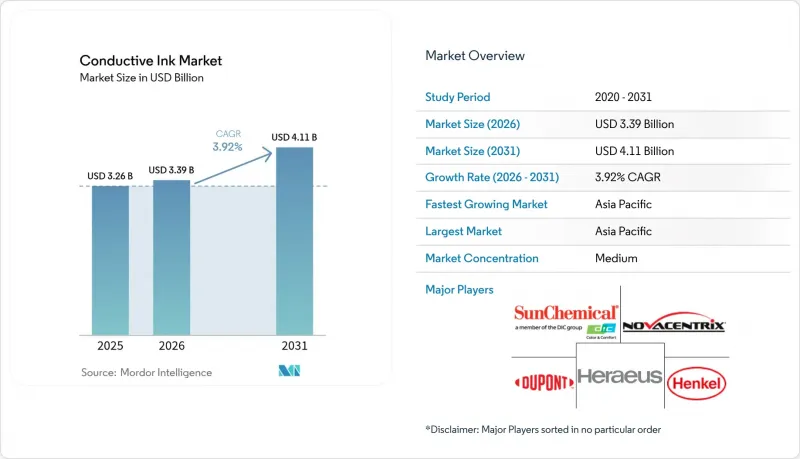
本報告按類型(銀基、銅基、石墨烯基、奈米碳管奈米管、導電聚合物、介電材料及其他)、應用(太陽能、射頻識別、感測器、觸控螢幕顯示器、印刷電路板及其他)和地區(亞太地區、北美地區、歐洲地區、南美地區、中東和非洲)進行細分。市場預測以美元計價。
全球導電油墨市場趨勢及洞察
擴大太陽能板安裝規模
隨著全球太陽能發電裝置容量的擴張,銀膠的消耗量持續成長,預計到2024年將達到7億盎司,年增7%。高效能N型電池需要更厚的銀指,導致每個電池板的油墨用量增加。中國和印度強制安裝大規模太陽能陣列的政策正在擴大到2030年的需求。國際能源總署(IEA)指出,未來十年太陽能發電將佔可再生能源發電裝置容量的60%以上。因此,每增加1吉瓦的發電裝置容量,都將刺激對導電油墨的需求,進而推動長期成長。
對印刷基板(PCB)的需求增加
採用銀墨進行精細佈線印刷對於高密度基板(HDI) 至關重要。預計到 2025 年 2 月,北美印刷電路基板出貨量將成長 11.3%,訂單出貨比將達到 1.33。由於產能從中國回流至泰國和越南,亞太地區的製造基地正在擴張。 HDI 的擴張與導電油墨市場降低精細佈線電阻損耗的目標相契合。網版印刷電路減少了蝕刻工序,也有助於縮短交貨週期。由於需求持續超過供應,油墨供應商正與基板製造商簽訂多年合約。
銅基油墨的氧化可靠性問題
銅奈米顆粒氧化迅速,形成電阻層,降低電路性能。聚合物塗層雖然能抑制氧化,但會導致黏度增加和印刷製程複雜化。先進的黏合劑雖然能達到 158 µΩ*cm 的電阻率,但需要惰性回流焊接爐,增加了資本投入成本。這些加工方面的限制使得銅在醫療感測器和航太電路等高可靠性產品中的應用受到限制,而銀儘管價格更高,仍然佔據主導地位。
細分市場分析
到2025年,銀基導電油墨將佔據導電油墨市場77.10%的佔有率,凸顯其在太陽能和電路基板無與倫比的導電性能。石墨烯基導電油墨雖然目前市佔率較小,但憑藉其成本優勢和柔軟性,正以4.88%的複合年成長率快速成長。石墨烯和銀的混合材料正在彌合性能差距,並促進從純銀漿料到石墨烯漿料的平穩過渡。由於需要使用保護性化學品來防止氧化以及製程複雜性的增加,銅基漿料的應用仍然局限於低成本電子設備。奈米碳管和導電聚合物正在滿足對可拉伸性和耐化學性有較高要求的細分市場需求,例如電子紡織品和生物貼片。
這種商業化也使介電油墨備受關注,它透過絕緣相鄰線路來實現多層結構。水性石墨烯油墨的導電率接近 1.5 × 10⁴ S/m,正在威脅銀在感測器應用中的地位,因為在這些應用中,一定的電阻是可以接受的。而使用金和鉑等貴金屬的油墨則專門用於航太和植入式設備,在這些應用中,任務關鍵型可靠性比成本更為重要。總而言之,性能和價格是選擇的關鍵因素,即使導電油墨市場整體上隨著替代品的出現而不斷擴大,銀的主導地位仍然穩固。
區域分析
預計到2025年,亞太地區將佔全球銷售額的45.20%,並將在2031年之前維持4.58%的複合年成長率。中國的可再生能源部署計劃、印度的超級工廠建設以及韓國的晶片封裝熱潮正在形成一個相互促進的生態系統。日本提供最佳化性能的特種漿料和列印頭。泰國和越南透過讓各品牌留在區域價值網路內,同時降低地緣政治風險,吸收了產能。這種叢集降低了物流成本,加快了產品迭代速度,並帶來了其他地區難以複製的優勢。
北美緊隨其後,這得益於有利於國內電動車供應鏈和國防電子產品的政策獎勵。 《晶片法案》(CHIPS Act)為新建晶圓廠提供資金,並推動了國內對印刷中介層的需求。汽車零件供應商正在採用依賴銀和石墨烯油墨的透明加熱器和電池管理電路。法規強調關鍵材料的安全性,迫使油墨製造商(如漢高公司目前正在展示的那樣)在本地採購原料並回收金屬。歐洲優先考慮永續性,強調符合REACH和RoHS標準的水性化學品。原始設備製造商(OEM)正在製定循環設計指南,其中規定了可回收的漿料。電動車正在推動先進電池集電器的應用,而這些集流體需要低電阻的可印刷材料。同時,南美洲、中東和非洲對太陽能發電廠的投資正在增加,但由於當地加工能力有限,大部分油墨仍來自亞太地區和歐洲。這些新興市場正在擴大導電油墨市場的地理範圍,但它們不會威脅到現有區域領導者的地位。
其他好處:
- Excel格式的市場預測(ME)表
- 3個月的分析師支持
目錄
第1章:引言
- 研究假設和市場定義
- 調查範圍
第2章:調查方法
第3章執行摘要
第4章 市場狀況
- 市場概覽
- 市場促進因素
- 安裝的太陽能板數量增加
- 對印刷基板的需求增加
- 軟性穿戴電子設備的擴展
- 汽車製造商轉向使用銀奈米線透明加熱器
- 石墨烯/銀混合低銀墨水的商業化
- 市場限制因素
- 白銀和銅價格波動
- 銅基油墨的氧化可靠性問題
- 卷對卷石墨烯油墨製程加工能力的局限性
- 價值鏈分析
- 波特五力模型
第5章 市場規模與成長預測
- 按類型
- 銀型
- 銅基
- 石墨烯基
- 奈米碳管
- 導電聚合物
- 電介質
- 其他類型(貴金屬(金、鉑等))
- 透過使用
- 太陽能
- 無線射頻識別(RFID)
- 感應器
- 觸控螢幕和顯示器
- 印刷基板
- 其他應用(暖氣設備和汽車電子產品等)
- 按地區
- 亞太地區
- 中國
- 日本
- 印度
- 韓國
- 其他亞太國家
- 北美洲
- 美國
- 加拿大
- 墨西哥
- 歐洲
- 德國
- 英國
- 法國
- 義大利
- 其他歐洲國家
- 南美洲
- 巴西
- 阿根廷
- 其他南美國家
- 中東和非洲
- 沙烏地阿拉伯
- 南非
- 其他中東和非洲國家
- 亞太地區
第6章 競爭情勢
- 市場集中度
- 策略趨勢
- 市佔率和排名分析
- 公司簡介
- AdNano Technologies Pvt Ltd,
- Celanese Corporation
- Creative Materials
- Daicel Corporation
- DuPont
- Henkel AG & Co. KGaA
- Heraeus Holding
- IDTechEx Ltd
- InkTec Co. Ltd.
- Johnson Matthey
- Nano Dimension
- NovaCentrix
- Parker Hannifin Corp
- Sun Chemical
- TEKRA, LLC.
- Vorbeck Materials Corp
第7章 市場機會與未來展望
According to Mordor Intelligence, the conductive ink market size in 2026 is estimated at USD 3.39 billion, growing from 2025 value of USD 3.26 billion with 2031 projections showing USD 4.11 billion, growing at 3.92% CAGR over 2026-2031.
This report is Segmented by Type (Silver-Based, Copper-Based, Graphene-Based, Carbon-Nanotube, Conductive Polymers, Dielectric, Other Types), Application (Photovoltaics, RFID, Sensors, Touchscreens & Displays, Pcbs, Other Applications), and Geography (Asia-Pacific, North America, Europe, South America, Middle East and Africa). The Market Forecasts are Provided in Terms of Value (USD).
Global Conductive Ink Market Trends and Insights
Growing Installation of Solar Panels
Global solar build-outs keep silver paste consumption rising, with 700 million oz used in 2024, a 7% year-on-year jump. Higher-efficiency N-type cells rely on thicker silver fingers, lifting per-panel ink usage. Chinese and Indian policies that mandate large-scale solar arrays extend the demand pipeline through 2030. The International Energy Agency states that solar will add over 60% of renewable capacity this decade. Each incremental gigawatt, therefore, translates into heightened conductive inks market demand, reinforcing long-run growth.
Rising Demand for Printed Circuit Boards
High-density interconnect boards need fine-line printing that silver inks deliver, and North American PCB shipments were up 11.3% in February 2025 with a 1.33 book-to-bill ratio. Capacity re-shoring from China to Thailand and Vietnam broadens the Asia-Pacific manufacturing base. HDI expansion aligns with the conductive inks market goal of lowering resistive losses on smaller traces. Quick-turn production cycles also benefit from screen-printed circuits that cut etching steps. As demand keeps exceeding supply, ink suppliers secure multi-year contracts with board fabricators.
Oxidation & Reliability Issues in Copper-Based Inks
Copper nanoparticles oxidize quickly, adding resistive layers that undercut circuit performance. Polymer capping reduces oxidation but increases viscosity and print complexity. Advanced binders can hit 158 µΩ*cm resistivity yet require inert reflow ovens that raise capital cost. These processing burdens limit copper's penetration in high-reliability products such as medical sensors or aerospace circuits, keeping silver ahead despite its premium.
Other drivers and restraints analyzed in the detailed report include:
- Expansion of Flexible & Wearable Electronics
- Automaker Shift to Silver-Nanowire Transparent Heaters
- Throughput Limits of Roll-to-Roll Graphene Ink Processes
For complete list of drivers and restraints, kindly check the Table Of Contents.
Segment Analysis
Silver compositions supplied 77.10% of the conductive inks market in 2025, underscoring their unmatched conductivity for photovoltaics and circuit boards. Graphene-based inks, although smaller today, grow at a 4.88% CAGR by offering cost relief and flexibility benefits. Hybrid graphene-silver blends bridge the performance gap, easing the transition away from full-silver pastes. Copper tracks remain limited to low-cost electronics because oxidation needs protective chemistries that raise process steps. Carbon nanotubes and conductive polymer classes serve stretchable, chemical-resistant niches such as e-textiles and bio-patches.
The commercialization push elevates dielectric inks too, which enable multilayer architectures by insulating adjacent traces. Water-based graphene formulations nearing 1.5 X 10⁴ S/m conductivity threaten silver in sensors that can tolerate modest resistance. Precious-metal formulations using gold and platinum stay reserved for aerospace or implantable devices where cost recedes behind mission-critical reliability. Overall, performance, not price alone, dictates selections, securing silver's lead even as alternatives enlarge the broader conductive inks market.
Complete Report Scope:
- By Type
- Silver-based
- Copper-based
- Graphene-based
- Carbon-nanotube
- Conductive Polymers
- Dielectric
- Other Types (Precious-metal (Au, Pt), etc.)
- By Application
- Photovoltaics
- Radio Frequency Identification (RFID)
- Sensors
- Touchscreens and Displays
- Printed Circuit Boards
- Other Applications (Thermal Heaters and Automotive Electronics, etc.)
- By Geography
- Asia-Pacifc
- China
- Japan
- India
- South Korea
- Rest of Asia-Pacific
- North America
- United States
- Canada
- Mexico
- Europe
- Germany
- United Kingdom
- France
- Italy
- Rest of Europe
- South America
- Brazil
- Argentina
- Rest of South America
- Middle East and Africa
- Saudi Arabia
- South Africa
- Rest of Middle East and Africa
- Asia-Pacifc
Geography Analysis
Asia-Pacific commanded 45.20% of 2025 revenue and posts a 4.58% CAGR through 2031. China's renewable mandates, India's giga-factory buildout, and South Korea's chip packaging boom form a self-reinforcing ecosystem. Japan supplies specialty pastes and printer heads that tune performance. Thailand and Vietnam absorb capacity as brands mitigate geopolitical risk, yet remain within the regional value network. Such clustering compresses logistics costs and accelerates product iteration, advantages difficult for other regions to replicate.
North America follows, supported by policy incentives that favor domestic EV supply chains and defense electronics. The CHIPS Act allocates capital for new fabs, bringing printed interposer demand in-house. Automotive suppliers adopt transparent heaters and battery management circuits that rely on silver and graphene inks. Regulations emphasize critical material security, pushing ink firms to source regionally or recycle metals as Henkel now demonstrates. Europe prioritizes sustainability, valuing water-based chemistries that comply with REACH and RoHS. OEMs develop circular design guidelines that specify recyclable pastes. Electric vehicles lead adoption of advanced battery current collectors that need low-resistance printable materials. Meanwhile, South America and the Middle East & Africa see rising solar farm investments, but limited local converting means many inks still arrive from Asia-Pacific or Europe. These emerging markets extend the geographic footprint of the conductive inks market yet do not displace existing regional leaders.
- AdNano Technologies Pvt Ltd,
- Celanese Corporation
- Creative Materials
- Daicel Corporation
- DuPont
- Henkel AG & Co. KGaA
- Heraeus Holding
- IDTechEx Ltd
- InkTec Co. Ltd.
- Johnson Matthey
- Nano Dimension
- NovaCentrix
- Parker Hannifin Corp
- Sun Chemical
- TEKRA, LLC.
- Vorbeck Materials Corp
Additional Benefits:
- The market estimate (ME) sheet in Excel format
- 3 months of analyst support
TABLE OF CONTENTS
1 Introduction
- 1.1 Study Assumptions and Market Definition
- 1.2 Scope of the Study
2 Research Methodology
3 Executive Summary
4 Market Landscape
- 4.1 Market Overview
- 4.2 Market Drivers
- 4.2.1 Growing installation of solar panels
- 4.2.2 Rising demand for printed circuit boards
- 4.2.3 Expansion of flexible and wearable electronics
- 4.2.4 Automaker shift to silver-nanowire transparent heaters
- 4.2.5 Commercialisation of graphene/silver hybrid low-Ag inks
- 4.3 Market Restraints
- 4.3.1 Volatility in silver and copper prices
- 4.3.2 Oxidation and reliability issues in copper-based inks
- 4.3.3 Throughput limits of roll-to-roll graphene ink processes
- 4.4 Value Chain Analysis
- 4.5 Porter's Five Forces
- 4.5.1 Bargaining Power of Suppliers
- 4.5.2 Bargaining Power of Buyers
- 4.5.3 Threat of New Entrants
- 4.5.4 Threat of Substitute Products and Services
- 4.5.5 Degree of Competition
5 Market Size and Growth Forecasts (Value)
- 5.1 By Type
- 5.1.1 Silver-based
- 5.1.2 Copper-based
- 5.1.3 Graphene-based
- 5.1.4 Carbon-nanotube
- 5.1.5 Conductive Polymers
- 5.1.6 Dielectric
- 5.1.7 Other Types (Precious-metal (Au, Pt), etc.)
- 5.2 By Application
- 5.2.1 Photovoltaics
- 5.2.2 Radio Frequency Identification (RFID)
- 5.2.3 Sensors
- 5.2.4 Touchscreens and Displays
- 5.2.5 Printed Circuit Boards
- 5.2.6 Other Applications (Thermal Heaters and Automotive Electronics, etc.)
- 5.3 By Geography
- 5.3.1 Asia-Pacifc
- 5.3.1.1 China
- 5.3.1.2 Japan
- 5.3.1.3 India
- 5.3.1.4 South Korea
- 5.3.1.5 Rest of Asia-Pacific
- 5.3.2 North America
- 5.3.2.1 United States
- 5.3.2.2 Canada
- 5.3.2.3 Mexico
- 5.3.3 Europe
- 5.3.3.1 Germany
- 5.3.3.2 United Kingdom
- 5.3.3.3 France
- 5.3.3.4 Italy
- 5.3.3.5 Rest of Europe
- 5.3.4 South America
- 5.3.4.1 Brazil
- 5.3.4.2 Argentina
- 5.3.4.3 Rest of South America
- 5.3.5 Middle East and Africa
- 5.3.5.1 Saudi Arabia
- 5.3.5.2 South Africa
- 5.3.5.3 Rest of Middle East and Africa
- 5.3.1 Asia-Pacifc
6 Competitive Landscape
- 6.1 Market Concentration
- 6.2 Strategic Moves
- 6.3 Market Share(%)/Ranking Analysis
- 6.4 Company Profiles (includes Global level Overview, Market level overview, Core Segments, Financials as available, Strategic Information, Market Rank/Share for key companies, Products and Services, and Recent Developments)
- 6.4.1 AdNano Technologies Pvt Ltd,
- 6.4.2 Celanese Corporation
- 6.4.3 Creative Materials
- 6.4.4 Daicel Corporation
- 6.4.5 DuPont
- 6.4.6 Henkel AG & Co. KGaA
- 6.4.7 Heraeus Holding
- 6.4.8 IDTechEx Ltd
- 6.4.9 InkTec Co. Ltd.
- 6.4.10 Johnson Matthey
- 6.4.11 Nano Dimension
- 6.4.12 NovaCentrix
- 6.4.13 Parker Hannifin Corp
- 6.4.14 Sun Chemical
- 6.4.15 TEKRA, LLC.
- 6.4.16 Vorbeck Materials Corp
7 Market Opportunities and Future Outlook
- 7.1 White-space and Unmet-need Assessment

 導電油墨市場:全球預測,2026-2032年
 全球導電油墨市場(2026-2036 年)
 銀琺瑯市場規模、佔有率和成長分析:按產品類型、應用、最終用途產業和地區分類-2026-2033年產業預測
 導電油墨市場預測至2034年-按類型、功能、基板、技術、應用、最終用戶和地區分類的全球分析
 導電油墨市場:依產品種類、應用及地區分類導電油墨市場規模、佔有率、成長及全球產業分析:按類型、應用和地區分類,並提供2026-2034年的洞察和預測導電油墨全球市場規模、佔有率、趨勢和成長分析報告(2026-2034)醫用氯化銀導電膠市場按類型、應用、最終用戶和銷售管道,全球預測(2026-2032年)
 全球導電油墨市場:依應用、類型、技術、終端用戶產業、基材和地區劃分-市場規模、產業趨勢、機會分析和預測(2026-2035 年)
 導電油墨市場規模、佔有率及成長分析(按應用、類型、印刷技術及地區分類)-2026-2033年產業預測