


 |
市場調查報告書
商品編碼
2114765
美國精密農業軟體:市場佔有率分析、產業趨勢與統計及成長預測(2026-2031)United States Precision Farming Software - Market Share Analysis, Industry Trends & Statistics, Growth Forecasts (2026 - 2031) |
||||||

※ 本網頁內容可能與最新版本有所差異。詳細情況請與我們聯繫。
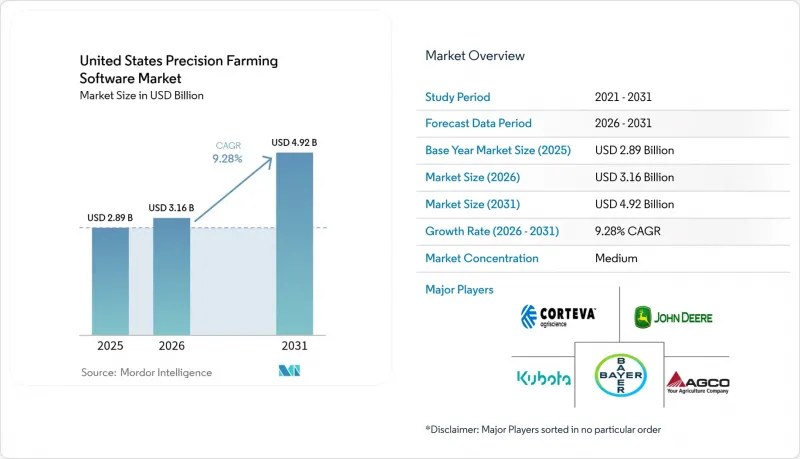
據 Mordor Intelligence 稱,2025 年美國精密農業軟體市場價值 28.9 億美元,預計到 2031 年將從 2026 年的 31.6 億美元成長至 49.2 億美元,預測期(2026-2031 年)複合年成長率為 9.28%。
本報告按應用領域(作物管理、財務管理等)、部署類型(本地/基於Web、基於雲端)、農場規模(小規模、中型、大型)和最終用戶(農民等)進行分類。市場預測以美元(USD)計價。
美國精密農業軟體市場趨勢與洞察。
農業勞動力短缺和平均農場規模擴大
隨著農場大規模擴大,這些壓力也日益加劇。這是因為管理更大的耕地面積會增加對協調田間作業、勞動力調度和庫存流轉的軟體的需求。中型農場反應最快,採用率高達12.2%,他們正努力追趕大型農場的效率。因此,美國精密農業軟體市場越來越關注那些能夠減少設備閒置時間、簡化投入分配和取代日益減少的人力的功能。這些趨勢使得工作流程自動化和車輛群聚協調模組成為未來兩個規劃週期升級的首要任務。
聯邦政府數位工具成本分攤計劃
2024會計年度申請數量激增至156,485份,顯示市場需求尚未滿足,這很可能促使該計畫擴大範圍。這些獎勵正在推動企業儘早升級到基於雲端的軟體包,這些軟體包能夠收集合規報告所需的詳細現場數據。雖然資金無法完全滿足未滿足的需求,但其持續性增強了貸款方的信心,並有助於為整合平台提供長期資金籌措。因此,美國精密農業軟體市場正經歷良性循環:成本分攤資金推動了對感測器、連接和訂閱服務的私人投資。
前期成本高,短期投資報酬率不確定
愛荷華州的一項調查顯示,74%的生產者雖然承認精密農業技術能夠提高效率,但認為其“成本高昂”,除非能保證投資回報,否則不願投資。分散的硬體生態系統常常迫使生產者進行多次缺乏協調的採購,導致投資回收期過長。大型農場(超過2000英畝)更容易承擔這些成本,目前佔63%的市場佔有率,而小規模農場則繼續推遲設備升級,除非有補貼覆蓋設備投資成本。
細分市場分析
至2025年,作物管理解決方案將佔據美國精密農業軟體市場45.35%的佔有率,凸顯其在播種、施肥和收割決策中的核心作用。受作物管理驅動的美國精密農業軟體市場規模預計將隨著先進影像處理、感測器融合和可變應用能力的進步而擴大。財務和合規模組的加入,將使獨立解決方案轉變為對各種農業運營都極具吸引力的綜合套件。
一款以11.35%的複合年成長率成長的天氣追蹤應用,利用高解析度雷達和機器學習模型來預測影響最佳播種時間的微氣候變化。它的成功清晰地展現了向微服務架構的轉變,在這種架構中,各種專業功能透過開放API整合到一個綜合平台中。
預計到2025年,雲端服務將占美國精密農業軟體市場60.25%的佔有率。這主要得益於遠端存取、自動更新和降低初始硬體投資等優勢。隨著光纖網路擴展到農村地區,通訊盲區得以消除,受雲端技術應用驅動的美國精密農業軟體市場預計將以11.02%的複合年成長率成長。早期採用者認為,無縫的多設備連接是其關鍵優勢,使農業科學家、機械操作員和負責人能夠共用單一資料來源。
在無線電訊號接收較差的地區,離線同步仍然至關重要,因此結合雲端核心和邊緣閘道器的混合配置仍然很受歡迎。服務供應商透過整合網路安全協定和加入合約條款來確保合約終止時資料可攜性,從而降低客戶對供應商鎖定的擔憂,以此來凸顯自身優勢。隨著機器遙測資料量的增加,計量收費的儲存和運算模式預計將進一步把成本從資本支出轉移到營運支出,從而保持雲端運算在美國精密農業軟體市場的發展動能。
其他好處:
- Excel格式的市場預測(ME)表
- 3個月的分析師支持
目錄
第1章:引言
- 研究假設和市場定義
- 調查範圍
第2章:調查方法
第3章執行摘要
第4章 市場狀況
- 市場概覽
- 市場促進因素
- 農業勞動力短缺和平均農場規模擴大
- 聯邦政府數位工具成本分攤計劃
- 擴大農村地區寬頻雲端連接
- 人工智慧驅動的農業技術正在提高投資回報率的可見性。
- 面向數據豐富型農場的排碳權收益模式
- 原始設備製造商和軟體供應商的合資活動
- 市場限制因素
- 前期投入成本高,短期投資報酬前景不確定。
- 對資料所有權和隱私的擔憂
- 整合異質機器的複雜性
- 老化農業管理人員的數位化技能差距
- 監理情勢
- 技術展望
- 波特五力分析
第5章 市場規模與成長預測
- 透過使用
- 作物管理
- 財務管理
- 農業庫存管理
- 人力資源管理
- 氣象追蹤與預報
- 其他用途
- 依部署類型
- 本地/網路
- 基於雲端的
- 按農場規模
- 小規模(不到500英畝)
- 中型(500-2000英畝)
- 大型(超過2000英畝)
- 最終用戶
- 農民
- 特種作物生產商
- 畜牧業和混合農業
第6章 競爭情勢
- 市場集中度
- 策略趨勢
- 市佔率分析
- 公司簡介
- Deere & Company
- Corteva Agriscience
- AGCO Corporation
- Topcon Corporation
- IBM Corporation
- Kubota Corporation
- Bayer AG
- Ag Leader Technology
- Farmers Edge Inc.(Fairfax Financial Holdings)
- Raven Industries, Inc.(CNH Industrial NV)
- CropX Inc
- Iteris Inc.(Almaviva SpA)
- Planet Labs PBC
- Farmers Business Network, Inc.
- Conservis Corp.(Rabobank and TELUS Agriculture)
第7章 市場機會與未來展望
According to Mordor Intelligence, the United States precision farming software market size was valued at USD 2.89 billion in 2025 and estimated to grow from USD 3.16 billion in 2026 to reach USD 4.92 billion by 2031, at a CAGR of 9.28% during the forecast period (2026-2031).
This report is Segmented by Application (Crop Management, Financial Management, and More), by Deployment Type (Local/Web-Based and Cloud-Based), by Farm Size (Small, Medium, and Large), and by End-User (Row-Crop Growers, and More). The Market Forecasts are Provided in Terms of Value (USD).
United States Precision Farming Software Market Trends and Insights
Farm-Labor Scarcity and Rising Average Farm Size
Consolidation into larger holdings amplifies these pressures because covering wider acreages intensifies demand for software that synchronizes field operations, labor scheduling, and inventory flows. Medium-scale farms are the most responsive, posting 12.2% CAGR adoption as they strive to match the efficiency of larger peers. Consequently, the United States precision farming software market increasingly targets features that reduce idle equipment time, streamline input allocation, and substitute scarce human labor. These dynamics position workflow automation and fleet coordination modules as core upgrade priorities over the next two planning cycles.
Federal Cost-Share Programs for Digital Tools
Application volume surged to 156,485 in fiscal 2024, signaling unmet demand that is likely to expand program breadth. These incentives stimulate early upgrades to cloud-based packages that capture granular field data needed for compliance reporting. Although funding does not fully cover backlog demand, its continuity reassures lenders and stimulates longer-term financing for integrated platforms. Consequently, the United States precision farming software market experiences a virtuous cycle wherein cost-share capital catalyzes private investment in sensors, connectivity, and subscription services.
High Upfront Cost and Unclear Short-Term Payback
Iowa surveys show 74% of growers label precision technologies expensive, even while acknowledging efficiency benefits, indicating hesitancy to invest absent guaranteed returns. Fragmented hardware ecosystems often force multiple, uncoordinated purchases that lengthen payback periods. Although large farms (>2,000 acres) shoulder these costs more easily and now hold 63% market share, smaller holdings still delay upgrades unless subsidies defray capital expense.
Other drivers and restraints analyzed in the detailed report include:
- Expanding Cloud Connectivity in Rural Broadband
- AI-Driven Agronomy Improving ROI Visibility
- Data Ownership and Privacy Concerns
For complete list of drivers and restraints, kindly check the Table Of Contents.
Segment Analysis
Crop management solutions controlled 45.35% of the United States precision farming software market share in 2025, underscoring their status as the operating hub for seeding, fertilization, and harvest decisions. The United States precision farming software market size attributed to crop management is projected to expand alongside advanced imaging, sensor fusion, and rate-variable application features. Adding financial and compliance modules converts point solutions into holistic suites that appeal to diversified operations.
Weather-tracking applications, rising at a 11.35% CAGR, exploit high-resolution radar and machine-learning models that predict micro-climate shifts affecting planting windows. Their success illustrates the shift to microservices architecture, where specialized functions bolt onto an overarching platform via open APIs.
Cloud offerings accounted for 60.25% of the United States precision farming software market in 2025 because of remote access, automatic updates, and lower upfront hardware outlays. The United States precision farming software market size for cloud deployments is primed for an 11.02% CAGR as rural fiber installations alleviate coverage gaps. Early adopters cite seamless multi-device collaboration, enabling agronomists, equipment operators, and accountants to share one data source as the principal advantage.
Offline-sync capabilities still matter in fringe signal zones, so hybrid configurations combining cloud cores with edge gateways remain popular. Providers differentiate by embedding cybersecurity protocols and contract clauses that guarantee data portability on termination, easing vendor-lock fears. As machine telemetry volumes escalate, pay-per-use storage and compute models will further shift costs from capital to operating expenditure, sustaining cloud momentum within the United States precision farming software market.
Complete Report Scope:
- By Application
- Crop Management
- Financial Management
- Farm Inventory Management
- Personnel Management
- Weather Tracking and Forecasting
- Other Applications
- By Deployment Type
- Local/Web-based
- Cloud-based
- By Farm Size
- Small (Less than 500 acres)
- Medium (500 to 2,000 acres)
- Large (More than 2,000 acres)
- By End-User
- Row-crop Growers
- Specialty-crop Growers
- Livestock and Mixed Operations
List of Companies Covered in this Report:
- Deere & Company
- Corteva Agriscience
- AGCO Corporation
- Topcon Corporation
- IBM Corporation
- Kubota Corporation
- Bayer AG
- Ag Leader Technology
- Farmers Edge Inc. (Fairfax Financial Holdings)
- Raven Industries, Inc.(CNH Industrial N.V)
- CropX Inc
- Iteris Inc. (Almaviva S.p.A.)
- Planet Labs PBC
- Farmers Business Network, Inc.
- Conservis Corp. (Rabobank and TELUS Agriculture)
Additional Benefits:
- The market estimate (ME) sheet in Excel format
- 3 months of analyst support
TABLE OF CONTENTS
1 Introduction
- 1.1 Study Assumptions and Market Definition
- 1.2 Scope of the Study
2 Research Methodology
3 Executive Summary
4 Market Landscape
- 4.1 Market Overview
- 4.2 Market Drivers
- 4.2.1 Farm-labor scarcity and rising average farm size
- 4.2.2 Federal cost-share programs for digital tools
- 4.2.3 Expanding cloud connectivity in rural broadband
- 4.2.4 AI-driven agronomy improving ROI visibility
- 4.2.5 Carbon-credit revenue models for data-rich farms
- 4.2.6 OEM-software vendor JV activity
- 4.3 Market Restraints
- 4.3.1 High upfront cost and unclear short-term payback
- 4.3.2 Data ownership and privacy concerns
- 4.3.3 Integration complexity across heterogeneous machinery
- 4.3.4 Digital-skills gap among ageing farm operators
- 4.4 Regulatory Landscape
- 4.5 Technological Outlook
- 4.6 Porter's Five Forces Analysis
- 4.6.1 Bargaining Power of Suppliers
- 4.6.2 Bargaining Power of Buyers
- 4.6.3 Threat of New Entrants
- 4.6.4 Threat of Substitutes
- 4.6.5 Intensity of Competitive Rivalry
5 Market Size and Growth Forecasts (Value)
- 5.1 By Application
- 5.1.1 Crop Management
- 5.1.2 Financial Management
- 5.1.3 Farm Inventory Management
- 5.1.4 Personnel Management
- 5.1.5 Weather Tracking and Forecasting
- 5.1.6 Other Applications
- 5.2 By Deployment Type
- 5.2.1 Local/Web-based
- 5.2.2 Cloud-based
- 5.3 By Farm Size
- 5.3.1 Small (Less than 500 acres)
- 5.3.2 Medium (500 to 2,000 acres)
- 5.3.3 Large (More than 2,000 acres)
- 5.4 By End-User
- 5.4.1 Row-crop Growers
- 5.4.2 Specialty-crop Growers
- 5.4.3 Livestock and Mixed Operations
6 Competitive Landscape
- 6.1 Market Concentration
- 6.2 Strategic Moves
- 6.3 Market Share Analysis
- 6.4 Company Profiles (Includes Global Level Overview, Market Level Overview, Core Segments, Financials as Available, Strategic Information, Market Rank/Share for Key Companies, Products and Services, and Recent Developments)
- 6.4.1 Deere & Company
- 6.4.2 Corteva Agriscience
- 6.4.3 AGCO Corporation
- 6.4.4 Topcon Corporation
- 6.4.5 IBM Corporation
- 6.4.6 Kubota Corporation
- 6.4.7 Bayer AG
- 6.4.8 Ag Leader Technology
- 6.4.9 Farmers Edge Inc. (Fairfax Financial Holdings)
- 6.4.10 Raven Industries, Inc.(CNH Industrial N.V)
- 6.4.11 CropX Inc
- 6.4.12 Iteris Inc. (Almaviva S.p.A.)
- 6.4.13 Planet Labs PBC
- 6.4.14 Farmers Business Network, Inc.
- 6.4.15 Conservis Corp. (Rabobank and TELUS Agriculture)


