


 |
市場調查報告書
商品編碼
2114744
發泡玻璃:市場佔有率分析、行業趨勢和統計數據、成長預測(2026-2031)Foam Glass - Market Share Analysis, Industry Trends & Statistics, Growth Forecasts (2026 - 2031) |
||||||

※ 本網頁內容可能與最新版本有所差異。詳細情況請與我們聯繫。
據 Mordor Intelligence 稱,發泡玻璃市場預計到 2026 年價值 29.6 億美元,高於 2025 年的 28.2 億美元,預計到 2031 年將達到 37.7 億美元,2026 年至 2031 年的複合年成長率為 4.97%。
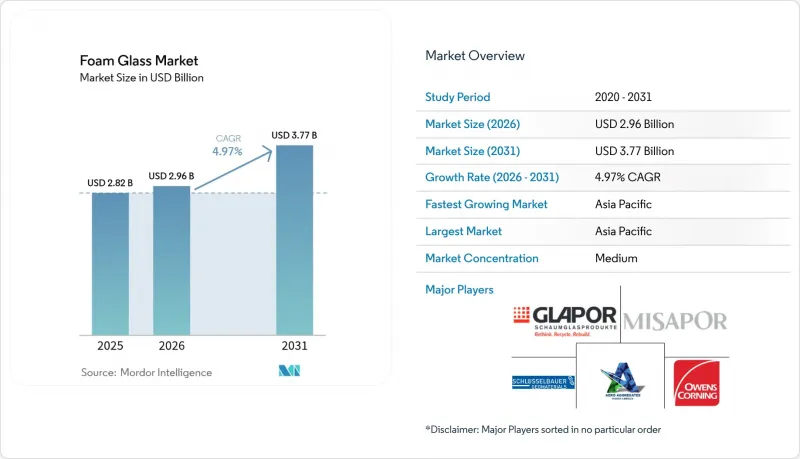
本報告按類型(開孔型、封閉式型、混合型)、製造程序(連續發泡、間歇發泡、其他)、應用領域(建築施工、基礎設施和土木工程、其他)、終端用戶行業(住宅、商業、工業)以及地區(亞太、北美、歐洲、其他)進行細分。市場預測以美元計價。
全球發泡玻璃市場趨勢與洞察
發泡玻璃作為輕質填充材在交通基礎設施中的迅速普及。
公路管理部門正在檢驗發泡玻璃骨材作為軟土地基工程結構解決方案的有效性。聯邦公路管理局 (FHWA) 報告稱,與傳統石材填料相比,橋墩荷載最多可降低 75%。荷載降低不僅降低了基礎成本,還提高了抗震性能,同時該材料的排水和保溫性能還能抑制凍脹。挪威的現場試驗表明,連續兩個冬季未發生凍土滲透,因此無需額外鋪設除冰層。這些結果正在改變人們對發泡玻璃的認知,使其從隔熱材料轉變為一種工程化的輕質填充材。
更嚴格的能源效率法規正在推動對高性能隔熱材料的需求。
歐盟和北美修訂後的建築規範優先考慮建築物的整體能源性能,要求建築師選擇具有數十年可靠隔熱性能的材料。 FIW 的研究表明,發泡玻璃的熱導率在設計限值內可保持 50 年。其無機基質能夠抵抗潮濕、微生物滋生和劣化,而這些特性會導致聚合物發泡體的劣化。在寒冷氣候下,其 -269 度C至 +482 度C的寬廣工作溫度範圍使得無論溫度範圍如何,都可以選用單一的隔熱解決方案。
生產線需要大量資金投入。
建造一座現代化的發泡玻璃工廠需要5000萬至1億美元,用於購買高溫熔爐、發泡系統、排放氣體控制設備。新興市場難以獲得長期資金籌措和專業工程人才,導致本地供應緩慢。最低有效產能往往超過國內需求,導致對進口的依賴性增強,並加劇了產業內部的適度整合。
細分市場分析
到2025年,閉孔泡沫玻璃產品將佔據發泡玻璃市場61.35%的佔有率,這反映出其在工業流程管道和地下建築圍護結構等領域的廣泛應用,這些領域對氣體滲透阻力要求極高。該細分市場憑藉其超過4 MPa的抗壓強度優勢,可支撐液化天然氣儲槽和冷庫地面等承重應用。結合閉孔和開孔的混合孔隙材料預計將以5.69%的複合年成長率成長,因為複合材料設計師正在最佳化密度,以兼顧結構和聲學性能。
雖然開孔板目前仍屬於小眾市場,但在對吸音和通風要求較高的建築構件中,它們正日益受到關注。現行的室內空氣品質認證標準已將透氣性隔熱材料納入考量,這催生了學校和醫療設施項目中對開孔板的需求。採用超過60%再生玻璃的製造商不僅符合綠建築認證標準,也實現了循環經濟的目標。
隧道爐連續發泡憑藉著數十年來效率的逐步提升,預計到2025年將佔據發泡玻璃市場62.60%的佔有率。該技術尤其擅長大量生產標準板材和塊材。同時,積層製造技術預計將以5.78%的複合年成長率成長,因為它能夠製造用於模組化幕牆和客製化工業零件的複雜形狀。
在某些領域,例如耐火管道支架,密度控制比規模更為重要,而間歇式發泡仍然發揮著至關重要的作用。近年來,低溫膨脹技術已將能耗降低至1度/公斤以下,縮小了與聚合物的成本差距,同時減少了碳排放。
區域分析
預計到2025年,亞太地區將佔全球銷售額的38.95%,年複合成長率達5.44%。中國支持節能製造的產業政策正在推動長江沿岸石化產業叢集廣泛採用相關技術。在日本材料產業,積層製造技術正逐步應用於高精度隔震發泡嵌件的供應。韓國造船廠透過在液化天然氣裝運船隻中採用封閉式模組,進一步鞏固了其在該地區的領先地位。
北美擁有成熟的市場需求,並受到嚴格的建築圍護結構標準的支撐。聯邦和省級政府對橋樑抗災能力的投資,為輕質骨材的應用開闢了新的途徑。在加拿大寒冷的氣候下,發泡玻璃被定位為單一材料解決方案,可應用於從地基到屋頂機房的各個結構。
在歐洲,我們受惠於完善的回收網路,能夠以極具競爭力的價格供應高品質的玻璃屑。德國和瑞士擁有主要的碎玻璃生產商,他們向鄰近的建築加工產業中心出口產品。我們在斯堪的納維亞半島永久凍土帶修建高速公路的經驗,如今已成為全球設計師競相參考的性能數據。
其他福利
- Excel格式的市場預測(ME)表
- 3個月的分析師支持
目錄
第1章:引言
- 研究假設和市場定義
- 調查範圍
第2章:調查方法
第3章執行摘要
第4章 市場狀況
- 市場概覽
- 市場促進因素
- 發泡玻璃作為輕質填充材在交通基礎設施中的迅速普及。
- 更嚴格的能源效率法規正在推動對高性能隔熱材料的需求。
- 液化天然氣和低溫儲存領域對化學惰性隔熱材料的工業應用。
- 由於強制回收,發泡玻璃製造所需的玻璃屑玻璃供應增加。
- 用於模組化建築的3D列印發泡玻璃零件
- 市場限制因素
- 生產線需要大量資金投入。
- 來自廉價聚合物發泡材和礦物棉的競爭。
- 在以建築美學為主要關注點的應用中,設計柔軟性較低。
- 價值鏈分析
- 波特五力模型
第5章 市場規模與成長預測
- 按類型
- 開孔
- 封閉式細胞
- 雜交細胞
- 透過製造程序
- 連續發泡
- 大量發泡
- 積層製造(3D列印)
- 透過使用
- 建築/施工
- 基礎設施和土木工程
- 工業和化學加工
- 低溫/液化天然氣
- 農業和水處理
- 其他用途(屋頂顆粒劑、園藝)
- 按最終用戶行業分類
- 住宅
- 商業
- 產業
- 按地區
- 亞太地區
- 中國
- 日本
- 印度
- 韓國
- ASEAN
- 其他亞太國家
- 北美洲
- 美國
- 加拿大
- 墨西哥
- 歐洲
- 德國
- 英國
- 法國
- 義大利
- 西班牙
- 俄羅斯
- 北歐國家
- 其他歐洲國家
- 南美洲
- 巴西
- 阿根廷
- 其他南美國家
- 中東和非洲
- 沙烏地阿拉伯
- 南非
- 其他中東和非洲國家
- 亞太地區
第6章 競爭情勢
- 市場集中度
- 策略趨勢
- 市佔率和排名分析
- 公司簡介
- AeroAggregates of North America, LLC
- Anhui Huichang New Material Co. Ltd
- Foamit Group
- Glapor Werk Mitterteich GmbH
- Glavel Inc
- JSC Gomelsteklo
- Misapor
- Ningbo Yoyo Foam Glass Co., Ltd.
- Owens Corning
- PINOSKLO cellular glass
- REFAGLASS sro
- SCHLUSSELBAUER Geomaterials GmbH
- Styro Insulations Mat. Ind. LLC.
- Tianjin Huali Thermal Insulation Building Material Co., Ltd.
- Uusioaines Oy-Foamit
- Veriso GmbH & Co. KG
- ZHEJIANG ZHENSHEN INSULATION TECHNOLOGY CORP.LTD.
第7章 市場機會與未來展望
According to Mordor Intelligence, foam glass market size in 2026 is estimated at USD 2.96 billion, growing from 2025 value of USD 2.82 billion with 2031 projections showing USD 3.77 billion, growing at 4.97% CAGR over 2026-2031.
This report is Segmented by Type (Open Cell, Closed Cell, Hybrid Cell), Manufacturing Process (Continuous Foaming, Batch Foaming, and More), Application (Building and Construction, Infrastructure and Civil Engineering, and More), End-User Industry (Residential, Commercial, Industrial), and Geography (Asia-Pacific, North America, Europe, and More). The Market Forecasts are Provided in Terms of Value (USD).
Global Foam Glass Market Trends and Insights
Rapid Adoption of Foam Glass as Lightweight Fill in Transportation Infrastructure
Highway agencies are validating foam glass aggregates as a structural solution in soft-soil projects. The Federal Highway Administration documented load reductions of up to 75% in bridge abutments compared with traditional stone fill. Lower loads cut foundation costs and improve seismic tolerance, while the material's drainage and thermal properties curb frost heave. Field trials in Norway reported two winter seasons without frost penetration, removing the need for extra frost-protection layers. These results reposition foam glass from an insulation material to an engineered lightweight fill.
Rising Energy-Efficiency Regulations Boosting Demand for High-Performance Insulation
Revised codes in the European Union and North America prioritize whole-building energy outcomes, prompting architects to select materials with reliable thermal performance over decades. FIW studies show foam glass retains conductivity within design limits for 50 years. Its non-organic matrix resists moisture, microbial growth, and degradation that undermine polymeric foams. Cold-climate regions rely on a -269 °C to +482 °C operating window to specify a single insulation solution across temperature zones.
High Capital-Investment Requirement for Production Lines
Building a modern foam glass plant demands USD 50-100 million for high-temperature furnaces, foaming systems, and emission controls. Emerging markets struggle to marshal patient capital and specialist engineering talent, delaying local supply. Minimum efficient capacity often exceeds domestic demand, reinforcing reliance on imports and sustaining moderate industry consolidation.
Other drivers and restraints analyzed in the detailed report include:
- Industrial Uptake for Chemically Inert Insulation in LNG and Cryogenic Storage
- 3-D Printed Foam-Glass Components for Modular Construction
- Price Competition from Cheaper Polymeric Foams and Mineral Wool
For complete list of drivers and restraints, kindly check the Table Of Contents.
Segment Analysis
Closed-cell products held 61.35% of the foam glass market share in 2025, reflecting strong adoption in industrial process pipework and below-grade building envelopes where vapor resistance is critical. The segment benefits from compressive strengths above 4 MPa, supporting load-bearing applications across LNG tanks and cold-storage floors. Hybrid-cell materials, blending closed and open pores, are slated to grow at 5.69% CAGR as formulators optimize densities for both structural and acoustic performance.
Open-cell variants remain niche but gain traction in architectural elements that prioritize sound absorption and breathability. Indoor air quality certifications now reference vapor-permeable insulation, creating pull for open-cell slabs in schools and healthcare projects. Manufacturers integrating over 60% recycled glass content satisfy green building credits and meet circular-economy targets.
Continuous foaming deployed in tunnel furnaces accounted for 62.60% of the foam glass market size in 2025, leveraging decades of incremental efficiency gains. The approach excels at long runs of standard boards and blocks. Additive manufacturing, however, is poised to expand at 5.78% CAGR as it unlocks complex geometries for modular facades and bespoke industrial parts.
Batch foaming remains relevant where density control overrides scale, such as in fireproof pipe supports. Recent cold-expansion methods cut energy use below 1 kWh/kg, narrowing the cost gap with polymers while shrinking the emissions footprint.
Complete Report Scope:
- By Type
- Open Cell
- Closed Cell
- Hybrid Cell
- By Manufacturing Process
- Continuous Foaming
- Batch Foaming
- Additive Manufacturing (3-D Printing)
- By Application
- Building and Construction
- Infrastructure and Civil Engineering
- Industrial and Chemical Processing
- Cryogenic and LNG
- Agriculture and Water Treatment
- Other Applications (Roofing Granules, Landscaping)
- By End-user Industry
- Residential
- Commercial
- Industrial
- By Geography
- Asia-Pacific
- China
- Japan
- India
- South Korea
- ASEAN Countries
- Rest of Asia-Pacific
- North America
- United States
- Canada
- Mexico
- Europe
- Germany
- United Kingdom
- France
- Italy
- Spain
- Russia
- NORDIC Countries
- Rest of Europe
- South America
- Brazil
- Argentina
- Rest of South America
- Middle East and Africa
- Saudi Arabia
- South Africa
- Rest of Middle East and Africa
- Asia-Pacific
Geography Analysis
Asia-Pacific generated 38.95% of global revenue in 2025 and is advancing at a 5.44% CAGR. Chinese industrial policy supporting energy-efficient manufacturing underpins widespread adoption in petrochemical clusters along the Yangtze. Japan's materials sector is trialing additive manufacturing to supply high-precision foamed inserts for seismic isolation. South Korea's shipyards specify closed-cell blocks in LNG carriers, reinforcing regional leadership.
North America forms a mature demand base anchored by stringent envelope codes. Federal and state investments in bridge resilience have opened a new route for lightweight aggregates. Canada's cold climate positions foam glass as a single-material solution from foundations to rooftop mechanical rooms.
Europe benefits from a dense recycling network that supplies high-quality cullet at competitive prices. Germany and Switzerland host major producers that export to neighboring construction and process-industry hubs. Nordic experiences in permafrost highways furnish performance data that global designers now cite.
- AeroAggregates of North America, LLC
- Anhui Huichang New Material Co. Ltd
- Foamit Group
- Glapor Werk Mitterteich GmbH
- Glavel Inc
- JSC Gomelsteklo
- Misapor
- Ningbo Yoyo Foam Glass Co., Ltd.
- Owens Corning
- PINOSKLO cellular glass
- REFAGLASS sro
- SCHLUSSELBAUER Geomaterials GmbH
- Styro Insulations Mat. Ind. LLC.
- Tianjin Huali Thermal Insulation Building Material Co., Ltd.
- Uusioaines Oy - Foamit
- Veriso GmbH & Co. KG
- ZHEJIANG ZHENSHEN INSULATION TECHNOLOGY CORP.LTD.
Additional Benefits:
- The market estimate (ME) sheet in Excel format
- 3 months of analyst support
TABLE OF CONTENTS
1 Introduction
- 1.1 Study Assumptions and Market Definition
- 1.2 Scope of the Study
2 Research Methodology
3 Executive Summary
4 Market Landscape
- 4.1 Market Overview
- 4.2 Market Drivers
- 4.2.1 Rapid adoption of foam glass as lightweight fill in transportation infrastructure
- 4.2.2 Rising energy-efficiency regulations boosting demand for high-performance insulation
- 4.2.3 Industrial uptake for chemically inert insulation in LNG and cryogenic storage
- 4.2.4 Recycling-mandate driven supply growth of cullet for foam-glass production
- 4.2.5 3-D printed foam-glass components for modular construction
- 4.3 Market Restraints
- 4.3.1 High capital-investment requirement for production lines
- 4.3.2 Price competition from cheaper polymeric foams and mineral wool
- 4.3.3 Limited design flexibility for aesthetic architectural use
- 4.4 Value Chain Analysis
- 4.5 Porter's Five Forces
- 4.5.1 Bargaining Power of Suppliers
- 4.5.2 Bargaining Power of Buyers
- 4.5.3 Threat of New Entrants
- 4.5.4 Threat of Substitutes
- 4.5.5 Degree of Competition
5 Market Size and Growth Forecasts (Value)
- 5.1 By Type
- 5.1.1 Open Cell
- 5.1.2 Closed Cell
- 5.1.3 Hybrid Cell
- 5.2 By Manufacturing Process
- 5.2.1 Continuous Foaming
- 5.2.2 Batch Foaming
- 5.2.3 Additive Manufacturing (3-D Printing)
- 5.3 By Application
- 5.3.1 Building and Construction
- 5.3.2 Infrastructure and Civil Engineering
- 5.3.3 Industrial and Chemical Processing
- 5.3.4 Cryogenic and LNG
- 5.3.5 Agriculture and Water Treatment
- 5.3.6 Other Applications (Roofing Granules, Landscaping)
- 5.4 By End-user Industry
- 5.4.1 Residential
- 5.4.2 Commercial
- 5.4.3 Industrial
- 5.5 By Geography
- 5.5.1 Asia-Pacific
- 5.5.1.1 China
- 5.5.1.2 Japan
- 5.5.1.3 India
- 5.5.1.4 South Korea
- 5.5.1.5 ASEAN Countries
- 5.5.1.6 Rest of Asia-Pacific
- 5.5.2 North America
- 5.5.2.1 United States
- 5.5.2.2 Canada
- 5.5.2.3 Mexico
- 5.5.3 Europe
- 5.5.3.1 Germany
- 5.5.3.2 United Kingdom
- 5.5.3.3 France
- 5.5.3.4 Italy
- 5.5.3.5 Spain
- 5.5.3.6 Russia
- 5.5.3.7 NORDIC Countries
- 5.5.3.8 Rest of Europe
- 5.5.4 South America
- 5.5.4.1 Brazil
- 5.5.4.2 Argentina
- 5.5.4.3 Rest of South America
- 5.5.5 Middle East and Africa
- 5.5.5.1 Saudi Arabia
- 5.5.5.2 South Africa
- 5.5.5.3 Rest of Middle East and Africa
- 5.5.1 Asia-Pacific
6 Competitive Landscape
- 6.1 Market Concentration
- 6.2 Strategic Moves
- 6.3 Market Share(%)/Ranking Analysis
- 6.4 Company Profiles (includes Global level Overview, Market level overview, Core Segments, Financials as available, Strategic Information, Market Rank/Share for key companies, Products and Services, and Recent Developments)
- 6.4.1 AeroAggregates of North America, LLC
- 6.4.2 Anhui Huichang New Material Co. Ltd
- 6.4.3 Foamit Group
- 6.4.4 Glapor Werk Mitterteich GmbH
- 6.4.5 Glavel Inc
- 6.4.6 JSC Gomelsteklo
- 6.4.7 Misapor
- 6.4.8 Ningbo Yoyo Foam Glass Co., Ltd.
- 6.4.9 Owens Corning
- 6.4.10 PINOSKLO cellular glass
- 6.4.11 REFAGLASS sro
- 6.4.12 SCHLUSSELBAUER Geomaterials GmbH
- 6.4.13 Styro Insulations Mat. Ind. LLC.
- 6.4.14 Tianjin Huali Thermal Insulation Building Material Co., Ltd.
- 6.4.15 Uusioaines Oy - Foamit
- 6.4.16 Veriso GmbH & Co. KG
- 6.4.17 ZHEJIANG ZHENSHEN INSULATION TECHNOLOGY CORP.LTD.
7 Market Opportunities and Future Outlook
- 7.1 White-space and Unmet-Need Assessment

 發泡玻璃市場分析及預測(至2035年):類型、產品類型、技術、應用、形狀、材料類型、製造流程、最終用戶、功能、安裝方法
 發泡玻璃市場:全球市場預測,2026-2032年
 發泡玻璃市場預測至2034年—按產品類型、形狀、製造流程、密度、應用、最終用戶和地區分類的全球分析
 發泡玻璃市場:按類型、應用、終端用戶產業和地區分類
 發泡玻璃市場機會、成長要素、產業趨勢分析及2026-2035年預測
 發泡玻璃市場:市場規模、佔有率和趨勢分析(按結構、應用和地區分類),細分市場預測(2026-2033 年)
 全球發泡玻璃市場規模、佔有率、趨勢和成長分析報告(2026-2034年)
 發泡玻璃市場規模、佔有率和成長分析(按類型、製造流程、應用、最終用戶和地區分類)—產業預測(2026-2033)
 泡沫玻璃市場-全球產業規模、佔有率、趨勢、機會和預測,按類型(開孔、閉孔)、按應用(工業、建築和施工、其他)、按地區、按競爭細分,2020-2030 年泡沫玻璃隔熱材料市場-全球產業規模、佔有率、趨勢、機會及預測(按類型、製造流程、應用、地區、競爭細分,2020-2030 年)