


 |
市場調查報告書
商品編碼
2114721
木材黏合劑:市場佔有率分析、產業趨勢與統計、成長預測(2026-2031)Wood Adhesives - Market Share Analysis, Industry Trends & Statistics, Growth Forecasts (2026 - 2031) |
||||||

※ 本網頁內容可能與最新版本有所差異。詳細情況請與我們聯繫。
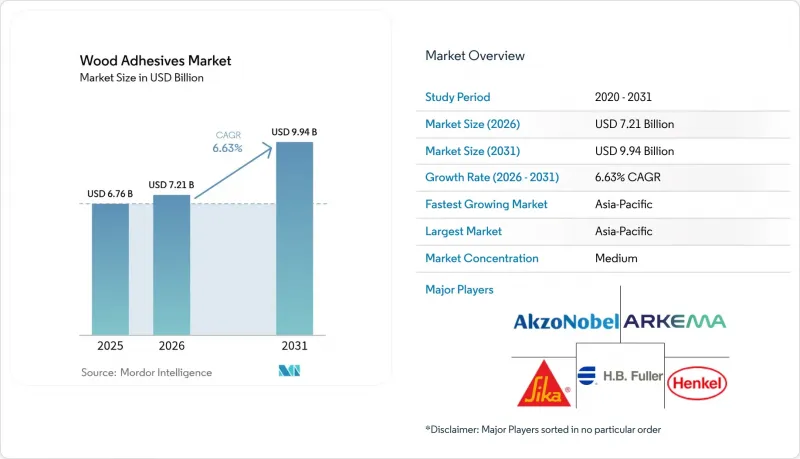
據 Mordor Intelligence 稱,2025 年木材黏合劑市場價值為 67.6 億美元,預計到 2031 年將達到 99.4 億美元,而 2026 年為 72.1 億美元,預測期(2026-2031 年)的複合年成長率為 6.63%。
本報告按樹脂類型(天然樹脂、合成樹脂)、技術(水性樹脂、溶劑型樹脂、其他技術)、應用領域(家具、膠合板、櫥櫃等)、最終用戶(住宅建築、商業建築等)和地區(亞太地區、北美地區、歐洲地區、南美地區、中東和非洲地區)進行細分。市場預測以美元計價。
全球木材黏合劑市場趨勢及洞察
亞太地區工程木材產量激增。
2024年,中國膠合板產能成長8%,達到2.21億立方米,而生產商數量下降19%。這表明規模經濟正在發揮作用,並推動了對先進黏合劑的需求。越南對美國的木製品出口創歷史新高,中國膠合板出口量達1,327萬立方米,顯示區域生產正在支撐全球價值鏈。在區域成長帶動國內消費的同時,出口導向製造業也擴大了對具有優異耐水性和耐熱性的黏合劑的需求。此外,中國、泰國和印度對生物聚合物投資的增加,進一步促進了永續樹脂的發展。
快速過渡到低揮發性有機化合物(VOC)水基系統
水性化學品目前已佔38.12%的市場佔有率,並在日益嚴格的監管環境下以7.14%的速度成長。加州空氣資源委員會(CARB)第二階段標準將硬木合板中的甲醛含量限制在0.05 ppm以內,歐盟計畫在2026年8月將甲醛排放量限制在0.062 mg/m³以內。像HB Fuller這樣的製造商目前已將60%的研發預算用於永續配方技術,例如用於可回收包裝材料的Swiftmelt 1850。水性體系降低了處理成本,提高了現場安全性,而聚合物交聯劑的進步正在縮小其與傳統體系之間的性能差距。
石油原料價格波動劇烈
根據富樂集團(HB Fuller)的報告顯示,2024年酚醛樹脂成本波動劇烈,原料成本佔銷貨成本的75%,對利潤率造成壓力。中小製造商難以對沖價格波動風險,導致合約修改和對現貨市場的依賴性增強。價格上漲在供應鏈中蔓延不均,如果家具和板材製造商無法承受不斷上漲的黏合劑成本,則存在需求替代的風險。
細分市場分析
預計到2025年,合成樹脂將佔銷售額的56.25%,即使在日益嚴格的環境審查下,也展現出其成本績效優勢。隨著超低排放(ULEF)和無甲醛(NAF)化學技術的成熟,預計到2031年,該細分商業性的年成長率將達到7.05%。製造商透過添加改質玉米芯粉等生物填料,減少了27.8%的排放,同時將黏合強度提高了19.6%。由此可見,合成樹脂平台在穩步降低環境影響的同時,樹立了性能標桿,並保持了其在木材黏合劑市場的主導地位。
在室內空氣品質法規嚴格的地區,環保技術的應用進展最為迅速。這些地區正在進行研發工作,以開發不影響結構完整性的酚醛黏合劑替代品。以橡子衍生成分增強的酚醛樹脂剪切強度可達0.93 MPa,這顯示混合化學技術能夠將生物成分與成熟的固化性能結合。此外,物聯網賦能的反應器能夠最佳化反應速率和供料精度,使製造商能夠進一步提高產品的一致性和加工能力。
到2025年,水性製程將佔據37.90%的市場佔有率,並有望以每年6.95%的速度成長,因為全球排放上限法規日益嚴格。這些配方無需高溫閃蒸,降低了溶劑回收成本,從而減少了工廠的能源負荷。目前,Selenes和漢高公司正在將回收的二氧化碳轉化為聚合物主鏈,這使其「從搖籃到大門」的生產流程對環境的影響降低了25%。塗佈設備也得到了改進,採用雷射引導噴嘴來塗覆均勻的薄膜,從而減少了以往用水量較大的問題。
我們的技術陣容不斷增強,包括反應型熱熔膠、紫外光固化分散體和數位化最佳化的混合乳液,每種產品都適用於特定的加工能力和環境要求。連續線上監測可實現即時黏度調節,確保高速黏合的可重複性,並提高木材黏合劑市場的營運效率。
區域分析
預計到2025年,亞太地區將佔全球支出的41.70%,並在2031年之前以7.12%的複合年成長率成長,這主要得益於出口導向板材工廠和國內大規模基礎設施項目的推動。 2024年,中國向台灣、越南和中東地區的買家出口了1,327萬立方公尺膠合板,總價值達52.71億美元。北美大規模木結構高層建築建築的蓬勃發展以及聯邦政府的基礎設施發展計劃,正在推動對特種結構性黏著劑需求的成長。在歐洲,更嚴格的化學品和回收法規正在加速向低揮發性有機化合物(VOC)系統的轉型,這通常有助於該技術向其他地區的推廣。
巴西和智利持續投資林業鋸木廠,鼓勵西卡等新參與企業在當地設立混合加工廠。中東工程木材產能的擴張凸顯了全球供應的相互依存性,原料、技術和終端用途的趨勢相互影響,共同推動全球木材黏合劑市場向前發展。
其他好處:
- Excel格式的市場預測(ME)表
- 3個月的分析師支持
目錄
第1章:引言
- 研究假設和市場定義
- 調查範圍
第2章:調查方法
第3章執行摘要
第4章 市場狀況
- 市場概覽
- 市場促進因素
- 亞太地區工程木材產量激增。
- 快速過渡到低揮發性有機化合物(VOC)水基系統
- 歐洲家具業的翻新熱潮
- 在高層建築專案中採用大塊木材(CLT 和複合板)
- 工業4.0技術的整合提高了黏合劑塗覆和固化的精度。
- 市場限制因素
- 石油基原料(苯酚、甲醛)價格波動
- 加州和歐盟收緊室內空氣揮發性有機化合物(VOC)法規
- 生物基多元醇/澱粉供不應求
- 價值鏈分析
- 波特五力模型
第5章 市場規模與成長預測
- 依樹脂類型
- 自然的
- 合成
- 透過技術
- 水溶液
- 溶劑型
- 其他技術
- 透過使用
- 家具
- 合板
- 內閣
- 門窗
- 其他用途
- 最終用戶
- 住宅
- 商業建築
- 工業和特殊木工
- 按地區
- 亞太地區
- 中國
- 印度
- 日本
- 韓國
- 其他亞太國家
- 北美洲
- 美國
- 加拿大
- 墨西哥
- 歐洲
- 德國
- 英國
- 法國
- 義大利
- 其他歐洲國家
- 南美洲
- 巴西
- 阿根廷
- 其他南美國家
- 中東和非洲
- 沙烏地阿拉伯
- 南非
- 中東和非洲
- 亞太地區
第6章 競爭情勢
- 市場集中度
- 策略趨勢
- 市佔率分析
- 公司簡介
- 3M
- Aica Kogyo Co. Ltd
- Akzo Nobel NV
- Arkema Group(Bostik)
- Ashland
- BASF SE
- Dow
- Dynea AS
- Franklin International
- HB Fuller Company
- Henkel AG & Co. KGaA
- Huntsman Corporation
- Jowat SE
- Jubilant Agri and Consumer Products Limited(JACPL)
- KLEIBERIT
- Pidilite Industries Ltd
- Sika AG
- Weyerhaeuser
第7章 市場機會與未來展望
According to Mordor Intelligence, the wood adhesives market size was valued at USD 6.76 billion in 2025 and estimated to grow from USD 7.21 billion in 2026 to reach USD 9.94 billion by 2031, at a CAGR of 6.63% during the forecast period (2026-2031).
This report is Segmented by Resin Type (Natural, Synthetic), Technology (Water-Based, Solvent-Based, Other Technologies), Application (Furniture, Plywood, Cabinets, and More), End-User (Residential Construction, Commercial Construction, and More), and Geography (Asia-Pacific, North America, Europe, South America, Middle East and Africa). The Market Forecasts are Provided in Terms of Value (USD).
Global Wood Adhesives Market Trends and Insights
Surging Engineered-Wood Production in Asia Pacific
China's plywood capacity rose 8% to 221 million m3 in 2024 even as producer numbers fell 19%, revealing scale efficiencies that heighten demand for sophisticated adhesives. Vietnam's record wood-product exports to the United States and China's 13.27 million m3 plywood export volume show r egional output feeding worldwide value chains. Local growth drives domestic consumption, while export-oriented manufacturing multiplies volumes for water-resistant, heat-stable bonding agents. Concurrent bio-polymer investments across China, Thailand, and India further stimulate sustainable resin development.
Rapid Shift to Low-VOC, Water-Based Systems
Water-based chemistries already command 38.12% share and are growing 7.14% as regulations tighten. California's CARB Phase II limits formaldehyde to 0.05 ppm for hardwood plywood, while the EU will cap emissions at 0.062 mg/m3 by August 2026. Producers, notably H.B. Fuller, now allocate 60% of R&D budgets to sustainable formulations such as Swiftmelt 1850 for recyclable packaging. Water-based systems lower handling costs and improve shop-floor safety while advances in polymer cross-linkers are closing historical performance gaps.
Volatile Petro-Feedstock Prices
Phenol-formaldehyde resin costs fluctuated sharply in 2024, squeezing margins when feedstock represents 75% of cost of sales as reported by H.B. Fuller. Smaller manufacturers struggle to hedge volatility, prompting contract revisions and greater reliance on spot markets. Price spikes pass through the supply chain unevenly, risking demand substitution when rising adhesive costs cannot be absorbed by furniture or panel producers.
Other drivers and restraints analyzed in the detailed report include:
- Renovation Boom in Europe Furniture Sector
- Mass-Timber (CLT & Glulam) Adoption in High-Rise Projects
- Limited Supply of Bio-Based Polyols/Starches
For complete list of drivers and restraints, kindly check the Table Of Contents.
Segment Analysis
Synthetic resins accounted for 56.25% of 2025 revenue, underscoring cost-to-performance leadership even as environmental scrutiny intensifies. This segment is expected to clock 7.05% growth through 2031 as ultra-low-emitting (ULEF) and no-added-formaldehyde (NAF) chemistries reach commercial maturity. Makers are blending bio-fillers-such as modified corn-cob powder that hikes bond strength up to 19.6%-to curb emissions by 27.8%. Synthetic platforms thus set performance benchmarks while steadily lowering environmental footprints, sustaining their primacy in the wood adhesives market.
Eco-adoption is fastest in jurisdictions with tight indoor-air codes, channeling R&D toward phenol substitutes without compromising structural integrity. Acorn-enhanced phenolic resins attaining 0.93 MPa shear strength show that hybrid chemistry can marry bio-content with proven curing behavior. As IoT-enabled reactors optimize reaction kinetics and feed precision, manufacturers unlock further gains in consistency and throughput.
Water-based processes held 37.90% share in 2025 and will scale at 6.95% as global emission caps converge. These formulations reduce plant energy loads because they forgo high-temperature flash-off and lower solvent recovery expenses. Celanese and Henkel now convert captured CO2 into polymer backbones, shrinking cradle-to-gate footprints by 25%. Application equipment has evolved, using laser-guided nozzles that meter thin, uniform films to offset historically higher water weight.
Reactive hot-melts, UV-curable dispersions, and digital-tailored hybrid emulsions round out the technology mix, each suited to niche throughput and environmental profiles. Continuous inline monitoring enables real-time viscosity adjustments, ensuring bond repeatability at speed and elevating the wood adhesives market's operational efficiency.
Complete Report Scope:
- By Resin Type
- Natural
- Synthetic
- By Technology
- Water-based
- Solvent-based
- Other Technologies
- By Application
- Furniture
- Plywood
- Cabinets
- Doors and Windows
- Other Applications
- By End-User
- Residential Construction
- Commercial Construction
- Industrial and Specialized Woodwork
- By Geography
- Asia-Pacific
- China
- India
- Japan
- South Korea
- Rest of Asia-Pacific
- North America
- United States
- Canada
- Mexico
- Europe
- Germany
- United Kingdom
- France
- Italy
- Rest of Europe
- South America
- Brazil
- Argentina
- Rest of South America
- Middle East and Africa
- Saudi Arabia
- South Africa
- Middle East and Africa
- Asia-Pacific
Geography Analysis
Asia Pacific accounted for 41.70% of 2025 spending and is tracking 7.12% CAGR to 2031 due to export-oriented panel plants and vast domestic infrastructure programs. China shipped 13.27 million m3 of plywood worth USD 5.271 billion in 2024, servicing buyers in Taiwan, Vietnam, and the Middle East. North America's wave of mass-timber towers and federal infrastructure packages fuels specialty structural adhesive uptake. Europe's stricter chemical and recycling mandates push rapid conversion to low-VOC systems, often catalyzing technology spillovers into other regions.
Brazil and Chile continue to invest in forestry mills, inviting entrants such as Sika to add local blending units. Middle East capacity additions in engineered-wood lines underscore global supply interdependencies, where feedstock, technology, and end-use trends cross-pollinate to advance the wood adhesives market worldwide.
- 3M
- Aica Kogyo Co. Ltd
- Akzo Nobel N.V.
- Arkema Group (Bostik)
- Ashland
- BASF SE
- Dow
- Dynea AS
- Franklin International
- H.B. Fuller Company
- Henkel AG & Co. KGaA
- Huntsman Corporation
- Jowat SE
- Jubilant Agri and Consumer Products Limited (JACPL)
- KLEIBERIT
- Pidilite Industries Ltd
- Sika AG
- Weyerhaeuser
Additional Benefits:
- The market estimate (ME) sheet in Excel format
- 3 months of analyst support
TABLE OF CONTENTS
1 Introduction
- 1.1 Study Assumptions and Market Definition
- 1.2 Scope of the Study
2 Research Methodology
3 Executive Summary
4 Market Landscape
- 4.1 Market Overview
- 4.2 Market Drivers
- 4.2.1 Surging engineered-wood production in Asia Pacific
- 4.2.2 Rapid shift to low-VOC, water-based systems
- 4.2.3 Renovation boom in Europe furniture sector
- 4.2.4 Mass-timber (CLT and glulam) adoption in high-rise projects
- 4.2.5 Integration of Industry 4.0 technologies enhancing precision in adhesive application and curing.
- 4.3 Market Restraints
- 4.3.1 Volatile petro-feedstock (phenol, formaldehyde) prices
- 4.3.2 Stricter indoor-air VOC caps in California and EU
- 4.3.3 Limited supply of bio-based polyols/starches
- 4.4 Value Chain Analysis
- 4.5 Porter's Five Forces
- 4.5.1 Bargaining Power of Suppliers
- 4.5.2 Bargaining Power of Buyers
- 4.5.3 Threat of New Entrants
- 4.5.4 Threat of Substitutes
- 4.5.5 Degree of Competition
5 Market Size and Growth Forecasts (Value and Volume)
- 5.1 By Resin Type
- 5.1.1 Natural
- 5.1.2 Synthetic
- 5.2 By Technology
- 5.2.1 Water-based
- 5.2.2 Solvent-based
- 5.2.3 Other Technologies
- 5.3 By Application
- 5.3.1 Furniture
- 5.3.2 Plywood
- 5.3.3 Cabinets
- 5.3.4 Doors and Windows
- 5.3.5 Other Applications
- 5.4 By End-User
- 5.4.1 Residential Construction
- 5.4.2 Commercial Construction
- 5.4.3 Industrial and Specialized Woodwork
- 5.5 By Geography
- 5.5.1 Asia-Pacific
- 5.5.1.1 China
- 5.5.1.2 India
- 5.5.1.3 Japan
- 5.5.1.4 South Korea
- 5.5.1.5 Rest of Asia-Pacific
- 5.5.2 North America
- 5.5.2.1 United States
- 5.5.2.2 Canada
- 5.5.2.3 Mexico
- 5.5.3 Europe
- 5.5.3.1 Germany
- 5.5.3.2 United Kingdom
- 5.5.3.3 France
- 5.5.3.4 Italy
- 5.5.3.5 Rest of Europe
- 5.5.4 South America
- 5.5.4.1 Brazil
- 5.5.4.2 Argentina
- 5.5.4.3 Rest of South America
- 5.5.5 Middle East and Africa
- 5.5.5.1 Saudi Arabia
- 5.5.5.2 South Africa
- 5.5.5.3 Middle East and Africa
- 5.5.1 Asia-Pacific
6 Competitive Landscape
- 6.1 Market Concentration
- 6.2 Strategic Moves
- 6.3 Market Share Analysis
- 6.4 Company Profiles (includes Global level Overview, Market level overview, Core Segments, Financials as available, Strategic Information, Market Rank/Share for key companies, Products and Services, and Recent Developments)
- 6.4.1 3M
- 6.4.2 Aica Kogyo Co. Ltd
- 6.4.3 Akzo Nobel N.V.
- 6.4.4 Arkema Group (Bostik)
- 6.4.5 Ashland
- 6.4.6 BASF SE
- 6.4.7 Dow
- 6.4.8 Dynea AS
- 6.4.9 Franklin International
- 6.4.10 H.B. Fuller Company
- 6.4.11 Henkel AG & Co. KGaA
- 6.4.12 Huntsman Corporation
- 6.4.13 Jowat SE
- 6.4.14 Jubilant Agri and Consumer Products Limited (JACPL)
- 6.4.15 KLEIBERIT
- 6.4.16 Pidilite Industries Ltd
- 6.4.17 Sika AG
- 6.4.18 Weyerhaeuser
7 Market Opportunities and Future Outlook
- 7.1 White-space and Unmet-Need Assessment
- 7.2 Development of Eco-friendly Adhesives

 家具黏合劑市場規模、佔有率和成長分析:按樹脂類型、應用、形態、最終用戶、分銷管道和地區分類 - 產業預測,2026-2033年
 木材黏合劑市場-2026-2032年全球市場預測
 2026年全球模組化建築用生物基結構木材黏合劑市場報告
 木材黏合劑和黏合劑市場:按黏合劑類型、應用、技術和地區分類
 木材黏合劑黏合劑市場報告:按產品類型、應用和地區分類(2026-2034年)複合板黏合劑:全球市場按樹脂類型、技術、應用和最終用戶分類的預測——2026-2032年木材黏合劑市場:按產品類型、技術、基材、最終用戶和地區分類2026年全球木材黏合劑市場報告
 木材黏合劑和黏合劑市場規模、佔有率和成長分析(按產品類型、應用和地區分類)-2026-2033年產業預測
 木材黏合劑市場規模、佔有率和成長分析(按樹脂類型、技術、應用、最終用戶和地區分類)—產業預測(2026-2033 年)