


 |
市場調查報告書
商品編碼
2114639
鑽井工具:市場佔有率分析、產業趨勢與統計、成長預測(2026-2031)Drilling Tools - Market Share Analysis, Industry Trends & Statistics, Growth Forecasts (2026 - 2031) |
||||||

※ 本網頁內容可能與最新版本有所差異。詳細情況請與我們聯繫。
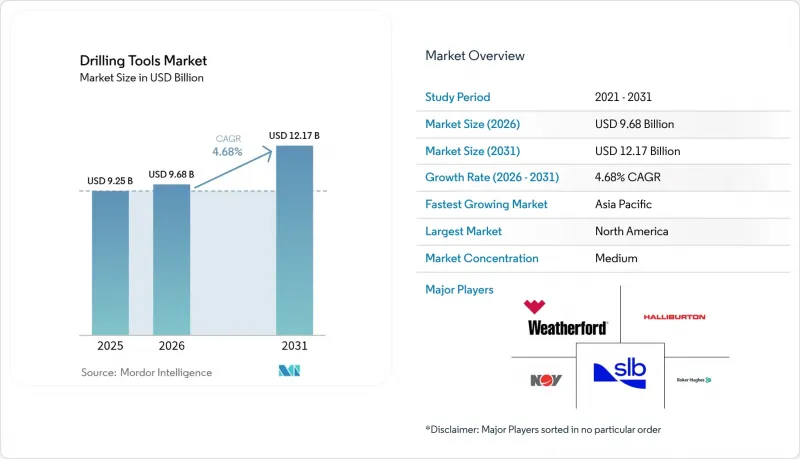
預計鑽井工具和鑽井設備的市場規模將從 2025 年的 92.5 億美元成長到 2026 年的 96.8 億美元,然後從 2026 年到 2031 年以 4.68% 的複合年成長率成長,到 2031 年達到 121.7 億美元。
本報告按類型(鑽頭、鑽桿、鑽鋌、擴孔器和穩定器、旋轉接頭及其他工具)、應用(開發和生產鑽井、地熱鑽井等)、安裝位置(陸上和海上)、最終用戶(石油和天然氣公司、地熱開發商等)和地區(北美、歐洲、亞太地區、南美等)進行分類。
全球鑽井及鑽井工具市場趨勢與洞察
疫情後上游產業資本支出(CAPEX)的復甦
根據國際能源論壇(IEF)的數據,2025年至2030年間,全球油氣投資預計將成長22%,結束先前長達三年的資本支出停滯,並提振對高性能鑽井工具的需求。在北美,墨西哥灣的營運商已批准了數十億美元的項目,其中包括雪佛龍的「Anchor」項目。這些項目需要使用額定壓力為20,000磅/平方英吋(psi)的設備,充分體現了頂級鑽柱的經濟效益。同樣,中東的國有石油公司也已恢復加密鑽井宣傳活動,旨在維持產量配額。資本投資的復甦有利於鑽井工具和設備的推廣,因為它們能夠顯著節省時間,供應商目前正將旋轉鑽井系統和數位化井孔規劃獎勵作為成套設備提供。服務合約也擴大將補償與鑽井速度的提升掛鉤,這種模式激勵了產品的持續升級。總而言之,投資前景的改善、對效率的需求以及合約條款的創新,共同推動了鑽井和鑽井工具市場需求的持續成長。
頁岩油井日益複雜,推動了對先進鑽頭的需求。
在美國主要頁岩地層中,水平井的長度現已超過20,000英尺,鑽頭面臨更嚴峻的振動和切屑層挑戰(《美國石油天然氣報告》)。 PDC鑽頭憑藉其先進的耐熱鑽石和最佳化的切削麵幾何形狀,能夠在這些條件下延長運作,並實現單鑽多段鑽井(11月)。同時,像哈里伯頓的LOGIX這樣的AI驅動平台能夠分析即時扭力數據,防止黏滑現象,並將鑽井效率提高高達30%。這些設計要求也體現在阿根廷瓦卡穆埃爾塔盆地和澳洲庫柏盆地不斷擴大的水平鑽井計畫中。因此,高階鑽頭的價格依然堅挺,支撐著該細分市場在鑽井和鑽井工具市場32.3%的銷售構成比。
原油價格波動會影響鑽井預算。
2025年初,WTI原油現貨價格跌破每桶70美元,促使美國獨立石油公司將計畫支出削減至601億美元,比先前預期減少4%。預算收緊將導致非核心探勘井鑽探延期,並抑制標準鑽桿和鑽鋌的短期訂單。同時,即使價格跌至谷底,對高階產品的需求仍將保持穩定,因為營運商仍願意為縮短作業週期的工具支付溢價。供應商透過多元化發展,進軍地熱和二氧化碳捕集與儲存(CCS)項目,在一定程度上緩解了原油價格波動的影響,減輕了對鑽井工具市場的負面影響,但並未完全消除這些影響。
細分市場分析
預計到2025年,鑽頭銷售額將達到29.6億美元,佔鑽井及鑽井工具市場31.98%的佔有率,凸顯了其在井口經濟效益中的關鍵作用。熱穩定性PDC刀具和鑽頭表面即時成像技術的日益普及,使得作業者能夠在一次鑽進中獲取穿越層狀地層的曲線,從而縮短連接時間並減少非連續測試(NPT)。透過將數位諮詢軟體整合到鑽頭中,為鑽頭提供即時轉速和鑽頭負載調整建議,原始設備製造商(OEM)獲得了溢價。
「其他工具」類別(震擊器、衝擊式潛水器、泥漿馬達、旋轉轉向系統)預計將以7.72%的複合年成長率超越整體市場成長率。哈里伯頓的「iCruise」和貝克休斯的「AutoTrak」可提供動態轉向校正並縮短滑動旋轉週期,而SLB的「Suppressor」阻尼工具可將扭轉振動降低60%以上。這些效能優勢使得即使在預算限制下,也能收取更高的日租金,從而為全套解決方案提供者帶來強勁的收入成長。
預計到2025年,開發和生產鑽井將佔總收入的51.45%,這反映出營運商專注於最佳化現有油田和提高資源採收率。多井平台設計和批量鑽井提高了工具運轉率,從而帶動了鑽桿、擴孔器和地下減振器的穩定訂單。探勘鑽井雖然具有週期性,但在大型石油公司尋求更新其資產組合的前沿深水油田中,其戰略重要性日益凸顯。
地熱井正以9.21%的複合年成長率成長,這主要得益於政府對超高溫岩層試點計畫的資助,並且地熱井的數量成長速度最快。捕碳封存(CCS)注入井雖然市場規模較小,但成長迅速,其定向鑽井作業需要耐磨的井底鑽具組合,以應對高密度二氧化碳泥漿。這些積極的連鎖反應正在使客戶群體多元化,並增強鑽井工具市場的韌性,從而抵消原油價格波動的影響。
區域分析
預計到2025年,北美將佔全球銷售額的32.75%,這主要得益於二疊紀盆地水平鑽井距離的突破性進展以及墨西哥灣深水鑽井作業的蓬勃發展。儘管資本紀律限制了鑽機的擴張,但該地區先進的物流網路和數位化鑽井生態系統仍能維持較高的設備利用率。聯邦甲烷排放法規和各州層級的井下安全距離限制給小型營運商帶來了壓力,但大型鑽井公司擴大採用三層鑽井完井法,推高了鑽桿的扭矩要求,並維持了對高性能鑽具的需求。
亞太地區將以6.18%的複合年成長率推動鑽井工具市場成長,預計到2031年這一數字將持續成長。中國國有企業正在塔里木盆地和四川盆地推進深層陸上鑽探項目,增加了對耐磨PDC鑽頭和耐熱泥漿馬達的需求。印尼正在推動地熱基礎基本負載項目,而澳洲的關鍵礦產探勘也催生了對能夠應對高壓硬岩鑽探的取芯鑽頭的新需求。這些趨勢共同推動了鑽井工具市場在油氣和可再生能源價值鏈中的覆蓋範圍不斷擴大。
在歐洲,以挪威和英國為中心,北海轉型協議下現有設施的連接工程以及二氧化碳捕集與儲存(CCS)井數量的激增,支撐了對鑽井工具的需求。在中東和非洲,低儲存和政府主導的產能擴張為市場提供了順風,但政治風險可能會導致訂單延遲。在南美洲,受巴西鹽鹽層下油氣開發的推動,大規模一體化合約集中在SLB和貝克休斯等公司手中,導致市場佔有率集中在少數幾家供應商手中。這些區域趨勢共同表明,採購方式正逐漸從「數量驅動」轉向「效率驅動」。
其他好處:
- Excel格式的市場預測(ME)表
- 3個月的分析師支持
目錄
第1章:引言
- 研究假設和市場定義
- 調查範圍
第2章:調查方法
第3章執行摘要
第4章 市場狀況
- 市場概覽
- 市場促進因素
- 疫情後上游產業資本投資的復甦
- 頁岩油井日益複雜,推動了對先進鑽頭的需求。
- 深海和超深海計畫的擴展
- 加大對地熱鑽探的投資
- 二氧化碳捕集與儲存(CCS)注入井項目
- 對重要礦產的探勘和鑽探需求不斷成長
- 市場限制因素
- 原油價格波動正在影響鑽井預算。
- 挖掘作業需遵守嚴格的環境法規
- 高性能鑽桿和鑽頭的供應鏈中斷
- 數位鑽井系統技術純熟勞工短缺
- 供應鏈分析
- 監理情勢
- 技術展望
- 波特五力模型
第5章 市場規模與成長預測
- 新產品
- 鑽頭
- 鑽桿
- 鑽頭顏色
- 鑽頭、鉸刀和穩定器
- 鑽頭旋轉接頭
- 其他工具(罐子、避震器、泥漿馬達、RSS)
- 透過使用
- 探勘鑽井
- 開發和生產鑽井
- 運動和井干預
- 地熱鑽探
- 碳捕集與封存與注入井
- 按部署位置
- 陸上
- 離岸
- 最終用戶
- 石油和天然氣公司
- 國營石油公司
- 獨立探勘開發公司
- 挖掘承包商
- 地熱開發公司
- 礦業探勘公司
- 按地區
- 北美洲
- 美國
- 加拿大
- 墨西哥
- 歐洲
- 德國
- 英國
- 挪威
- 俄羅斯
- 其他歐洲國家
- 亞太地區
- 中國
- 印度
- 韓國
- 東南亞國協
- 其他亞太國家
- 南美洲
- 巴西
- 阿根廷
- 哥倫比亞
- 其他南美國家
- 中東和非洲
- 沙烏地阿拉伯
- 阿拉伯聯合大公國
- 卡達
- 南非
- 埃及
- 奈及利亞
- 其他中東和非洲國家
- 北美洲
第6章 競爭情勢
- 市場集中度
- 策略趨勢(併購、聯盟、購電協議)
- 市場佔有率分析(主要公司的市場排名和佔有率)
- 公司簡介
- NOV Inc.
- Halliburton Company
- Schlumberger Limited
- Baker Hughes Company
- Weatherford International PLC
- Hunting PLC
- Rival Downhole Tools
- United Drilling Tools Ltd.
- Drilling Tools International
- Cougar Drilling Solutions
- Varel International Energy Services
- Sandvik AB(Rock Tools)
- Tenaris SA
- Tercel Oilfield Products
- Rubicon Oilfield International
- Nabors Industries Ltd.
- Drillmec SpA
- Expro Group Holdings
- Vallourec SA
- Zhongyuan Special Steel
第7章 市場機會與未來展望
According to Mordor Intelligence, the drilling tools market size is expected to grow from USD 9.25 billion in 2025 to USD 9.68 billion in 2026 and is forecast to reach USD 12.17 billion by 2031 at 4.68% CAGR over 2026-2031.
This report is Segmented by Type (Drill Bit, Drill Pipe, Drill Collar, Drill Reamer and Stabilizer, Drill Swivel, and Other Tools), Application (Development and Production Drilling, Geothermal Drilling, and More), Location of Deployment (Onshore and Offshore), End-User (Oil and Gas Operators, Geothermal Developers, and More), and Geography (North America, Europe, Asia-Pacific, South America, and More).
Global Drilling Tools Market Trends and Insights
Upstream CAPEX Rebound Post-Pandemic
Global oil and gas investment is set to increase by 22% between 2025 and 2030, reversing three years of capital restraint and renewing demand for high-performance drilling tools, according to the International Energy Forum. In North America, Gulf of Mexico operators sanctioned multi-billion-dollar projects such as Chevron's Anchor, which require 20,000 psi-rated equipment and validate the economic case for top-tier drill strings. Middle East national oil companies are likewise reviving infill drilling campaigns aimed at sustaining production quotas. This CAPEX upturn favors tools that deliver measurable rig-time savings, prompting suppliers to bundle rotary steerable systems with digital well-planning platforms. Service agreements are increasingly linking remuneration to improvements in penetration rates, a model that incentivizes continuous product upgrades. Taken together, an improving spend outlook, efficiency mandates, and contractual innovation provide sustained pull for the drilling tools market.
Shale Well Complexity Driving Demand for Advanced Drill Bits
Horizontal laterals now exceed 20,000 ft in premier US shale plays, subjecting drill bits to harsher vibration and cuttings-bed challenges AMERICAN OIL & GAS REPORTER. PDC cutters with advanced thermal-stable diamond and optimized face geometries extend run lengths under such regimes, enabling a single bit to drill multiple intervals NOV. Meanwhile, AI-driven platforms, such as Halliburton's LOGIX, analyze real-time torque data to preempt stick-slip, increasing lifting penetration rates by up to 30%. Argentina's Vaca Muerta and Australia's Cooper Basin replicate these design imperatives as they scale horizontal programs. Premium bit pricing, therefore, remains resilient, supporting the segment's 32.3% revenue contribution to the drilling tools market.
Volatile Crude-Oil Prices Impacting Drilling Budgets
WTI spot prices slipped below USD 70/bbl in early 2025, prompting US independents to trim their planned spending to USD 60.1 billion, 4% lower than the prior guidance. When budgets tighten, non-core exploration wells are deferred, curbing near-term orders for standard drill pipe and collars. Conversely, operators continue to pay premiums for tools that shorten cycle times, sustaining top-end demand even in price troughs. Suppliers that diversify into geothermal or CCS projects gain partial insulation from oil-price swings, tempering but not eliminating the drag on the drilling tools market.
Other drivers and restraints analyzed in the detailed report include:
- Expansion of Deep- and Ultra-Deepwater Projects
- Increasing Geothermal Drilling Investments
- Stringent Environmental Regulations on Drilling Operations
For complete list of drivers and restraints, kindly check the Table Of Contents.
Segment Analysis
Drill bits generated USD 2.96 billion in 2025, equal to 31.98% of the drilling tools market size, underscoring their pivotal role in well economics. Continued adoption of thermally stable PDC cutters and real-time imaging at the bit face allows operators to achieve single-run curves in interbedded formations, reducing connection time and NPT. OEMs capture price premiums by packaging bits with digital advisory software that recommends rotary speed and weight-on-bit adjustments in real time.
The "Other Tools" category-jars, shock subs, mud motors, and rotary steerable systems-will outpace overall growth at an 7.72% CAGR. Halliburton's iCruise and Baker Hughes' AutoTrak generate dynamic steering corrections that cut slide-rotate cycles, while SLB's Suppressor dampening tool mitigates torsional oscillation by more than 60%. That performance edge justifies higher day rates, despite budget pressure, and anchors robust revenue expansion for full-suite providers.
Development and production drilling accounted for 51.45% of 2025 revenue, reflecting operators' focus on brownfield optimization and resource recovery. Multi-well pad designs and batch drilling intensify tool utilization, driving steady orders for drill pipe, reamers, and downhole vibration absorbers. Exploration drilling, although cyclical, gains strategic importance in frontier deepwater blocks sanctioned by major oil companies seeking to renew their portfolios.
Geothermal wells represent the fastest floor-count addition, advancing at a 9.21% CAGR as governments fund superhot rock pilots. Carbon-capture injection wells form a smaller but fast-scaling niche, where directional profiles require abrasion-resistant bottom-hole assemblies capable of handling dense CO2 muds. The positive spill-over broadens the customer mix and offsets oil price-driven volatility, adding resilience to the drilling tools market.
Complete Report Scope:
- By Tool Type
- Drill Bit
- Drill Pipe
- Drill Collar
- Drill Reamer and Stabilizer
- Drill Swivel
- Other Tools (Jars, Shock Subs, Mud Motors, RSS)
- By Application
- Exploration Drilling
- Development and Production Drilling
- Workover and Well Intervention
- Geothermal Drilling
- CCS and Injection Wells
- By Location of Deployment
- Onshore
- Offshore
- By End-User
- Oil and Gas Operators
- National Oil Companies
- Independent EandP
- Drilling Contractors
- Geothermal Developers
- Mining Exploration Firms
- By Geography
- North America
- United States
- Canada
- Mexico
- Europe
- Germany
- United Kingdom
- Norway
- Russia
- Rest of Europe
- Asia-Pacific
- China
- India
- South Korea
- ASEAN Countries
- Rest of Asia-Pacific
- South America
- Brazil
- Argentina
- Colombia
- Rest of South America
- Middle East and Africa
- Saudi Arabia
- United Arab Emirates
- Qatar
- South Africa
- Egypt
- Nigeria
- Rest of Middle East and Africa
- North America
Geography Analysis
North America generated 32.75% of 2025 revenue, driven by record Permian horizontal footage and resilient Gulf of Mexico deepwater campaigns. The region's advanced logistics and digital drilling ecosystem keeps equipment utilization high, even as capital discipline tempers rig additions. Federal methane rules and state-level setback regulations pressure smaller operators, yet the supermajors' adoption of triple-frac completion methods is increasing drill-pipe torque requirements and sustaining premium-tool demand.
Asia-Pacific leads growth at a 6.18% CAGR through 2031. China's national firms drive deep onshore targets in the Tarim and Sichuan basins, demanding abrasion-resistant PDC bits and high-temperature mud motors. Indonesia pursues geothermal baseload projects, while Australia's critical-mineral exploration creates a fresh pull for coring bits compatible with HP hard-rock drilling. Collectively, these trends expand the drilling tools market footprint across both hydrocarbon and renewable value chains.
Europe, anchored by Norway and the UK, maintains tooling demand via brownfield tie-backs and a surge of CCS wells under the North Sea Transition Deal. The Middle East and Africa capitalize on low breakeven reservoirs and state-sponsored capacity expansions, though political risk occasionally delays purchase orders. South America, buoyed by Brazil's pre-salt, channels large integrated contracts to SLB and Baker Hughes, concentrating market share within a handful of vendors. The combined regional dynamics underscore a gradual shift from volume-led to efficiency-led purchasing.
- NOV Inc.
- Halliburton Company
- Schlumberger Limited
- Baker Hughes Company
- Weatherford International PLC
- Hunting PLC
- Rival Downhole Tools
- United Drilling Tools Ltd.
- Drilling Tools International
- Cougar Drilling Solutions
- Varel International Energy Services
- Sandvik AB (Rock Tools)
- Tenaris S.A.
- Tercel Oilfield Products
- Rubicon Oilfield International
- Nabors Industries Ltd.
- Drillmec S.p.A.
- Expro Group Holdings
- Vallourec S.A.
- Zhongyuan Special Steel
Additional Benefits:
- The market estimate (ME) sheet in Excel format
- 3 months of analyst support
TABLE OF CONTENTS
1 Introduction
- 1.1 Study Assumptions & Market Definition
- 1.2 Scope of the Study
2 Research Methodology
3 Executive Summary
4 Market Landscape
- 4.1 Market Overview
- 4.2 Market Drivers
- 4.2.1 Upstream CAPEX rebound post-pandemic
- 4.2.2 Shale well complexity driving demand for advanced drill bits
- 4.2.3 Expansion of deep- and ultra-deepwater projects
- 4.2.4 Increasing geothermal drilling investments
- 4.2.5 Carbon-capture & storage (CCS) injection well programs
- 4.2.6 Rising demand for critical-mineral exploration drilling
- 4.3 Market Restraints
- 4.3.1 Volatile crude-oil prices impacting drilling budgets
- 4.3.2 Stringent environmental regulations on drilling operations
- 4.3.3 Supply-chain disruptions for high-spec drill pipes & bits
- 4.3.4 Skilled-labor shortage for digital drilling systems
- 4.4 Supply-Chain Analysis
- 4.5 Regulatory Landscape
- 4.6 Technological Outlook
- 4.7 Porter's Five Forces
- 4.7.1 Bargaining Power of Suppliers
- 4.7.2 Bargaining Power of Buyers
- 4.7.3 Threat of New Entrants
- 4.7.4 Threat of Substitutes
- 4.7.5 Intensity of Competitive Rivalry
5 Market Size & Growth Forecasts
- 5.1 By Tool Type
- 5.1.1 Drill Bit
- 5.1.2 Drill Pipe
- 5.1.3 Drill Collar
- 5.1.4 Drill Reamer and Stabilizer
- 5.1.5 Drill Swivel
- 5.1.6 Other Tools (Jars, Shock Subs, Mud Motors, RSS)
- 5.2 By Application
- 5.2.1 Exploration Drilling
- 5.2.2 Development and Production Drilling
- 5.2.3 Workover and Well Intervention
- 5.2.4 Geothermal Drilling
- 5.2.5 CCS and Injection Wells
- 5.3 By Location of Deployment
- 5.3.1 Onshore
- 5.3.2 Offshore
- 5.4 By End-User
- 5.4.1 Oil and Gas Operators
- 5.4.2 National Oil Companies
- 5.4.3 Independent EandP
- 5.4.4 Drilling Contractors
- 5.4.5 Geothermal Developers
- 5.4.6 Mining Exploration Firms
- 5.5 By Geography
- 5.5.1 North America
- 5.5.1.1 United States
- 5.5.1.2 Canada
- 5.5.1.3 Mexico
- 5.5.2 Europe
- 5.5.2.1 Germany
- 5.5.2.2 United Kingdom
- 5.5.2.3 Norway
- 5.5.2.4 Russia
- 5.5.2.5 Rest of Europe
- 5.5.3 Asia-Pacific
- 5.5.3.1 China
- 5.5.3.2 India
- 5.5.3.3 South Korea
- 5.5.3.4 ASEAN Countries
- 5.5.3.5 Rest of Asia-Pacific
- 5.5.4 South America
- 5.5.4.1 Brazil
- 5.5.4.2 Argentina
- 5.5.4.3 Colombia
- 5.5.4.4 Rest of South America
- 5.5.5 Middle East and Africa
- 5.5.5.1 Saudi Arabia
- 5.5.5.2 United Arab Emirates
- 5.5.5.3 Qatar
- 5.5.5.4 South Africa
- 5.5.5.5 Egypt
- 5.5.5.6 Nigeria
- 5.5.5.7 Rest of Middle East and Africa
- 5.5.1 North America
6 Competitive Landscape
- 6.1 Market Concentration
- 6.2 Strategic Moves (M&A, Partnerships, PPAs)
- 6.3 Market Share Analysis (Market Rank/Share for key companies)
- 6.4 Company Profiles (includes Global level Overview, Market level overview, Core Segments, Financials as available, Strategic Information, Products & Services, and Recent Developments)
- 6.4.1 NOV Inc.
- 6.4.2 Halliburton Company
- 6.4.3 Schlumberger Limited
- 6.4.4 Baker Hughes Company
- 6.4.5 Weatherford International PLC
- 6.4.6 Hunting PLC
- 6.4.7 Rival Downhole Tools
- 6.4.8 United Drilling Tools Ltd.
- 6.4.9 Drilling Tools International
- 6.4.10 Cougar Drilling Solutions
- 6.4.11 Varel International Energy Services
- 6.4.12 Sandvik AB (Rock Tools)
- 6.4.13 Tenaris S.A.
- 6.4.14 Tercel Oilfield Products
- 6.4.15 Rubicon Oilfield International
- 6.4.16 Nabors Industries Ltd.
- 6.4.17 Drillmec S.p.A.
- 6.4.18 Expro Group Holdings
- 6.4.19 Vallourec S.A.
- 6.4.20 Zhongyuan Special Steel
7 Market Opportunities & Future Outlook
- 7.1 White-space & Unmet-Need Assessment

 至2035年的土壤鑽孔機市場分析及預測:依類型、產品、技術、組件、應用、材料類型、過程、最終用戶及安裝方式分類
 鑽井工具市場-2026-2032年全球市場預測
 挖土機市場規模及預測(2021-2034年)、全球及區域佔有率、趨勢及成長機會分析報告:按類型、應用及地區分類
 動力舌市場 - 全球產業規模、佔有率、趨勢、機會、預測:按類型、產品類型、功能、地點、地區和競爭格局分類,2021-2031年
 2026年全球雷射鑽孔機市場報告鑽井工具市場-全球產業規模、佔有率、趨勢、機會、預測:按類型、應用、地區和競爭格局分類,2021-2031年
 土方鑽孔機市場:按類型、設計、最終用途產業、銷售管道和地區分類
 破碎機市場機會、成長要素、產業趨勢分析及2026-2035年預測
 溝槽設備市場報告:按類型、運作方法、應用和地區分類(2026-2034 年)
 全球鑽井工具市場規模、佔有率、趨勢和成長分析報告(2026-2034年)