


 |
市場調查報告書
商品編碼
2114601
網路模擬器:市場佔有率分析、產業趨勢與統計、成長預測(2026-2031)Network Emulator - Market Share Analysis, Industry Trends & Statistics, Growth Forecasts (2026 - 2031) |
||||||

※ 本網頁內容可能與最新版本有所差異。詳細情況請與我們聯繫。
據 Mordor Intelligence 稱,網路模擬器市場在 2025 年的價值為 3 億美元,預計到 2031 年將達到 5.381 億美元,而 2026 年為 3.3063 億美元,預測期內(2026-2031 年)的複合年成長率為 10.21%。
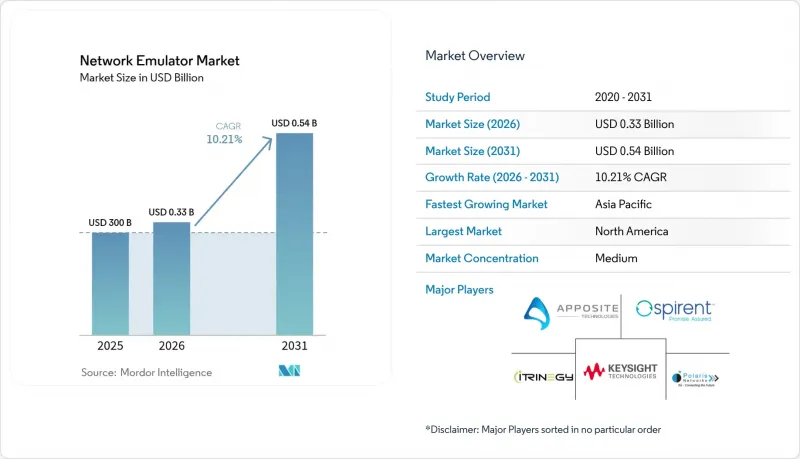
本報告按組件(硬體、軟體、服務)、應用(SD-WAN 和 SASE、雲端和資料中心等)、最終用戶產業(電信服務供應商、國防和航太、能源和公共產業等)、網路類型(5G/LTE、Wi-Fi 6/7 等)和地區進行細分。
全球網路模擬器市場趨勢與洞察
5G獨立核心網路的部署正在加速對即時測試的需求。
預計到2024年,獨立組網的5G用戶數將達到12億,其中中國和印度的絕對成長量最大。營運商現在需要在沒有LTE錨點的情況檢驗基於服務的介面、網路切片和微秒同步。 NTT DoCoMo和Keysight的一項聯合實驗表明,一級運營商如何依靠仿真技術在實際部署前模擬波束成形和超可靠低延遲通訊(URLLC)場景。這些高精度需求也延伸到了車聯網(V2X)和工業自動化領域,從而推動了對能夠提供確定性定時的網路模擬器的需求。
企業對 SD-WAN 和 SASE 的採用正在迅速增加。
從 MPLS 遷移到軟體定義網路架構的企業需要大規模地驗證動態路由邏輯和零信任策略。 VIAVI 的 TeraVM 可模擬數千個 VPN 用戶端並對 SASE 連結進行壓力測試。 Sixt 在部署 Cato Networks 後延遲降低了 15% 等成功案例清楚地表明,部署前檢驗如今已成為經營團隊的一項基本要求。隨著供應商將網路和安全功能整合到單一供應商雲端平台,網路模擬器市場正在向多租戶 SaaS 測試模式擴展。
奈秒精度故障模擬所需的硬體供不應求
高頻交易者需要在超過130家交易所實現5至85奈秒的精度,但只有少數幾家主時鐘晶片供應商能夠批量供應符合IEEE-1588標準的產品。 MiFID II迫使銀行從NTP(網路時間協定)遷移到PTP(點對點時間協定),這增加了硬體成本並延長了前置作業時間。類似的嚴格時序要求現在也適用於URLLC(超可靠低延遲通訊)和V2X(車聯網),限制了它們在依賴現成設備的領域中的快速普及。
細分市場分析
2025年,硬體在網路模擬器市場仍佔據60.20%的佔有率,這主要得益於400/800G乙太網路和毫米波5G專用部署設備的強勁成長。然而,業務收益的複合年成長率高達13.89%,超過了其他任何組成部分。據是德科技(Keysight)稱,軟體和服務目前佔總收入的39%,預計2025年第一季年度經常性收入(ARR)將成長16%。供應商正將永久授權和託管支援服務捆綁銷售,以期從整個DevSecOps流程的持續測試中獲得收入,而非僅依靠一次性的設備部署。
這種轉變源自於雲端原生架構的解耦。客戶越來越傾向於基於訂閱的測試即服務 (Test-as-a-Service) 模式,這種模式可以靈活擴展以滿足實驗室需求。羅德與施瓦茨 (Rohde & Schwarz) 正在部署用於 5G 波束成形和 MIMO 基準測試的分析服務,從而減輕營運商自行提供工具的負擔。同時,像安立 (Anritsu) 的 MT8000A 這樣的模組化底盤透過韌體金鑰延長了使用壽命,在降低資本支出 (CAPEX) 的同時,也鼓勵用戶持續獲得支援。服務的激增標誌著結構性轉折點,確保即使硬體的平均售價 (ASP) 趨於穩定,網路模擬器產業也能保持盈利。
受 MPLS 卸載專案推動,SD-WAN 和 SASE 在 2025 年仍維持 31.12% 的營收佔比,佔據市場領先地位。然而,5G RAN 和核心網檢驗是成長最快的應用,複合年成長率 (CAGR) 達 13.12%,反映了獨立組網系統在全球範圍內的部署。隨著網路切片、URLLC 和非地面電波網路等技術的出現,協定複雜性不斷增加,預計 5G 測試系統的網路模擬器市場規模將穩定成長。
開放式無線存取網路 (Open-RAN)互通性檢驗需要一個結合了射頻損傷測試架和雲端平台即服務 (PaaS) 模擬器的模擬器。羅德與施瓦茨 (Rohde & Schwarz) 和 VIAVI 的聯合解決方案提供了一個 O-RU 一致性測試套件,為製造商提供符合 NTIA 資助條件的承包解決方案。同時,Spirent 的 A1 400G 平檯面向人工智慧資料中心架構,旨在滿足通訊產業以外的高密度乙太網路需求。儘管 SD-WAN 在先前採用速度較慢的中小企業中的普及速度有所放緩,但現有客戶仍在繼續購買維護成本較高的許可證,從而維持了收入來源。
區域分析
預計到2025年,北美將佔全球收入的37.35%,這主要得益於5G中頻段的部署、華爾街對延遲的監管以及網路安全法規(例如強制進行持續彈性測試的第14144號行政命令)。該地區是VIAVI、Keysight和Spirent等公司的乙太網路部門所在地,也是研發中心,並擁有強大的本土市場優勢。矽谷和北維吉尼亞的AI資料中心率先採用者800G流量模擬技術,為該地區的銷售管道注入了新的活力。
亞太地區是成長最快的地區,年複合成長率高達13.05%。中國和印度正在大規模部署獨立網路(SA)5G,迫使當地原始設備製造商(OEM)採購先進的模擬設備。在吉隆坡,5G下載速度中位數已達到524 Mbps,凸顯了頻寬的正面利用。在日本,開放原始碼主導的測試實驗室(例如ISL Networks的5GC伺服器)正在蓬勃發展,使國內電信業者能夠在擴展區域網路的同時降低整體擁有成本(TCO)。日本和韓國的汽車供應鏈對TSN和乙太檢驗的需求日益成長。
在歐洲,我們看到的是穩定但成熟的擴張。歐盟《廢棄電子電氣設備指令》(WEEE Directive 2012/19/EU) 強制要求供應商設計可回收的測試設備,這加強了對材料清單(BOM) 的審查,並鼓勵向模組化、軟體定義底盤轉型。德國汽車產業叢集正在投資車載網路測試,而由於歐盟強調開放和安全的供應鏈,並得到國家電信和資訊管理局 (NTIA) 的相關資金支持,開放式無線接入網 (Open-RAN) 合規性已成為一項戰略重點。在非洲等小規模的市場,預算限制迫使營運商依賴開放原始碼和簡單的商用工具,但從長遠來看,4G 到 5G 的升級路徑預計將逐步提高平均售價 (ASP)。
其他好處:
- Excel格式的市場預測(ME)表
- 3個月的分析師支持
目錄
第1章:引言
- 研究假設和市場定義
- 調查範圍
第2章:調查方法
第3章 市場狀況
- 市場概覽
- 市場促進因素
- 5G獨立核心網路的部署增加將加速對即時測試的需求。
- 企業對 SD-WAN 和 SASE 的採用正在迅速增加。
- 在DevSecOps中實施雲端原生網路數位孿生
- 監管機構日益關注關鍵基礎設施的韌性測試
- 低地球軌道衛星寬頻的普及正在推動多鏈路模擬。
- 汽車軟體定義車輛(SDV)的檢驗要求
- 市場限制因素
- 用於奈秒精度維修的硬體供應有限。
- 分散的開放原始碼工具正在降低商業投資報酬率。
- 新興市場中專注於 4G 的電信服務供應商 (CSP) 的預算凍結。
- 關於電子測試設備產生的電子廢棄物的環境法規
- 價值鏈分析
- 監理情勢
- 技術展望
- 波特五力分析
第4章 市場規模與成長預測
- 按組件
- 硬體
- 軟體
- 服務
- 透過使用
- SD-WAN 和 SASE
- 雲端和資料中心
- 物聯網和工業
- 5G RAN 和核心網
- 衛星/航太
- 按最終用戶行業分類
- 電信服務供應商
- 國防/航太
- 銀行和金融服務
- 技術雲端供應商
- 汽車和運輸業
- 能源與公共產業
- 其他
- 依網路類型
- 5G/LTE
- Wi-Fi 6/7
- 乙太網路/IP
- 低地球軌道/地球同步軌道衛星
- 按地區
- 北美洲
- 美國
- 加拿大
- 墨西哥
- 南美洲
- 巴西
- 阿根廷
- 歐洲
- 德國
- 英國
- 法國
- 義大利
- 俄羅斯
- 亞太地區
- 中國
- 印度
- 日本
- 韓國
- ASEAN
- 其他亞太國家
- 中東
- 沙烏地阿拉伯
- UAE
- 土耳其
- 其他中東國家
- 非洲
- 南非
- 其他非洲國家
- 北美洲
第5章 競爭情勢
- 市場集中度
- 策略趨勢
- 市佔率分析
- 公司簡介
- Keysight Technologies, Inc.
- Spirent Communications plc
- Viavi Solutions Inc.
- Apposite Technologies, Inc.
- iTrinegy(now part of Calnex Solutions)
- Polaris Networks
- PacketStorm Communications, Inc.
- Aukua Systems, Inc.
- InterWorking Labs(IWL)
- GigaNet Systems
- Candela Technologies
- GL Communications
- Calnex Solutions plc
- Anritsu Corporation
- Rohde & Schwarz
- OctoScope(Spirent)
- Netropy(Apposite)
- Veryx Technologies
- IP NetFusion
- JDS Test & Measurement
第6章 市場機會與未來展望
- 評估未開發的領域和未滿足的需求
According to Mordor Intelligence, the network emulator market size was valued at USD 300 million in 2025 and estimated to grow from USD 330.63 million in 2026 to reach USD 538.1 million by 2031, at a CAGR of 10.21% during the forecast period (2026-2031).
This report is Segmented by Component (Hardware, Software, and Services), Application (SD-WAN and SASE, Cloud and Data Center, and More), End-User Vertical (Telecommunication Service Providers, Defense and Aerospace, Energy and Utilities, and More), Network Type (5G / LTE, Wi-Fi 6/7, and More), and Geography
Global Network Emulator Market Trends and Insights
5G Stand-Alone Core Roll-outs Accelerating Real-Time Test Demand
Standalone 5G subscriptions reached 1.2 billion in 2024, with China and India adding the largest absolute numbers. Operators must now validate service-based interfaces, network slicing, and microsecond synchronization without LTE anchors. NTT DoCoMo's lab work with Keysight illustrates how tier-1 carriers rely on emulation to replicate beamforming and URLLC scenarios before field deployment. Precision requirements spill over into automotive V2X and industrial automation, elevating demand for network emulators that deliver deterministic timing.
Surge in SD-WAN and SASE Enterprise Deployments
Enterprises shifting from MPLS to software-defined fabrics need to prove dynamic path-selection logic and zero-trust policies at scale. VIAVI's TeraVM emulates thousands of VPN clients to stress-test SASE links. Real-world evidence such as Sixt reducing latency 15% after adopting Cato Networks underscores why pre-deployment validation is now a board-level mandate. As vendors converge networking and security into single-vendor clouds, the network emulator market is widening toward multi-tenant SaaS test models.
Limited Availability of Nanosecond-Precision Impairment Hardware
High-frequency traders demand 5-85 ns precision across 130+ exchanges, yet only a handful of Grandmaster-clock silicon vendors can meet IEEE-1588 compliance at volume. MiFID II pushes banks to migrate from NTP to PTP, inflating hardware costs and lengthening lead times. Similar timing rigor now applies to URLLC and V2X, constraining rapid uptake in segments that rely on off-the-shelf appliances.
Other drivers and restraints analyzed in the detailed report include:
- Adoption of Cloud-Native Network Digital Twins for DevSecOps
- Growing Regulatory Focus on Critical-Infrastructure Resiliency Testing
- Fragmented Open-Source Tools Diluting Commercial ROI
For complete list of drivers and restraints, kindly check the Table Of Contents.
Segment Analysis
Hardware retained 60.20% share of the network emulator market in 2025, thanks to purpose-built impairment appliances for 400/800 G Ethernet and millimeter-wave 5G. Yet services revenue is pacing a 13.89% CAGR, outstripping any other component. Keysight reported that software-and-services now account for 39% of total sales, posting 16% ARR growth in Q1 2025, according to Keysight. Vendors are bundling perpetual licenses with managed support to monetize continuous testing across DevSecOps pipelines rather than one-time equipment drops.
The shift stems from cloud-native disaggregation: customers prefer subscription test-as-a-service that scales elastically with lab demand. Rohde & Schwarz positions its analytics service to benchmark 5G beamforming and MIMO, relieving operators from in-house tooling. Meanwhile, modular chassis like Anritsu's MT8000A extend lifespan through firmware keys, protecting capex while steering users toward recurring support. This service surge is a structural pivot, ensuring that the network emulator industry maintains profitability even as hardware ASPs flatten.
SD-WAN and SASE retained 31.12% revenue leadership in 2025, buoyed by MPLS offload projects. However, 5G RAN and Core verification is the fastest-rising application at a 13.12% CAGR, reflecting worldwide standalone roll-outs. The network emulator market size for 5G test systems is projected to expand steadily as network slicing, URLLC, and non-terrestrial networking add layers of protocol complexity.
Open-RAN interoperability checks need emulators that pair RF impairment shelves with cloud PaaS simulators. Joint solutions from Rohde & Schwarz and VIAVI deliver O-RU conformance kits, giving manufacturers a turnkey route to NTIA funding eligibility. In parallel, Spirent's A1 400G platform targets AI data-center fabrics, previewing demand beyond telecom toward high-density Ethernet. As SD-WAN penetrates even late-adopter SMBs, its growth moderates, but the installed base continues to purchase maintenance-heavy licenses, sustaining revenue.
Complete Report Scope:
- By Component
- Hardware
- Software
- Services
- By Application
- SD-WAN and SASE
- Cloud and Data-Centre
- IoT and Industrial
- 5G RAN and Core
- Satellite and Aerospace
- By End-user Vertical
- Telecommunication Service Providers
- Defense and Aerospace
- Banking and Financial Services
- Technology and Cloud Providers
- Automotive and Transportation
- Energy and Utilities
- Other Enterprises
- By Network Type
- 5G / LTE
- Wi-Fi 6/7
- Ethernet/IP
- LEO / GEO Satellite
- By Geography
- North America
- United States
- Canada
- Mexico
- South America
- Brazil
- Argentina
- Europe
- Germany
- United Kingdom
- France
- Italy
- Russia
- Asia Pacific
- China
- India
- Japan
- South Korea
- ASEAN
- Rest of Asia Pacific
- Middle East
- Saudi Arabia
- UAE
- Turkey
- Rest of Middle East
- Africa
- South Africa
- Rest of Africa
- South Africa
- North America
Geography Analysis
North America generated 37.35% of 2025 revenue, propelled by 5G mid-band deployments, Wall Street latency mandates, and cybersecurity statutes such as Executive Order 14144 that compel continuous resilience testing. The same region hosts head offices for VIAVI, Keysight, and Spirent's Ethernet unit, concentrating R&D and reinforcing home-market advantage. AI-centric data-centers in Silicon Valley and Northern Virginia are early adopters of 800 G traffic emulation, catalyzing local sales pipelines.
Asia-Pacific is the fastest-growing region with a 13.05% CAGR. China and India deploy standalone 5G at a massive scale, pushing local OEMs to procure advanced emulation gear. Median 5G download speeds already reach 524 Mbps in Kuala Lumpur, underscoring aggressive spectrum utilization. Japan fosters open-source-driven test labs such as ISL Networks' 5GC server, enabling lower TCO for domestic carriers upgrading rural coverage. Automotive supply chains in Japan and South Korea amplify demand for TSN and Ethernet validation.
Europe shows mature yet steady expansion. The WEEE Directive 2012/19/EU obliges vendors to design recyclable test equipment, increasing BOM scrutiny and nudging a shift toward modular, software-defined chassis. Germany's automotive cluster invests in in-vehicle network testing, while the EU's focus on open, secure supply chains makes Open-RAN conformance a strategic priority supported by NTIA's allied funding window. In smaller Middle East and African markets, budget limits steer operators toward open-source plus light commercial tooling, but the long-term 4G-to-5G upgrade path will slowly lift ASPs.
- Keysight Technologies, Inc.
- Spirent Communications plc
- Viavi Solutions Inc.
- Apposite Technologies, Inc.
- iTrinegy (now part of Calnex Solutions)
- Polaris Networks
- PacketStorm Communications, Inc.
- Aukua Systems, Inc.
- InterWorking Labs (IWL)
- GigaNet Systems
- Candela Technologies
- GL Communications
- Calnex Solutions plc
- Anritsu Corporation
- Rohde & Schwarz
- OctoScope (Spirent)
- Netropy (Apposite)
- Veryx Technologies
- IP NetFusion
- JDS Test & Measurement
Additional Benefits:
- The market estimate (ME) sheet in Excel format
- 3 months of analyst support
TABLE OF CONTENTS
1 INTRODUCTION
- 1.1 Study Assumptions and Market Definition
- 1.2 Scope of the Study
2 RESEARCH METHODOLOGY
3 MARKET LANDSCAPE
- 3.1 Market Overview
- 3.2 Market Drivers
- 3.2.1 5G Stand-Alone Core roll-outs accelerating real-time test demand
- 3.2.2 Surge in SD-WAN and SASE enterprise deployments
- 3.2.3 Adoption of cloud-native network digital-twins for DevSecOps
- 3.2.4 Growing regulatory focus on critical-infrastructure resiliency testing
- 3.2.5 Proliferation of LEO?satellite broadband driving multi-link emulation
- 3.2.6 Automotive software-defined vehicle (SDV) validation requirements
- 3.3 Market Restraints
- 3.3.1 Limited availability of nanosecond-precision impairment hardware
- 3.3.2 Fragmented open-source tools diluting commercial ROI
- 3.3.3 Budget freezes in 4G-focused CSPs of emerging economies
- 3.3.4 Environmental regulations on electronic test-bed e-waste
- 3.4 Value Chain Analysis
- 3.5 Regulatory Landscape
- 3.6 Technological Outlook
- 3.7 Porter's Five Forces Analysis
- 3.7.1 Threat of New Entrants
- 3.7.2 Bargaining Power of Buyers
- 3.7.3 Bargaining Power of Suppliers
- 3.7.4 Threat of Substitutes
- 3.7.5 Intensity of Rivalry
4 MARKET SIZE AND GROWTH FORECASTS (VALUE)
- 4.1 By Component
- 4.1.1 Hardware
- 4.1.2 Software
- 4.1.3 Services
- 4.2 By Application
- 4.2.1 SD-WAN and SASE
- 4.2.2 Cloud and Data-Centre
- 4.2.3 IoT and Industrial
- 4.2.4 5G RAN and Core
- 4.2.5 Satellite and Aerospace
- 4.3 By End-user Vertical
- 4.3.1 Telecommunication Service Providers
- 4.3.2 Defense and Aerospace
- 4.3.3 Banking and Financial Services
- 4.3.4 Technology and Cloud Providers
- 4.3.5 Automotive and Transportation
- 4.3.6 Energy and Utilities
- 4.3.7 Other Enterprises
- 4.4 By Network Type
- 4.4.1 5G / LTE
- 4.4.2 Wi-Fi 6/7
- 4.4.3 Ethernet/IP
- 4.4.4 LEO / GEO Satellite
- 4.5 By Geography
- 4.5.1 North America
- 4.5.1.1 United States
- 4.5.1.2 Canada
- 4.5.1.3 Mexico
- 4.5.2 South America
- 4.5.2.1 Brazil
- 4.5.2.2 Argentina
- 4.5.3 Europe
- 4.5.3.1 Germany
- 4.5.3.2 United Kingdom
- 4.5.3.3 France
- 4.5.3.4 Italy
- 4.5.3.5 Russia
- 4.5.4 Asia Pacific
- 4.5.4.1 China
- 4.5.4.2 India
- 4.5.4.3 Japan
- 4.5.4.4 South Korea
- 4.5.4.5 ASEAN
- 4.5.4.6 Rest of Asia Pacific
- 4.5.5 Middle East
- 4.5.5.1 Saudi Arabia
- 4.5.5.2 UAE
- 4.5.5.3 Turkey
- 4.5.5.4 Rest of Middle East
- 4.5.6 Africa
- 4.5.6.1 South Africa
- 4.5.6.2 Rest of Africa
- 4.5.6.3 South Africa
- 4.5.1 North America
5 COMPETITIVE LANDSCAPE
- 5.1 Market Concentration
- 5.2 Strategic Moves
- 5.3 Market Share Analysis
- 5.4 Company Profiles (includes Global level Overview, Market level overview, Core Segments, Financials as available, Strategic Information, Market Rank/Share for key companies, Products and Services, and Recent Developments)
- 5.4.1 Keysight Technologies, Inc.
- 5.4.2 Spirent Communications plc
- 5.4.3 Viavi Solutions Inc.
- 5.4.4 Apposite Technologies, Inc.
- 5.4.5 iTrinegy (now part of Calnex Solutions)
- 5.4.6 Polaris Networks
- 5.4.7 PacketStorm Communications, Inc.
- 5.4.8 Aukua Systems, Inc.
- 5.4.9 InterWorking Labs (IWL)
- 5.4.10 GigaNet Systems
- 5.4.11 Candela Technologies
- 5.4.12 GL Communications
- 5.4.13 Calnex Solutions plc
- 5.4.14 Anritsu Corporation
- 5.4.15 Rohde & Schwarz
- 5.4.16 OctoScope (Spirent)
- 5.4.17 Netropy (Apposite)
- 5.4.18 Veryx Technologies
- 5.4.19 IP NetFusion
- 5.4.20 JDS Test & Measurement
6 MARKET OPPORTUNITIES AND FUTURE OUTLOOK
- 6.1 White-space and Unmet-need Assessment

 時滯開關市場規模、佔有率和成長分析:按產品類型、安裝方式、應用領域、最終用戶、分銷管道和地區分類-2026-2033年產業預測
 全球網路模擬器市場規模、佔有率、趨勢和成長分析報告(2026-2034)
 網路模擬器市場機會、成長要素、產業趨勢分析及2026-2035年預測
 網路模擬器市場:按模擬類型、介面類型、部署模式、測試類型、最終用戶、協定、國家和地區分類-全球產業分析、市場規模、市場佔有率和預測(2026-2033 年)
 網路模擬器市場:2026-2032年全球市場預測(按產品、連接方式、部署類型、組織規模、應用和最終用戶產業分類)
 網路模擬器市場:市場規模、佔有率和趨勢分析(按產品、技術、測試、應用和地區分類),細分市場預測(2026-2033 年)
 全球網路模擬器市場
 2026年DoIP工具全球市場報告
 網路模擬器市場預測至2034年-按測試類型、組件、應用、最終用戶和地區分類的全球分析
 網路模擬器市場分析及預測(至2035年):按類型、產品類型、服務、技術、組件、應用、部署類型、最終用戶和功能分類