

 |
市場調查報告書
商品編碼
2109302
網路模擬器市場機會、成長要素、產業趨勢分析及2026-2035年預測Network Emulator Market Opportunity, Growth Drivers, Industry Trend Analysis, and Forecast 2026 - 2035 |
||||||

全球網路模擬器市場預計到 2025 年將達到 3.65 億美元,年複合成長率為 10.5%,到 2035 年將達到 9.852 億美元。
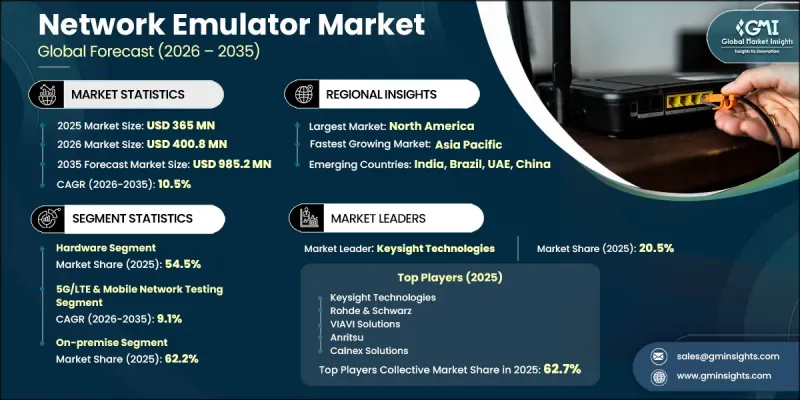
隨著企業越來越依賴複雜的測試環境來檢驗大規模部署前的複雜通訊網路,市場正經歷強勁成長。下一代連接技術、基於雲端的網路架構和先進通訊基礎設施的普及,推動了對可靠的網路模擬和效能測試解決方案的需求。網路模擬器正成為在受控環境中評估網路行為、檢驗系統效能和識別潛在問題的關鍵工具。現代網路架構的日益普及,推動了對能夠精確模擬真實世界流量模式、延遲和連接挑戰的測試解決方案的需求。此外,各關鍵產業對網路安全、網路可靠性和合規性的日益重視,也推動了網路模擬技術的更廣泛應用。朝向軟體定義網路 (SDN)、虛擬化基礎架構和雲端原生環境的轉變,進一步改變了測試格局。這些趨勢增強了網路模擬市場的長期前景,並將複雜的測試平台確立為確保安全、可靠和高效能通訊網路的關鍵要素。
| 市場範圍 | |
|---|---|
| 開始年份 | 2025 |
| 預測期 | 2026-2035 |
| 初始市場規模 | 3.65億美元 |
| 預測金額 | 9.852億美元 |
| 複合年成長率 | 10.5% |
隨著通訊業者、技術供應商和企業對用於現代通訊系統的高級檢驗工具的需求不斷成長,網路模擬器產業正蓬勃發展。網路模擬器能夠協助企業在部署前全面測試關鍵網路元件,評估其效能、可靠性和互通性。先進連接解決方案、企業網路平台和雲端基礎設施的日益普及,推動了對能夠模擬真實生產環境的模擬環境的需求。從傳統網路功能持續到虛擬化和雲端原生架構的演進,也促使企業進一步採用能夠應對複雜網路環境的高階測試解決方案。
預計到2025年,硬體部分將佔據54.5%的市場佔有率,並在2035年之前以7.9%的複合年成長率成長。基於硬體的網路模擬器憑藉其專用系統提供的穩定且高精度的測試性能,繼續保持著強勁的市場地位。這些解決方案旨在支援高速流量模擬、精確的網路故障建模、低延遲測試以及可複現的檢驗結果,使其適用於要求嚴苛的網路環境。通訊、企業網路和關鍵任務應用領域對可靠測試基礎設施日益成長的需求,預計將推動硬體部分在整個預測期內持續成長。
預計到2025年,協議和信令測試市場將佔據24%的市場。隨著通訊網路日益複雜,對能夠檢驗信令行為、協定效能以及跨不同網路環境互通性的高階測試解決方案的需求也日益成長。各組織機構越來越重視確保無縫連接、可靠通訊和最佳化網路效能,這推動了協定和訊號測試解決方案的普及應用。
中國網路模擬器市場佔41%的佔有率,預計到2025年市場規模將達4,410萬美元。憑藉其大規模的電信基礎設施和對先進連接技術的持續投入,中國已成為網路模擬解決方案最重要的市場之一。不斷擴大的網路部署、對可靠測試框架日益成長的需求以及電信基礎設施的持續進步,都在推動中國網路模擬器應用的普及。現代電信網路的日益複雜化,也進一步促使服務供應商和技術公司採用更先進的檢驗和效能測試解決方案。
目錄
第1章:調查方法
第2章執行摘要
第3章 行業洞察
- 產業生態系分析
- 供應商情況
- 利潤率分析
- 成本結構
- 每個階段增加的價值
- 影響價值鏈的因素
- 中斷
- 影響產業的因素
- 促進因素
- 5G網路部署加速以及對RAN/核心檢驗日益成長的需求。
- 擴大 SD-WAN、SASE 和雲端原生網路的應用程式。
- 網路虛擬化和軟體定義基礎設施的激增
- 關鍵產業對網路安全測試的要求日益提高
- 產業潛在風險與挑戰
- 基於硬體的網路仿真設備購置成本高昂
- 熟練的網路測試專家短缺
- 市場機遇
- 「模擬即服務 (EaaS)」與雲端原生部署模式的興起
- 低地球軌道衛星和非地面網路(NTN)試驗需求
- 擴大自動駕駛汽車、V2X 和互聯出行的測試範圍。
- 物聯網和邊緣運算的普及推動了分散式測試的需求。
- 促進因素
- 成長潛力分析
- 技術與創新展望
- 最新科技趨勢
- 基於硬體的高速網路仿真,用於 5G 和乙太檢驗
- 面向 SD-WAN、NFV 和雲端環境的虛擬化網路仿真
- 人工智慧驅動的流量產生和即時網路效能分析
- 新興技術
- 基於人工智慧的自主網路模擬與自最佳化測試環境
- 利用數位孿生進行網路建模和端到端基礎設施仿真
- 6G、非地面電波網路(NTN)及邊緣原生網路仿真
- 最新科技趨勢
- 價格分析
- 對過去價格趨勢的分析
- 定價策略:按業務類型分類
- 監理情勢
- 北美洲
- 美國國家標準與技術研究院 (NIST) 網路安全框架 2.0
- 美國證券交易委員會(SEC)網路安全揭露規則
- 美國國防部網路安全成熟度模型認證
- 《健康保險互通性與課責法案》(HIPAA) 安全規則
- 歐洲
- 網路與資訊安全指令 2
- 一般資料保護規則(GDPR)
- 網路彈性法案
- 數位營運韌性法
- 亞太地區
- 中國的網路安全法
- 中國的資料安全法
- 印度數位個人資料保護法
- 新加坡網路安全法
- 拉丁美洲
- 巴西通用資料保護法
- 巴西國家網路安全戰略
- 墨西哥關於保護私人企業所持有個人資料的聯邦法律
- 智利網路安全基本法
- 中東和非洲
- 沙烏地阿拉伯的關鍵網路安全措施
- 阿拉伯聯合大公國資訊安全標準
- 國家資訊安全框架
- 南非個人資料保護法
- 南非國家網路安全政策框架
- 北美洲
- 波特的分析
- PESTLE分析
- 專利分析
- 成本細分分析
- 貿易數據分析
- 網路測試設備進出口量及進口額趨勢
- 主要貿易路線及關稅的影響
- 目前網路安全和網路彈性狀況
- 人工智慧和生成式人工智慧對市場的影響
- 利用人工智慧改造現有經營模式
- 按細分市場分類的生成式人工智慧用例和部署藍圖
- 風險、限制和監管考量
- 預測假設和情境分析
- 基本案例:驅動複合年成長率的關鍵宏觀經濟與產業變量
- 樂觀情境:宏觀經濟與產業的順風
- 悲觀情景:宏觀經濟放緩或產業逆風
第4章 競爭情勢
- 介紹
- 企業市佔率分析
- 北美洲
- 歐洲
- 亞太地區
- LATAM
- 中東和非洲
- 主要市場公司的競爭分析
- 競爭定位矩陣
- 主要進展
- 併購
- 夥伴關係和聯盟
- 新產品發布
- 業務拓展計劃及資金籌措
- 按公司規模進行基準測試
- 排名分類標準與選擇標準
- 按銷售額、地區和創新能力分類的層級定位矩陣。
第5章 市場估算與預測:依產品類型分類,2022-2035年
- 硬體
- 機架式設備
- 可攜式/桌上型模擬器
- 軟體
- 獨立軟體平台
- 虛擬設備和基於容器的解決方案
- 雲端原生/SaaS軟體
- 服務
- 專業服務
- 託管服務
第6章 市場估計與預測:依發展階段分類,2022-2035年
- 現場
- 基於雲端的
- 混合
第7章 市場估計與預測:依應用領域分類,2022-2035年
- SD-WAN 和 SASE 測試
- 雲端和資料中心測試
- 5G/LTE 和行動網路測試
- 物聯網網路測試
- 廣域網路和衛星鏈路測試
- Wi-Fi 和無線區域網路測試
- 其他
第8章 市場估算與預測:依測試類型分類,2022-2035年
- 性能測試
- 應用測試
- 協議和訊號測試
- 功能測試
第9章 市場估價與預測:依最終用戶分類,2022-2035年
- 電信服務供應商
- 政府/國防
- IT 和雲端服務供應商
- 銀行、金融服務和保險(BFSI)
- 汽車和運輸業
- 衛生保健
- 研究與學術
- 其他
第10章 市場估價與預測:依地區分類,2022-2035年
- 北美洲
- 美國
- 加拿大
- 歐洲
- 德國
- 英國
- 法國
- 義大利
- 西班牙
- 俄羅斯
- 挪威
- 荷蘭
- 瑞典
- 亞太地區
- 中國
- 印度
- 日本
- 澳洲
- 韓國
- 新加坡
- 泰國
- 印尼
- 越南
- 拉丁美洲
- 巴西
- 墨西哥
- 阿根廷
- 中東和非洲
- 南非
- 沙烏地阿拉伯
- UAE
- 土耳其
第11章:公司簡介
- 世界公司
- Keysight Technologies
- VIAVI Solutions
- Rohde & Schwarz
- Anritsu
- Cisco Systems
- Calnex Solutions
- Teledyne LeCroy Xena
- EXFO
- 當地公司
- Apposite Technologies
- Aukua Systems
- PacketStorm Communications
- Candela Technologies
- GL Communications
- Simnovus
- TETCOS(NetSim)
- EVE-NG Pro
- Valid8
- East Coast Datacom
- Polaris Networks
- InterWorking Labs
The Global Network Emulator Market was valued at USD 365 million in 2025 and is estimated to grow at a CAGR of 10.5% to reach USD 985.2 million by 2035.
The market is witnessing strong growth as organizations increasingly depend on advanced testing environments to validate complex communication networks before large-scale deployment. Rising adoption of next-generation connectivity technologies, cloud-based networking architectures, and advanced telecom infrastructure is increasing the need for reliable network simulation and performance testing solutions. Network emulators are becoming essential tools for evaluating network behavior, validating system performance, and identifying potential issues under controlled conditions. Growing deployment of modern network architectures is creating demand for testing solutions that can accurately replicate real-world traffic patterns, latency conditions, and connectivity challenges. In addition, increasing emphasis on cybersecurity, network reliability, and regulatory compliance across critical industries is encouraging broader adoption of network emulation technologies. The shift toward software-defined networking, virtualized infrastructure, and cloud-native environments is further transforming the testing landscape. These trends are strengthening the long-term outlook for the network emulation market, positioning advanced testing platforms as a key component in ensuring secure, reliable, and high-performing communication networks.
| Market Scope | |
|---|---|
| Start Year | 2025 |
| Forecast Year | 2026-2035 |
| Start Value | $365 Million |
| Forecast Value | $985.2 Million |
| CAGR | 10.5% |
The network emulator industry is gaining momentum as telecom operators, technology providers, and enterprises increasingly require advanced validation tools for modern communication systems. Network emulators support comprehensive testing of critical network components by allowing organizations to evaluate performance, reliability, and interoperability before deployment. Growing adoption of advanced connectivity solutions, enterprise networking platforms, and cloud-based infrastructure is increasing the demand for simulation environments that replicate real operating conditions. The continued evolution from traditional network functions toward virtualized and cloud-native architectures is further encouraging organizations to adopt sophisticated testing solutions capable of supporting complex network environments.
The hardware segment accounted for a 54.5% share in 2025 and is expected to grow at a CAGR of 7.9% through 2035. Hardware-based network emulators continue to hold a strong market position because they provide dedicated systems capable of delivering consistent and highly accurate testing performance. These solutions are designed to support high-speed traffic simulation, precise network impairment modeling, low-latency testing, and repeatable validation outcomes, making them suitable for demanding network environments. Growing requirements for dependable testing infrastructure across telecommunications, enterprise networking, and mission-critical applications are expected to support continued growth of the hardware segment during the forecast period.
The protocol & signaling testing segment held a 24% share in 2025. Increasing complexity in communication networks is driving demand for advanced testing solutions capable of validating signaling behavior, protocol performance, and interoperability across different network environments. Organizations are increasingly focusing on ensuring seamless connectivity, reliable communication, and optimized network performance, which is strengthening the adoption of protocol and signaling testing solutions.
China Network Emulator Market held a 41% share, generating USD 44.1 million in 2025. The country represents one of the most significant markets for network emulation solutions due to extensive telecommunications infrastructure development and continued investment in advanced connectivity technologies. Expanding network deployments, rising demand for reliable testing frameworks, and ongoing advancements in communication infrastructure are supporting increased adoption of network emulators across the country. The growing complexity of modern telecom networks is further encouraging service providers and technology companies to implement advanced validation and performance testing solutions.
Major companies operating in the global network emulator market include Keysight Technologies, VIAVI Solutions, Calnex Solutions, Apposite Technologies, Rohde & Schwarz, Anritsu, Cisco Systems, Aukua Systems, PacketStorm Communications, and Teledyne LeCroy Xena. Companies operating in the network emulator market are strengthening their competitive position by investing in advanced testing technologies, expanding product capabilities, and developing solutions that support emerging communication architectures. Market participants are focusing on improving network simulation accuracy, enhancing automation capabilities, and integrating advanced analytics to provide more efficient testing environments. Many companies are expanding their offerings to address the growing requirements of telecommunications, cloud networking, enterprise infrastructure, and cybersecurity applications. Strategic partnerships, technology collaborations, and global expansion initiatives are helping businesses increase market reach and strengthen customer relationships.
Table of Contents
Chapter 1 Research Methodology
- 1.1 Research approach
- 1.2 Quality Commitments
- 1.2.1 GMI AI policy & data integrity commitment
- 1.2.1.1 Source consistency protocol
- 1.2.1 GMI AI policy & data integrity commitment
- 1.3 Research Trail & Confidence Scoring
- 1.3.1 Research Trail Components
- 1.3.2 Scoring Components
- 1.4 Data Collection
- 1.4.1 Partial list of primary sources
- 1.5 Data mining sources
- 1.5.1 Paid sources
- 1.5.1.1 Sources, by region
- 1.5.1 Paid sources
- 1.6 Base estimates and calculations
- 1.6.1 Base year calculation for any one approach
- 1.7 Forecast model
- 1.7.1 Quantified market impact analysis
- 1.7.1.1 Mathematical impact of growth parameters on forecast
- 1.7.1 Quantified market impact analysis
- 1.8 Research transparency addendum
- 1.8.1 Source attribution framework
- 1.8.2 Quality assurance metrics
- 1.8.3 Our commitment to trust
Chapter 2 Executive Summary
- 2.1 Industry 360° synopsis, 2022 – 2035
- 2.2 Key market trends
- 2.2.1 Regional
- 2.2.2 Offering
- 2.2.3 Deployment
- 2.2.4 Application
- 2.2.5 Test Type
- 2.2.6 End-User
- 2.3 TAM Analysis, 2026-2035
- 2.4 CXO perspectives: Strategic imperatives
Chapter 3 Industry Insights
- 3.1 Industry ecosystem analysis
- 3.1.1 Supplier landscape
- 3.1.2 Profit margin analysis
- 3.1.3 Cost structure
- 3.1.4 Value addition at each stage
- 3.1.5 Factor affecting the value chain
- 3.1.6 Disruptions
- 3.2 Industry impact forces
- 3.2.1 Growth drivers
- 3.2.1.1 Accelerating 5G Network Rollout & RAN/Core Validation Demand
- 3.2.1.2 Rising Adoption of SD-WAN, SASE & Cloud-Native Networking
- 3.2.1.3 Surge in Network Virtualization & Software-Defined Infrastructure
- 3.2.1.4 Growing Cybersecurity Testing Requirements Across Critical Industries
- 3.2.2 Industry pitfalls and challenges
- 3.2.2.1 High Capital Cost of Hardware-Based Network Emulator Appliances
- 3.2.2.2 Limited Availability of Skilled Network Testing Professionals
- 3.2.3 Market opportunities
- 3.2.3.1 Emergence of Emulation-as-a-Service (EaaS) & Cloud-Native Deployment Models
- 3.2.3.2 LEO Satellite & Non-Terrestrial Network (NTN) Testing Demand
- 3.2.3.3 Expansion of Autonomous Vehicles, V2X & Connected Mobility Testing
- 3.2.3.4 Proliferation of IoT & Edge Computing Driving Distributed Testing Needs
- 3.2.1 Growth drivers
- 3.3 Growth potential analysis
- 3.4 Technology and innovation landscape
- 3.4.1 Current technological trends
- 3.4.1.1 Hardware-Based High-Speed Network Emulation for 5G & Ethernet Validation
- 3.4.1.2 Virtualized Network Emulation for SD-WAN, NFV & Cloud Environments
- 3.4.1.3 AI-Assisted Traffic Generation & Real-Time Network Performance Analytics
- 3.4.2 Emerging technologies
- 3.4.2.1 AI-Driven Autonomous Network Emulation & Self-Optimizing Test Environments
- 3.4.2.2 Digital Twin-Based Network Modeling & End-to-End Infrastructure Simulation
- 3.4.2.3 6G, Non-Terrestrial Networks (NTN) & Edge-Native Network Emulation
- 3.4.1 Current technological trends
- 3.5 Pricing Analysis (Driven by primary research)
- 3.5.1 Historical Price Trend Analysis
- 3.5.2 Pricing Strategy by Player Type
- 3.6 Regulatory landscape
- 3.6.1 North America
- 3.6.1.1 National Institute of Standards and Technology Cybersecurity Framework 2.0
- 3.6.1.2 U.S. Securities and Exchange Commission Cybersecurity Disclosure Rules
- 3.6.1.3 U.S. Department of Defense Cybersecurity Maturity Model Certification
- 3.6.1.4 Health Insurance Portability and Accountability Act Security Rule
- 3.6.2 Europe
- 3.6.2.1 Network and Information Security Directive 2
- 3.6.2.2 General Data Protection Regulation
- 3.6.2.3 Cyber Resilience Act
- 3.6.2.4 Digital Operational Resilience Act
- 3.6.3 Asia Pacific
- 3.6.3.1 China Cybersecurity Law
- 3.6.3.2 China Data Security Law
- 3.6.3.3 Digital Personal Data Protection Act, India
- 3.6.3.4 Singapore Cybersecurity Act
- 3.6.4 Latin America
- 3.6.4.1 Brazil General Data Protection Law
- 3.6.4.2 Brazil National Cybersecurity Strategy
- 3.6.4.3 Federal Law on Protection of Personal Data Held by Private Parties, Mexico
- 3.6.4.4 Chile Cybersecurity Framework Law
- 3.6.5 Middle East & Africa
- 3.6.5.1 Saudi Essential Cybersecurity Controls
- 3.6.5.2 United Arab Emirates Information Assurance Standards
- 3.6.5.3 National Information Assurance Framework
- 3.6.5.4 Protection of Personal Information Act, South Africa
- 3.6.5.5 National Cybersecurity Policy Framework, South Africa
- 3.6.1 North America
- 3.7 Porter’s analysis
- 3.8 PESTEL analysis
- 3.9 Patent analysis (Driven by primary research)
- 3.10 Cost breakdown analysis
- 3.11 Trade Data Analysis (Driven by Primary Research)
- 3.11.1 Import/Export Volume & Value Trends - Network Testing Equipment
- 3.11.2 Key Trade Corridors & Tariff Impact
- 3.12 Cybersecurity & Network Resilience Landscape
- 3.13 Impact of AI and Generative AI on the Market
- 3.13.1 AI Driven Disruption of Existing Business Models
- 3.13.2 GenAI Use Cases and Adoption Roadmap by Segment
- 3.13.3 Risks Limitations and Regulatory Considerations
- 3.14 Forecast assumptions & scenario analysis (Driven by Primary Research)
- 3.14.1 Base Case- Key Macro & Industry Variables Driving CAGR
- 3.14.2 Optimistic Scenarios- Favorable macro and industry tailwinds
- 3.14.3 Pessimistic Scenario - Macroeconomic slowdown or industry headwinds
Chapter 4 Competitive Landscape, 2025
- 4.1 Introduction
- 4.2 Company market share analysis
- 4.2.1 North America
- 4.2.2 Europe
- 4.2.3 Asia Pacific
- 4.2.4 LATAM
- 4.2.5 MEA
- 4.3 Competitive analysis of major market players
- 4.4 Competitive positioning matrix
- 4.5 Key developments
- 4.5.1 Mergers & acquisitions
- 4.5.2 Partnerships & collaborations
- 4.5.3 New Product Launches
- 4.5.4 Expansion Plans and funding
- 4.6 Company tier benchmarking
- 4.6.1 Tier classification criteria & qualifying thresholds
- 4.6.2 Tier positioning matrix by revenue, geography & innovation
Chapter 5 Market Estimates & Forecast, By Offering, 2022 - 2035 (USD Bn)
- 5.1 Key trends
- 5.2 Hardware
- 5.2.1 Rack-Mounted Appliances
- 5.2.2 Portable/Benchtop Emulators
- 5.3 Software
- 5.3.1 Standalone Software Platforms
- 5.3.2 Virtual Appliances & Containerized Solutions
- 5.3.3 Cloud-Native / SaaS-Delivered Software
- 5.4 Services
- 5.4.1 Professional Services
- 5.4.2 Managed Service
Chapter 6 Market Estimates & Forecast, By Deployment, 2022 - 2035 (USD Bn)
- 6.1 Key trends
- 6.2 On-Premise
- 6.3 Cloud-Based
- 6.4 Hybrid
Chapter 7 Market Estimates & Forecast, By Application, 2022 - 2035 (USD Bn)
- 7.1 Key trends
- 7.2 SD-WAN & SASE Testing
- 7.3 Cloud & Data Center Testing
- 7.4 5G/LTE & Mobile Network Testing
- 7.5 IoT Network Testing
- 7.6 WAN & Satellite Link Testing
- 7.7 Wi-Fi & Wireless LAN Testing
- 7.8 Others
Chapter 8 Market Estimates & Forecast, By Test Type, 2022 - 2035 (USD Bn)
- 8.1 Key trends
- 8.2 Performance Testing
- 8.3 Application Testing
- 8.4 Protocol & Signaling Testing
- 8.5 Functional Testing
Chapter 9 Market Estimates & Forecast, By End-User, 2022 - 2035 (USD Bn)
- 9.1 Key trends
- 9.2 Telecommunications Service Providers
- 9.3 Government & Defense
- 9.4 IT & Cloud Service Providers
- 9.5 Banking, Financial Services & Insurance (BFSI)
- 9.6 Automotive & Transportation
- 9.7 Healthcare
- 9.8 Research & Academia
- 9.9 Others
Chapter 10 Market Estimates & Forecast, By Region, 2022 - 2035 (USD Bn)
- 10.1 Key trends
- 10.2 North America
- 10.2.1 US
- 10.2.2 Canada
- 10.3 Europe
- 10.3.1 Germany
- 10.3.2 UK
- 10.3.3 France
- 10.3.4 Italy
- 10.3.5 Spain
- 10.3.6 Russia
- 10.3.7 Norway
- 10.3.8 Netherlands
- 10.3.9 Sweden
- 10.4 Asia Pacific
- 10.4.1 China
- 10.4.2 India
- 10.4.3 Japan
- 10.4.4 Australia
- 10.4.5 South Korea
- 10.4.6 Singapore
- 10.4.7 Thailand
- 10.4.8 Indonesia
- 10.4.9 Vietnam
- 10.5 Latin America
- 10.5.1 Brazil
- 10.5.2 Mexico
- 10.5.3 Argentina
- 10.6 MEA
- 10.6.1 South Africa
- 10.6.2 Saudi Arabia
- 10.6.3 UAE
- 10.6.4 Turkey
Chapter 11 Company Profiles
- 11.1 Global Players
- 11.1.1 Keysight Technologies
- 11.1.2 VIAVI Solutions
- 11.1.3 Rohde & Schwarz
- 11.1.4 Anritsu
- 11.1.5 Cisco Systems
- 11.1.6 Calnex Solutions
- 11.1.7 Teledyne LeCroy Xena
- 11.1.8 EXFO
- 11.2 Regional Players
- 11.2.1 Apposite Technologies
- 11.2.2 Aukua Systems
- 11.2.3 PacketStorm Communications
- 11.2.4 Candela Technologies
- 11.2.5 GL Communications
- 11.2.6 Simnovus
- 11.2.7 TETCOS (NetSim)
- 11.2.8 EVE-NG Pro
- 11.2.9 Valid8
- 11.2.10 East Coast Datacom
- 11.2.11 Polaris Networks
- 11.2.12 InterWorking Labs

 全球網路模擬器市場規模、佔有率、趨勢和成長分析報告(2026-2034)
 網路模擬器市場:按模擬類型、介面類型、部署模式、測試類型、最終用戶、協定、國家和地區分類-全球產業分析、市場規模、市場佔有率和預測(2026-2033 年)
 網路模擬器市場:2026-2032年全球市場預測(按產品、連接方式、部署類型、組織規模、應用和最終用戶產業分類)
 網路模擬器市場:市場規模、佔有率和趨勢分析(按產品、技術、測試、應用和地區分類),細分市場預測(2026-2033 年)
 全球網路模擬器市場
 2026年DoIP工具全球市場報告
 網路模擬器市場預測至2034年-按測試類型、組件、應用、最終用戶和地區分類的全球分析
 網路模擬器市場分析及預測(至2035年):按類型、產品類型、服務、技術、組件、應用、部署類型、最終用戶和功能分類
 2025-2029年全球網路模擬器市場
 網路模擬器市場 - 全球產業規模、佔有率、趨勢、機會、預測:依產品、技術、應用、地區和競爭格局分類,2021-2031年