


 |
市場調查報告書
商品編碼
2114572
空中下載 (OTA) 測試:市場佔有率分析、行業趨勢和統計數據以及成長預測(2026-2031 年)Over-The-Air (OTA) Testing - Market Share Analysis, Industry Trends & Statistics, Growth Forecasts (2026 - 2031) |
||||||

※ 本網頁內容可能與最新版本有所差異。詳細情況請與我們聯繫。
據 Mordor Intelligence 稱,2025 年空中下載 (OTA) 測試市場價值為 22.3 億美元,預計到 2031 年將從 2026 年的 23.5 億美元成長至 30.1 億美元,預測期(2026-2031 年)的複合年成長率為 5.08%。
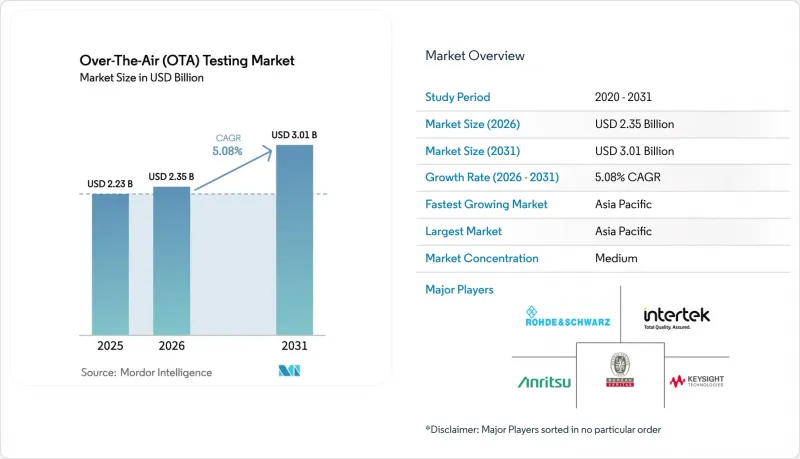
本報告按產品(硬體、軟體和分析、服務)、技術(5G NR、LTE、UMTS、GSM、Wi-Fi、藍牙、LPWAN)、測試類型(天線性能、一致性、相容性、生產)、應用(通訊、其他)、測試環境(遠場、CATR、近場、殘響)和地區進行細分。市場預測以美元計價。
全球空中下載(OTA)測試市場趨勢與洞察
5G非獨立組網和獨立組網部署的擴展需要新的合規協議
隨著超過300家業者部署網路切片和低延遲服務,獨立組網(SA)5G核心網路在2025年成為主流。 3GPP Release 17引入了3.5 GHz以上頻段64流大規模MIMO的測試案例,迫使實驗室採用能夠同時採樣的雙極化探針陣列。美國行動電話通訊和網際網路協會(CTIA)收緊了OTA 5.9規範,增加了52.6 GHz以上頻段輻射雜散發射的測試,迫使設備製造商升級現有測量設備。隨著非獨立組網(NSA)架構的逐步淘汰,智慧型手機廠商正在縮短雙模檢驗週期,將預算重新分配給僅用於獨立組網的測量設備,並將需求轉移到其內部設計中心實驗室。
消費性設備對毫米波和大規模 MIMO 天線的 OTA 合規性需求激增。
目前,旗艦智慧型手機最多配備16個相位陣列單元,每個單元都需要在360度方位角和180度仰角範圍內進行總輻射功率和各向同性靈敏度的掃描測量。美國聯邦通訊委員會(FCC)針對24.25–29.5 GHz頻段的規定,使得測試室佔用時間比6 GHz以下頻段的測試增加了40%,給全球測試能力帶來了壓力。蘋果計劃於2025年推出毫米波終端,引發了契約製造製造商對無線測試設備的訂單激增,多探頭系統的交貨週期超過18個月。同時,中國移動的192單元基地台需要進行互通性校準,這就催生了對攜帶式近距離場掃描儀的需求,這種掃描儀能夠在不中斷服務的情況下檢驗波束成形。
耗資巨大的消音室和混響室阻礙了二線實驗室採用這些設施。
一個5米毫米波暗室造價在250萬美元至400萬美元之間,一個混響暗室造價在80萬美元至120萬美元之間,但由於利用率低於60%,新興市場的測試實驗室很難證明這筆支出的合理性。國際電工委員會(IEC)於2024年修訂了攪拌效率標準,縮短了維修週期和投資回報期間。因此,拉丁美洲和非洲的測試中心擴大將工作外包給全球網路,導致前置作業時間延長,收入集中在前五大認證機構手中。
細分市場分析
預計到2025年,基於硬體的空中下載(OTA)測試市場將佔總收入的48%,這反映了市場對消音室、緊湊型測試場地和儀器設備的持續投資。同時,軟體和分析平台正以5.99%的複合年成長率快速成長,這主要得益於雲端託管的編配工具,這些工具能夠顯著縮短報告時間,並即時關聯來自多個地點的測量數據。持續整合(CI)管道現在可以透過應用程式介面(API)呼叫測試腳本,從而將消音室從靜態設施轉變為按需使用的資產。
服務完善了這個類別,OEM廠商將蜂窩V2X(蜂窩車聯網)檢驗給專業實驗室。這些實驗室將合規性、電磁相容性和安全應用程式打包成一個綜合宣傳活動。軟體定義無線電儀器的發展動能進一步削弱了對獨立硬體的需求,因為單一可重構收發器即可覆蓋6GHz以下頻段和毫米波頻段。這種轉變有利於那些能夠將程式碼庫、分析儀表板和遠端存取控制功能與模組化機殼捆綁在一起的供應商,使他們能夠確保持續的收入來源,因為訂閱模式將逐漸取代一次性設備銷售。
到2025年,5G新空口將佔據37.5%的市場佔有率,鞏固其作為最新行動電話和固定無線網路基地台發布基準的地位。然而,衛星直連服務是成長最快的領域,年複合成長率達6.21%,這要求測試實驗室整合軌道運動模擬器、高動態範圍多普勒源和低仰角波束追蹤器。長期演進(LTE)和機器類型演進(MTE)仍然是工業IoT領域的關鍵技術,在長達十年的生命週期中保持持續的向下相容性至關重要。
同時,隨著業者對頻段進行重組,第二代和第三代蜂窩協議正在逐漸式微,但認證機構仍在為新興市場認證已停產的設備。 Wi-Fi 6、Wi-Fi 7、低功耗藍牙和超寬頻 (UWB) 技術完善了現有產品線,而協同波束成形和 320 MHz 頻道則提出了新的無線通訊要求。能夠在單一設施內進行多重通訊協定、多頻段檢驗的測試實驗室,能夠最大限度地發揮傳統單頻段設施無法實現的跨技術協同效應。
區域分析
預計到2025年,亞太地區將佔全球銷售額的32.4%,並將以5.56%的複合年成長率成長至2031年。這項成長得益於中國的認證體系,預計到2025年將有超過1,200款5G智慧型手機獲得認證;此外,印度電信工程中心(TEC)針對本土品牌的快速核准流程也功不可沒。儘管本土設備製造商正擴大建立內部實驗室以縮短前置作業時間,但在自身技術成熟之前,他們仍然依賴外部供應商進行毫米波檢驗。韓國和日本獎勵透過津貼非地面電波測試基礎設施,進一步刺激了該地區的需求。
北美位居第二。這主要歸功於汽車原始設備製造商 (OEM) 對蜂窩車聯網 (C-V2X)檢驗的投資,以及美國聯邦通訊委員會 (FCC) 對毫米波輻射的嚴格限制。儘管底特律和矽谷周邊地區湧現大量內部實驗室,但獨立的認證機構透過專門研發能夠模擬真實世界多徑和多普勒效應的回放測試室,保持了其測試量。加拿大隨著資源開採站點的私有 5G 部署,對設備檢驗提出了更高的要求,其認證量也進一步成長。
在歐洲,智慧工廠的部署在德國、法國和北歐國家呈現強勁成長。在這些地區,對時間敏感型網路控制器進行空中下載 (OTA)檢驗是強制性的。混響室在工業IoT模組中的應用日益廣泛,而基於衛星的非地面電波測試則集中在慕尼黑和圖盧茲。在南美洲,受巴西 5G 服務推出的推動,智慧工廠的部署速度較為溫和,但由於認證實驗室短缺,認證工作集中在北美機構,導致認證週期延長。中東和非洲仍處於發展中階段,但隨著頻率競標的推進,非洲電訊聯盟 (ATU) 的互認框架有望促進區域能力建設。
其他好處:
- Excel格式的市場預測(ME)表
- 3個月的分析師支持
目錄
第1章:引言
- 研究假設和市場定義
- 調查範圍
第2章:調查方法
第3章執行摘要
第4章 市場狀況
- 市場概覽
- 市場促進因素
- 隨著 5G 非獨立組網 (NSA) 和獨立組網 (SA) 部署的擴展,將需要新的相容性協定。
- 消費性電子產品對符合OTA標準的毫米波和大規模MIMO天線的需求激增。
- 北美汽車OEM廠商向軟體定義與V2X連接平台的轉型
- 在歐洲部署工業專用 5G,用於需要強大射頻檢驗的智慧工廠。
- CTIA 和 GCF 要求對物料清單成本低於 10 美元的物聯網模組進行快速認證。
- 隨著衛星與設備之間直接連接衛星群的快速普及,需要新的近距離OTA協定。
- 市場限制因素
- 耗資巨大的消音室和殘響室阻礙了二流研究實驗室採用這些設備。
- 缺乏毫米波近距離場到遠場轉換演算法的技術技能。
- LPWAN OTA 測試缺乏全球統一標準,減緩了市場整合進程。
- 射頻吸收劑供應鏈的波動推高了測試基礎設施的成本。
- 共享設施中遠端OTA測試平台的連接性引發了人們對網路安全的日益關注。
- 產業價值鏈分析
- 監管和技術展望
- 標準化藍圖(3GPP Rel-17/18,CTIA OTA 5.x)
- 新的調查方法(用於可重構智慧表面的OTA,6G兆赫)
- 宏觀經濟因素對市場的影響
- 波特五力分析
第5章 市場規模與成長預測
- 報價
- 硬體
- 房間(消音室、殘響室、小型靶場)
- 測量儀器(訊號產生器、頻譜分析儀、控制器)
- 軟體和分析
- 服務
- 測試和認證服務
- 諮詢與整合
- 硬體
- 透過技術
- 5G NR(Sub-6 GHz 和毫米波)
- LTE、LTE-A 和 LTE-M
- UMTS 和 WCDMA
- GSM 和 CDMA
- Wi-Fi 6、Wi-Fi 7 和 Wi-Fi HaLow
- 藍牙和超寬頻
- LPWAN(NB-IoT、LoRaWAN、Sigfox)
- 按測試類型
- 天線效能(TRP、TIS、EIRP、EIS)
- 合格評定和認證
- 相容性和互通性
- 生產和最終工藝
- 透過使用
- 通訊和家用電子電器
- 汽車和運輸業
- 工業和製造業領域的物聯網
- 航太/國防
- 醫療設備和穿戴式裝置
- 智慧家庭和建築自動化
- 透過測試環境
- 遠場消音室
- 緊湊型天線測試範圍
- 近距離通訊系統
- 殘響室
- 按地區
- 北美洲
- 美國
- 加拿大
- 墨西哥
- 歐洲
- 德國
- 英國
- 法國
- 北歐的
- 其他歐洲國家
- 南美洲
- 巴西
- 其他南美國家
- 亞太地區
- 中國
- 日本
- 印度
- 東南亞
- 其他亞太國家
- 中東
- 波灣合作理事會(GCC)成員國
- 土耳其
- 其他中東國家
- 非洲
- 南非
- 其他非洲國家
- 北美洲
第6章 競爭情勢
- 市場集中度
- 策略趨勢
- 市佔率分析
- 公司簡介
- Keysight Technologies Inc.
- Rohde and Schwarz GmbH and Co. KG
- Anritsu Corporation
- SGS SA
- Intertek Group plc
- Bureau Veritas SA
- UL Solutions Inc.
- Eurofins Scientific SE
- Microwave Vision Group
- CETECOM GmbH
- BluFlux LLC
- Element Materials Technology
- National Technical Systems Inc.
- TUV Rheinland AG
- Spirent Communications plc
- VIAVI Solutions Inc.
- ETS-Lindgren Inc.
- Chotest Technology Inc.
- Shenzhen Sunwave Communications Co., Ltd.
第7章 市場機會與未來展望
According to Mordor Intelligence, the over-The-Air testing market size was valued at USD 2.23 billion in 2025 and is estimated to grow from USD 2.35 billion in 2026 to reach USD 3.01 billion by 2031, at a CAGR of 5.08% during the forecast period (2026-2031).
This report is Segmented by Offering (Hardware, Software and Analytics, and Services), Technology (5G NR, LTE, UMTS, GSM, Wi-Fi, Bluetooth, and LPWAN), Test Type (Antenna Performance, Conformance, Compatibility, and Production), Application (Telecom, and More), Test Environment (Far-Field, CATR, Near-Field, and Reverberation), and Geography. Market Forecasts are Provided in Terms of Value (USD).
Global Over-The-Air (OTA) Testing Market Trends and Insights
Proliferation of 5G Non-Standalone and Stand-Alone Deployments Requiring New Conformance Protocols
Stand-alone 5G cores reached mass-market status in 2025 as more than 300 operators enabled network slicing and low-latency services. Third Generation Partnership Project Release 17 introduced test cases for 64-stream massive-MIMO above 3.5 GHz, compelling laboratories to install dual-polarized probe arrays capable of simultaneous sampling. The Cellular Telecommunications Industry Association tightened its OTA 5.9 specification to include radiated spurious-emission checks at frequencies beyond 52.6 GHz, forcing device makers to upgrade legacy fixtures. With non-stand-alone architectures being phased out, smartphone vendors are compressing dual-mode validation windows, migrating budgets to stand-alone-specific instrumentation, and fragmenting demand across captive design-center labs.
Surging OTA Compliance Demand For mmWave And Massive-MIMO Antennas in Consumer Devices
Flagship phones now integrate up to 16 phased-array elements, each requiring total radiated power and isotropic sensitivity sweeps over 360-degree azimuth and 180-degree elevation planes. Federal Communications Commission rules for 24.25-29.5 GHz bands extend chamber occupancy by 40% versus sub-6 GHz tests, straining global capacity. Apple's 2025 millimeter-wave launches sparked a surge of over-the-air orders from contract manufacturers, pushing lead times for multi-probe systems beyond 18 months. Concurrently, China Mobile's 192-element base stations require reciprocity calibration, creating demand for portable near-field scanners that validate beamforming without service downtime.
Capital-Intensive Anechoic and Reverberation Chambers Discouraging Adoption by Tier-2 Labs
A 5-meter millimeter-wave chamber costs USD 2.5-4 million, while reverberation rooms run USD 0.8-1.2 million, outlays that emerging-market labs struggle to justify at sub-60% utilization. The International Electrotechnical Commission's 2024 stirrer-efficiency revision shortened refurbishment cycles, tightening return-on-investment timelines. Consequently, Latin American and African test centers outsource to global networks, increasing lead times and concentrating revenue among the top five certification houses.
Other drivers and restraints analyzed in the detailed report include:
- Accelerating Satellite-To-Device Direct-Link Constellations Necessitating New Near-Field OTA Protocols
- Automotive OEM Shift to Software-Defined and V2X Connectivity Platforms in North America
- Technical Skill Scarcity For mmWave Near-Field-To-Far-Field Transform Algorithms
For complete list of drivers and restraints, kindly check the Table Of Contents.
Segment Analysis
The Over-The-Air testing market size for hardware stood at 48% of total revenue in 2025, reflecting entrenched investments in anechoic chambers, compact ranges, and instrument stacks. Software and analytics platforms, however, are expanding at a 5.99% CAGR as cloud-hosted orchestration tools slash report-generation time and correlate multi-site measurements in real time. Continuous-integration pipelines now call test scripts through application programming interfaces, turning chambers into on-demand assets rather than static fixtures.
Services round out the category, with OEMs outsourcing Cellular Vehicle-to-Everything validation to specialist labs that package conformance, electromagnetic compatibility, and safety submissions into unified campaigns. The momentum behind software-defined radio instrumentation further erodes discrete hardware demand, as a single reconfigurable transceiver can span sub-6 GHz and millimeter-wave bands. This shift favours vendors capable of bundling code libraries, analytics dashboards, and remote-access controls with modular enclosures, positioning them for recurring revenue streams as subscription models replace one-off equipment sales.
5G New Radio commanded 37.5% share in 2025, underlining its status as the baseline for modern handset launches and fixed-wireless access points. Yet satellite direct-link services represent the fastest-growing slice, advancing at 6.21% CAGR and forcing laboratories to integrate orbital-motion emulators, high-dynamic-range Doppler sources, and low-elevation beam trackers. Long-Term Evolution and machine-type evolutions remain staples in industrial Internet-of-Things segments where decade-long lifecycles demand relentless backward compatibility.
Conversely, second- and third-generation cellular protocols fade as operators reform spectrum, though certification houses still process late-cycle devices destined for emerging markets. Wi-Fi 6, Wi-Fi 7, Bluetooth low energy, and ultra-wideband round out the roster, with coordinated beamforming and 320-MHz channels driving fresh over-the-air requirements. Laboratories capable of multi-protocol, multi-band validation under a single roof stand to capture cross-technology synergies that legacy single-band facilities cannot match.
Complete Report Scope:
- By Offering
- Hardware
- Chambers (Anechoic, Reverberation, Compact Range)
- Instrumentation (Signal Generators, Spectrum Analysers, Controllers)
- Software and Analytics
- Services
- Testing and Certification Services
- Consulting and Integration
- Hardware
- By Technology
- 5G NR (Sub-6 GHz and mmWave)
- LTE, LTE-A and LTE-M
- UMTS and WCDMA
- GSM and CDMA
- Wi-Fi 6, Wi-Fi 7 and Wi-Fi HaLow
- Bluetooth and UWB
- LPWAN (NB-IoT, LoRaWAN, Sigfox)
- By Test Type
- Antenna Performance (TRP, TIS, EIRP, EIS)
- Conformance and Certification
- Compatibility and Inter-operability
- Production and End-of-Line
- By Application
- Telecom and Consumer Electronics
- Automotive and Transportation
- Industrial and Manufacturing IoT
- Aerospace and Defense
- Healthcare Devices and Wearables
- Smart Home and Building Automation
- By Test Environment
- Far-Field Anechoic Chambers
- Compact Antenna Test Range
- Near-Field Systems
- Reverberation Chambers
- By Geography
- North America
- United States
- Canada
- Mexico
- Europe
- Germany
- United Kingdom
- France
- Nordics
- Rest of Europe
- South America
- Brazil
- Rest of South America
- Asia Pacific
- China
- Japan
- India
- South-East Asia
- Rest of Asia Pacific
- Middle East
- Gulf Cooperation Council Countries
- Turkey
- Rest of Middle East
- Africa
- South Africa
- Rest of Africa
- North America
Geography Analysis
Asia Pacific held 32.4% of 2025 revenue and is projected to expand at a 5.56% CAGR through 2031, buoyed by China's certification pipeline that cleared more than 1,200 5G smartphones in 2025 and India's Telecommunications Engineering Centre fast-track for domestic brands. Local device makers increasingly house captive labs to cut lead times yet still rely on external providers for millimeter-wave validation until homegrown expertise matures. Government incentives in South Korea and Japan further elevate regional demand by subsidizing non-terrestrial test infrastructure.
North America ranked second as automotive OEMs funnelled budgets into Cellular Vehicle-to-Everything validation and the Federal Communications Commission enforced stringent millimeter-wave emissions limits. Captive labs mushroomed around Detroit and Silicon Valley, but independent certifiers sustained volumes by specializing in replay chambers that emulate real-world multipath and Doppler. Canada contributed incremental growth via private-5G deployments in resource extraction sites that require ruggedized device validation.
Europe posted steady gains anchored by smart-factory rollouts in Germany, France, and the Nordics that mandate over-the-air verification of time-sensitive networking controllers. Reverberation chambers gained traction for industrial Internet-of-Things modules, while satellite non-terrestrial tests clustered in Munich and Toulouse. South America saw modest momentum led by Brazil's 5G launches, yet a paucity of accredited labs funnelled certifications to North American facilities, elongating schedules. Middle East and Africa remain nascent, though the African Telecommunications Union's mutual-recognition framework could catalyse regional capacity as spectrum auctions proceed.
- Keysight Technologies Inc.
- Rohde and Schwarz GmbH and Co. KG
- Anritsu Corporation
- SGS SA
- Intertek Group plc
- Bureau Veritas SA
- UL Solutions Inc.
- Eurofins Scientific SE
- Microwave Vision Group
- CETECOM GmbH
- BluFlux LLC
- Element Materials Technology
- National Technical Systems Inc.
- TUV Rheinland AG
- Spirent Communications plc
- VIAVI Solutions Inc.
- ETS-Lindgren Inc.
- Chotest Technology Inc.
- Shenzhen Sunwave Communications Co., Ltd.
Additional Benefits:
- The market estimate (ME) sheet in Excel format
- 3 months of analyst support
TABLE OF CONTENTS
1 INTRODUCTION
- 1.1 Study Assumptions and Market Definition
- 1.2 Scope of the Study
2 RESEARCH METHODOLOGY
3 EXECUTIVE SUMMARY
4 MARKET LANDSCAPE
- 4.1 Market Overview
- 4.2 Market Drivers
- 4.2.1 Proliferation of 5G Non-Standalone and Stand-Alone Deployments Requiring New Conformance Protocols
- 4.2.2 Surging OTA Compliance Demand for mmWave and Massive-MIMO Antennas in Consumer Devices
- 4.2.3 Automotive OEM Shift to Software-Defined and V2X Connectivity Platforms in North America
- 4.2.4 Industrial Private-5G Roll-outs in Europe for Smart Factories Requiring Robust RF Validation
- 4.2.5 Rapid Certification Cycles Mandated by CTIA and GCF for IoT Modules Below USD-10 BOM
- 4.2.6 Accelerating Satellite-to-Device Direct-Link Constellations Necessitating New Near-Field OTA Protocols
- 4.3 Market Restraints
- 4.3.1 Capital-Intensive Anechoic and Reverberation Chambers Discouraging Adoption by Tier-2 Labs
- 4.3.2 Technical Skill Scarcity for mmWave Near-Field-to-Far-Field Transform Algorithms
- 4.3.3 Lack of Harmonised Global Standards for LPWAN OTA Testing Delaying Market Convergence
- 4.3.4 Supply-Chain Volatility of RF Absorber Materials Inflating Test Infrastructure Costs
- 4.3.5 Rising Cyber-Security Concerns over Remote OTA Testbed Connectivity in Shared Facilities
- 4.4 Industry Value-Chain Analysis
- 4.5 Regulatory and Technological Outlook
- 4.5.1 Standardisation Roadmap (3GPP Rel-17/18, CTIA OTA 5.x)
- 4.5.2 Emerging Test Methodologies (OTA for Reconfigurable Intelligent Surfaces, 6G Terahertz)
- 4.6 Impact of Macroeconomic Factors on the Market
- 4.7 Porter's Five Forces Analysis
- 4.7.1 Bargaining Power of Suppliers
- 4.7.2 Bargaining Power of Buyers
- 4.7.3 Threat of New Entrants
- 4.7.4 Threat of Substitutes
- 4.7.5 Intensity of Competitive Rivalry
5 MARKET SIZE AND GROWTH FORECASTS (VALUES)
- 5.1 By Offering
- 5.1.1 Hardware
- 5.1.1.1 Chambers (Anechoic, Reverberation, Compact Range)
- 5.1.1.2 Instrumentation (Signal Generators, Spectrum Analysers, Controllers)
- 5.1.2 Software and Analytics
- 5.1.3 Services
- 5.1.3.1 Testing and Certification Services
- 5.1.3.2 Consulting and Integration
- 5.1.1 Hardware
- 5.2 By Technology
- 5.2.1 5G NR (Sub-6 GHz and mmWave)
- 5.2.2 LTE, LTE-A and LTE-M
- 5.2.3 UMTS and WCDMA
- 5.2.4 GSM and CDMA
- 5.2.5 Wi-Fi 6, Wi-Fi 7 and Wi-Fi HaLow
- 5.2.6 Bluetooth and UWB
- 5.2.7 LPWAN (NB-IoT, LoRaWAN, Sigfox)
- 5.3 By Test Type
- 5.3.1 Antenna Performance (TRP, TIS, EIRP, EIS)
- 5.3.2 Conformance and Certification
- 5.3.3 Compatibility and Inter-operability
- 5.3.4 Production and End-of-Line
- 5.4 By Application
- 5.4.1 Telecom and Consumer Electronics
- 5.4.2 Automotive and Transportation
- 5.4.3 Industrial and Manufacturing IoT
- 5.4.4 Aerospace and Defense
- 5.4.5 Healthcare Devices and Wearables
- 5.4.6 Smart Home and Building Automation
- 5.5 By Test Environment
- 5.5.1 Far-Field Anechoic Chambers
- 5.5.2 Compact Antenna Test Range
- 5.5.3 Near-Field Systems
- 5.5.4 Reverberation Chambers
- 5.6 By Geography
- 5.6.1 North America
- 5.6.1.1 United States
- 5.6.1.2 Canada
- 5.6.1.3 Mexico
- 5.6.2 Europe
- 5.6.2.1 Germany
- 5.6.2.2 United Kingdom
- 5.6.2.3 France
- 5.6.2.4 Nordics
- 5.6.2.5 Rest of Europe
- 5.6.3 South America
- 5.6.3.1 Brazil
- 5.6.3.2 Rest of South America
- 5.6.4 Asia Pacific
- 5.6.4.1 China
- 5.6.4.2 Japan
- 5.6.4.3 India
- 5.6.4.4 South-East Asia
- 5.6.4.5 Rest of Asia Pacific
- 5.6.5 Middle East
- 5.6.5.1 Gulf Cooperation Council Countries
- 5.6.5.2 Turkey
- 5.6.5.3 Rest of Middle East
- 5.6.6 Africa
- 5.6.6.1 South Africa
- 5.6.6.2 Rest of Africa
- 5.6.1 North America
6 COMPETITIVE LANDSCAPE
- 6.1 Market Concentration
- 6.2 Strategic Moves
- 6.3 Market Share Analysis
- 6.4 Company Profiles (includes Global Level Overview, Market Level Overview, Core Segments, Financials as Available, Strategic Information, Market Rank/Share for Key Companies, Products and Services, and Recent Developments)
- 6.4.1 Keysight Technologies Inc.
- 6.4.2 Rohde and Schwarz GmbH and Co. KG
- 6.4.3 Anritsu Corporation
- 6.4.4 SGS SA
- 6.4.5 Intertek Group plc
- 6.4.6 Bureau Veritas SA
- 6.4.7 UL Solutions Inc.
- 6.4.8 Eurofins Scientific SE
- 6.4.9 Microwave Vision Group
- 6.4.10 CETECOM GmbH
- 6.4.11 BluFlux LLC
- 6.4.12 Element Materials Technology
- 6.4.13 National Technical Systems Inc.
- 6.4.14 TUV Rheinland AG
- 6.4.15 Spirent Communications plc
- 6.4.16 VIAVI Solutions Inc.
- 6.4.17 ETS-Lindgren Inc.
- 6.4.18 Chotest Technology Inc.
- 6.4.19 Shenzhen Sunwave Communications Co., Ltd.
7 MARKET OPPORTUNITIES AND FUTURE OUTLOOK
- 7.1 White-Space and Unmet-Need Assessment

 全球汽車OTA升級市場(至2033年):依技術、應用(資訊娛樂與遠端資訊處理、ADAS、安全與安防、動力系統與車身控制、其他)、車輛類型(乘用車、輕型商用車)、電動車(純電動車、插電式混合動力車)、通訊方式與地區分類
 空中下載 (OTA) 測試市場機會、成長促進因素、產業趨勢分析及 2026-2035 年預測
 OTA傳輸平台市場報告:按組件、平台類型、最終用戶和地區分類(2026-2034年)
 無線測試市場:按交付類型、技術、應用和行業分類 - 2026-2032 年全球預測無線測試市場報告:按技術、應用、行業和地區分類(2026-2034 年)
 無線測試市場分析及預測(至2035年):依類型、產品類型、服務、技術、組件、應用、設備、流程、最終用戶、安裝類型分類
 全球OTA(空中下載)測試市場(至2035年):依技術類型、應用領域、產業、組件、公司規模和地區劃分
 到 2030 年 OTA(無線)測試市場預測:按組件、技術、最終用戶和地區分類的全球分析