


 |
市場調查報告書
商品編碼
2114536
滅鼠劑:市場佔有率分析、產業趨勢與統計、成長預測(2026-2031 年)Rodenticides - Market Share Analysis, Industry Trends & Statistics, Growth Forecasts (2026 - 2031) |
||||||

※ 本網頁內容可能與最新版本有所差異。詳細情況請與我們聯繫。
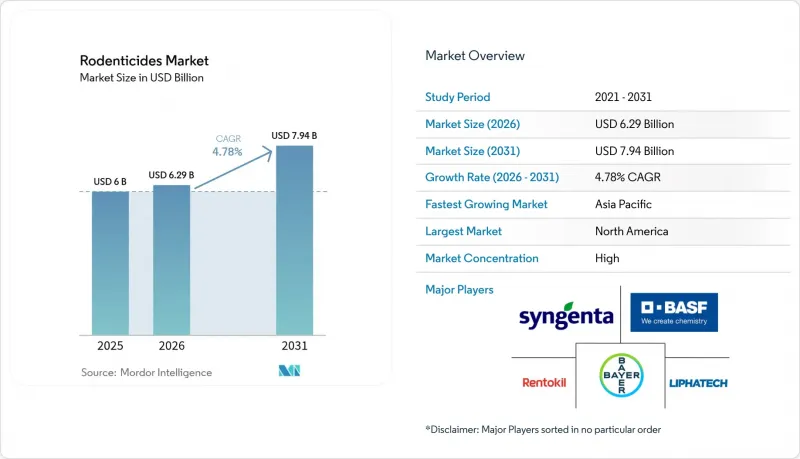
根據 Mordor Intelligence 預測,滅鼠劑市場規模將從 2025 年的 60 億美元成長到 2026 年的 62.9 億美元,然後在 2031 年達到 79.4 億美元,2026 年至 2031 年的複合年成長率為 4.78%。
本報告按類型(非抗凝血滅鼠劑和抗凝血滅鼠劑)、劑型(塊狀、顆粒狀、粉狀等)、應用領域(農田、倉庫和儲存設施等)、通路(害蟲防治公司等)以及地區(北美、歐洲、亞太地區等)進行細分。市場預測以美元計價。
全球滅鼠劑市場趨勢與洞察
加強生物安全措施的商品貿易標準大幅提高。
貿易協定日益要求採用經認證的滅鼠方案,以防止害蟲跨境傳播,迫使糧食碼頭、倉庫和航運公司實施專業的滅鼠劑噴灑和綜合蟲害管理(IPM)方案。歐盟和北美地區的類似法規將出口合格與「無害蟲」倉儲證明掛鉤,並鼓勵出口商使用符合第二代抗凝血滅鼠劑(SGAR)管理標準的防篡改誘餌盒。這些措施避免了價值數百萬美元的貨物在檢疫期間被扣押,使專業級滅鼠劑成為保障貿易連續性的前線工具。經合組織和聯合國糧農組織的《農業經濟合作暨發展組織獎勵。
糧食需求增加和農業生產力提高
氣候變遷導致的卡路里需求增加和產量波動加劇了糧食和園藝系統的收穫後損失。在鼠害控制不足的新興市場,損失可達30-40%。亞太地區水稻種植區的田間研究表明,基於生態系統的鼠害管理可使產量提高6-15%,農民收入增加15%以上,使其成為極具吸引力的滅鼠劑投資。在非洲,多乳鼠造成的玉米減產高達48%,迫使各國政府津貼大規模磷化鋅滅鼠宣傳活動。聯合國糧食及農業組織(糧農組織)已證實,將筒倉結構改善與有針對性的化學防治相結合,可顯著減少儲存期間的損失。隨著氣候變遷延長了鼠類的繁殖季節,生產者正從局部防治轉向計畫性噴灑,這推動了滅鼠劑市場的長期銷售量。
抗藥性害蟲數量增加
基因突變,特別是Vkorc1基因的突變,正在削弱第一代和第二代抗凝血劑的療效,增加治療成本,並延長傷害。黎巴嫩的實地研究證實,儘管對滅鼠劑銷售的監管不足,小鼠和大鼠仍出現了抗藥性。紐西蘭的一項研究在先前未接觸過溴敵隆的孤立族群中檢測到了抗藥性,這表明可能由於基因漂變而自發性產生抗藥性。加州的地鬆鼠現在能夠耐受單一劑量的敵鼠酮和Chlorophacinone,迫使人們改用磷酸鋅和膽鈣化醇混合物。抗藥性的蔓延增加了服務需求,推動了對診斷技術的投資,同時也減緩了傳統化學品的銷售量成長。
細分市場分析
預計到2025年,抗凝血劑將佔滅鼠劑銷售額的65.40%,鞏固在主導地位。即使監管機構降低了允許濃度,單劑量即可有效殺滅抗藥性鼠株,這使其在倉庫和食品加工廠的應用仍得以保留。雖然專家仍然青睞第二代化合物,例如溴敵隆(Brodifacom),但預計到2031年,非抗凝血劑系統的年複合成長率將達到7.35%,這將推動對磷化鋅和膽鈣化醇混合產品的需求成長。研究表明,磷化鋅可使野生鼠群數量減少58.15%,優於傳統的第一代產品。
另一方面,Bromethalin和士的寧在一些特殊應用領域,例如鼠洞系統中,由於抗凝血劑抗藥性迅速增加,因此被廣泛使用。儘管低收入地區對金屬磷化物的監管趨勢限制了其廣泛應用,但由於特定需求,市場仍維持著一定的需求水準。整體而言,產品組合多元化使市場領導者能夠減輕個別監管政策緊縮的影響,滅鼠劑市場仍具有強大的適應性。
由於其卓越的耐候性和與第二代抗凝血滅鼠劑(SGAR)管理系統要求的防篡改站的兼容性,預計到2025年,阻斷劑將保持44.30%的市場佔有率。專家高度評價其戶外高耐久性和減少重複施用次數的優點。顆粒劑緊隨其後,因其適用於稻田和農田作物的機械施用而備受青睞。受精準噴灑設備和餌袋填充機普及的推動,液體濃縮劑滅鼠劑的市場規模預計將以7.05%的複合年成長率成長,超過整體市場成長速度。
實地研究表明,石蠟塊即使在戶外也能保持100%的活性成分回收率,但50%的石蠟塊會在五週內脫落,因此需要對固定系統進行創新。膏劑和凝膠在零售和飯店等需要隱藏使用的場所需求量很大。由於擔心粉末會散落,其需求量有所下降,但在糧食設施的燻蒸滅鼠洞中仍扮演著重要角色。即用型小袋裝產品滿足了一般家庭的便利需求,但第二代抗凝血滅鼠劑(SGARs)日益嚴格的許可核准流程正促使DIY商店轉向使用第一代活性成分和繁殖控制片劑。隨著連網誘餌盒的普及,對能夠承受取食追蹤感測器的穩定配方的需求不斷成長。致力於開發高密度、抗壓碎的石蠟塊的製造商有望實現銷售量成長,因為服務合約要求減少現場服務次數。
區域分析
2025年,北美地區維持了35.60%的最大區域市佔率。這反映了該地區成熟的法律規範、專業害蟲防治服務的高滲透率以及在商業和工業領域的廣泛應用。該地區的主導地位得益於倉庫和加工廠嚴格的食品安全法規、需要系統性害蟲管理的大規模農業生產以及為囓齒動物繁殖創造理想條件的都市化趨勢。預計到2031年,年複合成長率(CAGR)將達到3.98%,這主要得益於氣候變遷導致的都市區囓齒動物數量增加以及相關技術的進步,但同時也受到環境法規的限制。美國環保署(EPA)於2024年11月公佈的綜合滅鼠劑策略,明確了相關法規,並增加了有針對性的緩解措施,以保護瀕危物種。
亞太地區預計將成為所有地區中成長最快的地區,到2031年複合年成長率將達到5.95%,這主要得益於快速的都市化、農業擴張以及開發中國家日益增強的糧食安全意識。中國的滅鼠計畫大量使用敵鼠酮防治共生鼠種,並使用磷化鋅防治農作物害蟲,各省級機構協調開展都市區大規模滅鼠宣傳活動。生態學滅鼠方法已使多個國家的糧食產量提高6%至15%,農業收入提高15%以上,這進一步加速了此方法的推廣應用。
在歐洲,受歐盟統一法規的推動,市場預計將以3.65%的複合年成長率成長至2031年。這些法規促進了產品標籤的標準化,並推動了環保配方的研發。在英國,隨著Bromadiolone和敵鼠靈於2024年7月起禁止在戶外使用,產品系列正轉向膽鈣化醇和氟鼠靈。受都市化加快、農業擴張以及旨在控制囓齒類動物傳播疾病的公共衛生措施的推動,非洲和中東的複合年成長率預計分別為5.25%和4.72%。南美洲的複合年成長率預計為5.02%,巴西以生物安全為重點的貿易法規支撐了穩定的需求。撒哈拉以南非洲地區逐步轉向生態友善滅鼠方法代表著一種策略演變,儘管在鼠患爆發期間仍需要使用傳統的滅鼠劑。
其他好處:
- Excel格式的市場預測(ME)表
- 3個月的分析師支持
目錄
第1章:引言
- 研究假設和市場定義
- 調查範圍
第2章:調查方法
第3章執行摘要
第4章 市場狀況
- 市場概覽
- 市場促進因素
- 大宗商品交易標準大幅提高,並納入了生物安全措施。
- 糧食需求增加和農業生產力提高
- 大規模、垂直一體化農業的擴張
- 都市區鼠患迅速蔓延與氣候變遷有關
- 採用已獲得生態標章認證的第二代抗凝血劑,可單劑量給藥。
- 預防囓齒動物傳播的通用感染疾病津貼項目
- 市場限制因素
- 抗藥性害蟲增加
- 對環境和人類健康的風險
- 加強戶外使用SGAR的監管
- 避孕方式選擇增多
- 監理情勢
- 技術展望
- 波特五力模型
第5章 市場規模與成長預測
- 按類型
- 非抗凝血滅鼠劑
- Bromethalin
- 膽鈣化醇
- 磷化鋅
- 士的寧
- 抗凝血滅鼠劑
- 第一代
- Warfarin
- Chlorophacinone
- 雙相酮
- Coumatetralyl
- 第二代
- 吉芬納庫姆
- 布羅迪·法庫姆
- Flocoumafen
- Bromadiolone
- 第一代
- 非抗凝血滅鼠劑
- 按形式
- 堵塞
- 顆粒
- 粉末
- 糊狀物和凝膠
- 濃縮液液
- 透過使用
- 農業部門
- 倉庫和儲存設施
- 商業和工業設施
- 住宅大樓
- 按發行格式
- 害蟲防治公司 (PCO)
- 零售和DIY通路
- 政府病媒控制計劃
- 按地區
- 北美洲
- 美國
- 加拿大
- 墨西哥
- 其他北美國家
- 歐洲
- 德國
- 英國
- 法國
- 俄羅斯
- 西班牙
- 其他歐洲國家
- 亞太地區
- 中國
- 日本
- 印度
- 澳洲
- 其他亞太國家
- 南美洲
- 巴西
- 阿根廷
- 其他南美國家
- 中東
- 沙烏地阿拉伯
- 阿拉伯聯合大公國
- 其他中東國家
- 非洲
- 南非
- 埃及
- 其他非洲國家
- 北美洲
第6章 競爭情勢
- 市場集中度
- 策略趨勢
- 市佔率分析
- 公司簡介
- BASF SE
- Bayer AG
- Syngenta Group
- Liphatech
- Rentokil Initial plc
- Neogen Corporation
- JT Eaton
- Bell Laboratories
- SenesTech Inc.
- PelGar International
- Impex Europa
- Russell IPM
- Truly Nolen
- Vebi Istituto Biochimico
- Fumakilla
- UPL Limited
- Detia Degesch GmbH
第7章 市場機會與未來展望
According to Mordor Intelligence, the rodenticides market size is expected to grow from USD 6.0 billion in 2025 to USD 6.29 billion in 2026 and is forecast to reach USD 7.94 billion by 2031 at 4.78% CAGR over 2026-2031.
This report is Segmented by Type (Non-Anticoagulant Rodenticides, and Anticoagulant Rodenticides), Form (Blocks, Pellets, Powders, and More), Application (Agricultural Fields, Warehouses and Storage Facilities, and More), Mode of Distribution (Pest Control Operators (PCO), and More) and Geography (North America, Europe, Asia-Pacific, and More). The Market Forecasts are Provided in Terms of Value (USD).
Global Rodenticides Market Trends and Insights
Surge in Bio-secure Commodity Trade Standards
Trade agreements are increasingly requiring certified rodent-control protocols to prevent the transmission of pests across borders, compelling grain terminals, warehouses, and shipping lines to adopt professionally applied rodenticides and integrated pest-management (IPM) plans. Parallel mandates in the European Union and North America tie export eligibility to pest-free storage certificates, prompting exporters to deploy tamper-resistant bait boxes that comply with stewardship codes for second-generation anticoagulant rodenticides (SGAR). These measures shield multi-million-dollar consignments from quarantine holds, making professional-grade rodenticides a frontline tool in safeguarding trade continuity. The economic incentive widens as the Organisation for Economic Co-operation and Development and Food and Agriculture Organization (OECD-FAO) Agricultural Outlook anticipates 1.3% annual growth in consumption through 2032, intensifying pressure on already-stretched logistics networks .
Increasing Demand for Food and Agricultural Productivity
Rising calorie needs and climate-induced yield volatility expose grain and horticulture systems to heavier post-harvest losses, which can reach 30-40% in emerging markets when rodent control is inadequate. Field studies across Asia-Pacific rice belts show ecologically based rodent management lifting yields 6-15% and farm incomes beyond 15%, a compelling return on rodenticide investments. In Africa, multimammate rats shave as much as 48% from maize harvests, pushing governments to subsidize broad-acre zinc-phosphide campaigns. The Food and Agriculture Organization confirms that combining structural silo upgrades with targeted chemical control sharply curtails storage losses. As climate shifts stretch breeding seasons, growers scale up from spot treatments to programmatic applications, reinforcing long-run volume growth in the rodenticides market.
Rise in the Number of Resistant Pests
Genetic mutations, particularly in the Vkorc1 gene, undermine first- and second-generation anticoagulants, raising treatment costs and prolonging infestation timelines. Lebanese fieldwork confirmed resistance in house mice and rats despite limited oversight of rodenticide sales. New Zealand studies detected brodifacoum tolerance in isolated populations lacking prior exposure, hinting at spontaneous resistance via genetic drift. California ground squirrels now survive diphacinone and chlorophacinone pulses, compelling rotation to zinc-phosphide or cholecalciferol mixtures. Resistance inflates service calls and drives investment in diagnostics, tempering volume growth for legacy chemistries.
Other drivers and restraints analyzed in the detailed report include:
- Proliferation of Large-scale, Vertically Integrated Farming
- Rapid Urban Rodent Infestations Linked to Climate Change
- Environmental and Human Health Hazards
For complete list of drivers and restraints, kindly check the Table Of Contents.
Segment Analysis
Anticoagulants secured 65.40% of 2025 revenue, underpinning the rodenticides market leadership story. Their single-dose lethality against resistant strains anchors usage in warehouses and food plants even as regulators trim permissible concentrations. Second-generation molecules, such as brodifacoum, remain favored among professionals, while non-anticoagulant classes are projected to grow at a 7.35% CAGR to 2031, drawing demand toward zinc phosphide and cholecalciferol hybrids. Studies show that zinc phosphide reduced field populations by 58.15%, surpassing traditional first-generation outcomes.
In parallel, bromethalin and strychnine hold niche utility for burrow systems where anticoagulant resistance soars. Regulatory developments against metal phosphides in low-income regions temper broader adoption, yet specialized needs sustain modest demand. Overall, portfolio diversification lets market leaders buffer exposure to any single regulatory clampdown, keeping the rodenticides market adaptable.
Blocks retained a 44.30% share of the 2025 market size demand due to weather resistance and compatibility with tamper-proof stations mandated under Second-generation anticoagulant rodenticides (SGAR) stewardship. Professionals appreciate their longevity outdoors, limiting call-backs. Pellets followed, favored for mechanical broadcast across rice paddies and row crops. The rodenticides market size attributable to liquid concentrates is forecast to grow 7.05% CAGR, outpacing overall sector expansion as precision-spray rigs and bait baggers gain traction.
Fieldwork shows that paraffin blocks kept 100% active-ingredient recovery in open air, although 50% detached within five weeks, prompting innovation in anchor systems. Pastes and gels have a growing demand in high-visibility retail and hospitality settings, where discreet application is crucial. Powders are declining due to drift concerns, but retain relevance for fumigant burrow dusting in grain facilities. Ready-to-use sachets meet the demand among homeowners for convenience, but rising licensing barriers on Second-generation anticoagulant rodenticides (SGARs) are tilting the DIY aisle toward first-generation actives or fertility tablets. The move toward internet-connected bait boxes amplifies demand for formulations stable under sensor rigs that log consumption. Manufacturers of engineering denser blocks that resist fragmentation stand to capture incremental volume as service contracts specify reduced site visits.
Complete Report Scope:
- By Type
- Non-Anticoagulant Rodenticides
- Bromethalin
- Cholecalciferol
- Zinc Phosphide
- Strychnine
- Anticoagulant Rodenticides
- First-Generation
- Warfarin
- Chlorophacinone
- Diphacinone
- Coumatetralyl
- Second-Generation
- Difenacoum
- Brodifacoum
- Flocoumafen
- Bromadiolone
- First-Generation
- Non-Anticoagulant Rodenticides
- By Form
- Blocks
- Pellets
- Powders
- Pastes and Gels
- Liquid Concentrates
- By Application
- Agricultural Fields
- Warehouses and Storage Facilities
- Commercial and Industrial Premises
- Residential Buildings
- By Mode of Distribution
- Pest Control Operators (PCOs)
- Retail/DIY Channels
- Government Vector-Control Programs
- By Geography
- North America
- United States
- Canada
- Mexico
- Rest of North America
- Europe
- Germany
- United Kingdom
- France
- Russia
- Spain
- Rest of Europe
- Asia-Pacific
- China
- Japan
- India
- Australia
- Rest of Asia-Pacific
- South America
- Brazil
- Argentina
- Rest of South America
- Middle East
- Saudi Arabia
- United Arab Emirates
- Rest of Middle East
- Africa
- South Africa
- Egypt
- Rest of Africa
- North America
Geography Analysis
North America maintained the largest regional market share at 35.60% in 2025, reflecting mature regulatory frameworks, high adoption of professional pest control services, and substantial commercial and industrial applications. The region's leadership stems from stringent food-safety regulations in warehousing and processing facilities, extensive agricultural operations requiring systematic pest management, and urbanization patterns that create ideal conditions for rodent infestations. Growth is projected at 3.98% CAGR through 2031, constrained by environmental regulations yet supported by climate-driven urban rodent population rises and advances in application technology. The Environmental Protection Agency's comprehensive rodenticide strategy, released in November 2024, delivers regulatory clarity while adding targeted mitigation measures for endangered-species protection.
Asia-Pacific represents the fastest-growing regional segment at a 5.95% CAGR to 2031, propelled by rapid urbanization, agricultural expansion, and heightened food security awareness in developing economies. China's rodent programs rely heavily on diphacinone for commensal species and zinc phosphide for field pests, with provincial agencies coordinating large-scale campaigns across urban and rural zones. Ecologically-based rodent management has lifted cereal yields by 6-15% and farm income by more than 15% across multiple nations, reinforcing adoption momentum.
Europe is expected to advance at a 3.65% CAGR through 2031, as harmonized EU rules encourage standardized product labeling and spur the development of eco-friendly formulations. The United Kingdom's ban on outdoor bromadiolone and difenacoum, effective July 2024, shifts product portfolios toward cholecalciferol and flocoumafen. Africa and the Middle East are projected to post CAGRs of 5.25% and 4.72%, respectively, driven by urban growth, expanding agriculture, and public health measures aimed at controlling rodent-borne diseases. South America is projected to advance at a 5.02% CAGR, with Brazil's biosecurity-centered trade rules underpinning steady demand. A gradual shift toward ecologically based rodent management in Sub-Saharan Africa signals a strategic evolution, yet acute outbreaks still necessitate conventional rodenticides.
- BASF SE
- Bayer AG
- Syngenta Group
- Liphatech
- Rentokil Initial plc
- Neogen Corporation
- JT Eaton
- Bell Laboratories
- SenesTech Inc.
- PelGar International
- Impex Europa
- Russell IPM
- Truly Nolen
- Vebi Istituto Biochimico
- Fumakilla
- UPL Limited
- Detia Degesch GmbH
Additional Benefits:
- The market estimate (ME) sheet in Excel format
- 3 months of analyst support
TABLE OF CONTENTS
1 Introduction
- 1.1 Study Assumptions and Market Definition
- 1.2 Scope of the Study
2 Research Methodology
3 Executive Summary
4 Market Landscape
- 4.1 Market Overview
- 4.2 Market Drivers
- 4.2.1 Surge in bio-secure commodity trade standards
- 4.2.2 Increasing demand for food and agricultural productivity
- 4.2.3 Proliferation of large-scale, vertically-integrated farming
- 4.2.4 Rapid urban rodent infestations linked to climate change
- 4.2.5 Adoption of single-dose, eco-labeled second-generation anticoagulants
- 4.2.6 Subsidized rodent-borne zoonosis prevention programs
- 4.3 Market Restraints
- 4.3.1 Rise in the number of resistant pests
- 4.3.2 Environmental and human-health hazards
- 4.3.3 Tightening restrictions on outdoor SGAR use
- 4.3.4 Growing availability of fertility-control alternatives
- 4.4 Regulatory Landscape
- 4.5 Technological Outlook
- 4.6 Porter's Five Forces
- 4.6.1 Threat of New Entrants
- 4.6.2 Bargaining Power of Buyers
- 4.6.3 Bargaining Power of Suppliers
- 4.6.4 Threat of Substitutes
- 4.6.5 Intensity of Competitive Rivalry
5 Market Size and Growth Forecasts (Value, USD)
- 5.1 By Type
- 5.1.1 Non-Anticoagulant Rodenticides
- 5.1.1.1 Bromethalin
- 5.1.1.2 Cholecalciferol
- 5.1.1.3 Zinc Phosphide
- 5.1.1.4 Strychnine
- 5.1.2 Anticoagulant Rodenticides
- 5.1.2.1 First-Generation
- 5.1.2.1.1 Warfarin
- 5.1.2.1.2 Chlorophacinone
- 5.1.2.1.3 Diphacinone
- 5.1.2.1.4 Coumatetralyl
- 5.1.2.2 Second-Generation
- 5.1.2.2.1 Difenacoum
- 5.1.2.2.2 Brodifacoum
- 5.1.2.2.3 Flocoumafen
- 5.1.2.2.4 Bromadiolone
- 5.1.2.1 First-Generation
- 5.1.1 Non-Anticoagulant Rodenticides
- 5.2 By Form
- 5.2.1 Blocks
- 5.2.2 Pellets
- 5.2.3 Powders
- 5.2.4 Pastes and Gels
- 5.2.5 Liquid Concentrates
- 5.3 By Application
- 5.3.1 Agricultural Fields
- 5.3.2 Warehouses and Storage Facilities
- 5.3.3 Commercial and Industrial Premises
- 5.3.4 Residential Buildings
- 5.4 By Mode of Distribution
- 5.4.1 Pest Control Operators (PCOs)
- 5.4.2 Retail/DIY Channels
- 5.4.3 Government Vector-Control Programs
- 5.5 By Geography
- 5.5.1 North America
- 5.5.1.1 United States
- 5.5.1.2 Canada
- 5.5.1.3 Mexico
- 5.5.1.4 Rest of North America
- 5.5.2 Europe
- 5.5.2.1 Germany
- 5.5.2.2 United Kingdom
- 5.5.2.3 France
- 5.5.2.4 Russia
- 5.5.2.5 Spain
- 5.5.2.6 Rest of Europe
- 5.5.3 Asia-Pacific
- 5.5.3.1 China
- 5.5.3.2 Japan
- 5.5.3.3 India
- 5.5.3.4 Australia
- 5.5.3.5 Rest of Asia-Pacific
- 5.5.4 South America
- 5.5.4.1 Brazil
- 5.5.4.2 Argentina
- 5.5.4.3 Rest of South America
- 5.5.5 Middle East
- 5.5.5.1 Saudi Arabia
- 5.5.5.2 United Arab Emirates
- 5.5.5.3 Rest of Middle East
- 5.5.6 Africa
- 5.5.6.1 South Africa
- 5.5.6.2 Egypt
- 5.5.6.3 Rest of Africa
- 5.5.1 North America
6 Competitive Landscape
- 6.1 Market Concentration
- 6.2 Strategic Moves
- 6.3 Market Share Analysis
- 6.4 Company Profiles (Includes Global-level Overview, Market-level Overview, Core Segments, Financials as available, Strategic Information, Market Rank/Share, Products & Services, Recent Developments)
- 6.4.1 BASF SE
- 6.4.2 Bayer AG
- 6.4.3 Syngenta Group
- 6.4.4 Liphatech
- 6.4.5 Rentokil Initial plc
- 6.4.6 Neogen Corporation
- 6.4.7 JT Eaton
- 6.4.8 Bell Laboratories
- 6.4.9 SenesTech Inc.
- 6.4.10 PelGar International
- 6.4.11 Impex Europa
- 6.4.12 Russell IPM
- 6.4.13 Truly Nolen
- 6.4.14 Vebi Istituto Biochimico
- 6.4.15 Fumakilla
- 6.4.16 UPL Limited
- 6.4.17 Detia Degesch GmbH
7 Market Opportunities and Future Outlook

 抗凝血滅鼠劑市場:全球市場預測(2026-2032 年)滅鼠劑市場:依作用機制、劑型、活性成分、應用、通路和最終用戶分類-2026-2032年全球市場預測
 非抗聚集性滅鼠劑市場規模、佔有率和成長分析:按產品類型、劑型、活性成分、應用、最終用戶、分銷管道和地區分類-2026-2033年產業預測
 滅鼠劑市場-全球產業規模、佔有率、趨勢、機會、預測:按類型、應用方式、囓齒動物類型、最終用途、地區和競爭格局分類,2021-2031年
 抗凝血滅鼠劑:市場佔有率分析、產業趨勢與統計及成長預測(2026-2031 年)
 滅鼠劑市場:依產品、劑型、應用及地區分類
 全球滅鼠劑市場規模、佔有率、趨勢和成長分析報告(2026-2034年)
 2026年全球滅鼠劑市場報告
 滅鼠劑市場規模、佔有率和趨勢分析報告:按產品、劑型、應用、地區和細分市場預測,2026-2033年全球Bromadiolone市場-2026-2031年預測