


 |
市場調查報告書
商品編碼
2114512
家禽飼料:市佔率分析、產業趨勢與統計、成長預測(2026-2031)Poultry Feed - Market Share Analysis, Industry Trends & Statistics, Growth Forecasts (2026 - 2031) |
||||||

※ 本網頁內容可能與最新版本有所差異。詳細情況請與我們聯繫。
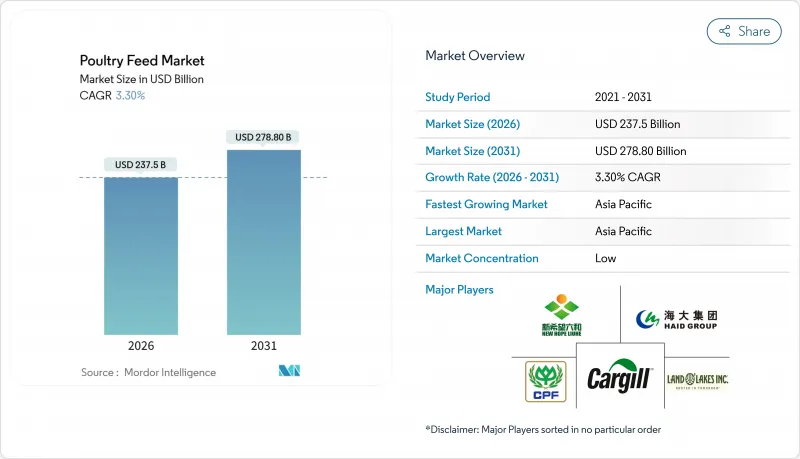
根據 Mordor Intelligence 預測,家禽飼料市場規模預計將在 2026 年達到 2,375 億美元,並在 2031 年擴大到 2,788 億美元,預測期內複合年成長率為 3.3%。
本報告按飼料類型(蛋雞飼料、肉雞飼料等)、形態(顆粒、碎粒等)、原料類型(穀物、油籽粕、糖蜜、魚油和魚粉、添加劑等)以及地區(北美、歐洲、亞太、南美、中東等)進行細分。市場預測以美元計價。
全球家禽飼料市場趨勢及洞察
全球家禽消費量增加
2024年,全球人均家禽消費量達到17.9公斤,其中以東南亞、撒哈拉以南非洲和中東地區的成長最為顯著。在奈及利亞、埃及和越南等市場,複合飼料的生產速度跟不上家禽存欄量的成長,飼料廠紛紛建在綜合家禽養殖場附近,以確保及時供應。都市區低溫運輸的擴展正在逐步淘汰活禽市場,從而增加了對品質穩定的飼料的需求,以支持冷藏肉的供應。經濟合作暨發展組織(OECD)預測,到2030年,家禽將佔全球肉品消費量的41%。儘管原料成本有所波動,但這些基本面需求支撐著家禽飼料市場的持續擴張。
新興經濟體家禽養殖業的產業化
至2025年,在中國,擁有超過10萬隻家禽的綜合性養雞場將佔肉雞總產量的68%,在印度則為54%,較2020年水準顯著成長。在這種規模下,混合飼料因其配方統一,有助於保障生物安全和可預測的生產結果,因此成為首選。類似的模式目前正在南非和奈及利亞推廣,這些國家的綜合性養雞場正在部署自動化飼料廠,年產能超過20萬噸。隨著零售商對可追溯性的要求日益提高,曾經在養殖場現場配製飼料的小規模農戶正逐漸消失。世界銀行預測,到2030年,新興市場75%的肉雞產量將來自工業化養雞場,這將進一步加劇市場對專業買家的需求。
原物料價格波動
2024年至2025年間,玉米價格在每蒲式耳4.20美元至5.80美元之間波動,而大豆粕價格則受天氣和需求突變的影響,在每噸380美元至520美元之間劇烈波動。埃及和菲律賓等依賴進口的市場,由於其貨幣對美元貶值,面臨成本上升的風險。如果現貨價格飆升,提前3至6個月簽訂固定價格合約的碾米廠將面臨利潤率壓力。用小麥或大麥取代高達30%的玉米可以起到一定的緩解作用,但亞洲這些穀物的期貨市場交易量仍然較低。高波動時期營運資金需求的增加進一步加劇了資產負債表的壓力。非洲和亞洲部分地區缺乏完善的避險工具,使生產者面臨風險,阻礙了家禽飼料市場的短期成長。
細分市場分析
預計到2025年,肉雞飼料將佔市場規模的42%,這主要得益於肉雞產量增加至1.1億噸,也印證了肉雞在禽類飼料市場中的核心地位。儘管北美和歐洲的成長已趨於平緩,但全球需求仍在持續成長,這主要得益於南亞和撒哈拉以南非洲地區兩位數的出貨量成長。雖然肉雞飼料在土耳其的市佔率較小,但預計將以6.2%的複合年成長率成長,這反映了蛋白質含量的提高以及美國和出口市場的季節性需求。蛋雞飼料佔了較大的市場佔有率,這得益於雞蛋需求的穩定性以及蛋雞飼料在麵包製作中應用範圍的擴大。同時,鴨子和鵪鶉等其他禽類則形成了細分市場。所有細分市場都轉向使用無抗生素配方,這導致添加劑的使用量增加,並提高了專業供應商的利潤率。
土耳其飼料要求幼畜飼料中粗蛋白質含量為24-28%,而肉雞飼料則為21-23%,因此土耳其飼料價格較高。這使得飼料設計師有空間添加昆蟲粉和有機微量元素。已開發國家的優質化趨勢提升了土耳其飼料的健康意識,而來自中東和墨西哥的進口則擴大了其市場覆蓋範圍。在蛋雞和特種禽類的複合飼料中,促進腸道健康的添加劑被強調用於提高雞蛋品質,從而在不同細分市場之間形成協同效應。垂直一體化生產的持續發展意味著大型一體化公司現在決定飼料規格,而家禽飼料市場的生產往往集中在少數幾家技術先進的飼料廠。
區域分析
預計到2025年,亞太地區將佔全球家禽飼料市場收入的32%,並在2031年之前以4.6%的複合年成長率成長,這主要得益於中國產能的提升以及印度向規範化家禽養殖的快速轉型。中國前十大生產商的國內產量佔有率正從2020年的22%成長到2025年的35%,為大規模複合飼料廠的建設創造了有利環境。印度的飼料消費量已達2,800萬噸,但該產業仍分散在5,000家工廠中,激烈的價格競爭為產業整合留下了空間。日本和韓國在推廣無抗生素飼料處於該地區領先地位,這導致特種添加劑的進口量增加。同時,泰國、越南和印尼正在投資興建年產超過50萬噸的大型飼料廠。
非洲的複合年成長率顯著,主要得益於奈及利亞和埃及快速成長的家禽業的需求。儘管奈及利亞的家禽業正在現代化,但電力和物流等基礎設施的不平衡限制了其效率。南非透過提高飼料轉換率和推動垂直整合,與巴西的廉價進口產品競爭。中東地區也持續成長,這得益於沙烏地阿拉伯和阿拉伯聯合大公國對原料進口的補貼以及一體化的農業管理。南美洲也在擴張,但仍容易受到外匯波動的影響,影響出口盈利。
歐洲和北美的家禽市場已進入成熟階段,受到嚴格的環境法規限制,家禽養殖規模難以擴張。歐盟的「從農場到餐桌」策略旨在到2030年將抗生素的使用量減半,這推動了酵素製劑的應用。美國作為家禽飼料的主要生產國,正轉向生長速度較慢的品種和放養蛋雞,改變了飼料的規格。俄羅斯正在推行進口替代,而大洋洲則透過瞄準亞洲出口市場實現成長。這些不同的成長軌跡凸顯了新興地區家禽飼料市場持續長期擴張的趨勢。
其他好處:
- Excel格式的市場預測(ME)表
- 3個月的分析師支持
目錄
第1章:引言
- 研究假設和市場定義
- 調查範圍
第2章:調查方法
第3章執行摘要
第4章 市場狀況
- 市場概覽
- 市場促進因素
- 全球家禽消費量增加
- 新興國家家禽養殖業的產業化
- 飼料添加劑的進步提高了飼料轉換率
- 嚴格的安全法規正在推動複合飼料的普及。
- 人們越來越關注利用昆蟲蛋白來緩解大豆價格波動。
- 擴大農場內微膠囊化技術的應用,以實現精準營養
- 市場限制因素
- 原物料價格波動
- 感染疾病爆發
- 對抗生素抗藥性的監管限制了抗生素生長促進劑的使用。
- 替代蛋白的競爭正在減緩長期需求。
- 監理情勢
- 技術展望
- 波特五力分析
第5章 市場規模與成長預測
- 按飼料類型
- 肉雞飼料
- 產蛋飼料
- 火雞飼料
- 其他家禽飼料
- 按形式
- 顆粒
- 崩潰
- Mash
- 其他
- 依成分類型
- 穀類
- 油籽粕
- 糖蜜
- 魚油和魚粉
- 添加劑
- 其他成分類型
- 按地區
- 北美洲
- 美國
- 加拿大
- 墨西哥
- 其他北美國家
- 南美洲
- 巴西
- 阿根廷
- 智利
- 其他南美國家
- 歐洲
- 德國
- 英國
- 法國
- 義大利
- 西班牙
- 俄羅斯
- 其他歐洲國家
- 亞太地區
- 中國
- 印度
- 日本
- 澳洲
- 韓國
- 其他亞太國家
- 中東
- 沙烏地阿拉伯
- 阿拉伯聯合大公國
- 其他中東國家
- 非洲
- 南非
- 埃及
- 其他非洲國家
- 北美洲
第6章 競爭情勢
- 市場集中度
- 策略趨勢
- 市佔率分析
- 公司簡介
- Cargill, Incorporated
- New Hope Liuhe Co. Ltd
- Charoen Pokphand Foods Public Co. Ltd
- Land O'Lakes Inc
- Guangdong HAID Group Co. Ltd
- Nutreco NV(SHV Holdings)
- Archer Daniels Midland Company
- Wen's Food Group
- ForFarmers NV
- De Heus Animal Nutrition
- BRF SA(Marfrig SA)
- Alltech Inc
- Novus International Inc(Mitsui & Co., Ltd.)
- Evonik Industries AG
- Kemin Industries, Inc.
第7章 市場機會與未來展望
According to Mordor Intelligence, the poultry feed market size reached USD 237.5 billion in 2026 and is projected to rise to USD 278.8 billion by 2031, reflecting a 3.3% CAGR during the forecast period.
This report is Segmented by Feed Type (Layer Feed, Broiler Feed, and More), by Form (Pellets, Crumbles, and More), by Ingredient Type (Cereals, Oilseed Meal, Molasses, Fish Oil and Fish Meal, Additives, and More), and by Geography (North America, Europe, Asia-Pacific, South America, Middle East, and More). The Market Forecasts are Provided in Terms of Value (USD).
Global Poultry Feed Market Trends and Insights
Rising Global Poultry Meat Consumption
The global per-capita poultry meat consumption reached 17.9 kg per person in 2024, with the sharpest gains in Southeast Asia, Sub-Saharan Africa, and the Middle East . In markets such as Nigeria, Egypt, and Vietnam, compound feed production lags flock growth, encouraging mill construction near integrated poultry complexes for just-in-time delivery. Urban cold-chain expansion is displacing live-bird markets and increasing demand for consistent feed quality to support chilled meat supply. The Organization for Economic Cooperation and Development projects poultry will account for 41% of global meat consumption by 2030. These demand fundamentals underpin sustained expansion of the poultry feed market, even as ingredient costs ebb and flow.
Industrialization of Poultry Farming in Emerging Economies
Integrated farms exceeding 100,000 birds represented 68% of broiler output in China and 54% in India during 2025, up sharply from 2020 levels. Such scale favors compound feed because uniform formulations support biosecurity and predictable performance. The same model is now spreading to South Africa and Nigeria, where integrators are adding automated mills with capacities above 200,000 metric tons. As retailers demand traceability, smallholders that once mixed on-farm rations lose ground. The World Bank anticipates industrial poultry to reach 75% of emerging-market production by 2030, further concentrating demand with professional buyers.
Volatile Raw Material Prices
Corn traded between USD 4.20 and USD 5.80 per bushel during 2024-2025, while soybean meal swung from USD 380 to USD 520 per metric ton, driven by weather and demand shocks . Import-dependent markets such as Egypt and the Philippines face amplified costs when local currencies weaken against the dollar. Millers that lock in fixed-price contracts three to six months ahead risk margin squeeze when spot prices spike. Substituting wheat and barley for up to 30% of corn offers some relief, but futures markets for these grains remain thin in Asia. Elevated working-capital needs further pressure balance sheets during volatile periods. The absence of sophisticated hedging tools in Africa and parts of Asia leaves producers exposed, tempering near-term growth in the poultry feed market.
Other drivers and restraints analyzed in the detailed report include:
- Advancements in Feed Additives Improving Feed Conversion Ratio
- Stringent Safety Regulations Pushing Adoption of Compound Feed
- Regulatory Scrutiny on Antimicrobial Resistance Restricting Antibiotic Growth Promoters
For complete list of drivers and restraints, kindly check the Table Of Contents.
Segment Analysis
Broiler feed generated 42% of 2025 value as broiler meat production climbed to 110 million metric tons, reinforcing the centrality of broilers to the poultry feed market size. Growth in North America and Europe has plateaued, yet double-digit volume gains in South Asia and Sub-Saharan Africa keep global demand expanding. Turkey feed contributed lower share but is set to grow at a 6.2% CAGR, reflecting higher protein inclusion and rising seasonal demand in the United States and export markets. Layer feed accounted for a significant share, benefiting from steady table-egg demand and bakery usage, while other species such as duck and quail formed a niche. Antibiotic-free reformulation across all sub-segments increases additive intensity, boosting margins for specialty suppliers.
Turkey feed commands higher prices because starter diets require 24-28% crude protein compared with 21-23% for broilers, giving formulators latitude to incorporate insect meal and organic trace minerals. Premiumization trends in developed economies support turkey's health positioning, while Middle Eastern and Mexican imports enlarge its geographic footprint. Layer and specialty bird formulations also emphasize gut-health additives to enhance egg quality, creating cross-segment synergies. The ongoing shift toward vertically integrated production ensures that large integrators dictate feed specifications, consolidating volume with fewer, technologically advanced mills within the poultry feed market.
Complete Report Scope:
- By Feed Type
- Broiler Feed
- Layer Feed
- Turkey Feed
- Other Poultry Feed
- By Form
- Pellets
- Crumbles
- Mash
- Others
- By Ingredient Type
- Cereals
- Oilseed Meal
- Molasses
- Fish Oil and Fish Meal
- Additives
- Other Ingredient Types
- By Geography
- North America
- United States
- Canada
- Mexico
- Rest of North America
- South America
- Brazil
- Argentina
- Chile
- Rest of South America
- Europe
- Germany
- United Kingdom
- France
- Italy
- Spain
- Russia
- Rest of Europe
- Asia-Pacific
- China
- India
- Japan
- Australia
- South Korea
- Rest of Asia-Pacific
- Middle East
- Saudi Arabia
- United Arab Emirates
- Rest of Middle East
- Africa
- South Africa
- Egypt
- Rest of Africa
- North America
Geography Analysis
Asia-Pacific generated 32% of poultry feed market revenue in 2025 and is on track for a 4.6% CAGR through 2031, powered by China's production capacity and India's rapid shift to organized poultry farming. China's top ten producers raised their share of national output to 35% in 2025 from 22% in 2020, favoring large compound mills. India consumed 28 million metric tons of feed, yet the sector remains fragmented among 5,000 mills that compete on price, creating scope for consolidation. Japan and South Korea lead regional adoption of antibiotic-free formulations, boosting specialty additive imports, while Thailand, Vietnam, and Indonesia invest in high-capacity mills exceeding 500,000 metric tons.
Africa recorded a significant CAGR, driven by the demand in Nigeria and Egypt's growing poultry sector. Nigeria's sector is modernizing, but infrastructure gaps in electricity and logistics constrain efficiency. South Africa counters cheap Brazilian imports by upgrading feed conversion and vertical integration. The Middle East is also growing, supported by Saudi and Emirati subsidies for ingredient imports and integrated farming. South America expands but remains exposed to currency swings that affect export profitability.
Europe and North America reflect maturity and stringent environmental caps that limit flock expansion. The European Union Farm to Fork strategy halves antimicrobial use by 2030, driving enzyme utilization. The United States, a major poultry feed producer, pivots to slower-growing genetics and cage-free layers, altering feed specs. Russia advances on import substitution, while Oceania grows by targeting Asian export markets. Diverging growth trajectories confirm that emerging regions will sustain long-term expansion of the poultry feed market.
- Cargill, Incorporated
- New Hope Liuhe Co. Ltd
- Charoen Pokphand Foods Public Co. Ltd
- Land O'Lakes Inc
- Guangdong HAID Group Co. Ltd
- Nutreco N.V. (SHV Holdings)
- Archer Daniels Midland Company
- Wen's Food Group
- ForFarmers N.V.
- De Heus Animal Nutrition
- BRF S.A. (Marfrig S.A.)
- Alltech Inc
- Novus International Inc (Mitsui & Co., Ltd.)
- Evonik Industries AG
- Kemin Industries, Inc.
Additional Benefits:
- The market estimate (ME) sheet in Excel format
- 3 months of analyst support
TABLE OF CONTENTS
1 Introduction
- 1.1 Study Assumptions and Market Definition
- 1.2 Scope of the Study
2 Research Methodology
3 Executive Summary
4 Market Landscape
- 4.1 Market Overview
- 4.2 Market Drivers
- 4.2.1 Rising global poultry meat consumption
- 4.2.2 Industrialization of poultry farming in emerging economies
- 4.2.3 Advancements in feed additives improving feed conversion ratio
- 4.2.4 Stringent safety regulations pushing adoption of compound feed
- 4.2.5 Growing interest in insect protein inclusion to mitigate soy volatility
- 4.2.6 Expansion of on-farm micro-encapsulation technology enabling precision nutrition
- 4.3 Market Restraints
- 4.3.1 Volatile raw material prices
- 4.3.2 Disease outbreaks
- 4.3.3 Regulatory scrutiny on antimicrobial resistance restricting antibiotic growth promoters
- 4.3.4 Competing alternative proteins dampening long-term demand
- 4.4 Regulatory Landscape
- 4.5 Technological Outlook
- 4.6 Porter's Five Forces Analysis
- 4.6.1 Intensity of Competitive Rivalry
- 4.6.2 Bargaining Power of Buyers
- 4.6.3 Bargaining Power of Suppliers
- 4.6.4 Threat of New Entrants
- 4.6.5 Threat of Substitutes
5 Market Size and Growth Forecasts (Value)
- 5.1 By Feed Type
- 5.1.1 Broiler Feed
- 5.1.2 Layer Feed
- 5.1.3 Turkey Feed
- 5.1.4 Other Poultry Feed
- 5.2 By Form
- 5.2.1 Pellets
- 5.2.2 Crumbles
- 5.2.3 Mash
- 5.2.4 Others
- 5.3 By Ingredient Type
- 5.3.1 Cereals
- 5.3.2 Oilseed Meal
- 5.3.3 Molasses
- 5.3.4 Fish Oil and Fish Meal
- 5.3.5 Additives
- 5.3.6 Other Ingredient Types
- 5.4 By Geography
- 5.4.1 North America
- 5.4.1.1 United States
- 5.4.1.2 Canada
- 5.4.1.3 Mexico
- 5.4.1.4 Rest of North America
- 5.4.2 South America
- 5.4.2.1 Brazil
- 5.4.2.2 Argentina
- 5.4.2.3 Chile
- 5.4.2.4 Rest of South America
- 5.4.3 Europe
- 5.4.3.1 Germany
- 5.4.3.2 United Kingdom
- 5.4.3.3 France
- 5.4.3.4 Italy
- 5.4.3.5 Spain
- 5.4.3.6 Russia
- 5.4.3.7 Rest of Europe
- 5.4.4 Asia-Pacific
- 5.4.4.1 China
- 5.4.4.2 India
- 5.4.4.3 Japan
- 5.4.4.4 Australia
- 5.4.4.5 South Korea
- 5.4.4.6 Rest of Asia-Pacific
- 5.4.5 Middle East
- 5.4.5.1 Saudi Arabia
- 5.4.5.2 United Arab Emirates
- 5.4.5.3 Rest of Middle East
- 5.4.6 Africa
- 5.4.6.1 South Africa
- 5.4.6.2 Egypt
- 5.4.6.3 Rest of Africa
- 5.4.1 North America
6 Competitive Landscape
- 6.1 Market Concentration
- 6.2 Strategic Moves
- 6.3 Market Share Analysis
- 6.4 Company Profiles (includes Global Level Overview, Market Level Overview, Core Segments, Financials as Available, Strategic Information, Market Rank/Share for Key Companies, Products and Services, and Recent Developments)
- 6.4.1 Cargill, Incorporated
- 6.4.2 New Hope Liuhe Co. Ltd
- 6.4.3 Charoen Pokphand Foods Public Co. Ltd
- 6.4.4 Land O'Lakes Inc
- 6.4.5 Guangdong HAID Group Co. Ltd
- 6.4.6 Nutreco N.V. (SHV Holdings)
- 6.4.7 Archer Daniels Midland Company
- 6.4.8 Wen's Food Group
- 6.4.9 ForFarmers N.V.
- 6.4.10 De Heus Animal Nutrition
- 6.4.11 BRF S.A. (Marfrig S.A.)
- 6.4.12 Alltech Inc
- 6.4.13 Novus International Inc (Mitsui & Co., Ltd.)
- 6.4.14 Evonik Industries AG
- 6.4.15 Kemin Industries, Inc.


