


 |
市場調查報告書
商品編碼
2114431
機器視覺相機:市場佔有率分析、產業趨勢與統計、成長預測(2026-2031)Machine Vision Camera - Market Share Analysis, Industry Trends & Statistics, Growth Forecasts (2026 - 2031) |
||||||

※ 本網頁內容可能與最新版本有所差異。詳細情況請與我們聯繫。
根據 Mordor Intelligence 預測,機器視覺相機市場規模將從 2025 年的 161.7 億美元成長到 2026 年的 175.2 億美元,到 2031 年將達到 261.3 億美元,2026 年至 2031 年的複合年成長率為 8.3%。
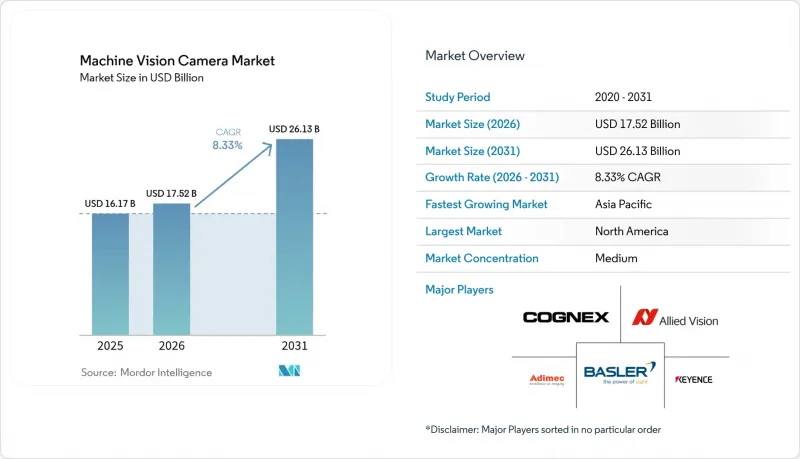
本報告按類型(面陣掃描和線陣掃描)、介面標準(USB3 Vision等)、感測器技術(全局百葉窗CMOS等)、終端用戶產業(電子和半導體、汽車和電動汽車電池等)、應用(品質檢測和缺陷檢測等)以及地區進行細分。市場預測以美元(USD)為單位。
全球機器視覺相機市場趨勢與洞察
工廠環境中的自動化浪潮迅速興起
受人手不足和對產品品質穩定性的需求驅動,製造商正迅速採用視覺引導機器人。台積電(TSMC)計畫在2024年將自動光學檢測(AOI)技術擴展至16家晶圓廠,進而縮短10奈米以下製程節點的回饋週期。食品加工企業也依賴視覺技術進行異物分類,以滿足更嚴格的安全標準。小批量製造商也加入了這一趨勢,協作機器人與輕便型相機結合,可減少換線損耗。這種廣泛的應用正在推動機器視覺相機市場在大量生產和客製化生產線中的成長。
由於 CMOS 和 USB3 的普及,相機的平均售價 (ASP) 正在下降。
全球百葉窗CMOS相機的出貨量正在快速成長,預計從2024年起,其價格將以每年15-20%的速度下降。標準化的USB3 Vision介面無需影像擷取卡,簡化了佈線,即使在中型工廠也能實現入門級部署。在東南亞,一些首次採用者已在其SMT生產線上部署了價格低於800美元的USB3相機。在利潤空間日益緊張的壓力下,老牌廠商正尋求透過人工智慧和專用光學元件等手段,在設備層面實現差異化競爭,而不僅僅是依靠硬體。
熟練的機器視覺工程師短缺
在北美和歐洲,高階視覺相關職缺的空缺率超過40%。各大學正努力更新課程,以整合光學、人工智慧框架和即時協議棧。因此,工廠將專案外包給承包整合商,優先考慮快速實施,卻犧牲了柔軟性。在短波紅外光譜和3D飛行時間(ToF)等新興領域,人才短缺問題更為嚴重,導致專案週期延長,並減緩了機器視覺相機市場的整體成長。
細分市場分析
線掃描相機適用於壓延鋼材、紡織品和太陽能帶等連續材料,預計到2031年將以9.27%的複合年成長率成長。高解析度陣列和頻譜濾波器的結合,使得在泡殼包裝生產過程中能夠檢測亞表面缺陷,以及在藥片中檢測顆粒級異常。過去依賴頻閃照明的連續卷材加工工藝,如今已採用高速生產線,支持超過500米/分鐘的輸送機速度,這清晰地展現了這一細分市場在更廣泛的機器視覺相機市場中的成長勢頭。
預計到2025年,面掃描設備仍將佔總銷售額的63.88%。感測器中全局百葉窗技術的最新進展消除了運動模糊,使得對瓶蓋、PCB焊點和電動車電源模組引腳等快速移動物體的檢測成為可能。整合式偏振濾光片可以檢測模塑塑膠內部的應力模式,而內建飛行時間(ToF)模組則擴展了基本的3D測量功能。這確保了即使線掃描技術的應用日益普及,供應商仍能維持對面掃描技術的重要性。
USB3 Vision憑藉其與PC的通用相容性,預計到2025年將佔據41.08%的出貨量佔有率。在低成本電子組裝,其即插即用的驅動程式和線纜供電(PoC)配置顯著縮短了安裝時間。價格敏感型買家將標準USB組件與易於維護聯繫起來,這也促成了該介面在機器視覺相機市場中保持高出貨量。
CoaXPress 的頻寬頻譜在於其高速成長,年複合成長率高達 9.05%。如今,它能夠透過單一電纜鏈路傳輸 25 Gbps 的數據,同時還能為 6,500 萬像素的感測器供電,這對於檢測先進 PCB 上的微孔直徑至關重要。汽車電池工廠正在使用 CoaXPress 以 700 fps 的幀率採集電極塗層,超越了 USB3 的性能。同時,GigE Vision 及其 5 Gbps 和 10 Gbps 版本在工廠內已部署乙太網路骨幹網路的環境中仍然非常實用,它們以較低的影格速率代價,提供了便捷的網路路由。
區域分析
預計到2025年,北美將佔全球銷售額的39.32%,主要得益於航太、醫療設備和高級駕駛輔助系統(ADAS)領域的早期應用。聯邦政府對國內半導體晶圓廠的獎勵措施正在推動用於檢驗300毫米晶圓均勻性的攝影機不斷升級。隨著汽車製造商轉向本地電池生產線,該地區的機器視覺攝影機市場規模也預計將隨之擴大。
亞太地區正以8.93%的複合年成長率成長,這得益於中國對智慧製造的補貼以及韓國半導體潔淨室的擴建。東南亞國協為促進中小企業數位轉型而採取的支援措施正在擴大基本客群,而日本則加大了對用於3D積體電路偵測的高速CoaXPress相機的投資。元件供應商、系統整合商和學術研究機構之間的叢集效應,透過縮短先導計畫週期和增強集體專業知識,進一步深化了機器視覺相機市場的滲透。
在歐洲,嚴格的法規結構維持著一種平衡的發展動能。製藥廠正在部署支援串列功能的攝影機,以符合歐盟假藥指令的修訂要求;汽車製造商則使用2D和3D組合工作站來檢驗電池機殼上的雷射焊接接縫。永續性目標正在推動金屬回收領域基於視覺的廢棄物分類技術,凸顯了環境保護義務並非主要驅動力。南美和中東的新興經濟體也開始部署利用視覺技術的物流中心,預計未來將逐步擴展到主要製造中心以外的地區。
其他好處:
- Excel格式的市場預測(ME)表
- 3個月的分析師支持
目錄
第1章:引言
- 研究假設和市場定義
- 調查範圍
第2章:調查方法
第3章執行摘要
第4章 市場狀況
- 市場概覽
- 市場促進因素
- 工廠環境中的自動化浪潮迅速興起
- CMOS 和 USB 3.0 的普及導致相機的平均售價 (ASP) 下降。
- 對3C產品和電動車更嚴格的品管要求
- 邊緣AI相機顯著降低了頻寬成本
- 東協「智慧工廠」補貼貸款
- 用於鋰電池品管的機器人搭載式短波紅外線視覺
- 市場限制因素
- 熟練的機器視覺工程師短缺
- 介面標準的差異導致 BOM(位元組順序標記)變得龐大。
- 加強對高速感測器的出口限制
- 板載AI SoC的熱設計限制
- 產業價值鏈分析
- 監理情勢
- 技術展望
- 波特五力分析
第5章 市場規模與成長預測
- 按類型
- 基於區域的分析
- 線掃描
- 透過介面標準
- USB3 Vision
- GigE/5~10 GigE Vision
- Camera Link/HS
- CoaXPress
- 其他/新興標準(MIPI、Thunderbolt)
- 感測器技術
- 世界百葉窗CMOS
- 捲簾百葉窗CMOS
- CCD
- SWIR/MWIR
- 飛行時間(ToF)3D
- 按最終用戶行業分類
- 電子和半導體
- 汽車和電動車電池
- 醫療保健和生命科學
- 食品/飲料加工
- 航太/國防
- 物流和倉儲
- 其他行業
- 透過使用
- 品質檢驗和缺陷檢測
- 測量和稱重
- 識別/OCR和可追溯性
- 視覺引導機器人
- 預測/狀態監測
- 按地區
- 北美洲
- 南美洲
- 歐洲
- 亞太地區
- 中東和非洲
第6章 競爭情勢
- 市場集中度
- 策略趨勢
- 市佔率分析
- 公司簡介
- Allied Vision Technologies GmbH
- Basler AG
- Cognex Corporation
- Keyence Corporation
- Teledyne DALSA Inc.
- Omron Microscan Systems, Inc.
- SICK AG
- LMI Technologies Inc.
- Adimec Advanced Image Systems BV
- JAI A/S
- IDS Imaging Development Systems GmbH
- FLIR Systems LLC
- Sony Semiconductor Solutions Corp.
- Hikrobot Technology Co., Ltd.
- Daheng Imaging Co., Ltd.
- Baumer Optronic GmbH
- Matrox Imaging, a division of Matrox Electronic Systems Ltd.
- Zebra Technologies Corp.(Machine-Vision Division)
- ISRA Vision AG
- TKH Group NV(Allied Vision and NET)
- Tordivel AS
- STEMMER IMAGING AG
- Opt Machine Vision Tech Co., Ltd.
- Datalogic SpA
第7章 市場機會與未來展望
According to Mordor Intelligence, the machine vision camera market size is expected to grow from USD 16.17 billion in 2025 to USD 17.52 billion in 2026 and is forecast to reach USD 26.13 billion by 2031 at 8.33% CAGR over 2026-2031.
This report is Segmented by Type (Area Scan and Line Scan), Interface Standard (USB3 Vision, and More), Sensor Technology (Global-Shutter CMOS, and More), End-User Industry (Electronics and Semiconductor, Automotive and EV Battery, and More), Application (Quality Inspection and Defect Detection, and More), and Geography. The Market Forecasts are Provided in Terms of Value (USD).
Global Machine Vision Camera Market Trends and Insights
Rapid Factory-Floor Automation Wave
Labor shortages and uniform-quality goals are pushing manufacturers to adopt vision-guided robotics at scale. Taiwan Semiconductor Manufacturing Company broadened automated optical inspection to 16 fabs in 2024, shortening feedback loops for sub-10 nm nodes. Food processors now rely on vision to isolate contaminants, aligning with stricter safety codes. Small-batch producers are also moving in, as collaborative robots paired with compact cameras cut changeover losses. This breadth of adoption lifts the machine vision camera market across both high-volume and custom production lines.
Falling Camera ASPs with CMOS and USB3 Adoption
Global-shutter CMOS output has grown quickly, driving 15-20% annual price drops since 2024. Standardized USB3 Vision connectors remove frame-grabber fees and simplify cabling, making entry-level deployments viable for mid-tier factories. In Southeast Asia, first-time buyers are equipping SMT lines with USB3 cameras priced below USD 800. Margin pressure is steering legacy brands toward differentiating through device-side AI and specialty optics rather than raw hardware.
Shortage of Skilled Machine-Vision Engineers
Vacancy rates for advanced vision roles top 40% in North America and Europe. Universities struggle to update curricula that merge optics, AI frameworks, and real-time protocol stacks. As a result, plants outsource projects to turnkey integrators, trading flexibility for quicker deployment. The talent gap is more acute in emerging fields like SWIR spectroscopy and 3D time-of-flight, lengthening project schedules and dampening the overall machine vision camera market growth.
Other drivers and restraints analyzed in the detailed report include:
- Tightening Quality-Control Mandates in 3C and EV
- Edge-AI Cameras Slashing Bandwidth Costs
- Fragmented Interface Standards Inflate BOM
For complete list of drivers and restraints, kindly check the Table Of Contents.
Segment Analysis
Line scan cameras address continuous materials such as rolled steel, textiles, and photovoltaic ribbons and are forecast to compound at 9.27% through 2031. High-resolution arrays paired with multi-spectral filters uncover sub-surface defects during blister-pack production and grain-level anomalies in pharmaceutical tablets. Continuous web processes, once reliant on stroboscopic lighting, now leverage faster line rates that match conveyor speeds above 500 m per minute, underscoring why this niche is climbing inside the broader machine vision camera market.
Area scan units still command 63.88% of 2025 revenue. Recent sensor shifts to global-shutter exposure removed motion-blur, unlocking inspection of fast-moving bottle caps, PCB solder joints, and EV power-module leads. Integrating polarizing filters enables detection of stress patterns in molded plastic, while embedded time-of-flight modules extend capability into basic 3D gauging. Vendors thereby safeguard area scan relevance even as line scan adoption widens.
USB3 Vision delivers 41.08% of 2025 shipments owing to universal PC compatibility. In low-cost electronics assembly, plug-and-play driver stacks and power-over-cable set-ups slash installation hours. Price-sensitive buyers equate standard USB components with serviceability, which helps sustain top-line volume for this interface within the machine vision camera market size.
CoaXPress addresses the opposite end of the bandwidth spectrum and is rising at 9.05% CAGR. Single-cable links now stream 25 Gbps while powering a 65 MP sensor, crucial for inspecting micro-via diameters on advanced PCBs. Automotive battery cell plants adopt CoaXPress to image electrode coatings at 700 fps, a feat beyond USB3. Meanwhile, GigE Vision and its 5 Gig and 10 Gig variants remain relevant where in-plant Ethernet backbones already exist, trading lower frame rates for easy network routing.
Complete Report Scope:
- By Type
- Area Scan
- Line Scan
- By Interface Standard
- USB3 Vision
- GigE / 5-10 GigE Vision
- Camera Link / HS
- CoaXPress
- Other / Emerging (MIPI, Thunderbolt)
- By Sensor Technology
- Global-shutter CMOS
- Rolling-shutter CMOS
- CCD
- SWIR / MWIR
- Time-of-Flight 3D
- By End-user Industry
- Electronics and Semiconductor
- Automotive and EV Battery
- Healthcare and Life-science
- Food and Beverage Processing
- Aerospace and Defence
- Logistics and Warehousing
- Other Industries
- By Application
- Quality Inspection and Defect Detection
- Measurement and Metrology
- Identification / OCR and Traceability
- Vision-Guided Robotics
- Predictive / Condition Monitoring
- By Geography
- North America
- South America
- Europe
- Asia Pacific
- Middle East and Africa
Geography Analysis
North America recorded 39.32% of 2025 revenue, capitalizing on early adoption in aerospace, medical devices, and advanced driver-assistance systems. Federal incentives for domestic semiconductor fabs sustain camera retrofits that verify 300 mm wafer uniformity. The machine vision camera market size in the region is projected to keep pace as carmakers shift to local battery cell production lines.
Asia Pacific is advancing at a 8.93% CAGR, underpinned by China's smart-manufacturing subsidies and South Korea's semiconductor clean-room expansions. ASEAN incentives for SME digitization broaden the customer base, while Japan doubles down on high-speed CoaXPress cameras for 3D IC inspection. The cluster effect of component suppliers, integrators, and academic labs accelerates cycle times for pilot projects and bolsters collective know-how, deepening the machine vision camera market penetration.
Europe maintains balanced momentum rooted in stringent regulatory frameworks. Pharma plants install serialization-ready cameras to meet EU Falsified Medicines Directive renewal, and automakers roll out combined 2D-plus-3D stations to validate laser-weld seams on battery enclosures. Sustainability targets spur vision-based scrap sorting in metal recycling, underscoring green mandates as a secondary driver. Emerging economies in South America and the Middle East begin to deploy vision-aided logistics hubs, foreshadowing gradual expansion beyond core manufacturing heartlands.
- Allied Vision Technologies GmbH
- Basler AG
- Cognex Corporation
- Keyence Corporation
- Teledyne DALSA Inc.
- Omron Microscan Systems, Inc.
- SICK AG
- LMI Technologies Inc.
- Adimec Advanced Image Systems BV
- JAI A/S
- IDS Imaging Development Systems GmbH
- FLIR Systems LLC
- Sony Semiconductor Solutions Corp.
- Hikrobot Technology Co., Ltd.
- Daheng Imaging Co., Ltd.
- Baumer Optronic GmbH
- Matrox Imaging, a division of Matrox Electronic Systems Ltd.
- Zebra Technologies Corp. (Machine-Vision Division)
- ISRA Vision AG
- TKH Group NV (Allied Vision and NET)
- Tordivel AS
- STEMMER IMAGING AG
- Opt Machine Vision Tech Co., Ltd.
- Datalogic S.p.A.
Additional Benefits:
- The market estimate (ME) sheet in Excel format
- 3 months of analyst support
TABLE OF CONTENTS
1 INTRODUCTION
- 1.1 Study Assumptions and Market Definition
- 1.2 Scope of the Study
2 RESEARCH METHODOLOGY
3 EXECUTIVE SUMMARY
4 MARKET LANDSCAPE
- 4.1 Market Overview
- 4.2 Market Drivers
- 4.2.1 Rapid factory-floor automation wave
- 4.2.2 Falling camera ASPs with CMOS and USB3 adoption
- 4.2.3 Tightening quality-control mandates in 3C and EV
- 4.2.4 Edge-AI cameras slashing bandwidth costs
- 4.2.5 Subsidised "smart factory" loans in ASEAN
- 4.2.6 On-robot SWIR vision for lithium-battery QC
- 4.3 Market Restraints
- 4.3.1 Shortage of skilled machine-vision engineers
- 4.3.2 Fragmented interface standards inflate BOM
- 4.3.3 Rising export controls on high-speed sensors
- 4.3.4 Thermal design limits for onboard AI SoCs
- 4.4 Industry Value Chain Analysis
- 4.5 Regulatory Landscape
- 4.6 Technological Outlook
- 4.7 Porter's Five Forces Analysis
- 4.7.1 Threat of New Entrants
- 4.7.2 Bargaining Power of Buyers
- 4.7.3 Bargaining Power of Suppliers
- 4.7.4 Threat of Substitutes
- 4.7.5 Intensity of Competitive Rivalry
5 MARKET SIZE AND GROWTH FORECASTS (VALUE)
- 5.1 By Type
- 5.1.1 Area Scan
- 5.1.2 Line Scan
- 5.2 By Interface Standard
- 5.2.1 USB3 Vision
- 5.2.2 GigE / 5-10 GigE Vision
- 5.2.3 Camera Link / HS
- 5.2.4 CoaXPress
- 5.2.5 Other / Emerging (MIPI, Thunderbolt)
- 5.3 By Sensor Technology
- 5.3.1 Global-shutter CMOS
- 5.3.2 Rolling-shutter CMOS
- 5.3.3 CCD
- 5.3.4 SWIR / MWIR
- 5.3.5 Time-of-Flight 3D
- 5.4 By End-user Industry
- 5.4.1 Electronics and Semiconductor
- 5.4.2 Automotive and EV Battery
- 5.4.3 Healthcare and Life-science
- 5.4.4 Food and Beverage Processing
- 5.4.5 Aerospace and Defence
- 5.4.6 Logistics and Warehousing
- 5.4.7 Other Industries
- 5.5 By Application
- 5.5.1 Quality Inspection and Defect Detection
- 5.5.2 Measurement and Metrology
- 5.5.3 Identification / OCR and Traceability
- 5.5.4 Vision-Guided Robotics
- 5.5.5 Predictive / Condition Monitoring
- 5.6 By Geography
- 5.6.1 North America
- 5.6.2 South America
- 5.6.3 Europe
- 5.6.4 Asia Pacific
- 5.6.5 Middle East and Africa
6 COMPETITIVE LANDSCAPE
- 6.1 Market Concentration
- 6.2 Strategic Moves
- 6.3 Market Share Analysis
- 6.4 Company Profiles (includes Global level Overview, Market level overview, Core Segments, Financials as available, Strategic Information, Market Rank/Share for key companies, Products and Services, and Recent Developments)
- 6.4.1 Allied Vision Technologies GmbH
- 6.4.2 Basler AG
- 6.4.3 Cognex Corporation
- 6.4.4 Keyence Corporation
- 6.4.5 Teledyne DALSA Inc.
- 6.4.6 Omron Microscan Systems, Inc.
- 6.4.7 SICK AG
- 6.4.8 LMI Technologies Inc.
- 6.4.9 Adimec Advanced Image Systems BV
- 6.4.10 JAI A/S
- 6.4.11 IDS Imaging Development Systems GmbH
- 6.4.12 FLIR Systems LLC
- 6.4.13 Sony Semiconductor Solutions Corp.
- 6.4.14 Hikrobot Technology Co., Ltd.
- 6.4.15 Daheng Imaging Co., Ltd.
- 6.4.16 Baumer Optronic GmbH
- 6.4.17 Matrox Imaging, a division of Matrox Electronic Systems Ltd.
- 6.4.18 Zebra Technologies Corp. (Machine-Vision Division)
- 6.4.19 ISRA Vision AG
- 6.4.20 TKH Group NV (Allied Vision and NET)
- 6.4.21 Tordivel AS
- 6.4.22 STEMMER IMAGING AG
- 6.4.23 Opt Machine Vision Tech Co., Ltd.
- 6.4.24 Datalogic S.p.A.
7 MARKET OPPORTUNITIES AND FUTURE OUTLOOK
- 7.1 White-space and Unmet-need Assessment

 數位成像市場:全球市場預測,2026-2032年
 線上攝影檢測市場機會、成長要素、產業趨勢分析及2026-2035年預測
 2026年全球USB檢測攝影機市場報告
 食品、飲料和製藥業線上攝影檢測系統全球市場:按組件、應用、產業和地區分類-預測至2032年
 檢測攝影系統市場規模、佔有率和成長分析:按組件、影像品質、應用、最終用途和地區分類-2026-2033年產業預測
 檢測設備市場規模、佔有率和成長分析:按產品類型、技術、部署模式、應用、最終用戶產業和地區分類-2026-2033年產業預測望遠鏡鏡頭濾鏡市場:依濾鏡類型、通路、最終用戶、相機類型、材料、鏡頭尺寸分類,全球預測(2026-2032年)卡扣式過濾器市場:按過濾器類型、過濾效率、技術、材料、最終用途和分銷管道分類,全球預測,2026-2032年相機以白色柔光濾鏡市場:按產品類型、分銷管道、價格範圍、應用和最終用戶分類 - 全球預測,2026-2032年
 偵測攝影系統市場分析及預測(至2035年):依類型、產品、服務、技術、組件、應用、最終用戶、功能、安裝類型及解決方案分類