


 |
市場調查報告書
商品編碼
2114375
記憶體內運算:市場佔有率分析、產業趨勢與統計及成長預測(2026-2031)In-memory Computing - Market Share Analysis, Industry Trends & Statistics, Growth Forecasts (2026 - 2031) |
||||||

※ 本網頁內容可能與最新版本有所差異。詳細情況請與我們聯繫。
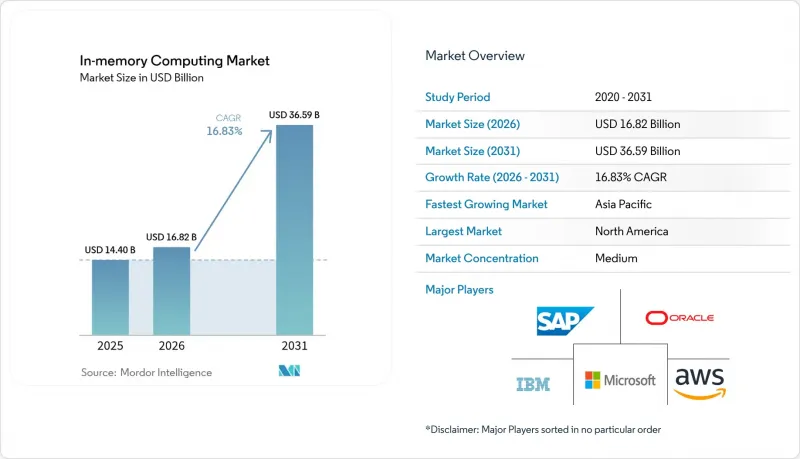
根據 Mordor Intelligence 預測,全球記憶體內運算市場規模將從 2025 年的 144 億美元成長到 2026 年的 168.2 億美元,然後在 2031 年達到 365.9 億美元,2026 年至 2031 年的複合年成長率為 16.83%。
本報告按組件(記憶體內資料管理平台、記憶體內應用平台)、部署模式(本地部署、雲端/SaaS)、應用(即時分析/商業智慧、高頻交易等)、終端用戶產業(銀行、金融服務和保險、醫療保健/生命科學等)、記憶體技術、組織規模和地區進行細分。市場預測以美元計價。
全球記憶體內運算市場趨勢與洞察
巨量資料爆炸性成長
目前,各組織機構產生的資料流規模高達數兆位元組,由於這些資料需要即時查詢,因此它們被迫從批次架構轉向基於記憶體中心平台的串流架構。醫療服務提供者正在運行持續的病患監測管道,可在數秒內檢測出臨床異常,而高頻交易員則基於微秒的計算執行價值數十億美元的交易。
對高速資料處理日益成長的需求
客戶互動、工廠自動化和聯網汽車對延遲的要求高達微秒。透過部署即時記憶體內分析層,Mercedes-AMG 將引擎測試週期縮短了 94%,每周有效節省了一整天的生產時間。
超大規模環境中DRAM的高成本
2025 年初 DRAM 價格上漲 50%,導致大型叢集的總擁有成本 (TCO) 增加,並減緩了記憶體密集型工作負載的記憶體升級週期。
細分市場分析
預計到 2025 年,記憶體內資料管理平台將佔總收入的 61.34%,凸顯了市場對符合 ACID 標準且可直接取代現有資料庫的解決方案的強勁需求。許多銀行已在不重寫應用程式的情況下遷移了核心分析工作負載,實現了每次查詢20-40 毫秒的延遲降低。相較之下,隨著數位原生企業從零開始建立即時微服務,記憶體內應用平台預計將以 21.85% 的複合年成長率成長。組件趨勢表明,供應商正在整合 SQL、流式處理和向量搜尋,以建立一個統一的架構,該架構可以並行處理操作和分析工作負載,從而減少資料移動開銷並促進 DevOps。
預計到 2025 年,雲端運算模式將佔總收入的 70.88%,並在 2031 年超越整個記憶體內運算市場。超大規模超大規模資料中心業者透過提供高容量記憶體實例、CXL 連接池和付費使用制的無伺服器擴展,降低了中型企業的進入門檻。 AWS 基於 Valkey 的 ElastiCache 層級為注重成本的 SaaS 供應商提供了極具吸引力的成本績效,與同等 Redis叢集相比,成本降低 33%,吞吐量提升超過一倍。
區域分析
預計到2025年,北美將佔全球營收的37.25%,這主要得益於強勁的資本市場、強大的人才生態系統以及超大規模資料中心業者營運商為加速人工智慧發展而提出的需求。由於即時支付基礎設施、自動駕駛汽車先導計畫和精準醫療平台的推動,各州的記憶體使用量持續成長。
亞太地區成長速度最快,複合年成長率達20.25%。在中國國家主導的半導體計畫和印度「數位印度」雲端走廊計畫的推動下,兆瓦級資料中心正在快速建設,其中許多資料中心已預先佈線,可進行CXL互連架構的擴展。除了該地區5G網路密度不斷提高外,資料本地化需求也促使推理任務在國家層級向邊緣轉移,從而推動了針對微服務最佳化的記憶體內架構的發展。
在歐洲,儘管面臨容量限制的挑戰,但創紀錄的資金正湧入新建設中心。 Vantage Data Centers 7.2億歐元的資產證券化項目(歐洲大陸首例)表明,投資者對人工智慧工作負載將迅速填滿新機架的信心日益增強。歐盟的人工智慧法律和永續發展法規正迫使企業轉向節能的記憶體內架構,以平衡吞吐量和功耗上限。
其他好處:
- Excel格式的市場預測(ME)表
- 3個月的分析師支持
目錄
第1章:引言
- 研究假設和市場定義
- 調查範圍
第2章:調查方法
第3章執行摘要
第4章 市場狀況
- 市場概覽
- 市場促進因素
- 巨量資料爆炸性成長
- 對快速數據處理日益成長的需求
- 以人工智慧為中心的工作負載(LLM、向量搜尋)的激增
- 持久記憶體(例如,英特爾傲騰的繼任者)的每 GB 成本較低。
- 擴大即時詐欺偵測在銀行、金融服務和保險(BFSI)產業的應用。
- 面向 5G 運營商雲的邊緣記憶體內分析
- 市場限制因素
- DRAM在超大規模應用的高成本
- 資料引力和集群間延遲
- 對專有IMC設備供應商鎖定問題的擔憂
- 熟練的IMC建築師和開發商短缺
- 價值供應鏈分析
- 監管狀態(資料居住和主權)
- 技術趨勢(CXL 連接的記憶體池、DDR5、MRAM)
- 波特五力模型
第5章 市場規模與成長預測
- 按組件
- 記憶體內資料管理平台
- 記憶體內應用平台
- 部署模式
- 現場
- 雲/SaaS
- 透過使用
- 即時分析與商業智慧
- 高頻交易
- 詐欺和風險管理
- 物聯網/邊緣流處理
- 按最終用戶行業分類
- BFSI
- 醫療保健和生命科學
- 資訊科技/通訊
- 政府/公共部門
- 製造業/汽車
- 透過儲存技術
- 基於DRAM的IMC
- 基於 NAND 的 IMC(例如,快閃記憶體上的 Redis)
- 持久性/儲存類別記憶體 (SCM)
- 按組織規模
- 大公司
- 中小企業
- 按地區
- 北美洲
- 美國
- 加拿大
- 墨西哥
- 歐洲
- 英國
- 德國
- 法國
- 義大利
- 其他歐洲國家
- 亞太地區
- 中國
- 日本
- 印度
- 韓國
- 其他亞洲國家
- 中東
- 以色列
- 沙烏地阿拉伯
- 阿拉伯聯合大公國
- 土耳其
- 其他中東國家
- 非洲
- 南非
- 埃及
- 其他非洲國家
- 南美洲
- 巴西
- 阿根廷
- 其他南美國家
- 北美洲
第6章 競爭情勢
- 市場集中度
- 策略趨勢
- 市佔率分析
- 公司簡介
- SAP SE
- Oracle Corporation
- Microsoft Corporation
- International Business Machines Corporation(IBM)
- Amazon Web Services, Inc.
- Altibase Corporation
- GridGain Systems, Inc.
- GigaSpaces Technologies Ltd.
- Software AG
- TIBCO Software Inc.
- Hazelcast Inc.
- SAS Institute Inc.
- MongoDB, Inc.
- DataStax, Inc.
- Redis Ltd.(Redis Labs)
- MemVerge, Inc.
- Hewlett Packard Enterprise Company
- Fujitsu Limited
- KX Systems, Inc.
- Volt Active Data, Inc.
- Aerospike Inc.
第7章 市場機會與未來展望
According to Mordor Intelligence, the global in-memory computing market size is expected to grow from USD 14.4 billion in 2025 to USD 16.82 billion in 2026 and is forecast to reach USD 36.59 billion by 2031 at 16.83% CAGR over 2026-2031.
This report is Segmented by Component (In-Memory Data Management Platforms, In-Memory Application Platforms), Deployment Mode (On-Premises, Cloud/SaaS), Application (Real-Time Analytics & BI, High-Frequency Trading, and More), End-User Vertical (BFSI, Healthcare and Life Sciences, and More), Memory Technology, Organization Size, and Geography. The Market Forecasts are Provided in Terms of Value (USD).
Global In-memory Computing Market Trends and Insights
Explosion of Big Data
Organizations now generate multi-quintillion-byte data streams that must be queried in real time, forcing a shift from batch processing to streaming architectures anchored in memory-centric platforms. Healthcare providers run continuous patient-monitoring pipelines that flag clinical anomalies within seconds, while high-frequency traders move billions of dollars on microsecond calculations.
Growing Need for Rapid Data Processing
Customer interactions, factory automation, and connected vehicles demand latencies measured in microseconds. Mercedes-AMG cut engine test-cycle times by 94% after adopting a real-time in-memory analytics layer, effectively gaining an extra production day each week.
High Cost of DRAM at Hyperscale
DRAM price spikes of 50% in early 2025 raised the total cost of ownership for large clusters, delaying refresh cycles for memory-intensive workloads.
Other drivers and restraints analyzed in the detailed report include:
- Proliferation of AI-centric Workloads
- Declining Cost/GB of Persistent Memory
- Shortage of Skilled IMC Architects and Developers
For complete list of drivers and restraints, kindly check the Table Of Contents.
Segment Analysis
In-memory data management platforms held 61.34% revenue in 2025, underscoring demand for ACID-compliant, drop-in replacements to entrenched databases. Many banks migrated core analytics workloads without rewriting applications, capturing latency cuts of 20-40 ms per query. In contrast, in-memory application platforms are forecast to grow at 21.85% CAGR as digital-native firms design real-time microservices from the ground up. The component landscape is converging vendors weave SQL, streaming, and vector search into unified fabrics that house operational and analytical workloads side-by-side, shrinking data-movement overheads and easing DevOps.
Cloud models accounted for 70.88% revenue in 2025 and will outpace the overall in-memory computing market through 2031. Hyperscalers bundle high-memory instances, CXL-attached pools, and serverless scaling under pay-as-you-go terms, lowering the barrier for midsize adopters. AWS's Valkey-based ElastiCache tier costs 33% less than equivalent Redis clusters while boosting throughput over 2X, proving price-performance gains attractive to cost-sensitive SaaS providers.
Complete Report Scope:
- By Component
- In memory Data Management Platforms
- In memory Application Platforms
- By Deployment Mode
- On-premises
- Cloud / SaaS
- By Application
- Real-time Analytics & BI
- High-frequency Trading
- Fraud & Risk Management
- IoT/Edge Stream Processing
- By End-user Vertical
- BFSI
- Healthcare & Life Sciences
- IT & Telecom
- Government & Public Sector
- Manufacturing & Automotive
- By Memory Technology
- DRAM-based IMC
- NAND-based IMC (Redis on-flash, etc.)
- Persistent / Storage-class Memory (SCM)
- By Organization Size
- Large Enterprises
- Small & Medium Enterprises (SME)
- By Geography
- North America
- United States
- Canada
- Mexico
- Europe
- United Kingdom
- Germany
- France
- Italy
- Rest of Europe
- Asia-Pacific
- China
- Japan
- India
- South Korea
- Rest of Asia
- Middle East
- Israel
- Saudi Arabia
- United Arab Emirates
- Turkey
- Rest of Middle East
- Africa
- South Africa
- Egypt
- Rest of Africa
- South America
- Brazil
- Argentina
- Rest of South America
- North America
Geography Analysis
North America generated 37.25% of 2025 revenue, underpinned by deep capital markets, a robust talent ecosystem, and hyperscaler appetite for AI acceleration. Real-time payment rails, autonomous-vehicle pilots, and precision-medicine platforms keep memory footprints climbing across every state.
Asia-Pacific is scaling fastest at a 20.25% CAGR. China's state-backed semiconductor programs and India's Digital India cloud corridors are spawning megawatt-class data centers, many pre-wired for CXL fabric expansion. Regional 5G densification plus data-locality mandates pull inference tasks to country-level edges, favouring in-memory fabrics tuned for micro-services.
Europe is wrestling with capacity constraints yet funnelling record capital into new builds. Vantage Data Centers' EUR 720 million securitization-the first of its kind on the continent-signals growing investor confidence that AI workloads will soak up new racks quickly. The EU AI Act and sustainability rules are nudging enterprises toward energy-efficient in-memory architectures that balance throughput with power caps.
- SAP SE
- Oracle Corporation
- Microsoft Corporation
- International Business Machines Corporation (IBM)
- Amazon Web Services, Inc.
- Altibase Corporation
- GridGain Systems, Inc.
- GigaSpaces Technologies Ltd.
- Software AG
- TIBCO Software Inc.
- Hazelcast Inc.
- SAS Institute Inc.
- MongoDB, Inc.
- DataStax, Inc.
- Redis Ltd. (Redis Labs)
- MemVerge, Inc.
- Hewlett Packard Enterprise Company
- Fujitsu Limited
- KX Systems, Inc.
- Volt Active Data, Inc.
- Aerospike Inc.
Additional Benefits:
- The market estimate (ME) sheet in Excel format
- 3 months of analyst support
TABLE OF CONTENTS
1 INTRODUCTION
- 1.1 Study Assumptions & Market Definition
- 1.2 Scope of the Study
2 RESEARCH METHODOLOGY
3 EXECUTIVE SUMMARY
4 MARKET LANDSCAPE
- 4.1 Market Overview
- 4.2 Market Drivers
- 4.2.1 Explosion of Big Data
- 4.2.2 Growing Need for Rapid Data Processing
- 4.2.3 Proliferation of AI-centric Workloads (LLMs, vector search)
- 4.2.4 Declining Cost/GB of Persistent Memory (e.g., Intel Optane successors)
- 4.2.5 Rising Adoption of Real-time Fraud Detection in BFSI
- 4.2.6 Edge-side In-Memory Analytics for 5G Telco Clouds
- 4.3 Market Restraints
- 4.3.1 High Cost of DRAM at Hyperscale
- 4.3.2 Data Gravity & Inter-cluster Latency
- 4.3.3 Vendor Lock-in Concerns for Proprietary IMC Appliances
- 4.3.4 Shortage of Skilled IMC Architects & Developers
- 4.4 Value / Supply-Chain Analysis
- 4.5 Regulatory Landscape (Data Residency & Sovereignty)
- 4.6 Technological Outlook (CXL?attached memory pools, DDR5, MRAM)
- 4.7 Porter's Five Forces
- 4.7.1 Bargaining Power of Suppliers
- 4.7.2 Bargaining Power of Buyers
- 4.7.3 Threat of New Entrants
- 4.7.4 Threat of Substitutes
- 4.7.5 Intensity of Competitive Rivalry
5 MARKET SIZE & GROWTH FORECASTS (VALUE, USD BILLION)
- 5.1 By Component
- 5.1.1 In memory Data Management Platforms
- 5.1.2 In memory Application Platforms
- 5.2 By Deployment Mode
- 5.2.1 On-premises
- 5.2.2 Cloud / SaaS
- 5.3 By Application
- 5.3.1 Real-time Analytics & BI
- 5.3.2 High-frequency Trading
- 5.3.3 Fraud & Risk Management
- 5.3.4 IoT/Edge Stream Processing
- 5.4 By End-user Vertical
- 5.4.1 BFSI
- 5.4.2 Healthcare & Life Sciences
- 5.4.3 IT & Telecom
- 5.4.4 Government & Public Sector
- 5.4.5 Manufacturing & Automotive
- 5.5 By Memory Technology
- 5.5.1 DRAM-based IMC
- 5.5.2 NAND-based IMC (Redis on-flash, etc.)
- 5.5.3 Persistent / Storage-class Memory (SCM)
- 5.6 By Organization Size
- 5.6.1 Large Enterprises
- 5.6.2 Small & Medium Enterprises (SME)
- 5.7 By Geography
- 5.7.1 North America
- 5.7.1.1 United States
- 5.7.1.2 Canada
- 5.7.1.3 Mexico
- 5.7.2 Europe
- 5.7.2.1 United Kingdom
- 5.7.2.2 Germany
- 5.7.2.3 France
- 5.7.2.4 Italy
- 5.7.2.5 Rest of Europe
- 5.7.3 Asia-Pacific
- 5.7.3.1 China
- 5.7.3.2 Japan
- 5.7.3.3 India
- 5.7.3.4 South Korea
- 5.7.3.5 Rest of Asia
- 5.7.4 Middle East
- 5.7.4.1 Israel
- 5.7.4.2 Saudi Arabia
- 5.7.4.3 United Arab Emirates
- 5.7.4.4 Turkey
- 5.7.4.5 Rest of Middle East
- 5.7.5 Africa
- 5.7.5.1 South Africa
- 5.7.5.2 Egypt
- 5.7.5.3 Rest of Africa
- 5.7.6 South America
- 5.7.6.1 Brazil
- 5.7.6.2 Argentina
- 5.7.6.3 Rest of South America
- 5.7.1 North America
6 COMPETITIVE LANDSCAPE
- 6.1 Market Concentration
- 6.2 Strategic Moves
- 6.3 Market Share Analysis
- 6.4 Company Profiles (includes Global level Overview, Market level overview, Core Segments, Financials as available, Strategic Information, Market Rank/Share for key companies, Products & Services, and Recent Developments)
- 6.4.1 SAP SE
- 6.4.2 Oracle Corporation
- 6.4.3 Microsoft Corporation
- 6.4.4 International Business Machines Corporation (IBM)
- 6.4.5 Amazon Web Services, Inc.
- 6.4.6 Altibase Corporation
- 6.4.7 GridGain Systems, Inc.
- 6.4.8 GigaSpaces Technologies Ltd.
- 6.4.9 Software AG
- 6.4.10 TIBCO Software Inc.
- 6.4.11 Hazelcast Inc.
- 6.4.12 SAS Institute Inc.
- 6.4.13 MongoDB, Inc.
- 6.4.14 DataStax, Inc.
- 6.4.15 Redis Ltd. (Redis Labs)
- 6.4.16 MemVerge, Inc.
- 6.4.17 Hewlett Packard Enterprise Company
- 6.4.18 Fujitsu Limited
- 6.4.19 KX Systems, Inc.
- 6.4.20 Volt Active Data, Inc.
- 6.4.21 Aerospike Inc.
7 MARKET OPPORTUNITIES & FUTURE OUTLOOK
- 7.1 White-space & Unmet-need Assessment

 神經型態晶片和記憶體內晶片在邊緣人工智慧加速方面的成長機會。
 2026-2030年全球記憶體內運算(IMC)市場
 記憶體中心計算:市場佔有率分析、產業趨勢與統計及成長預測(2026-2031 年)
 2026年全球資料庫加速市場報告
 記憶體內運算架構市場預測——按架構類型、部署模式、應用、最終用戶和地區分類的全球分析——2034年
 記憶體內運算市場規模、佔有率和成長分析:按產品類型、部署模式、應用、最終用戶產業和地區分類-2026-2033年產業預測
 記憶體內運算市場報告:按組件、企業規模、行業和地區分類(2026-2034 年)
 記憶體內運算晶片市場:分析與預測(至 2035 年)-按類型、產品類型、服務、技術、元件、應用、部署模式、最終使用者和功能分類2026年ReRAM(電阻式隨機存取記憶體)記憶體內運算顯示器全球市場報告
 記憶體內運算市場:2026-2032年全球市場預測(按組件、組織規模、應用程式、最終用戶和部署類型分類)