


 |
市場調查報告書
商品編碼
2099476
記憶體中心計算:市場佔有率分析、產業趨勢與統計及成長預測(2026-2031 年)Memory-Centric Computing - Market Share Analysis, Industry Trends & Statistics, Growth Forecasts (2026 - 2031) |
||||||

※ 本網頁內容可能與最新版本有所差異。詳細情況請與我們聯繫。
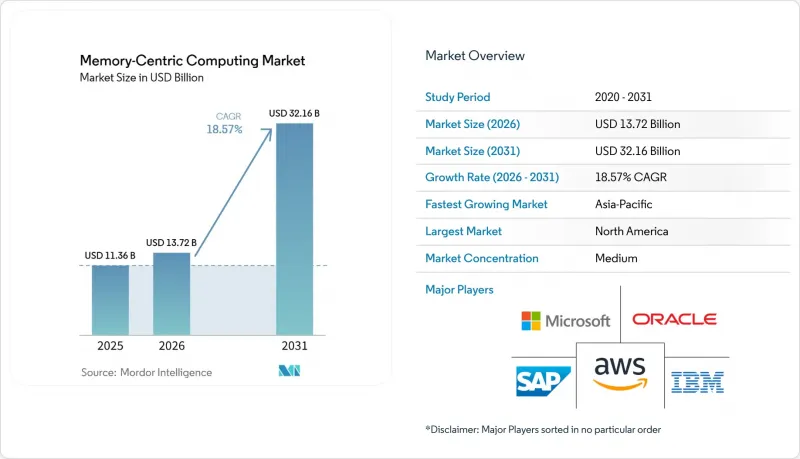
根據 Mordor Intelligence 預測,以記憶體為中心的運算市場規模將從 2025 年的 113.6 億美元和 2026 年的 137.2 億美元成長到 2031 年的 321.6 億美元,2026 年至 2031 年的年複合成長率(CAGR)為 18.57%。
本報告按組件(例如,記憶體內和資料網格)、部署模式(例如,本地部署和私有雲端)、應用(例如,即時分析和商業智慧)、最終用戶(例如,銀行、金融服務和保險 (BFSI)、IT 和電信)、資料架構(例如,純記憶體內架構)以及地區進行細分。市場預測以美元 (USD) 為單位。
全球以記憶體為中心的運算市場趨勢與洞察
AI原生工作負載和向量搜尋。
人工智慧原生應用,其推理、搜尋和智慧體間通訊都依賴於低延遲的狀態訪問,這使得以記憶體為中心的計算市場成為企業基礎設施規劃的核心。谷歌研究院將以記憶體為中心的運算定位為資料庫架構的結構性重構,並解釋分散式記憶體池為更高效地擴展對效能敏感的資料系統提供了途徑。這種轉變至關重要,因為基於智慧體的系統不僅需要快速的資料讀取,還需要持久的多會話狀態,而簡單的快取層無法可靠地提供這些狀態。 2026年3月,Aerospike發布了其NoSQL資料庫8的LangGraph整合,進一步強化了這一方向,為無狀態的基於智慧體的AI工作流提供了持久的低延遲內存支援。隨著越來越多的公司從AI實驗轉向生產部署,以記憶體為中心的運算市場正受益於需要在單一堆堆疊中實現持久性、並發性和快速恢復的工作負載。因此,平台選擇越來越依賴供應商對智慧體狀態、搜尋管道和事務級回應能力的支援程度,而不僅僅是快取速度。
數位銀行和反詐騙領域對低延遲決策引擎的需求日益成長。
記憶體運算市場發展的另一個原因是,即時金融決策不再容忍任何處理延遲。 2025 年發表在《國際基礎數學研究期刊》(International Journal of Fundamental Mathematics Research) 上的一項研究發現,即時銀行詐欺偵測流程要求每筆交易的預測延遲低於 50 毫秒。研究也指出,記憶體內特徵儲存可以透過消除磁碟 I/O,在個位數毫秒內提供預計算值。根據 Volt Active Data 發布的一項架構基準測試,一級銀行在 50 毫秒的核准時限內執行了 2000 多條生產規則,同時每秒處理超過 10000 筆交易。這種運作模式正在改變採購標準,因為合規性、客戶體驗和詐欺預防現在都依賴相同的低延遲基礎。這也解釋了為什麼受監管的金融機構繼續將記憶體內平台視為核心營運基礎設施,而不僅僅是可選的效能增強軟體。在以記憶體為中心的運算市場中,金融工作負載仍然很重要,因為它們能夠同時提供穩定的延遲、快速的規則變更和高交易並發性。
大規模記憶體架構部署會帶來高昂的硬體和基礎架構成本。
高昂的硬體成本持續限制以記憶體為中心的運算市場向中端市場滲透的速度。與基於快閃記憶體或磁碟的架構相比,大量使用記憶體的完整配置需要更昂貴的容量規劃,這使得基礎設施預算固定的買家難以獲得批准。當企業需要在生產環境中擴展使用規模之前,升級到支援 CXL 的伺服器並進行相關的整合工作時,這項挑戰會進一步加劇。微軟 Azure 對基於 CXL 的記憶體擴展的支援表明該技術正逐漸走向商業性實用化,但也凸顯了部署依賴相容的下一代硬體這一現實。實際上,這迫使一些公司必須比預期更長時間地維護混合架構,尤其是在採購委員會權衡性能優勢與多年資本計劃的情況下。因此,儘管以記憶體為中心的運算市場持續成長,但嚴格的成本控制仍然決定買家從試點部署到大規模基礎設施替換的步伐。
細分市場分析
到2025年,記憶體內和資料網格將佔組件市場佔有率的42.28%,成為記憶體運算市場中最大的元件。這一主導地位反映了銀行、金融和保險(BFSI)以及IT/電信行業在高交易量應用場景中對穩定、低延遲讀寫操作的持續需求,而傳統儲存系統無法始終如一地提供這種效能。這些平台也受益於與營運工作流程的深度整合,在這些流程中,可靠性和回應時間至關重要。預計到2031年,記憶體內快取和應用加速平台將以18.99%的最高成長率成長,因為應用團隊正在微服務和後端資料庫之間部署分散式快取層,以更有效地應對流量高峰。隨著越來越多的公司將事件管道視為即時營運層而非僅僅是報告管道,流處理和事件處理平台的佔有率也在持續擴大。 Apache Flink 2.0 透過直接在串流 SQL 中加入向量搜尋和 LLM 推理功能來加速這一轉變,讓進階事件處理更接近記憶體內執行。
隨著功能邊界不再像以往那麼清晰,組件領域的競爭日益激烈。快取廠商正朝著更廣泛的狀態管理方向發展,而流處理器則擴大處理以前僅限於專門設計的記憶體內的工作負載。這種重疊正在拓寬以記憶體為中心的運算市場的策略範圍,因為買家現在不僅可以透過替換核心資料庫進入市場,還可以透過應用程式加速、資料網格或即時串流等途徑進入市場。管理多個獨立工具的公司也在尋求整合,因為使用單獨的平台進行快取、流處理和網格操作會導致額外的營運成本和管治複雜性。在這種情況下,整合解決方案具有顯著的市場優勢,因為它們可以在保持可接受的延遲效能的同時降低整合開銷。因此,在以記憶體為中心的運算產業,儘管一流的專業廠商在要求嚴苛的應用程式場景中仍然佔據著強大的地位,但在元件層面,平台正在趨於整合。
預計到2025年,託管雲端和SaaS將佔據45.66%的市場佔有率,複合年成長率(CAGR)將達到創紀錄的19.16%,使其成為記憶體密集型運算超大規模資料中心業者中最主要的模式。這種雙重優勢表明,買家越來越重視營運彈性,而非對固定記憶體架構的投資,尤其是在尋求快速部署和降低平台管理負擔的情況下。隨著超大規模雲端服務商不斷擴展其面向企業客戶的託管記憶體內服務組合,公共雲端仍然是主要選擇。本地部署和私有雲端也依然重要,尤其對於資料機密性、主權或基礎設施控制比快速遷移更為重要的受監管工作負載而言。根據DSAG 2026年投資報告,70%的受訪德語區公司正在遷移或已完成SAP S/4HANA的遷移,這一趨勢凸顯了市場對以SAP HANA為中心的私有雲和託管雲環境的持續需求。此外,2025 年 3 月, Oracle和 Microsoft 將「Oracle Database@Azure」擴展到 Exascale 基礎架構上的 Exadata 資料庫服務,與專用 Exadata 平台相比,最低基礎架構成本降低了高達 95%。
部署策略不再局限於從本地遷移到雲端。混合模式如今已成為企業部署的主流。 2026年6月,諾基亞、SAP和微軟簽署了一項名為「RISE with SAP」的多年協議,將在微軟Azure雲端平台上運作諾基亞的SAP S/4HANA環境。這顯示大型企業正在關鍵轉型專案中利用雲端管理的記憶體內環境。此類遷移表明,記憶體運算市場將繼續成長,不僅透過直接取代私人基礎設施,還將透過共存模式實現成長。許多公司希望在保留本地敏感資料管理的同時,將這些環境與用於分析、容錯和可擴展性的託管平台整合。由於供應商必須同時應對完全雲端遷移、託管私有環境和混合擴展等場景,因此部署模式的競爭十分激烈。由此可見,記憶體運算產業的發展不僅取決於純粹的技術差異,還取決於靈活的使用模式。
區域分析
到2025年,北美將佔據記憶體計算市場42.34%的佔有率,繼續保持其作為該地區最大收入貢獻者的地位。該地區受益於金融服務技術買家的高度集中、完善的超大規模雲端基礎設施,以及已將記憶體內功能整合到大規模平台產品組合中的企業軟體供應商。美國仍然是記憶體計算技術應用的中心,因為欺詐檢測、演算法交易和即時個人化等應用已獲得充足的資金支持並實現了商業性化規模化。加拿大透過金融服務和政府分析需求為市場提供支持,而墨西哥則透過採用與近岸外包相關的製造智慧技術來增強其市場佔有率。憑藉這個應用基礎,記憶體運算市場正在建立一個強大的區域基礎,使專業供應商和大規模整合供應商都能快速實現新功能的商業化。
歐洲仍然是一個至關重要的市場,因為企業應用現代化和監管合規的雙重需求正在推動市場需求。德國是該地區最大的市場,DSAG在2026年發布的報告顯示,在受調查的德語區企業中,70%正在遷移到SAP S/4HANA或已完成遷移。這直接支撐了對記憶體內基礎設施的需求,因為SAP HANA是所有S/4HANA部署的基礎。英國和法國仍然是重要的市場,這主要得益於金融服務和公共部門對數位化計畫的持續投資。 2026年6月,諾基亞、SAP和微軟正式簽署了一項多年協議,將在微軟Azure上運行諾基亞的SAP S/4HANA環境,凸顯了歐洲企業記憶體內遷移活動的規模。預計義大利和其他歐洲國家的成長速度將放緩,這主要受銀行業和汽車製造業的需求驅動,而非大規模的雲端遷移。
預計到2031年,亞太地區將以19.46%的複合年成長率(CAGR)實現最高成長,並在預測期內展現出內存密集型計算市場規模最強勁的成長勢頭。該地區的需求成長主要得益於印度和東南亞數位銀行業務的蓬勃發展、日本和韓國私人5G的工業部署,以及中國電子商務和數位支付的持續擴張。韓國擁有雙重優勢:一方面,韓國在半導體和記憶體硬體創新方面處於領先地位;另一方面,工業邊緣運算的需求也在不斷成長。日本則透過工業IoT、精密製造和企業分析的現代化,持續推動5G技術的應用。南美市場雖然規模仍然較小,但隨著巴西及其周邊市場超大規模投資的增加,延遲障礙正在降低,南美市場正在迅速擴張。同時,中東和非洲地區也因智慧城市計畫和與國家經濟多元化政策相契合的金融部門現代化舉措蓬勃發展。
其他好處:
- Excel格式的市場預測(ME)表
- 3個月的分析師支持
目錄
第1章:引言
- 研究假設和市場定義
- 調查範圍
第2章:調查方法
第3章執行摘要
第4章 市場狀況
- 市場概覽
- 市場促進因素
- AI原生工作負載和向量搜尋。
- 數位銀行和反詐騙領域對低延遲決策引擎的需求日益成長。
- 利用雲端原生和串流媒體應用程式擴展高密度資料擷取
- 過渡到持久性內存和存儲級內存,以提高性能效率。
- 5G、工業IoT和即時遙測領域邊緣分析的擴展。
- 對傳統磁碟依賴型分析堆疊的更新需求日益成長。
- 市場限制因素
- 部署大規模儲存架構需要高昂的硬體和基礎架構成本。
- 限制因素包括資料引力、複製開銷和群集間延遲。
- 記憶體內和設備中供應商鎖定的風險。
- 專業記憶體系統架構師和運行時工程師短缺
- 供應鏈分析
- 技術展望
- 監理情勢
- 波特五力分析
第5章 市場規模與成長預測
- 按組件
- 記憶體內和資料網格
- 記憶體內體快取和應用程式加速平台
- 串流處理和事件處理平台
- 部署模式
- 本地部署和私有雲端
- 公共雲端
- 託管雲端和SaaS
- 透過使用
- 即時分析與商業智慧
- 數位應用、快取、個人化
- 詐欺偵測、風險管理、金融交易
- 物聯網、邊緣分析與遙測處理
- 人工智慧/機器學習的應用與決策自動化
- 最終用戶
- BFSI
- 資訊科技/通訊
- 零售、電子商務、數位平台
- 醫療保健和生命科學
- 製造業和汽車業
- 政府/公共部門
- 其他最終用戶
- 依資料架構
- 純記憶體內架構
- 混合記憶體內架構與持久存儲
- 按地區
- 北美洲
- 美國
- 加拿大
- 墨西哥
- 歐洲
- 德國
- 英國
- 法國
- 義大利
- 其他歐洲國家
- 亞太地區
- 中國
- 日本
- 韓國
- 印度
- 東南亞
- 其他亞太國家
- 南美洲
- 中東和非洲
- 北美洲
第6章 競爭情勢
- 市場集中度
- 策略趨勢
- 市佔率分析
- 公司簡介
- Microsoft Corporation
- Oracle Corporation
- SAP SE
- IBM Corporation
- Amazon Web Services, Inc.
- Google LLC
- Redis Ltd.
- GridGain Systems, Inc.
- GigaSpaces Technologies Ltd.
- Hazelcast Inc.
- TIBCO Software Inc.
- Software AG
- SAS Institute Inc.
- Datastax, Inc.
- MemVerge, Inc.
- Hewlett Packard Enterprise Company
- Fujitsu Limited
- KX Systems, Inc.
- Volt Active Data, Inc.
- Aerospike, Inc.
- Exasol AG
第7章 市場機會與未來展望
According to Mordor Intelligence, the memory-centric computing market size is projected to expand from USD 11.36 billion in 2025 and USD 13.72 billion in 2026 to USD 32.16 billion by 2031, registering a CAGR of 18.57% between 2026 to 2031.
This report is Segmented by Component (In-Memory Databases and Data Grids, and More), Deployment (On-Premises and Private Cloud, and More), Application (Real-Time Analytics and Business Intelligence, and More), End User (BFSI, IT and Telecommunications, and More), Data Architecture (Pure In-Memory Architecture, and More), and Geography. The Market Forecasts are Provided in Terms of Value (USD).
Global Memory-Centric Computing Market Trends and Insights
Proliferation of AI-Native Workloads and Vector Search
AI-native applications have pushed the memory-centric computing market closer to the center of enterprise infrastructure planning because inference, retrieval, and agent coordination all depend on low-latency state access. Google Research described memory-centric computing as a structural redesign of database architecture, with disaggregated memory pools offering a path to scale performance-sensitive data systems more efficiently. That shift matters because agentic systems not only read data quickly, they also need a durable multi-session state that simple cache layers cannot reliably provide. Aerospike reinforced this direction in March 2026 when it launched LangGraph integration for NoSQL Database 8 to provide durable, low-latency memory support for stateless agentic AI workflows. As more enterprises move from AI experimentation to production deployment, the memory-centric computing market is benefiting from workloads that need persistence, concurrency, and fast recovery in the same stack. This is why platform selection is increasingly tied to how well vendors support agent state, retrieval pipelines, and transaction-grade responsiveness rather than raw caching speed alone.
Escalating Need for Low-Latency Decision Engines in Digital Banking and Fraud Control
The memory-centric computing market is also advancing because real-time financial decisioning no longer leaves room for deferred processing windows. A 2025 study in the International Journal of Fundamental Mathematics Research found that real-time banking fraud detection pipelines require prediction latency below 50 milliseconds per transaction, and it noted that in-memory feature stores can serve pre-computed values in single-digit milliseconds by removing disk I/O. Volt Active Data published an architecture benchmark showing that a Tier-1 bank ran more than 2,000 production rules within a 50ms authorization budget while handling throughput above 10,000 transactions per second. This operating model changes the buying logic because compliance, customer experience, and fraud prevention now depend on the same low-latency foundation. It also helps explain why regulated institutions continue to treat in-memory platforms as core operational infrastructure rather than optional performance software. In the memory-centric computing market, financial workloads remain important because they reward stable latency, rapid rule changes, and high transaction concurrency at the same time.
High Hardware and Infrastructure Cost for Large-Scale Memory Fabric Deployment
High hardware cost still limits how quickly the memory-centric computing market can move into the mid-market segment. Full memory-heavy deployments require more expensive capacity planning than flash- or disk-led architectures, and that increases approval friction for buyers with fixed infrastructure budgets. The challenge becomes larger when organizations need CXL-capable server refreshes and related integration work before they can scale production use. Microsoft Azure's support for CXL-based memory expansion shows that the technology is becoming commercially viable, but it also underlines the reality that adoption depends on compatible next-generation hardware. In practice, this keeps some enterprises in hybrid designs longer than they would prefer, especially when procurement committees weigh performance benefits against multi-year capital planning. The memory-centric computing market, therefore, continues to grow, but cost discipline still shapes the pace at which buyers move from pilot deployments to broad infrastructure replacement.
Other drivers and restraints analyzed in the detailed report include:
- Growth of High-Density Data Ingestion from Cloud-Native and Streaming Applications
- Shift Toward Persistent Memory and Storage-Class Memory for Performance Efficiency
- Data Gravity, Replication Overhead, and Inter-Cluster Latency Constraints
For complete list of drivers and restraints, kindly check the Table Of Contents.
Segment Analysis
In-Memory Databases and Data Grids held 42.28% of the component segment in 2025, which made them the largest building block inside the memory-centric computing market. Their lead reflects the fact that transaction-heavy use cases in BFSI, IT, and telecommunications still need stable, low-latency reads and writes that general storage systems do not deliver consistently. These platforms also benefit from being deeply embedded in operational workflows where reliability matters as much as response time. In-Memory Caching and Application Acceleration Platforms are projected to record the fastest growth at 18.99% through 2031, as application teams place distributed cache layers between microservices and back-end databases to absorb spikes more efficiently. Stream Processing and Event Processing Platforms continue to gain share because more enterprises now treat event pipelines as a live operating layer rather than a reporting channel. Apache Flink 2.0 supported this shift by adding vector search and LLM inference capabilities directly in streaming SQL, which pulled advanced event processing closer to in-memory execution.
The structure of the component segment is becoming more competitive because functional boundaries are no longer as clear as they once were. Caching vendors are moving toward broader state management, while stream processors are increasingly handling workloads that were once reserved for purpose-built in-memory databases. That overlap widens the strategic scope of the memory-centric computing market because buyers can now enter through application acceleration, data grids, or real-time streams instead of through a core database replacement alone. Enterprises that manage several point tools are also looking for consolidation, since separate platforms for cache, streaming, and grid operations can create extra operational cost and governance complexity. In this setting, unified offerings have a stronger selling position because they reduce integration overhead while keeping latency performance within acceptable limits. The memory-centric computing industry is therefore seeing platform convergence at the component level, even though best-of-breed specialists still hold strong positions in demanding use cases.
Managed Cloud and SaaS held 45.66% share in 2025 and also recorded the highest projected CAGR at 19.16%, which made it the strongest delivery model in the memory-centric computing market. That dual position shows how buyers increasingly prefer operational elasticity over fixed memory-fabric investments, especially when they want faster implementation and lower platform administration burden. Public cloud remains the next major path because hyperscalers continue to expand managed in-memory service portfolios across enterprise accounts. On-premises and private cloud still matter, particularly in regulated workloads where data sensitivity, sovereignty, or infrastructure control carry more weight than rapid migration. The DSAG Investitionsreport 2026 found that 70% of surveyed German-speaking enterprises had SAP S/4HANA migration running or completed, and that pattern supports durable demand for private and managed environments built around SAP HANA. Oracle and Microsoft also expanded Oracle Database@Azure in March 2025 with Exadata Database Service on Exascale Infrastructure, reducing minimum infrastructure costs by up to 95% versus dedicated Exadata platforms.
The deployment story is no longer a simple shift from on-premises to cloud, because hybrid models now define a large share of enterprise rollouts. In June 2026, Nokia, SAP, and Microsoft signed a multi-year agreement to run Nokia's SAP S/4HANA landscape on Microsoft Azure under RISE with SAP, which shows how large enterprises are using cloud-managed in-memory environments for major transformation programs. This kind of migration suggests that the memory-centric computing market will keep growing through coexistence models, not only through direct displacement of private infrastructure. Many enterprises still want on-premises control for sensitive data while linking those environments to managed platforms for analytics, resilience, and scaling. That keeps deployment competition broad, since vendors must serve full cloud migration, hosted private environments, and hybrid extension paths at the same time. The memory-centric computing industry is therefore being shaped as much by flexible consumption models as by raw technology differentiation.
Complete Report Scope:
- By Component
- In-Memory Databases and Data Grids
- In-Memory Caching and Application Acceleration Platforms
- Stream Processing and Event Processing Platforms
- By Deployment Mode
- On-Premises and Private Cloud
- Public Cloud
- Managed Cloud and SaaS
- By Application
- Real-Time Analytics and Business Intelligence
- Digital Applications, Caching, and Personalization
- Fraud Detection, Risk Management, and Financial Trading
- IoT, Edge Analytics, and Telemetry Processing
- AI/ML Applications and Decision Automation
- By End User
- BFSI
- IT and Telecommunications
- Retail, E-Commerce, and Digital Platforms
- Healthcare and Life Sciences
- Manufacturing and Automotive
- Government and Public Sector
- Other End Users
- By Data Architecture
- Pure In-Memory Architecture
- Hybrid In-Memory Architecture with Persistent Storage
- By Geography
- North America
- United States
- Canada
- Mexico
- Europe
- Germany
- United Kingdom
- France
- Italy
- Rest of Europe
- Asia-Pacific
- China
- Japan
- South Korea
- India
- Southeast Asia
- Rest of Asia-Pacific
- South America
- Middle East and Africa
- North America
Geography Analysis
North America held 42.34% of the memory-centric computing market share in 2025, which kept it as the largest regional contributor by revenue. The region benefits from a dense concentration of financial services technology buyers, hyperscale cloud infrastructure, and enterprise software vendors that already package in-memory capabilities into larger platform portfolios. The United States remains the center of adoption because fraud detection, algorithmic trading, and real-time personalization are already well funded and commercially scaled there. Canada adds support through financial services and government analytics demand, while Mexico is gaining relevance through nearshoring-linked manufacturing intelligence deployments. This installed base gives the memory-centric computing market a strong regional foundation where both specialist vendors and large integrated providers can commercialize new capabilities quickly.
Europe remains important because enterprise application modernization and regulatory discipline are shaping demand at the same time. Germany is the region's largest market, and DSAG reported in 2026 that 70% of surveyed German-speaking enterprises had SAP S/4HANA migration running or completed, which directly supports in-memory infrastructure demand because every S/4HANA deployment relies on SAP HANA. The United Kingdom and France also remain large markets because of sustained investment in financial services and public sector digital programs. In June 2026, Nokia, SAP, and Microsoft formalized a multi-year agreement to run Nokia's SAP S/4HANA landscape on Microsoft Azure, which highlighted the scale of enterprise in-memory migration activity taking place in Europe. Italy and the rest of Europe are growing more gradually, with demand centered on banking and automotive manufacturing rather than broad-based cloud migration.
Asia-Pacific is projected to record the fastest CAGR at 19.46% through 2031, which gives it the strongest expansion profile in the memory-centric computing market size over the forecast period. Demand in the region is being driven by digital banking growth in India and Southeast Asia, private 5G industrial deployments in Japan and South Korea, and continued scale in Chinese e-commerce and digital payments. South Korea has a dual advantage because industrial edge demand is rising while the country also remains close to semiconductor and memory hardware innovation. Japan continues to support adoption through industrial IoT, precision manufacturing, and enterprise analytics modernization. South America remains smaller but is improving as hyperscale investment reduces latency barriers in Brazil and nearby markets, while the Middle East and Africa is gaining traction from smart city programs and financial sector modernization initiatives aligned with national diversification agendas.
- Microsoft Corporation
- Oracle Corporation
- SAP SE
- IBM Corporation
- Amazon Web Services, Inc.
- Google LLC
- Redis Ltd.
- GridGain Systems, Inc.
- GigaSpaces Technologies Ltd.
- Hazelcast Inc.
- TIBCO Software Inc.
- Software AG
- SAS Institute Inc.
- Datastax, Inc.
- MemVerge, Inc.
- Hewlett Packard Enterprise Company
- Fujitsu Limited
- KX Systems, Inc.
- Volt Active Data, Inc.
- Aerospike, Inc.
- Exasol AG
Additional Benefits:
- The market estimate (ME) sheet in Excel format
- 3 months of analyst support
TABLE OF CONTENTS
1 INTRODUCTION
- 1.1 Study Assumptions and Market Definition
- 1.2 Scope of the Study
2 RESEARCH METHODOLOGY
3 EXECUTIVE SUMMARY
4 MARKET LANDSCAPE
- 4.1 Market Overview
- 4.2 Market Drivers
- 4.2.1 Proliferation of AI-Native Workloads and Vector Search
- 4.2.2 Escalating Need For Low-Latency Decision Engines in Digital Banking and Fraud Control
- 4.2.3 Growth of High-Density Data Ingestion From Cloud-Native and Streaming Applications
- 4.2.4 Shift Toward Persistent Memory and Storage-Class Memory for Performance Efficiency
- 4.2.5 Expansion of Edge Analytics in 5G, Industrial IoT, and Real-Time Telemetry
- 4.2.6 Rising Replacement Demand From Legacy Disk-Heavy Analytical Stacks
- 4.3 Market Restraints
- 4.3.1 High Hardware and Infrastructure Cost for Large-Scale Memory Fabric Deployment
- 4.3.2 Data Gravity, Replication Overhead, and Inter-Cluster Latency Constraints
- 4.3.3 Vendor Lock-In Risks in Proprietary In-Memory Platforms and Appliances
- 4.3.4 Shortage of Specialized Memory Systems Architects and Runtime Engineers
- 4.4 Supply-Chain Analysis
- 4.5 Technological Outlook
- 4.6 Regulatory Landscape
- 4.7 Porter's Five Forces Analysis
- 4.7.1 Bargaining Power of Suppliers
- 4.7.2 Bargaining Power of Buyers
- 4.7.3 Threat of New Entrants
- 4.7.4 Threat of Substitutes
- 4.7.5 Competitive Rivalry
5 MARKET SIZE AND GROWTH FORECASTS (VALUE)
- 5.1 By Component
- 5.1.1 In-Memory Databases and Data Grids
- 5.1.2 In-Memory Caching and Application Acceleration Platforms
- 5.1.3 Stream Processing and Event Processing Platforms
- 5.2 By Deployment Mode
- 5.2.1 On-Premises and Private Cloud
- 5.2.2 Public Cloud
- 5.2.3 Managed Cloud and SaaS
- 5.3 By Application
- 5.3.1 Real-Time Analytics and Business Intelligence
- 5.3.2 Digital Applications, Caching, and Personalization
- 5.3.3 Fraud Detection, Risk Management, and Financial Trading
- 5.3.4 IoT, Edge Analytics, and Telemetry Processing
- 5.3.5 AI/ML Applications and Decision Automation
- 5.4 By End User
- 5.4.1 BFSI
- 5.4.2 IT and Telecommunications
- 5.4.3 Retail, E-Commerce, and Digital Platforms
- 5.4.4 Healthcare and Life Sciences
- 5.4.5 Manufacturing and Automotive
- 5.4.6 Government and Public Sector
- 5.4.7 Other End Users
- 5.5 By Data Architecture
- 5.5.1 Pure In-Memory Architecture
- 5.5.2 Hybrid In-Memory Architecture with Persistent Storage
- 5.6 By Geography
- 5.6.1 North America
- 5.6.1.1 United States
- 5.6.1.2 Canada
- 5.6.1.3 Mexico
- 5.6.2 Europe
- 5.6.2.1 Germany
- 5.6.2.2 United Kingdom
- 5.6.2.3 France
- 5.6.2.4 Italy
- 5.6.2.5 Rest of Europe
- 5.6.3 Asia-Pacific
- 5.6.3.1 China
- 5.6.3.2 Japan
- 5.6.3.3 South Korea
- 5.6.3.4 India
- 5.6.3.5 Southeast Asia
- 5.6.3.6 Rest of Asia-Pacific
- 5.6.4 South America
- 5.6.5 Middle East and Africa
- 5.6.1 North America
6 COMPETITIVE LANDSCAPE
- 6.1 Market Concentration
- 6.2 Strategic Moves
- 6.3 Market Share Analysis
- 6.4 Company Profiles (includes Global Level Overview, Market Level Overview, Core Segments, Financials as available, Strategic Information, Market Rank/Share, Products and Services, Recent Developments)
- 6.4.1 Microsoft Corporation
- 6.4.2 Oracle Corporation
- 6.4.3 SAP SE
- 6.4.4 IBM Corporation
- 6.4.5 Amazon Web Services, Inc.
- 6.4.6 Google LLC
- 6.4.7 Redis Ltd.
- 6.4.8 GridGain Systems, Inc.
- 6.4.9 GigaSpaces Technologies Ltd.
- 6.4.10 Hazelcast Inc.
- 6.4.11 TIBCO Software Inc.
- 6.4.12 Software AG
- 6.4.13 SAS Institute Inc.
- 6.4.14 Datastax, Inc.
- 6.4.15 MemVerge, Inc.
- 6.4.16 Hewlett Packard Enterprise Company
- 6.4.17 Fujitsu Limited
- 6.4.18 KX Systems, Inc.
- 6.4.19 Volt Active Data, Inc.
- 6.4.20 Aerospike, Inc.
- 6.4.21 Exasol AG
7 MARKET OPPORTUNITIES AND FUTURE OUTLOOK
- 7.1 White-space and Unmet-Need Assessment

 神經型態晶片和記憶體內晶片在邊緣人工智慧加速方面的成長機會。
 2026-2030年全球記憶體內運算(IMC)市場
 記憶體內運算:市場佔有率分析、產業趨勢與統計及成長預測(2026-2031)
 2026年全球資料庫加速市場報告
 記憶體內運算架構市場預測——按架構類型、部署模式、應用、最終用戶和地區分類的全球分析——2034年
 記憶體內運算市場規模、佔有率和成長分析:按產品類型、部署模式、應用、最終用戶產業和地區分類-2026-2033年產業預測
 記憶體內運算市場報告:按組件、企業規模、行業和地區分類(2026-2034 年)
 記憶體內運算晶片市場:分析與預測(至 2035 年)-按類型、產品類型、服務、技術、元件、應用、部署模式、最終使用者和功能分類2026年ReRAM(電阻式隨機存取記憶體)記憶體內運算顯示器全球市場報告
 記憶體內運算市場:2026-2032年全球市場預測(按組件、組織規模、應用程式、最終用戶和部署類型分類)