


 |
市場調查報告書
商品編碼
2114368
丙烯酸酯單體:市場佔有率分析、產業趨勢與統計、成長預測(2026-2031)Acrylate Monomers - Market Share Analysis, Industry Trends & Statistics, Growth Forecasts (2026 - 2031) |
||||||

※ 本網頁內容可能與最新版本有所差異。詳細情況請與我們聯繫。
據 Mordor Intelligence 稱,丙烯酸酯單體市場預計到 2026 年價值 58.1 億美元,高於 2025 年的 55.4 億美元,預計到 2031 年將達到 73.9 億美元。
預計從 2026 年到 2031 年,其複合年成長率將達到 4.95%。
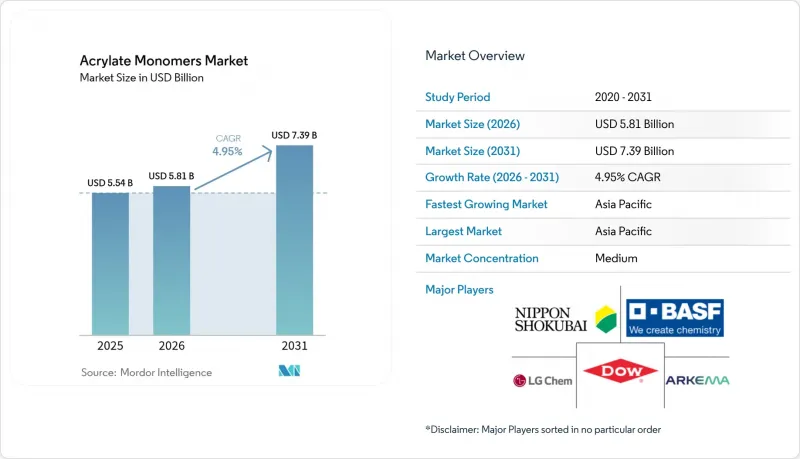
本報告按類型(丙烯酸丁酯、丙烯酸乙酯、丙烯酸乙基己酯、丙烯酸甲酯)、應用(油漆和塗料、黏合劑和密封劑、塑膠和聚合物、印刷油墨等)、最終用戶行業(建築、包裝等)以及地區(亞太地區、北美等)進行細分。市場預測以美元計價。
全球丙烯酸酯單體市場趨勢及洞察
低VOC建築塗料的蓬勃發展
丙烯酸丁酯共聚物能夠實現無揮發性有機化合物(VOC)配方,同時保持開放時間、濕擦洗耐久性和耐鹼性,使塗料生產商能夠逐步淘汰醋酸乙烯酯。中國的「十四五」規劃要求到2025年,許多新建住宅項目必須使用低排放塗料,這加速了中國本土乳化聚合物的生產。在印度,中小塗料生產商正在採用預配製丙烯酸黏合劑,以省去自身的聚合工藝,並加速區域色彩的開發。通過ISO 11890測試和LEED v4.1認證的第三方檢驗,正在加強採購標準,優先考慮先進的丙烯酸乳液,凸顯其在永續建築實踐中的適用性。
壓敏黏著劑需求快速成長
電子商務包裝、醫用膠帶和汽車裝飾件的黏合需求推動了壓敏黏著劑中丙烯酸酯單體的應用。丙烯酸乙酯作為壓敏黏著劑(PSA)的單體原料供應,因為它能確保熱熔膠和無溶劑配方在低溫下仍具有黏性。東南亞瓦楞紙箱產量的成長促使軟包裝袋需要使用光學透明的黏合薄膜。在醫用穿戴產品中,使用殘留單體濃度低於100 ppm的丙烯酸酯壓敏膠,以符合ISO 10993皮膚致敏閾值。美國食品藥物管理局(FDA)關於萃取物的指南要求醫療設備製造商在創傷護理貼片中明確使用高純度丙烯酸乙酯。
丙烯和丙烯酸原料價格波動劇烈
2024年,由於煉油廠檢修、丙二醇脫氫(PDH)裝置運作以及聚丙烯市場競爭,丙烯現貨價格出現波動。混煉企業正在試行以甘油和乳酸為原料生產生物基丙烯酸甲酯。歐盟的碳邊境調節機制(CBAM)將原料的碳排放強度納入採購流程,有助於簽訂長期丙烯供應合約。
細分市場分析
丙烯酸丁酯佔總出貨量的76.02%,預計2031年將以5.18%的複合年成長率成長。連續反應器的改進縮短了反應週期,降低了能耗,並促進了現貨市場的快速銷售。丙烯酸乙酯主要用於高固態工業塗料,其快速固化的特性使其價格較高。丙烯酸乙酯是壓敏黏著劑的關鍵組分,用於醫療和汽車膠帶等需要低溫黏性的領域。丙烯酸甲酯憑藉其快速的自由基聚合反應速度,在醫藥中間體和紫外光固化寡聚物細分市場中佔有一席之地。
對於向跨國塗料和黏合劑製造商提供產品的供應商而言,持續投資ISO 9001和ISO 14001認證如今至關重要,這提高了區域製造商的准入門檻。在丙烯酸酯單體市場,能夠提供配方支援並保證單體殘留濃度低於100 ppm的一體化企業仍具有優勢。連續生產過程還能確保分子量分佈的一致性,這對於建築塗料的低溫柔柔軟性至關重要。已維修反應器並具備先進壓力控制功能的製造商可以切換單體等級,並最大限度地提高設備運轉率。
區域分析
到2025年,亞太地區將佔據丙烯酸酯單體市場規模的44.80%,預計2026年至2031年將以5.28%的複合年成長率成長,成為所有地區中成長最快的地區。在中國,丙烯酸丁酯乳液正被應用於新建住宅的塗料中,而紫外光固化寡聚物則被用於深圳和蘇州電子產業叢集的折疊式顯示器。在印度,高速公路、機場和經濟適用住宅等國家基礎設施項目的支出正在推動市場需求。
北美佔全球消費量的大部分。加拿大在戰略創新基金聯合津貼的支持下,其消費主要集中在用於電動車電池黏合劑的丙烯酸甲酯。在墨西哥,近岸外包推動了丙烯酸乙基己酯在汽車和電子組裝的應用,而美墨加協定(USMCA)原產地規則下的獎勵則進一步促進了這一趨勢。
德國、法國和英國是歐洲市場需求的主要驅動力。 REACH法規註冊費和碳邊境調節措施(CBAM)下的碳課稅正在加速向生物基丙烯酸甲酯替代品的轉型。中東和非洲市場的需求主要集中在沙烏地阿拉伯和阿拉伯聯合大公國等石化中心,這些國家主要生產出口型丙烯酸。如今,符合ISO 9001和ISO 14001標準已成為供應商進入跨國供應鏈的強制性資格要求。
其他好處:
- Excel格式的市場預測(ME)表
- 3個月的分析師支持
目錄
第1章:引言
- 研究假設和市場定義
- 調查範圍
第2章:調查方法
第3章執行摘要
第4章 市場狀況
- 市場概覽
- 市場促進因素
- 低VOC建築塗料的蓬勃發展
- 壓敏黏著劑需求快速成長
- 亞太地區建築業超級週期
- 紫外光固化丙烯酸酯組合藥物在軟性電子產品的應用日益廣泛
- 有利於製造業回流和反傾銷稅的優惠政策正在推動北美產能的擴張。
- 市場限制因素
- 丙烯和丙烯酸原料成本的波動
- 加強對殘留單體毒性的監管
- 在塗料領域與新一代聚氨酯分散體競爭
- 價值鏈分析
- 波特五力模型
第5章 市場規模與成長預測
- 按類型
- 丙烯酸丁酯
- 丙烯酸乙酯
- 丙烯酸乙基己酯
- 丙烯酸甲酯
- 透過使用
- 油漆和塗料
- 黏合劑和密封劑
- 塑膠和聚合物
- 印刷油墨
- 其他用途
- 按最終用戶類別
- 建造
- 汽車和運輸業
- 包裝
- 電子與電機工程
- 醫療保健和衛生
- 按地區
- 亞太地區
- 中國
- 印度
- 日本
- 韓國
- 馬來西亞
- 泰國
- 印尼
- 越南
- 其他亞太國家
- 北美洲
- 美國
- 加拿大
- 墨西哥
- 歐洲
- 德國
- 英國
- 法國
- 義大利
- 西班牙
- 北歐國家
- 土耳其
- 俄羅斯
- 其他歐洲國家
- 南美洲
- 巴西
- 阿根廷
- 哥倫比亞
- 中東和非洲
- 沙烏地阿拉伯
- 卡達
- 阿拉伯聯合大公國
- 奈及利亞
- 埃及
- 南非
- 其他中東和非洲國家
- 亞太地區
第6章 競爭情勢
- 市場集中度
- 策略趨勢
- 市佔率和排名分析
- 公司簡介
- Arkema
- BASF SE
- Bharat Petroleum Corporation Limited
- Dow
- Jurong Group
- LG Chem
- LobaChemie Pvt. Ltd.
- Mitsubishi Chemical Holdings Corporation
- Nippon Shokubai Co., Ltd
- Prasol Chemicals Limited
- Sasol
- Satellite Chemical Co. Ltd
- Shenyang Chemical Co Ltd
- SIBUR Holding PJSC
- Synthomer PLC
- Tasnee(national Industrialization Company)
- TOAGOSEI CO.,LTD.
- Tokyo Chemical Industry Co., Ltd.
- Wanhua
第7章 市場機會與未來展望
According to Mordor Intelligence, acrylate monomers market size in 2026 is estimated at USD 5.81 billion, growing from 2025 value of USD 5.54 billion with 2031 projections showing USD 7.39 billion, growing at 4.95% CAGR over 2026-2031.
This report is Segmented by Type (Butyl Acrylate, Ethyl Acrylate, Ethylhexyl Acrylate, and Methyl Acrylate), Application (Paints and Coatings, Adhesives and Sealants, Plastics and Polymers, Printing Inks, and Other Applications), End-User Sector (Construction, Packaging, and More), and Geography (Asia-Pacific, North America, and More). The Market Forecasts are Provided in Terms of Value (USD).
Global Acrylate Monomers Market Trends and Insights
Low-VOC Architectural Coating Boom
Butyl-acrylate copolymers enable zero-VOC claims while preserving open time, wet-scrub durability, and alkalinity resistance, driving formulators to phase out vinyl acetate. China's 14th Five-Year Plan mandates low-emission coatings in many of the new residential projects by 2025, accelerating local emulsion-polymer output. In India, small paint makers are adopting pre-compounded acrylic binders to bypass in-house polymerization and speed regional color launches. Third-party verification through ISO 11890 testing and LEED v4.1 credits reinforces procurement criteria that favor advanced acrylic emulsions, underscoring their suitability for use in sustainable building practices.
Rapid Expansion of Pressure-Sensitive Adhesive Demand
E-commerce packaging, medical tapes, and automotive trim bonding drive the use of acrylate monomer in pressure-sensitive adhesives. Ethylhexyl acrylate supplied the PSA monomer feedstock because it supports low-temperature tack in hot-melt and solvent-free formulations. Southeast Asian corrugated box production is increasing, necessitating the use of optically clear adhesive films for flexible pouches. Medical wearables rely on acrylic PSAs with residual-monomer levels under 100 ppm to meet ISO 10993 skin-sensitization thresholds. FDA guidance on extractables is pushing device makers to specify high-purity ethyl acrylate in wound-care patches.
Volatile Propylene and Acrylic-Acid Feedstock Costs
Propylene spot values fluctuated in 2024 due to refinery maintenance, PDH start-ups, and polypropylene market competition. Formulators are trialing bio-based methyl acrylate derived from glycerol or lactic acid. The EU's Carbon Border Adjustment Mechanism embeds feedstock carbon intensity into procurement, encouraging the development of long-term propylene supply contracts.
Other drivers and restraints analyzed in the detailed report include:
- Asia-Pacific Construction Super-Cycle
- Rise of UV-Curable Acrylate Formulations for Flexible Electronics
- Regulatory Squeeze on Residual Monomer Toxicity
For complete list of drivers and restraints, kindly check the Table Of Contents.
Segment Analysis
Butyl acrylate accounts for 76.02% of the total volume and is expected to advance at a 5.18% CAGR through 2031. Continuous-reactor upgrades shorten cycle times, reducing energy consumption and enabling responsive spot market sales. Ethyl acrylate targets high-solids industrial coatings where faster cure rates justify its premium pricing. Ethylhexyl acrylate is a key component in pressure-sensitive adhesives that require low-temperature tack in medical and automotive tapes. Methyl acrylate occupies a niche in pharmaceutical intermediates and UV-curable oligomers, benefiting from rapid radical-polymerization kinetics.
Sustained investment in ISO 9001 and ISO 14001 certification is now mandatory for suppliers serving multinational paint and adhesive firms, raising entry barriers for regional producers. The acrylate monomers market continues to favor integrated players that can offer formulation assistance and residual monomer guarantees under 100 ppm. Continuous processes also provide consistent molecular-weight distribution, a key requirement for low-temperature flexibility in architectural coatings. Producers that retrofit reactors with advanced pressure control can toggle between monomer grades, maximizing asset utilization.
Complete Report Scope:
- By Type
- Butyl Acrylate
- Ethyl Acrylate
- Ethylhexyl Acrylate
- Methyl Acrylate
- By Application
- Paints and Coatings
- Adhesives and Sealants
- Plastics and Polymers
- Printing Inks
- Other Applications
- By End-User Sector
- Construction
- Automotive and Transportation
- Packaging
- Electronics and Electrical
- Healthcare and Hygiene
- By Geography
- Asia-Pacifc
- China
- India
- Japan
- South Korea
- Malaysia
- Thailand
- Indonesia
- Vietnam
- Rest of Asia-Pacific
- North America
- United States
- Canada
- Mexico
- Europe
- Germany
- United Kingdom
- France
- Italy
- Spain
- Nordic Countries
- Turkey
- Russia
- Rest of Europe
- South America
- Brazil
- Argentina
- Colombia
- Middle-East and Africa
- Saudi Arabia
- Qatar
- United Arab Emirates
- Nigeria
- Egypt
- South Africa
- Rest of Middle-East and Africa
- Asia-Pacifc
Geography Analysis
The Asia-Pacific region held 44.80% of the acrylate monomers market volume in 2025 and is projected to grow at a 5.28% CAGR from 2026 to 2031, at the highest regional pace. China is channeling butyl-acrylate emulsions into coatings for new housing units, while the Shenzhen and Suzhou electronics clusters utilize UV-curable oligomers for foldable screens. The National Infrastructure Pipeline spending on highways, airports, and affordable housing lifts demand in India.
North America commands a significant portion of global consumption. Canada's share concentrates on methyl acrylate for EV battery binders, supported by Strategic Innovation Fund co-grants. Mexico contributes as near-shoring drives ethylhexyl-acrylate uptake in automotive and electronics assembly, backed by USMCA rule-of-origin incentives.
Germany, France, and the United Kingdom lead Europe's demand. REACH fees and CBAM carbon levies encourage the substitution of methyl acrylate with bio-based alternatives. The Middle East and Africa share is centered on Saudi Arabian and UAE petrochemical hubs targeting export-oriented acrylic acid. ISO 9001 and ISO 14001 compliance are now mandatory credentials for suppliers entering multinational supply chains.
- Arkema
- BASF SE
- Bharat Petroleum Corporation Limited
- Dow
- Jurong Group
- LG Chem
- LobaChemie Pvt. Ltd.
- Mitsubishi Chemical Holdings Corporation
- Nippon Shokubai Co., Ltd
- Prasol Chemicals Limited
- Sasol
- Satellite Chemical Co. Ltd
- Shenyang Chemical Co Ltd
- SIBUR Holding PJSC
- Synthomer PLC
- Tasnee (national Industrialization Company)
- TOAGOSEI CO.,LTD.
- Tokyo Chemical Industry Co., Ltd.
- Wanhua
Additional Benefits:
- The market estimate (ME) sheet in Excel format
- 3 months of analyst support
TABLE OF CONTENTS
1 Introduction
- 1.1 Study Assumptions and Market Definition
- 1.2 Scope of the Study
2 Research Methodology
3 Executive Summary
4 Market Landscape
- 4.1 Market Overview
- 4.2 Market Drivers
- 4.2.1 Low-VOC architectural coating boom
- 4.2.2 Rapid expansion of pressure-sensitive adhesive demand
- 4.2.3 Asia-pacific construction super-cycle
- 4.2.4 Rise of UV-curable acrylate formulations for flexible electronics
- 4.2.5 On-shoring incentives and antidumping tariffs driving North America capacity adds
- 4.3 Market Restraints
- 4.3.1 Volatile propylene and acrylic-acid feedstock costs
- 4.3.2 Regulatory squeeze on residual monomer toxicity
- 4.3.3 Competition from next-gen polyurethane dispersions in coatings
- 4.4 Value Chain Analysis
- 4.5 Porter's Five Forces
- 4.5.1 Threat of New Entrants
- 4.5.2 Bargaining Power of Suppliers
- 4.5.3 Bargaining Power of Buyers
- 4.5.4 Threat of Substitutes
- 4.5.5 Degree of Competition
5 Market Size and Growth Forecasts (Value)
- 5.1 By Type
- 5.1.1 Butyl Acrylate
- 5.1.2 Ethyl Acrylate
- 5.1.3 Ethylhexyl Acrylate
- 5.1.4 Methyl Acrylate
- 5.2 By Application
- 5.2.1 Paints and Coatings
- 5.2.2 Adhesives and Sealants
- 5.2.3 Plastics and Polymers
- 5.2.4 Printing Inks
- 5.2.5 Other Applications
- 5.3 By End-User Sector
- 5.3.1 Construction
- 5.3.2 Automotive and Transportation
- 5.3.3 Packaging
- 5.3.4 Electronics and Electrical
- 5.3.5 Healthcare and Hygiene
- 5.4 By Geography
- 5.4.1 Asia-Pacifc
- 5.4.1.1 China
- 5.4.1.2 India
- 5.4.1.3 Japan
- 5.4.1.4 South Korea
- 5.4.1.5 Malaysia
- 5.4.1.6 Thailand
- 5.4.1.7 Indonesia
- 5.4.1.8 Vietnam
- 5.4.1.9 Rest of Asia-Pacific
- 5.4.2 North America
- 5.4.2.1 United States
- 5.4.2.2 Canada
- 5.4.2.3 Mexico
- 5.4.3 Europe
- 5.4.3.1 Germany
- 5.4.3.2 United Kingdom
- 5.4.3.3 France
- 5.4.3.4 Italy
- 5.4.3.5 Spain
- 5.4.3.6 Nordic Countries
- 5.4.3.7 Turkey
- 5.4.3.8 Russia
- 5.4.3.9 Rest of Europe
- 5.4.4 South America
- 5.4.4.1 Brazil
- 5.4.4.2 Argentina
- 5.4.4.3 Colombia
- 5.4.5 Middle-East and Africa
- 5.4.5.1 Saudi Arabia
- 5.4.5.2 Qatar
- 5.4.5.3 United Arab Emirates
- 5.4.5.4 Nigeria
- 5.4.5.5 Egypt
- 5.4.5.6 South Africa
- 5.4.5.7 Rest of Middle-East and Africa
- 5.4.1 Asia-Pacifc
6 Competitive Landscape
- 6.1 Market Concentration
- 6.2 Strategic Moves
- 6.3 Market Share (%)/Ranking Analysis
- 6.4 Company Profiles (includes Global-level Overview, Market-level Overview, Core Segments, Financials, Strategic Info, Market Rank/Share, Products and Services, Recent Developments)
- 6.4.1 Arkema
- 6.4.2 BASF SE
- 6.4.3 Bharat Petroleum Corporation Limited
- 6.4.4 Dow
- 6.4.5 Jurong Group
- 6.4.6 LG Chem
- 6.4.7 LobaChemie Pvt. Ltd.
- 6.4.8 Mitsubishi Chemical Holdings Corporation
- 6.4.9 Nippon Shokubai Co., Ltd
- 6.4.10 Prasol Chemicals Limited
- 6.4.11 Sasol
- 6.4.12 Satellite Chemical Co. Ltd
- 6.4.13 Shenyang Chemical Co Ltd
- 6.4.14 SIBUR Holding PJSC
- 6.4.15 Synthomer PLC
- 6.4.16 Tasnee (national Industrialization Company)
- 6.4.17 TOAGOSEI CO.,LTD.
- 6.4.18 Tokyo Chemical Industry Co., Ltd.
- 6.4.19 Wanhua
7 Market Opportunities and Future Outlook
- 7.1 White-space and Unmet-need Assessment

 椰油酸乙基己酯市場規模、佔有率和成長分析:按等級、應用、產地、分銷管道和地區分類 - 產業預測,2026-2033年
 異壬酸丙烯酸酯市場:全球市場預測,2026-2032年丙烯酸酯市場:2026-2032年全球市場預測(依產品類型、製造流程、應用及最終用途產業分類)
 全球丙烯酸酯市場規模、佔有率、趨勢和成長分析報告(2026-2034年)
 丙烯酸酯市場規模、佔有率和成長分析(按產品類型、等級、應用、最終用途和地區分類)-2026-2033年產業預測
 丙烯酸酯市場機會、成長要素、產業趨勢分析及預測(2026年至2035年)
 丙烯酸異丁酯市場規模、佔有率及成長分析(按應用、終端用戶產業、配方、通路及地區分類)-2026-2033年產業預測單官能酸酐市場按應用、最終用途產業、製程和等級分類 - 全球預測 2026-2032
 異壬酸丙烯酸酯市場規模、佔有率及成長分析(依產品類型、應用、最終用戶、等級、銷售管道及地區分類)-2026-2033年產業預測
 丙烯酸異辛酯:全球市場佔有率和排名、總收入和需求預測(2025-2031年)