


 |
市場調查報告書
商品編碼
2114322
亞太地區移動式起重機:市場佔有率分析、產業趨勢與統計及成長預測(2026-2031 年)Asia-Pacific Mobile Crane - Market Share Analysis, Industry Trends & Statistics, Growth Forecasts (2026 - 2031) |
||||||

※ 本網頁內容可能與最新版本有所差異。詳細情況請與我們聯繫。
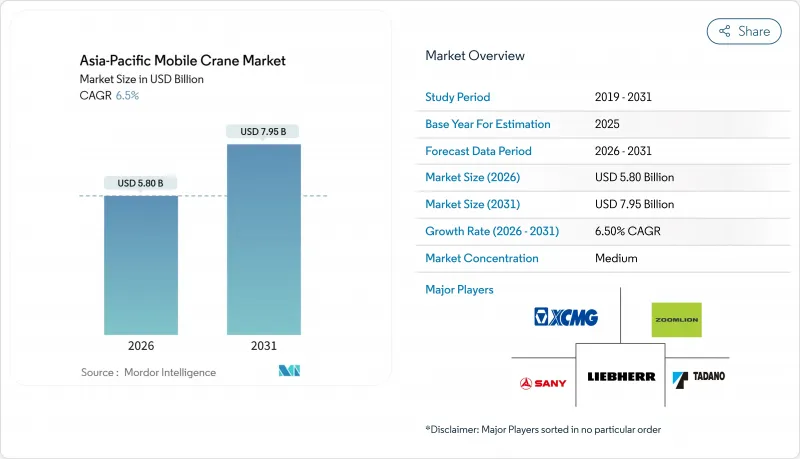
根據 Mordor Intelligence 預測,亞太地區行動式起重機市場規模預計將在 2026 年達到 58 億美元,到 2031 年達到 79.5 億美元,在預測期內複合年成長率將達到 6.50%。
本報告按產品類型(車載起重機、拖車式起重機等)、應用領域(建築、採礦和鑽探等)、最終用戶(租賃公司、建築承包商等)、起重能力(小於50噸、50-150噸等)和國家/地區(中國、印度等)進行細分。市場預測以貨幣價值(美元)和數量(台)兩種形式呈現。
亞太地區移動式起重機市場趨勢及洞察
大型大型企劃的支出正在激增。
2025年,該地區的基礎設施投資顯著成長。這得歸功於多年期鐵路、公路和港口建設計畫,這些項目維持了起重機的高運轉率。印度的「國家基礎設施管道」計畫已為二線城市的地鐵走廊撥款巨額預算,這些項目需要大型履帶式起重機來建造重達200噸以上的架空路段。中國的「一帶一路」計劃持續調動東南亞各地的起重機力量,僅在雅加達-萬隆高鐵線上,就動用了多台移動式起重機進行橋樑建設。印尼主權財富基金已為2025年撥款200億美元,其中包括港口維修項目,該項目需要能夠在垃圾掩埋場作業的非公路起重機。這些長期規劃為租賃協議奠定了基礎,並有助於實現可預測的起重機更換週期。
提升可再生能源領域(風能和太陽能)的需求
由於預計未來幾年離岸風力發電裝置容量將大幅成長,台灣、日本和韓國的建築公司正在預訂150公尺高的履帶式起重機。台灣1022兆瓦的「海龍2號」專案指定使用配備耐腐蝕液壓系統的履帶式起重機來吊掛單樁。日本的目標是到2030年實現10吉瓦的離岸風力發電,到2040年達到30-45吉瓦,這促使當地的原始設備製造商(OEM)開發符合嚴格波浪補償規定的海洋專用型號。在印度和澳洲的大型太陽能發電廠,由於組件和逆變器以預製件的形式交付,對車載起重機的需求仍然強勁。可再生能源開發商正在簽訂多年購電協議,這使得起重機租賃公司能夠獲得比投機性房地產建設更低的違約風險,從而確保收入。
鋼材價格波動和成本上升
2025年初,熱軋鋼卷價格較上年大幅上漲。此次上漲是由於中國減產和印尼鎳礦出口限制導致供應緊張所致。通常情況下,鋼材成本上漲會導致起重機等設備的出廠價格上漲,從而擠壓利潤空間,尤其是對於品牌知名度較低的目的地設備製造商(OEM)而言。利勃海爾和馬尼托瓦克等產業巨頭正透過在印度和中國在地化生產來應對這些挑戰,而小規模的公司則由於營運規模有限,難以應對運費波動。為了應對這些風險,買家擴大選擇簽訂長期固定價格契約,將成本轉嫁給生產商。
細分市場分析
履帶式起重機的需求正在成長,預計到2031年將以9.03%的複合年成長率成長。這反映了石化廠和離岸風力發電電場對300噸及以上起重能力的需求不斷增加。車載式起重機因其公路機動性和快速部署的優勢,在各種都市區作業中逐漸成為主流,預計到2025年將佔亞太地區移動式起重機市場的46.13%。三一重工的4000噸級SCC40000A起重機成功一次性吊裝並運輸了1200噸的儲罐部件,印證了超重型起重機的發展趨勢。全地形起重機兼具公路行駛速度和越野行駛能力,使其適用於印度風電場的進場道路。同時,越野起重機在基礎設施低度開發的地區,例如印尼和菲律賓,也發揮積極作用。目前的產品創新目標是混合動力驅動系統、更長的伸縮臂以及工廠安裝的遠端資訊處理系統,以便租賃公司能夠即時監控運作。
利勃海爾和馬尼托瓦克的混合動力全地形起重機顯著降低了柴油消耗,並符合新加坡「綠色建築標誌」的獎勵。多田野的GR-1000XLL-4起重機可在不完全展開支架的情況下延伸至60米,因此能夠在高層建築立面環繞的狹窄巷道中進行起重作業。在此背景下,製造商正致力於開發高度靈活的平台,這些平台無需柔軟性大規模的重新裝備即可在基礎設施項目的混凝土澆築和風力發電廠機艙吊裝之間輕鬆切換。因此,租賃業者可以降低每起重機運作小時的資本支出,並且由於運作週期縮短,盈利指標也得到了提升。
儘管到2025年建築業仍將佔總需求的56.22%,但由於離岸風力發電和港口疏浚等工程需要專業的起重作業,海洋和近海行業的需求正以8.12%的複合年成長率快速成長。亞太地區的移動式起重機市場受益於台灣建造的超過1吉瓦的離岸風力發電電場,這些風電場的單樁基礎重量超過2000噸。日本的目標是到2030年實現10吉瓦的離岸風力發電,因此日本國內的原始設備製造商(OEM)正在開發耐腐蝕的沿海型起重機。採礦和鑽探行業在澳洲的鐵礦石和印尼的鎳礦中繼續發揮至關重要的作用,履帶式起重機被用於運輸卡車的維修作業。
電力公司租賃車載起重機來升級電網,而航運碼頭則更傾向於使用移動式港口起重機進行貨櫃裝卸。政府推出的上網電價補貼(FIT)政策促進了海上起重業務的成長,該政策允許承包商簽訂跨季起重機租賃協議,從而確保現金流。石化聯合企業等工業客戶提前數年規劃停產檢修,這使得得起重機供應商更容易安排其設備輪調。航運公司和港口當局現在強制要求根據ISO 4309標準進行繩索檢驗,這提高了設備品質標準,並將非正規營運商排除在市場之外。這些因素正在擴大合規差距,使得信譽良好的租賃公司能夠提高租賃價格。
其他好處:
- Excel格式的市場預測(ME)表
- 3個月的分析師支持
目錄
第1章:引言
- 研究假設和市場定義
- 調查範圍
第2章:調查方法
第3章執行摘要
第4章 市場狀況
- 市場概覽
- 市場促進因素
- 基礎建設大型企劃支出激增
- 透過可再生能源(風能和太陽能)提振需求
- 都市區高層建築的建設正在加速進行中。
- 租賃業務模式的成長
- 推動混合動力/電動起重機綠色採購的行動
- 利用 5G 進行遠端控制可提高運作效率。
- 市場限制因素
- 鋼材價格波動和成本上升
- 熟練操作人員短缺和資格認證獲取方面的差距。
- 港口堵塞導致零件供應延誤。
- 颱風多發地區的保險費正在飆升。
- 價值供應鏈分析
- 監理情勢
- 技術展望
- 波特五力模型
第5章 市場規模及成長預測(價值:美元,數量:單位)
- 依產品類型
- 車載起重機
- 拖車式起重機
- 履帶式起重機
- 全地形起重機
- 用於崎嶇地形的起重機
- 其他
- 透過使用
- 建造
- 採礦和鑽探
- 工業應用
- 海洋/近海
- 公用事業
- 航運和港口建設
- 最終用戶
- 租賃公司
- 建築承包商
- 政府和地方當局
- 工業企業
- 負載能力
- 不到50噸
- 50-150噸
- 151-300噸
- 超過300噸
- 國家
- 中國
- 印度
- 日本
- 韓國
- 其他亞太國家
第6章 競爭情勢
- 市場集中度
- 策略趨勢
- 市佔率分析
- 公司簡介
- Xuzhou Construction Machinery Group Co., Ltd.
- Zoomlion Heavy Industry Science & Technology Co., Ltd.
- Sany Heavy Industry Co., Ltd.
- Liebherr
- Tadano Ltd.
- The Manitowoc Company, Inc.
- Kobelco Construction Machinery Co., Ltd.
- Kato Works Co., Ltd.
- Sumitomo Heavy Industries, Ltd.
- Terex Corporation
- Konecranes Oyj
- Hiab Corporation
- Palfinger AG
- Action Construction Equipment Ltd.
- Furukawa UNIC Corporation
- Guangxi LiuGong Machinery Co., Ltd.
- Sennebogen Maschinenfabrik GmbH
第7章 市場機會與未來展望
According to Mordor Intelligence, the Asia-Pacific mobile crane market size reached USD 5.80 billion in 2026 and is projected to touch USD 7.95 billion by 2031, registering a 6.50% CAGR over the forecast period.
This report is Segmented by Product Type (Truck-Mounted Cranes, Trailer-Mounted Cranes, and More), Application (Construction, Mining and Excavation, and More), End User (Rental Companies, Construction Contractors, and More), Lifting Capacity (Below 50 Tons, 50-150 Tons, and More), and Country (China, India, and More). The Market Forecasts are Provided in Terms of Value (USD) and Volume in Units.
Asia-Pacific Mobile Crane Market Trends and Insights
Infrastructure Megaproject Spending Surge
Regional infrastructure investment climbed significantly in 2025 and is underpinned by multi-year rail, road, and port programs that keep crane utilization high. India's National Infrastructure Pipeline earmarks a significant amount for metro corridors in tier-2 cities, where viaduct segments weighing over 200 tons demand heavy-duty crawler cranes. China's Belt and Road ventures continue to mobilize fleets across Southeast Asia; the Jakarta-Bandung high-speed rail alone used several mobile cranes during bridge works. Indonesia's sovereign wealth fund allocated USD 20 billion in 2025, including port upgrades that require rough-terrain models able to maneuver on reclaimed land. These long-dated schemes anchor rental contracts and foster predictable fleet-replacement cycles.
Renewable-Energy Lifting Demand (Wind and Solar)
Contractors in Taiwan, Japan, and South Korea are reserving crawler cranes for 150-meter hub heights, as offshore wind capacity is expected to experience significant growth in the coming years. Taiwan's 1,022 MW Hai Long 2 project specifies crawler units with corrosion-resistant hydraulics for monopile handling. Japan targets 10 GW of offshore wind by 2030 and 30-45 GW by 2040, prompting local OEMs to develop marine-rated variants obeying stringent wave-compensation rules . Large-scale solar parks in India and Australia also drive steady truck-mounted crane demand as modules and inverters arrive prefabricated. Renewable developers sign multi-year power-purchase agreements, enabling crane lessors to lock in revenues with lower default risk than speculative real-estate work.
Volatile Steel Prices and Cost Inflation
In early 2025, hot-rolled coil prices experienced a notable increase compared to the previous year. This rise was driven by supply constraints caused by Chinese output curbs and restrictions on nickel ore exports from Indonesia. Typically, higher steel costs lead to an increase in ex-factory crane prices, which puts pressure on margins for original equipment manufacturers (OEMs), particularly those with weaker brand power. Industry leaders like Liebherr and Manitowoc have addressed these challenges by localizing fabrication in India and China, while smaller firms face difficulties in managing freight volatility due to their limited scale. To address these risks, buyers are increasingly negotiating fixed-price contracts with longer validity periods, transferring the burden back to producers.
Other drivers and restraints analyzed in the detailed report include:
- Accelerating Urban High-Rise Construction
- Growth of Rental / Leasing Business Models
- Skilled-Operator Shortages and Certification Gaps
For complete list of drivers and restraints, kindly check the Table Of Contents.
Segment Analysis
Crawler models are rising and are forecast to expand at a 9.03% CAGR through 2031, signaling demand for 300-ton-plus lifts on petrochemical plants and offshore wind sites. Truck-mounted cranes dominate mixed urban work because road mobility and quick setup outweigh brute capacity, holding a 46.13% share of the Asia-Pacific mobile crane market size in 2025. Sany's 4,000-ton SCC40000A demonstrated single picks of 1,200-ton tank sections, validating the shift toward super-heavy duty. All-terrain cranes bridge highway speed and off-road access, suiting wind-farm access roads in India, while rough-terrain units fill low-infrastructure jobsites in Indonesia and the Philippines. Product innovation now targets hybrid drivelines, longer telescopic booms, and factory-installed telematics that let rental firms monitor usage hours in real time.
Hybrid-ready all-terrain cranes from Liebherr and Manitowoc cut diesel use significantly, qualifying for Green Mark incentives in Singapore. Tadano's GR-1000XLL-4 extends 60 m without full outrigger deployment, permitting lifts in alleys surrounded by high-rise facades. Manufacturers are thus converging around flexible platforms that can shift from infrastructure pours to wind-farm nacelle lifts without major re-rigging. As a result, rental fleets lower capital expenditure per usable crane-hour, improving return metrics as utilization cycles tighten.
Construction still accounts for 56.22% of 2025 demand, yet marine and offshore tasks are scaling faster at an 8.12% CAGR because offshore wind and port dredging require specialized lifting. The Asia-Pacific mobile crane market benefits as Taiwan installs 1 GW-plus offshore parks where monopile foundations exceed 2,000 tons. Japan's 10 GW offshore aim by 2030 nudges domestic OEMs to build corrosion-resistant coastal models. Mining and excavation stay relevant in Australia's iron-ore pits and Indonesia's nickel assets, where crawler cranes service haul-truck maintenance bays.
Power utilities hire truck-mounted units for grid-modernization, while shipping terminals favor mobile harbor cranes for container moves. Growth in marine lifting is helped by governments granting feed-in tariffs, letting contractors sign multi-season crane charters that secure cash flow. Industrial clients such as petrochemical complexes schedule shutdowns years ahead, letting crane providers plan fleet rotation. Shipping and port authorities now specify ISO 4309 rope inspection, raising equipment-quality thresholds and sidelining informal operators. These factors widen the compliance gap, enabling premium rental firms to raise rates.
Complete Report Scope:
- By Product Type
- Truck-Mounted Cranes
- Trailer-Mounted Cranes
- Crawler Cranes
- All-Terrain Cranes
- Rough-Terrain Cranes
- Others
- By Application
- Construction
- Mining and Excavation
- Industrial Applications
- Marine and Offshore
- Utility
- Shipping and Port Building
- By End User
- Rental Companies
- Construction Contractors
- Government and Municipalities
- Industrial Operators
- By Lifting Capacity
- Below 50 Tons
- 50-150 Tons
- 151-300 Tons
- Above 300 Tons
- By Country
- China
- India
- Japan
- South Korea
- Rest of Asia-Pacific
List of Companies Covered in this Report:
- Xuzhou Construction Machinery Group Co., Ltd.
- Zoomlion Heavy Industry Science & Technology Co., Ltd.
- Sany Heavy Industry Co., Ltd.
- Liebherr
- Tadano Ltd.
- The Manitowoc Company, Inc.
- Kobelco Construction Machinery Co., Ltd.
- Kato Works Co., Ltd.
- Sumitomo Heavy Industries, Ltd.
- Terex Corporation
- Konecranes Oyj
- Hiab Corporation
- Palfinger AG
- Action Construction Equipment Ltd.
- Furukawa UNIC Corporation
- Guangxi LiuGong Machinery Co., Ltd.
- Sennebogen Maschinenfabrik GmbH
Additional Benefits:
- The market estimate (ME) sheet in Excel format
- 3 months of analyst support
TABLE OF CONTENTS
1 Introduction
- 1.1 Study Assumptions and Market Definition
- 1.2 Scope of the Study
2 Research Methodology
3 Executive Summary
4 Market Landscape
- 4.1 Market Overview
- 4.2 Market Drivers
- 4.2.1 Infrastructure Megaproject Spending Surge
- 4.2.2 Renewable-Energy Lifting Demand (Wind and Solar)
- 4.2.3 Accelerating Urban High-Rise Construction
- 4.2.4 Growth of Rental / Leasing Business Models
- 4.2.5 Green-Procurement Push for Hybrid/E-Cranes
- 4.2.6 5G-Enabled Tele-Operations Boost Uptime
- 4.3 Market Restraints
- 4.3.1 Volatile Steel Prices and Cost Inflation
- 4.3.2 Skilled-Operator Shortages and Certification Gaps
- 4.3.3 Port Congestion Delaying Component Supply
- 4.3.4 Rising Insurance Costs in Typhoon-Prone Zones
- 4.4 Value / Supply-Chain Analysis
- 4.5 Regulatory Landscape
- 4.6 Technological Outlook
- 4.7 Porter's Five Forces
- 4.7.1 Bargaining Power of Suppliers
- 4.7.2 Bargaining Power of Buyers
- 4.7.3 Threat of New Entrants
- 4.7.4 Threat of Substitutes
- 4.7.5 Competitive Rivalry
5 Market Size and Growth Forecasts (Value in USD and Volume in Units)
- 5.1 By Product Type
- 5.1.1 Truck-Mounted Cranes
- 5.1.2 Trailer-Mounted Cranes
- 5.1.3 Crawler Cranes
- 5.1.4 All-Terrain Cranes
- 5.1.5 Rough-Terrain Cranes
- 5.1.6 Others
- 5.2 By Application
- 5.2.1 Construction
- 5.2.2 Mining and Excavation
- 5.2.3 Industrial Applications
- 5.2.4 Marine and Offshore
- 5.2.5 Utility
- 5.2.6 Shipping and Port Building
- 5.3 By End User
- 5.3.1 Rental Companies
- 5.3.2 Construction Contractors
- 5.3.3 Government and Municipalities
- 5.3.4 Industrial Operators
- 5.4 By Lifting Capacity
- 5.4.1 Below 50 Tons
- 5.4.2 50-150 Tons
- 5.4.3 151-300 Tons
- 5.4.4 Above 300 Tons
- 5.5 By Country
- 5.5.1 China
- 5.5.2 India
- 5.5.3 Japan
- 5.5.4 South Korea
- 5.5.5 Rest of Asia-Pacific
6 Competitive Landscape
- 6.1 Market Concentration
- 6.2 Strategic Moves
- 6.3 Market Share Analysis
- 6.4 Company Profiles (includes Global Level Overview, Market Level Overview, Core Segments, Financials as Available, Strategic Information, Market Rank/Share for Key Companies, Products and Services, SWOT Analysis, and Recent Developments)
- 6.4.1 Xuzhou Construction Machinery Group Co., Ltd.
- 6.4.2 Zoomlion Heavy Industry Science & Technology Co., Ltd.
- 6.4.3 Sany Heavy Industry Co., Ltd.
- 6.4.4 Liebherr
- 6.4.5 Tadano Ltd.
- 6.4.6 The Manitowoc Company, Inc.
- 6.4.7 Kobelco Construction Machinery Co., Ltd.
- 6.4.8 Kato Works Co., Ltd.
- 6.4.9 Sumitomo Heavy Industries, Ltd.
- 6.4.10 Terex Corporation
- 6.4.11 Konecranes Oyj
- 6.4.12 Hiab Corporation
- 6.4.13 Palfinger AG
- 6.4.14 Action Construction Equipment Ltd.
- 6.4.15 Furukawa UNIC Corporation
- 6.4.16 Guangxi LiuGong Machinery Co., Ltd.
- 6.4.17 Sennebogen Maschinenfabrik GmbH
7 Market Opportunities & Future Outlook
- 7.1 White-space & Unmet-Need Assessment

 移動式起重機輪胎市場規模、佔有率和成長分析:按輪胎類型、輪胎結構、起重機負載容量、應用、分銷管道、最終用戶和地區分類-2026-2033年產業預測
 全球移動式起重機市場規模、佔有率、趨勢和成長分析報告(2026-2034年)
 移動式起重機:市佔率分析、產業趨勢與統計、成長預測(2026-2031 年)
 移動式起重機市場-2026-2032年全球市場預測
 移動式起重機市場機會、成長要素、產業趨勢分析及2026-2035年預測。
 移動式起重機市場規模、佔有率和趨勢分析報告:按產品、應用、地區和細分市場預測(2026-2033 年)
 2026年全球移動式起重機市場報告移動式起重機鋼絲繩市場:依產品類型、材質、直徑範圍、最終用途產業和應用分類-2026-2032年全球預測
 移動式起重機市場-全球產業規模、佔有率、趨勢、機會和預測,按臂架類型、底盤類型、地形類型、最終用戶產業、地區和競爭格局分類,2021-2031年預測
 移動式起重機市場規模、佔有率和成長分析(按地形類型、最終用戶產業、類型、容量、臂架類型、底盤類型和地區分類)—2026-2033年產業預測