


 |
市場調查報告書
商品編碼
2114132
移動式起重機:市佔率分析、產業趨勢與統計、成長預測(2026-2031 年)Mobile Crane - Market Share Analysis, Industry Trends & Statistics, Growth Forecasts (2026 - 2031) |
||||||

※ 本網頁內容可能與最新版本有所差異。詳細情況請與我們聯繫。
根據 Mordor Intelligence 估計,2026 年行動式起重機市值為 216.3 億美元,預計在預測期(2026-2031 年)內將以 5.81% 的複合年成長率成長,到 2031 年達到 286.8 億美元。
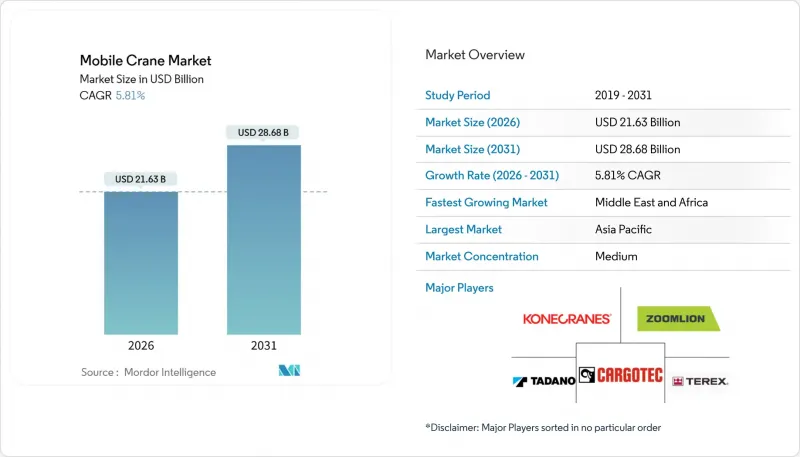
本報告按產品類型(例如,車載式)、應用領域(例如,建築、採礦/挖掘)、最終用戶(例如,租賃公司、承包商)、起重能力(例如,小於50噸)和地區進行細分。市場預測以貨幣價值(美元)和數量(台)兩種形式呈現。
全球移動式起重機市場趨勢與洞察
亞洲新興國家的建築業蓬勃發展
中國和印度持續在公路、地鐵和水利項目上投入創紀錄的資金,確保了移動式起重機市場未來多年的需求前景。在印度,政府已宣布大幅增加基礎建設的資本支出,反映了其加強國家交通網路和城市基礎設施建設的努力。同樣,中國在基礎設施相關固定資產支出方面也保持穩定成長,顯示其致力於擴大和現代化基礎設施網路。亞洲基礎設施投資銀行(亞投行)透過對眾多項目的大力投資,在推動車載式起重機和全地形起重機的需求方面發揮著至關重要的作用。這些起重機對於在人口稠密的都市區和偏遠、難以到達的地區高效作業都至關重要。儘管面臨熟練操作人員短缺和零件供應延遲等挑戰,但強力的資金投入和持續的基礎設施建設努力正在有效緩解中期供應鏈中斷問題。
公私合作加速投資5G和綠色能源基礎設施
在經合組織成員國,除了傳統的土木工程項目外,數位化和能源轉型項目的激增也帶動了移動式起重機市場的擴張。根據全球行動通訊系統協會(GSMA)的預測,電信業者預計將在未來幾年保持大規模的資本投資,這主要受對更高密度5G網路的需求所驅動。預計這將顯著增加對塔架和屋頂起重機的需求。超大規模資料中心的擴張目前正加速發展,預計其電力消耗量將大幅成長。這一趨勢凸顯了精確安裝重型預製模組以支撐這些設施的迫切需求。英國的國家基礎設施策略撥款大量資金用於升級電網,以應對未來十年離岸風力發電裝置容量的大幅成長。這項措施迫使承包商優先選擇兼具高起重能力和高效拆卸週期的起重機。此外,模組化施工方法的興起也增加了在日益緊張的專案工期內進行重複、高精度起重作業的需求。
鋼材價格波動對OEM廠商的利潤率帶來了壓力。
近年來,美國鋼鐵產品生產者物價指數波動劇烈,在大幅下跌後趨於穩定,此前曾出現急劇上漲。由於全地形起重機大量使用結構鋼,在價格飆升期間簽訂合約的原始設備製造商(OEM)如今面臨著巨大的利潤壓力。一家大型製造商指出成本上漲的影響,並強調了漲價和提高生產效率等策略對於緩解原物料價格波動的影響至關重要。然而,許多中小製造商缺乏對沖此類波動的能力,被迫將成本轉嫁給客戶,這可能會削弱其市場競爭力。此外,由於產品價格趨勢的不可預測性,租賃企業也難以預測殘值。
細分市場分析
依產品類型分析行動式起重機市場,預計到2025年,車載起重機將佔總銷量的37.17%,而全地形起重機預計到2031年將以5.83%的複合年成長率成長。利勃海爾的「LTM 1650-8.1」和馬尼托瓦克的「Grove GMK6400-1」是符合歐V排放標準的單引擎佈局的典範,它們最大限度地降低了油耗並簡化了維護。歐洲和北美的業者高度重視兼具公路合法性和越野柔軟性的配置,這種組合正在推動車隊的合理化。在新興市場,由於初始成本較低和維修網路較為簡單,車載起重機仍然很受歡迎,但更嚴格的排放氣體法規正逐步促使買家轉向更新的設計。
原始設備製造商 (OEM) 透過專注於模組化臂架、遠端資訊處理和混合動力驅動系統來實現差異化競爭。徐工的 XCA400L8 整合了負載和力矩監控以及自動支架展開功能,從而縮短了設定時間。這些功能旨在滿足熟練操作人員稀缺的領域的需求。履帶式起重機在石油化學和海上項目中仍然發揮著重要作用,但由於其在各種土木工程中的運轉率較低,市場佔有率成長受到限制。越野型和拖車式起重機主要面向採礦、公共產業設施維護和工業工廠停工檢修,但其需求成長更多地受大宗商品市場週期而非穩定的基礎設施投資驅動。總而言之,全地形起重機市場佔有率的成長表明移動式起重機市場正在轉向更通用、排放氣體標準的設備。
受住宅、商業和公共工程活性化的推動,建築業在2025年仍佔據移動式起重機市場53.41%的佔有率。同時,隨著英國50吉瓦離岸風力發電、台灣數吉瓦級競標以及美國大西洋沿岸首批運作項目的啟動,預計到2031年,海洋和近海項目將實現5.88%的複合年成長率。配備2500噸起重機的安裝船,例如卡德勒公司的“風峰號”,能夠快速裝載渦輪機,縮短週期時間,並增加樞紐港口對支線起重機的需求。資料中心和半導體製造廠的工業模組也需要精確的重物搬運,這促使具備遠端資訊處理能力的全地形起重機的運轉率日益廣泛。
採礦和鑽探活動仍受經濟週期影響,而挖土機的升級則取決於大宗商品價格走勢。公共產業部門受益於加強電網建設的預算以及電動吊車的引入,這反映了更廣泛的電氣化政策。沙烏地阿拉伯和阿拉伯聯合大公國(阿拉伯聯合大公國)的航運和港口基礎設施正在蓬勃發展。 NEOM港已安裝了10台利勃海爾移動式港口起重機,隨著該物流樞紐的擴張,預計長期起重需求將持續成長。總體而言,建築業以外的業務拓展正在支撐移動式起重機市場多元化的需求基礎。
區域分析
預計到2025年,亞太地區將佔據移動式起重機市場38.86%的佔有率,這主要得益於中國基礎設施支出的穩定成長以及印度的大規模資本投資計畫。日本活躍的建設活動,包括大阪世博會等大型活動以及磁浮線路等交通基礎設施的開發,持續支撐市場需求。同時,韓國施工機械出口的強勁表現凸顯了該地區強大的製造業能力。儘管人手不足和供應鏈中斷等挑戰依然存在,但並未對正在進行的車輛更新週期造成顯著阻礙。
在北美,建設活動提供了強勁的推動力,尤其側重於非建築結構,而受人工智慧(AI)技術進步的驅動,資料中心專案也在不斷增加。儘管利率上升對租賃市場造成影響,但營運商正有效地利用聯邦稅收優惠和省級基礎設施津貼來更新設備並採用新技術。在加拿大,雖然專案規模相對較小,但主要精力仍集中在擴大能源基礎設施和交通運輸系統。在歐洲,隨著經濟從近期的低迷中復甦,建設活動再次活躍起來。在英國,在長期基礎設施發展計畫的支持下,經濟呈現穩定成長;而在德國,能源轉型正在推動陸上風力發電機的更換。在整個歐盟,未來幾十年來雄心勃勃的基礎設施目標預計將持續推動對用於大規模交通和電網專案重型負載搬運的重型設備的需求。
儘管南美洲的發展速度略顯緩慢,但巴西的建築業在政府對眾多特許經營項目和官民合作關係(PPP)舉措的資助下,呈現溫和成長態勢。阿根廷雖然面臨宏觀經濟不穩定的困境,但巴西國家經濟社會發展銀行(BNDES)的貸款核准表明,某些產業仍有流動性。中東和非洲地區的複合年成長率(CAGR)最高,達到5.87%,這主要得益於沙烏地阿拉伯的專案規劃以及阿拉伯聯合大公國物流基礎設施的現代化改造。 NEOM部署的10台利勃海爾港口起重機便是大型土木工程項目活躍的典型例證,而南非則優先考慮電力供應穩定,而非擴大基礎設施支出。
其他好處:
- Excel格式的市場預測(ME)表
- 3個月的分析師支持
目錄
第1章:引言
- 市場分析與定義的前提條件
- 分析範圍
第2章 分析方法
第3章執行摘要
第4章 市場狀況
- 市場概覽
- 市場促進因素
- 亞洲新興國家的建築業蓬勃發展
- (經合組織成員國)公共和私人部門在5G和綠色能源基礎設施方面的快速支出
- 第五階段/第四階段 - 因最終排放氣體法規(歐盟和北美)而進行的車輛更換
- 模組化吊臂設計顯著縮短了運輸和安裝時間。
- 利用饋線式自升式船舶加速降低離岸風力發電設施的風險
- 都市區改造工地對小型起重機的需求日益成長。
- 市場限制因素
- 鋼材價格波動對OEM廠商的利潤率帶來了壓力。
- 經合組織國家技術工人短缺
- 由於電網碳排放強度法規的限制,柴油起重機的許可證發放被推遲了。
- 利率上升為租賃車輛資金籌措帶來挑戰
- 價值鍊和供應鏈分析
- 監理情勢
- 技術展望
- 波特五力分析
第5章:預測市場規模與成長率
- 依產品類型
- 車載起重機
- 拖車式起重機
- 履帶式起重機
- 全地形起重機
- 用於崎嶇地形的起重機
- 其他
- 透過使用
- 建造
- 採礦和鑽探
- 工業應用
- 海洋/近海
- 公用事業
- 航運/港口建設
- 最終用戶
- 租賃公司
- 建築承包商
- 政府/市政當局
- 工業企業
- 按起重能力
- 不到50噸
- 50-150噸
- 151-300噸
- 超過300噸
- 按地區
- 北美洲
- 美國
- 加拿大
- 其他北美國家
- 南美洲
- 巴西
- 阿根廷
- 其他南美國家
- 歐洲
- 德國
- 英國
- 法國
- 義大利
- 西班牙
- 其他歐洲國家
- 亞太地區
- 中國
- 印度
- 日本
- 韓國
- 其他亞太國家
- 中東和非洲
- 阿拉伯聯合大公國
- 沙烏地阿拉伯
- 南非
- 土耳其
- 其他中東和非洲國家
- 北美洲
第6章 競爭情勢
- 市場集中度
- 策略趨勢
- 市佔率分析
- 公司簡介
- Liebherr-International AG
- XCMG Construction Machinery Co., Ltd
- Zoomlion Heavy Industry Science & Technology Co., Ltd
- SANY Heavy Industry Co., Ltd
- Tadano Ltd
- The Manitowoc Company, Inc
- Terex Corporation
- Kobelco Construction Machinery Co., Ltd
- Cargotec Corporation
- Konecranes Plc
- Hitachi Sumitomo Heavy Industries Construction Crane Co., Ltd
- Palfinger AG
- Sarens NV
- ZoomBoom Crane Inc
- Manitex International Inc
- Fassi Gru SpA
- Sennebogen Maschinenfabrik GmbH
- Elliott Equipment Company
- Franna
- Furukawa UNIC Corporation
第7章 市場機會與未來展望
According to Mordor Intelligence, the mobile crane market size is estimated at USD 21.63 billion in 2026, and is expected to reach USD 28.68 billion by 2031, at a CAGR of 5.81% during the forecast period (2026-2031).
This report is Segmented by Product Type (Truck-Mounted and More), Application (Construction, Mining & Excavation, and More), End User (Rental Companies, Contractors, and More), Lifting Capacity (Below 50 Tons and More), and Geography. The Market Forecasts are in Value (USD) and Volume (Units).
Global Mobile Crane Market Trends and Insights
Construction Boom in Emerging Asia
China and India continue to allocate record capital toward highways, metros, and water projects, ensuring multi-year visibility for the mobile crane market . In India, the government has announced a substantial increase in capital outlays for infrastructure development, reflecting its commitment to enhancing the country's connectivity and urban infrastructure. Similarly, China has reported consistent growth in its fixed-asset infrastructure spending, demonstrating its focus on expanding and modernizing its infrastructure network. The Asian Infrastructure Investment Bank has played a pivotal role by committing substantial funding across numerous projects, driving demand for truck-mounted and all-terrain cranes. These cranes are crucial for efficiently operating in both densely populated urban areas and remote, less accessible regions. Despite challenges such as a shortage of skilled operators and delays in the availability of components, the strong financial commitments and ongoing infrastructure initiatives are effectively mitigating supply-chain disruptions over the medium term.
Rapid Public-Private Spending on 5G & Green-Energy Infrastructure
OECD nations are expanding the mobile crane market's horizons by layering digital and energy-transition projects atop traditional civil works. GSMA forecasts that operator capital expenditures will remain substantial in the coming years, primarily driven by the need for 5G densification, which is expected to significantly increase demand for tower and rooftop lifts . Currently, the expansion of hyperscale data centers is gaining momentum, with electricity consumption projected to grow considerably. This trend highlights the critical need for precise placement of heavy prefabricated modules to support these facilities . The UK's National Infrastructure Strategy has allocated significant funding for grid upgrades, aiming to accommodate a substantial increase in offshore wind capacity over the next decade. This initiative compels contractors to prioritize cranes that offer both high capacity and efficient rig-down cycles. Furthermore, the rise of modular construction methods is intensifying the demand for repeated high-accuracy lifts, all within increasingly compressed project schedules.
Steel Price Volatility Squeezing OEM Margins
In recent years, the Producer Price Index for U.S. steel mill products experienced significant fluctuations, with a sharp increase followed by a notable decline before stabilizing. Since a substantial portion of structural steel is embedded in all-terrain cranes, original equipment manufacturers (OEMs) that entered into contracts during the period of elevated prices are now facing considerable pressure on their profit margins. A leading manufacturer highlighted the impact of rising costs, emphasizing the importance of strategies such as price surcharges and productivity improvements to mitigate the effects of volatile material costs. Smaller brands, however, often lack the ability to hedge against such fluctuations, forcing them to pass on costs to customers, which can undermine their competitiveness in the market. Additionally, rental fleets are encountering difficulties in forecasting residual values due to the unpredictable nature of commodity price trends.
Other drivers and restraints analyzed in the detailed report include:
- Fleet Renewal Driven by Stage V / Tier 4-Final Emission Mandates
- Modular Boom Designs Slashing Transport Time
- Skilled-Operator Shortages in OECD
For complete list of drivers and restraints, kindly check the Table Of Contents.
Segment Analysis
The mobile crane market size attributed to product types shows truck-mounted units capturing 37.17% of 2025 revenue, while all-terrain cranes are projected to grow at a 5.83% CAGR through 2031. Liebherr's LTM 1650-8.1 and Manitowoc's Grove GMK6400-1 demonstrate how Stage V-compliant single-engine layouts cut fuel use by minimal and simplify maintenance. Operators in Europe and North America value the highway-legal configuration paired with off-road flexibility, a combination that encourages fleet rationalization. Emerging markets retain a preference for truck-mounted cranes because of lower acquisition cost and simpler service networks, yet stricter emission rules are slowly nudging buyers toward modern designs.
OEM differentiation is focusing on modular booms, telematics, and hybrid drivetrains. XCMG's XCA400L8 integrates load-moment monitoring and automated outrigger deployment to reduce setup time, a feature set aimed at regions facing skilled-operator shortfalls. Crawler cranes maintain relevance for petrochemical and offshore projects, but their lower utilization rates in diverse civil work limit share gains. Rough-terrain and trailer-mounted models target mining, utility maintenance, and industrial plant shut-downs, yet incremental demand rests on commodity cycles rather than steady infrastructure spending. Taken together, the all-terrain segment's rising share underscores a pivot toward versatile, emission-compliant equipment in the mobile crane market.
Construction retained 53.41% of the 2025 mobile crane market share due to housing, commercial, and public works activity. Marine and offshore projects, however, are forecast to post a 5.88% CAGR to 2031 as 50 GW of U.K. offshore wind, Taiwanese multi-gigawatt rounds, and early U.S. Atlantic leases come online. Installation vessels such as Cadeler's Wind Peak with a 2,500-tonne crane enable rapid turbine stacking, cutting cycle times, and raising demand for feeder cranes at marshaling ports. Industrial modules at data centers and semiconductor fabs also require precise heavy lifts, feeding higher utilization rates for telematics-equipped all-terrain units.
Mining and excavation remain cyclical, with dragline replacements tied to commodity price trends. Utility applications benefit from grid-reinforcement budgets and the roll-out of electric bucket trucks, reflecting broader electrification policies. Shipping and port infrastructure are buoyant in Saudi Arabia and the UAE, where the Port of NEOM deployed ten Liebherr mobile harbor cranes, signaling long-term lift demand as logistics hubs scale up. Collectively, the widening scope of non-building work sustains a diversified demand base within the mobile crane market.
Complete Report Scope:
- By Product Type
- Truck-Mounted Cranes
- Trailer-Mounted Cranes
- Crawler Cranes
- All-Terrain Cranes
- Rough Terrain Cranes
- Others
- By Application
- Construction
- Mining & Excavation
- Industrial Applications
- Marine & Offshore
- Utility
- Shipping & Port Building
- By End User
- Rental Companies
- Construction Contractors
- Government & Municipalities
- Industrial Operators
- By Lifting Capacity
- Below 50 Tons
- 50-150 Tons
- 151-300 Tons
- Above 300 Tons
- By Geography
- North America
- United States
- Canada
- Rest of North America
- South America
- Brazil
- Argentina
- Rest of South America
- Europe
- Germany
- United Kingdom
- France
- Italy
- Spain
- Rest of Europe
- Asia Pacific
- China
- India
- Japan
- South Korea
- Rest of Asia Pacific
- Middle East and Africa
- United Arab Emirates
- Saudi Arabia
- South Africa
- Turkey
- Rest of Middle East and Africa
- North America
Geography Analysis
Asia-Pacific captured 38.86% of the 2025 mobile crane market share, driven by steady growth in infrastructure spending in China and a substantial capital expenditure plan in India. Japan's robust construction activities, including major events like the Osaka Expo and advancements in transportation infrastructure such as maglev routes, continue to sustain demand. Meanwhile, South Korea's strong performance in construction-equipment exports highlights the region's manufacturing capabilities. Although challenges such as labor shortages and supply-chain disruptions persist, they have not significantly hindered the ongoing fleet-renewal cycles.
North America benefits from substantial investments in construction activities, with a notable focus on nonbuilding structures and a growing number of data-center projects fueled by advancements in artificial intelligence. Despite the impact of higher interest rates on leasing markets, operators are effectively leveraging federal tax incentives and state-level infrastructure grants to modernize equipment and adopt newer technologies. In Canada, while the scope of projects is narrower, key initiatives remain centered on energy infrastructure and transit system expansions. Europe, recovering from a recent downturn, is witnessing a resurgence in construction activities. The United Kingdom is experiencing steady growth, supported by a long-term infrastructure roadmap, while Germany's energy transition efforts are driving the repowering of onshore turbines. Across the European Union, ambitious infrastructure goals over the coming decades are expected to sustain demand for heavy-lift equipment in large-scale transport and grid projects.
South America is progressing at a slower pace, with Brazil's construction sector showing gradual growth, supported by government funding directed toward numerous concession and public-private partnership initiatives. BNDES credit approvals underscore selective liquidity pockets even as Argentina wrestles with macro instability. The Middle East & Africa corridor holds the fastest 5.87% CAGR, fueled by Saudi Arabia's project slate and UAE logistics upgrades. NEOM's deployment of ten Liebherr harbor cranes exemplifies the heavy civil tempo, while South Africa pushes to stabilize power supply before scaling infrastructure outlays.
- Liebherr-International AG
- XCMG Construction Machinery Co., Ltd
- Zoomlion Heavy Industry Science & Technology Co., Ltd
- SANY Heavy Industry Co., Ltd
- Tadano Ltd
- The Manitowoc Company, Inc
- Terex Corporation
- Kobelco Construction Machinery Co., Ltd
- Cargotec Corporation
- Konecranes Plc
- Hitachi Sumitomo Heavy Industries Construction Crane Co., Ltd
- Palfinger AG
- Sarens NV
- ZoomBoom Crane Inc
- Manitex International Inc
- Fassi Gru S.p.A.
- Sennebogen Maschinenfabrik GmbH
- Elliott Equipment Company
- Franna
- Furukawa UNIC Corporation
Additional Benefits:
- The market estimate (ME) sheet in Excel format
- 3 months of analyst support
TABLE OF CONTENTS
1 Introduction
- 1.1 Study Assumptions & Market Definition
- 1.2 Scope of the Study
2 Research Methodology
3 Executive Summary
4 Market Landscape
- 4.1 Market Overview
- 4.2 Market Drivers
- 4.2.1 Construction Boom in Emerging Asia
- 4.2.2 Rapid Public-Private Spending on 5G & Green-Energy Infrastructure (OECD Nations)
- 4.2.3 Fleet Renewal Driven by Stage V / Tier 4-Final Emission Mandates (EU & NA)
- 4.2.4 Modular Boom Designs Slashing Transport/Setup Time
- 4.2.5 Accelerating De-Risking of Offshore Wind Installation Through "Feeder" Jack-Ups
- 4.2.6 Growing Demand for Small-Footprint Cranes on Urban Infill Sites
- 4.3 Market Restraints
- 4.3.1 Steel Price Volatility Squeezing OEM Margins
- 4.3.2 Skilled-Operator Shortages in OECD
- 4.3.3 Grid-Carbon-Intensity Rules Delaying Diesel Crane Permits
- 4.3.4 Financing Hurdles for Rental Fleets Amid Rising Interest Rates
- 4.4 Value / Supply-Chain Analysis
- 4.5 Regulatory Landscape
- 4.6 Technological Outlook
- 4.7 Porter's Five Forces
- 4.7.1 Threat of New Entrants
- 4.7.2 Bargaining Power of Suppliers
- 4.7.3 Bargaining Power of Buyers
- 4.7.4 Threat of Substitutes
- 4.7.5 Competitive Rivalry
5 Market Size & Growth Forecasts (Value (USD) and Volume (Units))
- 5.1 By Product Type
- 5.1.1 Truck-Mounted Cranes
- 5.1.2 Trailer-Mounted Cranes
- 5.1.3 Crawler Cranes
- 5.1.4 All-Terrain Cranes
- 5.1.5 Rough Terrain Cranes
- 5.1.6 Others
- 5.2 By Application
- 5.2.1 Construction
- 5.2.2 Mining & Excavation
- 5.2.3 Industrial Applications
- 5.2.4 Marine & Offshore
- 5.2.5 Utility
- 5.2.6 Shipping & Port Building
- 5.3 By End User
- 5.3.1 Rental Companies
- 5.3.2 Construction Contractors
- 5.3.3 Government & Municipalities
- 5.3.4 Industrial Operators
- 5.4 By Lifting Capacity
- 5.4.1 Below 50 Tons
- 5.4.2 50-150 Tons
- 5.4.3 151-300 Tons
- 5.4.4 Above 300 Tons
- 5.5 By Geography
- 5.5.1 North America
- 5.5.1.1 United States
- 5.5.1.2 Canada
- 5.5.1.3 Rest of North America
- 5.5.2 South America
- 5.5.2.1 Brazil
- 5.5.2.2 Argentina
- 5.5.2.3 Rest of South America
- 5.5.3 Europe
- 5.5.3.1 Germany
- 5.5.3.2 United Kingdom
- 5.5.3.3 France
- 5.5.3.4 Italy
- 5.5.3.5 Spain
- 5.5.3.6 Rest of Europe
- 5.5.4 Asia Pacific
- 5.5.4.1 China
- 5.5.4.2 India
- 5.5.4.3 Japan
- 5.5.4.4 South Korea
- 5.5.4.5 Rest of Asia Pacific
- 5.5.5 Middle East and Africa
- 5.5.5.1 United Arab Emirates
- 5.5.5.2 Saudi Arabia
- 5.5.5.3 South Africa
- 5.5.5.4 Turkey
- 5.5.5.5 Rest of Middle East and Africa
- 5.5.1 North America
6 Competitive Landscape
- 6.1 Market Concentration
- 6.2 Strategic Moves
- 6.3 Market Share Analysis
- 6.4 Company Profiles (includes Global Level Overview, Market Level Overview, Core Segments, Financials as Available, Strategic Information, Market Rank/Share for Key Companies, Products and Services, SWOT Analysis, and Recent Developments)
- 6.4.1 Liebherr-International AG
- 6.4.2 XCMG Construction Machinery Co., Ltd
- 6.4.3 Zoomlion Heavy Industry Science & Technology Co., Ltd
- 6.4.4 SANY Heavy Industry Co., Ltd
- 6.4.5 Tadano Ltd
- 6.4.6 The Manitowoc Company, Inc
- 6.4.7 Terex Corporation
- 6.4.8 Kobelco Construction Machinery Co., Ltd
- 6.4.9 Cargotec Corporation
- 6.4.10 Konecranes Plc
- 6.4.11 Hitachi Sumitomo Heavy Industries Construction Crane Co., Ltd
- 6.4.12 Palfinger AG
- 6.4.13 Sarens NV
- 6.4.14 ZoomBoom Crane Inc
- 6.4.15 Manitex International Inc
- 6.4.16 Fassi Gru S.p.A.
- 6.4.17 Sennebogen Maschinenfabrik GmbH
- 6.4.18 Elliott Equipment Company
- 6.4.19 Franna
- 6.4.20 Furukawa UNIC Corporation
7 Market Opportunities & Future Outlook
- 7.1 White-space & Unmet-Need Assessment

 移動式起重機輪胎市場規模、佔有率和成長分析:按輪胎類型、輪胎結構、起重機負載容量、應用、分銷管道、最終用戶和地區分類-2026-2033年產業預測
 全球移動式起重機市場規模、佔有率、趨勢和成長分析報告(2026-2034年)
 亞太地區移動式起重機:市場佔有率分析、產業趨勢與統計及成長預測(2026-2031 年)
 移動式起重機市場-2026-2032年全球市場預測
 移動式起重機市場機會、成長要素、產業趨勢分析及2026-2035年預測。
 移動式起重機市場規模、佔有率和趨勢分析報告:按產品、應用、地區和細分市場預測(2026-2033 年)
 2026年全球移動式起重機市場報告移動式起重機鋼絲繩市場:依產品類型、材質、直徑範圍、最終用途產業和應用分類-2026-2032年全球預測
 移動式起重機市場-全球產業規模、佔有率、趨勢、機會和預測,按臂架類型、底盤類型、地形類型、最終用戶產業、地區和競爭格局分類,2021-2031年預測
 移動式起重機市場規模、佔有率和成長分析(按地形類型、最終用戶產業、類型、容量、臂架類型、底盤類型和地區分類)—2026-2033年產業預測