

 |
市場調查報告書
商品編碼
2114297
汽車引擎封裝:市場佔有率分析、產業趨勢與統計及成長預測(2026-2031)Automotive Engine Encapsulation - Market Share Analysis, Industry Trends & Statistics, Growth Forecasts (2026 - 2031) |
||||||

※ 本網頁內容可能與最新版本有所差異。詳細情況請與我們聯繫。
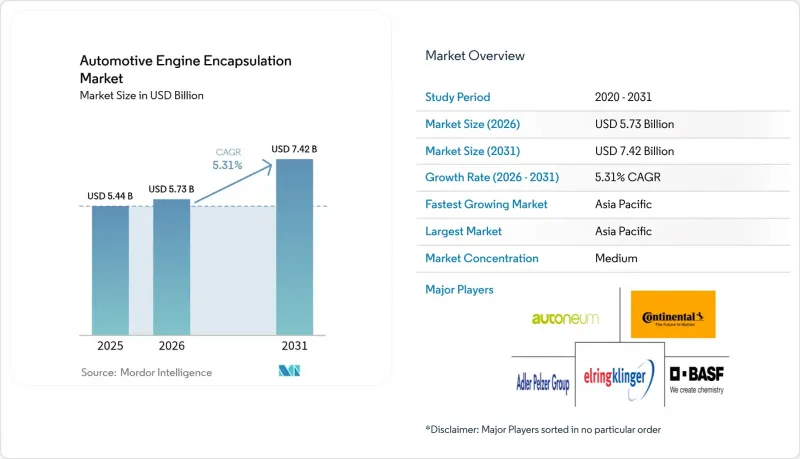
根據 Mordor Intelligence 預測,汽車引擎封裝市場將從 2025 年的 54.4 億美元成長到 2026 年的 57.3 億美元,然後在 2031 年達到 74.2 億美元,2026 年至 2031 年的複合年成長率為 5.31%。
本報告按產品類型(引擎安裝式和車身安裝式)、燃料類型(汽油、柴油等)、材料類型(碳纖維、聚氨酯等)、車輛類型(乘用車、輕型商用車等)、銷售管道(原廠配套和售後市場)以及地區(北美、南美等)進行細分。市場預測以美元計價。
全球汽車引擎封裝市場趨勢及洞察
歐盟7標準之後,冷啟動二氧化碳排放目標將更加嚴格。
歐盟7排放標準將於2026年11月起對新車生效,將合規里程延長至20萬公里,並對冷啟動排放氣體進行比以往更加嚴格的監管。汽車製造商現在需要採用封裝技術,以縮短引擎預熱時間,並在-7 度C至35 度C的寬廣環境溫度範圍內降低引擎噪音。這項需求推動了混合材料堆疊技術的發展,將碳纖維結構與相變層結合,確保在滿足排放氣體法規要求的同時,又不犧牲聲學性能。
過渡到高階品牌打造的「圖書館般安靜」的ICE列車內部環境
豪華汽車品牌的目標是將怠速時的車廂噪音降低到40分貝以下,以體現電動車的靜謐體驗。採用氣凝膠屏障的多層封裝技術,在保持隔熱性能的同時,可實現0.9或更高的降噪係數。目前,該研發項目已從引擎延伸至傳動軸通道,將整個動力傳動系統視為單一的聲源,從而打造一體化的解決方案。
純電動動力傳動系統的快速普及導致內燃機(ICE)市場佔有率下降。
預計到2030年,純電動車(BEV)在歐洲新車註冊量中佔比將超過50%,佔比為15.40%,但同時,專門用於內燃機(ICE)的封裝系統需求卻在萎縮。除非供應商將內燃機專案利潤再投資於電動車隔熱產品,否則將面臨利潤率下降的困境。
細分市場分析
到2025年,引擎安裝式機罩將主導汽車引擎機罩市場,佔51.12%的市場。這些模組由於直接安裝在動力傳動系統上,具有卓越的隔振性能,可實現快速預熱和生產線旁安裝。車身安裝式設計正以7.26%的複合年成長率成長,擴大採用更大的底盤組件進行鑄造,以方便平台整合並縮短組裝時間。
車身安裝式引擎室罩將隔音材料與結構部件整合在一起,既能密封引擎艙,又能提高車身剛性。這種設計非常適合一體式鑄造底盤,無需使用多個支架和緊固件。供應商需要開發能夠承受壓鑄熱循環且不會分層的材料。因此,預計到 2031 年,車身安裝式引擎室罩市場將穩定成長。
預計到2025年,汽油引擎將佔汽車引擎封裝市場65.20%的佔有率,這主要得益於其在全球乘用車市場的高滲透率。對於汽油引擎封裝而言,重點在於快速預熱和降低怠速噪音。
在混合動力汽車和增程器車型中,由於電池冷卻和燃燒室隔熱技術的結合,電動動力傳動系統展現出最高的複合年成長率,達到7.61%。供應商正在設計兼具雙重功能的隔熱罩:既能保護電池免受引擎溫度快速升高的影響,又能同時降低逆變器噪音。柴油引擎仍然用於扭矩需求高的應用場景,但由於後處理的複雜性,面臨成本方面的挑戰。
區域分析
預計到2025年,亞太地區將以48.10%的市佔率引領汽車引擎封裝市場,複合年成長率(CAGR)為8.18%。中國的市場主導地位源於其龐大的汽車產量和政策主導的混合動力汽車成長,即使在以電動車為中心的藍圖下,這些因素仍將維持對內燃機(ICE)封裝的需求。在印度,基於績效的獎勵鼓勵供應商進入本地封裝生產,從而提供成本競爭力和關稅優勢。
在歐洲,歐7排放標準正被用於推動先進解決方案,以排放氣體。此外,混合動力汽車的普及凸顯了內燃機(ICE)的持續重要性。碳纖維和數位孿生技術率先在該地區走向成熟,隨後在全球範圍內推廣,從而鞏固了該地區在技術領域的領先地位。北美市場正經歷穩定成長,這主要得益於SUV和皮卡車對更大功率動力傳動系統以及更堅固的隔熱隔音性能的需求。
中東、非洲和南美洲仍是新興市場。儘管這些地區依賴進口的NVH套件和CKD(全組裝套件),但隨著本地產能的成長,越來越多的供應商正在建造待開發區的工廠。總體而言,汽車引擎封裝市場正在經歷區域整合,主要集中在亞太地區的產能,而歐洲則引領全球市場接受度不斷提高的趨勢。
其他好處:
- Excel格式的市場預測(ME)表
- 3個月的分析師支持
目錄
第1章:引言
- 研究假設和市場定義
- 調查範圍
第2章:調查方法
第3章執行摘要
第4章 市場狀況
- 市場概覽
- 市場促進因素
- 自歐7標準以來,冷啟動時的二氧化碳排放目標變得更加嚴格。
- 高階品牌正朝著「像圖書館一樣安靜」的ICE車廂發展。
- 插電式混合動力汽車電池預處理的必要性
- 輕質碳纖維成本曲線的轉折點
- 千兆廣播技術可實現更大的體表封裝。
- OEM的數位孿生模型最佳化了引擎室內的熱分佈圖。
- 市場限制因素
- 純電動動力傳動系統的快速擴張正在稀釋內燃機汽車的銷售量。
- 用於聚合物泡沫的石化產品價格波動
- 多層NVH複合材料可回收性的局限性
- 小型化內燃機引擎室佈局面臨的挑戰
- 價值供應鏈分析
- 監理情勢
- 技術展望
- 波特五力模型
第5章 市場規模與成長預測
- 依產品類型
- 配備引擎的類型
- 穿戴式
- 按燃料類型
- 汽油
- 柴油引擎
- 電的
- 依材料類型
- 碳纖維
- 聚氨酯
- 聚丙烯
- 聚醯胺
- 玻璃絨
- 車輛類型
- 搭乘用車
- 輕型商用車
- 中型和重型商用車輛
- 按銷售管道
- 原廠正品零件
- 售後市場
- 地區
- 北美洲
- 美國
- 加拿大
- 其他北美國家
- 南美洲
- 巴西
- 阿根廷
- 其他南美國家
- 歐洲
- 德國
- 英國
- 法國
- 義大利
- 西班牙
- 其他歐洲國家
- 亞太地區
- 中國
- 日本
- 印度
- 韓國
- 澳洲
- 紐西蘭
- 其他亞太國家
- 中東和非洲
- 沙烏地阿拉伯
- 阿拉伯聯合大公國
- 埃及
- 土耳其
- 南非
- 其他中東和非洲國家
- 北美洲
第6章 競爭情勢
- 市場集中度
- 策略趨勢
- 市佔率分析
- 公司簡介
- Autoneum Holding AG
- Continental AG
- ElringKlinger AG
- BASF SE
- 3M Company
- Rochling Group
- Adler Pelzer Group
- Trocellen Automotive
- Woco Group
- SA Automotive
- Charlotte Baur Formschaumtechnik GmbH
- Sumitomo Riko Co. Ltd
- Sika Automotive
- Pritex Ltd
- UGN Inc.
- Langfang Sound(China)
第7章 市場機會與未來展望
According to Mordor Intelligence, the automotive engine encapsulation market size is expected to grow from USD 5.44 billion in 2025 to USD 5.73 billion in 2026 and is forecast to reach USD 7.42 billion by 2031 at 5.31% CAGR over 2026-2031.
This report is Segmented by Product Type (Engine-Mounted and Body-Mounted), Fuel Type (Gasoline, Diesel, and More), Material Type (Carbon Fiber, Polyurethane, and More), Vehicle Type (Passenger Cars, Light Commercial Vehicles, and More), Sales Channel (OEM-Fitted and Aftermarket), and Geography (North America, South America, and More). The Market Forecasts are Provided in Terms of Value (USD).
Global Automotive Engine Encapsulation Market Trends and Insights
Stricter Post-Euro 7 Cold-Start CO2 Targets
Euro 7 takes effect for new vehicle types in November 2026 and extends compliance to 200,000 km, putting cold-start emissions under unprecedented scrutiny. Automakers now need encapsulation that accelerates warm-up times and dampens engine noise across ambient ranges from -7°C to 35°C. The requirement pushes hybrid material stacks that blend carbon-fiber structures with phase-change layers, securing emission compliance without sacrificing acoustics.
Premium-Brand Shift to Library-Quiet ICE Cabins
Luxury marques target idle cabin noise below 40 dB, mirroring silent EV experiences. Multi-layer encapsulation with aerogel barriers achieves noise reduction coefficients above 0.9 while sustaining thermal insulation. Programs now extend beyond engines to transmission tunnels, treating the full powertrain as one acoustic source for a unified solution.
Rapid BEV Power-Train Mix Diluting ICE Volume
BEV penetration in new car registration across Europe hit 15.40% in 2024 and is forecast to be above 50% by 2030, shrinking demand for ICE-specific encapsulation. Suppliers must reinvest profits from declining ICE programs into EV-thermal products or face margin erosion.
Other drivers and restraints analyzed in the detailed report include:
- Battery Pre-Conditioning Needs in PHEVs
- Lightweight Carbon-Fiber Cost Curve Inflection
- Petro-Chemical Price Volatility for Polymer Foams
For complete list of drivers and restraints, kindly check the Table Of Contents.
Segment Analysis
Engine-mounted encapsulations led the automotive engine encapsulation market with a 51.12% share in 2025. These modules excel at vibration isolation because they sit directly on the power unit, enabling rapid warm-up and line-side installation. Body-mounted designs are accelerating at 7.26% CAGR and increasingly cast into large underbody sections, supporting platform consolidation and lowering assembly time.
Body-mounted encapsulation integrates acoustic barriers with structural members, improving stiffness while sealing the engine bay. This format dovetails with gigacast underbodies that eliminate multiple brackets and fasteners. Suppliers must formulate materials that tolerate die-casting thermal cycles without delamination. Consequently, the automotive engine encapsulation market size for body-mounted solutions is projected to expand steadily through 2031.
Gasoline engines accounted for 65.20% automotive engine encapsulation market size in 2025, supported by their prevalence in global passenger fleets. Encapsulation for gasoline units emphasizes rapid warm-up and idle noise suppression.
Electric powertrains exhibit the briskest 7.61% CAGR because hybrids and range-extended models blend battery cooling with combustion insulation. Suppliers engineer dual-purpose barriers that protect cells from engine heat spikes while muting inverter whine. Diesel remains for torque-intensive use cases but faces cost headwinds due to after-treatment complexity.
Complete Report Scope:
- By Product Type
- Engine-Mounted
- Body-Mounted
- By Fuel Type
- Gasoline
- Diesel
- Electric
- By Material Type
- Carbon Fiber
- Polyurethane
- Polypropylene
- Polyamide
- Glasswool
- By Vehicle Type
- Passenger Cars
- Light Commercial Vehicles
- Medium and Heavy Commercial Vehicles
- By Sales Channel
- OEM-Fitted
- Aftermarket
- Geography
- North America
- United States
- Canada
- Rest of North America
- South America
- Brazil
- Argentina
- Rest of South America
- Europe
- Germany
- United Kingdom
- France
- Italy
- Spain
- Rest of Europe
- Asia-Pacific
- China
- Japan
- India
- South Korea
- Australia
- New Zealand
- Rest of Asia-Pacific
- Middle East and Africa
- Saudi Arabia
- United Arab Emirates
- Egypt
- Turkey
- South Africa
- Rest of Middle East and Africa
- North America
Geography Analysis
Asia-Pacific led the automotive engine encapsulation market with 48.10% share in 2025 and is advancing at 8.18% CAGR. China's dominance derives from vast vehicle output and policy-driven hybrid growth that prolongs ICE encapsulation demand even in an EV-centric roadmap. India's production-linked incentives lure suppliers to localize encapsulation, combining cost competitiveness with duty advantages.
Europe is leveraging Euro 7 regulations to drive advanced solutions for cold-start emissions. This, coupled with the widespread adoption of hybrids, underscores the continued relevance of internal combustion engines (ICE). Carbon-fiber and digital-twin tools mature here first, then migrate globally, reinforcing the region's thought leadership. North America grows steadily on the back of SUV and pickup sales that use larger powertrains, which need robust thermal-acoustic barriers.
The Middle East and Africa, and South America, remain emerging pockets. They rely on imported NVH kits or CKD assembly, yet rising local output attracts suppliers establishing greenfield plants. Altogether, the automotive engine encapsulation market continues regional consolidation around APAC capacity while Europe drives specification trends embraced worldwide.
- Autoneum Holding AG
- Continental AG
- ElringKlinger AG
- BASF SE
- 3M Company
- Rochling Group
- Adler Pelzer Group
- Trocellen Automotive
- Woco Group
- SA Automotive
- Charlotte Baur Formschaumtechnik GmbH
- Sumitomo Riko Co. Ltd
- Sika Automotive
- Pritex Ltd
- UGN Inc.
- Langfang Sound (China)
Additional Benefits:
- The market estimate (ME) sheet in Excel format
- 3 months of analyst support
TABLE OF CONTENTS
1 Introduction
- 1.1 Study Assumptions & Market Definition
- 1.2 Scope of the Study
2 Research Methodology
3 Executive Summary
4 Market Landscape
- 4.1 Market Overview
- 4.2 Market Drivers
- 4.2.1 Stricter post-Euro 7 cold-start CO2 targets
- 4.2.2 Premium-brand shift to "library-quiet" ICE cabins
- 4.2.3 Battery pre-conditioning needs in PHEVs
- 4.2.4 Lightweight carbon-fiber cost curve inflection
- 4.2.5 Gigacasting enabling larger body-mounted encapsulations
- 4.2.6 OEM digital twins optimising under-hood thermal maps
- 4.3 Market Restraints
- 4.3.1 Rapid BEV power-train mix diluting ICE volumes
- 4.3.2 Petro-chemical price volatility for polymer foams
- 4.3.3 Limited recyclability of multi-layer NVH composites
- 4.3.4 Engine-bay packaging conflicts in downsized ICEs
- 4.4 Value / Supply-Chain Analysis
- 4.5 Regulatory Landscape
- 4.6 Technological Outlook
- 4.7 Porter's Five Forces
- 4.7.1 Threat of New Entrants
- 4.7.2 Bargaining Power of Buyers / Consumers
- 4.7.3 Bargaining Power of Suppliers
- 4.7.4 Threat of Substitute Products
- 4.7.5 Intensity of Competitive Rivalry
5 Market Size & Growth Forecasts (Value in USD)
- 5.1 By Product Type
- 5.1.1 Engine-Mounted
- 5.1.2 Body-Mounted
- 5.2 By Fuel Type
- 5.2.1 Gasoline
- 5.2.2 Diesel
- 5.2.3 Electric
- 5.3 By Material Type
- 5.3.1 Carbon Fiber
- 5.3.2 Polyurethane
- 5.3.3 Polypropylene
- 5.3.4 Polyamide
- 5.3.5 Glasswool
- 5.4 By Vehicle Type
- 5.4.1 Passenger Cars
- 5.4.2 Light Commercial Vehicles
- 5.4.3 Medium and Heavy Commercial Vehicles
- 5.5 By Sales Channel
- 5.5.1 OEM-Fitted
- 5.5.2 Aftermarket
- 5.6 Geography
- 5.6.1 North America
- 5.6.1.1 United States
- 5.6.1.2 Canada
- 5.6.1.3 Rest of North America
- 5.6.2 South America
- 5.6.2.1 Brazil
- 5.6.2.2 Argentina
- 5.6.2.3 Rest of South America
- 5.6.3 Europe
- 5.6.3.1 Germany
- 5.6.3.2 United Kingdom
- 5.6.3.3 France
- 5.6.3.4 Italy
- 5.6.3.5 Spain
- 5.6.3.6 Rest of Europe
- 5.6.4 Asia-Pacific
- 5.6.4.1 China
- 5.6.4.2 Japan
- 5.6.4.3 India
- 5.6.4.4 South Korea
- 5.6.4.5 Australia
- 5.6.4.6 New Zealand
- 5.6.4.7 Rest of Asia-Pacific
- 5.6.5 Middle East and Africa
- 5.6.5.1 Saudi Arabia
- 5.6.5.2 United Arab Emirates
- 5.6.5.3 Egypt
- 5.6.5.4 Turkey
- 5.6.5.5 South Africa
- 5.6.5.6 Rest of Middle East and Africa
- 5.6.1 North America
6 Competitive Landscape
- 6.1 Market Concentration
- 6.2 Strategic Moves
- 6.3 Market Share Analysis
- 6.4 Company Profiles (Includes Global Level Overview, Market Level Overview, Core Segments, Financials as Available, Strategic Information, Market Rank/Share for Key Companies, Products and Services, SWOT Analysis, and Recent Developments)
- 6.4.1 Autoneum Holding AG
- 6.4.2 Continental AG
- 6.4.3 ElringKlinger AG
- 6.4.4 BASF SE
- 6.4.5 3M Company
- 6.4.6 Rochling Group
- 6.4.7 Adler Pelzer Group
- 6.4.8 Trocellen Automotive
- 6.4.9 Woco Group
- 6.4.10 SA Automotive
- 6.4.11 Charlotte Baur Formschaumtechnik GmbH
- 6.4.12 Sumitomo Riko Co. Ltd
- 6.4.13 Sika Automotive
- 6.4.14 Pritex Ltd
- 6.4.15 UGN Inc.
- 6.4.16 Langfang Sound (China)
7 Market Opportunities & Future Outlook
- 7.1 White-space & Unmet-Need Assessment

 汽車引擎封裝市場:2026-2032年全球市場預測(按產品、材料、技術、引擎類型、製造流程、車輛類型和應用分類)
 2026年全球引擎封裝市場報告
 汽車引擎封裝市場規模、佔有率、成長及全球產業分析:按類型、應用和地區分類的洞察,2026-2034 年預測全球汽車引擎封裝市場規模、佔有率、趨勢和成長分析報告(2026-2034)
 2025-2029年全球汽車引擎封裝市場
 汽車引擎封裝市場規模、佔有率及成長分析(按材料、燃料類型、產品類型及地區分類)-2026-2033年產業預測
 汽車引擎封裝市場-全球產業規模、佔有率、趨勢、機會和預測,按類型、材料、車輛類型、地區和競爭格局分類,2020-2030年預測
 汽車引擎封裝市場機會、成長動力、產業趨勢分析與預測 2024 - 2032