


 |
市場調查報告書
商品編碼
2114183
加工油:市場佔有率分析、產業趨勢與統計、成長預測(2026-2031)Process Oils - Market Share Analysis, Industry Trends & Statistics, Growth Forecasts (2026 - 2031) |
||||||

※ 本網頁內容可能與最新版本有所差異。詳細情況請與我們聯繫。
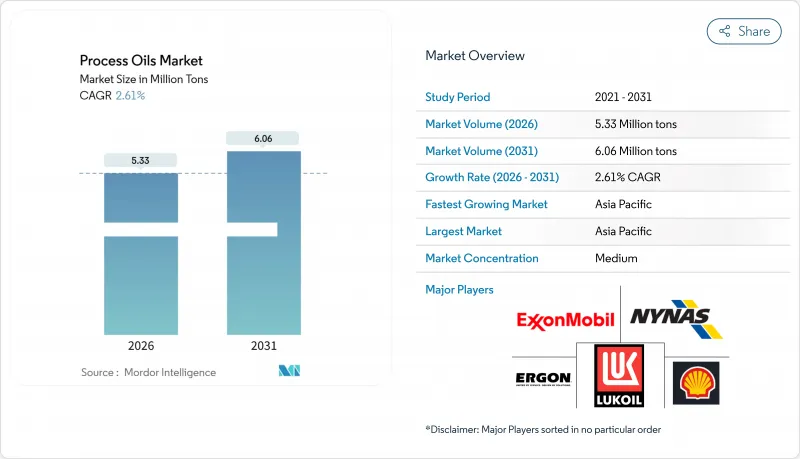
據 Mordor Intelligence 稱,2026 年加工油市場規模估計為 533 萬噸,預計在預測期(2026-2031 年)內將以 2.61% 的複合年成長率成長,到 2031 年達到 606 萬噸。
本報告按類型(芳香族、石蠟族、環烷族)、應用(橡膠、聚合物、個人護理、紡織品及其他應用)和地區(亞太地區、北美地區、歐洲地區、南美地區以及中東和非洲地區)進行細分。市場預測以噸為單位。
全球加工油市場趨勢與洞察
提高聚合物和合成橡膠產能的進展
贏創在上海新建並已運作的聚丁二烯生產廠,提升了自身對低黏度加工油的需求。同時,陶氏化學的運轉率顯示市場供應緊張,這促使其與綜合煉油廠簽訂多年期供應契約,以擴大產能。由於溶液聚合橡膠配方對環烷烴油溶解性的要求更高,環烷烴油的市場佔有率正在不斷成長,而亞洲生產商則透過利用位置原料來確保利潤率。這些趨勢正在擴大加工油市場的潛在基本客群,並推動中期成長。沒有自有基礎油生產線的綜合煉油廠正面臨價差收窄的困境,並轉向專業細分市場或進口策略。
高性能輪胎配方的需求增加
中國輪胎生產正經歷顯著成長,高階子午線輪胎的每種配方中都添加了加工油,這表明市場需求強勁。高階市場正在推廣使用二氧化矽降低滾動阻力的「綠色」輪胎,但這些創新依賴於加工分餾芳烴萃取物(TDAE)或生物基替代品。這些替代品必須符合多環芳烴(PAH)限值,目前已被全球整車製造商(OEM)採用。同時,在南亞和非洲,價格更實惠的芳烴提取物仍然是斜交輪胎和非公路輪胎的首選。這種選擇不僅凸顯了地理套利,也增強了這些地區現有的產能。隨著輪胎配方的不斷發展,將引入更廣泛的等級要求,這將使加工油市場與汽車行業的發展趨勢緊密相連。
歐盟和北美對芳香族萃取物有嚴格的多環芳烴法規。
由於REACH法規附件XVII禁止使用苯並[a]芘和總多環芳烴含量超過指定閾值的加工油,輪胎製造商被迫放棄傳統的萃取物。為因應這些措施,北美監管機構也透過加州法規設定了類似的閾值。這種監管協調,加上殼牌公司計劃於2025年關閉其位於佩爾尼斯的芳烴部門,以及埃克森美孚公司計劃於2023年撤出其位於博蒙特的工廠,導致符合標準的TDAE(三環芳烴衍生物)供應減少。因此,TDAE的現貨價格上漲,給對成本敏感的混煉油商帶來壓力,並阻礙了加工油市場的短期成長。
細分市場分析
預計到2025年,環烷烴類油將佔加工油市場佔有率的44.28%,年複合成長率達6.03%,兼具規模和成長率,實屬難得。其環烷烴結構賦予其低溫流動性和高溶解能力,使其成為電動車金屬加工液和超低多環芳烴輪胎胎面液的理想選擇。石蠟基油滿足橡膠和聚合物產業對中級油的需求,而芳烴油在監管相對寬鬆的亞太地區,在斜交輪胎和瀝青應用領域也佔據著一定地位。
Ninus、Ergon 和 Calmet 等公司正投資建設應用實驗室,與輪胎製造商合作開發環烷烴解決方案,並簽署了長期合約以避免原油價格波動的影響。儘管豐富的 II 類和 III 類石蠟基原料使石蠟油價格保持競爭力,但商品化進程正在推進,利潤率正在下降。如果中國和印度在本十年後半期採用與歐盟相同的多環芳烴 (PAH) 標準,大量芳烴需求可能會消失,這可能導致韓國和泰國的資產閒置。這些相互矛盾的趨勢使得加工油市場波動不定,有利於那些柔軟性的生產商。
區域分析
預計到2025年,亞太地區將佔加工油市場規模的66.06%,並在2031年之前以2.94%的複合年成長率成長。茂名、大連和金陵的綜合油廠同時生產基礎油和加工油,為中石化和中石油提供了交付的成本優勢。中國輪胎生產消耗大量石油。由於商用車尺寸的不斷增大,印度的石油需求也在成長;而韓國和日本則向電子和製藥業出口優質白油。鑑於該地區原料供應穩定且營運規模龐大,其市場佔有率可能進一步小幅上升,從而鞏固其在全球加工油市場的主導地位。
由於博蒙特、埃爾塞貢多和舊金山的I類工廠關閉,北美年產能下降,面臨結構性供不應求。卡魯梅特、HF Sinclair和Ergon等公司目前接近滿載運作,但現貨市場的供不應求推高了TDAE的價格。來自韓國的進口有助於填補供不應求,但高昂的運費擠壓了買家的利潤空間。加拿大基礎油選擇有限,這意味著它將繼續依賴進口,這將限制加工油市場供應的成長。
歐洲也出現了類似的趨勢。儘管米其林和大陸集團對輪胎的需求強勁,但殼牌佩爾尼斯工廠的關閉和道達爾貢弗萊維爾工廠的改造卻導致供應趨緊。 REACH法規中關於多環芳烴(PAH)的排放要求加速了氫化處理的環烷烴和石烷烴的轉變,推高了平均價格。南美洲、中東和非洲市場規模雖小規模,但成長迅速,這得益於中國輪胎製造商在巴西和南非建廠。從運輸成本的角度來看,本地供應具有吸引力,巴西石油公司和沙索公司正在投資以獲取加工油市場的區域市場佔有率。
其他好處:
- Excel格式的市場預測(ME)表
- 3個月的分析師支持
目錄
第1章:引言
- 研究假設和市場定義
- 調查範圍
第2章:調查方法
第3章執行摘要
第4章 市場狀況
- 市場概覽
- 市場促進因素
- 提高聚合物和合成橡膠的生產能力
- 高性能輪胎配方帶來的需求增加
- 環烷油在電動車製造切削液的廣泛應用
- 使用白加工油的個人保健產品激增。
- 過渡到使用氫化處理加工油的超低VOC印刷油墨
- 市場限制因素
- 歐盟和北美對芳香族萃取物中的多環芳烴含量有嚴格的規定。
- 由於一級基礎油煉廠停產,原料供應趨於緊張。
- 與原油和基礎油裂解價差相關的價格波動
- 價值鏈分析
- 波特五力模型
第5章 市場規模與成長預測
- 按類型
- 芳香
- 石蠟基
- 萘
- 透過使用
- 橡皮
- 聚合物
- 個人護理
- 紡織品
- 其他用途
- 按地區
- 亞太地區
- 中國
- 印度
- 日本
- 韓國
- 東南亞國協
- 其他亞太國家
- 北美洲
- 美國
- 加拿大
- 墨西哥
- 歐洲
- 德國
- 英國
- 法國
- 義大利
- 西班牙
- 俄羅斯
- 其他歐洲國家
- 南美洲
- 巴西
- 阿根廷
- 其他南美國家
- 中東和非洲
- 沙烏地阿拉伯
- 南非
- 其他中東和非洲國家
- 亞太地區
第6章 競爭情勢
- 市場集中度
- 策略趨勢
- 市佔率和排名分析
- 公司簡介
- Calumet, Inc.
- Chevron Corporation
- China Petroleum & Chemical Corporation.
- ENEOS Corporation
- Ergon Inc.
- Exxon Mobil Corporation
- H&R GROUP
- HF Sinclair Corporation
- Idemitsu Kosan Co. Ltd.
- LUKOIL
- Neste
- Nynas AB
- ORGKHIM Biochemical Holding
- Panama Petrochem Ltd.
- PetroChina
- PETRONAS Lubricants International
- Phillips 66 Company
- SEOJIN CHEMICAL CO.,LTD.
- Shell plc
- TotalEnergies SE
第7章 市場機會與未來展望
According to Mordor Intelligence, the process oils market size is estimated at 5.33 million tons in 2026, and is expected to reach 6.06 million tons by 2031, at a CAGR of 2.61% during the forecast period (2026-2031).
This report is Segmented by Type (Aromatic, Paraffinic, and Naphthenic), Application (Rubber, Polymers, Personal Care, Textile, and Other Applications), and Geography (Asia-Pacific, North America, Europe, South America, and Middle-East and Africa). The Market Forecasts are Provided in Terms of Volume (Tons).
Global Process Oils Market Trends and Insights
Rising Polymer And Synthetic Rubber Capacity Additions
Evonik's new polybutadiene unit in Shanghai, which came online recently, has boosted the captive demand for low-viscosity process oils. Meanwhile, Dow's utilization rate indicates a tightening market, prompting debottlenecking efforts linked to multi-year supply contracts with integrated refiners. Naphthenic grades gain share as solution-polymerized rubber formulas need superior solvency, and Asian producers leverage co-located feedstock to secure margins. These dynamics enlarge the addressable base for the process oil market, reinforcing mid-term growth. Merchant refiners without captive base oil streams face thinner spreads, pushing them toward specialty niches or import strategies.
Elevated Demand From High-Performance Tire Formulations
China's tire production has seen significant growth, with premium radial categories incorporating process oils per compound, signaling strong demand. While premium segments embrace "green" tires, which utilize silica to reduce rolling resistance, these innovations hinge on treated distillate aromatic extract (TDAE) or bio-based substitutes. These substitutes must adhere to a PAH ceiling, a benchmark now adopted by global OEMs. Meanwhile, in South Asia and Africa, bias-ply and off-road tires continue to favor more affordable aromatic extracts. This choice not only highlights a geographic arbitrage but also bolsters legacy capacities in those regions. As tire formulations evolve, they introduce a broader spectrum of grade requirements, ensuring the process oil market remains closely tied to the automotive industry's rhythms.
Stringent PAH Limits On Aromatic Extracts In EU And North America
In response to REACH Annex XVII's ban on process oils containing benzo[a]pyrene and total PAHs above specified thresholds, tire companies have been forced to move away from conventional extracts. Echoing these measures, North American regulators, via California statutes, set similar thresholds. This regulatory alignment, coupled with Shell's 2025 closure of its Pernis aromatics unit and ExxonMobil's 2023 exit from Beaumont, has led to a diminished supply of compliant TDAE. Consequently, spot TDAE prices increased, putting pressure on cost-sensitive compounders and stifling short-term growth in the process oil market.
Other drivers and restraints analyzed in the detailed report include:
- Growth Of Naphthenic Oils In Metal-Working Fluids For EV Manufacturing
- Surging Personal-Care Formulations Using White Process Oils
- Group I Base-Oil Refinery Shutdowns Tightening Feedstock Supply
For complete list of drivers and restraints, kindly check the Table Of Contents.
Segment Analysis
Naphthenic grades held 44.28% of the process oil market share in 2025 and are growing at a 6.03% CAGR, a rare blend of scale and velocity. Their cycloparaffinic structure delivers low-temperature fluidity and high solvency, making them indispensable in EV metal-working fluids and ultra-low-PAH tire treads. Paraffinic oils fill mid-range needs in rubber and polymers, while aromatic oils retain a foothold in bias-ply tires and asphalt in Asia-Pacific where enforcement is looser.
Nynas, Ergon, and Calumet are investing in application labs to co-develop naphthenic solutions with tire makers, locking in long contracts that buffer them from crude swings. Abundant Group II and III paraffinic feedstock keeps paraffinic prices competitive, yet commoditization erodes margins. Should China and India adopt EU-equivalent PAH norms later this decade, significant aromatic demand could vanish, stranding assets in South Korea and Thailand. These cross-currents keep the process oil market fluid, rewarding flexible producers.
Complete Report Scope:
- By Type
- Aromatic
- Paraffinic
- Naphthenic
- By Application
- Rubber
- Polymers
- Personal Care
- Textile
- Other Applications
- By Geography
- Asia-Pacific
- China
- India
- Japan
- South Korea
- ASEAN Countries
- Rest of Asia-Pacific
- North America
- United States
- Canada
- Mexico
- Europe
- Germany
- United Kingdom
- France
- Italy
- Spain
- Russia
- Rest of Europe
- South America
- Brazil
- Argentina
- Rest of South America
- Middle-East and Africa
- Saudi Arabia
- South Africa
- Rest of Middle-East and Africa
- Asia-Pacific
Geography Analysis
Asia-Pacific held 66.06% of the process oil market size in 2025 and is poised for a 2.94% CAGR through 2031. Integrated complexes at Maoming, Dalian, and Jinling co-produce base oils and process oils, giving Sinopec and PetroChina a delivered-cost edge. China's tire production consumes a significant amount of oil. Indian demand is rising as commercial fleets upsize, while South Korea and Japan export premium white oils for electronics and pharma niches. The region's feedstock security and scale suggest its share could even inch higher, cementing leadership in the global process oil market.
After Group I closures at Beaumont, El Segundo, and San Francisco reduced annual capacity, North America grapples with structural shortages. While Calumet, HF Sinclair, and Ergon operate near full capacity, spot shortfalls have driven TDAE prices up. Although imports from South Korea help fill the void, they come with a hefty freight cost, squeezing buyer margins. With Canada boasting a smaller base-oil slate, its reliance on imports is set to continue, curbing volume growth in the process oil market.
Europe mirrors this pattern: Shell's Pernis shutdown and Total's Gonfreville conversion tightened supply even as tire demand from Michelin and Continental stayed firm. Compliance with REACH PAH limits has accelerated the move to hydro-treated paraffinic and naphthenic grades, lifting average unit values. South America and the Middle-East and Africa remain slender but rising outlets, thanks to Chinese tire manufacturers establishing plants in Brazil and South Africa. Freight economics make localized supply attractive, inviting investments by Petrobras and Sasol to capture regional slices of the process oil market.
- Calumet, Inc.
- Chevron Corporation
- China Petroleum & Chemical Corporation.
- ENEOS Corporation
- Ergon Inc.
- Exxon Mobil Corporation
- H&R GROUP
- HF Sinclair Corporation
- Idemitsu Kosan Co. Ltd.
- LUKOIL
- Neste
- Nynas AB
- ORGKHIM Biochemical Holding
- Panama Petrochem Ltd.
- PetroChina
- PETRONAS Lubricants International
- Phillips 66 Company
- SEOJIN CHEMICAL CO.,LTD.
- Shell plc
- TotalEnergies SE
Additional Benefits:
- The market estimate (ME) sheet in Excel format
- 3 months of analyst support
TABLE OF CONTENTS
1 Introduction
- 1.1 Study Assumptions and Market Definition
- 1.2 Scope of the Study
2 Research Methodology
3 Executive Summary
4 Market Landscape
- 4.1 Market Overview
- 4.2 Market Drivers
- 4.2.1 Rising polymer and synthetic rubber capacity additions
- 4.2.2 Elevated demand from high-performance tire formulations
- 4.2.3 Growth of naphthenic oils in metal-working fluids for EV manufacturing
- 4.2.4 Surging personal-care formulations using white process oils
- 4.2.5 Shift to ultra-low VOC printing inks using hydro-treated process oils
- 4.3 Market Restraints
- 4.3.1 Stringent PAH limits on aromatic extracts in European Union and North America
- 4.3.2 Group I base-oil refinery shutdowns tightening feedstock supply
- 4.3.3 Price volatility linked to crude and base-oil crack spreads
- 4.4 Value Chain Analysis
- 4.5 Porter's Five Forces
- 4.5.1 Bargaining Power of Suppliers
- 4.5.2 Bargaining Power of Buyers
- 4.5.3 Threat of New Entrants
- 4.5.4 Threat of Substitutes
- 4.5.5 Degree of Competition
5 Market Size and Growth Forecasts (Volume)
- 5.1 By Type
- 5.1.1 Aromatic
- 5.1.2 Paraffinic
- 5.1.3 Naphthenic
- 5.2 By Application
- 5.2.1 Rubber
- 5.2.2 Polymers
- 5.2.3 Personal Care
- 5.2.4 Textile
- 5.2.5 Other Applications
- 5.3 By Geography
- 5.3.1 Asia-Pacific
- 5.3.1.1 China
- 5.3.1.2 India
- 5.3.1.3 Japan
- 5.3.1.4 South Korea
- 5.3.1.5 ASEAN Countries
- 5.3.1.6 Rest of Asia-Pacific
- 5.3.2 North America
- 5.3.2.1 United States
- 5.3.2.2 Canada
- 5.3.2.3 Mexico
- 5.3.3 Europe
- 5.3.3.1 Germany
- 5.3.3.2 United Kingdom
- 5.3.3.3 France
- 5.3.3.4 Italy
- 5.3.3.5 Spain
- 5.3.3.6 Russia
- 5.3.3.7 Rest of Europe
- 5.3.4 South America
- 5.3.4.1 Brazil
- 5.3.4.2 Argentina
- 5.3.4.3 Rest of South America
- 5.3.5 Middle-East and Africa
- 5.3.5.1 Saudi Arabia
- 5.3.5.2 South Africa
- 5.3.5.3 Rest of Middle-East and Africa
- 5.3.1 Asia-Pacific
6 Competitive Landscape
- 6.1 Market Concentration
- 6.2 Strategic Moves
- 6.3 Market Share/Ranking Analysis
- 6.4 Company Profiles {(includes Global level Overview, Market level overview, Core Segments, Financials as available, Strategic Information, Market Rank/Share for key companies, Products and Services, and Recent Developments)}
- 6.4.1 Calumet, Inc.
- 6.4.2 Chevron Corporation
- 6.4.3 China Petroleum & Chemical Corporation.
- 6.4.4 ENEOS Corporation
- 6.4.5 Ergon Inc.
- 6.4.6 Exxon Mobil Corporation
- 6.4.7 H&R GROUP
- 6.4.8 HF Sinclair Corporation
- 6.4.9 Idemitsu Kosan Co. Ltd.
- 6.4.10 LUKOIL
- 6.4.11 Neste
- 6.4.12 Nynas AB
- 6.4.13 ORGKHIM Biochemical Holding
- 6.4.14 Panama Petrochem Ltd.
- 6.4.15 PetroChina
- 6.4.16 PETRONAS Lubricants International
- 6.4.17 Phillips 66 Company
- 6.4.18 SEOJIN CHEMICAL CO.,LTD.
- 6.4.19 Shell plc
- 6.4.20 TotalEnergies SE
7 Market Opportunities and Future Outlook
- 7.1 White-space and Unmet-need Assessment

 加工油市場:2026-2032年全球市場預測(依產品類型、原料、功能、黏度等級、應用、最終用途產業及銷售管道)
 石油加工市場預測-按產品類型、煉製方法、技術、應用和地區分類的全球分析-2034年
 全球加工油市場按類型、應用、功能和地區分類-預測(至2030年)
 2026年全球加工油市場報告
 加工油市場規模、佔有率和成長分析(按類型、功能、生產技術、應用和地區分類)-2026-2033年產業預測
 加工油的全球市場 (~2035年):油類型·生產技術·用途·終端用戶·流通管道·各地區
 全球加工油市場,2024-2031年
 工藝油市場-全球產業規模、佔有率、趨勢、機會和預測,按類型、功能、應用、生產技術、地區和競爭細分,2020-2030 年
 全球加工油市場:產業分析、規模、佔有率、成長、趨勢、預測(2024-2031)