


 |
市場調查報告書
商品編碼
2114141
LED封裝:市場佔有率分析、產業趨勢與統計、成長預測(2026-2031年)LED Encapsulation - Market Share Analysis, Industry Trends & Statistics, Growth Forecasts (2026 - 2031) |
||||||

※ 本網頁內容可能與最新版本有所差異。詳細情況請與我們聯繫。
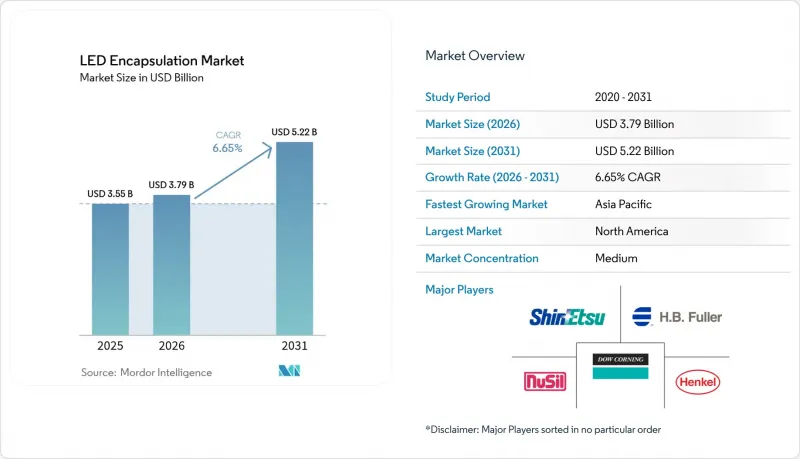
據 Mordor Intelligence 稱,LED封裝市場預計到 2026 年價值 37.9 億美元,高於 2025 年的 35.5 億美元,預計到 2031 年將達到 52.2 億美元。
預計從 2026 年到 2031 年,其複合年成長率將達到 6.65%。
本報告封裝(環氧樹脂、矽膠、聚氨酯、丙烯酸酯及其他封裝)、 LED構裝類型(板載晶片(COB)、表面黏著型元件(SMD)、晶片級封裝 (CSP)、迷你/微型LED模組等)、最終用途(汽車、家用電子電器、工業/戶外/園藝等)和地區進行細分。市場預測以美元計價。
全球LED封裝市場趨勢及洞察
高功率LED在一般照明領域的廣泛應用
如今,取代金屬鹵化物燈具的商用照明燈具的光效已超過每瓦150流明。這要求封裝材料配方能夠在晶片溫度超過120 度C的環境下保持50,000小時以上的光學透明度。 DesignLights聯盟的規定要求即使在36,000小時後,光通量保持率仍需超過90%,這實際上排除了易泛黃的環氧樹脂基系統。陶氏化學的免底塗DOWSIL EI-2888符合UL 94標準,並可在室溫下固化,有助於照明製造商縮短組裝週期。美國和歐洲鼓勵採用高效可調光白光照明的能源法規持續推動對矽酮的需求。此外,磷光體轉換的白光LED需要不析硫且能保持晝夜節律照明程序所需顏色穩定性的封裝材料。
汽車LED照明系統加速普及
自我調整遠光燈和矩陣式頭燈已成為歐洲和亞洲許多中檔車型的標準配置,例如ams OSRAM的25,600像素“EVIYOS 2.0”模組,該模組被應用於大眾和歐寶平台。日亞化學的「µPLS」將16,384個微型LED整合在由Pholbia Hella選定的ASIC驅動器上,需要使用導熱係數超過1.0 W/m*K的封裝,以承受-40 度C至+125 度C的溫度循環。首爾半導體的WICOP無線LED將系統效率提升至240 lm/W,並減少了每流明尾燈組件和封裝的體積。聯合國R-123標準和SAE J2650光度標準對無眩光光束的監管要求正在推動LED的普及,並將持續支撐LED封裝市場直至2030年。
矽酮和環氧樹脂原料價格的波動
信越化學將於2024年7月起將矽油價格至少上調10%,而海克斯昂將於2024年1月起將環氧樹脂價格每磅上調0.10美元。這給中型封裝生產商的利潤率帶來了壓力。陶氏化學高性能材料與塗料部門2023年的淨銷售額下降了21%,至84.97億美元,反映出供應過剩和需求疲軟。化合物生產商正在將成本更低的聚氨酯和丙烯酸類化學品應用於一些非關鍵性應用中,並與LED構裝製造商協商成本轉嫁條款,以減輕價格波動的影響。
細分市場分析
預計到2025年,矽酮封裝將在LED封裝市場佔據55.30%的市場佔有率,其複合年成長率(CAGR)將達到7.52%,超過環氧樹脂和聚氨酯。這主要得益於矽酮超過180°C的耐熱性和超過5萬小時的90%以上的紫外線透過率。信越化學已撥款1800億日圓(約12.4億美元)用於拓展其在日本和泰國的矽酮業務,重點發展LED構裝和環保產品。環氧樹脂在其旗艦低功率LED領域仍保持一定的地位,但在藍光成分豐富的頻譜會加速光氧化的領域,其市佔率持續下滑。聚氨酯在對成本要求較高的條形LED應用中不斷成長,但其易受潮性限制了其發展。丙烯酸樹脂因其快速的紫外線固化性能,在軟性條形LED應用中佔據了一席之地。
陶氏化學計畫於2025年推出DOWSIL EG-4175凝膠,該產品標誌著超高溫矽橡膠的轉型,具備自修復和免底塗黏合性能,可簡化組裝流程,並確保在180 度C下介電可靠性。艾爾科姆上海生產線正在將其導熱矽橡膠的年產能提高1500噸,以搶佔與高功率LED日益融合的電子產品和電池模組市場。
到2025年,「板上晶片封裝」( 板載晶片-on -Board)將佔據LED封裝市場38.10%的佔有率,並因其每瓦成本效益高而在高流明照明燈具中備受青睞。同時,「晶片級封裝(CSP)」正以7.05%的複合年成長率快速成長,三星計劃在2024年第三季出貨15億個CSP,以滿足智慧型手機和環境照明的需求。 CSP無需導線架和焊線,可將封裝高度降低至0.5毫米以下,從而實現更窄的邊框設計。此外,自我調整頭燈和平板電腦背光中mini-LED和micro-LED的廣泛應用,也增加了對低熱膨脹係數(CTE)和低釋氣封裝的需求,以保護量子點顏色轉換器。
首爾半導體公司的WICOP架構提高了發光效率,並減少了每流明所需的封裝用量。歐司朗公司的高像素密度產品「EVIYOS 2.0」和日亞化學公司的「µPLS」封裝,以防止在-40 度C至+125 度C的溫度循環中發生分層。
區域分析
預計到2025年,北美將佔據LED封裝市場38.30%的佔有率。這部分歸功於《晶片與科學法案》下2,310億美元的經濟獎勵策略,該計劃正推動供應鏈回流北美。由於預計對中國進口產品徵收60%的關稅, LED構裝製造商正根據美墨加協定(USMCA)的條款在墨西哥和加拿大擴大產能。隨著美國汽車製造商(OEM)將自我調整遠光燈技術應用於其主流車型,汽車LED的需求正在加速成長,而鄰近地區的封裝生產則降低了運輸和關稅成本。
亞太地區預計將繼續保持其作為製造地的強勁地位,年複合成長率將達到7.16%。中國佔全球LED晶片產量的70%,而印尼和越南則受惠於多元化的供應鏈。此外,印度的生產連結獎勵計畫計畫(PLI)正在推動國內零件生產線的擴張。日本和韓國在研發領域處於領先地位,瓦克化學對特種矽酮的投資就是一個例證。
在歐洲,基於「2019/2020生態設計」的嚴格能效和可回收性法規正在實施,這導致對無需底塗、低VOC(揮發性有機化合物)矽酮的需求增加。高解析度車頭燈在德國佔據主導地位,而拉丁美洲對需要耐高溫封裝的園藝照明燈具的需求正在成長。南美市場雖然規模仍然較小,但在巴西現有設施的維修推動下,市場持續成長。在非洲和中東,高效照明燈具正作為智慧城市和離網太陽能發電計畫的一部分進行部署,這為能夠承受沙漠高溫和強烈紫外線輻射的封裝創造了一個利基市場。
其他好處:
- Excel格式的市場預測(ME)表
- 3個月的分析師支持
目錄
第1章:引言
- 研究假設和市場定義
- 調查範圍
第2章:調查方法
第3章執行摘要
第4章 市場狀況
- 市場概覽
- 市場促進因素
- 高功率LED在通用照明領域的應用率不斷提高。
- 汽車LED照明系統加速普及
- 家用電子電器。
- UV-C/UV-B LED 模組需求激增,需要高透明度的封裝
- 根據2025年關稅制度,封裝材料供應鏈的近岸外包
- 園藝和農業技術照明技術的發展,實現了90 度C的連續結溫
- 市場限制因素
- 矽膠和環氧樹脂原料價格波動
- OLED在高階顯示器領域的應用率不斷提高
- 藍光輸出密度增加引發可靠性擔憂
- 歐盟和加州對揮發性有機化合物和微矽氧烷的釋放有嚴格的規定。
- 產業價值鏈分析
- 監理情勢
- 技術展望
- 波特五力分析
第5章 市場規模與成長預測
- 透過封裝
- 環氧樹脂
- 矽酮
- 聚氨酯
- 丙烯酸封裝
- LED構裝類型
- 板載晶片(COB)
- 表面黏著技術裝置(SMD)
- 晶片級封裝(CSP)
- 迷你/微型LED模組
- 按最終用途
- 汽車照明
- 家用電子電器和顯示器
- 建築和商業照明
- 工業及戶外用途/園藝
- 透過固化技術
- 熱固性樹脂(熱固型)
- UV/LED光固化
- 雙重固化系統
- 室溫硫化(RTV)
- 按地區
- 北美洲
- 美國
- 加拿大
- 南美洲
- 巴西
- 墨西哥
- 阿根廷
- 其他南美國家
- 歐洲
- 德國
- 英國
- 法國
- 義大利
- 其他歐洲國家
- 亞太地區
- 中國
- 日本
- 印度
- 韓國
- 其他亞太國家
- 中東和非洲
- 中東
- 阿拉伯聯合大公國
- 沙烏地阿拉伯
- 其他中東國家
- 非洲
- 南非
- 奈及利亞
- 其他非洲國家
- 中東
- 北美洲
第6章 競爭情勢
- 市場集中度分析
- 戰略措施和投資
- 市佔率分析
- 公司簡介
- Dow Inc.
- DuPont de Nemours, Inc.
- Wacker Chemie AG
- Shin-Etsu Chemical Co., Ltd.
- Momentive Performance Materials Inc.
- Henkel AG and Co. KGaA
- HB Fuller Company
- Panasonic Holdings Corporation
- Elkem ASA
- Nagase and Co., Ltd.
- NuSil Technology LLC
- Epic Resins
- Intertronics Ltd.
- Momentive Performance Materials Inc.
- Citizen Electronics Co., Ltd.
- OSRAM Licht AG
- Nichia Corporation
- Seoul Semiconductor Co., Ltd.
- Cree LED(SG Hldg.)
- Everlight Electronics Co., Ltd.
- Sumitomo Bakelite Co., Ltd.
- 3M Company
第7章 市場機會與未來展望
According to Mordor Intelligence, lED encapsulation market size in 2026 is estimated at USD 3.79 billion, growing from 2025 value of USD 3.55 billion with 2031 projections showing USD 5.22 billion, growing at 6.65% CAGR over 2026-2031.
This report is Segmented by Encapsulant Material (Epoxy, Silicone, Polyurethane, Acrylic and Other Encapsulant Material), LED Package Type (Chip-On-Board (COB), Surface-Mount Device (SMD), Chip-Scale Package (CSP), Mini/Micro-LED Modules, End-Use Application (Automotive, Consumer Electronics, Industrial/Outdoor/Horticulture), and More), and Geography. Market Forecasts are Provided in Terms of Value (USD).
Global LED Encapsulation Market Trends and Insights
Rising Penetration of High-Power LEDs Across General Illumination
Commercial luminaires replacing metal-halide fixtures now exceed 150 lumens per watt, which requires encapsulant formulations to retain optical clarity for over 50,000 hours at die temperatures exceeding 120 °C. DesignLights Consortium rules require lumen maintenance above 90% at 36,000 hours, effectively sidelining epoxy systems prone to yellowing. Dow's primerless DOWSIL EI-2888 meets UL 94 and cures at room temperature, helping fixture makers hit tight assembly takt times. Energy codes in the United States and Europe that reward high-efficacy, tunable-white installations continue to drive silicone volume. Phosphor-converted white LEDs also need matrices that do not leach sulfur, maintaining chromatic stability demanded in circadian lighting programs.
Accelerating Adoption of Automotive LED Lighting Systems
Adaptive driving-beam and matrix headlamps have become standard on many mid-tier models in Europe and Asia, exemplified by ams OSRAM's 25,600-pixel EVIYOS 2.0 module deployed in VW and Opel platforms. Nichia's µPLS integrates 16,384 micro-LEDs onto ASIC drivers chosen by Forvia Hella, requiring encapsulants with thermal conductivity above 1.0 W/m*K to manage cycles from -40 °C to +125 °C. Seoul Semiconductor's WICOP no-wire LEDs increase system efficacy to 240 lm/W, reducing taillight assemblies and encapsulant volume per lumen. Regulatory requirements under UN R-123 for glare-free beams and SAE J2650 photometry reinforce uptake, sustaining the LED encapsulation market through 2030.
Volatile Silicone and Epoxy Feedstock Pricing
Shin-Etsu raised silicone prices by at least 10% from July 2024 and Hexion lifted epoxy resin prices by USD 0.10 per lb from January 2024, compressing margins for mid-tier encapsulant producers. Dow's Performance Materials and Coatings segment saw 2023 net sales slide 21% to USD 8.497 billion, reflecting oversupply and soft demand. Formulators are blending lower-cost polyurethane or acrylic chemistries in non-critical applications and negotiating pass-through clauses with LED packagers to cushion volatility.
Other drivers and restraints analyzed in the detailed report include:
- Surge in UV-C and UV-B LED Modules Requiring High-Clarity Encapsulants
- Growth of Horticultural and Agri-Tech Lighting with 90 °C Continuous Junction Temps
- Stringent VOC and Micro-Siloxane Outgassing Regulations in EU and California
For complete list of drivers and restraints, kindly check the Table Of Contents.
Segment Analysis
Silicone encapsulants held a 55.30% market share in the LED encapsulation market in 2025 and are forecast to register a 7.52% CAGR, outperforming epoxy and polyurethane due to their endurance above 180 °C and UV transmittance surpassing 90% over 50,000 hours. Shin-Etsu has earmarked JPY 180 billion (USD 1.24 billion) for domestic and Thai silicone expansions, focusing on LED packaging and environmentally friendly grades. Epoxy retains a foothold in low-power signage but continues to cede ground where blue-rich spectra accelerate photo-oxidation. Polyurethane grows in cost-sensitive strips yet is constrained by moisture sensitivity. Acrylics occupy a niche in flexible-strip uses thanks to their fast UV cure.
Dow's 2025 launch of DOWSIL EG-4175 gel underscores a shift toward ultra-high-temperature silicones with self-healing and primerless adhesion, reducing assembly steps and ensuring dielectric reliability at 180 °C. Elkem's Shanghai line adds 1,500 t/y of thermal-conductive silicone to capture electronics and battery modules that increasingly overlap with high-power LEDs
Chip-on-Board dominated with 38.10% of LED encapsulation market size in 2025, prized in high-lumen luminaires for cost-per-watt efficiency. Yet, Chip-Scale Packages are surging at a 7.05% CAGR, as Samsung shipped 1.5 billion CSP units in Q3 2024, meeting demand for smartphones and ambient lighting. CSP removes lead frames and wire bonds, lowering package height to under 0.5 mm and slimming bezel designs. Mini- and micro-LED penetration in adaptive headlamps and tablet backlights is also lifting encapsulant requirements for low CTE and minimal outgassing to protect quantum-dot color converters.
Seoul Semiconductor's WICOP architecture boosts efficacy and slices encapsulant volume per lumen. ams OSRAM's pixel-dense EVIYOS 2.0 and Nichia's µPLS need encapsulants aligned with GaN silicon CTE to avert delamination across -40 °C to +125 °C cycles.
Complete Report Scope:
- By Encapsulant Material
- Epoxy
- Silicone
- Polyurethane
- Acrylic and Other Encapsulant Material
- By LED Package Type
- Chip-on-Board (COB)
- Surface-Mount Device (SMD)
- Chip-Scale Package (CSP)
- Mini/Micro-LED Modules
- By End-Use Application
- Automotive Lighting
- Consumer Electronics and Displays
- Architectural and Commercial Lighting
- Industrial and Outdoor / Horticulture
- By Curing Technology
- Heat-Cure Thermoset
- UV / LED Light-Cure
- Dual-Cure Systems
- Room-Temperature Vulcanization (RTV)
- By Geography
- North America
- United States
- Canada
- South America
- Brazil
- Mexico
- Argentina
- Rest of South America
- Europe
- Germany
- United Kingdom
- France
- Italy
- Rest of Europe
- Asia-Pacific
- China
- Japan
- India
- South Korea
- Rest of Asia-Pacific
- Middle East and Africa
- Middle East
- United Arab Emirates
- Saudi Arabia
- Rest of Middle East
- Africa
- South Africa
- Nigeria
- Rest of Africa
- Middle East
- North America
Geography Analysis
North America accounted for 38.30% of LED encapsulation market revenue in 2025, buoyed by the CHIPS and Science Act's USD 231 billion stimulus that pulls supply chains back onshore. Prospective 60% tariffs on Chinese imports are prompting LED packagers to establish capacity in Mexico and Canada under USMCA terms. Automotive LED demand accelerates as U.S. OEMs embed adaptive beams into mainstream models, while near-shored encapsulant manufacturing mitigates freight and tariff costs.
Asia-Pacific is projected to post a 7.16% CAGR, retaining its manufacturing stronghold. China accounts for 70% of global LED chip output, while Indonesia and Vietnam benefit from supply-chain diversification. Additionally, India's PLI incentives are spurring domestic component lines. Japan and South Korea are at the forefront of R&D advances, as reflected in Wacker Chemie's specialty silicone investments.
Europe enforces strict energy-efficiency and recyclability mandates under Ecodesign 2019/2020, steering demand toward primerless, low-VOC silicones. Germany champions high-pixelated headlamps, while Central and Eastern Europe scale horticultural fixtures requiring high-temp encapsulants. South America's market remains smaller but growing, led by Brazilian retrofits and Mexican automotive lines. Middle East and Africa adopt high-efficacy luminaires within smart-city and off-grid solar programs, creating niches for encapsulants that handle desert temperatures and high UV.
- Dow Inc.
- DuPont de Nemours, Inc.
- Wacker Chemie AG
- Shin-Etsu Chemical Co., Ltd.
- Momentive Performance Materials Inc.
- Henkel AG and Co. KGaA
- H.B. Fuller Company
- Panasonic Holdings Corporation
- Elkem ASA
- Nagase and Co., Ltd.
- NuSil Technology LLC
- Epic Resins
- Intertronics Ltd.
- Momentive Performance Materials Inc.
- Citizen Electronics Co., Ltd.
- OSRAM Licht AG
- Nichia Corporation
- Seoul Semiconductor Co., Ltd.
- Cree LED (SG Hldg.)
- Everlight Electronics Co., Ltd.
- Sumitomo Bakelite Co., Ltd.
- 3M Company
Additional Benefits:
- The market estimate (ME) sheet in Excel format
- 3 months of analyst support
TABLE OF CONTENTS
1 INTRODUCTION
- 1.1 Study Assumptions and Market Definition
- 1.2 Scope of the Study
2 RESEARCH METHODOLOGY
3 EXECUTIVE SUMMARY
4 MARKET LANDSCAPE
- 4.1 Market Overview
- 4.2 Market Drivers
- 4.2.1 Rising Penetration Of High-Power LEDs Across General Illumination
- 4.2.2 Accelerating Adoption Of Automotive LED Lighting Systems
- 4.2.3 Expansion Of Consumer Electronics Back-Lighting Demand
- 4.2.4 Surge In UV-C/UV-B LED Modules Requiring High-Clarity Encapsulants
- 4.2.5 Near-Shoring Of Encapsulant Supply Chains Due To 2025 Tariff Regimes
- 4.2.6 Growth Of Horticultural And Agri-Tech Lighting With 90 °C Continuous Junction Temps
- 4.3 Market Restraints
- 4.3.1 Volatile Silicone And Epoxy Feed-Stock Pricing
- 4.3.2 Increasing OLED Penetration In Premium Displays
- 4.3.3 Reliability Concerns Amid Rising Blue-Light Output Densities
- 4.3.4 Stringent VOC And Micro-Siloxane Out-Gassing Regulations In EU And California
- 4.4 Industry Value Chain Analysis
- 4.5 Regulatory Landscape
- 4.6 Technological Outlook
- 4.7 Porter's Five Forces Analysis
- 4.7.1 Threat of New Entrants
- 4.7.2 Bargaining Power of Buyers
- 4.7.3 Bargaining Power of Suppliers
- 4.7.4 Threat of Substitutes
- 4.7.5 Intensity of Competitive Rivalry
5 MARKET SIZE AND GROWTH FORECASTS (VALUE)
- 5.1 By Encapsulant Material
- 5.1.1 Epoxy
- 5.1.2 Silicone
- 5.1.3 Polyurethane
- 5.1.4 Acrylic and Other Encapsulant Material
- 5.2 By LED Package Type
- 5.2.1 Chip-on-Board (COB)
- 5.2.2 Surface-Mount Device (SMD)
- 5.2.3 Chip-Scale Package (CSP)
- 5.2.4 Mini/Micro-LED Modules
- 5.3 By End-Use Application
- 5.3.1 Automotive Lighting
- 5.3.2 Consumer Electronics and Displays
- 5.3.3 Architectural and Commercial Lighting
- 5.3.4 Industrial and Outdoor / Horticulture
- 5.4 By Curing Technology
- 5.4.1 Heat-Cure Thermoset
- 5.4.2 UV / LED Light-Cure
- 5.4.3 Dual-Cure Systems
- 5.4.4 Room-Temperature Vulcanization (RTV)
- 5.5 By Geography
- 5.5.1 North America
- 5.5.1.1 United States
- 5.5.1.2 Canada
- 5.5.2 South America
- 5.5.2.1 Brazil
- 5.5.2.2 Mexico
- 5.5.2.3 Argentina
- 5.5.2.4 Rest of South America
- 5.5.3 Europe
- 5.5.3.1 Germany
- 5.5.3.2 United Kingdom
- 5.5.3.3 France
- 5.5.3.4 Italy
- 5.5.3.5 Rest of Europe
- 5.5.4 Asia-Pacific
- 5.5.4.1 China
- 5.5.4.2 Japan
- 5.5.4.3 India
- 5.5.4.4 South Korea
- 5.5.4.5 Rest of Asia-Pacific
- 5.5.5 Middle East and Africa
- 5.5.5.1 Middle East
- 5.5.5.1.1 United Arab Emirates
- 5.5.5.1.2 Saudi Arabia
- 5.5.5.1.3 Rest of Middle East
- 5.5.5.2 Africa
- 5.5.5.2.1 South Africa
- 5.5.5.2.2 Nigeria
- 5.5.5.2.3 Rest of Africa
- 5.5.5.1 Middle East
- 5.5.1 North America
6 COMPETITIVE LANDSCAPE
- 6.1 Market Concentration Analysis
- 6.2 Strategic Moves and Investments
- 6.3 Market Share Analysis
- 6.4 Company Profiles (includes Global level Overview, Market level overview, Core Segments, Financials, Strategic Information, Market Rank/Share, Products and Services, Recent Developments)
- 6.4.1 Dow Inc.
- 6.4.2 DuPont de Nemours, Inc.
- 6.4.3 Wacker Chemie AG
- 6.4.4 Shin-Etsu Chemical Co., Ltd.
- 6.4.5 Momentive Performance Materials Inc.
- 6.4.6 Henkel AG and Co. KGaA
- 6.4.7 H.B. Fuller Company
- 6.4.8 Panasonic Holdings Corporation
- 6.4.9 Elkem ASA
- 6.4.10 Nagase and Co., Ltd.
- 6.4.11 NuSil Technology LLC
- 6.4.12 Epic Resins
- 6.4.13 Intertronics Ltd.
- 6.4.14 Momentive Performance Materials Inc.
- 6.4.15 Citizen Electronics Co., Ltd.
- 6.4.16 OSRAM Licht AG
- 6.4.17 Nichia Corporation
- 6.4.18 Seoul Semiconductor Co., Ltd.
- 6.4.19 Cree LED (SG Hldg.)
- 6.4.20 Everlight Electronics Co., Ltd.
- 6.4.21 Sumitomo Bakelite Co., Ltd.
- 6.4.22 3M Company
7 MARKET OPPORTUNITIES AND FUTURE OUTLOOK
- 7.1 White-Space and Unmet-Need Assessment


