


 |
市場調查報告書
商品編碼
2114138
物聯網晶片:市場佔有率分析、產業趨勢與統計、成長預測(2026-2031)IoT Chip - Market Share Analysis, Industry Trends & Statistics, Growth Forecasts (2026 - 2031) |
||||||

※ 本網頁內容可能與最新版本有所差異。詳細情況請與我們聯繫。
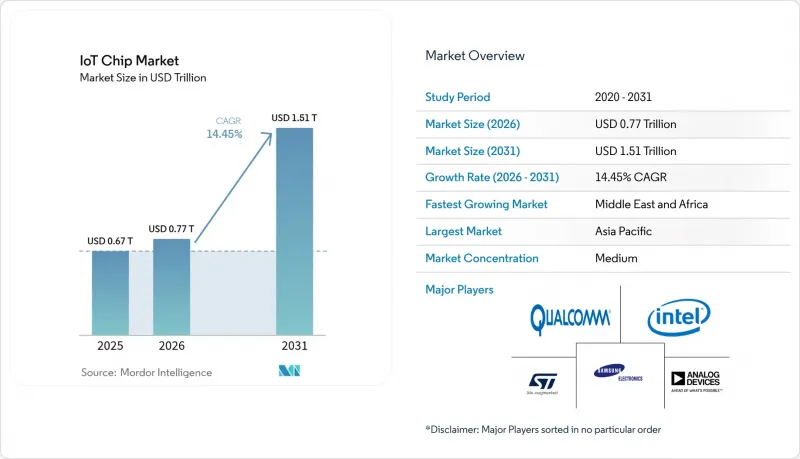
根據 Mordor Intelligence 預測,物聯網晶片市場規模將從 2025 年的 6,700 億美元成長到 2026 年的 7,700 億美元,然後在 2031 年達到 1.51 兆美元,2026 年至 2031 年的複合年成長率為 14.45%。
本報告按產品(處理器、感測器等)、最終用戶(醫療保健、家用電子電器等)、製程節點(90奈米及以上等)、連接技術(藍牙/BLE、Wi-Fi等)、處理器架構(基於Arm、RISC-V等)和地區(北美、歐洲、亞太、南美、中東和非洲)進行細分。市場預測以美元(USD)計價。
全球物聯網晶片市場趨勢與洞察
互聯消費設備和穿戴式裝置的激增
隨著對環境運算體驗的需求不斷成長,用於維持感測器和無線功能持續運作的超低功耗晶片出貨量也在上升。用於健康監測的穿戴式設備如今整合了醫用級光學脈搏波、體溫和心電圖 (ECG) 感測器,這需要安全的資料通道來遵守日益嚴格的隱私法規。高通公司報告稱,其 2025 年第一季的物聯網銷售額將達到 15 億美元,年增 36%,這印證了消費市場的強勁成長動能。隨著 5G 數據機和裝置端人工智慧的融合,設計人員正轉向異構 SoC,將應用處理器、NPU 和連接功能整合在單一晶片上,從而提升全球物聯網晶片市場的矽面積效率。
工業4.0正在推動對低功耗微控制器的需求。
實施數位孿生和預測性維護的工廠正在使用微控制器,這些微控制器能夠本地採集振動、溫度和聲學數據,並降低網路延遲。英特爾的智慧工廠產品線透過即時光刻校準實現了接近理論良率,證明了邊緣分析在嚴苛環境下的價值。如今,功能強大的微控制器整合了機器學習指令集、安全啟動和OTA更新功能,預計未來十年全球物聯網晶片市場將持續獲得來自工業領域的訂單。
端對端安全和隱私漏洞
白宮網路信任標誌 (CyberTrust Mark) 要求符合 NIST IR 8425 標準,提高了在資源受限設備中整合安全元件的門檻。由於晶片面積增加和韌體檢驗工作量加大,對成本敏感的原始設備製造商 (OEM) 面臨額外的成本。量子運算日益成長的威脅迫使晶片製造商採用基於格的加密技術,這導致產品發布延遲,並減緩了全球物聯網晶片市場的短期成長。
細分市場分析
到2025年,處理器將佔銷售額的25.10%,佔據最大的市場佔有率,其核心是整合了CPU、NPU和多重通訊協定無線電功能的單晶片組合。整合度的提高將透過減少印刷基板面積和縮短認證週期,進一步鞏固處理器在全球物聯網晶片市場的主導地位。安全IC預計將實現最快成長,複合年成長率(CAGR)將達到17.55%,因為零信任架構將信任根硬體整合到物聯網晶片市場的每個節點。感測器、連接、記憶體、邏輯和電源管理產品線的出貨量成長趨勢與整體趨勢一致,其中低功耗DRAM的價格尤其高。
封裝內電壓調節技術的進步,如今可為人工智慧加速器提供低於0.5V的軌電壓,從而延長穿戴式裝置的電池續航力。微機電系統(MEMS)製造商正在開發高度小於0.8毫米的實用壓力感測器,這為戒指和耳機等產品的設計提供了更大的自由度。 SEALSQ公司已獲得一份契約,將為英國的智慧電錶提供2,400萬顆抗量子晶片,凸顯了關鍵基礎設施安全措施的轉變。
到2025年,由於亞太地區工廠中數位孿生技術的廣泛應用,工業和製造業將維持22.20%的市場佔有率。預計到2030年,狀態監控MCU的需求將維持兩位數的出貨量成長。汽車產業以16.45%的複合年成長率引領成長,這得益於軟體定義汽車(SDV)對運算領域的整合。受分區架構的推動,汽車半導體中物聯網晶片的市場規模預計將快速擴張,分區架構能夠實現更輕的線束和空中下載(OTA)功能提升銷售。
醫療保健產業正從遠端監控擴展到受監管醫療設備的連接框架,從而推動對認證安全元件的需求。零售業的先導計畫利用人工智慧驅動的庫存管理機器人,採用視覺處理最佳化的系統單晶片 (SoC) 來即時匹配貨架庫存,從而豐富了物聯網晶片市場的收入來源。隨著光纖網路透過單一光纖骨幹網路連接暖通空調、照明和安防系統,建築自動化訂單正在不斷成長。
區域分析
預計到2025年,亞太地區將佔物聯網晶片市場收入的34.40%。這主要得益於台灣地區63.8%的半導體總產量比重以及中國大陸產能的擴張。從晶圓到封裝的垂直整合縮短了前置作業時間,使原始設備製造商(OEM)能夠更快地改進產品。然而,出口限制迫使跨國OEM廠商將產能分散到日本、印度和美國等地,重塑了物聯網晶片市場的供應鏈。
中東和非洲地區呈現最快成長勢頭,複合年成長率高達18.35%。海灣國家在智慧城市預算中投入數十億美元,用於交通分析、能源儀表板和公共安全感測器網路,從而催生了對性能穩定、寬溫域矽晶片的需求。北非地區5G網路的部署,使得從港口到內陸自由貿易區的物流走廊能夠實現低延遲遙測,進一步拓展了物聯網晶片市場的終端基礎設施。
北美和歐洲仍然是創新中心。美國的《晶片法案》(CHIPS Act)計劃在16個州投資500億美元用於半導體製造工廠,力爭2027年將國內先進製程節點產能翻倍至22%。歐洲的《晶片法案》則計劃在2030年佔據20%的全球市場佔有率,英特爾和義法半導體等公司正在德國和法國投資建設叢集。這些地區優先發展高價值的汽車和醫療晶片,這在物聯網晶片市場中構成了一個盈利的細分領域,儘管其銷售成長較為緩慢。
其他好處:
- Excel格式的市場預測(ME)表
- 3個月的分析師支持
目錄
第1章:引言
- 研究假設和市場定義
- 調查範圍
第2章:調查方法
第3章執行摘要
第4章 市場狀況
- 市場概覽
- 市場促進因素
- 互聯消費設備和穿戴式裝置的激增
- 工業4.0正在推動對低功耗微控制器的需求。
- 汽車ADAS和V2X對半導體的需求
- 物聯網SoC中的邊緣AI推理
- Matter協定加速了智慧家庭的升級週期。
- 利用衛星和Sub-GHz頻段連線進行遠端資產追蹤。
- 市場限制因素
- 端對端安全和隱私漏洞
- 通訊標準的碎片化
- 傳統製程節點(28/40奈米)晶圓代工廠產能短缺
- 對先進射頻知識產權的出口限制
- 產業價值鏈分析
- 監理情勢
- 技術展望
- 波特五力分析
- 宏觀經濟趨勢對市場的影響
第5章 市場規模與成長預測
- 依產品
- 處理器
- 感應器
- 連線IC
- 儲存裝置
- 邏輯裝置
- 電源管理積體電路
- 安全積體電路
- 最終用戶
- 衛生保健
- 家用電子產品
- 工業和製造業
- 車
- BFSI
- 零售
- 建築自動化
- 其他最終用戶
- 依技術節點
- 90奈米或以上
- 65~45 nm
- 40~28 nm
- 22~16 nm
- ≤14 nm
- 透過連接技術
- Bluetooth/BLE
- Wi-Fi(802.11x)
- NB-IoT/LTE-M
- 5G RedCap
- 超寬頻(UWB)
- Thread/Zigbee
- 衛星物聯網
- 依處理器架構
- 臂基
- RISC-V
- x86
- 其他/混合型
- 按地區
- 北美洲
- 美國
- 加拿大
- 墨西哥
- 南美洲
- 巴西
- 阿根廷
- 其他南美國家
- 歐洲
- 德國
- 英國
- 法國
- 義大利
- 西班牙
- 其他歐洲國家
- 亞太地區
- 中國
- 日本
- 韓國
- 印度
- 新加坡
- 澳洲
- 其他亞太國家
- 中東和非洲
- 中東
- 沙烏地阿拉伯
- 阿拉伯聯合大公國
- 土耳其
- 其他中東國家
- 非洲
- 南非
- 奈及利亞
- 埃及
- 其他非洲國家
- 中東
- 北美洲
第6章 競爭情勢
- 市場集中度
- 策略趨勢
- 市佔率分析
- 公司簡介
- Qualcomm Technologies Inc.
- Intel Corporation
- Texas Instruments Incorporated
- NXP Semiconductors NV
- Cypress Semiconductor Corporation(Infineon)
- MediaTek Inc.
- Microchip Technology Inc.
- Samsung Electronics Co., Ltd.
- Silicon Laboratories Inc.
- TDK InvenSense Inc.
- STMicroelectronics NV
- Nordic Semiconductor ASA
- Analog Devices, Inc.
- Broadcom Inc.
- Infineon Technologies AG
- Renesas Electronics Corporation
- ON Semiconductor Corporation
- Arm Holdings plc
- NVIDIA Corporation
- Marvell Technology Group Ltd.
第7章 市場機會與未來展望
According to Mordor Intelligence, the ioT chip market size is expected to grow from USD 0.67 trillion in 2025 to USD 0.77 trillion in 2026 and is forecast to reach USD 1.51 trillion by 2031 at 14.45% CAGR over 2026-2031.
This report is Segmented by Product (Processor, Sensor, and More), End-User (Healthcare, Consumer Electronics, and More), Technology Node ( >=90 Nm, and More), Connectivity Technology (Bluetooth/BLE, Wi-Fi, and More), Processor Architecture (Arm-Based, RISC-V, and More), and Geography (North America, Europe, Asia Pacific, South America, and Middle East and Africa). The Market Forecasts are Provided in Terms of Value (USD).
Global IoT Chip Market Trends and Insights
Proliferation of Connected Consumer and Wearable Devices
Demand for ambient computing experiences is lifting volumes for ultra-low-power chips that keep sensors and radios active at all times. Health-focused wearables now integrate medical-grade photoplethysmography, temperature, and ECG sensors that need secure data paths to comply with tightening privacy rules. Qualcomm reported USD 1.5 billion in IoT revenue for Q1 2025, up 36% year over year, underscoring consumer momentum. As 5G modems converge with on-device AI, designers shift to heterogeneous SoCs that fuse application processors, NPUs, and connectivity on one die, driving silicon-area efficiency across the Global IoT Chip market.
Industry 4.0-Led Demand for Low-Power MCUs
Factories deploying digital twins and predictive maintenance lean on microcontrollers that ingest vibration, thermal, and acoustic data locally, cutting network latency. Intel's smart-factory line achieved near-theoretical yield through real-time lithography calibration, proving the value of edge analytics inside harsh environments. Rugged MCUs now combine machine-learning instruction sets with secure boot and OTA updates, positioning the Global IoT Chip market for sustained industrial orders through the decade.
End-to-End Security and Privacy Vulnerabilities
The White House Cyber Trust Mark requires compliance with NIST IR 8425, raising the bar for secure-element integration in resource-limited devices. Cost-sensitive OEMs face additional silicon area and firmware validation expenses. Rising quantum-computing threats press chipmakers to support lattice-based cryptography, delaying product launches and tempering short-term Global IoT Chip market growth.
Other drivers and restraints analyzed in the detailed report include:
- Automotive ADAS and V2X Silicon Requirements
- Edge-AI Inference Inside IoT SoCs
- Legacy-Node (28/40 nm) Foundry Capacity Crunch
For complete list of drivers and restraints, kindly check the Table Of Contents.
Segment Analysis
Processors generated the largest revenue slice in 2025 at 25.10%, anchored by single-die combos that merge CPU, NPU, and multi-protocol radios. Enhanced integration trims printed-circuit area and shortens certification cycles, fortifying processor dominance in the Global IoT Chip market. Security ICs are poised for the fastest expansion with a 17.55% CAGR as zero-trust architectures embed hardware roots-of-trust into every node of the IoT Chip market. Sensor, connectivity, memory, logic, and power-management lines track broader unit shipment curves, with specialized low-power DRAM commanding premium price points.
Upgrades in in-package voltage regulation now supply sub-0.5 V rails for AI accelerators, extending battery life in wearables. MEMS makers push shippable pressure sensors below 0.8 mm height, opening design space in rings and earbuds. SEALSQ secured contracts for 24 million quantum-resistant chips that protect UK smart meters, showcasing a security shift across critical infrastructure.
Industrial and manufacturing retained a 22.20% share in 2025 as digital-twin rollouts scaled across Asia Pacific plants. Demand for condition-monitoring MCUs sustains double-digit unit growth through 2030. Automotive leads in CAGR at 16.45% as software-defined vehicles centralize compute domains. The IoT Chip market size for automotive silicon is projected to climb sharply on the back of zonal architectures that cut harness weight and enable OTA feature upsells.
Healthcare extends beyond remote monitoring to regulated device connectivity frameworks, strengthening demand for certified secure elements. Retail pilots using AI-powered inventory robots enlist vision-optimized SoCs to reconcile shelf stock in real time, diversifying the IoT Chip market revenue base. Building-automation orders rise as passive optical networks connect HVAC, lighting, and security over a single fibre backbone.
Complete Report Scope:
- By Product
- Processor
- Sensor
- Connectivity IC
- Memory Device
- Logic Device
- Power-Management IC
- Security IC
- By End-user
- Healthcare
- Consumer Electronics
- Industrial and Manufacturing
- Automotive
- BFSI
- Retail
- Building Automation
- Other End-users
- By Technology Node
- >=90 nm
- 65-45 nm
- 40-28 nm
- 22-16 nm
- <=14 nm
- By Connectivity Technology
- Bluetooth / BLE
- Wi-Fi (802.11x)
- NB-IoT / LTE-M
- 5G RedCap
- Ultra-Wideband (UWB)
- Thread / Zigbee
- Satellite IoT
- By Processor Architecture
- Arm-based
- RISC-V
- x86
- Other / Hybrid
- By Geography
- North America
- United States
- Canada
- Mexico
- South America
- Brazil
- Argentina
- Rest of South America
- Europe
- Germany
- United Kingdom
- France
- Italy
- Spain
- Rest of Europe
- Asia-Pacific
- China
- Japan
- South Korea
- India
- Singapore
- Australia
- Rest of Asia-Pacific
- Middle East and Africa
- Middle East
- Saudi Arabia
- United Arab Emirates
- Turkey
- Rest of Middle East
- Africa
- South Africa
- Nigeria
- Egypt
- Rest of Africa
- Middle East
- North America
Geography Analysis
Asia-Pacific contributed 34.40% of the IoT Chip market revenue in 2025, propelled by Taiwan's 63.8% share of total semiconductor output and China's capacity build-out. Vertical integration from wafer to packaging lowers lead times, letting OEMs iterate faster. Yet export controls nudge multinational OEMs toward capacity hedging in Japan, India, and the United States, reshaping the IoT Chip market supply map.
The Middle East and Africa exhibit the fastest trajectory at 18.35% CAGR. Gulf smart-city budgets allocate billions for traffic analytics, energy dashboards, and public-safety sensor grids, demanding robust, wide-temperature-range silicon. 5G rollouts across North Africa unlock low-latency telemetry for logistics corridors stretching from ports to inland free-trade zones, enlarging the endpoint base for the IoT Chip market.
North America and Europe remain innovation centers. The U.S. CHIPS Act channels USD 50 billion into fabs across 16 states, doubling domestic advanced-node capacity to 22% by 2027. Europe's Chips Act targets a 20% global share by 2030, with Intel and STMicroelectronics investing in Germany and France clusters. These regions prioritize high-value automotive and medical silicon, forming lucrative slices of the IoT Chip market size despite moderate unit growth.
- Qualcomm Technologies Inc.
- Intel Corporation
- Texas Instruments Incorporated
- NXP Semiconductors N.V.
- Cypress Semiconductor Corporation (Infineon)
- MediaTek Inc.
- Microchip Technology Inc.
- Samsung Electronics Co., Ltd.
- Silicon Laboratories Inc.
- TDK InvenSense Inc.
- STMicroelectronics N.V.
- Nordic Semiconductor ASA
- Analog Devices, Inc.
- Broadcom Inc.
- Infineon Technologies AG
- Renesas Electronics Corporation
- ON Semiconductor Corporation
- Arm Holdings plc
- NVIDIA Corporation
- Marvell Technology Group Ltd.
Additional Benefits:
- The market estimate (ME) sheet in Excel format
- 3 months of analyst support
TABLE OF CONTENTS
1 INTRODUCTION
- 1.1 Study Assumptions and Market Definition
- 1.2 Scope of the Study
2 RESEARCH METHODOLOGY
3 EXECUTIVE SUMMARY
4 MARKET LANDSCAPE
- 4.1 Market Overview
- 4.2 Market Drivers
- 4.2.1 Proliferation of Connected Consumer and Wearable Devices
- 4.2.2 Industry 4.0-led Demand for low-power MCUs
- 4.2.3 Automotive ADAS and V2X Silicon Requirements
- 4.2.4 Edge-AI Inference Inside IoT SoCs
- 4.2.5 Matter protocol Accelerating Smart-home Refresh Cycles
- 4.2.6 Satellite and Sub-GHz Connectivity for Remote Asset Tracking
- 4.3 Market Restraints
- 4.3.1 End-to-end Security and Privacy Vulnerabilities
- 4.3.2 Fragmented Communications Standards
- 4.3.3 Legacy-node (28/40 nm) Foundry Capacity Crunch
- 4.3.4 Export-control Limits on Advanced RF IP
- 4.4 Industry Value Chain Analysis
- 4.5 Regulatory Landscape
- 4.6 Technological Outlook
- 4.7 Porter's Five Forces Analysis
- 4.7.1 Bargaining Power of Suppliers
- 4.7.2 Bargaining Power of Buyers
- 4.7.3 Threat of New Entrants
- 4.7.4 Threat of Substitute Products
- 4.7.5 Intensity of Competitive Rivalry
- 4.8 Impact of Macroeconomic Trends on the Market
5 MARKET SIZE AND GROWTH FORECASTS (VALUE)
- 5.1 By Product
- 5.1.1 Processor
- 5.1.2 Sensor
- 5.1.3 Connectivity IC
- 5.1.4 Memory Device
- 5.1.5 Logic Device
- 5.1.6 Power-Management IC
- 5.1.7 Security IC
- 5.2 By End-user
- 5.2.1 Healthcare
- 5.2.2 Consumer Electronics
- 5.2.3 Industrial and Manufacturing
- 5.2.4 Automotive
- 5.2.5 BFSI
- 5.2.6 Retail
- 5.2.7 Building Automation
- 5.2.8 Other End-users
- 5.3 By Technology Node
- 5.3.1 >=90 nm
- 5.3.2 65-45 nm
- 5.3.3 40-28 nm
- 5.3.4 22-16 nm
- 5.3.5 <=14 nm
- 5.4 By Connectivity Technology
- 5.4.1 Bluetooth / BLE
- 5.4.2 Wi-Fi (802.11x)
- 5.4.3 NB-IoT / LTE-M
- 5.4.4 5G RedCap
- 5.4.5 Ultra-Wideband (UWB)
- 5.4.6 Thread / Zigbee
- 5.4.7 Satellite IoT
- 5.5 By Processor Architecture
- 5.5.1 Arm-based
- 5.5.2 RISC-V
- 5.5.3 x86
- 5.5.4 Other / Hybrid
- 5.6 By Geography
- 5.6.1 North America
- 5.6.1.1 United States
- 5.6.1.2 Canada
- 5.6.1.3 Mexico
- 5.6.2 South America
- 5.6.2.1 Brazil
- 5.6.2.2 Argentina
- 5.6.2.3 Rest of South America
- 5.6.3 Europe
- 5.6.3.1 Germany
- 5.6.3.2 United Kingdom
- 5.6.3.3 France
- 5.6.3.4 Italy
- 5.6.3.5 Spain
- 5.6.3.6 Rest of Europe
- 5.6.4 Asia-Pacific
- 5.6.4.1 China
- 5.6.4.2 Japan
- 5.6.4.3 South Korea
- 5.6.4.4 India
- 5.6.4.5 Singapore
- 5.6.4.6 Australia
- 5.6.4.7 Rest of Asia-Pacific
- 5.6.5 Middle East and Africa
- 5.6.5.1 Middle East
- 5.6.5.1.1 Saudi Arabia
- 5.6.5.1.2 United Arab Emirates
- 5.6.5.1.3 Turkey
- 5.6.5.1.4 Rest of Middle East
- 5.6.5.2 Africa
- 5.6.5.2.1 South Africa
- 5.6.5.2.2 Nigeria
- 5.6.5.2.3 Egypt
- 5.6.5.2.4 Rest of Africa
- 5.6.5.1 Middle East
- 5.6.1 North America
6 COMPETITIVE LANDSCAPE
- 6.1 Market Concentration
- 6.2 Strategic Moves
- 6.3 Market Share Analysis
- 6.4 Company Profiles (includes Global level Overview, Market level overview, Core Segments, Financials as available, Strategic Information, Market Rank/Share, Products and Services, Recent Developments)
- 6.4.1 Qualcomm Technologies Inc.
- 6.4.2 Intel Corporation
- 6.4.3 Texas Instruments Incorporated
- 6.4.4 NXP Semiconductors N.V.
- 6.4.5 Cypress Semiconductor Corporation (Infineon)
- 6.4.6 MediaTek Inc.
- 6.4.7 Microchip Technology Inc.
- 6.4.8 Samsung Electronics Co., Ltd.
- 6.4.9 Silicon Laboratories Inc.
- 6.4.10 TDK InvenSense Inc.
- 6.4.11 STMicroelectronics N.V.
- 6.4.12 Nordic Semiconductor ASA
- 6.4.13 Analog Devices, Inc.
- 6.4.14 Broadcom Inc.
- 6.4.15 Infineon Technologies AG
- 6.4.16 Renesas Electronics Corporation
- 6.4.17 ON Semiconductor Corporation
- 6.4.18 Arm Holdings plc
- 6.4.19 NVIDIA Corporation
- 6.4.20 Marvell Technology Group Ltd.
7 MARKET OPPORTUNITIES AND FUTURE OUTLOOK
- 7.1 White-space and Unmet-Need Assessment

 物聯網晶片市場-2026-2032年全球市場預測
 窄頻聯網晶片組市場:按晶片類型、應用、終端用戶產業和地區分類物聯網晶片市場:按晶片類型、連接技術、部署方式、應用領域和最終用戶分類-2026-2032年全球市場預測
 物聯網晶片市場分析及預測(至2035年):依類型、產品類型、服務、技術、組件、應用、形狀、材質及最終用戶分類
 2026年窄頻聯網晶片組全球市場報告
 物聯網晶片市場-全球產業規模、佔有率、趨勢、機會、預測:按產品、最終用戶、地區和競爭對手分類,2021-2031年非蜂巢式物聯網晶片市場:按晶片類型、連接通訊協定、整合度、收發器類型、銷售管道和最終用途應用分類,全球預測,2026-2032年
 物聯網晶片:全球市場佔有率和排名、總銷售額和需求預測(2025-2031 年)
 物聯網晶片市場:2025 年至 2030 年預測交通運輸物聯網晶片市場:2025-2030 年預測