


 |
市場調查報告書
商品編碼
2114090
線上廣告:市場佔有率分析、產業趨勢與統計、成長預測(2026-2031)Online Advertising - Market Share Analysis, Industry Trends & Statistics, Growth Forecasts (2026 - 2031) |
||||||

※ 本網頁內容可能與最新版本有所差異。詳細情況請與我們聯繫。
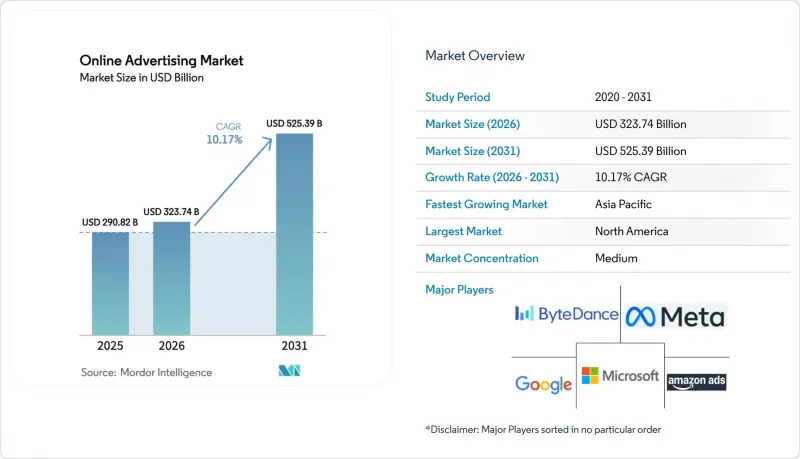
根據 Mordor Intelligence 預測,線上廣告市場規模將從 2025 年的 2908.2 億美元和 2026 年的 3,237.4 億美元成長到 2031 年的 5,253.9 億美元,2026 年至 2031 年的年複合成長率(CAGR)為 10.17%。
本報告按廣告形式(社群媒體、搜尋引擎、影片、電子郵件、展示廣告)、平台(行動裝置、桌上型電腦和筆記型電腦、聯網電視及其他平台)、終端用戶產業(汽車、零售和電子商務等)、廣告購買模式(程式化購買、即時競價等)和地區進行細分。市場預測以美元計價。
全球線上廣告市場趨勢與洞察
透過零售媒體網路實現貨幣化,正在推動消費品品牌實現閉合迴路回報率 (ROAS)。
到2025年,亞馬遜廣告、沃爾瑪互聯和Instacart廣告合計將吸引約500億美元的廣告支出,使零售媒體網路轉型為重要的策略收入來源。品牌正優先考慮閉合迴路歸因,將網站展示次數與已確認的結帳交易關聯起來,從而無需再對可見性等替代指標進行猜測。貝恩公司估計,到2025年,零售媒體的廣告支出回報率(ROAS)將是開放式網路展示廣告的三到五倍。山姆會員商店已擴展其“會員訪問平台”,向供應商提供交易數據,從而實現傳統出版商無法企及的精細化受眾細分。因此,傳統展示廣告媒體的預算佔有率正在下降,廣告庫存正集中在同時擁有廣告伺服器和銷售點(POS)系統的垂直整合生態系統中。
智慧型手機的日益普及正在提升全球行動廣告的曝光量。
到2025年,全球智慧型手機用戶數量將達到68億,行動廣告支出將佔廣告總支出的63.79%,為廣告商提供「始終在線」的螢幕,從而主導用戶的日常媒體消費。用戶平均每天在行動裝置上花費4.8小時,是桌上型電腦使用時間的兩倍以上。在印度、印尼和奈及利亞,低成本5G智慧型手機的普及正在擴大目標受眾,即使在桌上型電腦普及率仍低於20%的地區也是如此。 2025年上半年,Google的Performance Max宣傳活動在行動廣告位上的每美元轉換率比在桌上型電腦上高出18%,這進一步強化了廣告主對行動優先創新策略的偏好。
歐盟逐步淘汰第三方 cookie 將導致訊號遺失,削弱定向效果。
谷歌逐步淘汰第三方 Cookie 的計畫將在 2025 年年中之前消除 65% 歐洲網路用戶的跨站點識別。根據 IAB Europe 的數據,2025 年上半年開放網路發布商的程式化 CPM 下降了 23%。由於其商業數據合作夥伴關係未能完全取代確定性 Cookie,Criteo 在 2025 年第二季的歐洲營收年減了 11%。截至 2025 年 12 月,隱私沙盒 API 的採用率仍低於 30%,進一步擴大了封閉網路和開放網路之間的效能差距。
細分市場分析
預計到2025年,影片廣告將佔廣告支出的29%,複合年成長率(CAGR)為10.59%,成長速度超過整體線上廣告市場。 YouTube Shorts的日均觀看量預計將在2025年達到700億次,Alphabet在第二季度開始對影片插播廣告進行商業化,開闢了新的廣告空間。 TikTok的資訊流廣告單位在2024年創造了145億美元的收入,年增35%。廣告商正在將商業和娛樂融合起來,透過在影片幀中嵌入產品標籤來實現一鍵購買。搜尋在2025年仍維持39.16%的市佔率。這是因為具有高購買意願的搜尋查詢的轉換率是打斷觀看的廣告位的2-3倍,儘管隨著搜尋查詢數量的成長趨於平緩,其成長速度正在放緩。由於 cookie 的逐步淘汰,展示廣告正面臨結構性挑戰,廣告支出也轉向 CPM 較低的情境廣告。電子郵件廣告仍然是 D2C(直接面對消費者)品牌的利基選擇,這些品牌利用自己的郵件清單來避免平台費用,但收件匣飽和以及更嚴格的垃圾郵件過濾器限制了其規模化發展。
作為第二波創新浪潮,影片與交易數據直接關聯。亞馬遜的Fire TV整合了可購買的疊加功能,可與Prime Checkout配合使用;Meta的Advantage+能夠即時產生影片創新,在試點研究中將每次轉換成本降低了12%。隨著影片與電商和自動化技術的融合,預計影片在整體線上廣告市場中的佔有率將在預測期內持續成長。
2025年,智慧型手機仍將佔行動廣告支出的63.79%,因為用戶一天中幾乎都離不開智慧型手機,智慧型手機還能促進多會話行為。聯網電視雖然目前市佔率仍較小,但卻是線上廣告市場成長最快的領域,複合年成長率高達11.09%。亞馬遜Prime Video已將廣告覆蓋全球2億用戶,隨著需求的激增,2024年第一季CPM一度下降了12%。 Roku到2024年底擁有8500萬活躍帳戶,而三星廣告目前已收集了北美和歐洲6000萬台智慧電視的觀看數據。年輕一代更傾向於行動優先的消費方式,桌上型電腦的使用率正在下降,但在職場用戶的B2B宣傳活動中,桌上型電腦仍然具有價值。其他螢幕,例如遊戲內廣告和戶外數位廣告(DOOH),正在擴大覆蓋範圍,但由於缺乏統一的衡量標準,目前的預算投入仍然有限。
跨螢幕身分識別解決方案旨在連接家庭級曝光和行動重新導向,實現聯網電視的無縫銜接。 The Trade Desk 的「Ventura OS」提供了一個統一的控制面板,用於跨平台規劃,涵蓋展示廣告、音訊廣告和串流媒體廣告,從而簡化了中型廣告主進入程式化採購領域的工作流程。隨著定向能力的提升,聯網電視將與行動裝置和其他管道的預算展開競爭,尤其是在品牌影片廣告預算從傳統廣播轉向智慧電視方面。
區域分析
2025年,北美地區的廣告支出佔全球總支出的35.19%。美國是這一成長的中心,人均支出達到650美元,Google、Meta和亞馬遜佔了超過60%的預算。在加拿大,Loblaw旗下的「PC Optimum」和Canadian Tire的「Triangle Rewards」等零售網路推動了9%的成長。在墨西哥,Mercado Libre透過消費者數據變現,實現了12%的成長。儘管加州消費者隱私法案(CCPA)等隱私法規的實施增加了合規負擔,但高價值消費者仍維持著較高的每千次曝光成本(CPM)。
亞太地區是成長最快的地區,複合年成長率達11.37%。在中國,隨著淘寶和抖音整合影片、電商和支付功能,預計到2025年,廣告收入將達到約1,200億美元。印度、印尼和越南高度依賴行動端用戶,這使得廣告商無需依賴桌面端的基礎設施。在日本,隨著NHK和富士電視台推出廣告支援的串流服務,廣告預算已轉向聯網電視。在韓國,NAVER和Kakao正進一步加強對超級應用生態系統的投入。澳洲的CartologyAI正在推動程式化音訊廣告的發展,紐西蘭也正在效仿這些模式。
在歐洲,禁用cookies和引入數位服務稅正在阻礙開放網路的獲利。德國、英國和法國的全部區域廣告支出的55%。在英國,即使到了2025年,預計成長率也只能達到7%,因為品牌紛紛轉向「圍牆花園」式的網站。在法國,由於Canal+的程序化廣告投放,聯網電視的廣告支出增加了18%。義大利和西班牙的廣告支出分別成長了9%和8%,這主要得益於行動商務的發展。
預計到2025年,南美洲將實現13%的成長,其中巴西佔全部區域支出的60%,主要得益於Mercado Libre和Magazine Luisa等零售媒體的擴張。然而,阿根廷由於貨幣不穩定,支出下降了5%。其人均支出僅85美元,限制了成長潛力,而寬頻普及率的差異也減緩了聯網電視的成長。
中東和非洲地區雖然規模最小,但發展迅速。中東地區70%的廣告支出集中在阿拉伯聯合大公國和沙烏地阿拉伯。儘管里拉匯率波動,但預計到2025年,土耳其的廣告支出仍將增加15%;而由於WhatsApp Business行動廣告的推出,南非的廣告支出預計也將增加11%。雖然基礎設施瓶頸阻礙了寬頻格式的普及,但該地區年輕人口眾多,顯示線上廣告市場擁有巨大的長期潛力。
其他好處:
- Excel格式的市場預測(ME)表
- 3個月的分析師支持
目錄
第1章:引言
- 研究假設和市場定義
- 調查範圍
第2章:調查方法
第3章執行摘要
第4章 市場狀況
- 市場概覽
- 市場促進因素
- 透過零售媒體網路實現貨幣化,推動了消費品品牌閉迴路廣告閉合迴路的提升。
- 智慧型手機的日益普及正在提升全球行動廣告的曝光量。
- 電視廣告預算向聯網電視平台的轉移正在擴大程序化影片廣告的庫存。
- 5G技術賦能的身臨其境型影片廣告正加速東南亞廣告支出的成長。
- 人工智慧驅動的動態創新最佳化降低了北美地區的每次轉換成本 (CPA)。
- 超級應用程式中電商和搜尋的整合,正在推動中國和東南亞地區的應用程式內廣告發展。
- 市場限制因素
- 由於歐盟逐步淘汰第三方 cookie,導致訊號遺失,從而影響了定向投放。
- 英國和法國的數位服務稅正在給平台利潤率帶來壓力。
- 諸如 CCPA 和 LGPD 等嚴格的隱私法規正在增加合規成本。
- 人工智慧生成的聊天機器人正在推高新興市場的每千次展示成本 (CPM)。
- 監理展望
- 科技趨勢(人工智慧、隱私沙箱、無塵室)
- 宏觀經濟因素對市場的影響
- 產業價值鏈分析
- 波特五力分析
第5章 市場規模與成長預測
- 廣告格式
- 社群媒體
- 搜尋引擎
- 影片
- 電子郵件
- 展示廣告
- 按平台
- 移動的
- 桌上型電腦和筆記型電腦
- 聯網電視
- 其他平台
- 按最終用戶行業分類
- 車
- 零售與電子商務
- 醫療和製藥
- BFSI
- 溝通
- 其他終端用戶產業
- 透過廣告購買模式
- 程式化即時競價
- 程序化擔保
- 直接插入訂單
- 自助服務
- 按地區
- 北美洲
- 美國
- 加拿大
- 墨西哥
- 南美洲
- 巴西
- 阿根廷
- 其他南美國家
- 歐洲
- 德國
- 英國
- 法國
- 義大利
- 西班牙
- 其他歐洲國家
- 亞太地區
- 中國
- 日本
- 韓國
- 印度
- 澳洲
- 紐西蘭
- 其他亞太國家
- 中東和非洲
- 中東
- 阿拉伯聯合大公國
- 沙烏地阿拉伯
- 土耳其
- 其他中東國家
- 非洲
- 南非
- 其他非洲國家
- 中東
- 北美洲
第6章 競爭情勢
- 市場集中度
- Strategic Developments
- 市佔率分析
- 公司簡介
- Google LLC
- Meta Platforms Inc.
- Amazon.com Inc.(Amazon Ads)
- ByteDance Ltd.(TikTok)
- Microsoft Corp.(LinkedIn, Bing Ads)
- Alibaba Group(Alimama)
- Tencent Holdings Ltd.(WeChat, Tencent Ads)
- Baidu Inc.
- Snap Inc.
- Pinterest Inc.
- X Corp.(Twitter)
- Spotify Technology SA
- Roku Inc.
- Comcast Corp.(FreeWheel)
- Samsung Ads
- Verizon Media(Yahoo)
- Adobe Inc.
- Oracle Advertising
- The Trade Desk Inc.
- Magnite Inc.
- Criteo SA
- Taboola Inc.
- PubMatic Inc.
第7章 市場機會與未來展望
According to Mordor Intelligence, the online advertising market size is projected to expand from USD 290.82 billion in 2025 and USD 323.74 billion in 2026 to USD 525.39 billion by 2031, registering a CAGR of 10.17% between 2026 to 2031.
This report is Segmented by Advertising Format (Social Media, Search Engine, Video, and Email, and Display Advertising), Platform (Mobile, Desktop and Laptop, Connected TV, and Other Platforms), End-User Vertical (Automotive, Retail and E-Commerce, and More), Ad Buying Model (Programmatic Real-Time Bidding, and More), and Geography. The Market Forecasts are Provided in Terms of Value (USD).
Global Online Advertising Market Trends and Insights
Retail Media Networks Monetization Driving Closed-Loop ROAS for CPG Brands
Retail media networks grew into strategic profit centers in 2025 as Amazon Ads, Walmart Connect, and Instacart Ads jointly attracted roughly USD 50 billion in annual spend. Brands value the closed-loop attribution that links on-site impressions to confirmed checkouts, eliminating guesswork around viewability proxies. Bain and Company calculated three-to-five-times higher return on ad spend for retail media versus open-web display in 2025. Sam's Club extended its Member Access Platform by giving suppliers transactional data for granular audience segmentation capabilities that conventional publishers cannot match. As a result, legacy display outlets lose budget share, and inventory supply is concentrating in vertically integrated ecosystems that own both ad server and point of sale.
Increasing Smartphone Penetration Boosting Mobile Ad Impressions Globally
Global smartphone subscriptions hit 6.8 billion in 2025, lifting mobile to 63.79% of total spend and giving advertisers an always-on screen that dominates daily media time. Users average 4.8 hours per day on handheld devices, more than double desktop engagement. Cheaper 5G phones in India, Indonesia, and Nigeria are enlarging addressable audiences where desktop ownership remains below 20%. Google's Performance Max campaigns generated 18% more conversions per dollar on mobile placements than desktop during H1 2025, reinforcing advertiser preference for mobile-first creative strategies.
Signal-Loss from Third-Party-Cookie Deprecation in the European Union Undermining Targeting
Google's staged phase-out of third-party cookies removed cross-site IDs for 65% of European web users by mid-2025. IAB Europe recorded a 23% decline in programmatic CPMs for open-web publishers during H1 2025. Criteo's European revenue slid 11% year-over-year in Q2 2025 as commerce-data partnerships failed to fully replace deterministic cookies. Privacy Sandbox APIs remain below 30% adoption as of December 2025, widening the performance gap between walled gardens and open web.
Other drivers and restraints analyzed in the detailed report include:
- Shift of TV Budgets to Connected-TV Platforms Expanding Programmatic Video Inventory
- 5G-Enabled Immersive Video Ads Accelerating Spend in South-East Asia
- Digital-Services Taxes in the United Kingdom and France Squeezing Platform Margins
For complete list of drivers and restraints, kindly check the Table Of Contents.
Segment Analysis
Video accounted for 29% of 2025 spend and is growing at a 10.59% CAGR, outpacing the broader online advertising market. YouTube Shorts logged 70 billion daily views in 2025, and Alphabet activated mid-roll monetization in Q2, unlocking fresh inventory. TikTok's in-feed units generated USD 14.5 billion in 2024 revenue, expanding 35% year-over-year. Advertisers embed product tags inside video frames for one-tap purchases, blending commerce with entertainment. Search retained a leading 39.16% share in 2025 because intent-rich queries convert two-to-three times better than interruptive placements, though growth moderates as incremental query volume plateaus. Display faces structural headwinds from cookie deprecation, steering spend to contextual placements that carry lower CPMs. Email remains niche for direct-to-consumer brands using owned lists to bypass platform fees, yet inbox saturation and tightening spam filters cap scale.
A second wave of innovation ties video directly to transaction data. Amazon's Fire TV integrates shoppable overlays tied to Prime checkout, while Meta's Advantage+ generates video creatives on the fly, trimming CPA by 12% in pilot studies. As video merges with commerce and automation, the format's share within online advertising market size is poised to keep widening over the forecast horizon.
Mobile maintained 63.79% of spend in 2025 because smartphones accompany users throughout the day and drive multisession behavior. Connected-TV share remains smaller but rises at an 11.09% CAGR, the fastest platform trajectory within the online advertising market. Amazon's Prime Video introduced ads to 200 million global viewers, temporarily softening CPMs by 12% in Q1 2024 before demand caught up. Roku finished 2024 with 85 million active accounts, and Samsung Ads now reads viewing data from 60 million smart TVs across North America and Europe. Desktop usage declines among younger cohorts who favor mobile-first consumption, though it retains value for workplace B2B campaigns. Other screens such as in-game or digital out-of-home add incremental reach but lack unified measurement, limiting budget flows for now.
Cross-screen identity solutions seek to tie household-level exposure on connected-TV to mobile retargeting. The Trade Desk's Ventura OS offers a single dashboard for planning across display, audio, and streaming, simplifying workflow for midsize advertisers entering programmatic buying. As addressability improves, connected-TV could challenge mobile for incremental dollars, especially for brand video budgets relocating from broadcast.
Complete Report Scope:
- By Advertising Format
- Social Media
- Search Engine
- Video
- Display Advertising
- By Platform
- Mobile
- Desktop and Laptop
- Connected TV
- Other Platforms
- By End-User Vertical
- Automotive
- Retail and E-commerce
- Healthcare and Pharma
- BFSI
- Telecom
- Other End-User Verticals
- By Ad Buying Model
- Programmatic Real-Time Bidding
- Programmatic Guaranteed
- Direct Insertion Order
- Self-Serve
- By Geography
- North America
- United States
- Canada
- Mexico
- South America
- Brazil
- Argentina
- Rest of South America
- Europe
- Germany
- United Kingdom
- France
- Italy
- Spain
- Rest of Europe
- Asia Pacific
- China
- Japan
- South Korea
- India
- Australia
- New Zealand
- Rest of Asia Pacific
- Middle East and Africa
- Middle East
- United Arab Emirates
- Saudi Arabia
- Turkey
- Rest of Middle East
- Africa
- South Africa
- Rest of Africa
- Middle East
- North America
Geography Analysis
North America contributed 35.19% of 2025 spending, anchored by the United States where per-capita outlay reached USD 650 and Google, Meta, and Amazon absorbed over 60% of budget. Canada rose 9% in 2025, powered by Loblaw's PC Optimum and Canadian Tire's Triangle Rewards retail networks. Mexico advanced 12% as Mercado Libre monetized shopper data. While privacy regulation such as the California Consumer Privacy Act lifts compliance overhead, high-value consumers sustain premium CPMs.
Asia Pacific is the fastest-growing region at an 11.37% CAGR. China generated roughly USD 120 billion in 2025 advertising revenue as Taobao and Douyin blended video, commerce, and payments. India, Indonesia, and Vietnam rely on mobile-only users, letting advertisers skip desktop era infrastructure. Japan shifted budgets to connected-TV where NHK and Fuji Television launched ad-supported streaming. South Korea doubles down on super-app ecosystems from Naver and Kakao. Australia's CartologyAI pushes programmatic audio while New Zealand emulates these models.
Europe faces cookie deprecation and digital-services taxes that damp open-web monetization. Germany, the United Kingdom, and France deliver 55% of regional spend. The United Kingdom still grew 7% in 2025 as brands took refuge within walled gardens. France saw 18% connected-TV growth thanks to Canal+ programmatic ad insertion. Italy and Spain expanded 9% and 8% respectively on back of mobile commerce.
South America added 13% in 2025, with Brazil at 60% of regional spend as Mercado Libre and Magazine Luiza grew retail media. Argentina contracted 5% amid currency stress. Lower per-capita outlay at USD 85 limits upside, and connected-TV trails due to broadband gaps.
Middle East and Africa are the smallest yet expanding swiftly. The United Arab Emirates and Saudi Arabia concentrate 70% of Middle East spend. Turkey rose 15% in 2025 despite lira volatility, and South Africa increased 11% on mobile WhatsApp Business placements. Infrastructure bottlenecks restrain high-bandwidth formats but young demographics offer long-run potential within the online advertising market.
- Google LLC
- Meta Platforms Inc.
- Amazon.com Inc. (Amazon Ads)
- ByteDance Ltd. (TikTok)
- Microsoft Corp. (LinkedIn, Bing Ads)
- Alibaba Group (Alimama)
- Tencent Holdings Ltd. (WeChat, Tencent Ads)
- Baidu Inc.
- Snap Inc.
- Pinterest Inc.
- X Corp. (Twitter)
- Spotify Technology S.A.
- Roku Inc.
- Comcast Corp. (FreeWheel)
- Samsung Ads
- Verizon Media (Yahoo)
- Adobe Inc.
- Oracle Advertising
- The Trade Desk Inc.
- Magnite Inc.
- Criteo S.A.
- Taboola Inc.
- PubMatic Inc.
Additional Benefits:
- The market estimate (ME) sheet in Excel format
- 3 months of analyst support
TABLE OF CONTENTS
1 INTRODUCTION
- 1.1 Study Assumptions and Market Definition
- 1.2 Scope of the Study
2 RESEARCH METHODOLOGY
3 EXECUTIVE SUMMARY
4 MARKET LANDSCAPE
- 4.1 Market Overview
- 4.2 Market Drivers
- 4.2.1 Retail Media Networks Monetization Driving Closed-Loop ROAS for CPG Brands
- 4.2.2 Increasing Smartphone Penetration Boosting Mobile Ad Impressions Globally
- 4.2.3 Shift of TV Budgets to Connected TV Platforms Expanding Programmatic Video Inventory
- 4.2.4 5G-Enabled Immersive Video Ads Accelerating Spend in South-East Asia
- 4.2.5 AI-Generated Dynamic Creative Optimisation Reducing CPA in North America
- 4.2.6 Commerce-Search Integration in Super-Apps Fueling In-App Ads Across China and South-East Asia
- 4.3 Market Restraints
- 4.3.1 Signal-Loss from Third-Party-Cookie Deprecation in the EU Undermining Targeting
- 4.3.2 Digital-Services Taxes in the United Kingdom and France Squeezing Platform Margins
- 4.3.3 Strict Privacy Regulations such as CCPA and LGPD Raising Compliance Costs
- 4.3.4 Fraudulent Traffic from AI-Generated Bots Inflating CPMs in Emerging Markets
- 4.4 Regulatory Outlook
- 4.5 Technological Outlook (AI, Privacy Sandbox, Clean Rooms)
- 4.6 Impact of Macroeconomic Factors on the Market
- 4.7 Industry Value-Chain Analysis
- 4.8 Porter's Five Forces Analysis
- 4.8.1 Threat of New Entrants
- 4.8.2 Bargaining Power of Suppliers
- 4.8.3 Bargaining Power of Buyers
- 4.8.4 Threat of Substitutes
- 4.8.5 Intensity of Rivalry
5 MARKET SIZE AND GROWTH FORECASTS (VALUE)
- 5.1 By Advertising Format
- 5.1.1 Social Media
- 5.1.2 Search Engine
- 5.1.3 Video
- 5.1.4 Email
- 5.1.5 Display Advertising
- 5.2 By Platform
- 5.2.1 Mobile
- 5.2.2 Desktop and Laptop
- 5.2.3 Connected TV
- 5.2.4 Other Platforms
- 5.3 By End-User Vertical
- 5.3.1 Automotive
- 5.3.2 Retail and E-commerce
- 5.3.3 Healthcare and Pharma
- 5.3.4 BFSI
- 5.3.5 Telecom
- 5.3.6 Other End-User Verticals
- 5.4 By Ad Buying Model
- 5.4.1 Programmatic Real-Time Bidding
- 5.4.2 Programmatic Guaranteed
- 5.4.3 Direct Insertion Order
- 5.4.4 Self-Serve
- 5.5 By Geography
- 5.5.1 North America
- 5.5.1.1 United States
- 5.5.1.2 Canada
- 5.5.1.3 Mexico
- 5.5.2 South America
- 5.5.2.1 Brazil
- 5.5.2.2 Argentina
- 5.5.2.3 Rest of South America
- 5.5.3 Europe
- 5.5.3.1 Germany
- 5.5.3.2 United Kingdom
- 5.5.3.3 France
- 5.5.3.4 Italy
- 5.5.3.5 Spain
- 5.5.3.6 Rest of Europe
- 5.5.4 Asia Pacific
- 5.5.4.1 China
- 5.5.4.2 Japan
- 5.5.4.3 South Korea
- 5.5.4.4 India
- 5.5.4.5 Australia
- 5.5.4.6 New Zealand
- 5.5.4.7 Rest of Asia Pacific
- 5.5.5 Middle East and Africa
- 5.5.5.1 Middle East
- 5.5.5.1.1 United Arab Emirates
- 5.5.5.1.2 Saudi Arabia
- 5.5.5.1.3 Turkey
- 5.5.5.1.4 Rest of Middle East
- 5.5.5.2 Africa
- 5.5.5.2.1 South Africa
- 5.5.5.2.2 Rest of Africa
- 5.5.5.1 Middle East
- 5.5.1 North America
6 COMPETITIVE LANDSCAPE
- 6.1 Market Concentration
- 6.2 Strategic Developments
- 6.3 Market Share Analysis
- 6.4 Company Profiles (includes Global Level Overview, Market Level Overview, Core Segments, Financials as Available, Strategic Information, Market Rank/Share for Key Companies, Products and Services, and Recent Developments)
- 6.4.1 Google LLC
- 6.4.2 Meta Platforms Inc.
- 6.4.3 Amazon.com Inc. (Amazon Ads)
- 6.4.4 ByteDance Ltd. (TikTok)
- 6.4.5 Microsoft Corp. (LinkedIn, Bing Ads)
- 6.4.6 Alibaba Group (Alimama)
- 6.4.7 Tencent Holdings Ltd. (WeChat, Tencent Ads)
- 6.4.8 Baidu Inc.
- 6.4.9 Snap Inc.
- 6.4.10 Pinterest Inc.
- 6.4.11 X Corp. (Twitter)
- 6.4.12 Spotify Technology S.A.
- 6.4.13 Roku Inc.
- 6.4.14 Comcast Corp. (FreeWheel)
- 6.4.15 Samsung Ads
- 6.4.16 Verizon Media (Yahoo)
- 6.4.17 Adobe Inc.
- 6.4.18 Oracle Advertising
- 6.4.19 The Trade Desk Inc.
- 6.4.20 Magnite Inc.
- 6.4.21 Criteo S.A.
- 6.4.22 Taboola Inc.
- 6.4.23 PubMatic Inc.
7 MARKET OPPORTUNITIES AND FUTURE OUTLOOK
- 7.1 White-Space and Unmet-Need Assessment

 2026-2030年全球網路廣告市場
 區域廣告智慧市場預測至2034年-按解決方案類型、管道、資料來源、部署方式、應用程式、最終用戶和區域分類的全球分析
 線上廣告市場報告:按類型、按地區分類,2026-2034 年
 2026年全球網路廣告市場報告
 網路廣告市場-全球產業規模、佔有率、趨勢、機會和預測(按廣告形式、平台、地區和競爭格局分類,2021-2031年)
 線上廣告市場規模、佔有率和趨勢分析報告:按類型、平台、定價模式、最終用途、地區和細分市場預測(2026-2033 年)日本線上廣告市場報告(按類型(搜尋、展示、分類、影片及其他)、平台(行動裝置、桌上型電腦和筆記型電腦及其他)、最終用戶(汽車、零售、醫療保健、銀行、金融服務和保險、電信及其他)和地區分類,2026-2034 年)
 全球線上廣告市場:產業分析、規模、佔有率、成長、趨勢和預測(2025-2032 年)
 全球網路廣告市場全球線上廣告市場