


 |
市場調查報告書
商品編碼
2114086
智慧體育場:市場佔有率分析、產業趨勢與統計、成長預測(2026-2031)Smart Stadium - Market Share Analysis, Industry Trends & Statistics, Growth Forecasts (2026 - 2031) |
||||||

※ 本網頁內容可能與最新版本有所差異。詳細情況請與我們聯繫。
根據 Mordor Intelligence 預測,到 2026 年,智慧體育場市場規模預計將達到 216.5 億美元,高於 2025 年的 191.2 億美元。
預計到 2031 年,該產業的價值將達到 402.8 億美元,並且預計從 2026 年到 2031 年的複合年成長率將達到 13.22%。
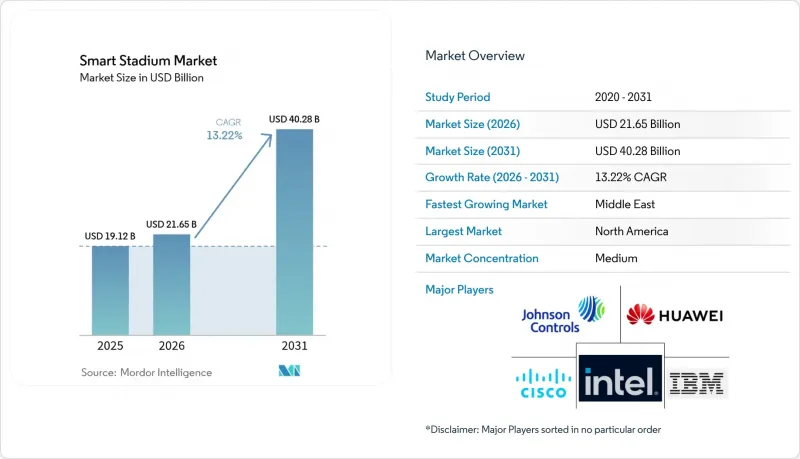
本報告按組件(硬體、軟體、服務)、軟體解決方案(例如建築自動化管理)、部署模式(本地部署、雲端部署)、連接技術(例如 Wi-Fi 6/7、5G、專用 LTE)、應用領域(例如體育賽事)、收入來源(例如門票銷售和商品銷售)以及地區進行細分。市場預測以美元計價。
全球智慧體育場市場趨勢及洞察
5G網路的部署將促進高密度連接。
電信業者對毫米波和C波段頻率的投資,使得體育場館能夠以千兆Gigabit的速度同時上線用戶提供服務——這在傳統的分散式天線系統中是無法實現的。 2024年,Verizon完成了在28個NFL場館的5G超寬頻部署,實現了擴增實境(AR)回放和現場投注等功能,這些功能對延遲的要求低於20毫秒。在聖母大學體育場,2024年引入的Wi-Fi 6E疊加網路實現了每場比賽26 Gbps的總合通訊速度,並結合專用LTE核心網實現了確定性的物聯網遙測。沃達豐和德國電信等歐洲營運商正將體育場館網路密度的提升作為獨立組網5G核心網部署的典範,並以此向市政當局等買家推廣網路切片技術。專用小型基地台網路可減少尖峰時段接入擁塞期間的干擾,此時每個網路基地台的連接數超過 1500 個。由此獲得的頻寬將支持下一代服務,從而提高人均消費和贊助收入。
計劃中的大型活動將加速數位化預算的落實
2026年國際足總世界盃和2028年洛杉磯奧運會正在將長達十年的更新周期縮短為短期、高強度的兩年項目。根據聯想於2024年與國際足總簽署的全球協議,聯想將為美國、墨西哥和加拿大的16個場館提供邊緣伺服器和人工智慧設備。在墨西哥的阿茲特克體育場,一項耗資1.5億美元的維修工程於2024年啟動,旨在打造一個「光纖到座位」的連接環境,支援4K點播影像。洛杉磯2028奧運組委會正在利用歐特克的BIM工作流程來整合預測性維護,該維護將在奧運結束後繼續進行。這些旗艦建設項目正在產生示範效應,鼓勵次市場升級到奧運標準,並將智慧體育場市場遠遠擴展到主辦城市之外。
舊有系統的碎片化推高了維修成本。
1990年至2010年間建造的歐洲體育場館通常採用基於不同協議的專有平台,例如用於暖通空調、門禁和監控系統的BACnet、Modbus和ONVIF。整合這些孤立的系統需要客製化中間件和漫長的現場試運行,這可能會使每個座位的成本比新建設(待開發區)翻倍。 2024年體育場館商業高峰會的一項調查發現,63%的業者認為整合複雜性是實施的最大障礙,大規模場館的維修可能需要長達18個月的時間。營運商可能還需要在過渡期間並行維護多個系統,從而降低投資報酬率。雖然歐盟的《建築能源性能指令》正在加速淘汰過時的設備,但資金限制和市政租賃協議的限制延緩了大規模設備的更換,阻礙了智慧體育場館市場的發展。
細分市場分析
隨著系統整合商將傳統的電氣、機械和IT資產整合到單一的物聯網架構中,服務收入在2025年佔比達到51.88%。同時,軟體預計將以15.02%的複合年成長率成長,成為推動智慧體育場市場成長最快的細分領域。營運商傾向於採用基於訂閱的建築自動化和觀眾分析模組授權模式,以避免大規模的系統升級。思科2024年推出的私人5G套裝組合將無線設備、核心軟體和專業服務整合到單一SKU中,清楚展現了這項轉變。隨著通用x86伺服器被專用設備取代,場館正在降低總體擁有成本(TCO)並加快功能部署。智慧體育場產業正日益將軟體視為新收入來源的主要驅動力,硬體升級的時機也與營運商的5G藍圖和Wi-Fi的世代更迭保持一致。
硬體佔據著至關重要的中間位置。邊緣閘道器、網路基地台和感測器陣列必須滿足廣播級延遲標準,尤其是在即時投注整合方面。更新週期與Wi-Fi 7的普及以及6 GHz頻寬在主要市場的引入相一致。將韌體更新和AI推理功能與現有設備捆綁銷售的供應商最能滿足更新需求。組件配置的這種轉變凸顯了智慧體育場館市場從資本密集建設模式轉向產生持續收入的服務模式的轉型。
到了2025年,數位內容和粉絲互動軟體將佔解決方案收入的28.10%,這反映出行動應用、座位預訂和擴增實境(AR)疊加技術的需求不斷成長,從而推高了人均消費。 「智慧票務與停車」領域正迅速崛起,預計複合年成長率將達到13.95%。利物浦足球俱樂部引入近場通訊(NFC)技術後,平均入場時間從12分鐘縮短至7分鐘,並為廣告商產生了帶有時間戳的旅行數據。 SKIDATA的2024年雲端停車解決方案已在德國和奧地利投入運營,可與城市交通系統結合,以實現動態定價。
在永續發展需求的推動下,建築自動化和能源管理正在融合。Schneider Electric的EcoStruxure平台可實現20-30%的節能效果,這對於面臨近零能耗目標的歐盟營運商而言極具吸引力。安防軟體仍以合規性為導向,歐足總和國際足總正尋求將人工智慧驅動的觀眾分析納入場館主導要求。在所有領域,模組化、雲端原生設計正在拓展智慧體育場的市場。
區域分析
2025年,北美引領智慧體育場市場,佔37.10%的市場。這主要得益於成熟的博彩監管和5G網路密度的快速成長。 Verizon在28個NFL場館部署的專用小型基地台網路和邊緣運算節點,實現了擴增實境(AR)回放和即時投注。在加拿大和墨西哥,體育場館正在進行維修,以迎接2026年世界盃。其中,阿茲特克體育場耗資1.5億美元的「光纖到座位」升級計畫樹立了區域標竿。然而,加州的隱私法規要求場館在邊緣端對位置資料進行匿名化處理,這在一定程度上減緩了生物識別技術的應用。
中東地區預計將以14.45%的複合年成長率成為該地區成長最快的市場,這主要得益於政府為響應「2030願景」而大力投資建設的大型場館。利雅德的薩勒曼國王體育場致力於透過整合太陽能發電系統和人工智慧驅動的觀眾分析來實現淨零能耗,而杜拜競技場則採用了無現金特許經行銷售和動態停車管理。儘管每年不到40個活動日的運轉率可能會影響投資報酬率,但政府的支持措施可以降低再融資風險,並確保旗艦計畫準時完工。這些趨勢正在推動智慧體育場館市場的擴張。
在亞太地區和歐洲,智慧體育場的實施進展各不相同,受到公共資金項目和相關法規的影響。印度的「Kero India 2.0」計畫已撥款300億印度盧比(約3.6億美元),用於2024年至2025年間二級體育場館的物聯網升級改造。中國的「十四五」規劃已將體育場館物聯網納入地方債券融資方案,加速了廣東和浙江兩省的實施進程。歐洲的零信任指令和能源指令雖然提高了基準成本,但也保護了能夠確保供應鏈安全的現有業者。日本和韓國正利用5G技術實現無現金支付和基於擴增實境(AR)的球迷體驗,但由於需要進行抗震維修,兩國面臨日益成長的資金需求。在每個地區,政策催化劑和重大賽事的安排都會影響實施時間,但由於球迷對互聯體驗的持續需求,智慧體育場館市場正保持著穩定成長的態勢。
其他好處:
- Excel格式的市場預測(ME)表
- 3個月的分析師支持
目錄
第1章:引言
- 研究假設和市場定義
- 調查範圍
第2章:調查方法
第3章執行摘要
第4章 市場狀況
- 市場概覽
- 市場促進因素
- 5G 網路的部署正在促進北美和歐洲各場所的高密度連接。
- 即將到來的重大賽事(2026 年 FIFA 世界盃和 2028 年洛杉磯奧運會)正在推動數位化預算的增加。
- 歐盟人群安全義務(第 2023/1881 號條例):強制實施即時分析平台。
- 在美國,現場體育博彩和數據授權正在開闢新的收入來源。
- 亞太地區(例如印度的“Khelo India 2.0”)的智慧城市津貼正在資助體育場館升級改造,以融入物聯網技術。
- 在歐盟的各個領域, 「綠色新政」的目標正在推動節能型建築自動化。
- 市場限制因素
- 在歐洲,舊有系統的碎片化推高了系統維修的整合成本。
- GDPR 和 CCPA 規定的網路責任增加,正在減緩粉絲數據平台的普及。
- 在南美洲,由於地方政府租賃核准流程冗長,資本投資被延後。
- 設備運轉率下降(每年不到40天)導致中東私人體育場投資者的投資報酬率降低
- 產業價值鏈分析
- 監管和技術展望
- 波特五力模型
- 投資與資金籌措分析
第5章 市場規模與成長預測
- 按組件
- 硬體
- 軟體
- 服務
- 透過軟體解決方案
- 建築自動化管理
- 體育場和公共安全
- 活動和人群管理
- 數位內容和粉絲互動
- 網管
- 能源管理
- 智慧停車票
- 部署模式
- 現場
- 雲
- 透過連接技術
- Wi-Fi 6/7
- 5G 和專用 LTE
- 分散式天線系統(DAS)
- 藍牙低功耗/BLE 信標
- 光纖和邊緣運算基礎設施
- 按應用程式字段
- 體育賽事
- 音樂會和娛樂
- 電競錦標賽
- 公司及其他活動
- 按收入來源
- 門票銷售和商品銷售
- 特許經營和招待
- 廣告與贊助
- 場地租賃及體育以外的活動
- 數據貨幣化和博彩
- 按地區
- 北美洲
- 美國
- 加拿大
- 墨西哥
- 南美洲
- 巴西
- 阿根廷
- 其他南美國家
- 亞太地區
- 中國
- 印度
- 日本
- 韓國
- 其他亞太國家
- 歐洲
- 德國
- 英國
- 法國
- 義大利
- 西班牙
- 其他歐洲國家
- 中東
- 沙烏地阿拉伯
- 阿拉伯聯合大公國
- 其他中東國家
- 非洲
- 南非
- 埃及
- 其他非洲國家
- 北美洲
第6章 競爭情勢
- 市場集中度
- 策略趨勢
- 市佔率分析
- 公司簡介
- Cisco Systems Inc.
- IBM Corporation
- Huawei Technologies Co. Ltd.
- Johnson Controls International plc
- Intel Corporation
- Schneider Electric SE
- Ericsson AB
- Honeywell International Inc.
- Hewlett Packard Enterprise(Aruba Networks)
- CommScope
- NEC Corporation
- Tech Mahindra Ltd.
- NXP Semiconductors NV
- JMA Wireless
- Axess AG
- AllGoVision Technologies Pvt. Ltd.
- Qualcomm Technologies Inc.
- KORE Wireless Group
- Daktronics Inc.
- SAP SE
- Oracle Corporation
- Schneider Electric
- Extreme Networks Inc.
- Zebra Technologies Corp.
- Panasonic Holdings Corp.
第7章 市場機會與未來展望
According to Mordor Intelligence, smart stadium market size in 2026 is estimated at USD 21.65 billion, growing from 2025 value of USD 19.12 billion with 2031 projections showing USD 40.28 billion, growing at 13.22% CAGR over 2026-2031.
This report is Segmented by Component (Hardware, Software, and Services), Software Solution (Building Automation Management, and More), Deployment Mode (On-Premise, and Cloud), Connectivity Technology (Wi-Fi 6/7, 5G and Private LTE, and More), Application Area (Sports Events, and More), Revenue Stream (Ticketing and Merchandise, and More), and Geography. The Market Forecasts are Provided in Terms of Value (USD).
Global Smart Stadium Market Trends and Insights
5G Network Roll-outs Catalyzing High-Density Connectivity
Carrier investment in millimeter-wave and C-band spectrum is enabling stadiums to serve tens of thousands of concurrent users at multi-gigabit speeds, a feat that legacy distributed-antenna systems could not economically achieve. Verizon completed 5G Ultra Wideband builds across 28 NFL venues in 2024, supporting augmented-reality replays and in-seat betting that demand sub-20-millisecond latency. Notre Dame Stadium's 2024 Wi-Fi 6E overlay achieved an aggregate of 26 Gbps during a single game and is being paired with a private LTE core for deterministic IoT telemetry. European operators such as Vodafone and Deutsche Telekom are positioning stadium densification as anchor tenants for standalone 5G cores that also showcase slicing to municipal buyers. Dedicated small-cell grids reduce interference during peak ingress when device density exceeds 1,500 connections per access point. The resulting bandwidth is underpinning next-generation services that raise per-capita spending and sponsorship yield.
Mega-Event Pipeline Accelerating Digitization Budgets
The 2026 FIFA World Cup and 2028 Los Angeles Olympics are compressing decade-long refresh cycles into two-year sprints. Lenovo's 2024 global deal with FIFA supplies edge servers and AI appliances to 16 venues across the United States, Mexico, and Canada. Mexico's Estadio Azteca began a USD 150 million renovation in 2024, installing fiber-to-the-seat connectivity for 4K on-demand video. The LA28 organizing committee is utilizing Autodesk BIM workflows to integrate predictive maintenance that will continue beyond the games. These flagship builds create a demonstration effect that pushes secondary markets to upgrade to Olympic-grade standards, expanding the smart stadium market well beyond host cities.
Legacy System Fragmentation Elevating Retrofit Costs
European arenas built between 1990 and 2010 often run proprietary HVAC, access control, and surveillance platforms on disparate protocols such as BACnet, Modbus, and ONVIF. Converging these silos demands custom middleware and lengthy on-site commissioning, which can double the per-seat cost of a greenfield build. A 2024 Stadium Business Summit survey found that 63% of operators identified integration complexity as their top barrier to adoption, with retrofit timelines reaching 18 months for large venues. Operators must sometimes maintain parallel systems during migration, eroding ROI. Although the EU's Energy Performance of Buildings Directive accelerates decommissioning of obsolete equipment, capital constraints and municipal lease restrictions slow wholesale replacement, weighing on smart stadium market growth.
Other drivers and restraints analyzed in the detailed report include:
- EU Crowd-Safety Mandates Requiring Real-time Analytics
- In-Venue Sports Betting and Data Licensing Opening New Revenue Streams
- Rising Cyber-Liability Under GDPR and CCPA
For complete list of drivers and restraints, kindly check the Table Of Contents.
Segment Analysis
Services anchored 51.88% of 2025 revenue as system integrators mapped legacy electrical, mechanical, and IT assets into a single IoT fabric. Software, however, is forecast to grow at a 15.02% CAGR, making it the fastest driver of smart stadium market growth. Operators prefer subscription licenses for building-automation and crowd-analytics modules that avoid forklift upgrades. Cisco's 2024 Private 5G bundle illustrates the shift, combining radios, core software, and professional services into a single SKU. As commodity x86 servers replace proprietary appliances, venues cut the total cost of ownership and accelerate feature roll-outs. The smart stadium industry is increasingly treating software as the principal lever for new revenue streams, with hardware refreshes timed to coincide with carrier 5G roadmaps and Wi-Fi generational shifts.
Hardware occupies an essential middle ground. Edge gateways, access points, and sensor arrays must still meet broadcast-quality latency thresholds, particularly for real-time betting integrations. Replacement cycles align with the adoption of Wi-Fi 7 and the introduction of 6 GHz spectrum in major markets. Vendors that bundle firmware updates and AI inference capabilities into existing devices are best positioned to capture replacement demand. The evolving component mix underscores how the smart stadium market is migrating from capital-intensive builds toward recurring-revenue service models.
Digital Content and Fan Engagement software accounted for 28.10% of 2025 solution revenue, reflecting demand for mobile apps, in-seat ordering, and augmented-reality overlays that increase per-capita spending. Smart Ticketing and Parking, projected to post a 13.95% CAGR, is emerging as the breakout. Liverpool FC's NFC roll-out cut average ingress times from 12 to 7 minutes and produced timestamped mobility data for advertisers. SKIDATA's 2024 cloud parking solution, already live in Germany and Austria, integrates with city traffic systems to enable dynamic pricing.
Building Automation and Energy Management are converging around sustainability mandates; Schneider Electric's EcoStruxure platform claims 20-30% energy savings, a compelling metric for EU operators facing near-zero-energy targets. Security software remains compliance-driven as UEFA and FIFA push AI crowd analytics into venue licensure. Across categories, modular, cloud-native design is expanding the addressable market for smart stadiums.
Complete Report Scope:
- By Component
- Hardware
- Software
- Services
- By Software Solution
- Building Automation Management
- Stadium and Public Security
- Event and Crowd Management
- Digital Content and Fan Engagement
- Network Management
- Energy Management
- Smart Ticketing and Parking
- By Deployment Mode
- On-Premise
- Cloud
- By Connectivity Technology
- Wi-Fi 6/7
- 5G and Private LTE
- Distributed Antenna Systems (DAS)
- Bluetooth Low Energy / BLE Beacons
- Fiber and Edge Compute Infrastructure
- By Application Area
- Sports Events
- Concerts and Entertainment
- Esports Tournaments
- Corporate and Other Events
- By Revenue Stream
- Ticketing and Merchandise
- Concessions and Hospitality
- Advertising and Sponsorship
- Venue Rental and Non-Sport Events
- Data Monetization and Betting
- By Geography
- North America
- United States
- Canada
- Mexico
- South America
- Brazil
- Argentina
- Rest of South America
- Asia Pacific
- China
- India
- Japan
- South Korea
- Rest of Asia Pacific
- Europe
- Germany
- United Kingdom
- France
- Italy
- Spain
- Rest of Europe
- Middle East
- Saudi Arabia
- United Arab Emirates
- Rest of Middle East
- Africa
- South Africa
- Egypt
- Rest of Africa
- North America
Geography Analysis
North America led the smart stadium market with 37.10% share in 2025, lifted by mature betting regulations and aggressive 5G densification. Verizon's dedicated small-cell grids and edge-compute nodes across 28 NFL venues enable augmented-reality replays and real-time wagering. Canada and Mexico are renovating ahead of the 2026 World Cup, with Estadio Azteca's USD 150 million fiber-to-seat upgrade setting a regional benchmark. California's privacy rules, however, compel venues to anonymize location data at the edge, which slows biometric rollouts.
The Middle East is projected to post the fastest regional CAGR at 14.45% thanks to sovereign-funded mega-venues aligned with Vision 2030. Riyadh's King Salman Stadium is targeting net-zero energy through integrated solar arrays and AI crowd analytics, while Dubai Arena operates cashless concessions and dynamic parking. Underutilization below 40 event days per year threatens ROI, yet government backstops are mitigating refinancing risk to ensure showcase projects land on time, a dynamic that broadens the smart stadium market reach.
The Asia Pacific and Europe follow diverse adoption curves, shaped by public funding programs and regulations. India's Khelo India 2.0 earmarked INR 30 billion (USD 360 million) in 2024-2025 for IoT upgrades in tier-2 stadiums. China's 14th Five-Year Plan bundles stadium IoT into municipal bond packages, accelerating deployment in Guangdong and Zhejiang. Europe's zero-trust and energy directives lift baseline costs but protect incumbents that can certify supply-chain security. Japan and South Korea leverage 5G penetration for cashless payments and AR fan experiences, yet seismic-code retrofits raise capital needs. Across regions, policy drivers and mega-event timetables dictate timing, but the underlying demand for connected fan experiences keeps the smart stadium market on a steady growth path.
- Cisco Systems Inc.
- IBM Corporation
- Huawei Technologies Co. Ltd.
- Johnson Controls International plc
- Intel Corporation
- Schneider Electric SE
- Ericsson AB
- Honeywell International Inc.
- Hewlett Packard Enterprise (Aruba Networks)
- CommScope
- NEC Corporation
- Tech Mahindra Ltd.
- NXP Semiconductors N.V.
- JMA Wireless
- Axess AG
- AllGoVision Technologies Pvt. Ltd.
- Qualcomm Technologies Inc.
- KORE Wireless Group
- Daktronics Inc.
- SAP SE
- Oracle Corporation
- Schneider Electric
- Extreme Networks Inc.
- Zebra Technologies Corp.
- Panasonic Holdings Corp.
Additional Benefits:
- The market estimate (ME) sheet in Excel format
- 3 months of analyst support
TABLE OF CONTENTS
1 INTRODUCTION
- 1.1 Study Assumptions and Market Definition
- 1.2 Scope of the Study
2 RESEARCH METHODOLOGY
3 EXECUTIVE SUMMARY
4 MARKET LANDSCAPE
- 4.1 Market Overview
- 4.2 Market Drivers
- 4.2.1 5G Network Roll-outs Catalyzing High-Density Connectivity in North American and European Venues
- 4.2.2 Mega-Event Pipeline (2026 FIFA World Cup, 2028 LA Olympics) Accelerating Digitization Budgets
- 4.2.3 EU Crowd-Safety Mandates (Regulation 2023/1881) Requiring Real-time Analytics Platforms
- 4.2.4 In-Venue Sports Betting and Data Licensing Opening New Revenue Streams in the US
- 4.2.5 Smart-City Grants in APAC (e.g., India's Khelo India 2.0) Funding Stadium IoT Upgrades
- 4.2.6 Green-Deal Targets Driving Energy-Efficient Building Automation in EU Arenas
- 4.3 Market Restraints
- 4.3.1 Legacy System Fragmentation Elevating Retrofit Integration Costs in Europe
- 4.3.2 Rising Cyber-Liability Under GDPR and CCPA Slowing Fan-Data Platform Adoption
- 4.3.3 Prolonged Municipal Lease Approvals Delaying Capex in South America
- 4.3.4 Under-utilization (<40 days/yr) Curtailing ROI for Private Middle-East Stadium Investors
- 4.4 Industry Value Chain Analysis
- 4.5 Regulatory and Technological Outlook
- 4.6 Porter's Five Forces
- 4.6.1 Threat of New Entrants
- 4.6.2 Bargaining Power of Buyers
- 4.6.3 Bargaining Power of Suppliers
- 4.6.4 Threat of Substitute Products
- 4.6.5 Intensity of Competitive Rivalry
- 4.7 Investment and Funding Analysis
5 MARKET SIZE AND GROWTH FORECASTS (VALUE)
- 5.1 By Component
- 5.1.1 Hardware
- 5.1.2 Software
- 5.1.3 Services
- 5.2 By Software Solution
- 5.2.1 Building Automation Management
- 5.2.2 Stadium and Public Security
- 5.2.3 Event and Crowd Management
- 5.2.4 Digital Content and Fan Engagement
- 5.2.5 Network Management
- 5.2.6 Energy Management
- 5.2.7 Smart Ticketing and Parking
- 5.3 By Deployment Mode
- 5.3.1 On-Premise
- 5.3.2 Cloud
- 5.4 By Connectivity Technology
- 5.4.1 Wi-Fi 6/7
- 5.4.2 5G and Private LTE
- 5.4.3 Distributed Antenna Systems (DAS)
- 5.4.4 Bluetooth Low Energy / BLE Beacons
- 5.4.5 Fiber and Edge Compute Infrastructure
- 5.5 By Application Area
- 5.5.1 Sports Events
- 5.5.2 Concerts and Entertainment
- 5.5.3 Esports Tournaments
- 5.5.4 Corporate and Other Events
- 5.6 By Revenue Stream
- 5.6.1 Ticketing and Merchandise
- 5.6.2 Concessions and Hospitality
- 5.6.3 Advertising and Sponsorship
- 5.6.4 Venue Rental and Non-Sport Events
- 5.6.5 Data Monetization and Betting
- 5.7 By Geography
- 5.7.1 North America
- 5.7.1.1 United States
- 5.7.1.2 Canada
- 5.7.1.3 Mexico
- 5.7.2 South America
- 5.7.2.1 Brazil
- 5.7.2.2 Argentina
- 5.7.2.3 Rest of South America
- 5.7.3 Asia Pacific
- 5.7.3.1 China
- 5.7.3.2 India
- 5.7.3.3 Japan
- 5.7.3.4 South Korea
- 5.7.3.5 Rest of Asia Pacific
- 5.7.4 Europe
- 5.7.4.1 Germany
- 5.7.4.2 United Kingdom
- 5.7.4.3 France
- 5.7.4.4 Italy
- 5.7.4.5 Spain
- 5.7.4.6 Rest of Europe
- 5.7.5 Middle East
- 5.7.5.1 Saudi Arabia
- 5.7.5.2 United Arab Emirates
- 5.7.5.3 Rest of Middle East
- 5.7.6 Africa
- 5.7.6.1 South Africa
- 5.7.6.2 Egypt
- 5.7.6.3 Rest of Africa
- 5.7.1 North America
6 COMPETITIVE LANDSCAPE
- 6.1 Market Concentration
- 6.2 Strategic Moves
- 6.3 Market Share Analysis
- 6.4 Company Profiles (includes Global level Overview, Market level overview, Core Segments, Financials as available, Strategic Information, Market Rank/Share for key companies, Products AND Services, and Recent Developments)
- 6.4.1 Cisco Systems Inc.
- 6.4.2 IBM Corporation
- 6.4.3 Huawei Technologies Co. Ltd.
- 6.4.4 Johnson Controls International plc
- 6.4.5 Intel Corporation
- 6.4.6 Schneider Electric SE
- 6.4.7 Ericsson AB
- 6.4.8 Honeywell International Inc.
- 6.4.9 Hewlett Packard Enterprise (Aruba Networks)
- 6.4.10 CommScope
- 6.4.11 NEC Corporation
- 6.4.12 Tech Mahindra Ltd.
- 6.4.13 NXP Semiconductors N.V.
- 6.4.14 JMA Wireless
- 6.4.15 Axess AG
- 6.4.16 AllGoVision Technologies Pvt. Ltd.
- 6.4.17 Qualcomm Technologies Inc.
- 6.4.18 KORE Wireless Group
- 6.4.19 Daktronics Inc.
- 6.4.20 SAP SE
- 6.4.21 Oracle Corporation
- 6.4.22 Schneider Electric
- 6.4.23 Extreme Networks Inc.
- 6.4.24 Zebra Technologies Corp.
- 6.4.25 Panasonic Holdings Corp.
7 MARKET OPPORTUNITIES AND FUTURE OUTLOOK
- 7.1 White-Space and Unmet-Need Assessment

 全球智慧體育場館解決方案市場規模、佔有率、趨勢和成長分析報告(2026-2034年)
 體育場館安保:市場佔有率分析、產業趨勢與統計、成長預測(2026-2031 年)
 2026年5G賦能智慧體育場全球市場報告智慧體育場市場規模、佔有率、成長及全球產業分析:按類型、應用和地區分類的洞察,2026-2034 年預測
 智慧體育場市場:2026-2032年全球市場預測(按服務類型、體育場類型、部署方式和應用程式分類)2026年全球智慧體育場市場報告2026年全球體育場館人工智慧市場報告
 2026-2030年全球智慧體育場市場
 智慧體育場市場報告:按組件、部署模式、應用和地區分類,2026-2034 年
 智慧體育場市場規模、佔有率和成長分析(按體育場類型、部署模式、提供的服務和地區分類)-2026-2033年產業預測