


 |
市場調查報告書
商品編碼
2063232
體育場館安保:市場佔有率分析、產業趨勢與統計、成長預測(2026-2031 年)Stadium Security - Market Share Analysis, Industry Trends & Statistics, Growth Forecasts (2026 - 2031) |
||||||

※ 本網頁內容可能與最新版本有所差異。詳細情況請與我們聯繫。
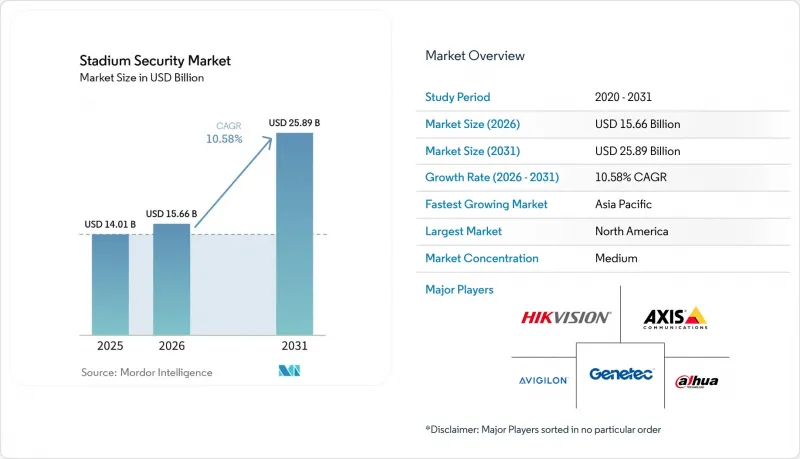
根據 Mordor Intelligence 預測,體育場館保全市場規模將從 2025 年的 140.1 億美元和 2026 年的 156.6 億美元成長到 2031 年的 258.9 億美元,2026 年至 2031 年的年複合成長率(CAGR)為 10.58%。
本報告按組件(硬體、軟體、服務)、解決方案類型(視訊監控系統、門禁系統等)、部署模式(本地部署、雲端部署)、體育場館容量(3萬座以下、3萬至5萬座、5萬座以上)以及地區(北美、亞太及其他地區)進行細分。市場預測以美元計價。
全球體育場館安保市場趨勢與洞察
恐怖主義威脅日益加劇,加速了安全合規強制執行的進程。
2024年7月美洲盃足球賽期間發生的球迷衝入球場事件暴露了周邊安保漏洞和情報收集不足的問題,促使監管機構在贊助合約中加入安全條款。聯邦緊急災難管理署(FEMA)津貼6.25億美元,但前提是相關場館必須在武器偵測、反無人機措施和網路安全方面達到既定目標,並敦促場館將專案實施計畫從五年縮短至18個月。保險公司現在將保費折扣與人工智慧分析和生物識別門禁系統的應用掛鉤,以確保即使在消費者支出減少時期也能擁有穩定的需求基礎。
人工智慧驅動的影像分析技術正迅速普及,用於即時威脅偵測
用於偵測無人認領行李、人群湧動和武器特徵的人工智慧影像分析技術正從試點計畫轉向全面部署。 Convergint公司已整合物件辨識軟體,使美國多個場館的監控室人員減少了60%。皇家挑戰者班加羅爾板球場將於2026年1月部署300多台人工智慧鏡頭,用於人群預測預警和臉部辨識,這表明該技術在亞太地區的部署取得了顯著進展。
整合式安全套件需要大量的初始資金投入。
一座擁有4萬個座位的中型體育場館,預算在800萬至1,200萬美元之間,用於購買人工智慧攝影機、生物識別、入侵偵測感測器和整合指揮中心。然而,由於預算限制,這些體育場館通常分階段採購設備,導致安全漏洞和投資收益(ROI)降低。這種零散的安全升級方式可能會讓安全漏洞長期無法解決。在南美洲和非洲等地區,營運商擴大採用分階段升級和託管安全即服務(MaaS)解決方案。這些策略既能避免前期的大筆資本投入,又能維持一定的營運安全水準。此外,這些方法還能靈活應對不斷變化的安全需求。
細分市場分析
截至2025年,以攝影機、旋轉平台和周界感測器為代表的硬體設備將佔據體育場館安防市場61.63%的佔有率。然而,隨著場館將全天候整合監控和合規性審計外包,預計到2031年,服務業將以10.78%的複合年成長率推動市場成長。這種轉變在座位數少於3萬的場館中尤為顯著,這些場館缺乏內部IT專業知識,因此正轉向演算法調優與事件回應的訂閱模式。
服務業的快速成長與Genetec和Convergint等公司提供的託管安防服務包的轉型不謀而合,這些服務包正從資本密集型銷售模式轉向經常性收入模式。另一方面,軟體產業則介於這兩種趨勢之間,透過影像管理授權和預測性人群管理模組,將向IP攝影機的過渡轉化為獲利模式。 Evolv Technologies的「按掃描次數收取行李安檢費」模式,反映了供應商如何轉向基於消費的經濟模式,從而在無需頻繁續訂的情況下提升客戶終身價值(CLV)。
到2025年,視訊監控將佔體育場館安防市場43.28%的佔有率,鞏固攝影機作為主要安全層級的地位。網路安全雖然市佔率仍較小,但由於勒索軟體、分散式阻斷服務(DDoS)攻擊和營運技術(OT)網路漏洞等威脅賽事連續性的風險,正以10.91%的複合年成長率快速成長。 Fortinet為巴塞隆納足球俱樂部提供票務銷售、POS機和監控網路的安全保障,而Nozomi Networks則負責監控暖通空調(HVAC)控制器上的異常流量。
受中東地區場館強制生物識別以及可將防護範圍擴展至體育場圍籬外500公尺的自動雲台雷達追蹤技術推動,門禁控制、邊界偵測和警報平台正經歷穩定的個位數中段成長。保險公司也強制要求進行年度穿透測試,實際上是將網路安全要求納入了租賃和贊助協議中。
區域分析
預計2025年,北美將維持38.55%的體育場館保全市場佔有率。這得歸功於聯邦緊急災難管理署(FEMA)的資金支持、美國國家橄欖球聯盟(NFL)和美國職棒大聯盟(MLB)的安全要求,以及強大的系統整合商生態系統。為了迎接2026年國際足總世界杯,大都會人壽體育場、SoFi體育場和AT&T體育場都進行了升級,採用了人工智慧分析、生物識別門禁和反無人機雷達等技術。加拿大和墨西哥的場館也呈現類似的趨勢,Axis Communications公司在阿茲特克體育場部署了車牌辨識和臉部認證系統。
亞太地區是成長最快的地區,年複合成長率達11.31%。 2026年1月在皇家挑戰者班加羅爾體育場部署攝影機的項目,以及中國在東南亞投資的項目,都凸顯了新建設中徹底淘汰模擬系統的趨勢。澳洲正在為2032年布里斯班冬季奧運部署無人機系統(UAS)對抗措施,而日本正在將其體育場館網路整合到智慧城市基礎設施中,以服務緊急服務。資料保護的監管差異仍然是一個不確定因素,尤其是在印度,該國尚未制定全國性的生物識別法規。
歐洲、中東和非洲的生物辨識技術普及速度各不相同。 《一般資料保護規則》(GDPR) 的罰款阻礙了西班牙和丹麥生物識別的應用,而巴黎聖日耳曼足球俱樂部採用的保護隱私的臉部認證分析技術則展示了一種商業性的變通方案。沙烏地阿拉伯政府資助的15座體育場館計畫正在推動中東地區生物辨識技術的快速普及,而南美洲在美洲杯資料外洩事件後正在恢復信心,巴西和阿根廷已強制要求使用QR碼驗票並加強安保措施。在非洲,場館也在穩步推動生物辨識技術的普及,並在資金限制下優先考慮分階段升級。
其他好處:
- Excel格式的市場預測(ME)表
- 3個月的分析師支持
目錄
第1章:引言
- 研究假設和市場定義
- 調查範圍
第2章:調查方法
第3章執行摘要
第4章 市場狀況
- 市場概覽
- 市場促進因素
- 恐怖主義威脅日益加劇,正在加速安全的法律合規進程。
- 人工智慧驅動的影像分析技術在即時威脅偵測。
- 政府資助的智慧體育場維修,旨在迎接 2026 年至 2028 年的重大賽事。
- 透過將類比CCTV遷移到 IP/PoE 系統來降低整體擁有成本。
- 利用行人流量資料進行贊助商分析
- 用於活動安防的臨時專用 5G 網路一體化套件
- 市場限制因素
- 整合安防套件需要較高的初始資本投入
- 隱私法規限制了生物識別的採用。
- 人工智慧平台缺乏熟練的安全分析師
- 高密度物聯網設備造成的射頻擁塞導致感測器干擾
- 產業價值鏈分析
- 監理情勢
- 技術展望
- 宏觀經濟因素對市場的影響
- 波特五力分析
第5章 市場規模與成長預測
- 按組件
- 硬體
- 軟體
- 服務
- 按解決方案類型
- 影像監控系統
- 門禁系統
- 邊界入侵偵測系統
- 警報和通知系統
- 網路安全與網路監控
- 按部署模式
- 現場
- 基於雲端的
- 體育場容量
- 不到3萬個座位
- 3萬至5萬個座位
- 超過5萬個座位
- 按地區
- 北美洲
- 美國
- 加拿大
- 墨西哥
- 歐洲
- 德國
- 英國
- 法國
- 俄羅斯
- 其他歐洲國家
- 亞太地區
- 中國
- 日本
- 印度
- 韓國
- 澳洲
- 其他亞太國家
- 南美洲
- 中東和非洲
- 北美洲
第6章 競爭情勢
- 市場集中度
- 策略趨勢
- 市佔率分析
- 公司簡介
- Avigilon Corporation
- Genetec Inc.
- Axis Communications AB
- Hangzhou Hikvision Digital Technology Co., Ltd.
- Zhejiang Dahua Technology Co., Ltd.
- Dallmeier Electronic GmbH & Co. KG
- AxxonSoft Limited
- Rapiscan Systems, Inc.
- Evolv Technologies Holdings, Inc.
- Patriot One Technologies Inc.(Xtract One)
- Senstar Corporation
- BriefCam Ltd.
- Hanwha Vision Co., Ltd.
- Bosch Sicherheitssysteme GmbH
- NEC Corporation
- Teledyne FLIR LLC
- Gallagher Group Limited(Security Division)
- IDEMIA Group SAS
- Magal Security Systems Ltd.
- Fortem Technologies, Inc.
第7章 市場機會與未來展望
According to Mordor Intelligence, the stadium security market size is projected to expand from USD 14.01 billion in 2025 and USD 15.66 billion in 2026 to USD 25.89 billion by 2031, registering a CAGR of 10.58% between 2026 to 2031.
This report is Segmented by Component (Hardware, Software, and Services), Solution Type (Video Surveillance Systems, Access Control Systems, and More), Deployment Model (On-Premise, and Cloud-Based), Stadium Capacity (Less Than 30, 000 Seats, 30, 000-50, 000 Seats, and Greater Than 50, 000 Seats), and Geography (North America, Asia-Pacific, and More). The Market Forecasts are Provided in Terms of Value (USD).
Global Stadium Security Market Trends and Insights
Heightened Terrorism Threat Accelerating Mandatory Security Compliance
The July 2024 Copa America pitch invasion exposed perimeter weaknesses and intelligence gaps, motivating regulators to embed security clauses into hosting contracts. FEMA tied USD 625 million in grants to weapon-detection, counter-drone, and cybersecurity milestones, forcing venues that once planned five-year rollouts to compress projects into 18 months. Insurance carriers now peg premium discounts to AI analytics and biometric access control, ensuring a durable demand baseline even during discretionary-spending pauses.
Rapid Adoption of AI-Powered Video Analytics for Real-Time Threat Detection
AI video analytics that flag unattended bags, crowd surges, and weapon signatures are moving from pilots to mass deployment. Convergint integrated object-recognition software that cut control-room headcount by 60% at multiple U.S. venues. Royal Challengers Bangalore funded 300-plus AI cameras for predictive congestion alerts and facial recognition in January 2026, illustrating Asia-Pacific's leapfrog adoption.
High Upfront CapEx for Integrated Security Suites
A mid-tier stadium, with a capacity of 40,000 seats, allocates a budget of USD 8-12 million for AI cameras, biometrics, intrusion sensors, and a unified command center. However, these stadiums often stagger their purchases due to budget constraints, which creates security gaps and reduces their return on investment (ROI). This fragmented approach to security upgrades can leave vulnerabilities unaddressed for extended periods. In regions like South America and Africa, operators are increasingly turning to incremental upgrades or managed security as-a-service solutions. These strategies help them avoid significant upfront capital expenditures while maintaining a degree of operational security. Such approaches also allow for flexibility in adapting to evolving security needs over time.
Other drivers and restraints analyzed in the detailed report include:
- Government-Funded Smart-Stadium Renovations Ahead of 2026-2028 Mega-Events
- Migration from Analog CCTV to IP/PoE Lowering TCO
- Privacy Regulations Constraining Biometric Deployment
For complete list of drivers and restraints, kindly check the Table Of Contents.
Segment Analysis
Hardware anchored 61.63% of stadium security market share in 2025 on the back of cameras, turnstiles, and perimeter sensors, yet services are pacing the expansion at 10.78% CAGR to 2031 as venues outsource integration, 24-hour monitoring, and compliance audits. The shift is most visible in facilities under 30,000 seats that lack in-house IT depth and pivot to subscription models for algorithm tuning and incident response.
The services boom aligns with managed-security bundles from Genetec and Convergint that convert capital sales into annuities, while software sits between the two streams, monetizing IP camera migrations with video management licensing and predictive crowd modules. Evolv Technologies' per-scan bag-screening fees illustrate how hardware vendors pivot to consumption economics, extending customer lifetime value without heavy refresh cycles.
Video surveillance accounted for 43.28% of the stadium security market in 2025, cementing cameras as the primary security layer. Cybersecurity, though a smaller slice, is accelerating at 10.91% CAGR because ransomware, distributed denial-of-service risks, and OT network exposures threaten event continuity. Fortinet secured ticketing, point-of-sale, and surveillance networks at FC Barcelona, while Nozomi Networks monitors HVAC controllers for anomalous traffic.
Access control, perimeter detection, and alarm platforms post steady mid-single-digit growth, supported by biometrics mandates in Middle East venues and automated PTZ radar tracking that stretches protection 500 m beyond stadium fences. Insurers require annual penetration testing, effectively hard-wiring cybersecurity demand into lease covenants and sponsorship agreements.
Geography Analysis
North America retained 38.55% stadium security market share in 2025, lifted by FEMA funding, NFL and Major League Baseball security mandates, and a dense integrator ecosystem. MetLife Stadium, SoFi Stadium, and AT&T Stadium all upgraded to AI analytics, biometric gates, and counter-drone radar ahead of FIFA 2026. Canadian and Mexican venues mirror the pattern, with Axis Communications integrating license-plate recognition and facial analytics at Estadio Azteca.
Asia-Pacific, with a 11.31% CAGR, is the fastest-growing region. Royal Challengers Bangalore's January 2026 camera project and China-financed deployments in Southeast Asia underscore how new builds skip analog entirely. Australia is installing counter-UAS systems for the 2032 Brisbane Olympics, and Japan is tying stadium networks into smart-city grids for emergency services. Data-protection fragmentation remains a wild card, particularly in India, where national biometric rules are still pending.
Europe, the Middle East, and Africa show mixed momentum. GDPR fines temper biometric rollouts in Spain and Denmark, but privacy-preserving facial analytics at Paris Saint-Germain reveal a commercial workaround. Saudi Arabia's sovereign-funded 15-stadium initiative positions the Middle East for rapid category adoption, while South America rebuilds confidence after the Copa America breach, with Brazil and Argentina mandating QR ticket checks and expanded guard staffing. African venues proceed gradually, prioritizing incremental upgrades within fiscal constraints.
- Avigilon Corporation
- Genetec Inc.
- Axis Communications AB
- Hangzhou Hikvision Digital Technology Co., Ltd.
- Zhejiang Dahua Technology Co., Ltd.
- Dallmeier Electronic GmbH & Co. KG
- AxxonSoft Limited
- Rapiscan Systems, Inc.
- Evolv Technologies Holdings, Inc.
- Patriot One Technologies Inc. (Xtract One)
- Senstar Corporation
- BriefCam Ltd.
- Hanwha Vision Co., Ltd.
- Bosch Sicherheitssysteme GmbH
- NEC Corporation
- Teledyne FLIR LLC
- Gallagher Group Limited (Security Division)
- IDEMIA Group S.A.S.
- Magal Security Systems Ltd.
- Fortem Technologies, Inc.
Additional Benefits:
- The market estimate (ME) sheet in Excel format
- 3 months of analyst support
TABLE OF CONTENTS
1 INTRODUCTION
- 1.1 Study Assumptions and Market Definition
- 1.2 Scope of the Study
2 RESEARCH METHODOLOGY
3 EXECUTIVE SUMMARY
4 MARKET LANDSCAPE
- 4.1 Market Overview
- 4.2 Market Drivers
- 4.2.1 Heightened Terrorism Threat Accelerating Mandatory Security Compliance
- 4.2.2 Rapid Adoption of AI-Powered Video Analytics for Real-Time Threat Detection
- 4.2.3 Government-Funded Smart-Stadium Renovations Ahead of 2026-2028 Mega-Events
- 4.2.4 Migration from Analog CCTV to IP/PoE Lowering TCO
- 4.2.5 Monetization of Crowd-Flow Data for Sponsor Analytics
- 4.2.6 Temporary Private-5G Network-in-a-Box Kits for Event Security
- 4.3 Market Restraints
- 4.3.1 High Upfront CapEx for Integrated Security Suites
- 4.3.2 Privacy Regulations Constraining Biometric Deployment
- 4.3.3 Shortage of Skilled Security Analysts for AI Platforms
- 4.3.4 RF Congestion from Dense IoT Devices Causing Sensor Interference
- 4.4 Industry Value-Chain Analysis
- 4.5 Regulatory Landscape
- 4.6 Technological Outlook
- 4.7 Impact of Macroeconomic Factors on the Market
- 4.8 Porter's Five Forces Analysis
- 4.8.1 Threat of New Entrants
- 4.8.2 Bargaining Power of Suppliers
- 4.8.3 Bargaining Power of Buyers
- 4.8.4 Threat of Substitutes
- 4.8.5 Industry Rivalry
5 MARKET SIZE AND GROWTH FORECASTS (VALUE)
- 5.1 By Component
- 5.1.1 Hardware
- 5.1.2 Software
- 5.1.3 Services
- 5.2 By Solution Type
- 5.2.1 Video Surveillance Systems
- 5.2.2 Access Control Systems
- 5.2.3 Perimeter Intrusion Detection Systems
- 5.2.4 Alarm and Notification Systems
- 5.2.5 Cybersecurity and Network Monitoring
- 5.3 By Deployment Model
- 5.3.1 On-Premise
- 5.3.2 Cloud-Based
- 5.4 By Stadium Capacity
- 5.4.1 Less Than 30,000 Seats
- 5.4.2 30,000-50,000 Seats
- 5.4.3 Greater Than 50,000 Seats
- 5.5 By Geography
- 5.5.1 North America
- 5.5.1.1 United States
- 5.5.1.2 Canada
- 5.5.1.3 Mexico
- 5.5.2 Europe
- 5.5.2.1 Germany
- 5.5.2.2 United Kingdom
- 5.5.2.3 France
- 5.5.2.4 Russia
- 5.5.2.5 Rest of Europe
- 5.5.3 Asia-Pacific
- 5.5.3.1 China
- 5.5.3.2 Japan
- 5.5.3.3 India
- 5.5.3.4 South Korea
- 5.5.3.5 Australia
- 5.5.3.6 Rest of Asia-Pacific
- 5.5.4 South America
- 5.5.5 Middle East and Africa
- 5.5.1 North America
6 COMPETITIVE LANDSCAPE
- 6.1 Market Concentration
- 6.2 Strategic Moves
- 6.3 Market Share Analysis
- 6.4 Company Profiles (includes Global Level Overview, Market Level Overview, Core Segments, Financials as available, Strategic Information, Market Rank/Share, Products and Services, Recent Developments)
- 6.4.1 Avigilon Corporation
- 6.4.2 Genetec Inc.
- 6.4.3 Axis Communications AB
- 6.4.4 Hangzhou Hikvision Digital Technology Co., Ltd.
- 6.4.5 Zhejiang Dahua Technology Co., Ltd.
- 6.4.6 Dallmeier Electronic GmbH & Co. KG
- 6.4.7 AxxonSoft Limited
- 6.4.8 Rapiscan Systems, Inc.
- 6.4.9 Evolv Technologies Holdings, Inc.
- 6.4.10 Patriot One Technologies Inc. (Xtract One)
- 6.4.11 Senstar Corporation
- 6.4.12 BriefCam Ltd.
- 6.4.13 Hanwha Vision Co., Ltd.
- 6.4.14 Bosch Sicherheitssysteme GmbH
- 6.4.15 NEC Corporation
- 6.4.16 Teledyne FLIR LLC
- 6.4.17 Gallagher Group Limited (Security Division)
- 6.4.18 IDEMIA Group S.A.S.
- 6.4.19 Magal Security Systems Ltd.
- 6.4.20 Fortem Technologies, Inc.
7 MARKET OPPORTUNITIES AND FUTURE OUTLOOK
- 7.1 White-Space and Unmet-Need Assessment

 全球智慧體育場館解決方案市場規模、佔有率、趨勢和成長分析報告(2026-2034年)
 智慧體育場:市場佔有率分析、產業趨勢與統計、成長預測(2026-2031)
 2026年5G賦能智慧體育場全球市場報告智慧體育場市場規模、佔有率、成長及全球產業分析:按類型、應用和地區分類的洞察,2026-2034 年預測
 智慧體育場市場:2026-2032年全球市場預測(按服務類型、體育場類型、部署方式和應用程式分類)2026年全球智慧體育場市場報告2026年全球體育場館人工智慧市場報告
 2026-2030年全球智慧體育場市場
 智慧體育場市場報告:按組件、部署模式、應用和地區分類,2026-2034 年
 智慧體育場市場規模、佔有率和成長分析(按體育場類型、部署模式、提供的服務和地區分類)-2026-2033年產業預測