


 |
市場調查報告書
商品編碼
2114083
嵌入式系統分析:市場佔有率分析、產業趨勢與統計、成長預測(2026-2031)Embedded Analytics - Market Share Analysis, Industry Trends & Statistics, Growth Forecasts (2026 - 2031) |
||||||

※ 本網頁內容可能與最新版本有所差異。詳細情況請與我們聯繫。
根據 Mordor Intelligence 預測,嵌入式分析市場規模將從 2025 年的 785.3 億美元成長到 2026 年的 892.5 億美元,然後在 2031 年達到 1,691.8 億美元,2026 年至 2031 年的複合年成長率為 13.65%。
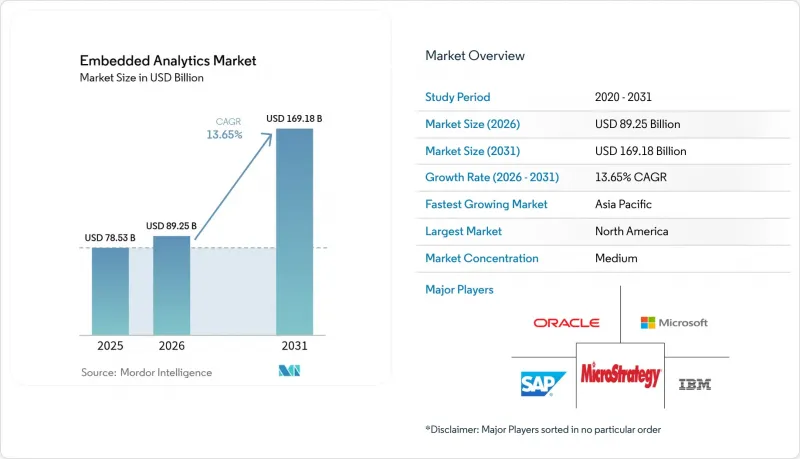
本報告按解決方案(軟體和服務)、組織規模(中小企業及其他)、部署模式(雲端和本地部署)、最終用戶行業(銀行、金融服務和保險、醫療保健及其他)、整合模式(應用內/工作流內及其他)、業務職能(財務、銷售及其他)、分析類型(說明分析及其他)和地區進行細分。市場預測以美元計價。
全球嵌入式分析市場趨勢與洞察
無頭BI框架與低程式碼平台的融合正在逐步推進。
透過將無頭 BI 與低程式碼工具結合,開發團隊可以將資料層與展示層分離,從而加速客製化分析功能的開發。到 2025 年,37% 的北美高階主管將尋求支援客製化資料應用的 BI 工具。 RamSoft 利用 Cube 的無頭架構,僅用兩週時間就完成了生產部署,比傳統流程快了數月。這些解決方案無需切換上下文,使用戶能夠直接從工作介面獲取洞察,從而將生產力提高 20% 至 40%。
中型製造業對近乎即時洞察的需求
工廠營運商正在將分析功能整合到製造執行系統 (MES) 和監控與資料採集系統 (SCADA) 中,以便立即檢測異常情況。與嵌入式分析市場相關的製造業收入預計將從 2020 年的 411 億美元成長到 2025 年的 773 億美元。僅預測性維護一項就能將設備停機時間減少 30% 至 50%。德國和日本的工廠正在將這些功能納入其工業 4.0藍圖,以在投入成本波動和物流中斷的情況下穩定運作。
資料居住限制了應用程式內雲整合
嚴格的資料主權法規迫使跨國公司將敏感資料(及其處理)保留在特定國家境內,這使得全球分析系統的部署變得複雜。目前,混合架構約佔部署總量的40%,它將用於受監管工作負載的本地節點與非敏感分析的雲端資源結合。這種複雜性和成本正在延緩價值實現,尤其是在合規負擔最重的金融和醫療保健產業。
細分市場分析
預計到2025年,軟體業務的收入將達到559.9億美元,佔總收入的71.30%,凸顯了其作為驅動視覺化、建模和人工智慧推理的核心引擎的作用。這一成長得益於更豐富的API庫,這些API支援託管應用程式中的規範邏輯和自動化決策。同時,隨著企業尋求整合專業知識、模式設計和變更管理支持,服務業務正以15.95%的複合年成長率快速擴張。由於涉及基於角色的安全、多租戶資料模型和使用者體驗調優等複雜部署,專業服務正成為一項策略性支出。
致力於建立多重雲端和混合分析架構的組織需要深入了解連接性、資料處理歷程管治以及分析資產的持續整合/持續交付 (CI/CD) 管線。因此,諮詢合作夥伴正積極參與架構藍圖設計等上游工程,而託管服務供應商則提供語意層更新、查詢最佳化和機器學習模型持續學習等「日常」維運服務。隨著低程式碼工具的普及,嵌入式分析市場將擴展到不熟悉傳統 BI 技術堆疊的業務部門團隊,預計這項服務生態系統將進一步擴展。
到2025年,大型企業將在嵌入式分析市場佔據496.3億美元的佔有率(佔市場佔有率的63.20%),它們已部署聯合資料架構,向數千名內部用戶提供符合管治要求的指標。這些公司正在建立多租戶模型,以服務各個業務部門,同時維護跨域安全性和稽核追蹤。它們的首要任務是確保其全球業務地點的關鍵績效指標(KPI)定義保持一致。
儘管投資規模較小,中小企業 (SME) 的複合年成長率 (CAGR) 卻高達 14.75%,位居行業之首。付費使用制的雲端原生平台使這些企業能夠獲得以往只有財富 500 強企業才能享有的功能。知識整合研究表明,只要擁有合適的文化和流程基礎,中小企業就能將分析洞察轉化為產品創新和營運敏捷性。隨著低程式碼可配置性的進一步降低准入門檻,中小企業預計將在無需承擔傳統企業級 BI 套件所需資本投入的情況下,擴大其實驗範圍。
預計到2025年,雲端運算帶來的營收將達到464.1億美元(佔總營收的59.10%),並將以15.35%的複合年成長率成長,這主要得益於SaaS供應商不斷透過原生分析功能豐富其產品。低廉的前期成本、彈性擴展能力和持續的功能發布,使得雲端運算成為數位化原生企業和中型企業的首選。對於高度監管的工作負載而言,本地部署解決方案仍然至關重要,其支出達321.2億美元(佔總支出的40.90%)。這些環境提供資料在地化和客製化功能,而這些功能在公共雲端中並非總是能夠實現。
將本地資料處理節點與雲端視覺化層融合的混合架構已成為主流設計模式。這種方法能夠在滿足資料主權法規要求的同時,實現非敏感資料的跨域整合。因此,與混合模式相關的嵌入式分析市場規模預計將超過純本地部署環境的成長,從而支援分階段遷移策略並確保即時突發容量。
區域分析
預計到2025年,北美市場規模將達到286.6億美元,佔全球整體營收的36.50%。這反映了北美成熟的數位基礎設施、高度普及的雲端運算以及精通數據驅動流程的勞動力。金融服務、醫療保健和科技公司是推動市場需求的主要力量,而無頭BI和低程式碼技術的整合正在加速嵌入式分析市場的部署。早期採用者正不斷從說明儀表板升級到人工智慧驅動的處方模組。
在歐洲,由於健全的隱私法規,安全技術正穩定成長,這些法規也影響技術的應用選擇。德國、英國和法國引領相關投資,製造商正在整合「工業4.0」框架,金融平台則在非銀行應用中擴展嵌入式金融模型。供應商透過精細化的授權管理、加密技術以及符合GDPR和主權雲端要求的本地託管選項來脫穎而出。
亞太地區是成長最快的地區,複合年成長率高達15.05%,這主要得益於行動優先的消費行為和雄心勃勃的政府轉型計畫。日本在自動化規劃方面處於主導地位,89%的財務長計畫在2025年進一步深化嵌入式分析。印度和東南亞國家正透過低成本的雲端基礎設施和金融科技創新加速採用嵌入式分析技術。這些趨勢正在擴大該地區的嵌入式分析市場規模,催生了本地平台提供商,並為跨國供應商創造了新的夥伴關係。
其他好處:
- Excel格式的市場預測(ME)表
- 3個月的分析師支持
目錄
第1章:引言
- 研究假設和市場定義
- 調查範圍
第2章:調查方法
第3章執行摘要
第4章 市場狀況
- 市場概覽
- 市場促進因素
- 無頭BI框架與低程式碼平台的融合正在逐步推進。
- 中型製造業對近乎即時洞察的需求
- 金融科技產業正在推動將人工智慧驅動的儀錶板整合到行動應用程式中。
- 醫療保健產業轉向基於價值的報銷模式,需要進行床邊分析。
- 能源和公共產業的輸電網路現代化需要對工作流程進行分析。
- 對即時數據驅動決策的需求日益成長
- 市場限制因素
- 資料居住限制了應用程式內部的雲端整合。
- 開放原始碼軟體授權分散,導致中小企業的隱性總擁有成本不斷增加。
- 非洲各產業商業智慧人才短缺,阻礙了該技術在這些產業的應用。
- 遺留核心銀行體系內部累積了大量技術債務
- 產業價值鏈分析
- 監理情勢
- 科技趨勢
- 波特五力分析
- 宏觀經濟因素影響評估
- 投資分析
第5章 市場規模與成長預測
- 透過解決方案
- 軟體
- 服務
- 按組織規模
- 小型企業
- 大公司
- 部署模式
- 雲
- 現場
- 按最終用戶行業分類
- BFSI
- 資訊科技/通訊
- 衛生保健
- 零售與電子商務
- 製造業
- 能源公用事業
- 運輸/物流
- 整合模式
- 儀錶板內建圖表
- 應用程式內/工作流程
- 在門戶網站上提供,並嵌入網頁。
- 業務職能
- 財會
- 銷售與行銷
- 營運和供應鏈
- 人力資源
- 按分析類型
- 說明分析
- 診斷分析
- 預測分析
- 指示性分析
- 按地區
- 北美洲
- 美國
- 加拿大
- 墨西哥
- 南美洲
- 巴西
- 阿根廷
- 智利
- 秘魯
- 其他南美國家
- 歐洲
- 德國
- 英國
- 法國
- 義大利
- 西班牙
- 其他歐洲國家
- 亞太地區
- 中國
- 日本
- 韓國
- 印度
- 澳洲
- 紐西蘭
- 其他亞太國家
- 中東
- 阿拉伯聯合大公國
- 沙烏地阿拉伯
- 土耳其
- 其他中東國家
- 非洲
- 南非
- 其他非洲國家
- 北美洲
第6章 競爭情勢
- 市場集中度
- Strategic Developments
- Vendor Positioning Analysis
- 公司簡介
- Microsoft Corp.
- SAP SE
- IBM Corp.
- Oracle Corp.
- Salesforce(Tableau)
- SAS Institute Inc.
- TIBCO Software Inc.
- QlikTech International AB
- MicroStrategy Inc.
- Sisense Inc.
- Infor(Birst)
- Google Cloud(Looker)
- ThoughtSpot Inc.
- Domo Inc.
- Zoho Analytics
- GoodData Corp.
- Yellowfin BI
- Sigma Computing
- Exago Inc.
第7章 市場機會與未來展望
According to Mordor Intelligence, the embedded analytics market size is expected to grow from USD 78.53 billion in 2025 to USD 89.25 billion in 2026 and is forecast to reach USD 169.18 billion by 2031 at 13.65% CAGR over 2026-2031.
This report is Segmented by Solution (Software, and Service), Organization Size (SME, and More), Deployment (Cloud, and On-Premise), End-User Vertical (BFSI, Healthcare, and More), Integration Mode (In-Application/Workflow, and More), Business Function (Finance, Sales, and More), Analytics Type (Descriptive Analytics, and More), and Geography. The Market Forecasts are Provided in Terms of Value (USD).
Global Embedded Analytics Market Trends and Insights
Growing Convergence of Headless BI Frameworks with Low-Code Platforms
Headless BI paired with low-code tooling lets development teams decouple the data layer from the presentation layer, accelerating custom analytics builds. In 2025, 37% of executives in North America seek BI tooling that supports bespoke data apps. RamSoft completed a production-grade rollout in two weeks through Cube's headless architecture, trimming months from earlier timelines. These solutions remove context-switching, delivering productivity lifts of 20-40% as users stay within operational screens while consuming insight.
Demand for Near-Real-Time Insight in Mid-Market Manufacturing Hubs
Factory operators embed analytics into MES and SCADA systems to flag anomalies as they emerge. Manufacturing-sector revenue tied to the embedded analytics market is set to climb from USD 41.1 billion in 2020 to USD 77.3 billion in 2025. Predictive maintenance alone cuts equipment downtime by 30-50%. German and Japanese plants fold these capabilities into Industrie 4.0 roadmaps to steady operations amid volatile input costs and logistics disruptions.
Data-Residency Rules Limiting In-App Cloud Embedding
Stringent sovereignty mandates force multinationals to keep sensitive data-and often processing-within specific borders, complicating global analytic rollouts. Hybrid architectures now account for roughly 40% of deployments, blending on-premise nodes for regulated workloads with cloud resources for less sensitive analyses. Complexity and cost slow time-to-value, particularly in finance and healthcare where compliance burdens are highest.
Other drivers and restraints analyzed in the detailed report include:
- FinTech Push for Embedded AI-Driven Dashboards inside Mobile Apps
- Energy-Utility Grid Modernization Needing In-Workflow Analytics
- Fragmented Open-Source Licensing Increasing Hidden TCO in SMEs
For complete list of drivers and restraints, kindly check the Table Of Contents.
Segment Analysis
The software segment generated USD 55.99 billion in 2025, equal to 71.30% of total revenue, underscoring its role as the core engine powering visualisation, modelling, and AI inference. Growth stems from richer libraries and APIs that now support prescriptive logic and automated decisioning inside host applications. Services, however, race ahead at a 15.95% CAGR as enterprises seek integration expertise, schema design, and change-management support. Complex rollouts involving role-based security, multi-tenant data models, and user-experience tuning are turning professional services into a strategic spend category.
Organizations pursuing multi-cloud or hybrid analytics architectures require deep knowledge of connectivity, data-lineage governance, and CI/CD pipelines for analytics assets. Advisory partners thus move upstream into architectural blueprints, while managed-service providers offer day-two operations that update semantic layers, tune queries, and continuously train ML models. This service ecosystem is expected to widen as low-code tooling expands the reach of the embedded analytics market into business-unit teams unfamiliar with traditional BI stacks.
Large enterprises controlled USD 49.63 billion-63.20% of the embedded analytics market-in 2025, deploying federated data fabrics that push governed metrics to thousands of internal users. These firms build multi-tenant models to serve business lines while preserving cross-domain security and audit trails. Their priority is consistency of KPI definitions across global footprints.
SMEs, though smaller in spending, are the fastest risers at 14.75% CAGR. Cloud-native platforms with usage-based pricing allow these firms to acquire capabilities once reserved for Fortune 500 budgets. Knowledge-integration research shows that SMEs convert analytical insight into product innovation and operational agility when cultural and process enablers are in place. As low-code composability lowers barriers further, SMEs are expected to widen experimentation without the capex burden previously attached to enterprise BI suites.
Cloud deployments generated USD 46.41 billion in 2025-59.10% of revenue-and will climb at 15.35% CAGR as SaaS vendors enrich their offerings with native analytics. Lower up-front cost, elastic scaling, and continuous feature releases make cloud the default for digital-native firms and mid-market adopters. On-premise remains essential for highly regulated workloads, accounting for USD 32.12 billion or 40.90% of spend. These environments provide data locality and bespoke customization that public clouds cannot always match.
Hybrid architecture is now a mainstream design pattern, blending local data-processing nodes with cloud-based visualisation layers. This approach satisfies sovereignty rules while still allowing cross-domain consolidation of non-sensitive data. As a result, the embedded analytics market size tied to hybrid patterns is projected to outpace purely on-premise growth, supporting phased migration strategies and just-in-time burst capacity.
Complete Report Scope:
- By Solution
- Software
- Service
- By Size of Organization
- Small and Medium Enterprises
- Large Enterprises
- By Deployment
- Cloud
- On-Premise
- By End-User Vertical
- BFSI
- IT and Telecommunication
- Healthcare
- Retail and E-Commerce
- Manufacturing
- Energy and Utilities
- Transportation and Logistics
- By Integration Mode
- On-Dashboard/Embedded Charts
- In-Application/Workflow
- On-Portal and Web Embedding
- By Business Function
- Finance and Accounting
- Sales and Marketing
- Operations and Supply Chain
- Human Resources
- By Analytics Type
- Descriptive Analytics
- Diagnostic Analytics
- Predictive Analytics
- Prescriptive Analytics
- By Geography
- North America
- United States
- Canada
- Mexico
- South America
- Brazil
- Argentina
- Chile
- Peru
- Rest of South America
- Europe
- Germany
- United Kingdom
- France
- Italy
- Spain
- Rest of Europe
- Asia-Pacific
- China
- Japan
- South Korea
- India
- Australia
- New Zealand
- Rest of Asia-Pacific
- Middle East
- United Arab Emirates
- Saudi Arabia
- Turkey
- Rest of Middle East
- Africa
- South Africa
- Rest of Africa
- North America
Geography Analysis
North America generated USD 28.66 billion in 2025, or 36.50% of global revenue, reflecting mature digital infrastructure, deep cloud penetration, and a workforce versed in data-driven processes. Financial services, healthcare, and technology firms lead demand, with headless BI and low-code convergence accelerating product rollouts across the embedded analytics market. Early enterprise adopters continue to upgrade from descriptive dashboards to AI-augmented prescriptive modules.
Europe exhibits steady growth anchored by strong privacy regulation that shapes deployment choices. Germany, the U.K., and France spearhead investment as manufacturers integrate Industry 4.0 frameworks and financial platforms extend embedded finance models inside non-bank apps. Vendors differentiate through granular consent management, encryption, and local hosting options that align with GDPR and sovereign-cloud mandates.
Asia-Pacific is the fastest-expanding region at 15.05% CAGR, powered by mobile-first consumer behaviour and ambitious government transformation agendas. Japan leads automation plans, with 89% of CFOs targeting deeper embedded analytics by 2025. India and Southeast Asian economies accelerate adoption via low-cost cloud infrastructure and fintech innovation. These dynamics broaden the embedded analytics market size in the region, giving rise to local platform providers and creating new partnerships for multinational vendors.
- Microsoft Corp.
- SAP SE
- IBM Corp.
- Oracle Corp.
- Salesforce (Tableau)
- SAS Institute Inc.
- TIBCO Software Inc.
- QlikTech International AB
- MicroStrategy Inc.
- Sisense Inc.
- Infor (Birst)
- Google Cloud (Looker)
- ThoughtSpot Inc.
- Domo Inc.
- Zoho Analytics
- GoodData Corp.
- Yellowfin BI
- Sigma Computing
- Exago Inc.
Additional Benefits:
- The market estimate (ME) sheet in Excel format
- 3 months of analyst support
TABLE OF CONTENTS
1 INTRODUCTION
- 1.1 Study Assumptions and Market Definition
- 1.2 Scope of the Study
2 RESEARCH METHODOLOGY
3 EXECUTIVE SUMMARY
4 MARKET LANDSCAPE
- 4.1 Market Overview
- 4.2 Market Drivers
- 4.2.1 Growing Convergence of Headless BI Frameworks with Low-Code Platforms
- 4.2.2 Demand for Near-Real-Time Insight in Mid-Market Manufacturing Hubs
- 4.2.3 FinTech Push for Embedded AI-Driven Dashboards inside Mobile Apps
- 4.2.4 Healthcare Shift to Value-Based Reimbursement Demanding Bedside Analytics
- 4.2.5 Energy-Utility Grid Modernization Needing In-Workflow Analytics
- 4.2.6 Increasing Demand for Real-time Data-driven Decision-making
- 4.3 Market Restraints
- 4.3.1 Data-Residency Rules Limiting In-App Cloud Embedding
- 4.3.2 Fragmented Open-Source Licensing Increasing Hidden TCO in SMEs
- 4.3.3 Scarcity of Domain-Contextual BI Talent Hindering Vertical Adoption in Africa
- 4.3.4 High Technical Debt inside Legacy Core-Banking Systems
- 4.4 Industry Value Chain Analysis
- 4.5 Regulatory Landscape
- 4.6 Technology Outlook
- 4.7 Porter's Five Forces Analysis
- 4.7.1 Bargaining Power of Suppliers
- 4.7.2 Bargaining Power of Buyers
- 4.7.3 Threat of New Entrants
- 4.7.4 Threat of Substitutes
- 4.7.5 Competitive Rivalry
- 4.8 Assessment of Macroeconomic Factors Impact
- 4.9 Investment Analysis
5 MARKET SIZE AND GROWTH FORECASTS (VALUE)
- 5.1 By Solution
- 5.1.1 Software
- 5.1.2 Service
- 5.2 By Size of Organization
- 5.2.1 Small and Medium Enterprises
- 5.2.2 Large Enterprises
- 5.3 By Deployment
- 5.3.1 Cloud
- 5.3.2 On-Premise
- 5.4 By End-User Vertical
- 5.4.1 BFSI
- 5.4.2 IT and Telecommunication
- 5.4.3 Healthcare
- 5.4.4 Retail and E-Commerce
- 5.4.5 Manufacturing
- 5.4.6 Energy and Utilities
- 5.4.7 Transportation and Logistics
- 5.5 By Integration Mode
- 5.5.1 On-Dashboard/Embedded Charts
- 5.5.2 In-Application/Workflow
- 5.5.3 On-Portal and Web Embedding
- 5.6 By Business Function
- 5.6.1 Finance and Accounting
- 5.6.2 Sales and Marketing
- 5.6.3 Operations and Supply Chain
- 5.6.4 Human Resources
- 5.7 By Analytics Type
- 5.7.1 Descriptive Analytics
- 5.7.2 Diagnostic Analytics
- 5.7.3 Predictive Analytics
- 5.7.4 Prescriptive Analytics
- 5.8 By Geography
- 5.8.1 North America
- 5.8.1.1 United States
- 5.8.1.2 Canada
- 5.8.1.3 Mexico
- 5.8.2 South America
- 5.8.2.1 Brazil
- 5.8.2.2 Argentina
- 5.8.2.3 Chile
- 5.8.2.4 Peru
- 5.8.2.5 Rest of South America
- 5.8.3 Europe
- 5.8.3.1 Germany
- 5.8.3.2 United Kingdom
- 5.8.3.3 France
- 5.8.3.4 Italy
- 5.8.3.5 Spain
- 5.8.3.6 Rest of Europe
- 5.8.4 Asia-Pacific
- 5.8.4.1 China
- 5.8.4.2 Japan
- 5.8.4.3 South Korea
- 5.8.4.4 India
- 5.8.4.5 Australia
- 5.8.4.6 New Zealand
- 5.8.4.7 Rest of Asia-Pacific
- 5.8.5 Middle East
- 5.8.5.1 United Arab Emirates
- 5.8.5.2 Saudi Arabia
- 5.8.5.3 Turkey
- 5.8.5.4 Rest of Middle East
- 5.8.6 Africa
- 5.8.6.1 South Africa
- 5.8.6.2 Rest of Africa
- 5.8.1 North America
6 COMPETITIVE LANDSCAPE
- 6.1 Market Concentration
- 6.2 Strategic Developments
- 6.3 Vendor Positioning Analysis
- 6.4 Company Profiles (includes Global level Overview, Market level overview, Core Segments, Financials as available, Strategic Information, Products and Services, and Recent Developments)
- 6.4.1 Microsoft Corp.
- 6.4.2 SAP SE
- 6.4.3 IBM Corp.
- 6.4.4 Oracle Corp.
- 6.4.5 Salesforce (Tableau)
- 6.4.6 SAS Institute Inc.
- 6.4.7 TIBCO Software Inc.
- 6.4.8 QlikTech International AB
- 6.4.9 MicroStrategy Inc.
- 6.4.10 Sisense Inc.
- 6.4.11 Infor (Birst)
- 6.4.12 Google Cloud (Looker)
- 6.4.13 ThoughtSpot Inc.
- 6.4.14 Domo Inc.
- 6.4.15 Zoho Analytics
- 6.4.16 GoodData Corp.
- 6.4.17 Yellowfin BI
- 6.4.18 Sigma Computing
- 6.4.19 Exago Inc.
7 MARKET OPPORTUNITIES AND FUTURE OUTLOOK
- 7.1 White-space and Unmet-Need Assessment

 嵌入式分析市場預測至 2034 年—按組件、部署模式、分析類型、業務功能、最終用戶和地區分類的全球分析
 具備內建分析功能的ERP系統:市佔率分析、產業趨勢與統計、成長預測(2026-2031年)
 嵌入式分析市場規模、佔有率、趨勢和預測:按解決方案、分析工具、部署類型、業務功能、組織規模、行業和地區分類,2026-2034 年
 嵌入式分析市場:按組件、組織規模、部署模式、應用和產業分類的全球市場預測 – 2026-2032 年
 2026年全球嵌入式分析市場報告嵌入式分析解決方案市場:按組件、部署類型、組織規模、應用和產業分類 - 2026-2032 年全球預測
 全球嵌入式分析市場:市場規模、佔有率、成長率、產業分析、依類型、應用和地區劃分的分析及預測(2026-2034年)
 嵌入式分析工具市場-全球產業規模、佔有率、趨勢、機會與預測:部署模式、整合能力、功能、產業垂直領域、地區與競爭格局(2021-2031)嵌入式分析市場 - 全球產業規模、佔有率、趨勢、機會及預測(按組件、部署模式、組織規模、應用、最終用戶產業、地區和競爭格局分類),2021-2031年
 嵌入式分析市場規模、佔有率和成長分析(按組件、業務功能、部署模式、組織規模、最終用戶和地區分類)-2026-2033年產業預測