


 |
市場調查報告書
商品編碼
2065555
具備內建分析功能的ERP系統:市佔率分析、產業趨勢與統計、成長預測(2026-2031年)ERP With Embedded Analytics - Market Share Analysis, Industry Trends & Statistics, Growth Forecasts (2026 - 2031) |
||||||

※ 本網頁內容可能與最新版本有所差異。詳細情況請與我們聯繫。
據 Mordor Intelligence 稱,嵌入式分析的企業資源規劃 (ERP) 市場規模預計將從 2026 年的 245.5 億美元成長到 2031 年的 484.4 億美元,2026 年至 2031 年的複合年成長率為 14.55%。
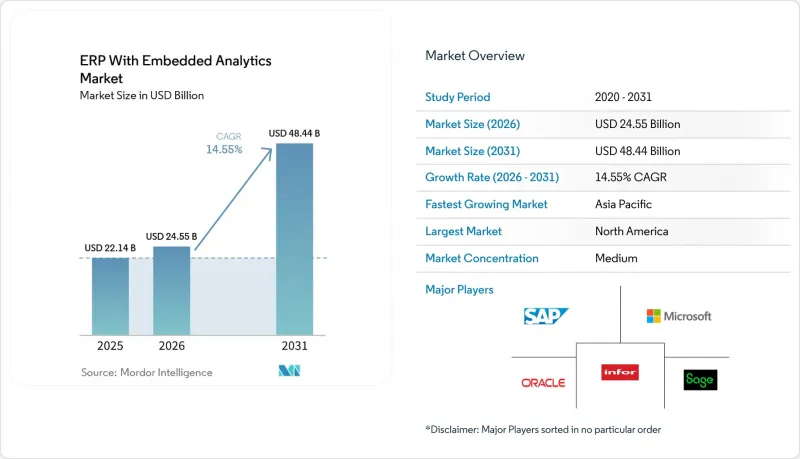
本報告按部署方式(雲端、本地部署、混合部署)、組件(軟體、部署和整合服務、培訓和支援服務)、企業規模(中小企業、大型企業)、職能(財務和會計、人力資源、其他職能)、產業(製造業、銀行、金融服務和保險業、其他行業)以及地區進行細分。市場預測以美元計價。
全球ERP系統嵌入式分析市場趨勢與分析
企業採用雲端ERP系統的趨勢正在加速。
到 2025 年,中大型企業超過 70% 的部署將基於雲端。平均基礎設施成本將比本地部署降低 30%,使企業能夠為高技能分析人員預留預算,並透過集中式資料湖實現跨職能儀表板。訂閱式定價將把最初數百萬美元的授權費用轉化為可預測的年度營運支出,從而促進資本預算有限的企業採用雲端技術。雖然交易密集產業對延遲非常敏感,但安全的 API 閘道和區域資料中心有助於企業遵守 GDPR 和中國的《個人資訊保護法》。因此,內建分析功能的 ERP 市場規模將持續成長。
對即時數據和預測性洞察的需求,以最佳化業務運營
在製造業領域,越來越多的企業利用物聯網遙測技術提早72小時預測設備故障,進而將意外停機時間減少40%。同樣,零售商和製藥公司也看到了營運方面的顯著改進,例如縮短補貨週期和減少臨床試驗提交時間。這些跨產業的進步凸顯了嵌入式分析所能帶來的擴充性和變革性價值。
雲端ERP實施中資料安全和隱私的擔憂
2024年,金融和醫療保健產業發生大規模資料外洩事件,造成12億筆記錄遺失。 43%的公司暫停了資料遷移,直到更嚴格的控制措施到位。因違反GDPR和資料本地化法律而被處以數百萬歐元的罰款,迫使企業採用區域性資料中心,並導致分析服務碎片化。零信任架構、不可竄改的備份和本土資料中心如今已成為必備條件,但所有這些加起來可能會使訂閱成本增加高達18%。
細分市場分析
混合雲方案目前預計將以每年 18.00% 的速度成長,這反映了受監管企業對本地儲存小規模、高度敏感資產的需求。在銀行業,企業正在將營運分析遷移到公共雲端,同時將交易帳簿保留在本地以滿足巴塞爾協議 III 的報告要求,從而降低了 22% 的基礎設施成本。在醫療保健產業,HIPAA 法規也推動了臨床和非臨床工作負荷的類似分離。邊緣運算透過處理來自工廠車間感測器的數據並將匯總資訊傳輸到中央雲,增強了這些設計。這消除了延遲問題,並透過嵌入式分析提高了 ERP 的市場吸引力。
混合拓樸結構也是使用專有資料訓練生成式人工智慧的首選方案。在模型訓練期間,本地 GPU叢集可保護智慧財產權,而推理處理則在彈性、可擴展的雲端環境中進行。災害復原要求也支援這種模型,可在幾分鐘內將本地主節點故障轉移到雲端容錯移轉,從而防止分析作業中斷。 API 管理的複雜性仍然是一個障礙,因此供應商現在通常會捆綁託管閘道器,其價格通常比基本訂閱費高出 10-15%。
軟體收入仍佔總收入的68%,但成長最快的領域是實施和整合服務,複合年成長率高達15.50%。企業在從大型主機資料提取、清理資料品質和開發客製化模型方面面臨許多挑戰,為此,他們將總預算的30%至40%用於系統整合商。遷移專家的時薪為200至350美元,凸顯了技能人才的短缺。分析工具的普及促使銷售、人力資源和營運團隊更多地採用分析技術,從而推動了對培訓和支援的需求,課程成本也因此達到了相當高的水平。
負責更新、安全和調優的託管服務正在興起,通常佔授權價格的 15% 至 25%。針對特定行業細微差別(例如預測臨床試驗結果或對資產組合進行壓力測試)開發的客製化演算法,正在創造與產品收入相當的新型業務收益。因此,嵌入式分析功能的 ERP 市場正朝向服務主導的價值創造模式轉變。
區域分析
由於早期對生成式人工智慧的採用和強大的雲端基礎設施,北美地區在2025年佔據了37%的銷售額。其中,美國佔該地區近四分之三的銷售額,這主要得益於創業投資為中型企業提供API優先的產品。在加拿大,聯邦政府的數位化預算推動了各政府部門雙語雲端ERP系統的部署。同時,在墨西哥,近岸外包浪潮迫使供應商採用美國汽車OEM廠商要求的即時視覺化工具。
亞太地區是成長最快的地區,複合年成長率達13.50%。預計到2025年,中國對工業數位化的補貼將新增12萬個雲端ERP實施案例,其中許多是面臨嚴格資料在地化法規挑戰的中小型製造商。印度的生產連結獎勵計畫計畫強調可追溯性,加速了電子和製藥出口商對雲ERP的採用。在日本和韓國,將物聯網分析整合到舊有系統中,可降低高達22%的能耗,隨著嵌入式分析市場進入成長軌道,推動了該地區ERP的普及。
到2025年,歐洲將佔據28%的市場。德國的中型企業(Mittelstands)正在升級其平台以滿足ESG報告要求,而英國正在實施貿易合規分析,以減少高達40%的海關瓶頸。在南美洲,80億美元正被分配給公共部門的ERP轉型,其中巴西處於領先地位,已將45個機構遷移到雲端套件。在中東,智慧城市預算正被投入到涵蓋公共產業和交通運輸的整合分析中;而在非洲,人們正利用行動介面克服桌面系統的局限性,從而完善全球整體情況。
其他好處:
- Excel格式的市場預測(ME)表
- 3個月的分析師支持
目錄
第1章:引言
- 市場分析與定義的前提條件
- 分析範圍
第2章 分析方法
第3章執行摘要
第4章 市場狀況
- 市場概覽
- 市場促進因素
- 加速企業採用雲端ERP
- 對即時數據和預測性洞察的需求,以最佳化業務運營。
- 人工智慧、機器學習和物聯網的整合正在推動嵌入式分析能力的發展。
- 將ESG和永續發展報告納入ERP分析
- 雙層ERP架構的興起需要統一分析
- 生成式人工智慧加速了ERP資料遷移和分析模型的建構。
- 市場限制因素
- 雲端ERP實施中的資料安全與隱私問題
- 實施的複雜性與成本超支
- 嵌入式分析領域熟練資料工程師短缺
- 供應商鎖定風險會限制分析的柔軟性。
- 產業價值鏈分析
- 監理情勢
- 技術展望
- 宏觀經濟因素對市場的影響
- 波特五力分析
第5章:預測市場規模與成長率
- 透過部署方法
- 雲
- 現場
- 混合
- 按組件
- 軟體
- 部署和整合服務
- 培訓和支援服務
- 按公司規模
- 小規模企業(1至99名員工)
- 中型企業(100-999名員工)
- 大型公司(員工人數1000人或以上)
- 按行業
- 製造業
- 銀行、金融服務和保險業 (BFSI)
- 醫療保健
- 零售與電子商務
- 政府
- IT/通訊
- 其他工業部門
- 按功能
- 財會
- 供應鏈和庫存管理
- 人力資源
- 生產計畫和調度
- 客戶關係管理
- 其他功能
- 按地區
- 北美洲
- 美國
- 加拿大
- 墨西哥
- 南美洲
- 巴西
- 阿根廷
- 其他南美國家
- 歐洲
- 德國
- 英國
- 法國
- 義大利
- 西班牙
- 俄羅斯
- 其他歐洲國家
- 亞太地區
- 中國
- 日本
- 印度
- 韓國
- 澳洲和紐西蘭
- 其他亞太國家
- 中東
- 沙烏地阿拉伯
- 阿拉伯聯合大公國
- 土耳其
- 其他中東國家
- 非洲
- 南非
- 埃及
- 奈及利亞
- 其他非洲國家
- 北美洲
第6章 競爭情勢
- 市場集中度
- 策略趨勢
- 市佔率分析
- 公司簡介
- SAP SE
- Oracle Corporation
- Microsoft Corporation
- Infor Inc.
- The Sage Group plc
- Epicor Software Corporation
- IFS AB
- Workday Inc.
- Acumatica Inc.
- QAD Inc.
- Plex Systems Inc.
- Syspro(Pty)Ltd.
- Unit4 NV
- Odoo SA
- Ramco Systems Limited
- Rootstock Software LLC
- Priority Software Ltd.
- Aptean Inc.
- Deltek Inc.
- Totvs SA
第7章 市場機會與未來展望
According to Mordor Intelligence, the eRP with Embedded Analytics market size is expected to increase from USD 24.55 billion in 2026 to USD 48.44 billion by 2031, growing at a CAGR of 14.55% over 2026-2031.
This report is Segmented by Deployment Mode (Cloud, On-Premise, and Hybrid), Component (Software, Implementation and Integration Services, and Training and Support Services), Enterprise Size (SMEs and Large), Function (Finance and Accounting, HR, and Other Functions), Industry Vertical (Manufacturing, BFSI, and Other Verticals), and Geography. Market Forecasts are Provided in Terms of Value (USD).
Global ERP With Embedded Analytics Market Trends and Insights
Accelerating Cloud ERP Adoption Among Enterprises
Cloud penetration exceeded 70% of mid-market and large-enterprise installations in 2025. Average infrastructure cost fell 30% relative to on-premise, unlocking budget for advanced analytics talent while centralized data lakes enabled cross-functional dashboards. Subscription pricing converted multi-million-dollar upfront licenses into predictable annual operating expenses, bolstering uptake among organizations with constrained capital budgets. Despite latency sensitivities in transaction-intensive verticals, secure API gateways and regional data centers are easing compliance with GDPR and China's PIPL. The net result is sustained momentum that enlarges the ERP with Embedded Analytics market footprint
Demand for Real-Time Data and Predictive Insights to Optimize Operations
Manufacturers are increasingly using IoT telemetry to predict equipment failures up to 72 hours in advance, reducing unplanned downtime by 40%. Similarly, retailers and pharmaceutical companies are experiencing significant operational improvements, including faster replenishment cycles and reduced timelines for clinical-trial submissions. These advancements underscore the scalable, transformative value of embedded analytics across industries.
Data Security and Privacy Concerns in Cloud ERP Deployments
High-profile breaches exposed 1.2 billion records across finance and healthcare during 2024, prompting 43% of enterprises to pause migrations pending stronger controls. Multi-million-euro GDPR fines and data-localization laws are forcing region-specific instances that fragment analytics. Zero-trust architectures, immutable backups, and in-country data centers are now table stakes, but collectively raise subscription spend by up to 18%.
Other drivers and restraints analyzed in the detailed report include:
- Integration of AI, ML and IoT Driving Embedded Analytics Capabilities
- Shift Toward ESG and Sustainability Reporting Embedded Into ERP Analytics
- Implementation Complexity and Cost Overruns
For complete list of drivers and restraints, kindly check the Table Of Contents.
Segment Analysis
Hybrid approaches, though smaller today, are projected to grow 18.00% annually, reflecting regulated enterprises that must keep sensitive assets on-premise. Banking players keep transaction ledgers locally for Basel III reporting while pushing operational analytics to the public cloud, an arrangement that trims infrastructure spending by 22%. In healthcare, HIPAA drives similar splits between clinical and non-clinical workloads. Edge computing augments these designs by processing sensor feeds at the factory floor before forwarding aggregated insights to central clouds, eliminating latency complaints and expanding the ERP's market appeal with Embedded Analytics.
Generative-AI training on proprietary data also favors hybrid topologies, with on-premises GPU clusters safeguarding intellectual property during model training while inference runs in elastically scaled cloud environments. Disaster-recovery imperatives reinforce the model, enabling failover from on-premises primaries to cloud replicas within minutes, ensuring uninterrupted analytics. API management complexity remains a stumbling block, so vendors now bundle managed gateways, typically priced at a 10-15% premium over base subscriptions.
Software still accounts for 68% of revenue, yet the fastest-growing segment will be implementation and integration services, with a 15.50% CAGR. Enterprises grapple with mainframe extraction, data-quality cleansing, and bespoke model development, funneling 30-40% of total budgets into system integrators. Migration specialists command USD 200-350 per hour, underscoring the scarcity of skills. Training and support lines are swelling because democratized analytics now touch sales, HR, and operations teams, adding sizable curriculum costs.
Managed services offerings that assume responsibility for updates, security, and tuning are emerging, typically 15-25% of license value. Custom algorithm development for vertical nuances. such as clinical-trial outcome prediction or asset-portfolio stress testing, creates fresh service revenue that rivals product income. As a result, the ERP with Embedded Analytics market is tilting toward service-led value capture.
Geography Analysis
North America accounted for 37% of 2025 sales, buoyed by early generative AI adoption and deep cloud infrastructure. The United States captured almost three-quarters of regional turnover, aided by venture-capital-backed vendors that supply API-first products to mid-market buyers. Canada channeled federal digital budgets into bilingual cloud ERP roll-outs across agencies, while Mexico's nearshoring wave compelled suppliers to adopt real-time visibility tools demanded by U.S. automotive OEMs.
Asia-Pacific is the fastest-growing region, with a 13.50% CAGR. China's industrial digitization subsidies added 120,000 cloud ERP tenants in 2025, many of them small manufacturers navigating stringent data localization edicts. India's production-linked incentive programs hinge on traceability, accelerating uptake among electronics and pharmaceutical exporters. Japan and South Korea embed IoT analytics into legacy systems to cut energy use by up to 22%, enhancing regional ERP adoption amid the Embedded Analytics market growth trajectory.
Europe held 28% share in 2025, with Germany's Mittelstand upgrading platforms to satisfy ESG reporting, and the United Kingdom installing trade-compliance analytics to shave customs bottlenecks by up to 40%. South America earmarked USD 8 billion for public-sector ERP transformations, Brazil leading the charge by migrating 45 agencies to cloud suites. The Middle East funnels smart-city budgets into unified analytics that span utilities and transport, and Africa leverages mobile interfaces to circumvent desktop limitations, completing the global picture.
- SAP SE
- Oracle Corporation
- Microsoft Corporation
- Infor Inc.
- The Sage Group plc
- Epicor Software Corporation
- IFS AB
- Workday Inc.
- Acumatica Inc.
- QAD Inc.
- Plex Systems Inc.
- Syspro (Pty) Ltd.
- Unit4 N.V.
- Odoo SA
- Ramco Systems Limited
- Rootstock Software LLC
- Priority Software Ltd.
- Aptean Inc.
- Deltek Inc.
- Totvs S.A.
Additional Benefits:
- The market estimate (ME) sheet in Excel format
- 3 months of analyst support
TABLE OF CONTENTS
1 INTRODUCTION
- 1.1 Study Assumptions and Market Definition
- 1.2 Scope of the Study
2 RESEARCH METHODOLOGY
3 EXECUTIVE SUMMARY
4 MARKET LANDSCAPE
- 4.1 Market Overview
- 4.2 Market Drivers
- 4.2.1 Accelerating Cloud ERP Adoption among Enterprises
- 4.2.2 Demand for Real-Time Data and Predictive Insights to Optimize Operations
- 4.2.3 Integration of AI, ML and IoT Driving Embedded Analytics Capabilities
- 4.2.4 Shift Toward ESG and Sustainability Reporting Embedded into ERP Analytics
- 4.2.5 Rise of Two-Tier ERP Architectures Requiring Unified Analytics
- 4.2.6 Generative AI Accelerating ERP Data Migration and Analytics Model Creation
- 4.3 Market Restraints
- 4.3.1 Data Security and Privacy Concerns in Cloud ERP Deployments
- 4.3.2 Implementation Complexity and Cost Overruns
- 4.3.3 Shortage of Skilled Data Engineers for Embedded Analytics
- 4.3.4 Vendor Lock-In Risks Limiting Analytics Flexibility
- 4.4 Industry Value Chain Analysis
- 4.5 Regulatory Landscape
- 4.6 Technological Outlook
- 4.7 Impact of Macroeconomic Factors on the Market
- 4.8 Porter's Five Forces Analysis
- 4.8.1 Threat of New Entrants
- 4.8.2 Bargaining Power of Suppliers
- 4.8.3 Bargaining Power of Buyers
- 4.8.4 Threat of Substitutes
- 4.8.5 Competitive Rivalry
5 MARKET SIZE AND GROWTH FORECASTS (VALUE)
- 5.1 By Deployment Mode
- 5.1.1 Cloud
- 5.1.2 On-Premise
- 5.1.3 Hybrid
- 5.2 By Component
- 5.2.1 Software
- 5.2.2 Implementation and Integration Services
- 5.2.3 Training and Support Services
- 5.3 By Enterprise Size
- 5.3.1 Small Enterprises (1-99 Employees)
- 5.3.2 Medium Enterprises (100-999 Employees)
- 5.3.3 Large Enterprises (1,000+ Employees)
- 5.4 By Industry Vertical
- 5.4.1 Manufacturing
- 5.4.2 Banking, Financial Services and Insurance
- 5.4.3 Healthcare
- 5.4.4 Retail and E-commerce
- 5.4.5 Government
- 5.4.6 IT and Telecom
- 5.4.7 Other Industry Verticals
- 5.5 By Function
- 5.5.1 Finance and Accounting
- 5.5.2 Supply Chain and Inventory Management
- 5.5.3 Human Resources
- 5.5.4 Production Planning and Scheduling
- 5.5.5 Customer Relationship Management
- 5.5.6 Other Functions
- 5.6 By Geography
- 5.6.1 North America
- 5.6.1.1 United States
- 5.6.1.2 Canada
- 5.6.1.3 Mexico
- 5.6.2 South America
- 5.6.2.1 Brazil
- 5.6.2.2 Argentina
- 5.6.2.3 Rest of South America
- 5.6.3 Europe
- 5.6.3.1 Germany
- 5.6.3.2 United Kingdom
- 5.6.3.3 France
- 5.6.3.4 Italy
- 5.6.3.5 Spain
- 5.6.3.6 Russia
- 5.6.3.7 Rest of Europe
- 5.6.4 Asia-Pacific
- 5.6.4.1 China
- 5.6.4.2 Japan
- 5.6.4.3 India
- 5.6.4.4 South Korea
- 5.6.4.5 Australia and New Zealand
- 5.6.4.6 Rest of Asia-Pacific
- 5.6.5 Middle East
- 5.6.5.1 Saudi Arabia
- 5.6.5.2 United Arab Emirates
- 5.6.5.3 Turkey
- 5.6.5.4 Rest of Middle East
- 5.6.6 Africa
- 5.6.6.1 South Africa
- 5.6.6.2 Egypt
- 5.6.6.3 Nigeria
- 5.6.6.4 Rest of Africa
- 5.6.1 North America
6 COMPETITIVE LANDSCAPE
- 6.1 Market Concentration
- 6.2 Strategic Moves
- 6.3 Market Share Analysis
- 6.4 Company Profiles (includes Global Level Overview, Market Level Overview, Core Segments, Financials as available, Strategic Information, Market Rank/Share, Products and Services, Recent Developments)
- 6.4.1 SAP SE
- 6.4.2 Oracle Corporation
- 6.4.3 Microsoft Corporation
- 6.4.4 Infor Inc.
- 6.4.5 The Sage Group plc
- 6.4.6 Epicor Software Corporation
- 6.4.7 IFS AB
- 6.4.8 Workday Inc.
- 6.4.9 Acumatica Inc.
- 6.4.10 QAD Inc.
- 6.4.11 Plex Systems Inc.
- 6.4.12 Syspro (Pty) Ltd.
- 6.4.13 Unit4 N.V.
- 6.4.14 Odoo SA
- 6.4.15 Ramco Systems Limited
- 6.4.16 Rootstock Software LLC
- 6.4.17 Priority Software Ltd.
- 6.4.18 Aptean Inc.
- 6.4.19 Deltek Inc.
- 6.4.20 Totvs S.A.
7 MARKET OPPORTUNITIES AND FUTURE OUTLOOK
- 7.1 White-Space and Unmet-Need Assessment

 嵌入式系統分析:市場佔有率分析、產業趨勢與統計、成長預測(2026-2031)
 嵌入式分析市場預測至 2034 年—按組件、部署模式、分析類型、業務功能、最終用戶和地區分類的全球分析
 嵌入式分析市場規模、佔有率、趨勢和預測:按解決方案、分析工具、部署類型、業務功能、組織規模、行業和地區分類,2026-2034 年
 嵌入式分析市場:按組件、組織規模、部署模式、應用和產業分類的全球市場預測 – 2026-2032 年
 2026年全球嵌入式分析市場報告嵌入式分析解決方案市場:按組件、部署類型、組織規模、應用和產業分類 - 2026-2032 年全球預測
 全球嵌入式分析市場:市場規模、佔有率、成長率、產業分析、依類型、應用和地區劃分的分析及預測(2026-2034年)
 嵌入式分析工具市場-全球產業規模、佔有率、趨勢、機會與預測:部署模式、整合能力、功能、產業垂直領域、地區與競爭格局(2021-2031)嵌入式分析市場 - 全球產業規模、佔有率、趨勢、機會及預測(按組件、部署模式、組織規模、應用、最終用戶產業、地區和競爭格局分類),2021-2031年
 嵌入式分析市場規模、佔有率和成長分析(按組件、業務功能、部署模式、組織規模、最終用戶和地區分類)-2026-2033年產業預測