


 |
市場調查報告書
商品編碼
2114066
聚氨酯(PU)塗料:市場佔有率分析、產業趨勢與統計數據、成長預測(2026-2031)Polyurethane (PU) Coatings - Market Share Analysis, Industry Trends & Statistics, Growth Forecasts (2026 - 2031) |
||||||

※ 本網頁內容可能與最新版本有所差異。詳細情況請與我們聯繫。
據 Mordor Intelligence 稱,聚氨酯塗料市場預計到 2026 年價值 2,518 萬美元,高於 2025 年的 2,408 萬美元,預計到 2031 年將達到 3,154 萬美元。
預計從 2026 年到 2031 年,其複合年成長率將達到 4.58%。
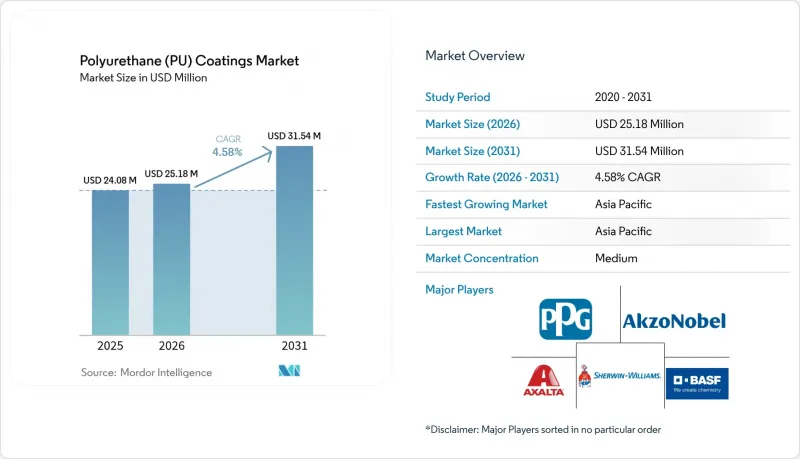
本報告按技術(粉末、溶劑、水性、輻射固化/UV固化)、終端用戶產業(汽車、交通運輸、建築、電氣/電子、木材/家具及其他終端用戶產業)和地區(亞太地區、北美、歐洲、南美以及中東和非洲)進行細分。市場預測以美元(USD)為單位。
全球聚氨酯(PU)塗料市場趨勢及洞察
透過疫情後基礎建設獎勵策略重新運作建設業
全球基礎設施建設項目持續訂單對能夠抵禦惡劣天氣和化學品侵蝕的聚氨酯防護塗料的需求。美國《基礎設施投資與就業法案》以及中國的大規模區域性項目,共同推動了建築和土木工程領域的強勁需求。此外,綠建築認證的趨勢在該領域不斷增強,建築師擴大指定使用低排放量的分散型聚氨酯產品。亞太地區銷售量最大,而北美和歐洲則更注重卓越的耐久性和快速固化性能。模組化建築的興起也促使工廠預塗裝系統更受青睞,因為它可以減少現場施工。更長的專案週期為供應商創造了可預測的需求,並確保了供應的持續性。
汽車OEM廠商轉向輕質複合材料:需高柔軟性面漆。
在電氣化目標和燃油效率法規的推動下,汽車製造商被迫用碳纖維和玻璃纖維複合材料取代金屬,這些材料能夠在動態負載下彎曲變形。由於傳統塗料在這些基材上容易開裂和分層,製造商開始轉向使用具有高延伸率和耐刮擦性的彈性體聚氨酯塗料。日本和韓國的汽車製造商已經更新了內部塗料標準,而美國和歐洲的汽車品牌也在調整其規範。配備眾多感測器的自動駕駛汽車車身面板需要滿足電磁屏蔽要求,而高固態含量聚氨酯配方可有效滿足此要求。擁有內部塗料實驗室設施的供應商可以透過與供應商共同開發新型車身結構的噴塗參數來獲得競爭優勢。
異氰酸酯和多元醇原料價格波動劇烈
硬質和軟質MDI/TDI的價格走勢仍取決於原油價格的波動以及全球多個反應器的計劃內和計劃外停產。里昂巴塞爾的年度報告顯示,2024年價差將收窄,該公司退出煉油廠的舉措凸顯了石油衍生原料的風險。錦湖三井在麗水的新增產能將有所幫助,但並不能完全保護買家免受不可抗力事件的影響。雖然大型調合商透過多年期合約和後向整合來對沖風險,但許多小眾生產商沒有這些選擇,被迫將價格轉嫁給消費者或承受利潤率下降的後果。高濃度高性能添加劑的特殊等級產品受成本上漲的影響最為嚴重。
細分市場分析
2025年,溶劑型配方聚氨酯塗料在聚氨酯塗料市場仍將維持47.20%的市場佔有率,這得益於現有設備、豐富的產品線以及與OEM生產線的良好合作關係。水性塗料正以6.67%的複合年成長率快速成長,吸引了汽車、電子和木製家具製造商的投資,他們希望在不影響光澤的前提下減少VOC排放。粉末塗料非常適合已鋪設靜電噴塗生產線的領域,具有近乎零廢棄物和低能耗固化的優點。紫外光固化塗料正在電子和汽車透明塗層領域開拓利基市場,其加工速度優勢足以抵銷設備成本。
透過採用自交聯聚氨酯主鏈,水性分散體在耐腐蝕性方面正日益接近溶劑型塗料。科思創在上海運作了一條分散體生產線,使其在亞洲的產能翻倍,並降低了運輸成本,縮短了前置作業時間。調查團隊還引入了聚碳酸酯二醇,以增強其耐水解性,從而為以往溶劑型塗料佔據主導地位的海洋應用領域開闢了道路。融合了矽酮和氟聚合物鏈段的混合化學技術為高階櫥櫃和智慧型手機機殼提供了抗污性能。該行業受益於客戶工廠的ISO 14001獎勵,該認證評估的是工廠的整體排放,而非單一產品的指標。
區域分析
2025年,亞太地區將佔據聚氨酯塗料市場42.75%的佔有率,主要得益於汽車組裝、消費性電子產品出口以及基礎建設的加速推進。預計到2031年,該地區的需求將以5.36%的複合年成長率成長,超過其他所有地區。在中國,彰化化工的二氧化碳基多元醇計畫正在降低碳排放強度並確保本地原料供應。越南珍珠集團在東南亞開設了第五家系統化工廠,為其工廠提供靈活的批量生產能力,縮短交貨時間並降低外匯風險。日本原始設備製造商在水性化學品領域保持研發領先地位,而韓國MDI產能的擴張則為韓國國內塗料製造商提供了穩定且具競爭力的供應。
北美市場成熟且盈利,工業地坪塗料專案和航太特殊塗料的需求彌補了銷售量成長放緩的不足。聯邦和州政府的大規模基礎設施建設項目也維持了橋樑和高速公路的定期翻新。低VOC法規推動了對分散型塗料和雙組分高固態塗料的投資,從而推高了每公升塗料的平均售價。
歐洲在塑造全球配方標準的法律規範中扮演核心角色。 REACH法規逐步淘汰某些二異氰酸酯,迫使人們對配方進行前瞻性的重新評估。 MOL-ThyssenKrupp位於匈牙利的多元醇生產基地確保了該地區原料的穩定供應,並縮短了向中歐OEM製造商的供應路線。東歐汽車產業叢集依靠該工廠來規避海運成本波動所帶來的風險。
由於基礎設施、採礦以及石油和天然氣設施對高耐久性和耐化學腐蝕塗料的需求,預計拉丁美洲、中東和非洲將實現長期成長。由於當地生產商往往缺乏先進的研發能力,國際供應商透過授權和合資等方式與其合作。模組化間歇式塗裝廠的優勢在於其較低的產量和波動的外匯,因此,全球主要公司正在考慮在這些地區進行選擇性資本投資。
其他好處:
- Excel格式的市場預測(ME)表
- 3個月的分析師支持
目錄
第1章:引言
- 研究假設和市場定義
- 調查範圍
第2章:調查方法
第3章執行摘要
第4章 市場狀況
- 市場概覽
- 市場促進因素
- 透過疫情後基礎設施獎勵策略恢復建設活動
- 汽車原始設備製造商正在轉向輕質複合材料,而這種材料需要高度柔軟性的聚氨酯面塗層。
- 監理政策轉向低VOC水性塗料和高固態塗料體系
- 電子商務物流的快速發展帶動了對工業地板用聚氨酯塗料需求的成長。
- 推出採用奈米技術的自修復PU塗層,可延長重新上漆週期。
- 市場限制因素
- 異氰酸酯和多元醇原料價格的波動
- 加強有關二異氰酸酯的職業安全法規
- 碳關稅增加了進口前驅材料的成本。
- 價值鏈分析
- 波特五力模型
第5章 市場規模與成長預測
- 透過技術
- 粉末
- 溶劑型
- 水溶液
- 輻射固化型/紫外線
- 按最終用戶行業分類
- 車
- 運輸
- 建造
- 電氣和電子設備
- 木材/家具
- 其他終端用戶產業
- 按地區
- 亞太地區
- 中國
- 印度
- 日本
- 韓國
- 東南亞國協
- 其他亞太國家
- 北美洲
- 美國
- 加拿大
- 墨西哥
- 歐洲
- 德國
- 英國
- 法國
- 義大利
- 西班牙
- 俄羅斯
- 北歐國家
- 其他歐洲國家
- 南美洲
- 巴西
- 阿根廷
- 其他南美國家
- 中東和非洲
- 沙烏地阿拉伯
- 阿拉伯聯合大公國
- 卡達
- 埃及
- 南非
- 其他中東和非洲國家
- 亞太地區
第6章 競爭情勢
- 市場集中度
- 策略趨勢
- 市佔率和排名分析
- 公司簡介
- Akzo Nobel NV
- Asian Paints
- Axalta Coating Systems
- BASF
- Evonik Industries AG
- Hempel A/S
- IVM Chemicals SRL
- Jotun
- Kansai Paint Co. Ltd.
- Nippon Paint Holdings
- Polycoat Products
- PPG Industries Inc.
- RPM International Inc.
- Sika AG
- The Sherwin-Williams Company
第7章 市場機會與未來展望
According to Mordor Intelligence, polyurethane coatings market size in 2026 is estimated at USD 25.18 million, growing from 2025 value of USD 24.08 million with 2031 projections showing USD 31.54 million, growing at 4.58% CAGR over 2026-2031.
This report is Segmented by Technology (Powder, Solvent-Borne, Water-Borne, and Radiation-cured/UV), End-User Industry (Automotive, Transportation, Construction, Electrical and Electronics, Wood and Furniture, and Other End-User Industries), and Geography (Asia-Pacific, North America, Europe, South America, and Middle-East and Africa). The Market Forecasts are Provided in Terms of Value (USD).
Global Polyurethane (PU) Coatings Market Trends and Insights
Construction Reboot in Post-Pandemic Infrastructure Stimulus
Global infrastructure packages are unlocking steady orders for protective polyurethane finishes that endure harsh weather and chemical exposure. The United States Infrastructure Investment and Jobs Act, combined with large provincial projects in China, keeps architectural and civil engineering demand elevated. The sector also pivots toward green-building certifications, pushing architects to specify low-emission polyurethane dispersion products. Asia-Pacific contributes the highest volume, while North America and Europe emphasize premium resilience and rapid-cure performance. Modular construction growth favors factory-applied systems that reduce onsite labor. Longer project pipelines create predictable demand for suppliers, which can guarantee an uninterrupted supply.
Automotive OEM Shift to Lightweight Composites Needing High-Flex Top-Coats
Electrification targets and fuel-efficiency rules force OEMs to replace metal with carbon-fiber and glass-fiber composites that flex under dynamic loads. Conventional coatings crack or delaminate on these substrates, so manufacturers turn to elastomeric polyurethane chemistries with high elongation and chip resistance. Japanese and South Korean automakers have already updated internal paint standards, and US and European brands are aligning specification sheets. Sensor-laden body panels for autonomous vehicles introduce electromagnetic shielding requirements that high-solids polyurethane formulas can effectively address. Suppliers with in-house application-equipment labs gain an edge by co-developing spray parameters for new body architectures.
Volatile Isocyanate and Polyol Feedstock Prices
Rigid and flexible MDI/TDI chains remain tied to crude-oil swings and planned or unplanned outages at a handful of global reactors. LyondellBasell's annual report flagged thin spreads in 2024, and its refinery exit highlights the risk profile associated with oil-derived inputs. New capacity in Yeosu from Kumho Mitsui provides relief but cannot fully insulate buyers from force-majeure events. Larger formulators hedge their risks via multi-year contracts or backward integration, whereas many niche producers lack these options, forcing them to pass through prices or experience margin erosion. Specialty grades, which contain higher proportions of performance additives, are the most affected by the most profound cost spikes.
Other drivers and restraints analyzed in the detailed report include:
- Regulatory Pivot to Low-VOC Water-Borne and High-Solids Systems
- E-Commerce Logistics Boom Raising Demand for Industrial Floor Coatings
- Tightening Worker-Safety Rules on Di-Isocyanates
For complete list of drivers and restraints, kindly check the Table Of Contents.
Segment Analysis
Solvent-borne formulations retained 47.20% of the polyurethane coatings market share in 2025 owing to legacy installations, extensive product catalogs, and familiarity with OEM lines. Water-borne alternatives, advancing at a 6.67% CAGR, receive investment from automotive, electronics, and wood-furniture plants seeking to reduce VOC emissions without compromising gloss. Powder coatings are ideal for areas where electrostatic lines are already installed, leveraging near-zero waste and low-energy curing. UV-curing segments carve out niches in electronics and automotive clear-outs where throughput speed offsets equipment costs.
Water-borne dispersions are increasingly comparable to solvent systems in terms of corrosion resistance after the adoption of self-cross-linking polyurethane backbones. Covestro commissioned a dispersion line in Shanghai that doubles its Asian capacity, lowering freight charges and shortening lead times. Research teams are also blending polycarbonate diols to enhance hydrolysis resistance, opening doors to marine applications previously dominated by solvent systems. Hybrid chemistries that integrate silicone or fluoropolymer segments offer stain resistance for premium kitchen cabinets and smartphone casings. The segment benefits from ISO 14001 incentives at customer factories, which weigh entire plant emissions rather than single product metrics.
Complete Report Scope:
- By Technology
- Powder
- Solvent-borne
- Water-borne
- Radiation-cured / UV
- By End-user Industry
- Automotive
- Transportation
- Construction
- Electrical and Electronics
- Wood and Furniture
- Other End-user Industries
- By Geography
- Asia-Pacific
- China
- India
- Japan
- South Korea
- ASEAN Countries
- Rest of Asia-Pacific
- North America
- United States
- Canada
- Mexico
- Europe
- Germany
- United Kingdom
- France
- Italy
- Spain
- Russia
- NORDIC Countries
- Rest of Europe
- South America
- Brazil
- Argentina
- Rest of South America
- Middle-East and Africa
- Saudi Arabia
- United Arab Emirates
- Qatar
- Egypt
- South Africa
- Rest of Middle-East and Africa
- Asia-Pacific
Geography Analysis
The Asia-Pacific region controlled 42.75% of the polyurethane coatings market in 2025, driven by automotive assembly, consumer electronics exports, and accelerated infrastructure programs. Regional demand will climb at a 5.36% CAGR through 2031, outpacing every other territory. China's CO2-based polyol project by Changhua Chemical reduces carbon intensity and secures local feedstock. Vietnam's Pearl Group has added a fifth system house that supplies flexible batch sizes to Southeast Asian plants, improving delivery times and mitigating currency risks. Japanese OEMs maintain R&D leadership in water-borne chemistry, and South Korea's MDI expansion offers domestic paint makers stable supply at competitive cost.
North America represents a mature yet lucrative market, where industrial floor projects and specialty aerospace coatings help offset slower volume growth. Major federal-state infrastructure packages sustain bridge and highway repaint cycles. Low-VOC mandates shepherd investment into dispersion and 2K high-solids chemistries, providing higher average selling prices per liter.
Europe anchors regulatory frameworks that shape global formulation norms. REACH phase-outs of certain di-isocyanates force proactive reformulation. The MOL-thyssenkrupp polyol unit in Hungary improves regional input security and shortens supply lines for Central European OEMs. Eastern European automotive clusters rely on this plant to hedge against maritime freight volatility.
Latin America, the Middle East, and Africa together represent a long-run upswing where infrastructure, mining, and oil & gas facilities demand durable, chemical-resistant coatings. Local producers often lack advanced R&D, so international suppliers partner through licensing or joint ventures. Smaller volumes and fluctuating currencies make modular batch plants advantageous, and large global players weigh selective capital deployment.
- Akzo Nobel N.V.
- Asian Paints
- Axalta Coating Systems
- BASF
- Evonik Industries AG
- Hempel A/S
- IVM Chemicals SRL
- Jotun
- Kansai Paint Co. Ltd.
- Nippon Paint Holdings
- Polycoat Products
- PPG Industries Inc.
- RPM International Inc.
- Sika AG
- The Sherwin-Williams Company
Additional Benefits:
- The market estimate (ME) sheet in Excel format
- 3 months of analyst support
TABLE OF CONTENTS
1 Introduction
- 1.1 Study Assumptions & Market Definition
- 1.2 Scope of the Study
2 Research Methodology
3 Executive Summary
4 Market Landscape
- 4.1 Market Overview
- 4.2 Market Drivers
- 4.2.1 Construction reboot in post-pandemic infrastructure stimulus
- 4.2.2 Automotive OEM shift to lightweight composites needing high-flex PU top-coats
- 4.2.3 Regulatory pivot to low-VOC water-borne and high-solids systems
- 4.2.4 E-commerce logistics boom raising demand for industrial floor PU coatings
- 4.2.5 Emergence of nano-enabled self-healing PU coatings extending repaint cycles
- 4.3 Market Restraints
- 4.3.1 Volatile isocyanate and polyol feedstock prices
- 4.3.2 Tightening worker-safety rules on di-isocyanates
- 4.3.3 Carbon-border tariffs raising import costs of precursors
- 4.4 Value Chain Analysis
- 4.5 Porter's Five Forces
- 4.5.1 Bargaining Power of Suppliers
- 4.5.2 Bargaining Power of Buyers
- 4.5.3 Threat of New Entrants
- 4.5.4 Threat of Substitutes
- 4.5.5 Competitive Rivalry
5 Market Size & Growth Forecasts (Value)
- 5.1 By Technology
- 5.1.1 Powder
- 5.1.2 Solvent-borne
- 5.1.3 Water-borne
- 5.1.4 Radiation-cured / UV
- 5.2 By End-user Industry
- 5.2.1 Automotive
- 5.2.2 Transportation
- 5.2.3 Construction
- 5.2.4 Electrical and Electronics
- 5.2.5 Wood and Furniture
- 5.2.6 Other End-user Industries
- 5.3 By Geography
- 5.3.1 Asia-Pacific
- 5.3.1.1 China
- 5.3.1.2 India
- 5.3.1.3 Japan
- 5.3.1.4 South Korea
- 5.3.1.5 ASEAN Countries
- 5.3.1.6 Rest of Asia-Pacific
- 5.3.2 North America
- 5.3.2.1 United States
- 5.3.2.2 Canada
- 5.3.2.3 Mexico
- 5.3.3 Europe
- 5.3.3.1 Germany
- 5.3.3.2 United Kingdom
- 5.3.3.3 France
- 5.3.3.4 Italy
- 5.3.3.5 Spain
- 5.3.3.6 Russia
- 5.3.3.7 NORDIC Countries
- 5.3.3.8 Rest of Europe
- 5.3.4 South America
- 5.3.4.1 Brazil
- 5.3.4.2 Argentina
- 5.3.4.3 Rest of South America
- 5.3.5 Middle-East and Africa
- 5.3.5.1 Saudi Arabia
- 5.3.5.2 United Arab Emirates
- 5.3.5.3 Qatar
- 5.3.5.4 Egypt
- 5.3.5.5 South Africa
- 5.3.5.6 Rest of Middle-East and Africa
- 5.3.1 Asia-Pacific
6 Competitive Landscape
- 6.1 Market Concentration
- 6.2 Strategic Moves
- 6.3 Market Share/Ranking Analysis
- 6.4 Company Profiles (includes Global level Overview, Market level overview, Core Segments, Financials as available, Strategic Information, Market Rank/Share, Products & Services, Recent Developments)
- 6.4.1 Akzo Nobel N.V.
- 6.4.2 Asian Paints
- 6.4.3 Axalta Coating Systems
- 6.4.4 BASF
- 6.4.5 Evonik Industries AG
- 6.4.6 Hempel A/S
- 6.4.7 IVM Chemicals SRL
- 6.4.8 Jotun
- 6.4.9 Kansai Paint Co. Ltd.
- 6.4.10 Nippon Paint Holdings
- 6.4.11 Polycoat Products
- 6.4.12 PPG Industries Inc.
- 6.4.13 RPM International Inc.
- 6.4.14 Sika AG
- 6.4.15 The Sherwin-Williams Company
7 Market Opportunities & Future Outlook
- 7.1 White-space and Unmet-Need Assessment

 2026年全球聚氨酯塗料市場報告
 聚氨酯塗料市場-全球產業規模、佔有率、趨勢、機會、預測:按基材、最終用戶、地區和競爭格局分類,2021-2031年
 軟觸感聚氨酯塗料市場:依產品類型、基材類型、最終用途產業及地區分類
 聚氨酯塗料市場規模、佔有率、成長及全球產業分析:按類型、應用和地區的洞察,2026-2034年預測2026年全球軟觸感聚氨酯塗料市場報告軟觸感聚氨酯塗料市場-全球產業規模、佔有率、趨勢、機會和預測,按產品類型、基材類型、最終用途、地區和競爭格局分類,2020-2030年預測
 亞太地區的聚氨酯塗料市場(2025年)
 聚氨酯(PU)塗料市場需求、地區、應用分析及2034年預測報告
 聚氨酯塗料市場規模、佔有率、趨勢分析報告(按技術、最終用途、地區、細分市場預測,2025-2030 年)
 美洲聚氨酯塗料市場:2024年