


 |
市場調查報告書
商品編碼
2114020
隨鑽測井(LWD):市場佔有率分析、行業趨勢和統計數據、成長預測(2026-2031 年)Logging While Drilling (LWD) - Market Share Analysis, Industry Trends & Statistics, Growth Forecasts (2026 - 2031) |
||||||

※ 本網頁內容可能與最新版本有所差異。詳細情況請與我們聯繫。
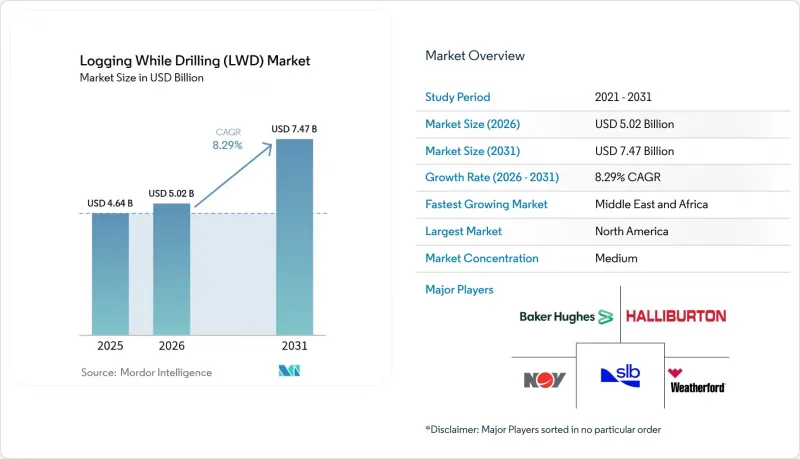
據 Mordor Intelligence 稱,2026 年隨鑽測井(LWD) 市場規模估計為 50.2 億美元,高於 2025 年的 46.4 億美元,預計到 2031 年將達到 74.7 億美元。
預計 2026 年至 2031 年的複合年成長率為 8.29%。
本報告按服務類型(電阻率隨鑽測量、壓力和流體取樣等)、應用(地質評估、地質導向和儲存導航等)、井類型(常規垂直井、高溫高壓井、水平井和超長井)、部署地點(陸上、海上)和地區(北美、歐洲、亞太地區、南美、中東和非洲)進行分類。
全球隨鑽測井(LWD)市場趨勢與洞察
頁岩氣和深海鑽探活動增加
2024年,隨著營運商持續開發巴西鹽層下下層和墨西哥灣的高利潤油田,深水鑽井鑽機的平均利用率達到92%,這增加了對即時深度數據的需求,而這些數據無法透過纜線技術來應對複雜的儲存。二疊紀盆地也產生了進一步的需求。水平井延伸和多層完井工程需要持續的地質評估,以保持與生產層的接觸。
即時地質地層評估的引入
哈里伯頓公司的LOGIX自動化平台將地下電阻率和伽馬射線遙測資料與地面演算法結合,透過調整鑽頭負載和轉速,將鑽井速度提高了30%。 SLB公司的Neuro系統展示了人工智慧如何透過在厄瓜多爾鑽探一口井,實現25次自動軌跡修正而無需人工監控,從而將地下數據與鑽頭方向連接起來。即時地質評估在高成本環境下至關重要,因為它可以省去單獨的纜線作業,從而將複雜傾斜井的總鑽井時間縮短10-15%。
原油價格波動抑制了油氣探勘開發領域的資本投資。
儘管布蘭特原油價格徘徊在每桶80美元左右,但美國獨立石油公司在2024年至2025年間削減了鑽井預算,優先考慮降低債務和分紅,而非成長投資。預計2025年全球油氣探勘開發投資將維持在600億至650億美元左右,而對隨鑽測量需求最高的早期探勘則受到抑制。深海大型企劃正在進行中,但小規模的頁岩油業者則專注於創造自由現金流,鑽機的擴張步伐也較為緩慢。
細分市場分析
至2025年,電阻率測量服務將佔隨鑽測量(LWD)市場規模的33.78%,鞏固其作為幾乎所有油井都必需的基礎測量技術的地位。即時識別油氣層的能力預計將推動其在陸上和海上項目的持續應用。該領域受益於機器學習演算法,這些演算法可在鑽井過程中將電阻率曲線轉化為岩性預測,從而進一步將測量結果整合到自動化工作流程中。壓力和流體取樣目前市場佔有率較小,但預計將以10.95%的複合年成長率推動市場成長,因為營運商需要動態地層壓力數據和流體類型識別,而無需中斷鑽井作業。 SLB的SpectraSphere工具和貝克休斯的AziTrak系列產品正是這一趨勢的例證,它們實現了以前需要單獨纜線作業才能進行的井內PVT取樣。在成熟盆地中,伽瑪射線、密度中子和聲波測井仍是孔隙度和岩性評估的主要手段。同時,孔洞成像技術在裂隙碳酸鹽岩中再次引起關注,可視化技術可作為最終設計的指南。
服務業的競爭格局呈現出感測器持續小型化和遙測資料頻寬不斷擴展的趨勢。目前,電阻率測量工具能夠以30 bps的脈衝速率傳輸多深度測量數據,從而實現伽馬射線和壓力數據流的同步傳輸。在採樣方面,地下光譜技術能夠將地面實驗室採集的流體資訊即時傳輸到鑽機上,從而提高決策的準確性。隨著數位化油田預算的增加,這些技術升級使傳統和新興服務提供者都能夠獲得額外的投資。
至2025年,地質評估將佔隨鑽測井(LWD)市場佔有率的42.35%。這是因為儲存和流體表徵在每次鑽井作業開始時都至關重要。在鑽井過程中提供孔隙度、電阻率、密度和聲波測井資料的工具可以縮短井筒建造時間,並為每口深水井節省40萬至60萬美元的成本。同時,隨著水平側鑽井深度超過10,000英尺,且產層厚度縮減至少於10英尺,地質導向鑽井技術正以9.85%的複合年成長率快速發展。像Neuro這樣的自主系統利用井下電阻率成像技術在幾秒鐘內完成鑽頭定向,從而最大限度地提高薄層目標的產量。此外,在高壓高溫(HPHT)井中,井筒穩定性監測也日益受到關注,透過即時井徑和聲波剪切測量,可以對井壁崩落風險進行早期預警。最後,即時鑽井最佳化將隨鑽測量數據與地面分析相結合,以最大限度地提高鑽井速度,同時確保井的質量,這推動了自主鑽機的發展。
從實際角度來看,地質導向鑽井技術的興起反映了精準定位日益成長的經濟價值。即使是偏差也可能使北海一口油井的淨現值減少高達200萬歐元,這推動了人工智慧驅動鑽井路徑的普及。雖然地質評估的重要性未來可能會有所下降,但壓力和飽和度模型仍然至關重要,因為它們為儲存模擬工具提供信息,而油藏模擬工具又會影響油田開發策略。
區域分析
2025年,北美在鑽井測井市場中佔據31.42%的佔有率,主要得益於二疊紀盆地、巴肯盆地和丹佛-朱爾斯堡盆地的頁岩油氣開採,以及墨西哥灣的深水鑽井。該地區的營運商正在利用邊緣運算技術,採用先進的地質導向技術,從多層地層中開採更多原油,並一次鑽出3英里長的水平井。加拿大油砂的SAGD(蒸氣注入重力洩油)作業也依賴超深水電阻率測量來控制蒸氣注入的一致性。而在墨西哥,Trion油田是第一個根據新的產品分成合約(PSC)條款開發的油田項目,正在推動超深水領域的需求成長。預計到2031年,該地區的複合年成長率將達到7.92%,這得益於豐富的優質一級頁岩油氣蘊藏量和穩定的服務基礎設施。
預計中東和非洲地區將呈現最快成長,到2031年複合年成長率將達到10.02%。沙烏地阿美公司2025-2030年的鑽井計劃,在「2030願景」目標的支持下,正推動鑽機需求的持續成長;同時,阿布達比國家石油公司(ADNOC)斥資7.5億至9.5億美元進行鑽機平台現代化改造的計劃,也加速了隨鑽井測井(LWD)技術的部署。在西非近海地區,奈及利亞邦加西南油田和塞內加爾亞卡爾特蘭加油田的預許可核准工作正在推進,帶動了高溫高壓(HPHT)感測器訂單的成長。阿拉伯聯合大公國、卡達和奈及利亞的在地採購限制迫使服務供應商在該地區投資生產,進一步加深了市場滲透率。
亞太地區以其技術野心而非鑽井規模而聞名。中國大型國有企業正在塔里木盆地和準噶爾盆地探勘8,000公尺深的鑽井目標,這需要能夠承受240度C海底高溫的電子設備。印度透過OALP輪次分配區塊,加速了克里希納-戈達瓦里深水區塊的探勘;同時,澳洲布勞斯盆地和波拿巴盆地的液化天然氣原料鑽探活動也不斷擴大。該地區的鑽機鑽機佔全球需求的36%,因此,亞太地區在鑽井工具規格方面的影響力日益增強。
在歐洲,受北海回接計畫以及德國、荷蘭和冰島地熱試點計畫激增的推動,市場持續保持溫和成長。該地區的營運商需要超高溫耐受工具和碳核算能力,以符合歐盟分類法規。在拉丁美洲,市場呈現兩極化的趨勢。巴西鹽層下超深水油田仍是加值服務的熱門地區,而阿根廷瓦卡穆埃爾塔頁岩區的陸上鑽井鑽機數量則隨宏觀經濟趨勢波動。在各個地區,隨鑽測井(LWD)市場受益於多種因素,但都朝著一個通用的方向發展:配備豐富感測器的數位化整合式井底鑽具組合。
其他好處:
- Excel格式的市場預測(ME)表
- 3個月的分析師支持
目錄
第1章:引言
- 研究假設和市場定義
- 調查範圍
第2章:調查方法
第3章執行摘要
第4章 市場狀況
- 市場概覽
- 市場促進因素
- 頁岩氣和深海鑽探活動增加
- 引入即時編隊評價
- 水平井和定向井數量快速成長
- 數位油田自動化預算
- 對地熱和天然氫井的需求
- 用於SAGD重質燃料油的超深電阻率測量裝置
- 市場限制因素
- 原油價格波動抑制了油氣探勘開發行業的資本支出。
- 加強ESG和環境法規
- 射頻遙測頻寬擁塞
- 稀土元素感測器供應瓶頸
- 供應鏈分析
- 監理情勢
- 技術展望
- 波特五力模型
第5章 市場規模與成長預測
- 按服務類型
- 電阻率隨鑽測量
- 伽瑪射線和頻譜
- 密度和中子
- 聲學和音效
- 壓力和流體採樣
- Vohol 成像
- 透過使用
- 地層評價
- 地質導向和儲存導航
- 井穩定性監測
- 即時鑽井最佳化
- 按井類型
- 常規垂直井
- HPHT
- 水平井
- 延伸範圍
- 按部署位置
- 陸上
- 離岸
- 按地區
- 北美洲
- 美國
- 加拿大
- 墨西哥
- 歐洲
- 英國
- 挪威
- 俄羅斯
- 烏克蘭
- 其他歐洲國家
- 亞太地區
- 中國
- 印度
- 東南亞國協
- 澳洲
- 其他亞太國家
- 南美洲
- 巴西
- 阿根廷
- 哥倫比亞
- 其他南美國家
- 中東和非洲
- 沙烏地阿拉伯
- 阿拉伯聯合大公國
- 卡達
- 奈及利亞
- 阿爾及利亞
- 其他中東和非洲國家
- 北美洲
第6章 競爭情勢
- 市場集中度
- 策略趨勢(併購、聯盟、購電協議)
- 市場佔有率分析(主要公司的市場排名和佔有率)
- 公司簡介
- Halliburton
- Schlumberger
- Baker Hughes
- Weatherford
- National Oilwell Varco(NOV)
- Nabors Industries
- Scientific Drilling
- China Oilfield Services(COSL)
- Vallourec
- Gyrodata
- APS Technology
- Cougar Drilling Solutions
- Leam Drilling
- GEOLOG International
- Weatherford HeatWave Extreme
- Schlumberger Pulsar
- BH EarthStar
- Kongsberg EM2040 LWD
- Bentec Logging Services
- Sinopec Oilfield Service Corp.
第7章 市場機會與未來展望
According to Mordor Intelligence, logging while drilling market size in 2026 is estimated at USD 5.02 billion, growing from 2025 value of USD 4.64 billion with 2031 projections showing USD 7.47 billion, growing at 8.29% CAGR over 2026-2031.
This report is Segmented by Service Type (Resistivity LWD, Pressure and Fluid Sampling, and More), Application (Formation Evaluation, Geosteering and Reservoir Navigation, and More), Well Type (Conventional Vertical, HPHT, Horizontal, and Extended-Reach), Location of Deployment (Onshore and Offshore), and Geography (North America, Europe, Asia-Pacific, South America, and Middle East and Africa).
Global Logging While Drilling (LWD) Market Trends and Insights
Rising Shale & Deep-Water Drilling Activity
Deepwater rig utilization averaged 92% in 2024 as operators pursued higher-return fields in Brazil's pre-salt and the Gulf of Mexico, boosting demand for real-time downhole data that wireline tools cannot deliver in unstable boreholes. SLB's USD 800 million contract covering more than 100 Petrobras wells underlines the scale of upcoming ultra-deepwater campaigns that depend on autonomous geosteering to navigate complex reservoirs. The Permian Basin adds further volume: longer laterals and multizone completions require continuous formation evaluation to maintain contact with the pay zone.
Adoption of Real-Time Formation Evaluation
Halliburton's LOGIX automation platform showed up to 30% gains in rate of penetration after integrating downhole resistivity and gamma-ray telemetry with surface algorithms that adjust weight-on-bit and rotary speed. SLB's Neuro system steered a well in Ecuador through 25 automated trajectory corrections without manual oversight, illustrating how AI closes the loop between subsurface data and bit direction. Eliminating separate wireline runs trims 10-15% off total well construction time in complex deviated wells, making real-time formation evaluation a universal requirement in high-cost environments.
Oil-Price Volatility Curbing E&P CAPEX
US independents trimmed their drilling budgets during 2024-2025, despite Brent prices hovering near USD 80 per barrel, preferring debt reduction and dividends over growth spending. Global E&P investment is forecast to hold around USD 60-65 billion in 2025, suppressing early-stage exploration where LWD demand is highest. Although deepwater megaprojects are proceeding, smaller shale operators are focusing on generating free cash flow and making slow additions to their rig fleet.
Other drivers and restraints analyzed in the detailed report include:
- Surge in Horizontal & Directional Wells
- Digital-Oilfield Automation Budgets
- Tightening ESG & Environmental Mandates
For complete list of drivers and restraints, kindly check the Table Of Contents.
Segment Analysis
Resistivity services generated 33.78% of the logging while drilling market size in 2025, confirming their status as the baseline measurement required on nearly every well. Their ability to flag hydrocarbon-bearing zones in real-time ensures continued adoption in both land and offshore programs. The segment benefits from machine-learning algorithms that now convert resistivity curves into lithology predictions while drilling, further embedding the measurement into automated workflows. Pressure and fluid sampling, although a smaller slice today, is projected to lead growth at 10.95% CAGR as operators seek dynamic formation pressure data and fluid typing without halting drilling. SLB's SpectraSphere tool and Baker Hughes' AziTrak family exemplify this trend by enabling downhole PVT sampling that formerly required separate wireline runs. Across mature basins, gamma-ray, density-neutron, and acoustic packages remain staples for porosity and lithology assessment, while borehole imaging is enjoying renewed interest in fractured carbonates, where visualization guides completion design.
The competitive landscape within the services sector is characterized by continuous sensor miniaturization and increased data bandwidth for telemetry. Resistivity tools now transmit multi-depth measurements at 30-bps mud-pulse rates, allowing simultaneous transmission of gamma and pressure data streams. In sampling, downhole spectroscopic analysis enables the identification of moving fluids from surface labs to real-time rig displays, thereby improving decision accuracy. These technology upgrades position both traditional and emerging services to capture incremental spending as digital oilfield budgets rise.
Formation evaluation controlled 42.35% of the logging while drilling market share in 2025 because every spud requires reservoir and fluid characterization. Tools that deliver porosity, resistivity, density, and sonic logs while drilling cut days from well construction, saving USD 400,000-600,000 per deepwater well. Geosteering, however, is expanding at a 9.85% CAGR as horizontal laterals stretch past 10,000 ft and pay zones narrow to less than 10 ft. Autonomous systems like Neuro use downhole resistivity images to pivot the bit within seconds, maximizing production rates from thin targets. Wellbore stability monitoring is also gaining traction in HPHT wells, where real-time caliper and sonic shear measurements provide early warnings of breakout risks. Finally, real-time drilling optimization blends LWD data with surface analytics to maximize penetration rate while safeguarding hole quality, underpinning the push toward self-driven rigs.
In practical terms, geosteering's rise reflects the economic premium on precise placement. A single misalignment can reduce the net present value of a North Sea well by EUR 2 million, incentivizing the adoption of AI-supported trajectories. The relative weight of formation evaluation may erode over time, but it remains indispensable, as pressure and saturation models feed reservoir simulation tools that dictate field development strategies.
Complete Report Scope:
- By Service Type
- Resistivity LWD
- Gamma-Ray and Spectral
- Density-Neutron
- Acoustic and Sonic
- Pressure and Fluid Sampling
- Borehole Imaging
- By Application
- Formation Evaluation
- Geosteering and Reservoir Navigation
- Wellbore Stability Monitoring
- Real-time Drilling Optimization
- By Well Type
- Conventional Vertical
- HPHT
- Horizontal
- Extended-Reach
- By Location of Deployment
- Onshore
- Offshore
- By Geography
- North America
- United States
- Canada
- Mexico
- Europe
- United Kingdom
- Norway
- Russia
- Ukraine
- Rest of Europe
- Asia-Pacific
- China
- India
- ASEAN Countries
- Australia
- Rest of Asia-Pacific
- South America
- Brazil
- Argentina
- Colombia
- Rest of South America
- Middle East and Africa
- Saudi Arabia
- United Arab Emirates
- Qatar
- Nigeria
- Algeria
- Rest of Middle East and Africa
- North America
Geography Analysis
North America retained 31.42% of the logging while drilling market share in 2025, driven by shale drilling in the Permian Basin, Bakken, and DJ Basin, as well as deepwater activdeepwatere the Gulf of Mexico. Operators here deploy advanced geosteering with edge computing to extract incremental barrels from stacked pays and to drill 3-mile laterals on a single curve. Canadian oil-sands SAGD operations also rely on ultra-deep resistivity to manage steam conformance, while Mexico's first field development under new PSC terms, Trion, introduces ultra-deepwater demand. The regional CAGR is forecasted at 7.92% to 2031, supported by ample Tier-1 shale inventory and stable service infrastructure.
The Middle East and Africa are expected to exhibit the fastest expansion at a 10.02% CAGR through 2031. Saudi Aramco's 2025-2030 drilling plan, backed by Vision 2030 targets, drives sustained rig demand, with ADNOC's USD 750-950 million rig-fleet upgrade similarly stimulating LWD uptake. Offshore West Africa sees pre-sanction momentum in Nigeria's Bonga Southwest and Senegal's Yakaar-Teranga, encouraging orders for HPHT-capable sensors. Local content regulations in the UAE, Qatar, and Nigeria compel service providers to invest in regional manufacturing, deepening market penetration.
Asia-Pacific region stands out for its technical ambition rather than volume. China's state majors are pursuing 8,000-m targets in Tarim and Junggar, mandating electronics that can survive bottom-hole temperatures of 240 °C. India's OALP-round acreage spurs exploration in deepwater Krishna-Godavari blocks, while Australia expands LNG feedstock drilling in Browse and Bonaparte basins. Regional rig demand accounts for 36% of global fleet requirements, giving the Asia-Pacific region a growing influence on tool-specification roadmaps.
Europe sustains moderate growth from North Sea tie-back campaigns and burgeoning geothermal pilots in Germany, the Netherlands, and Iceland. Operators there seek ultra-high-temperature tools and carbon-accounting features to comply with EU taxonomy rules. Latin America exhibits a two-speed dynamics: Brazil's pre-salt ultra-deepwater complex remains a magnet for premium services, in contrast to Argentina's Vaca Muerta shale, where land rig counts fluctuate in line with macroeconomic trends. Across geographies, the logging while drilling market benefits from varied drivers, but converges on a common theme: sensor-rich, digitally integrated bottom-hole assemblies.
- Halliburton
- Schlumberger
- Baker Hughes
- Weatherford
- National Oilwell Varco (NOV)
- Nabors Industries
- Scientific Drilling
- China Oilfield Services (COSL)
- Vallourec
- Gyrodata
- APS Technology
- Cougar Drilling Solutions
- Leam Drilling
- GEOLOG International
- Weatherford HeatWave Extreme
- Schlumberger Pulsar
- BH EarthStar
- Kongsberg EM2040 LWD
- Bentec Logging Services
- Sinopec Oilfield Service Corp.
Additional Benefits:
- The market estimate (ME) sheet in Excel format
- 3 months of analyst support
TABLE OF CONTENTS
1 Introduction
- 1.1 Study Assumptions & Market Definition
- 1.2 Scope of the Study
2 Research Methodology
3 Executive Summary
4 Market Landscape
- 4.1 Market Overview
- 4.2 Market Drivers
- 4.2.1 Rising shale & deep-water drilling activity
- 4.2.2 Adoption of real-time formation evaluation
- 4.2.3 Surge in horizontal & directional wells
- 4.2.4 Digital-oilfield automation budgets
- 4.2.5 Geothermal & natural-hydrogen well demand
- 4.2.6 Ultra-deep resistivity tools for SAGD heavy-oil
- 4.3 Market Restraints
- 4.3.1 Oil-price volatility curbing E&P CAPEX
- 4.3.2 Tightening ESG & environmental mandates
- 4.3.3 RF-telemetry bandwidth congestion
- 4.3.4 Rare-earth sensor supply bottlenecks
- 4.4 Supply-Chain Analysis
- 4.5 Regulatory Landscape
- 4.6 Technological Outlook
- 4.7 Porter's Five Forces
- 4.7.1 Bargaining Power of Suppliers
- 4.7.2 Bargaining Power of Buyers
- 4.7.3 Threat of New Entrants
- 4.7.4 Threat of Substitutes
- 4.7.5 Competitive Rivalry
5 Market Size & Growth Forecasts
- 5.1 By Service Type
- 5.1.1 Resistivity LWD
- 5.1.2 Gamma-Ray and Spectral
- 5.1.3 Density-Neutron
- 5.1.4 Acoustic and Sonic
- 5.1.5 Pressure and Fluid Sampling
- 5.1.6 Borehole Imaging
- 5.2 By Application
- 5.2.1 Formation Evaluation
- 5.2.2 Geosteering and Reservoir Navigation
- 5.2.3 Wellbore Stability Monitoring
- 5.2.4 Real-time Drilling Optimization
- 5.3 By Well Type
- 5.3.1 Conventional Vertical
- 5.3.2 HPHT
- 5.3.3 Horizontal
- 5.3.4 Extended-Reach
- 5.4 By Location of Deployment
- 5.4.1 Onshore
- 5.4.2 Offshore
- 5.5 By Geography
- 5.5.1 North America
- 5.5.1.1 United States
- 5.5.1.2 Canada
- 5.5.1.3 Mexico
- 5.5.2 Europe
- 5.5.2.1 United Kingdom
- 5.5.2.2 Norway
- 5.5.2.3 Russia
- 5.5.2.4 Ukraine
- 5.5.2.5 Rest of Europe
- 5.5.3 Asia-Pacific
- 5.5.3.1 China
- 5.5.3.2 India
- 5.5.3.3 ASEAN Countries
- 5.5.3.4 Australia
- 5.5.3.5 Rest of Asia-Pacific
- 5.5.4 South America
- 5.5.4.1 Brazil
- 5.5.4.2 Argentina
- 5.5.4.3 Colombia
- 5.5.4.4 Rest of South America
- 5.5.5 Middle East and Africa
- 5.5.5.1 Saudi Arabia
- 5.5.5.2 United Arab Emirates
- 5.5.5.3 Qatar
- 5.5.5.4 Nigeria
- 5.5.5.5 Algeria
- 5.5.5.6 Rest of Middle East and Africa
- 5.5.1 North America
6 Competitive Landscape
- 6.1 Market Concentration
- 6.2 Strategic Moves (M&A, Partnerships, PPAs)
- 6.3 Market Share Analysis (Market Rank/Share for key companies)
- 6.4 Company Profiles (includes Global level Overview, Market level overview, Core Segments, Financials as available, Strategic Information, Products & Services, and Recent Developments)
- 6.4.1 Halliburton
- 6.4.2 Schlumberger
- 6.4.3 Baker Hughes
- 6.4.4 Weatherford
- 6.4.5 National Oilwell Varco (NOV)
- 6.4.6 Nabors Industries
- 6.4.7 Scientific Drilling
- 6.4.8 China Oilfield Services (COSL)
- 6.4.9 Vallourec
- 6.4.10 Gyrodata
- 6.4.11 APS Technology
- 6.4.12 Cougar Drilling Solutions
- 6.4.13 Leam Drilling
- 6.4.14 GEOLOG International
- 6.4.15 Weatherford HeatWave Extreme
- 6.4.16 Schlumberger Pulsar
- 6.4.17 BH EarthStar
- 6.4.18 Kongsberg EM2040 LWD
- 6.4.19 Bentec Logging Services
- 6.4.20 Sinopec Oilfield Service Corp.
7 Market Opportunities & Future Outlook
- 7.1 White-space & Unmet-need Assessment

 油井干預市場:按服務、應用、類別和地區分類
 油氣井作業用有線壓力控制設備:市場佔有率分析、產業趨勢與統計及成長預測(2026-2031 年)油井干預:市場佔有率分析、產業趨勢與統計、成長預測(2026-2031 年)
 油井干預市場:2026-2032年全球市場預測(依干預方法、服務類型、油井類型和應用分類)
 油井干預市場報告:按服務類型、油井類型、應用和地區分類(2026-2034 年)
 2026年全球油井干預市場報告
 全球油井修復市場規模、佔有率、趨勢和成長分析報告(2026-2034年)
 區域架構:智慧型執行器(微型馬達)子場景應用趨勢(2026)
 油井干預市場規模、佔有率和趨勢分析報告:按應用、干預類型、服務、地區和細分市場預測,2026-2033年
 油井干預服務市場-全球產業規模、佔有率、趨勢、機會、預測:按干預類型、服務、應用、地區和競爭格局分類,2021-2031年