


 |
市場調查報告書
商品編碼
2114002
蔬果加工設備:市場佔有率分析、產業趨勢與統計、成長預測(2026-2031)Fruit And Vegetable Processing Equipment - Market Share Analysis, Industry Trends & Statistics, Growth Forecasts (2026 - 2031) |
||||||

※ 本網頁內容可能與最新版本有所差異。詳細情況請與我們聯繫。
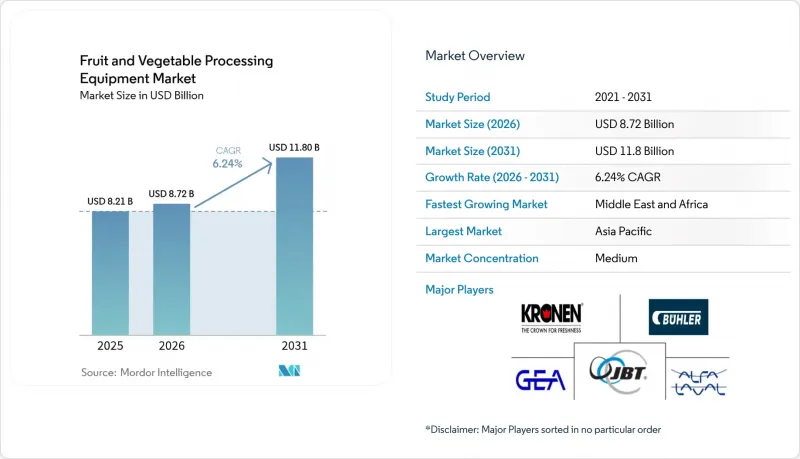
據 Mordor Intelligence 稱,2025 年果蔬加工設備市場價值為 82.1 億美元,預計到 2031 年將從 2026 年的 87.2 億美元成長至 118 億美元,預測期(2026-2031 年)複合年成長率為 6.24%。
本報告按設備類型(預處理設備、加工設備、包裝和輸送設備)、產品類型(果汁和食物泥、冷凍產品、罐裝產品、乾燥和脫水產品、新鮮產品、切塊新鮮產品)以及地區(北美、歐洲、亞太、南美、中東和非洲)進行細分。市場預測以美元(USD)為單位。
全球蔬果加工設備市場趨勢及洞察
擴大低溫運輸和保鮮技術的應用
在政府要求減少收穫後損失並延長出口市場保存期限的推動下,低溫運輸基礎設施正以前所未有的速度擴張。 2024年,印度根據「總理農民財富計畫」(Pradhan Mantri Kisan Sampada Yojana)批准了399個低溫運輸項目,目標是建造配備預冷、老化室和冷藏運輸網路的一體化包裝廠。這催生了對速凍機、獨立速凍隧道和調節氣體包裝設備的需求,以在收穫時維持農產品品質。同樣,新加坡的「30 by 30」糧食安全舉措也要求為國產農產品配備冷藏保管能力,迫使垂直農場和氣調農業經營者安裝收穫後加工生產線。從戰略角度來看,這意味著對低溫運輸的投資不再局限於分銷環節,而是延伸至加工環節,模糊了農場設備和工廠設備之間的界限。
自動化和高效加工設備的技術進步
自動化正從分類和切割等重複性任務轉向缺陷檢測和產量最佳化等認知功能。布勒公司的LumoVision光學分類機利用高光譜影像和機器學習演算法來識別人工檢驗員無法發現的內部缺陷,從而將誤剔率降低15%,並提高加工能力。 JBT公司的Frigoscandia GYRoCOMPACT螺旋式冷凍機整合了物聯網感測器,可即時調節傳送帶速度和冷媒流量,與傳統系統相比,能耗降低20%。這些進步至關重要,因為它們將價值提案從“取代人工”轉變為“數據驅動的過程控制”,使加工商能夠保證品質的一致性和可追溯性。這些正成為零售業自有品牌協議和出口認證的必要條件。具備預測性維護和遠距離診斷功能的設備供應商正獲得更高的溢價,因為意外運作可能導致加工商每天損失5萬至20萬美元的生產損失和處置成本。
先進的加工設備需要大量的初始投資。
自動化加工生產線,包括清洗、分類、切割、漂燙和包裝,需要200萬至500萬美元的資金投入,這筆巨額資金阻礙了大多數中小企業升級其老舊設備。雖然投資報酬率 (ROI) 的計算取決於加工能力的提升和人事費用的降低,但新興市場的加工商面臨著12%至18%的設備融資利率,這使得投資回收期延長至七年以上,並降低了淨現值。租賃和「設備即服務」模式在北美和歐洲以外的地區仍不發達,迫使加工商要麼自籌資金,要麼依賴政府補貼。然而,政府補貼往往發放延遲,或上限僅為專案成本的30%。這些資金限制造成了市場兩極化。大型加工企業可以透過大量訂單收回投資,而小規模企業則被迫推遲設備升級。因此,品質差異仍然存在,限制了它們進入出口市場,因為在這些市場中,可追溯性和 HACCP 合規性是強制性的。
細分市場分析
到2025年,加工設備將佔市場佔有率的53.78%,這反映了其作為核心增值環節的作用,該環節透過漂燙、殺菌、萃取和濃縮等工藝將新鮮農產品轉化為可供消費者購買的產品。然而,「包裝和輸送設備」的年成長率將達到7.71%,直至2031年,是所有設備類型中成長最快的。這是因為加工商優先考慮生產線末端的自動化,以滿足調節氣體包裝(MAP)標準並降低最終加工階段的污染風險。垂直成型、填充和封口機、機器人裝箱機和線上編織機正在取代人工操作,這些設備應用於那些旨在獲得「安全優質食品」(SQF)和「英國零售商協會」(BRC)認證的工廠,這些認證要求在包裝過程的每個環節都進行有據可查的控制。預處理設備,包括清洗機、去皮機和除石機,仍然必不可少,但其商品化程度越來越高,差異化僅限於水循環效率和符合 3-A 和 EHEDG 衛生標準的衛生設計特點。
向「包裝和搬運」領域的轉變反映了更廣泛的策略轉變。加工商意識到,不當的包裝會損害製作流程已建立的產品品質。對於保存期限為7至14天的鮮切產品和加工工序極少的產品而言,這一點尤其明顯。 GEA的機器人取放系統整合了視覺引導分類功能,能夠以每分鐘超過120件的速度進行混合SKU包裝。這對於電商履約和零售業的混合包裝至關重要。 ISO 22000等合規框架擴展了包裝線驗證要求,將過敏原交叉污染預防和防篡改密封納入其中,這促使企業將資金投入到具備自動換型和就地清洗(CIP)功能的設備上。雖然預處理設備是基礎,但除非供應商採用光學分類和缺陷去除等傳統上與製作流程相關的技術,否則利潤率的提升將受到限制。這導致不同設備類別之間的融合程度不斷提高。
區域分析
預計到2025年,亞太地區將佔全球市場佔有率的31.05%,這主要得益於中國的低溫運輸法規、印度的PMFME補貼以及日本因人手不足推動的自動化發展。據中國國家發展和改革委員會稱,「十四五」規劃撥款150億美元用於低溫運輸物流,其中包括在山東、廣東和四川等省份建設加工中心,這些中心將小規模農戶的農產品集中起來,達到出口規模。在日本,勞動人口減少(預計2019年至2024年製造業就業人數將下降8%)正在加速蔬菜加工廠採用協作機器人和人工智慧品質控制技術,這些加工廠為便利商店和蒸餾食品生產商供貨。在澳大利亞,出口導向園藝產業,特別是面向東南亞市場的漿果和核果,正推動對符合植物檢疫標準的光學分類機和調節氣體包裝線的投資。該地區的發展並不均衡。在中國沿海地區和印度都市區,跨國加工企業佔據主導地位,而內陸和農村地區則依賴手工加工。這造成了市場兩極化:高階設備供應商在技術上競爭,而本地製造商則在價格上競爭。
中東和非洲正以7.92%的年成長率保持該地區最高的成長速度,這主要得益於對糧食安全和進口替代政策的需求。阿拉伯聯合大公國(阿拉伯聯合大公國)的「2051年國家糧食安全戰略」要求新鮮農產品自給率達到70%。為此,阿拉伯聯合大公國政府表示,垂直農業營運商和環境控制農業計畫正在引入綠葉蔬菜和番茄的採後加工生產線。沙烏地阿拉伯政府表示,其「2030願景」已撥款32億美元用於農業加工基礎設施建設,其中包括位於阿赫薩的椰棗加工廠和位於吉讚的蔬菜包裝廠,旨在減少對埃及和約旦進口的依賴。南非的柑橘和葡萄出口產業(年產值達25億美元)正在升級其分類和包裝生產線,以滿足歐盟的可追溯性要求和全球良好農業規範(GlobalGAP)認證。
儘管歐洲和北美市場已趨於成熟,但對設備升級的投資仍在持續,且重點在於永續性。據歐盟委員會稱,歐洲的「從農場到餐桌」戰略要求到2030年將食物廢棄物減少50%,這促進了人工智慧分揀系統的應用,該系統能夠利用外觀不完美的農產品生產果汁和食物泥。在北美,降低人事費用是當務之急,加州和華盛頓州的最低工資已超過每小時15美元,加速了機器人採摘和自動化包裝的普及。設備供應商正在提供整合田間機械和加工生產線的承包解決方案。以巴西和阿根廷為首的南美洲,冷凍水果對北美和歐洲的出口正在不斷成長,這催生了對符合HACCP和猶太潔食認證標準的速凍隧道和快速冷凍庫的需求。由於FDA、EFSA和食品轉碼器等機構的監管,設備規格現已在所有地區實現標準化,衛生設計和可追溯性功能已成為面向出口市場的加工商的必備條件。
其他好處:
- Excel格式的市場預測(ME)表
- 3個月的分析師支持
目錄
第1章:引言
- 研究假設和市場定義
- 調查範圍
第2章:調查方法
第3章執行摘要
第4章 市場狀況
- 市場概覽
- 市場促進因素
- 低溫運輸和保鮮技術正變得越來越普及。
- 自動化和高效加工設備的技術進步
- 消費者越來越偏好加工最少、口味新鮮的產品。
- 政府為促進食品加工和農業技術現代化所採取的舉措
- 開發多功能設備以減少加工時間和人事費用
- 人們對食品安全和衛生標準的認知不斷提高
- 市場限制因素
- 先進的加工設備需要大量的初始投資。
- 自動化機械的複雜性與維護需求
- 技術純熟勞工短缺
- 每個地區都有嚴格的監管合規和認證要求。
- 技術展望
- 監理情勢
- 波特五力模型
第5章 市場規模與成長預測
- 依設備類型
- 預處理裝置
- 加工設備
- 包裝和輸送設備
- 依最終產品類型
- 果汁和食物泥
- 冷凍農產品
- 罐裝農產品
- 乾/脫水產品
- 新鮮的
- 新鮮切割
- 按地區
- 北美洲
- 美國
- 加拿大
- 墨西哥
- 其他北美國家
- 歐洲
- 德國
- 英國
- 義大利
- 法國
- 西班牙
- 荷蘭
- 其他歐洲國家
- 亞太地區
- 中國
- 印度
- 日本
- 澳洲
- 其他亞太國家
- 南美洲
- 巴西
- 阿根廷
- 其他南美國家
- 中東和非洲
- 南非
- 沙烏地阿拉伯
- 阿拉伯聯合大公國
- 其他中東和非洲國家
- 北美洲
第6章 競爭情勢
- 市場集中度
- 策略趨勢
- Market Positioning Analysis
- 公司簡介
- Buhler AG
- GEA Group Aktiengesellschaft
- JBT
- KRONEN GmbH
- Alfa Laval AB
- Turatti Group
- Navatta Group Food Processing Srl
- Allround Vegetable Processing
- FENCO Food Machinery Srl
- Bertuzzi Food Processing Srl
- Sormac BV
- Mepaco
- Heat and Control, Inc.
- Key Technology, Inc.
- Krones AG
- Bucher Industries AG
- ANKO Food Machine Co., Ltd.
- Bigtem Makine AS
- Syntegon Technology GmbH
- SPX FLOW, Inc.
- LVMH(Maison Francis Kurkdjian, Fresh)
第7章 市場機會與未來展望
According to Mordor Intelligence, the fruit and vegetable processing equipment market size was valued at USD 8.21 billion in 2025 and estimated to grow from USD 8.72 billion in 2026 to reach USD 11.8 billion by 2031, at a CAGR of 6.24% during the forecast period (2026-2031).
This report is Segmented by Equipment Type (Pre-Processing Equipment, Processing Equipment, Packaging, and Handling Equipment), End-Product Type (Juices and Purees, Frozen Produce, Canned Produce, Dried and Dehydrated, Fresh, Fresh Cut), and Geography (North America, Europe, Asia-Pacific, South America, and Middle East and Africa). The Market Forecasts are Provided in Terms of Value (USD).
Global Fruit And Vegetable Processing Equipment Market Trends and Insights
Increasing Adoption of Cold Chain and Preservation Technologies
Cold chain infrastructure is expanding at an unprecedented pace, driven by government mandates to reduce post-harvest losses and extend shelf life for export markets. India approved 399 cold chain projects under the Pradhan Mantri Kisan Sampada Yojana in 2024, targeting integrated pack-houses with pre-cooling, ripening chambers, and refrigerated transport links. This creates derived demand for blast freezers, individual quick freezing tunnels, and modified atmosphere packaging equipment that lock in quality at the point of harvest. Singapore's 30 by 30 food security initiative similarly mandates cold storage capacity for domestic produce, compelling vertical farms and controlled-environment agriculture operators to install post-harvest processing lines. The strategic implication is that cold chain investments are no longer confined to distribution; they now encompass processing, blurring the line between farm-gate and factory-floor equipment.
Technological Advancements in Automated and High-Efficiency Processing Equipment
Automation is migrating from repetitive tasks like sorting and cutting to cognitive functions such as defect detection and yield optimization. Buhler's LumoVision optical sorters deploy hyperspectral imaging and machine learning algorithms to identify internal defects invisible to human inspectors, reducing false rejects by 15% and improving throughput. JBT Corporation's Frigoscandia GYRoCOMPACT spiral freezers integrate IoT sensors that adjust belt speed and refrigerant flow in real time, cutting energy consumption by 20% compared to legacy systems. These advancements matter because they shift the value proposition from labor replacement to data-driven process control, enabling processors to guarantee consistent quality and traceability, prerequisites for retail private-label contracts and export certifications. Equipment suppliers that embed predictive maintenance and remote diagnostics are capturing premium pricing, as unplanned downtime costs processors USD 50,000 to USD 200,000 per day in lost production and spoilage.
High Initial Capital Investment Required for Advanced Processing Equipment
Processing lines with integrated automation, spanning washing, sorting, cutting, blanching, and packaging, demand USD 2 million to USD 5 million in capital, a threshold that excludes most small and medium enterprises from upgrading legacy equipment. Return-on-investment calculations hinge on throughput gains and labor savings, yet processors in emerging markets face 12% to 18% interest rates on equipment loans, extending payback periods beyond 7 years, and eroding net present value. Leasing and equipment-as-a-service models remain underdeveloped outside North America and Europe, leaving processors to self-finance or rely on government subsidies that are often delayed or capped at 30% of project costs. This capital constraint bifurcates the market: large processors amortize investments across high-volume contracts, while smaller operators defer upgrades, perpetuating quality inconsistencies and limiting access to export markets that mandate traceability and HACCP compliance.
Other drivers and restraints analyzed in the detailed report include:
- Growing Consumer Preference for Minimally Processed and Fresh-Tasting Products
- Government Initiatives Promoting Food Processing and Agri-Tech Modernization
- Shortage of Skilled Workforce to Operate Sophisticated Equipment
For complete list of drivers and restraints, kindly check the Table Of Contents.
Segment Analysis
Processing Equipment held 53.78% of the market in 2025, reflecting its role as the core value-add stage where raw produce is transformed into consumer-ready formats through blanching, pasteurization, extraction, and concentration. However, Packaging and Handling Equipment is expanding at 7.71% annually through 2031, the fastest growth among all equipment types, as processors prioritize end-of-line automation to meet modified atmosphere packaging standards and reduce contamination risks during final handling. Vertical form-fill-seal machines, robotic case packers, and inline checkweighers are displacing manual labor in facilities pursuing Safe Quality Food and British Retail Consortium certifications, which mandate documented controls at every packaging touchpoint. Pre-processing Equipment, encompassing washers, peelers, and destoners, remains essential but commoditized, with differentiation limited to water recirculation efficiency and sanitary design features that comply with 3-A and EHEDG hygiene standards.
The shift toward Packaging and Handling reflects a broader strategic reorientation: processors recognize that product quality established during processing can be compromised by inadequate packaging, particularly for fresh-cut and minimally processed items with 7- to 14-day shelf lives. GEA's robotic pick-and-place systems, integrated with vision-guided sorting, enable mixed-SKU packing at speeds exceeding 120 units per minute, a capability critical for e-commerce fulfillment and retail variety packs. Compliance frameworks such as ISO 22000 now extend packaging line validation requirements to include allergen cross-contact prevention and tamper-evident sealing, driving capital allocation toward equipment with automated changeover and clean-in-place functionality. Pre-processing Equipment, while foundational, offers limited margin expansion unless suppliers incorporate optical sorting or defect rejection, technologies traditionally associated with processing stages, creating convergence between equipment categories.
Complete Report Scope:
- By Equipment Type
- Pre-processing Equipment
- Processing Equipment
- Packaging and Handling Equipment
- By End-Product Type
- Juices and Purees
- Frozen Produce
- Canned Produce
- Dried and Dehydrated
- Fresh
- Fresh Cut
- By Geography
- North America
- United States
- Canada
- Mexico
- Rest of North America
- Europe
- Germany
- United Kingdom
- Italy
- France
- Spain
- Netherlands
- Rest of Europe
- Asia-Pacific
- China
- India
- Japan
- Australia
- Rest of Asia-Pacific
- South America
- Brazil
- Argentina
- Rest of South America
- Middle East and Africa
- South Africa
- Saudi Arabia
- United Arab Emirates
- Rest of Middle East and Africa
- North America
Geography Analysis
Asia-Pacific captured 31.05% of the market in 2025, driven by China's cold chain mandates, India's PMFME subsidies, and Japan's labor-shortage-induced automation. China's 14th Five-Year Plan allocated USD 15 billion for cold chain logistics, including processing hubs in Shandong, Guangdong, and Sichuan provinces that consolidate smallholder output into export-grade volumes according to the National Development and Reform Commission, China. Japan's labor force contraction, manufacturing employment fell 8% from 2019 to 2024, is accelerating the adoption of collaborative robots and AI-driven quality inspection in vegetable processing facilities supplying convenience stores and ready-meal manufacturers. Australia's focus on export-oriented horticulture, particularly berries and stone fruit destined for Southeast Asia, is driving investments in optical sorters and modified atmosphere packaging lines that meet phytosanitary standards. The region's growth is uneven: multinational processors dominate in coastal China and urban India, while inland and rural areas rely on manual processing, creating a dual market where premium equipment suppliers compete on technology and local manufacturers compete on price.
The Middle East and Africa are expanding at 7.92% annually, the fastest regional growth rate, propelled by food security imperatives and import substitution policies. UAE's National Food Security Strategy 2051 mandates 70% self-sufficiency in perishable produce, prompting vertical farm operators and controlled-environment agriculture projects to install post-harvest processing lines for leafy greens and tomatoes according to the Government of the United Arab Emirates. Saudi Arabia's Vision 2030 allocated USD 3.2 billion for agri-processing infrastructure, including date processing facilities in Al-Ahsa and vegetable packing houses in Jizan that reduce reliance on imports from Egypt and Jordan, according to the Government of Saudi Arabia. South Africa's citrus and grape export sector, valued at USD 2.5 billion annually, is upgrading sorting and packing lines to meet European Union traceability requirements and Global GAP certification.
Europe and North America, while mature, continue to invest in sustainability-focused equipment upgrades. Europe's Farm to Fork Strategy mandates a 50% reduction in food waste by 2030, driving adoption of AI-powered sorting systems that salvage cosmetically imperfect produce for juice and puree production according to the European Commission. North America's focus on labor cost mitigation, minimum wages in California and Washington exceeding USD 15 per hour, is accelerating robotic harvesting and automated packing, with equipment suppliers offering turnkey solutions that integrate field machinery with processing lines. South America, led by Brazil and Argentina, is expanding frozen fruit exports to North America and Europe, requiring IQF tunnels and blast freezers that meet HACCP and Kosher certification standards. Compliance influence from bodies such as the FDA, EFSA, and Codex Alimentarius shapes equipment specifications across all geographies, with sanitary design and traceability features becoming non-negotiable for processors targeting export markets.
- Buhler AG
- GEA Group Aktiengesellschaft
- JBT
- KRONEN GmbH
- Alfa Laval AB
- Turatti Group
- Navatta Group Food Processing S.r.l.
- Allround Vegetable Processing
- FENCO Food Machinery S.r.l.
- Bertuzzi Food Processing S.r.l.
- Sormac B.V.
- Mepaco
- Heat and Control, Inc.
- Key Technology, Inc.
- Krones AG
- Bucher Industries AG
- ANKO Food Machine Co., Ltd.
- Bigtem Makine A.S.
- Syntegon Technology GmbH
- SPX FLOW, Inc.
- LVMH (Maison Francis Kurkdjian, Fresh)
Additional Benefits:
- The market estimate (ME) sheet in Excel format
- 3 months of analyst support
TABLE OF CONTENTS
1 INTRODUCTION
- 1.1 Study Assumptions and Market Definition
- 1.2 Scope of the Study
2 RESEARCH METHODOLOGY
3 EXECUTIVE SUMMARY
4 MARKET LANDSCAPE
- 4.1 Market Overview
- 4.2 Market Drivers
- 4.2.1 Increasing adoption of cold chain and preservation technologies
- 4.2.2 Technological advancements in automated and high-efficiency processing equipment
- 4.2.3 Growing consumer preference for minimally processed and fresh-tasting products
- 4.2.4 Government initiatives promoting food processing and agri-tech modernization
- 4.2.5 Development of multifunctional equipment reducing processing time and labor costs
- 4.2.6 Rising awareness about food safety and hygiene standards
- 4.3 Market Restraints
- 4.3.1 High initial capital investment required for advanced processing equipment
- 4.3.2 Complexity and maintenance requirements of automated machinery
- 4.3.3 Shortage of skilled workforce to operate sophisticated equipment
- 4.3.4 Strict regulatory compliance and certification requirements in different regions
- 4.4 Technological Outlook
- 4.5 Regulatory Landscape
- 4.6 Porter's Five Forces
- 4.6.1 Threat of New Entrants
- 4.6.2 Bargaining Power of Buyers
- 4.6.3 Bargaining Power of Suppliers
- 4.6.4 Threat of Substitutes
- 4.6.5 Competitive Rivalry
5 MARKET SIZE AND GROWTH FORECASTS (VALUE)
- 5.1 By Equipment Type
- 5.1.1 Pre-processing Equipment
- 5.1.2 Processing Equipment
- 5.1.3 Packaging and Handling Equipment
- 5.2 By End-Product Type
- 5.2.1 Juices and Purees
- 5.2.2 Frozen Produce
- 5.2.3 Canned Produce
- 5.2.4 Dried and Dehydrated
- 5.2.5 Fresh
- 5.2.6 Fresh Cut
- 5.3 By Geography
- 5.3.1 North America
- 5.3.1.1 United States
- 5.3.1.2 Canada
- 5.3.1.3 Mexico
- 5.3.1.4 Rest of North America
- 5.3.2 Europe
- 5.3.2.1 Germany
- 5.3.2.2 United Kingdom
- 5.3.2.3 Italy
- 5.3.2.4 France
- 5.3.2.5 Spain
- 5.3.2.6 Netherlands
- 5.3.2.7 Rest of Europe
- 5.3.3 Asia-Pacific
- 5.3.3.1 China
- 5.3.3.2 India
- 5.3.3.3 Japan
- 5.3.3.4 Australia
- 5.3.3.5 Rest of Asia-Pacific
- 5.3.4 South America
- 5.3.4.1 Brazil
- 5.3.4.2 Argentina
- 5.3.4.3 Rest of South America
- 5.3.5 Middle East and Africa
- 5.3.5.1 South Africa
- 5.3.5.2 Saudi Arabia
- 5.3.5.3 United Arab Emirates
- 5.3.5.4 Rest of Middle East and Africa
- 5.3.1 North America
6 COMPETITIVE LANDSCAPE
- 6.1 Market Concentration
- 6.2 Strategic Moves
- 6.3 Market Positioning Analysis
- 6.4 Company Profiles (includes Global level Overview, Market level overview, Core Segments, Financials as available, Strategic Information, Market Rank/Share for key companies, Products and Services, and Recent Developments)
- 6.4.1 Buhler AG
- 6.4.2 GEA Group Aktiengesellschaft
- 6.4.3 JBT
- 6.4.4 KRONEN GmbH
- 6.4.5 Alfa Laval AB
- 6.4.6 Turatti Group
- 6.4.7 Navatta Group Food Processing S.r.l.
- 6.4.8 Allround Vegetable Processing
- 6.4.9 FENCO Food Machinery S.r.l.
- 6.4.10 Bertuzzi Food Processing S.r.l.
- 6.4.11 Sormac B.V.
- 6.4.12 Mepaco
- 6.4.13 Heat and Control, Inc.
- 6.4.14 Key Technology, Inc.
- 6.4.15 Krones AG
- 6.4.16 Bucher Industries AG
- 6.4.17 ANKO Food Machine Co., Ltd.
- 6.4.18 Bigtem Makine A.S.
- 6.4.19 Syntegon Technology GmbH
- 6.4.20 SPX FLOW, Inc.
- 6.4.21 LVMH (Maison Francis Kurkdjian, Fresh)
7 MARKET OPPORTUNITIES AND FUTURE OUTLOOK

 蛋糕裝飾機市場:全球市場預測(2026-2032)商用棉花糖機市場:全球市場預測,2026-2032年種子分類機市場:全球市場預測(2026-2032)糧食加工自動化系統市場:全球市場預測,2026-2032年
 2026年全球稻穀脫殼機市場報告2026年全球碾米機市場報告2026年全球碾米機市場報告
 全球雞蛋加工機械市場(2026-2030 年)
 乳製品切片機市場規模、佔有率和成長分析:按機器類型、產品類型、產能、最終用戶和地區分類-2026-2033年產業預測
 雞蛋加工機械市場規模、佔有率、成長、全球產業分析、區域趨勢及2026-2034年預測