


 |
市場調查報告書
商品編碼
2114065
碾米機械:市場佔有率分析、產業趨勢與統計、成長預測(2026-2031)Rice Milling Machinery - Market Share Analysis, Industry Trends & Statistics, Growth Forecasts (2026 - 2031) |
||||||

※ 本網頁內容可能與最新版本有所差異。詳細情況請與我們聯繫。
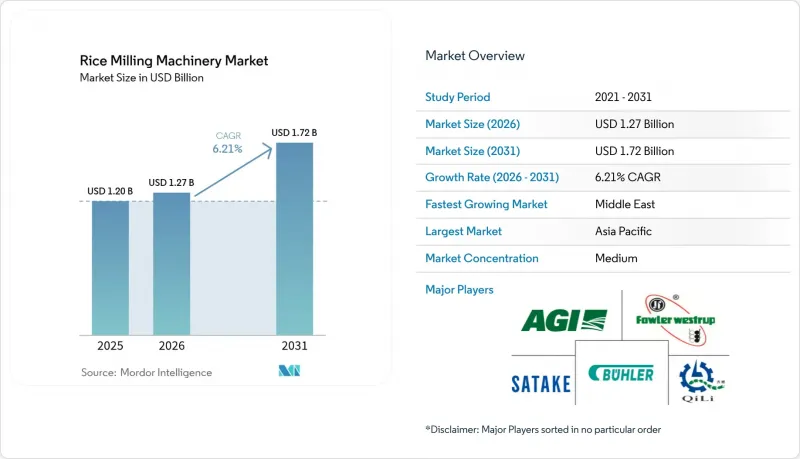
根據 Mordor Intelligence 預測,碾米機械市場規模將從 2025 年的 12 億美元成長到 2026 年的 12.7 億美元,然後在 2031 年達到 17.2 億美元,2026 年至 2031 年的複合年成長率為 6.21%。
本報告按機械類型(分離磨機和粉碎磨機)、製程(預處理設備、分類機、分級分類機等)和地區(北美、歐洲、亞太、南美以及中東和非洲)進行分類。市場預測以美元計價。
全球碾米機械市場趨勢與洞察
產量和稻田面積增加
印度、越南和奈及利亞種植面積的擴大正在推動全球稻米產量成長,每公頃產量達4-6噸,亟需即時碾米能力。撒哈拉以南非洲地區的灌溉計畫和改良種子的引進,凸顯了對能夠應對季節性產量高峰且不影響品質的自動化碾米廠的長期需求。以越南出口型碾米廠為例,例如奧蘭集團(Olam)每小時處理能力達16-24噸的工廠,顯示上游產量的增加如何轉化為對現代化生產線的更多投資。隨著種植面積的擴大,向自給自足的轉變使得可擴展分類和拋光設備的需求加倍。自動化輸送、脫粒和拋光模組消除了人工操作的瓶頸,使生產者能夠迅速掌握豐收高峰。因此,種植面積的持續擴大確保了市場對更大規模、更有效率的碾米機械的結構性需求。
精米出口需求不斷成長
進口商對優質米的含粒率要求超過70%,促使企業投資光學分類機、彩色相機和多波長近紅外線(NIR)檢測器,以滿足歐洲和中東買家嚴格的分級標準。泰國和越南仍然是主要供應國,但面臨來自奈及利亞和巴西的新挑戰。這些國家正在升級生產線,以獲取每噸高達200美元的營養強化溢價(高於糙米價格)。對於向機構餐飲項目供應米的出口商而言,能夠均勻混合微量營養素預混合料的設備如今至關重要。隨著關稅差異的縮小,精密加工正成為決定性的競爭優勢,而高性能分選機則是碾米機械市場的核心。
碾米廠的大量初始投資
全自動碾米廠的價格從每小時2噸生產線的50萬美元到每小時10噸一體化綜合體的500萬美元不等,遠遠超出大多數家庭式碾米廠的現金儲備。印度銀行通常要求25%至50%的首付,以及相當於貸款額一半的抵押品,導致許多申請者退出競爭。七年的貸款償還期與收割週期相關的收入波動相衝突,阻礙了許多擴張計劃。如果沒有更優惠的租賃方案,高額的資本需求將持續抑制短期支出,嚴重限制碾米機械市場的發展。
細分市場分析
到2025年,分選機在碾米機械市場中仍將佔據52.60%的市場佔有率,這得益於高度靈活的加工工藝,這些工藝能夠保護長粒米品種,使其符合高階出口標準。這些機器是印度、越南和巴西中型碾米廠的核心設備,在確保產能的同時,也兼顧了米粒品質。隨著香米和有機米出口量的成長,分選機的市場規模預計將進一步擴大,因為這些米需要保持一定的米粒長度以符合品牌形像要求。
碾米機的複合年成長率最高,達7.54%。這是因為大規模加工廠正在追求更嚴格的白度控制和均勻出米率,以滿足強化米和碎米等衍生產品的需求。可預測控制的研磨輪最大限度地減少了穀物損傷,真空輸送減少了污染,從而提高了出口標準的符合性。即時儀錶板整合了水分數據,並允許對輥隙進行即時微調,這在潮濕的熱帶氣候中尤其重要。系統整合商現在將機器人裝袋功能整合到碾米機中,以降低人事費用,使碾米機的升級在碾米機械行業更具成本效益。
區域分析
預計到2025年,亞太地區將佔全球市場規模的71.35%,其中中東地區預計將在2031年之前保持市場領先地位,年複合成長率達7.55%。在印度和中國,補貼計畫有效地降低了採購成本。廣東省和江蘇省的地方政府津貼正在加速升級人工智慧配色分類機,以確保符合嚴格的國內食品安全標準。東南亞的出口商,例如越南和泰國,正在投資最先進的光學分類機,以超過日本和歐洲買家設定的70%或更高的稻米回收率目標。印尼正在維修現有設施,以減少對越南米進口的依賴,這符合其國家糧食安全目標。這些趨勢共同鞏固了亞太地區在碾米機械市場的主導地位。
在北美和歐洲,一些成熟的工廠正致力於最佳化能源效率並運作。在美國,碾米廠正在進行維修,採用變頻驅動系統並實施基於區塊鏈的可追溯性,以滿足有機食品零售商的需求。歐洲的加工商正在安裝防塵罩,以滿足嚴格的工人安全指令,並投資氮氣填充系統以延長蒸穀米產品的保存期限。因此,這些地區的需求主要由現有設施的升級改造所驅動,而非新建設。全球米產量持續成長,美國農業部(USDA)預測,全部區域的面積將會增加,這主要是為了因應糧食安全問題和人口成長。中東和非洲擁有巨大的長期成長潛力。中東消費者正轉向進口巴斯馬蒂米和茉莉香米,促使海灣地區的投資者在巴基斯坦和泰國共同投資建造最先進的分類機和碾米設備。南美洲正經歷溫和的成長。在巴西,透過對碾米廠進行現代化改造、整合乙醇熱電汽電共生以及利用稻殼鍋爐向電網輸送剩餘電力,正在降低淨營運成本。在阿根廷,為了開發安地斯山脈地區的高階市場,正在擴大蒸穀米的產能,並投資建設水熱預熱器和溫控乾燥機,將其整合到現有設施中。
其他好處:
- Excel格式的市場預測(ME)表
- 3個月的分析師支持
目錄
第1章:引言
- 研究假設和市場定義
- 調查範圍
第2章:調查方法
第3章執行摘要
第4章 市場狀況
- 市場概覽
- 市場促進因素
- 稻米產量和種植面積增加
- 精米出口需求不斷成長
- 碾米廠的技術進步
- 政府對機械化的補貼
- 中小規模碾米廠的數位化維修降低了能源消耗。
- 「按產量付費」的經營模式將改善獲取途徑。
- 市場限制因素
- 碾米廠的初始投資成本相對較高。
- 進口米帶來的競爭
- 米價格波動會影響資本投資週期。
- 新興市場售後服務的去中心化
- 監理情勢
- 技術展望
- 波特五力分析
第5章 市場規模與成長預測
- 按組織
- 獨立式碾米機
- 破碎式碾米機
- 透過流程
- 預處理裝置
- 分離機
- 分類機
- 碾米機
- 其他流程
- 按地區
- 北美洲
- 美國
- 加拿大
- 墨西哥
- 其他北美國家
- 歐洲
- 德國
- 英國
- 法國
- 義大利
- 西班牙
- 其他歐洲國家
- 亞太地區
- 印度
- 中國
- 日本
- 其他亞太國家
- 南美洲
- 巴西
- 阿根廷
- 其他南美國家
- 中東
- 沙烏地阿拉伯
- 阿拉伯聯合大公國
- 其他中東國家
- 非洲
- 南非
- 埃及
- 其他非洲國家
- 北美洲
第6章 競爭情勢
- 市場集中度
- 策略趨勢
- 市佔率分析
- 公司簡介
- Buhler Group
- Satake Corporation
- AG Growth International Inc.
- Fowler Westrup India Pvt. Ltd.
- Zhejiang QiLi Machinery Co. Ltd.(QiLi Group)
- Hubei Bishan Machinery Co. Ltd.(Bishan Group)
- Mill Master Machinery Pvt. Ltd.
- GS International
- GG Dandekar Machine Works Ltd.
- Leshan Dongya Machinery Co. Ltd.
- PETKUS Technologie GmbH
- Koolmill Systems Ltd.
- Ricetec Machinery Pvt. Ltd.
- Henan Huatai Machinery
- Perfect Equipments Pvt. Ltd.(PEPL)
第7章 市場機會與未來展望
According to Mordor Intelligence, the rice milling machinery market size is expected to grow from USD 1.20 billion in 2025 to USD 1.27 billion in 2026 and is forecast to reach USD 1.72 billion by 2031 at 6.21% CAGR over 2026-2031.
This report is Segmented by Mechanism (Fraction Rice Milling Machines, and Grind Rice Milling Machines), by Operations (Pre-Cleaning Machinery, Separating Machinery, Grading Machinery, and More), and by Geography (North America, Europe, Asia-Pacific, South America, Middle East, and Africa). The Market Forecasts are Provided in Terms of Value (USD).
Global Rice Milling Machinery Market Trends and Insights
Rising Production and Area Under Rice Cultivation
Expanded planting areas in India, Vietnam, and Nigeria are boosting global paddy output, and each hectare generates 4-6 metric tons of grain that requires immediate milling capacity. Sub-Saharan African irrigation projects and the adoption of improved seeds underscore the long-term need for automated plants that can handle seasonal surges without compromising quality. Vietnam's export-oriented processors, exemplified by Olam's 16-24 metric tons per hour facility, demonstrate how upstream production gains translate into higher capital expenditures on modern lines . The push toward self-sufficiency multiplies demand for scalable cleaning and whitening units that can be expanded as acreage rises. Automated conveying, husking, and polishing modules eliminate labor bottlenecks, enabling producers to capitalize on harvest peaks quickly. Continuous crop growth, therefore, locks in a structural requirement for larger, more efficient rice milling machinery market installations.
Growing Export Demand for Milled Rice
Premium importers insist on head-rice recovery above 70%, catalyzing investments in optical sorters, color cameras, and multi-wavelength Near-Infrared (NIR) detectors that meet the stringent grades demanded by European and Middle Eastern buyers . Thailand and Vietnam remain supply pivots but face new challenges from Nigeria and Brazil, which are upgrading lines to capture fortification premiums that can top USD 200 per metric ton over rough rice. Equipment capable of blending micronutrient premixes uniformly is now a must-have for exporters serving institutional feeding programs. As tariff differentials shrink, precision processing becomes the decisive competitive edge, placing high-performance grading machinery at the center of the rice milling machinery market.
High Initial Investment in Rice Mills
Full-scale automated plants range from USD 0.5 million for 2 MT-hour lines to USD 5 million for 10 MT-hour integrated complexes, figures well beyond the cash holdings of most family-run mills. Indian banks often demand 25-50% down payment and collateral equal to half the loan value, which pushes many applicants out of contention. Loan amortization over 7 years clashes with income volatility tied to harvest cycles, derailing many expansion plans. Without stronger leasing options, high capital thresholds will continue to curb near-term outlays and weigh on the rice milling machinery market.
Other drivers and restraints analyzed in the detailed report include:
- Increasing Technology Advancements in Rice Mills
- Government Mechanization Subsidies
- Competition from Imported Rice
For complete list of drivers and restraints, kindly check the Table Of Contents.
Segment Analysis
Fraction rice milling machines retained 52.60% of the rice milling machinery market share in 2025, supported by their adaptable flow paths that protect long-grain varieties destined for premium export slots. They anchor mid-sized plants across India, Vietnam, and Brazil, where processors balance capacity and grain integrity. The rice milling machinery market size for fraction units is projected to widen along with rising exports of aromatic and organic rice, which must maintain kernel length for branding purposes.
Grind rice milling machines post the highest 7.54% CAGR as high-volume complexes chase tighter whiteness control and uniform output for fortified and broken-rice derivatives. Predictive abrasion wheels limit kernel damage, while vacuum transport cuts contamination, boosting export compliance. Real-time dashboards integrate moisture data to tweak roller gaps on the fly, a capability highly prized in humid tropical climates. Integrators now bundle robotic bagging to lower labor costs, strengthening the cost argument for grind-machine upgrades inside the rice milling machinery industry.
Complete Report Scope:
- By Mechanism
- Fraction rice milling machines
- Grind rice milling machines
- By Operations
- Pre-cleaning machinery
- Separating machinery
- Grading machinery
- Rice whitening machinery
- Other operations
- By Geography
- North America
- United States
- Canada
- Mexico
- Rest of North America
- Europe
- Germany
- United Kingdom
- France
- Italy
- Spain
- Rest of Europe
- Asia-Pacific
- India
- China
- Japan
- Rest of Asia-Pacific
- South America
- Brazil
- Argentina
- Rest of South America
- Middle East
- Saudi Arabia
- United Arab Emirates
- Rest of Middle East
- Africa
- South Africa
- Egypt
- Rest of Africa
- North America
Geography Analysis
Asia-Pacific captured 71.35% of the market size in 2025 and the Middle East is anticipated to expand at a market-leading 7.55% CAGR to 2031. India and China, whose subsidy packages reduce effective purchase costs. Provincial grants in Guangdong and Jiangsu fast-track upgrades to AI-enabled color sorters, ensuring compliance with stringent domestic food safety norms. Southeast Asian exporters such as Vietnam and Thailand channel private capital into cutting-edge optical sorters to exceed 70% head-rice recovery targets set by Japanese and European buyers. Indonesia follows with brownfield retrofits to curb reliance on imported Vietnamese finished rice, aligning with national food security targets. These trends collectively fortify Asia-Pacific's primacy within the rice milling machinery market.
North America and Europe operate mature plants focused on energy optimization. United States mills retrofit variable-frequency drives and adopt blockchain traceability to serve organic retailers. European processors integrate dust-control enclosures that meet stringent worker safety directives and invest in nitrogen flushing systems to prolong the shelf life of parboiled variants. Replacements rather than new builds therefore govern demand in these regions. Global rice production continues expanding, with the United States Department of Agriculture (USDA) projecting increased cultivation area across major producing regions, particularly in response to food security concerns and population growth . Africa and the Middle East provide long-run upside. Middle East consumers shift to basmati and jasmine imports, prompting Gulf investors to co-fund processing hubs in Pakistan and Thailand that deploy cutting-edge graders and whiteners. South America showcases moderate growth. Brazil aligns milling upgrades with ethanol cogeneration by using rice husk boilers that feed residue power to the grid, lowering net operating costs. Argentina pursues expanded parboiled capacity to tap premium Andean markets, investing in hydrothermal pre-heaters and tempered dryers integrated into existing facilities.
- Buhler Group
- Satake Corporation
- AG Growth International Inc.
- Fowler Westrup India Pvt. Ltd.
- Zhejiang QiLi Machinery Co. Ltd. (QiLi Group)
- Hubei Bishan Machinery Co. Ltd. (Bishan Group)
- Mill Master Machinery Pvt. Ltd.
- G S International
- G.G. Dandekar Machine Works Ltd.
- Leshan Dongya Machinery Co. Ltd.
- PETKUS Technologie GmbH
- Koolmill Systems Ltd.
- Ricetec Machinery Pvt. Ltd.
- Henan Huatai Machinery
- Perfect Equipments Pvt. Ltd. (PEPL)
Additional Benefits:
- The market estimate (ME) sheet in Excel format
- 3 months of analyst support
TABLE OF CONTENTS
1 Introduction
- 1.1 Study Assumptions and Market Definition
- 1.2 Scope of the Study
2 Research Methodology
3 Executive Summary
4 Market Landscape
- 4.1 Market Overview
- 4.2 Market Drivers
- 4.2.1 Rising production and area under rice cultivation
- 4.2.2 Growing export demand for milled rice
- 4.2.3 Increasing technology advancements in rice mills
- 4.2.4 Government mechanization subsidies
- 4.2.5 Digital retro-fits for SME mills cut energy use
- 4.2.6 Pay-as-you-mill business models improve access
- 4.3 Market Restraints
- 4.3.1 High initial investment in rice mills
- 4.3.2 Competition from imported rice
- 4.3.3 Volatility of paddy prices affects cap-ex cycles
- 4.3.4 Fragmented after-sales service in emerging markets
- 4.4 Regulatory Landscape
- 4.5 Technological Outlook
- 4.6 Porter's Five Forces Analysis
- 4.6.1 Threat of New Entrants
- 4.6.2 Bargaining Power of Buyers
- 4.6.3 Bargaining Power of Suppliers
- 4.6.4 Threat of Substitute Products
- 4.6.5 Intensity of Competitive Rivalry
5 Market Size and Growth Forecasts (Value)
- 5.1 By Mechanism
- 5.1.1 Fraction rice milling machines
- 5.1.2 Grind rice milling machines
- 5.2 By Operations
- 5.2.1 Pre-cleaning machinery
- 5.2.2 Separating machinery
- 5.2.3 Grading machinery
- 5.2.4 Rice whitening machinery
- 5.2.5 Other operations
- 5.3 By Geography
- 5.3.1 North America
- 5.3.1.1 United States
- 5.3.1.2 Canada
- 5.3.1.3 Mexico
- 5.3.1.4 Rest of North America
- 5.3.2 Europe
- 5.3.2.1 Germany
- 5.3.2.2 United Kingdom
- 5.3.2.3 France
- 5.3.2.4 Italy
- 5.3.2.5 Spain
- 5.3.2.6 Rest of Europe
- 5.3.3 Asia-Pacific
- 5.3.3.1 India
- 5.3.3.2 China
- 5.3.3.3 Japan
- 5.3.3.4 Rest of Asia-Pacific
- 5.3.4 South America
- 5.3.4.1 Brazil
- 5.3.4.2 Argentina
- 5.3.4.3 Rest of South America
- 5.3.5 Middle East
- 5.3.5.1 Saudi Arabia
- 5.3.5.2 United Arab Emirates
- 5.3.5.3 Rest of Middle East
- 5.3.6 Africa
- 5.3.6.1 South Africa
- 5.3.6.2 Egypt
- 5.3.6.3 Rest of Africa
- 5.3.1 North America
6 Competitive Landscape
- 6.1 Market Concentration
- 6.2 Strategic Moves
- 6.3 Market Share Analysis
- 6.4 Company Profiles (Includes Global level Overview, Market Level Overview, Core Segments, Financials as Available, Strategic Information, Market Rank/Share, Products and Services, Recent Developments)
- 6.4.1 Buhler Group
- 6.4.2 Satake Corporation
- 6.4.3 AG Growth International Inc.
- 6.4.4 Fowler Westrup India Pvt. Ltd.
- 6.4.5 Zhejiang QiLi Machinery Co. Ltd. (QiLi Group)
- 6.4.6 Hubei Bishan Machinery Co. Ltd. (Bishan Group)
- 6.4.7 Mill Master Machinery Pvt. Ltd.
- 6.4.8 G S International
- 6.4.9 G.G. Dandekar Machine Works Ltd.
- 6.4.10 Leshan Dongya Machinery Co. Ltd.
- 6.4.11 PETKUS Technologie GmbH
- 6.4.12 Koolmill Systems Ltd.
- 6.4.13 Ricetec Machinery Pvt. Ltd.
- 6.4.14 Henan Huatai Machinery
- 6.4.15 Perfect Equipments Pvt. Ltd. (PEPL)
7 Market Opportunities and Future Outlook

 蛋糕裝飾機市場:全球市場預測(2026-2032)商用棉花糖機市場:全球市場預測,2026-2032年種子分類機市場:全球市場預測(2026-2032)糧食加工自動化系統市場:全球市場預測,2026-2032年
 2026年全球稻穀脫殼機市場報告2026年全球碾米機市場報告2026年全球碾米機市場報告
 全球雞蛋加工機械市場(2026-2030 年)
 乳製品切片機市場規模、佔有率和成長分析:按機器類型、產品類型、產能、最終用戶和地區分類-2026-2033年產業預測
 雞蛋加工機械市場規模、佔有率、成長、全球產業分析、區域趨勢及2026-2034年預測